Mini Split AC in Minneapolis, MN
Installation, Costs & Filter Guide (MN Climate)
Author: Michelle Wan, Brand Manager & Air Quality Writer.
Reviewed by: David Clark, HVAC Specialist, Filterbuy HVAC Solutions.
Published: August 26, 2026 Updated: August 26, 2026
What Does a Mini Split Cost in Minneapolis, and Will It Work in Winter?
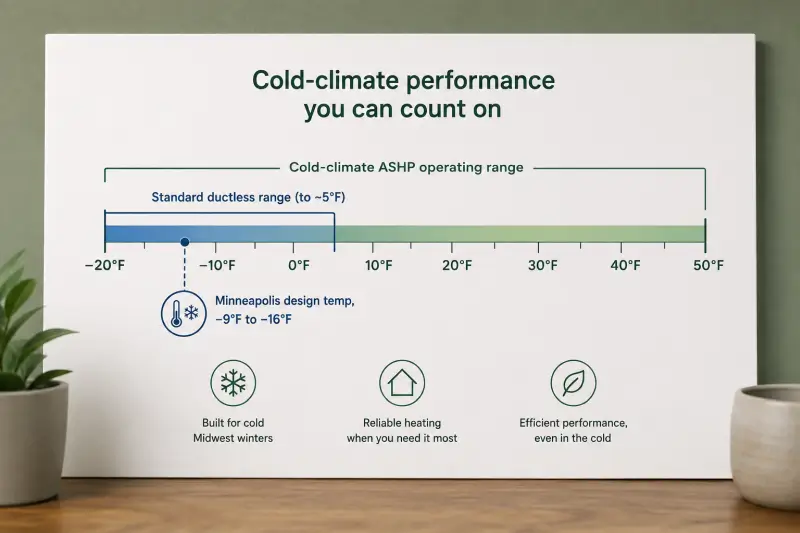
A single-zone mini split runs $2,500 to $5,550 installed in Minneapolis, and it will cool all summer but needs backup heat in a Minnesota winter. The metro average is $3,144, and Xcel Energy rebates of $1,600 to $2,000 still apply now that the federal 25C credit has ended. Most ductless systems, including Filterbuy's, are rated to about 5°F, while Minneapolis winter design temperatures run -9°F to -16°F.
Which setup you need depends on the job:
- Cooling, plus spring and fall heat. A standard ductless system, with your furnace still handling winter.
- A garage, attic office, or sunroom year-round. A cold-climate model with electric backup in that space.
- Replacing the furnace. A cold-climate system sized by Manual J, with dual-fuel controls.

Prefer to browse first? Shop Filterbuy mini split systems in 12,000, 18,000, and 24,000 BTU.
Answer three quick questions and we'll match you to the right mini split for your space.
TL;DR
A ductless mini split installed in Minneapolis costs about $2,500 to $5,550 for a single zone and $6,500 or more for multi-zone in 2026. The federal 25C tax credit expired December 31, 2025, but Xcel Energy and City of Minneapolis rebates now stack to as much as $7,000 on a qualifying cold-climate system, more than the old credit ever paid. Mini splits cool Twin Cities summers beautifully. Heating a Zone 6A winter takes a cold-climate model, backup heat, or both.
Key Takeaways
Single-zone installation in Minneapolis averages $3,144, typically $2,096 to $5,240, per Angi's 2026 Minneapolis data.
The federal 25C tax credit is gone for equipment placed in service after December 31, 2025. Quotes still promising "30% back, up to $2,000" are outdated.
Xcel Energy pays $2,000 for a cold-climate mini split and $1,600 for a standard one; Minneapolis adds up to $5,000 more in a Green Zone.
Minnesota homeowners cannot pull their own electrical permit. A licensed electrical contractor must file it.
A standard mini split is not a furnace replacement here. Most ductless units, including Filterbuy's, are rated to about 5°F; Minneapolis design temperatures run far colder.
Mini split filters are washable, not disposable. A wall head filters only the air passing through it, so the furnace filter still does the real work.
Filterbuy sells ductless mini splits and air filters. This guide includes our own equipment pricing alongside market data, and it states plainly where our units are not the right choice.
How Much Does Mini Split Installation Cost in Minneapolis in 2026?
Expect $2,500 to $5,550 installed for a single zone in the Twin Cities, with the metro average at $3,144 according to Angi's Minneapolis mini split cost data. Multi-zone systems with two to four heads run $6,500 to $15,000 or more per HomeGuide national data, with each additional head adding $2,000 to $7,000. Labor of $70 to $150 per hour and cold-climate equipment premiums push Minneapolis above the national average.
Equipment alone is a smaller share of that than most people expect. Filterbuy's units list at $799 for 12,000 BTU, $899 for 18,000 BTU, and $1,349 for 24,000 BTU, all 17 SEER2 inverter systems using R32 refrigerant.
Two costs get left out of most estimates. Mechanical and electrical permits together run $250 to $500, and both are required in Minneapolis. An electrical panel upgrade, needed only in some homes, runs $1,258 to $2,096 and averages $1,677; many pre-1960 Minneapolis homes still run 100A service, though rebates offset up to $1,500 of that.
Most installs need only a dedicated 240V circuit, not a panel upgrade. A load calculation tells you which.
Filterbuy's systems are single zone and require professional installation. The warranty is void if you install one yourself.
What Actually Changed in 2026
The federal credit disappeared, but Minnesota incentives more than filled the gap for qualifying systems.
Take a $6,000 single-zone project. In 2025 the federal 25C credit cut $1,800 off it, 30% capped at $2,000, bringing the net to roughly $4,200. In 2026 that credit is expired and contributes nothing. What replaced it is larger: the same Xcel and Minneapolis rebate tiers that existed in 2025 now carry the full weight, subtracting $3,000 to $7,000 depending on tier and Green Zone status. The net on that same project lands between $0 and $3,000 if the system qualifies.
The catch is qualifying: equipment that misses the efficiency tiers gets none of this. The 25C credit was terminated for systems placed in service after December 31, 2025. Confirm your own eligibility with a tax professional, and confirm rebate amounts with your utility before you sign anything.
What Mini Split Rebates Can Minneapolis Homeowners Get in 2026?
Xcel Energy pays a mini split rebate directly, and Minneapolis stacks a bonus on top through the Center for Energy and Environment. The published amounts break down by system tier.
A cold-climate mini split (ccMSHP) earns the most: $2,000 from Xcel, plus a Minneapolis bonus of $5,000 in a Green Zone or $1,000 outside one. Qualifying means 16.0 SEER2, 9.0 EER2, 9.5 HSPF2, a COP of at least 1.75 at 5°F, and a NEEP listing.
A standard mini split (MSHP) earns $1,600 from Xcel, with a Minneapolis bonus of $4,000 in a Green Zone or $1,000 outside one. The efficiency bar is lower: 15.2 SEER2, 9.3 EER2, and 8.5 HSPF2.
An electric panel upgrade carries its own money if it increases amperage and is installed alongside a qualifying heat pump: $1,500 from Xcel, plus $3,000 in a Green Zone or $800 outside one.
Sources: Xcel Energy's Minnesota rebate summary and the Minneapolis Bonus Rebate Program.
Four rules decide whether you collect: the city bonus requires a utility rebate first; combined rebates cannot exceed project cost; only 1–4 unit Minneapolis properties qualify, with work by a Minnesota DLI–licensed contractor; and funds are first come, first served after December 15, 2025.
Cold-climate qualification is stricter than the marketing suggests: the system must appear on the NEEP cold-climate product list and deliver at least 70% of its 47°F heating capacity at 5°F. Check the model number before signing.
Will a Mini Split Actually Heat a Minneapolis Winter?
A cold-climate mini split can heat a Minneapolis home; a standard ductless AC and heat pump cannot do it alone. Minneapolis sits in IECC zone 6A, with winter design temperatures of roughly −9°F to −16°F. Most ductless systems are rated to about 5°F, which covers a large share of the season but not the coldest nights. Backup heat covers that gap.
Three situations, three different answers. If you want to cool the house and take the edge off spring and fall, a standard ductless heat pump rated to about 5°F is right, and you keep the existing furnace for winter. If you want to heat a garage, attic office, or three-season porch year-round, step up to a cold-climate ASHP that is NEEP-listed at −13°F and add electric resistance backup in that space. If you want to replace the furnace as your primary heat, you need a cold-climate ASHP sized by Manual J with dual-fuel controls, and backup heat is not optional: either a gas furnace or an electric strip.
Filterbuy sells mini splits, so read this with that in mind, then notice what we are telling you anyway.
Filterbuy's 17 SEER2 ductless systems are rated for reliable heating down to 5°F, with a heating range of −4°F to 86°F. Against a Minneapolis design temperature of −9°F to −16°F, that math does not work as a sole heat source. It works well for cooling and shoulder-season heating in a bedroom, addition, sunroom, or finished basement, which is where we think most Twin Cities buyers should point a mini split anyway. We would rather lose the sale than have you cold in January.
"The question with a mini split in Minnesota is never whether it heats. It's what runs the week it can't. Size the backup heat first, then size the heat pump to it."
David Clark, HVAC Specialist, Filterbuy HVAC Solutions
See Filterbuy's guides to choosing a mini split system and mini split pros and cons.
Size for the Heating Load, Not the Cooling Load
A Minnesota Department of Commerce field study found a cold-climate heat pump meets 81% of the annual heating load in the Minneapolis climate. Whether that applies to your house comes down to sizing.
That study sized its heat pumps to each home's heating load, not its cooling load, typically one ton larger. Sizing moves the changeover temperature, where the heat pump hands off to backup. On one test home with a 38,000 BTU/hr load, the difference was stark.
A two-ton unit handed off at 27°F, a three-ton at 14°F, and a four-ton held until 5°F. Sizing to the heating load landed on the four-ton unit; sizing to cooling alone would have landed lower.
That spread is the whole point. A mini split sized the ordinary way, for summer cooling, can hand off to backup heat at 27°F, which in a Twin Cities winter is most of the season. It is how homeowners end up with an efficient system and an ugly electric bill. Ask your contractor which load they sized to, and what changeover temperature they are programming.
What Minneapolis Requires Before Installation
Minneapolis treats a mini split like any mechanical system: mechanical permit, electrical permit, final inspection. Four local details catch homeowners off guard.
You cannot pull the electrical permit yourself. Minnesota reserves that for a licensed electrical contractor under Minn. Stat. 326B.33.
Older homes often need a load calculation first. Many Minneapolis bungalows and postwar ramblers still run 100A service, and a 240V circuit can push that to its limit.
A weatherproof disconnect is required within sight of the outdoor unit, in a NEMA 3R enclosure, per NEC 440.14.
Refrigerant rules changed January 1, 2026. Under the EPA's AIM Act rule, new residential split systems must use refrigerant with a global warming potential below 700. R-410A is out; R32 systems, including Filterbuy's, comply.
Choosing a Minneapolis Mini Split Contractor or Installer
Check the City's licensed mechanical contractor list, and confirm they are an Xcel participating contractor. Otherwise the rebate paperwork never gets filed.
Ask for a Manual J load calculation, not a square-footage rule of thumb.
Ask which NEEP-listed model they are quoting and its rated capacity at 5°F.
Verify EPA Section 608 certification, and ask where the outdoor unit will sit. Snow drift and roof runoff clearance matter more here than in most markets.
Mini Split Service, Repair, and Maintenance in Minneapolis
Budget one professional visit a year on top of the filter cleaning you do yourself. A single-zone tune-up generally runs $150 to $350; Angi puts full annual mini split maintenance at $300 to $550, with multi-zone systems at the top of that range because every head needs its own cleaning. A diagnostic service call is typically $75 to $200, usually credited toward the repair if you proceed.
Book it in spring. You want charge and defrost behavior verified before cooling season, and technicians are less swamped than in the first hot week of June. Between visits, the maintenance that moves the needle is nearly free: rinse the mesh, and keep a clean filter in the furnace.
Four things fail differently in this climate:
Defrost cycling. Below freezing the outdoor coil frosts, and the system reverses periodically to clear it. The Minnesota Commerce study measured the cost: in the 10–20°F range, COP fell from 1.86 to 1.65 once defrost was counted, and defrost pulled in backup heat well above the programmed changeover point. A system that seems to run backup constantly in shoulder weather often has a defrost tuning problem, not a broken heat pump.
Snow and drift. The outdoor unit needs clear airflow and drainage all winter. Mount it on a wall bracket or stand above your drift line, not flat on a slab where plow spray and roof runoff collect.
Condensate freeze. Blocked or poorly pitched condensate drainage backs up and ices. It is a common mid-winter call.
Refrigerant charge. Refrigerant work requires an EPA Section 608 certified technician. Charge problems show up as weak heating long before no heating.
Mini Split Filters in Minneapolis: Cleaning, Replacement, and the Filter You Still Need
Mini split filters are washable, not disposable. The mesh rinses in lukewarm water and goes back in. Mitsubishi Electric, Daikin, Fujitsu, and LG all recommend cleaning it about every two weeks in heavy-use months. (Filterbuy is not affiliated with or endorsed by these manufacturers; their guidance is cited from published owner documentation.) Use water under 104°F and mild soap, skip stiff brushes and solvents, and never reinstall a damp filter. Trapped moisture causes that musty smell after cleaning.
Secondary filters differ: carbon, silver-ion, and photocatalytic inserts break down when soaked, so they get replaced on a schedule. Replace the mesh when it is torn, brittle, or still discolored after washing. Filterbuy's mini split filter cleaning guide covers it brand by brand.
The Twin Cities Filter Calendar
March through May, tree and grass pollen drive the load. Rinse the mini split mesh every two weeks and run a MERV 13 in the furnace.
June through August, the AC runs hard against ozone and smoke drifting in from Canadian wildfires. Keep rinsing every two weeks and stay on MERV 13.
September and October bring ragweed. Monthly rinses are enough, with a MERV 11 or 13 in the furnace.
November through February, the house is sealed, the air is dry, and the furnace cycles constantly. Rinse monthly, and change a MERV 11 or 13 furnace filter every 60 to 90 days.
The Part Most Mini Split Pages Leave Out
Most mini split guides are written by people who sell installations. Filterbuy came the other way. The company manufactures air filters in the USA and added ductless systems to the catalog later. Coming at it from the filter side changes what stands out.
A wall-mounted mini split only filters the air that passes through that one head. Ductless filters largely keep the equipment clean. That is not whole-home air cleaning, and that mesh is not a MERV-rated filter. If your Minneapolis home still has a furnace, and most do, that filter does the real work on pollen, dust, and smoke.
The honest sequencing: the mini split is a comfort decision, the furnace filter is the air quality decision, and buying the first does not settle the second. Keep a properly sized MERV 11 or MERV 13 in the furnace year-round (Filterbuy makes them in 600+ sizes, including custom) and let auto-delivery handle the remembering.
Supporting Statistics
Three findings from government and publicly funded research support the mini split guidance on this page.
1. A cold-climate heat pump covers 81% of a Minneapolis heating season.
81% of the annual heating load, at a 10°F changeover point, vs. 71% in Duluth.
Site energy savings: 37% to 58%.
Ductless systems cut heating costs 52% to 54% vs. electric resistance heat.
One ductless unit still delivered heat at −19°F.
Method: six Minnesota homes, two heating seasons.
Source: Cold Climate Air Source Heat Pump, CARD final report, Minnesota Department of Commerce / Center for Energy and Environment.
Why it matters: measured proof that a mini split needs backup heat here, rather than carrying January alone.
2. Minnesota's unhealthy-air days rose more than fivefold in five years.
2018: 7 orange-category alerts.
2023: 37 orange alerts, plus 12 red.
Red means unhealthy for everyone, not just sensitive groups.
MPCA expects the trend to continue.
Source: The Air We Breathe legislative report, Minnesota Pollution Control Agency.
Why it matters: the summer row of the filter calendar is not hypothetical. Smoke and ozone days are now routine.
3. Indoor air is often dirtier than outdoor air.
Indoor pollutant levels frequently run 2 to 5 times outdoor levels.
Americans spend roughly 90% of their time indoors.
Energy-efficient construction without matching ventilation is one driver.
Source: Indoor Air Quality, EPA Report on the Environment, U.S. Environmental Protection Agency.
Why it matters: that describes a sealed Minnesota house in February, which is why the furnace filter matters more here, not less.
Frequently Asked Questions
Do I need a permit to install a mini split in Minneapolis?
Yes: a mechanical permit, an electrical permit, and a final inspection. In Minnesota a licensed electrical contractor must pull the electrical permit; a homeowner cannot.
How often should I clean a mini split filter?
Rinse the washable mesh about every two weeks during heavy cooling or heating use, and monthly in shoulder seasons. Dry it completely before reinstalling.
Will a mini split improve my home's air quality?
Only in the room it serves, and only modestly. The mesh in the head is not MERV-rated. For pollen, dust, and wildfire smoke, a MERV 11 or MERV 13 filter in the furnace does the work. That is the part Filterbuy makes.
Is there still a federal tax credit for a mini split in 2026?
No. The 25C credit expired for equipment placed in service after December 31, 2025. Xcel and City of Minneapolis rebates remain available and, for qualifying cold-climate systems, are worth more.
Ready to size a system? Browse Filterbuy ductless mini split systems in 12,000, 18,000, and 24,000 BTU.
Glossary
Ductless mini split: A heat pump with an outdoor compressor connected by refrigerant lines to one or more indoor heads, heating and cooling without ductwork.
Cold-climate ASHP (ccASHP): A heat pump engineered to hold useful heating capacity at low outdoor temperatures, typically verified on the NEEP product list.
NEEP list: The Northeast Energy Efficiency Partnerships cold-climate heat pump product list, used by utilities including Xcel Energy to verify rebate eligibility.
SEER2 / HSPF2: The current federal cooling and heating efficiency ratings for heat pumps. Higher is more efficient.
COP at 5°F: Coefficient of performance measured at 5°F outdoors; Xcel Energy requires at least 1.75 for its cold-climate tier.
Manual J: The ACCA load calculation method determining the capacity a home actually needs.
MERV: Minimum Efficiency Reporting Value, the 1–16 scale rating how much fine particulate a filter captures. MERV 13 captures PM2.5.
AIM Act: The federal law whose Technology Transitions rule capped refrigerant GWP below 700 for new residential split systems as of January 1, 2026.
Green Zone: Two designated Minneapolis areas, Northside and Southside, where city energy rebates pay more.
Dual fuel: A heat pump paired with a gas furnace that switches to gas below a set outdoor temperature.