

Adding a Mini Split AC System in Kansas
Costs, Rebates & 2026 Guide
The federal tax credit on heat pump mini-splits expired on December 31, 2025. A lot of Kansas homeowners adding a mini split in 2026 are still chasing it—wasting the search and missing what’s actually available. Here’s what’s real this year: Evergy’s KEEIA rebate running through 2027, the honest install cost for a Kansas home, and the filter setup your whole house still needs after the mini split goes in. We’ve shipped filters to Kansas families for thirteen years, and this is the version of the conversation we have most often.
TL;DR Quick Answers
Adding A Mini Split AC System Including Rebates In Kansas
To add a mini split in Kansas, Filterbuy makes ductless heat pump systems in 12,000, 18,000, and 24,000 BTU sizes, all built with variable-speed inverters, R-32 refrigerant, and AHRI certification that supports Evergy's KEEIA rebate.
Sizing: The 12,000 BTU model covers up to about 550 sq ft, the 18,000 BTU up to 850, and the 24,000 BTU up to roughly 1,100. Add 10 to 15% for Kansas heat and older insulation.
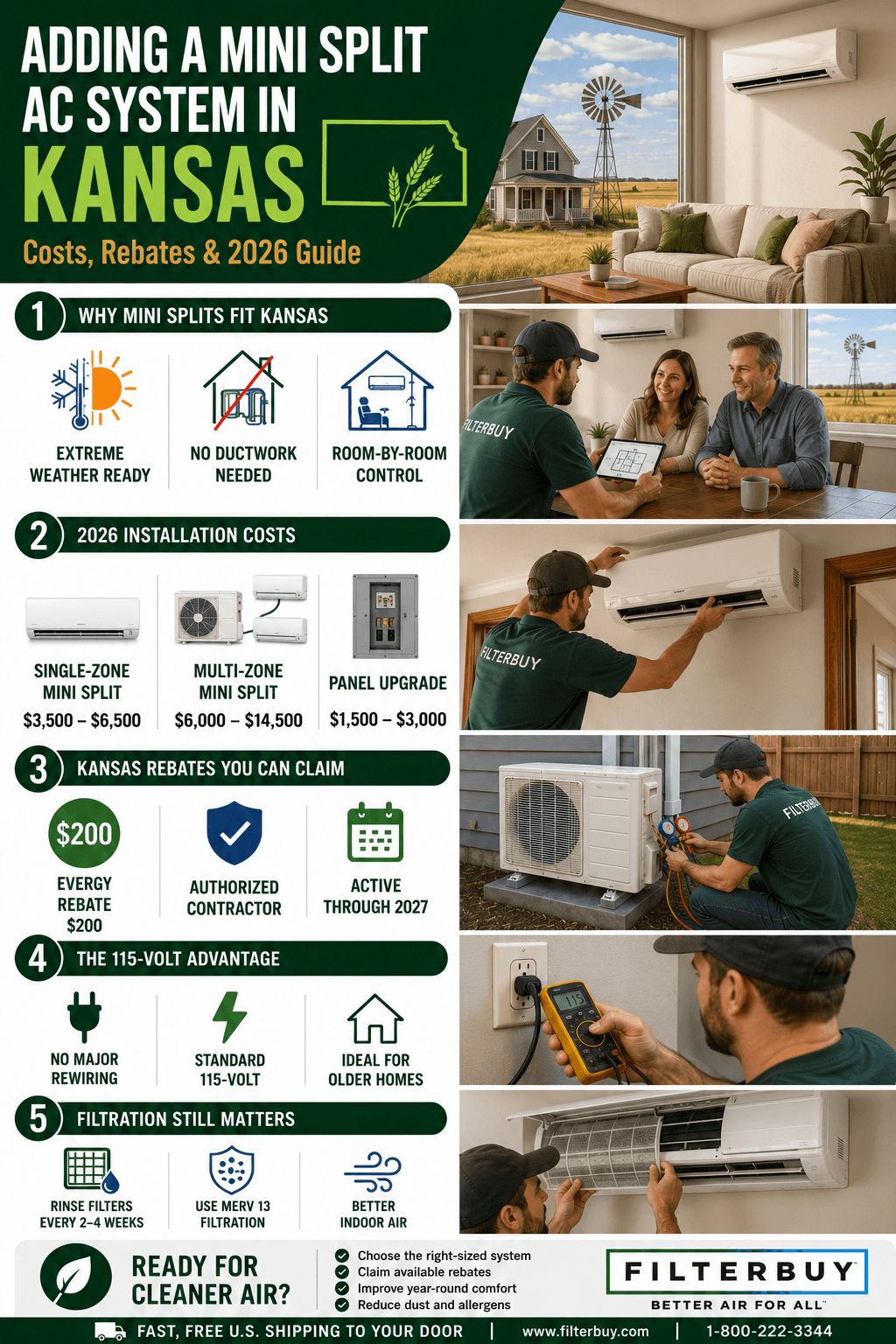
No panel upgrade: The Filterbuy 24,000 BTU model runs on standard 115-volt power, so most older Kansas homes skip a $1,500 to $3,000 panel upgrade for a two-ton install.
Built for Kansas swings: The variable-speed inverter and R-32 refrigerant hold temperature from 100°F-plus summers to sub-zero winters.
Rebate-ready: AHRI-certified Filterbuy units qualify for Evergy's $200 KEEIA heat pump mini split rebate through 2027 when an Evergy Authorized Contractor installs them. The federal Section 25C credit expired December 31, 2025, so Evergy is the live program.
Low maintenance: Each system pairs 55°C self-cleaning operation with a 5-year warranty, plus a washable pre-filter to rinse every 2 to 4 weeks.
Top 5 Takeaways
Cost range (2026): Single-zone mini split $3,500–$6,500 installed; multi-zone $6,000–$14,500.
Active Kansas rebate: Evergy pays $200 for a qualifying heat pump mini-split, with higher tiers of $400–$600 for SEER2 15.2+ central AC. The KEEIA program runs through December 31, 2027.
Federal 25C tax credit expired December 31, 2025. Only installs completed on or before that date remain claimable on 2026 tax filings.
Sizing for Kansas: Add 10 to 15% BTU capacity above base sizing charts to account for extreme summer heat and the older insulation common in KS homes.
Filtration still matters. Mini-splits use coarse pre-filters. Your whole-home system still needs MERV 13 filtration for pollen, ag dust, and drifting wildfire smoke.
How a Mini Split System Works (and Why It Fits Kansas)
A mini split is two pieces: an outdoor compressor and one or more indoor air handlers, linked by a small refrigerant line. Instead of making heat the way a furnace does, it moves heat out of your home in summer, and in from outside in winter. Same operating principle as any modern air conditioning system, just with no ductwork in between.
That design suits Kansas homes for a few specific reasons:
No ductwork needed. Many older Kansas homes, especially pre-1970 builds in Wichita, Topeka, Kansas City, and Lawrence, weren’t built with ductwork. A mini split installs through a 3-inch hole in the wall, which is a meaningful advantage for retrofits.
Zone control. A single-zone unit heats and cools one room. A multi-zone system—up to 4–8 indoor heads on one outdoor unit—lets you set different temperatures in different spaces. Handy for a finished basement that runs cold, or a south-facing bonus room that cooks in July.
Cold-climate performance. Modern cold-climate heat pump mini splits keep producing usable heat down to around –5°F or below. If you plan to use a heat pump as primary heat in a Kansas home, look for an HSPF2 rating of 8.1 or higher.
The two common configurations are single-zone (one indoor head, one outdoor unit, best for a garage, sunroom, or addition) and multi-zone (multiple indoor heads sharing one outdoor unit, better for whole-home coverage on a budget).
What It Costs to Add a Mini Split in Kansas (2026)
Three things drive the price: the BTU capacity you need, the number of zones, and how much electrical work the install requires.
Typical 2026 ranges across Kansas :
Single-zone system: $3,500–$6,500 installed. Smaller rooms (under 500 sq ft) fall at the lower end.
Multi-zone system: $6,000–$14,500 installed, depending on the number of indoor heads.
Electrical panel upgrade (if needed): $1,500–$3,000 extra. Older Kansas homes with 100-amp service often need this.
Quick sizing guide:
150–250 sq ft → 6,000 BTU
250–350 sq ft → 9,000 BTU
350–550 sq ft → 12,000 BTU
550–1,000 sq ft → 18,000–24,000 BTU
Add 10 to 15% capacity for Kansas summer heat, older insulation, heavy sun exposure on south- or west-facing walls, or vaulted ceilings. A professional Manual J load calculation is worth paying for on any multi-zone system.
One honest aside on DIY. The big-box kits look tempting, but installing a mini split yourself usually voids your Evergy rebate eligibility and most manufacturer warranties. If the rebate matters, pay a licensed installer.
Kansas Rebates You Can Actually Claim in 2026
The rebate landscape changed on January 1, 2026, and the details matter.
Evergy KEEIA rebates (active through December 31, 2027)
Heat pump mini-split, replacing failed unit or new construction: $200
Central AC, SEER2 15.2–15.99: $400
Central AC, SEER2 16–16.99: $500
Central AC, SEER2 17+: $600
Combined HVAC upgrades can reach up to $1,000 depending on project scope.
Systems must carry AHRI certification at the rated SEER2 level. Use an Evergy Authorized Contractor (Trade Ally) whenever possible. They handle the rebate paperwork, and many apply the discount at the register instead of mailing a check later, which means a lower out-of-pocket cost the day of install.
Evergy FastTrack HVAC PAYS® (limited rollout)
This program pairs an instant rebate with on-bill financing for up to 80% of projected energy savings, and the payments tie to the home’s meter rather than to you personally. The program launched in Missouri first and is rolling out in Kansas. Confirm availability with your Evergy Authorized Contractor at the quote stage.
Federal Section 25C tax credit (expired December 31, 2025)
The federal 30% / up-to-$2,000 credit no longer applies to 2026 mini split installs. If you completed a qualifying install on or before December 31, 2025, you can still claim the credit on your 2025 tax return filed in 2026 using IRS Form 5695. You’ll need the manufacturer’s Qualified Manufacturer ID (QMID). This isn’t tax advice, so run the specifics by a tax professional for your situation.
How to apply for your KEEIA rebate
Choose an Evergy Authorized Contractor from Evergy’s contractor finder.
Confirm the specific system model carries AHRI certification at the SEER2 tier you expect the rebate for.
Complete the install.
Your contractor submits the rebate application (most handle this for you).
Receive the rebate by mail, or as an instant discount at install, depending on the program.
Filter Care and Indoor Air Quality for Kansas Homes
Here’s what most mini split guides skip: a mini split doesn’t replace whole-home filtration. It carries a washable mesh pre-filter sized to catch larger particles and protect the evaporator coil—basically a dust screen. That’s very different from the MERV 11 or MERV 13 filtration your central HVAC runs to catch pollen, ag dust from Kansas wheat and row-crop fields, and the fine particulate matter that drifts in from western wildfire smoke each summer.
If you have both a mini split and central HVAC, treat them as two layers:
Mini split pre-filters: Rinse every 2 to 4 weeks during heavy use. They’re washable and reusable. Our team walks you through the steps in our guide to maintaining your mini-split.
Whole-home HVAC filters: Replace every 1 to 3 months. For Kansas homes with allergies, pets, or anyone sensitive to air quality, MERV 13 is the sweet spot. It catches pollen, pet dander, and the PM2.5 particulates that matter for health.
Homes that rely only on a mini split (common in garages, small additions, and older homes without ducts) should pair it with a portable HEPA unit during high-pollen or wildfire-smoke days. A mini split’s built-in pre-filter isn’t rated for that level of filtration, and pretending otherwise costs you in symptoms.
Filterbuy makes all filters in the USA, ships them fast and free, and stocks more than 600 standard sizes plus custom. If your HVAC size doesn’t show up at the big-box store, we almost certainly make it.
“We have watched too many Kansas homeowners assume they need a costly panel upgrade just to run a mini split large enough for a basement or workshop. We built the Filterbuy 24,000 BTU ductless mini split to run on standard 115-volt power for that reason, so Kansas families get two-ton heating and cooling without rewiring an older home around it."
— Filterbuy Air Quality Team
Essential Resources on Adding a Mini Split AC System, Including Rebates in Kansas
A short tour of the most useful places to confirm numbers, find certified equipment, and see how Kansas rebates flow through the system.
1. ENERGY STAR — Confirm Which Mini Splits Qualify for Rebates
ENERGY STAR’s Most Efficient certification is the fastest way to check whether a specific mini split meets federal and utility rebate efficiency thresholds. Their product finder lists every certified unit by model number, so you can verify eligibility before you sign a contract.
Source: ENERGY STAR air-source heat pumps eligibility page
2. IRS — Read the Official Rules on the Expired 25C Credit
If you completed your install on or before December 31, 2025, the IRS page on the Energy Efficient Home Improvement Credit spells out the filing requirements, QMID reporting, and the Form 5695 process for your 2025 return.
Source: IRS Energy Efficient Home Improvement Credit guidance
3. DSIRE — Every Rebate in Kansas, in One Database
The Database of State Incentives for Renewables and Efficiency, run by NC State University, pulls federal, state, utility, and local rebates into a single searchable tool by ZIP code. A Kansas search surfaces Evergy KEEIA details and newer local programs as they launch.
Source: DSIRE state incentives database
4. EPA — Understand the Refrigerant Transition Before You Buy
As of January 1, 2026, new HVAC systems in the U.S. must use lower-GWP refrigerants like R-32 or R-454B rather than R-410A. The EPA’s Significant New Alternatives Policy page walks through the regulatory shift so you don’t end up with soon-to-be-obsolete equipment.
Source: EPA Significant New Alternatives Policy
5. ACEEE — See How Your Utility Ranks on Efficiency Programs
The American Council for an Energy-Efficient Economy tracks which states and utilities run the strongest rebate programs. Their state scorecard is a reality check on what’s realistically available in Kansas and where the state stands nationally.
Source: ACEEE State Energy Efficiency Scorecard
6. NREL — Cold-Climate Heat Pump Performance Research
The National Renewable Energy Laboratory publishes peer-reviewed performance data on how cold-climate heat pumps perform below freezing. Worth reading before trusting a heat pump to carry a Kansas home through January.
Source: NREL buildings research library
7. Kansas Corporation Commission — The Regulator Behind KEEIA
The KCC oversees Kansas investor-owned utilities, Evergy included, and approves the KEEIA rebate amounts and program terms. Their site posts program filings, orders, and rate changes that affect your rebate eligibility from year to year.
Source: Kansas Corporation Commission official site
Supporting Statistics
1. Duct Losses Cost Traditional HVAC Systems Up to 30% of Their Output
The U.S. Department of Energy reports that ductwork losses can account for more than 30% of a home’s space-conditioning energy consumption, especially when ducts run through unconditioned attics or crawlspaces (a common setup in older Kansas homes). That’s roughly 30 cents of every utility dollar leaking out of the ducts before it reaches the room. Mini splits skip the ducts entirely.
Source: U.S. Department of Energy ductless mini split guide
2. Space Cooling Is One of the Largest Electricity Uses in U.S. Homes
The U.S. Energy Information Administration’s Residential Energy Consumption Survey shows space cooling consistently ranks among the top electricity uses in American homes. In hot-summer Kansas, cooling’s share of summer-month bills climbs well above the national average. A right-sized high-SEER2 mini split is one of the most direct ways to cut that load.
Source: EIA Residential Energy Consumption Survey
3. Kansas Sees Some of the Widest Annual Temperature Swings in the U.S.
According to National Weather Service climate data, much of Kansas routinely sees summer highs above 100°F and winter lows below 0°F, a spread greater than 100°F within a single year. That’s the climate any mini split serving as a primary heating and cooling source has to handle, which is why cold-climate heat pump ratings (HSPF2 8.1+) matter so much for Kansas homes.
Source: National Weather Service climate data
Final Thoughts And Opinion
The 2026 math on adding a mini split in Kansas works once you stop chasing the expired federal tax credit. Section 25C ended December 31, 2025, and many homeowners are still searching for it.
Here is what is actually live this year:
Evergy's KEEIA rebate, running through 2027.
Honest sizing for the Kansas climate. Add 10 to 15% BTU capacity for summer heat and older insulation.
An Evergy Authorized Contractor who can apply the rebate at install.
Typical 2026 budget:
Single-zone system: $3,500 to $6,500.
Multi-zone system: $6,000 to $14,500.
After years of fielding Kansas HVAC questions, three points shape what we tell people.
Match the Filterbuy ductless lineup to the room.
12,000 BTU: spaces up to about 550 sq ft.
18,000 BTU: up to 850 sq ft.
24,000 BTU: up to roughly 1,100 sq ft.
All run a variable-speed inverter on R-32 refrigerant, with self-cleaning operation and a 5-year warranty.
Check the electrical panel before you buy.
Older Kansas homes on 100-amp service often need a $1,500 to $3,000 upgrade for a 230-volt circuit.
The Filterbuy 24,000 BTU model runs on standard 115-volt power, so a two-ton install skips that cost in most homes.
Do not skip filtration.
A Filterbuy mini split uses a washable pre-filter that protects the coil but does little for your air.
Pair it with MERV 13 whole-home filtration on a steady change schedule.
Our customer data shows fewer allergy complaints and lower repair bills.
One more honest call before you commit:
If your ducts still work, run the rebate math first. A SEER2 17+ central AC upgrade earns $600 from Evergy and often beats a full mini split conversion.
If your ducts are missing or failing, the Filterbuy ductless line is the cleaner path, right-sized for the space and ready for the 100°F-plus annual swings the National Weather Service records across Kansas.
Frequently Asked Questions
Ready to Add a Mini Split to Your Kansas Home?
Start with the right-sized system and a clear rebate plan. Filterbuy’s mini split hub covers both, and our filter team has your air quality handled before, during, and after install.