Mini Split AC in San Jose, CA: Installation, Costs & Filter Guide (CA Climate)
Michelle Wan · Reviewed by David Clark, Licensed HVAC Technician · Published September 9, 2026 · Updated September 9, 2026
How Much Does a Mini Split Cost in San Jose, CA?
A mini split in San Jose costs about $4,000 to $15,000 installed in 2026. Zone count drives most of that range. One room sits near the bottom. A whole-home system replacing a gas furnace sits near the top.
- Single zone: $4,000 to $7,000. One bedroom, a garage office, or an ADU.
- Two zones: $6,000 to $10,000. Upstairs bedrooms that overheat.
- Three zones: $8,000 to $12,500. Most homes built before central air.
- Four to five zones: $11,000 to $15,000+. Whole-home replacement for a gas furnace.
Sizing is the decision most homeowners get wrong, and San Jose rewards a smaller system than people expect. Take the quick match below to find the size that fits your room.

Answer a few quick questions and we will match you to the right mini split size.
Already know your size? Shop Filterbuy mini split systems. Single-zone units from $799 to $1,349, 17 SEER2, free 2-day delivery, and a 7-year compressor warranty. Professional installation is required and the warranty is void if the unit is self-installed.
TL;DR
Mini split installation in San Jose runs roughly $4,000 to $15,000 in 2026, single-zone at the low end and whole-home multi-zone at the top. San Jose sits in California Building Climate Zone 4: a short but real cooling season with a large day-to-night swing, which rewards a correctly sized variable-speed system and punishes an oversized one. San Jose Clean Energy pays a $1,500 EcoHome rebate (up to $2,500 in Environmental Justice Communities), but only when the heat pump replaces a gas appliance and only when you apply before work starts.
Key Takeaways
• Mini split installation in San Jose costs about $4,000 to $15,000 in 2026. Santa Clara County labor and permit costs sit at the upper end of the statewide range.
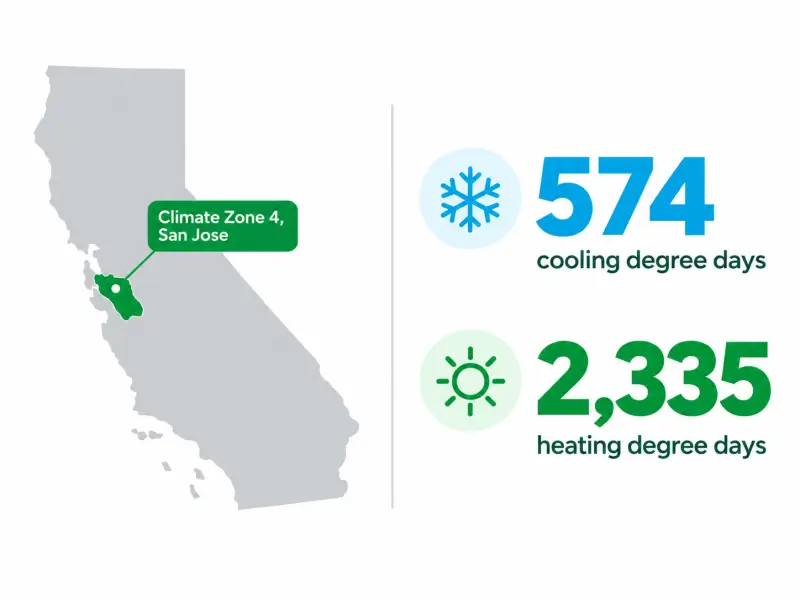
• San Jose is the reference city for California Climate Zone 4. Pacific Gas & Electric lists San Jose at 574 cooling degree days and 2,335 heating degree days, with hot, dry summers and a large daily temperature swing.
• The San Jose Clean Energy EcoHome rebate pays $1,500 for a heat pump HVAC system, or $2,500 in an Environmental Justice Community. Ductless mini splits qualify only if they replace an existing gas furnace, and the application must be approved before installation begins.
• The federal 25C tax credit expired December 31, 2025. TECH Clean California and HEEHRA single-family funds are fully reserved, so local utility programs are the live path in 2026.
• A mini split does not use a disposable filter. Each indoor head has a washable mesh pre-filter that needs cleaning every two to four weeks; homes that also run a ducted system should move those filters to MERV 13 before wildfire season.
Where We Come Out on Mini Splits in San Jose
Filterbuy is an American air filter manufacturer, not an HVAC installer, and Filterbuy does not send trucks to San Jose. Filterbuy has made air filters in the United States since 2013, more than 50 million of them, across factories in Alabama, Florida, Pennsylvania, and Utah. The Filterbuy HVAC Solutions team services ductless systems in the field in Florida and Texas, so what we see is the aftermath: the equipment people bought, and how it aged.
Disclosure: Filterbuy sells single-zone mini split systems and air filters, and this page recommends both. Filterbuy is not a San Jose installer and has no commercial relationship with any contractor, utility, or rebate program named here. Where a Filterbuy product is not the right answer, this page says so.
That vantage point produces an opinion we will state plainly. In San Jose, two decisions settle the outcome, and neither one appears on a quote. The first is whether you have a gas appliance to remove, because that single fact decides whether your rebate is $1,500 or $0. The second is whether your installer sizes down rather than up, because Climate Zone 4 punishes oversized equipment in a way hotter markets do not. Brand choice, the thing most homeowners agonize over, matters less than either.
How Much Does a Mini Split Cost in San Jose, CA?
Mini split installation in San Jose costs approximately $4,000 to $15,000 in 2026, installed and permitted. Zone count is the biggest variable: a one-room system for a bedroom, garage conversion, or ADU lands near the bottom, while a four- or five-head whole-home system replacing a furnace lands near the top. Santa Clara County labor and permit costs push South Bay pricing to the upper end of the statewide range.
Ranges are installed and permitted. Electrical panel upgrades ($2,000 – $5,000), permit fees, and HERS verification are billed separately.
Three San Jose line items surprise homeowners most. Electrical capacity comes first: many Willow Glen, Cambrian, and Berryessa homes still run 100-amp panels, and an upgrade adds $2,000 to $5,000. Permits are second, generally in the low hundreds through SJPermits.org. HERS verification is third, an independent field test required to close out the permit and billed separately from your contractor's labor.
Ask every bidder to itemize equipment, labor, line set, electrical, permit, and HERS testing separately. In our experience reviewing what homeowners send us, the quotes that bundle everything into one number are the ones that grow later.
Does San Jose's Climate Actually Justify a Mini Split?
Yes, but the reason is efficiency and comfort rather than raw heat. San Jose is the official reference city for California Building Climate Zone 4. Pacific Gas & Electric's Climate Zone 4 reference data puts San Jose at 574 cooling degree days and 2,335 heating degree days, and describes Zone 4 summers as hot and dry with a large daily temperature swing. Translation: you need cooling, but you need it for fewer hours than the Central Valley does, and the nights cool off hard.
That profile is close to ideal for a variable-speed inverter compressor, the technology inside every modern mini split. Inverters ramp to reach a setpoint, then throttle down to hold it, and the throttling is where the efficiency lives. San Jose spends most of its cooling season in exactly that mild part-load band.
It also means oversizing is the most expensive mistake a San Jose homeowner can make. An oversized head blasts to setpoint, shuts off, and repeats, short-cycling that wears the compressor and wastes electricity. Insist on a Manual J load calculation instead of a square-footage rule of thumb; the Department of Energy's guide to ductless mini split heat pumps explains why sizing drives performance. Filterbuy's mini split lineup runs 12,000, 18,000, and 24,000 BTU single-zone, and in Climate Zone 4 the smaller end covers more house than most people expect.
Which San Jose Homes Are the Best Fit for Ductless AC?
Ductless AC solves a problem a large share of the South Bay housing stock actually has: no ductwork and nowhere to put it. Three San Jose situations come up constantly.
Eichlers and other mid-century post-and-beam homes. Joseph Eichler built thousands of Santa Clara Valley homes with radiant tubing in the slab, open-beam ceilings, and no attic. There is no hidden space for ducts, and soffits would wreck the architecture. A wall-mounted head and a three-inch lineset penetration preserve the ceiling line, which is why ductless is now the default Eichler retrofit.
Homes with a failing radiant slab. When slab tubing develops pinhole leaks, repair means cutting the floor. Many owners retire the loop in place and switch to zoned ductless heating and cooling.
ADUs and garage conversions. San Jose's accessory dwelling unit boom created thousands of small spaces needing their own climate control, and extending the main house's system rarely pencils out. San Jose Clean Energy treats an ADU as its own dwelling unit for rebates, though new builds are excluded.
What Rebates Can San Jose Homeowners Actually Get in 2026?
The San Jose Clean Energy EcoHome Rebate is the main live incentive for San Jose addresses in 2026. It pays $1,500 for a heat pump HVAC system, or $2,500 for homes in an Environmental Justice Community. San Jose Clean Energy confirms that both ducted central systems and ductless mini splits qualify, and it requires a cooling efficiency of SEER 17 or higher, or SEER2 16 or higher.
Silicon Valley Clean Energy serves many neighboring Santa Clara County cities and runs a separate program. Your electricity bill confirms which applies.
Four rules trip people up:
• The system has to replace an existing gas appliance. A mini split added purely for cooling, with no gas furnace removed and gas line capped, does not qualify. This is the most common disqualification.
• Approval must come before installation starts. San Jose Clean Energy reserves funds for 120 days once approved and will not pay on work already done.
• Add-ons only stack on a qualifying heat pump. A panel upgrade and attic insulation are worth real money, but neither is available on its own.
• Dual-fuel systems are excluded, and proof of final permitting is required with the claim.
Any guide still describing a three-way stack of TECH, HEEHRA, and the federal credit is out of date. The 25C credit was terminated for systems placed in service after December 31, 2025, and eligibility questions belong with a tax professional. Verify current federal status on the IRS page for the Energy Efficient Home Improvement Credit, confirm the San Jose terms on the SJCE EcoHome Rebate page, and see our statewide guide to adding a mini split AC system in California for the broader picture.
One spec detail worth checking early: San Jose Clean Energy sets its efficiency floor at SEER 17 or higher, or SEER2 16 or higher, and a good deal of budget ductless equipment sits below it. Filterbuy's mini split systems are published at $799 to $1,349 with free 2-day delivery and a 7-year compressor warranty, and they run 17 SEER2, which clears the SEER2 side of that floor. Clearing it is necessary rather than sufficient. The gas-appliance rule still governs. The Filterbuy line is single-zone only, so a whole-home multi-zone project needs equipment your installer sources, and 17 SEER2 is a value figure rather than a high-efficiency one.
One conflict to plan around. San Jose Clean Energy permits self-installed projects for rebate purposes. Filterbuy does not: professional installation is required on Filterbuy mini splits, and the warranty is void if the unit is self-installed. Whichever brand you choose, check the manufacturer's terms before anyone opens a box.
What the Rebate Is Actually Worth: Two San Jose Houses
Nobody publishes the arithmetic, so here it is. Both of these are real configurations we see constantly in the South Bay, and they land in completely different places.
House A is a Cambrian ranch with a gas furnace and a 100-amp panel, inside an Environmental Justice Community. The furnace comes out, the gas line gets capped, and the panel goes to 200 amps. This household stacks the heat pump HVAC rebate, the panel-upgrade add-on, and attic insulation:
• Heat pump HVAC: $2,500
• Electric service panel upgrade: $2,000
• Attic insulation: up to $1,000
• Total: up to $5,500, plus an interest-free EcoHome payment plan of up to $5,000 against the balance. Amounts are San Jose Clean Energy's published figures, not a determination of what any household will receive. Confirm eligibility with the program before you budget around it.
House B is a Willow Glen bungalow adding one head to a west-facing bonus room, keeping the gas furnace. Same city, same utility, same equipment, same installer. The rebate is $0, and the add-ons go with it, because nothing qualifies without a heat pump HVAC rebate underneath it. Outside an Environmental Justice Community, House A's figures drop to $1,500, $1,000, and $700.
House B should still buy the mini split if the room needs it. House B should simply stop budgeting around a rebate that will never arrive. House A has the opposite job: file the application before signing anything.
What Permits Does San Jose Require for a Mini Split?
San Jose requires permits for mini split installation, with no like-for-like exemption. The City of San Jose's guidance on air conditioning, heating and fireplaces permits directs homeowners to SJPermits.org, where one application submitted through the mechanical projects process can cover every permit the job needs.
All three can be applied for in one session at SJPermits.org. HERS verification by an independent certified rater is required to pass final inspection.
Two more requirements apply here. Refrigerant work requires a C-20 licensed HVAC contractor under California law, and you can verify any contractor's licence through the Contractors State License Board. Title 24 documentation must also be filed for the new system under the California Energy Commission's Building Energy Efficiency Standards. The city also requires an accessible electrical disconnect within sight of the outdoor unit.
Skipping permits is a false economy in this market. Unpermitted HVAC work surfaces during escrow, and it disqualifies you from the rebate, since proof of final permitting is part of the claim.
How Do You Keep a San Jose Mini Split's Air Clean?
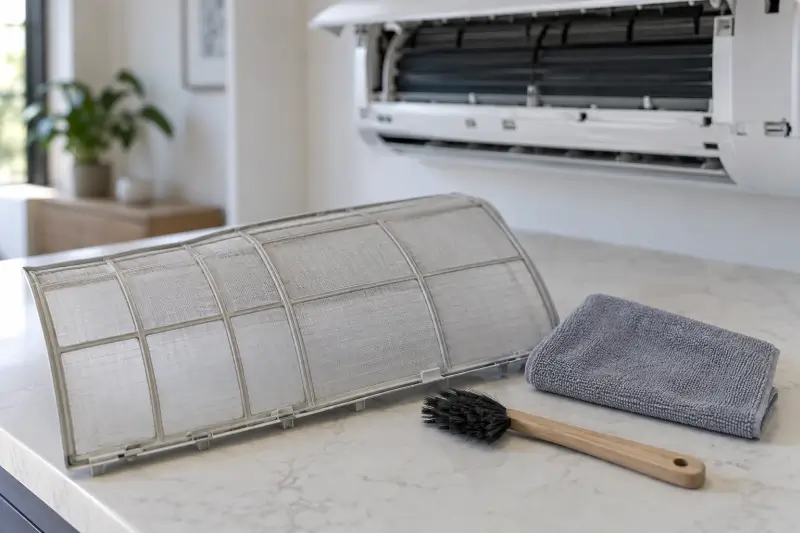
A mini split does not take a disposable air filter, and we will say plainly that this is the single most misunderstood thing about ductless systems. Each indoor head contains a washable mesh pre-filter that protects the coil. It is the most-skipped maintenance item we encounter. Our step-by-step guide to cleaning mini split filters covers the method by brand; the short version is to clean it every two to four weeks during heavy-use months. Slide it out, vacuum or rinse it in lukewarm water, dry it completely, reinstall. If your model has a secondary carbon or electrostatic layer, replace that every three to six months, as explained in do mini splits have filters.
Plan a professional tune-up on the schedule in Filterbuy's guide to how often to service a mini split.
What Filterbuy Sees in Its Own Service Data
Filtration is the part of this system Filterbuy actually has data on, because neglected filters are what come back to us. In Filterbuy's service data, a dirty, restricted filter cuts a mini split's efficiency by 5 to 30 percent, depending on how bad the buildup is. On a ductless head the mesh sits directly in front of the coil, so airflow loss shows up fast. In Filterbuy's customer-service data, restoring a dust-coated coil after a neglected filter runs about $350 to $600, against a mesh screen you rinse for free.
Filterbuy's own factory testing changed how we talk about this. When Filterbuy tested particle capture, fine dust under 10 microns proved harder on a system than visible dirt, because it settles deeper and is far tougher to clean off later. The practical translation for a San Jose homeowner: do not wait until the mesh looks filthy. By the time it looks dirty, the damage pattern is already set.
Air quality is the second reason San Jose homeowners care. The American Lung Association's State of the Air 2026 report for the San Jose metro places the San Jose-San Francisco-Oakland area among the worst 25 in the nation for both ozone and short-term particle pollution, with the short-term spikes driven largely by wildfire smoke, though the region did post its lowest particle level on record for a second straight year. See how that compares nationally in our roundup of the worst air quality cities in the U.S..
A mini split's mesh pre-filter is coil protection, not smoke filtration. So during California's May-to-October fire season, if your home also runs a ducted furnace or air handler, consider MERV 13 air filters for those returns. The EPA notes that a MERV 13 filter captures a larger share of fine particles than a MERV 8. Check your equipment first, because not every residential system is built for the added airflow resistance of a higher-MERV filter. If the mini split is the only system in the home, a portable HEPA air cleaner in the bedroom is the better addition.
California's fire season generally runs May through October. Keep windows closed on smoke days and run the mini split on recirculate.
The EPA makes the same point: a wall-mounted ductless unit filters mainly to keep the equipment itself clean, not to scrub fine particles from a whole house. Set the cleaning schedule the day the system is commissioned, not the first time it underperforms, and see how mini splits affect indoor air quality for where a ductless head fits alongside the rest of your home's setup.
Supporting Statistics
Three findings from U.S. government sources support the case above.
1. Half of Pacific-Coast Homes Still Have No Air Conditioning
Only 49% of households in the Pacific-coast marine climate region used air conditioning in 2020.
• Built before 1950: 39% used AC.
• Built 2010 to 2020: 66% used AC.
• Why it matters: San Jose's older housing was never designed around cooling, and most of it has no ductwork to extend.
Source: U.S. Energy Information Administration, Residential Energy Consumption Survey (2020)
2. A Typical Duct System Loses 20% to 30% of Its Air
In a typical house, 20% to 30% of the air moving through the ducts is lost before it reaches a room.
• The cause: leaks, holes, and poorly connected ducts.
• A ductless mini split has no duct run, so it never incurs that loss.
• Why it matters: this is the efficiency case for going ductless instead of retrofitting ducts into a house that never had them.
Source: ENERGY STAR (U.S. EPA and U.S. Department of Energy), Duct Sealing
3. Wildland Fires Are the Largest Single Source of U.S. PM2.5
Wildland fires produced 52% of total U.S. PM2.5 emissions in the EPA's 2020 National Emissions Inventory.
• Smoke infiltrates indoors, so closing the windows only goes so far.
• A mini split's mesh pre-filter is coil protection, not smoke protection.
• Why it matters: filtration belongs in the system decision, not after it.
Source: U.S. EPA, Wildland Fire Research: Reducing Exposures
“The number-one callback we could prevent is the damp-filter mold call. A mesh that goes back in even slightly wet is how mold gets started inside the head. Give it the full drying time. A few extra minutes beats a service visit.”DAVID CLARK, LICENSED HVAC TECHNICIAN
“I don't want anyone to feel like they need an HVAC license just to pick the right filter. My job is to give you the straight answer, explain why it matters, and let you get back to your day.”
MICHELLE WAN, BRAND MANAGER AND AIR QUALITY WRITER, FILTERBUY
About the Author
Michelle Wan is Filterbuy's Brand Manager and air quality writer. She works directly with Filterbuy's U.S.-based manufacturing team across factories in Alabama, Florida, Pennsylvania, and Utah, so her guidance is grounded in how filters are actually built, tested, and used in real homes. Filterbuy has manufactured air filters in the United States since 2013, producing more than 50 million and serving over two million households, and its HVAC Solutions team services ductless systems in the field. This page was reviewed for technical accuracy by David Clark, Licensed HVAC Technician.
Frequently Asked Questions
The San Jose Pre-Signature Checklist
Assembled from the City of San Jose's permit requirements and San Jose Clean Energy's published program rules. Work it in order, because two of these steps stop counting once a contract is signed.
• Confirm your utility. San Jose Clean Energy or Silicon Valley Clean Energy. Your bill settles it, and the programs are not interchangeable.
• Decide whether a gas appliance is coming out. This determines whether your rebate is $1,500, $2,500, or nothing.
• File the EcoHome application and wait for approval. Funds reserve for 120 days. Work started before approval is disqualified.
• Check the equipment against the spec. SEER 17 or higher, or SEER2 16 or higher. Dual-fuel systems are excluded.
• Photograph your electrical panel. The panel-upgrade rebate requires proof the existing panel is under 200 amps.
• Get three itemized quotes from C-20 licensed contractors. Pick the one who explains the Manual J math rather than quoting from square footage.
• Confirm who pulls the permits and who schedules HERS. Proof of final permitting is required with your rebate claim.
Browse Filterbuy mini split systems for single-zone options, and set up air filter auto-delivery for any ducted system running alongside it. Odd opening? Filterbuy ships custom-size air filters free, factory-direct.
Glossary
California Building Climate Zone 4: One of 16 climate zones in California's Title 24 energy code. San Jose is its reference city.
Cooling degree days (CDD): Annual cooling demand, summing how far daily average temperatures rise above 65F. San Jose's figure is 574.
Manual J: The industry-standard room-by-room load calculation used to size heating and cooling equipment correctly.
HERS verification: Home Energy Rating System field testing by an independent certified rater, required to close out a Title 24 permit in California.
C-20 license: The California Contractors State License Board classification required to perform HVAC and refrigerant work.
SEER2: The current federal seasonal cooling efficiency rating, measured under updated test conditions. SEER and SEER2 figures are not interchangeable. San Jose Clean Energy requires SEER 17 or higher, or SEER2 16 or higher, for its rebate.
Environmental Justice Community: A San Jose neighborhood designated by the city as facing higher pollution and health risk, or a household meeting income qualifications. Rebate amounts are higher in both cases.
MERV 13: A filter efficiency rating capable of capturing fine PM2.5 particles, including wildfire smoke.
Pre-filter: The washable mesh screen inside a mini split's indoor head that protects the coil from dust and lint.