
Orange, CA Live Wildfire Smoke Map
Get Alerts For Wildfires In Your Area
The moment a wildfire starts near you, you'll get an instant alert and simple tips to reduce your smoke exposure.
What's In The Smoke
30xSmaller than a human hair
Fine enough to reach deep into the lungs. A MERV 13 is built to capture it.
How Far It Travels


It Doesn't Stay Local
Smoke rides the wind far downwind — you can get smoky air with no fire nearby.
What To Do During A Smoke Event
Simple steps to reduce indoor exposure.
- Stay In, Close UpShut windows and doors to keep smoke out.
- Set Fan To "On"Keeps air cycling through your filter, not just when heating or cooling.
- Recirculate AirSwitch off fresh-air intake so you're not pulling smoke in.
- Run A MERV 13Built to capture the fine PM2.5 in smoke.
- Add A PurifierExtra filtration for the room you use most.
- Wear an N95 if OutsideFits snug to block fine particles — a cloth mask won't.


The Best Air Filter For Wildfire Smoke
During smoke events, the EPA recommends upgrading to a MERV 13 filter — or the highest-rated filter your system can handle — to help reduce the fine particles smoke brings indoors. MERV 13 is the level most home HVAC systems can run while still capturing PM2.5, the fine particulate that makes up the bulk of wildfire smoke.
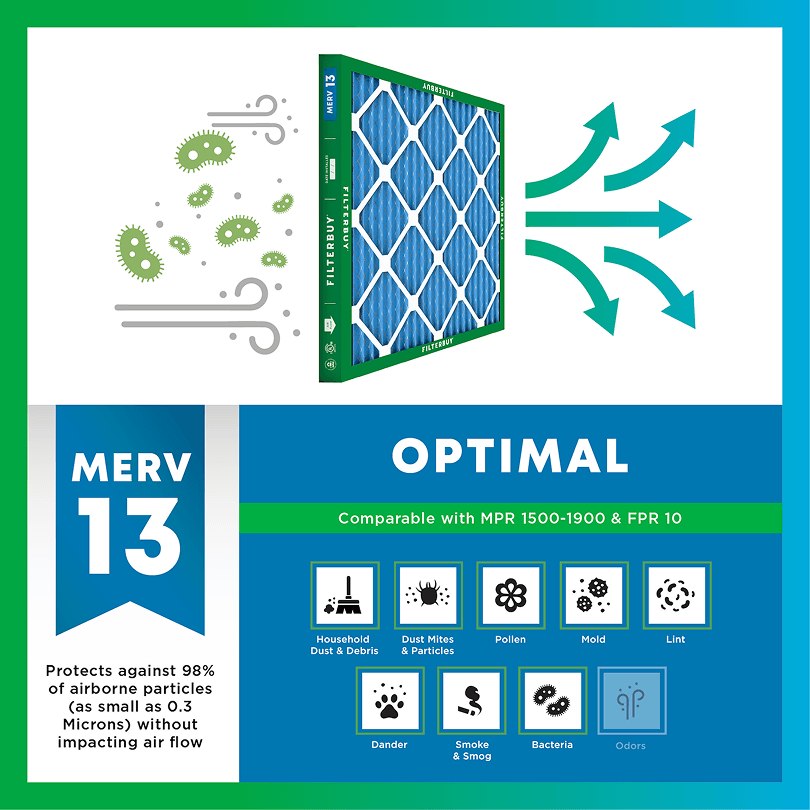

- Captures PM2.5 particles
- Blocks ash, soot, and smoke odor
- Keeps your indoor air safe—even when the outdoor air is dangerous
- Meets the EPA's recommended rating for filtering fine wildfire smoke particles.

Wildfire Smoke FAQs
Facts About Wildfires
Over 70,000 wildfires burn in the U.S. every year.
Wildfire smoke can travel 1,000+ miles, affecting states that aren't even near the blaze.
Exposure to wildfire smoke can worsen asthma, trigger heart issues, and lead to ER visits.
Indoor air can hold more fine particles during wildfire events unless it's properly filtered.
The EPA advises using MERV 13 filters or portable HEPA air cleaners during wildfire smoke events.
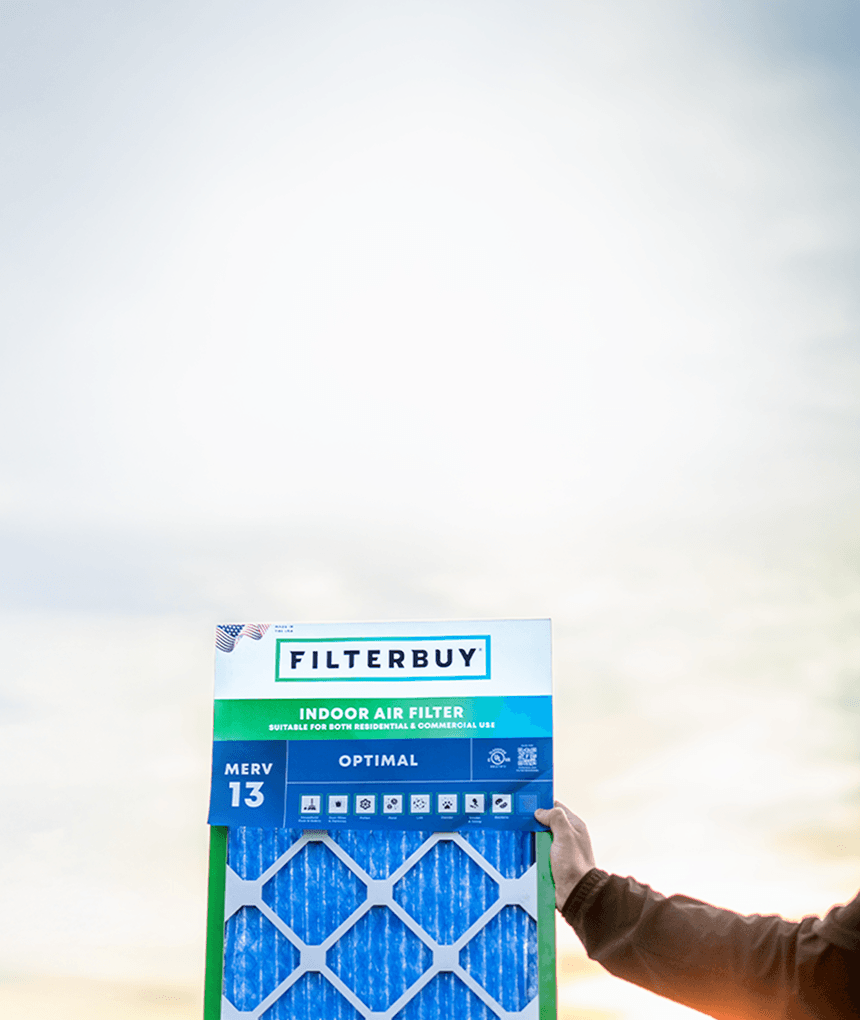
Don't Wait Until The Smoke's Inside.
Use the live wildfire smoke tracker and upgrade your air filters today to protect your lungs and your home.
Shop Filters For Smoke Protection
Current Live Forest Wildfire and Smoke Map Today in Orange, CA – Real-Time Updates You Can Trust
Wildfire smoke doesn't stop at your front door. When active fires push smoke into Orange, CA, fine particulate matter infiltrates your home through every gap, vent, and air return — and your HVAC system circulates it into every room before most people even realize air quality has changed outside.
This page gives you live wildfire tracking, real-time smoke plume maps, and current AQI data for Orange pulled directly from AirNow.gov, CAL FIRE, and the National Interagency Fire Center — updated continuously, not recycled from yesterday.
But here's what most wildfire map pages won't tell you: what's happening to the air inside your home while you're watching the smoke outside. After serving thousands of Southern California homes through multiple wildfire seasons, our HVAC technicians have pulled filters that turned completely black within 48 hours of a major smoke event — filters that were brand-new at installation. We've measured indoor particulate levels in Orange County homes during fire season that exceeded outdoor readings because sealed-up houses with running HVAC systems were recirculating trapped smoke particles with no adequate filtration path. That's the kind of real-world insight that only comes from being inside local homes when conditions turn dangerous.
Use this page to track active fires and smoke conditions affecting Orange, then follow our field-tested guidance below to protect both your family's air and your HVAC system before damage is done.
TL;DR Quick Answers
Current Live Forest Wildfire and Smoke Map Today in Orange, CA
The best real-time wildfire and smoke map for Orange, CA is the AirNow Fire and Smoke Map — a free tool from the EPA and U.S. Forest Service.
What it combines into one live view:
Federal air monitors tracking PM2.5 in real time
Crowd-sourced ground-level air quality sensors
Satellite-detected smoke plumes showing active movement and direction
Zoom into Orange, CA, for neighborhood-level AQI readings that update continuously.
For hyperlocal Orange County data: Check South Coast AQMD — tracking air quality at 1,200+ locations across the basin.
From our experience monitoring these maps during fire events across the region, posted AQI readings typically lag actual ground conditions by about one hour. If you see haze or smell smoke, treat conditions as worse than the number shown and protect your indoor air immediately — start with a MERV 13 filter and switch your HVAC to recirculate mode.
Top Takeaways
1. Wildfire Smoke Doesn't Stop at Your Front Door
Fine particulate matter (PM2.5) infiltrates your home through every gap, vent, and air return. Your HVAC system circulates it into every room — often before you realize air quality has changed outside.
2. Your HVAC Filter Is Your Last Line of Defense
Standard MERV 4–8 filters allow the majority of wildfire smoke particles to pass straight through.
MERV 13 captures approximately 85% of particles in the size range that makes up the bulk of wildfire smoke
During active smoke events, filters can saturate in as little as 48 hours.
3. Orange County's Geography Compounds the Risk
The Santa Ana Canyon funnels smoke directly into residential neighborhoods from fires burning 40+ miles away.
Santa Ana winds (40–60+ mph gusts) drive both fire spread and smoke transport.
Smoke advisories from LA County fires routinely extend across all of Orange County.
4. Wildfire Activity Is Getting Worse — Not Better
2024: 64,897 wildfires burned nearly 8.9 million acres — above the 10-year average
January 2026: Year-to-date acres already running at 148% of the 10-year average
This is a sustained, accelerating trend — not a one-time event
5. Preparation Is the Only Intervention That Works
The families who take 20 minutes to prepare before smoke arrives consistently have better outcomes than families with more expensive equipment who react after the fact:
Swap in a MERV 13 filter before the first Red Flag Warning
Switch thermostat to ON (not AUTO) for continuous filtration
Close the fresh air intake and set the system to recirculate
Stock 2–3 replacement filters before fire season tightens supply chains
Bookmark this page for instant access to live tracking and trusted resources
Live Wildfire and Smoke Tracking Map for Orange, CA
The map below pulls real-time data from AirNow's Fire and Smoke Map — a joint resource developed by the EPA and U.S. Forest Service that combines readings from federal regulatory air monitors with crowd-sourced sensor networks for the most complete picture available. You can zoom into Orange, CA, and surrounding communities to see active fire perimeters, smoke plume movement, and current PM2.5 particulate readings at ground level where you're actually breathing.
Bookmark this page. During active wildfire events, conditions in Orange County can shift within hours as wind patterns change — particularly during Santa Ana wind events when gusts through the Santa Ana Canyon and inland valleys can redirect smoke plumes across the entire county in a single afternoon.
Understanding Air Quality Index (AQI) Readings in Orange, CA
The AQI number on the map tells you how clean or polluted the air is at any given moment — but during wildfire events, the reading that matters most is PM2.5, the fine particulate matter produced by burning vegetation and, increasingly in Southern California, burning structures. These particles are small enough to bypass your body's natural defenses and penetrate deep into lung tissue.
Here's what the AQI levels mean for your family during a smoke event in Orange:
Green (0–50): Air quality is good. Normal activity is safe for everyone.
Yellow (51–100): Moderate. Unusually sensitive individuals should consider limiting prolonged outdoor exertion.
Orange (101–150): Unhealthy for sensitive groups. Children, older adults, and anyone with respiratory or heart conditions should reduce outdoor activity.
Red (151–200): Unhealthy. Everyone should limit prolonged outdoor exertion. Keep windows and doors closed.
Purple (201–300): Very unhealthy. Avoid all outdoor activity. Your HVAC system becomes your primary line of defense.
Maroon (301+): Hazardous. Remain indoors. If you can smell smoke inside your home, your filtration is insufficient and needs immediate attention.
One critical detail most wildfire pages leave out: the AQI reading on your screen typically lags actual conditions by about an hour. During fast-moving smoke events — especially when Santa Ana winds are pushing plumes across Orange County — that lag can mean the difference between safe air and dangerous exposure. If you can see haze or smell smoke outside, treat conditions as worse than the current posted number, regardless of what the map shows.
Why Orange, CA, Faces Unique Wildfire Smoke Risks
Orange sits in a geographic position that makes it particularly vulnerable to wildfire smoke from multiple directions. The Santa Ana Canyon — the very feature that gives the infamous winds their name — funnels hot, dry air directly through the area, and those same wind corridors carry smoke from fires burning in the Santa Ana Mountains, the Cleveland National Forest, and even from major fire complexes in Los Angeles County to the north.
Santa Ana wind events, which typically produce gusts between 40 and 60+ mph through Orange County's canyons and inland valleys, create a compounding problem. The winds that drive fire spread are the same winds that push dense smoke plumes into residential neighborhoods that may be miles from any active flame. During the January 2025 Southern California wildfires, smoke advisories extended across the entire South Coast Air Basin — including all of Orange County — even though the primary fires were burning in Los Angeles County.
From our experience servicing HVAC systems across this region, we've seen how quickly conditions deteriorate indoors once smoke settles over Orange County. Homes built in the 1970s through 1990s — which make up a significant portion of the housing stock in Orange and neighboring communities — tend to have older ductwork with gaps at joints and connections that allow unfiltered air to bypass the system entirely. The smoke doesn't just come through your front door. It enters through every return duct leak, every unsealed penetration, and every gap around your air handler that was never an issue until particulate counts spiked into the hundreds.
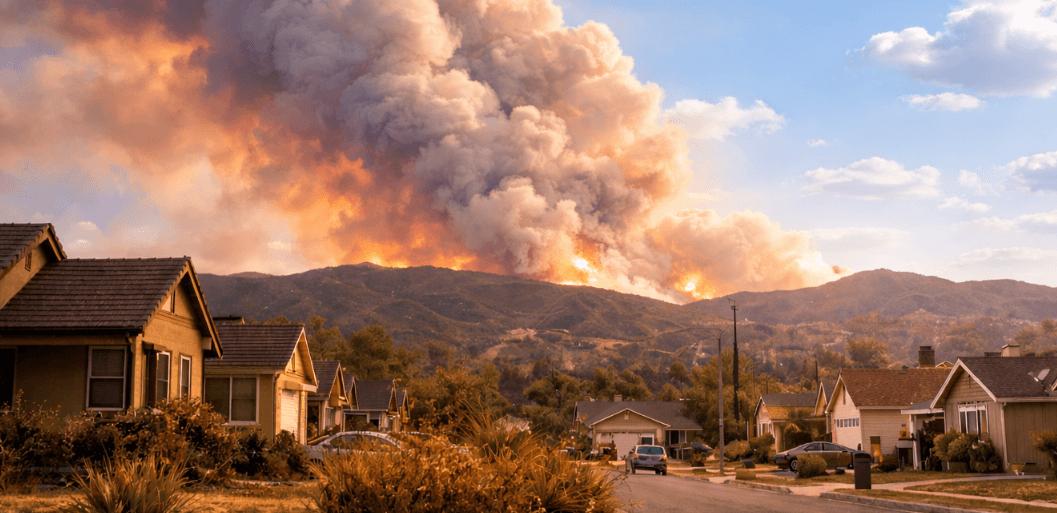
How Wildfire Smoke Impacts Your HVAC System and Indoor Air
Your HVAC system was not designed to be a smoke filtration device. Standard residential filters — the ones most Orange County homes are running right now — are rated between MERV 4 and MERV 8, which means they capture dust and some pollen but allow the majority of wildfire smoke particles to pass straight through. PM2.5 particles, the primary health threat in wildfire smoke, are so small that they slip through low-rated filter media as if they weren't there.
During a smoke event, even homes with adequate filtration face accelerated filter loading. The EPA recommends checking and potentially replacing HVAC filters every few days during active wildfire smoke conditions — not every 90 days as most homeowners are used to. We've personally pulled filters from Orange County homes during fire season that were completely saturated within 48 hours of a major smoke event, and a clogged filter doesn't just stop working — it restricts airflow, forces your system to work harder, and can cause compressor strain or evaporator coil icing that leads to expensive repairs.
Trusted Sources for Orange, CA Wildfire and Air Quality Data
Not all wildfire maps and air quality tools are created equal. Some sites recycle data, others display readings from a single sensor that may not represent conditions in your specific neighborhood. Here are the sources our team relies on — the same ones feeding the live map on this page:
AirNow Fire and Smoke Map (fire.airnow.gov)
CAL FIRE Incident Information (fire.ca.gov)
South Coast Air Quality Management District (aqmd.gov)
National Weather Service – Los Angeles/Oxnard Office (weather.gov)
Orange County Health Care Agency (ochealthinfo.com)
California Smoke Spotter App (CARB)
"After servicing HVAC systems across Orange County through multiple wildfire seasons, the one thing that surprises homeowners most is how fast smoke destroys a brand-new filter — and how their indoor air can actually test worse than the air outside when a saturated filter starts recirculating trapped particulate instead of capturing it."
7 Essential Wildfire and Smoke Resources
Don't take your indoor air for granted — especially during wildfire season in Orange County. When smoke rolls in, the families who stay protected are the ones who knew where to find reliable information before conditions turned dangerous.
After manufacturing air filters for over a decade and serving thousands of Southern California homes through multiple wildfire seasons, these are the seven resources we trust with our own families' safety — and the same ones we recommend to every customer in Orange, CA.
1. AirNow Fire and Smoke Map — See Exactly What's in the Air Over Orange, CA Right Now
Air quality in Orange County can shift from green to red in hours during an active fire event. This is the most comprehensive real-time smoke tracking tool available to the public.
What it provides:
Live PM2.5 readings from federal regulatory monitors and thousands of crowd-sourced sensors
Satellite-detected smoke plume positions are updated continuously
Interactive zoom to neighborhood-level AQI data for Orange, CA
Source: U.S. Environmental Protection Agency & U.S. Forest Service
2. CAL FIRE Incidents Page — Know Exactly Where Fires Are Burning and How Close They're Getting
When wildfire news breaks in Southern California, misinformation spreads almost as fast as the flames. This is the official state source — updated directly by incident command teams on the ground.
What it provides:
Verified acreage and containment percentages for every active California wildfire over 10 acres
Real-time evacuation orders and status updates
Incident data is posted hours before most news outlets report it
Source: California Department of Forestry and Fire Protection
URL: https://www.fire.ca.gov/incidents
3. South Coast AQMD Current Air Quality Data — The Most Detailed Air Quality Readings for Your Orange County Neighborhood
Most national air quality maps show a handful of data points across an entire county. South Coast AQMD goes far deeper.
What it provides:
AQI readings at over 1,200 locations across the South Coast Air Basin
Dozens of monitoring points throughout Orange County are using blended regulatory and sensor data
Official smoke advisories and mandatory burn ban notifications for your area
Source: South Coast Air Quality Management District
URL: https://www.aqmd.gov/home/air-quality/current-air-quality-data
4. EPA Wildfires and Indoor Air Quality Guide — Protect Your Family Inside Your Home When Smoke Hits
Most wildfire pages tell you what's happening outside. This resource addresses what's happening inside your home — the part that directly impacts your family's health and your HVAC system.
What it covers:
HVAC filter selection and MERV rating guidance for smoke events
How to set your system to recirculation mode
Step-by-step instructions for creating a designated clean room
Proper procedures for airing out your home after the smoke clears
Source: U.S. Environmental Protection Agency
URL: https://www.epa.gov/emergencies-iaq/wildfires-and-indoor-air-quality-iaq
5. Orange County Fire Authority (OCFA) — Your Local Source for Real-Time Emergency Response
OCFA is the agency coordinating fire response across your community. When a wildfire threatens Orange County, they deliver the fastest verified local updates available.
What it provides:
Real-time active incident deployment and response information
Coverage across 23 Orange County cities, all unincorporated areas, and 77 fire stations
Social media updates that often post evacuation notices and road closures minutes before traditional media
Source: Orange County Fire Authority
URL: https://ocfa.org
6. National Weather Service (Los Angeles/Oxnard Office) — Track the Santa Ana Winds That Push Smoke Into Orange County
If you want to know whether wildfire smoke is heading toward Orange, CA, before it arrives, this is the resource to watch. Santa Ana wind forecasts from this NWS office are the single most important predictor of incoming smoke.
What it provides:
Red Flag Warnings and fire weather watches directly impacting Orange County
Wind speed and direction forecasts for the Santa Ana Canyon and inland valleys
Early warning on conditions that drive both fire spread and smoke transport
Source: National Weather Service
URL: https://www.weather.gov/lox/
7. CARB Smoke Ready California — Prepare Before Smoke Season and Find Clean Air When It Hits
California's Air Resources Board built this portal specifically for wildfire smoke preparedness and real-time response — with tools that fill gaps other resources leave open.
What it provides:
Smoke Spotter mobile app with Purple Air sensor data and 72-hour smoke forecasts
Interactive map of Clean Air Centers where Orange County residents can find filtered, safe air during severe events
Real-time local sensor data that fills monitoring gaps between federal stations
Source: California Air Resources Board
URL: https://ww2.arb.ca.gov/smokereadyca
Critical Statistics Every Orange, CA Homeowner Needs to Understand About Wildfire Smoke and Indoor Air
Don't take your indoor air for granted — especially when the federal data tells a story most homeowners never hear until they're already breathing it.
After years of manufacturing air filters and servicing HVAC systems across Orange County during active fire seasons, we've seen what wildfire smoke does to homes and equipment in real time. The federal research backs up what we observe in the field — and puts hard numbers behind the urgency we feel every time smoke settles over this region.
These three statistics from U.S. government sources aren't abstract data points. They explain exactly why the filter in your system right now may not be enough.
1. Wildland Fires Are the Single Largest Source of Fine Particulate Matter in the U.S. — Responsible for 52% of All PM2.5 Emissions
Most Orange County homeowners assume vehicle exhaust or industrial activity is the biggest air quality threat to their family. It's not.
The data: The EPA's 2020 National Emissions Inventory found that wildland fires produced 52% of all PM2.5 emitted in the United States. More than every car on every freeway, every factory, and every power plant combined.
Source: U.S. Environmental Protection Agency — Wildland Fire Research: Reducing Exposures
https://www.epa.gov/air-research/wildland-fire-research-reducing-exposures
2. 2024 Wildfires Burned Nearly 8.9 Million Acres Nationally — and 2026 Is Already Trending at 148% of the 10-Year Average
This isn't a one-time event. It's a sustained, worsening pattern.
The data:
2024: 64,897 wildfires burned 8,924,884 acres — both above the 5-year and 10-year averages (NIFC 2024 Annual Report)
January 2026: Year-to-date acres burned running at 148%+ of the 10-year average, with wildfire count at 220% above average (NIFC February 2026 Monthly Outlook)
Source: National Interagency Fire Center — 2024 Wildland Fire Summary and Statistics Annual Report & February 2026 National Monthly Outlook
https://www.nifc.gov/fire-information/statistics
3. EPA Field Research Confirms What We See in Every Smoke-Affected Home: HVAC Maintenance Is the Deciding Factor
This isn't a lab study or a theoretical model. It's field research from actual wildfire smoke events — and it validates exactly what we observe in Orange County homes every fire season.
The data: EPA researchers partnered with local public health agencies to measure indoor and outdoor PM2.5 during real wildfire smoke events. They found:
Significant variability in how well different buildings protected occupants from smoke infiltration
The determining factors were HVAC operation and maintenance — specifically, replacing dirty filters and repairing dampers
EPA's conclusion: HVAC maintenance is crucial to preventing unhealthy indoor smoke
Source: U.S. Environmental Protection Agency — Wildland Fire Research: Reducing Exposures (Field Studies in Missoula, MT and Hoopa Valley, CA)
https://www.epa.gov/air-research/wildland-fire-research-reducing-exposures
Our Final Thought
Every wildfire resource page on the internet will show you a map. Most will explain AQI levels. Some will list the same government sources we've linked above.
What almost none of them will tell you is what's actually happening inside your home while you're watching the smoke outside. That's the gap this page exists to fill — and it's a gap we can fill because we've spent years inside Orange County homes during the exact conditions most content creators only write about from behind a desk.
What We've Learned After Years of Servicing Orange County Homes During Wildfire Smoke Events
After manufacturing millions of air filters and servicing HVAC systems across Orange County through multiple wildfire seasons, the single most important thing we've learned is this:
The homes that stay safe during smoke events are never the ones with the best technology, the newest systems, or the most expensive equipment. They're the homes where someone took 20 minutes to prepare before the smoke arrived.
Every time. Here's what that looks like in practice:
The family that swapped in a MERV 13 filter during the first Red Flag Warning breathed cleaner air than the family with a $15,000 system running a saturated MERV 8 they forgot to check.
The homeowner who switched from AUTO to ON and closed the fresh air intake before bed woke up to measurably better indoor air than the neighbor who sealed every window but left the system pulling smoky air through a wide-open damper.
The household that stocked three extra filters before October had options when supply chains tightened during the January 2025 fires. The household that didn't was running a clogged filter for days because their size was backordered everywhere.
None of those interventions costs more than a few dollars and a few minutes. But the difference in outcomes — in actual measured indoor particulate levels, in HVAC system health, in whether your family wakes up with headaches and irritated eyes — is enormous.
The Uncomfortable Truth About Wildfire Smoke in Orange County
The wildfire problem in Southern California is not going away:
National fire activity is accelerating. The 2024 wildfire season burned nearly 8.9 million acres — above the 10-year average — and 2026 is already trending at 148%.
Wildfire smoke is the nation's largest PM2.5 source. The EPA's own data shows wildland fires now produce more than half of all fine particulate matter emitted in the U.S.
Orange County's geography compounds the risk. The Santa Ana Canyon funnels smoke from fires burning 40+ miles away directly into residential neighborhoods — meaning your air quality depends on conditions you can't see and may not even know about.
We're not saying this to alarm you. We're saying it because after pulling charcoal-black filters out of homes that installed them 48 hours earlier, after measuring indoor particulate levels that exceeded outdoor readings in sealed homes with running HVAC systems, and after watching families scramble to figure out filtration while smoke was already circulating through their ductwork, we've developed a very specific opinion about what actually protects people.
Our Opinion: Preparation Is the Only Intervention That Works
Not a reaction. Not scrambling to find information after the AQI spikes. Do not order filters when smoke is already visible outside your window.
The families who bookmark this page, who check their filter before fire season, who know how to switch their system to recirculate, who have extra filters in the garage and the Smoke Spotter app on their phone — those are the families we don't get emergency calls from.
Next Steps — What to Do Right Now to Protect Your Home and Family From Wildfire Smoke in Orange, CA
You've got the live tracking tools, the trusted resources, and the field-tested guidance. Now it's about turning knowledge into action before the next smoke event reaches your neighborhood.
We've broken this into three priority levels based on years of servicing Orange County homes during wildfire seasons. The families who follow this sequence are consistently the ones who call us for routine maintenance — not emergency repairs.
Do Today — Takes Less Than 30 Minutes
Complete these five steps right now for the biggest immediate impact on your home's smoke readiness:
Check your current HVAC filter. Pull it out. If it's gray, discolored, or you can't see light through the media, replace it. If it's below MERV 13, plan to upgrade before the next Red Flag Warning.
Locate your fresh air intake. Not every system has one. If yours does, find it now and learn how to close it or switch to recirculate mode. Don't wait until smoke is in your ductwork to figure this out.
Switch your thermostat from AUTO to ON. This keeps air circulating through your filter continuously — not just during active heating or cooling cycles. During smoke events, continuous filtration is the difference between clean air and recirculated particulate.
Bookmark this page. Save it to your home screen so you have instant access to the live wildfire map, AQI data, and all seven trusted resources when conditions change.
Download the Smoke Spotter app. Install it from the California Air Resources Board before you need it. Know your nearest Clean Air Center location in case indoor conditions become unmanageable.
Do Before Fire Season — Annual Smoke Readiness Checklist
Complete these before the first Santa Ana wind event, typically starting in October:
Stock 2–3 replacement MERV 13 filters. Keep them in the garage. Supply chains for popular sizes tighten during major fire events. Having replacements on hand means you're never running a saturated filter because your size is backordered.
Schedule an HVAC system inspection. Have a technician check ductwork joints, air handler seals, and damper operation. Gaps and leaks that don't matter during normal conditions become direct smoke entry points during a fire event.
Seal visible gaps around your air handler and ductwork. If you can see daylight or feel air movement at duct connections, return plenums, or where ducts meet registers — those are paths for unfiltered smoke to bypass your system entirely.
Test your recirculation mode. Run it for 30 minutes and confirm the fresh air intake is actually closing. We've found systems in Orange County homes where the damper was stuck open, or the actuator had failed, and the homeowner had no idea until smoke was already inside.
Follow OCFA and NWS Los Angeles on social media. These are your first-alert sources:
OCFA posts evacuation updates and local incident status minutes before traditional media
NWS issues Red Flag Warnings that tell you when Santa Ana wind conditions are imminent
Read the EPA's Wildfires and Indoor Air Quality Guide once. Familiarize yourself with clean room setup and HVAC smoke settings before fire season. The families who already know these steps don't waste critical time scrambling for information when the AQI spikes.
Do When Smoke Is Active — Immediate Response Protocol
When you see haze, smell smoke, or the AQI on this page's live map reaches Orange (101+) for your area:
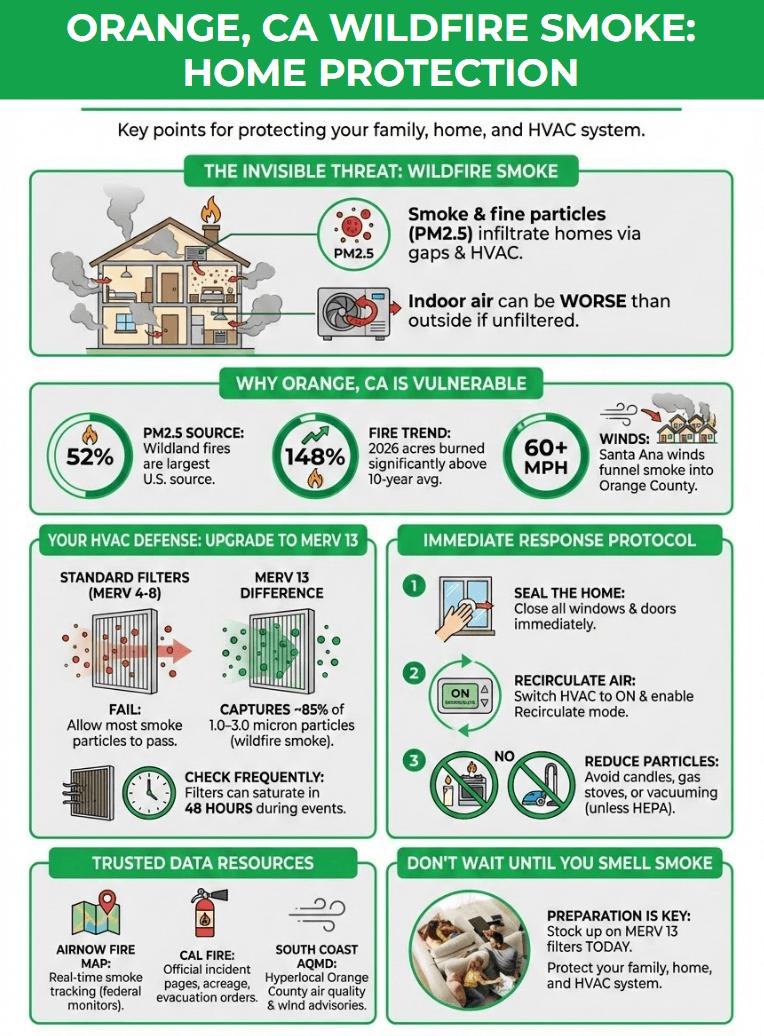
1. Close all windows and doors immediately. Every opening is a direct path for PM2.5 into your home.
2. Switch to recirculate mode and confirm the fresh air intake is closed. If your system doesn't have a recirculate option, keep it running with the fan set to ON. Continuous circulation through your MERV 13 filter is your primary defense.
3. Check the live map on this page. Zoom into Orange, CA on the AirNow Fire and Smoke Map for current PM2.5 readings. Remember — posted AQI runs approximately one hour behind actual conditions. If you can see or smell smoke, treat it as worse than the current number.
4. Check your filter every 24–48 hours. During active smoke, filters can saturate in as little as 48 hours. A clogged filter doesn't just stop filtering — it restricts airflow, strains your compressor, and can recirculate trapped particulate back into your home.
5. Monitor CAL FIRE and OCFA for incident updates. Even if the fire isn't in Orange County, smoke from fires 40+ miles away in LA County can funnel through the Santa Ana Canyon and push indoor air quality into unhealthy ranges.
6. Avoid adding to your indoor particulate load. During active smoke events, do not:
Burn candles or incense
Use gas stoves if avoidable
Vacuum without a HEPA filter
Use aerosol products or air fresheners
Every particle you generate indoors compounds what's already infiltrating from outside
7. Know when to leave. If any of the following apply, relocate to a Clean Air Center or a home with better air quality:
AQI exceeds 300 (Hazardous)
You can smell smoke inside despite a sealed home and running filtration
Anyone in your household has persistent respiratory symptoms
Know your nearest Clean Air Center location before you need it
Frequently Asked Questions
Q: Where can I find a real-time wildfire and smoke map for Orange, CA right now?
A: Best resource: AirNow Fire and Smoke Map — a joint EPA and U.S. Forest Service tool.
Three data layers in one interactive view:
Federal regulatory air monitors — 1,700+ stations tracking PM2.5 in real time
Crowd-sourced sensor networks — thousands of ground-level air quality sensors filling gaps between federal stations
Satellite-detected smoke plumes — showing active smoke movement and direction
Zoom into Orange, CA, for neighborhood-level AQI readings that update continuously.
For hyperlocal data: South Coast AQMD generates readings at 1,200+ locations across the South Coast Air Basin, including dozens throughout Orange County.
Important note from our experience: Posted AQI readings typically lag actual ground conditions by about one hour. If you can see haze or smell smoke, treat conditions as worse than the displayed number and take indoor air protection steps immediately.
Q: Can wildfire smoke from fires outside Orange County affect my air quality in Orange, CA?
A: Yes — and it happens more often than most residents realize.
Why Orange County is uniquely vulnerable:
The Santa Ana Canyon acts as a natural funnel, channeling hot, dry air and smoke plumes directly into Orange County from multiple directions
Santa Ana wind events produce gusts between 40–60+ mph, pushing smoke from fires 40+ miles away into residential areas
During the January 2025 Southern California wildfires, smoke advisories covered all of Orange County — even though primary fires were in Los Angeles County
What we've seen firsthand, servicing HVAC systems across this region:
Some of the worst indoor air quality in Orange County homes came from fires that weren't burning anywhere near the county
Smoke traveled through wind corridors, infiltrated homes through duct gaps and air returns, and saturated filters that homeowners assumed were fine
Recommended monitoring:
AirNow Fire and Smoke Map — for real-time local air quality
CAL FIRE incidents page — track fires in LA County and the Santa Ana Mountains, not just your own neighborhood
Q: How does wildfire smoke get inside my home, and what does it do to my HVAC system?
A: Smoke entry points:
Fresh air intakes — pulls smoky outdoor air directly into ductwork if set to bring in outside air
Ductwork gaps — joints, connections, and unsealed penetrations allow unfiltered air to bypass your filter
Windows, doors, and cracks — even closed, small gaps around frames let fine particulate infiltrate
Return air leaks — gaps around the air handler cabinet pull air from attics, crawl spaces, and wall cavities
What smoke does to your HVAC system:
Standard MERV 4–8 filters allow the majority of PM2.5 particles (the primary health threat in wildfire smoke) to pass straight through
Even MERV 13 filters face rapid saturation during active smoke events
We've pulled brand-new filters that turned completely black within 48 hours of a major smoke event in Orange County homes
Risks of a saturated filter:
Restricts airflow — forces your compressor to work harder
Causes evaporator coil icing — can lead to expensive repairs
Recirculates trapped particulate — indoor air can actually test worse than outdoor air
Q: What air filter should I use during wildfire smoke events in Orange, CA?
A: EPA recommendation: MERV 13 — captures approximately 85% of particles in the 1.0–3.0 micron range.
MERV 13 is the highest rating most standard residential HVAC systems can handle without excessive airflow restriction.
Filter change schedule during active smoke events:
Check your filter every 24–48 hours when smoke is visible, or AQI exceeds 100
Replace immediately if the filter is visibly discolored, gray, orif you can't see light through the media
Stock 2–3 replacement MERV 13 filters before fire season — supply chains for popular sizes tighten during major events
Key insight from manufacturing millions of air filters:
The biggest mistake homeowners make is assuming a standard 90-day replacement cycle applies during smoke conditions. It doesn't. During the worst smoke events we've serviced across Orange County, filters installed that same week needed replacement within days. Having the right filter in your system before smoke arrives — and having replacements ready — is one of the most impactful steps you can take for your family's indoor air.
Q: What should I do right now to protect my family's indoor air from wildfire smoke in Orange, CA?
A: If smoke is active right now:
Close all windows and doors immediately
Switch HVAC to recirculate mode — confirm the fresh air intake is closed
Set thermostat fan to ON (not AUTO) for continuous filtration
Check the AirNow Fire and Smoke Map — zoom into Orange, CA for current PM2.5 readings
Inspect your filter — replace if discolored or in use more than 48 hours during heavy smoke
Avoid adding indoor particles:
No candles or gas stove use
No vacuuming without a HEPA filter
No aerosol products
If you're preparing before fire season:
Upgrade to a MERV 13 filter and stock 2–3 replacements
Locate your fresh air intake and learn how to switch to recirculate mode
Have ductwork inspected for gaps and leaks at joints, connections, and the air handler cabinet
Download the CARB Smoke Spotter app and identify your nearest Clean Air Center
Follow OCFA and NWS Los Angeles on social media for the earliest local alerts
Bookmark this page for instant access to live tracking and trusted resources
Bottom line from years of servicing Orange County homes during wildfire seasons:
Families who take 20 minutes to prepare before smoke arrives breathe clean air during the event. Families who react after smoke is already in their ductwork face dramatically worse outcomes — regardless of how expensive their equipment is.
Now That You're Tracking Wildfire Smoke in Orange, CA — Make Sure Your Home's Air Is Protected Too
The map shows you what's happening outside, but your HVAC filter determines what your family actually breathes inside. Find your exact filter size and get MERV 13 protection shipped free to your door before the next smoke event hits Orange County.