The moment a wildfire starts near you, you'll get an instant alert and simple tips to reduce your smoke exposure.
30xSmaller than a human hair
Fine enough to reach deep into the lungs. A MERV 13 is built to capture it.
It Doesn't Stay Local
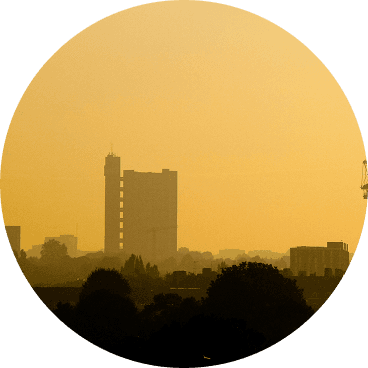
Smoke rides the wind far downwind — you can get smoky air with no fire nearby.
Simple steps to reduce indoor exposure.
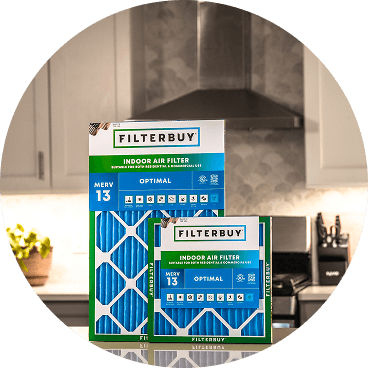
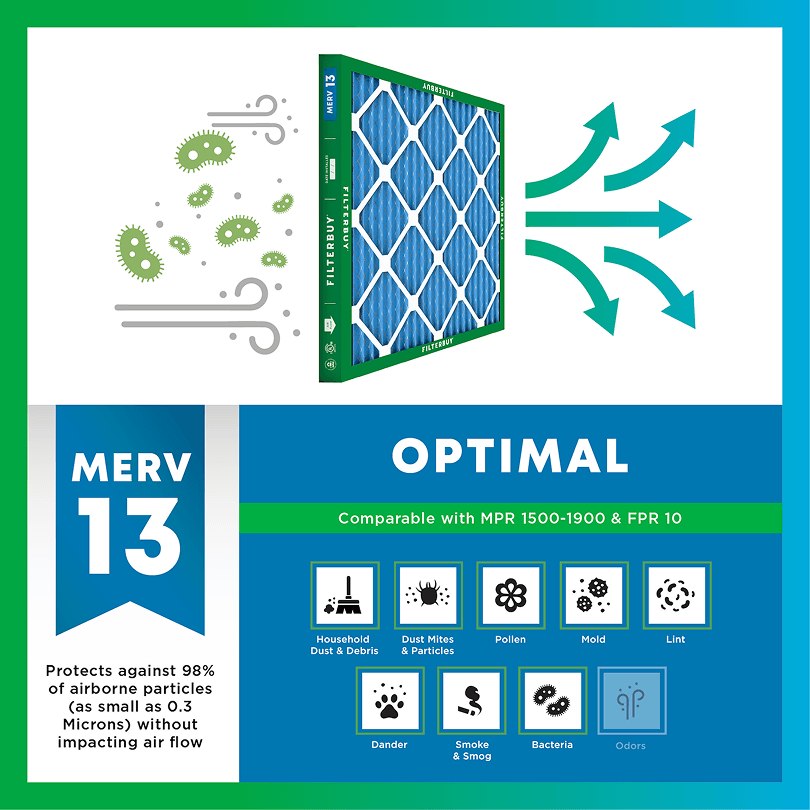
During smoke events, the EPA recommends upgrading to a MERV 13 filter — or the highest-rated filter your system can handle — to help reduce the fine particles smoke brings indoors. MERV 13 is the level most home HVAC systems can run while still capturing PM2.5, the fine particulate that makes up the bulk of wildfire smoke.
Over 70,000 wildfires burn in the U.S. every year.
Wildfire smoke can travel 1,000+ miles, affecting states that aren't even near the blaze.
Exposure to wildfire smoke can worsen asthma, trigger heart issues, and lead to ER visits.
Indoor air can hold more fine particles during wildfire events unless it's properly filtered.
The EPA advises using MERV 13 filters or portable HEPA air cleaners during wildfire smoke events.
Use the live wildfire smoke tracker and upgrade your air filters today to protect your lungs and your home.
Shop Filters For Smoke Protection
By Michelle Wan, Brand Manager & Air Quality Writer
Reviewed By: David Clark, Licensed HVAC Technician
Published: August 16, 2026 | Updated: August 16, 2026
The live map below shows fire detections, smoke plumes, and PM2.5 for Madison County, refreshed hourly from EPA AirNow and the Alabama Wildfire Map. In Huntsville, the flame icons are usually the wrong thing to watch, because Madison County rarely sees a large wildfire. Most smoke here arrives from brush fires, prescribed burns, or Canadian smoke carried south, so the PM2.5 dots matter more. Above AQI 100, close the windows, set the fan to ON, and run a Filterbuy MERV 13 filter.
Huntsville runs its own air pollution control program through the City Department of Natural Resources, not the state. ADEM covers the rest of the state.
Alabama's fire seasons are spring and fall rather than summer, because they track dryness, not heat. October is the driest month, and the AFC issues Fire Danger Advisories when conditions favor spread.
You can have smoky air with zero fires on the map. That is the common summer case.
The EPA recommends MERV 13 or higher during smoky periods, and notes most home systems handle it if the filter is changed often.
Smoke loads a filter far faster than dust. Inspect it every two weeks while smoke lasts, not on the calendar.
Most smoke guidance assumes a fire you can point to, which is the wrong model for Madison County. Here the flame icons stay empty while particle counts climb, and homeowners cannot work out why the house smells like a campfire.
Filterbuy has built filters in Talladega, Alabama, two hours south of Huntsville, since 2013, so this is the air our own employees drive home into. For conditions beyond Madison County, see our Alabama air quality map and the USA live AQI map.
The map carries three signals. Colored dots report PM2.5 from permanent and low-cost sensors, gray polygons mark where satellites see smoke overhead, and flame icons show active fires. Smoke overhead does not mean smoke at ground level, so trust the nearest dot over the shading.
Dot colors follow the national Air Quality Index scale, the same as in Sacramento, and AirNow explains how to use it during a smoke event.
Color bands follow the U.S. EPA Air Quality Index. Live Huntsville readings update hourly on the map above.
A gray polygon over a green dot is the classic North Alabama pattern: smoke passing high above the Tennessee Valley, giving vivid sunsets and no measurable air quality hit.
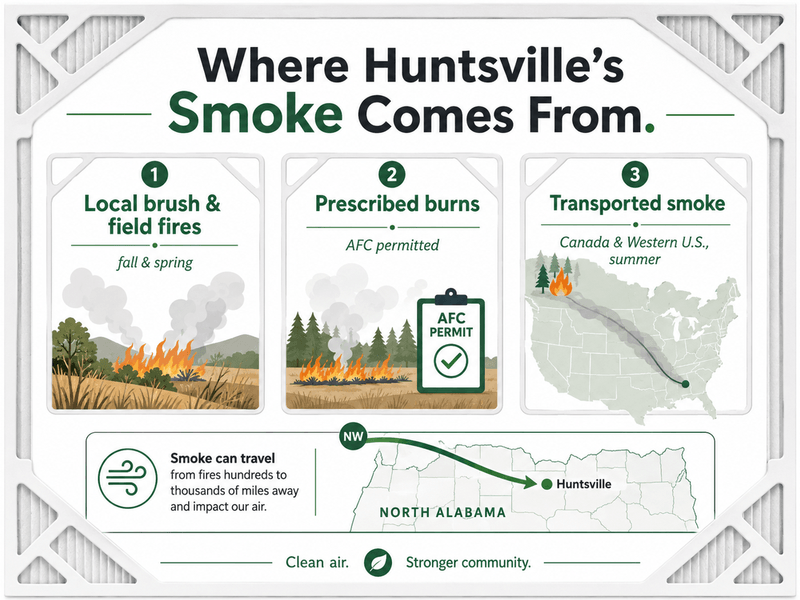
Smoke reaches Huntsville from three directions, and almost none of it is the forest wildfire the phrase implies. Local brush and field fires burn through Alabama's dry seasons, prescribed burns run on permit, and smoke drifts in from fires thousands of miles away.
Local brush and field fires (fall and spring). Alabama burns in two seasons, and both track low humidity, not heat. The AFC has issued advisories for Madison, Limestone, and Jackson counties during dry autumn spells. These fires stay small by Western standards, but they burn close to home, which is what puts their smoke in your air handler.
Transported smoke (summer). June 2025 is the template. North Alabama spent a week with degraded air and nothing visibly burning nearby, and the PM2.5 numbers still climbed.
The index hides something else worth knowing. An AQI of 130 is not one kind of day: from summer ozone it is a rough afternoon that clears by sunset, while from transported smoke it is a rough week. That distinction is why Filterbuy treats Huntsville smoke as a filter problem, not a scheduling problem: you cannot move practice to the morning and wait it out, and the clean filter Monday is loaded by Thursday.
I pull air quality readings for Huntsville most mornings, and the question from North Alabama is seldom 'where is the fire.' It's 'why does my house smell like smoke when nothing near me is burning.' That is the tell. Down here the fire is usually somebody else's, and the only part of it you control is what your HVAC system does with the air once it's inside.
Michelle Wan, Brand Manager & Air Quality Writer, Filterbuy
Trust your nose over the dot. A green map above a smoky house usually means the source is local and small, and three things keep it invisible. Alabama requires a burn permit only for fires over a quarter acre or within 25 feet of woods or grass, so a neighbor's brush pile burns legally without appearing anywhere. AQI dots report monitors rather than your street, and satellites see plumes rather than backyards.
Close the windows and set the fan to ON anyway. The map is regional; your nose is local, and the response is the same either way.
If you can see flame or an unattended fire, report it. AFC dispatch takes reports at 800-392-5679, the same free line that issues burn permits.
If the smell lasts for days rather than an afternoon, the source is probably not local. Transported smoke settles in across a region, and the monitors register it soon enough.
The permit system is why this map can tell a controlled burn from a wildfire. Alabama law requires a free permit before burning woodland, grass, or field over a quarter acre, so the state knows which fires are intentional. The restriction stage in force also tells you what smoke to expect, and the four stages are not interchangeable.
Source: Alabama Forestry Commission burn restrictions. Report a wildfire or request a free burn permit at 800-392-5679.
Fire Alert is the stage worth watching, because the State Forester can declare one specifically when smoke is degrading air quality. That makes it the closest thing Alabama has to an official signal that the air itself has become the problem.
Air quality inside city limits is regulated by the City of Huntsville Department of Natural Resources rather than the state, and the city publishes its own annual Air Quality Report. ADEM covers the rest of Alabama apart from Jefferson County. That split surprised us when we first went looking for an official Huntsville number, and it still trips up most pages about the city's air.
For live PM2.5, the EPA AirNow Fire and Smoke Map blends regulatory monitors with crowdsourced PurpleAir sensors, while the American Lung Association grades Madison County year over year.
The EPA recommends upgrading to a MERV 13 or higher HVAC filter during smoky periods, and notes most furnaces handle MERV 13 provided the filter is replaced often. It is the practical ceiling for most residential systems.
The U.S. EPA recommends MERV 13 or higher during smoky periods. Confirm your system can handle the added airflow resistance before upgrading.
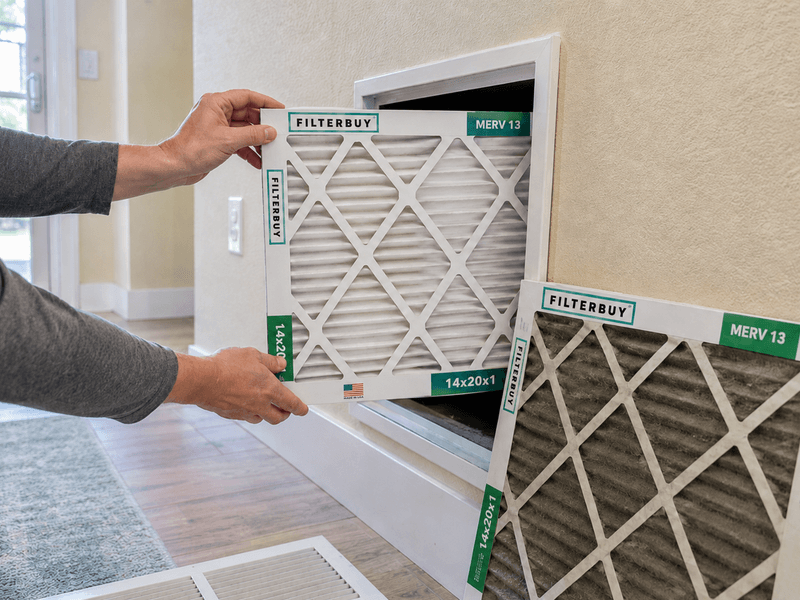
A decade of shipping filters into Alabama homes taught us where that advice goes wrong, so we asked our reviewing technician to put the caveat plainly.
If you are unsure what your system handles, our guide to MERV ratings covers it. Filterbuy builds MERV 8, MERV 11, and MERV 13 pleated filters in Talladega in 600+ standard sizes plus custom sizes, shipped factory-direct.
Every fire season we see homeowners jump to the highest MERV number they can find. On an older Huntsville furnace with a PSC blower motor, that resistance makes the system work harder and move less air, so you get worse filtration, not better. MERV 13 is the right target for smoke, but only if your system can pull through it.
David Clark, Licensed HVAC Technician
387 wildfires burned nearly 16,000 acres of Alabama forestland in one month, prompting a statewide Fire Alert. Alabama Forestry Commission, April 2026
A high-efficiency HVAC filter may cut indoor PM2.5 by about 50% with the fan running, against about 24% with a low-efficiency one. U.S. EPA, Strategies to Reduce Exposure Indoors
Canadian smoke held North Alabama air quality at moderate levels for a week in June 2025, with no fire near Madison County. FOX54 / Rocket City Now, June 2025
Check the live map above, where detections within 100 miles appear as flame icons drawn from satellites and the AFC Wildfire Map. Large forest wildfires are uncommon in Madison County, so most are brush fires or permitted burns.
Yes. Keep it running with the fan set to ON so indoor air passes through a Filterbuy MERV 13 filter, and keep the windows closed.
Not entirely. MERV 13 captures the fine particles in smoke, but the smell comes from gases that pass straight through pleated media. An Odor Eliminator carbon filter handles that side, so heavy smoke usually calls for both.
Inspect it every two weeks while smoke is around, and replace it once it looks dark rather than waiting for the usual interval.
Smoke season does not send a warning, so the filter you want is already in the system before the haze arrives. Check today's reading on the Huntsville live AQI map, then find your filter size and shop MERV 13 filters built in Alabama and shipped factory-direct. You can also set up auto-delivery so a fresh filter arrives on schedule, and during a Madison County smoke stretch, that schedule tightens.
AQI (Air Quality Index): The EPA's 0-500 scale for daily air quality, in six color categories from Good to Hazardous.
PM2.5: Fine particles 2.5 micrometers or smaller, the main health hazard in smoke.
MERV: Minimum Efficiency Reporting Value, the 1-20 scale of how well a filter captures particles.
Fire Alert: An Alabama Forestry Commission stage limiting burn permits, triggered when smoke degrades air quality.
Subscribe to wildfire smoke alerts for Huntsville, AL, to get a heads-up before the next event reaches your area.