
Tip: Ensure you buy the exact air filter size for your system. Certain brands have precise dimensions that only fit their specific models. See related filters
Actual Size: 19.63x19.88x4.38"
 Free Delivery
  Factory-Direct Low Prices, Made in the USA
 Hassle-Free Returns & Free Exchanges
RESIDENTIAL AND/OR COMMERCIAL USE
Change Every 3 Months
Tip: Ensure you buy the exact air filter size for your system. Certain brands have precise dimensions that only fit their specific models. See related filters
Actual Size: 19.63x19.88x4.38"
Free Delivery Factory-Direct Low Prices, Made in the USAHassle-Free Returns & Free ExchangesRESIDENTIAL AND/OR COMMERCIAL USE
Change Every 3 Months
Tip: Ensure you buy the exact air filter size for your system. Certain brands have precise dimensions that only fit their specific models. See related filters
Actual Size: 19.63x19.88x4.38"
Free Delivery Factory-Direct Low Prices, Made in the USAHassle-Free Returns & Free ExchangesRESIDENTIAL AND/OR COMMERCIAL USE
Change Every 3 Months
At Filterbuy, we don't cut corners—we craft high-quality air filters right here in the USA and ship them to your doorstep for free. No delays, no gimmicks—just clean air, made easy. With thousands of five-star reviews and filters built for real life & every HVAC system, it's no wonder why over 4 million families trust Filterbuy.

Proudly Made In The USA

Fast, Free Shipping on Every Order

Premium Materials That Go The Distance

85,000+ 5-Star Reviews From Happy Customers

Save Up to 70% Per Filter with Packs


Measure length × width × depth with a tape measure to find the actual size.

Round up each dimension to the nearest whole number to get the nominal size. Example: 19.63x19.88x4.38" in → 20X20X5 nominal.

Search by nominal size on our site for the best fit.


5″ filters give you maximum filtration with minimal maintenance — lasting up to 12 months while handling higher MERV ratings without restricting airflow.
Sizing note:

If the filter you buy doesn't fit, we'll send you a better size.
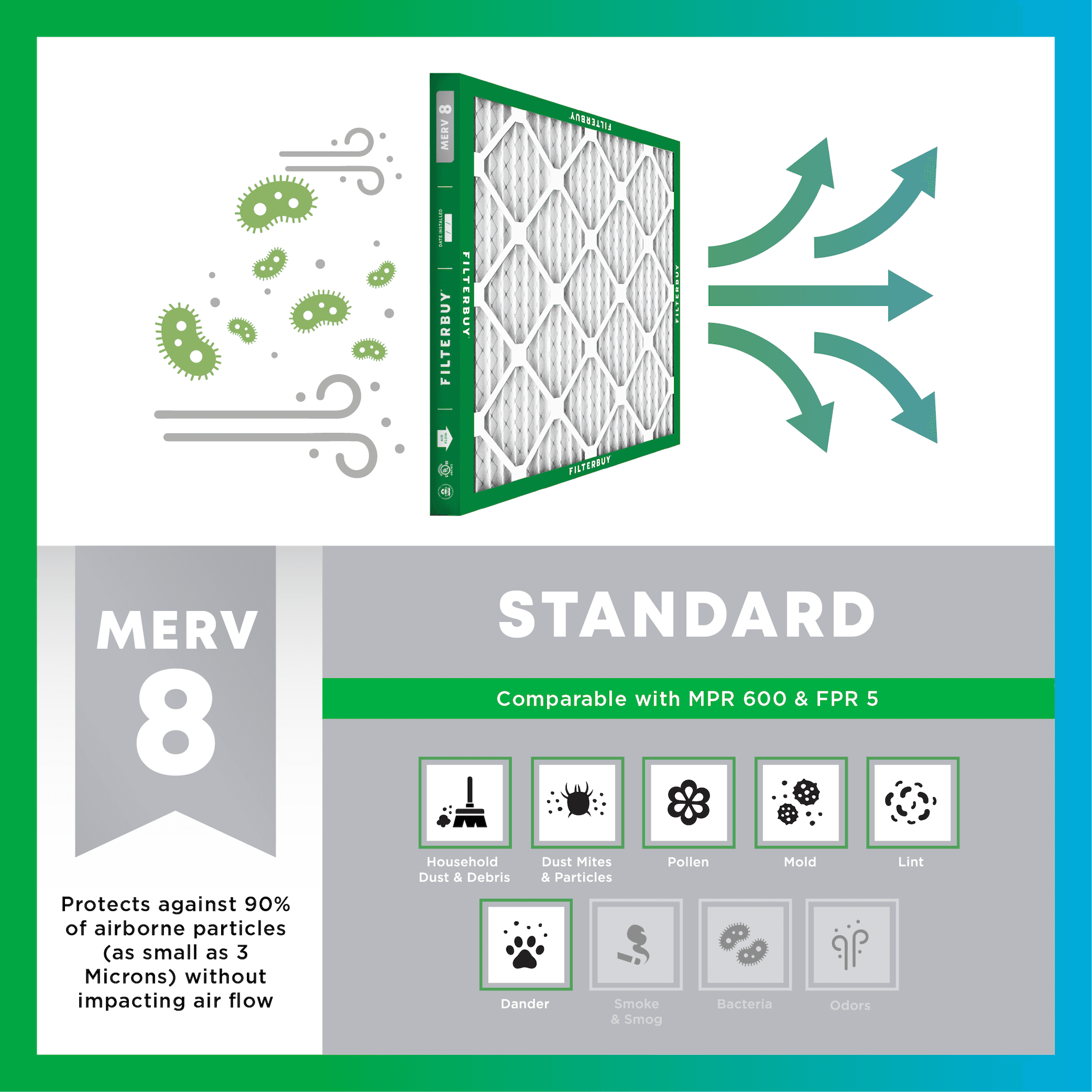
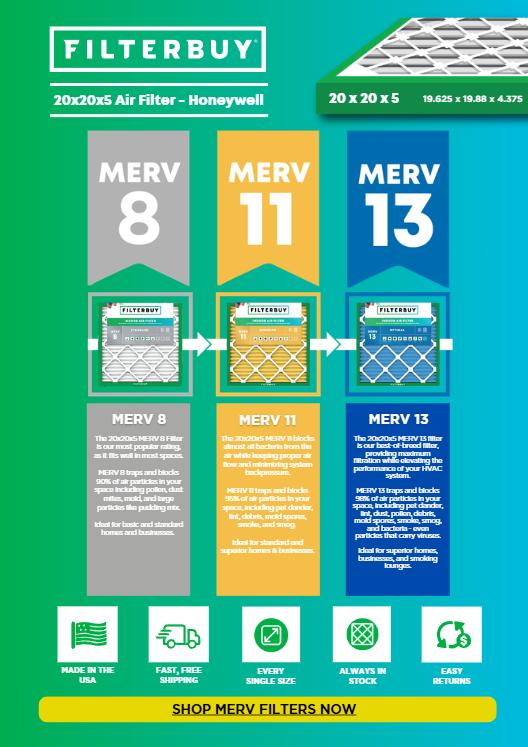
MERV stands for Minimum Efficiency Reporting Value—but don't let the technical name fool you. It's just a way to rate how well an air filter traps stuff like dust, pollen, pet dander, and smoke. The higher the MERV number, the more particles it catches—and the cleaner your air will be.

Comparable to:FPR: 4-7
MPR: 600-1000
 Dust & Debris
 Dust Mites & Particles
 Pollen
 Mold
Mold Lint
Lint Dander
Comparable to:FPR: 6-9
MPR: 1200-1550
Dust & DebrisDust Mites & ParticlesPollenMoldLintDander Smoke & Smog
Comparable to:FPR: 10
MPR: 1900-2800
Dust & DebrisDust Mites & ParticlesPollenMoldLintDanderSmoke & Smog Bacteria


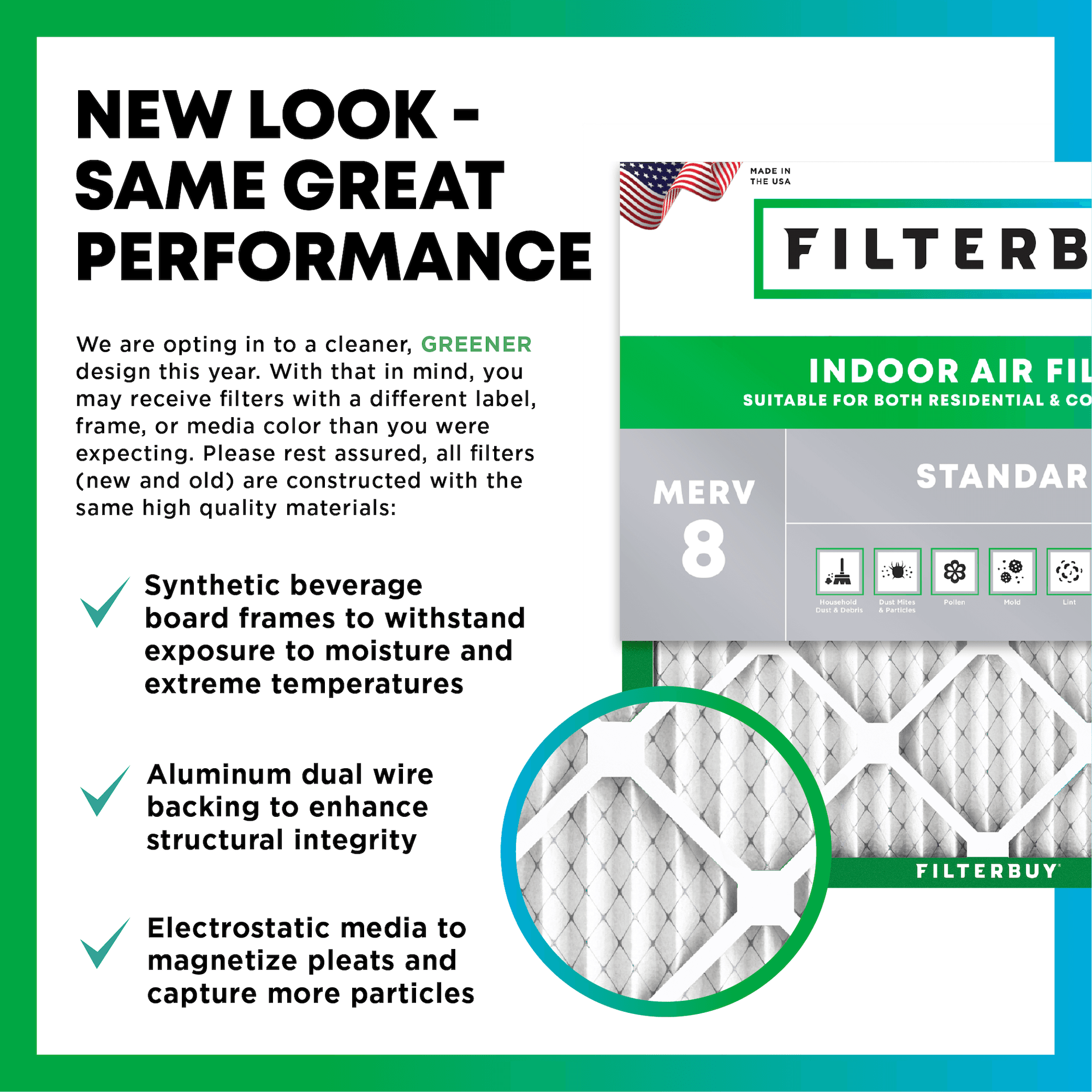
We build every Filterbuy filter to deliver reliable 90-day performance—thanks to smart design and premium materials that do the heavy lifting. Here's what makes the difference:
More pleats = more surface area to capture dust and debris, keeping your air cleaner longer.
Pleats are magnetized to attract and trap microscopic particles—like pet dander, pollen, and smoke.
Engineered to resist warping in extreme temperatures and high humidity.

A layer of metal reinforcement keeps pleats evenly spaced and structurally sound—no sagging, even at high airflow.
Assembled with care. Built to perform. Ships fast, free, and reliably from our U.S. facilities.

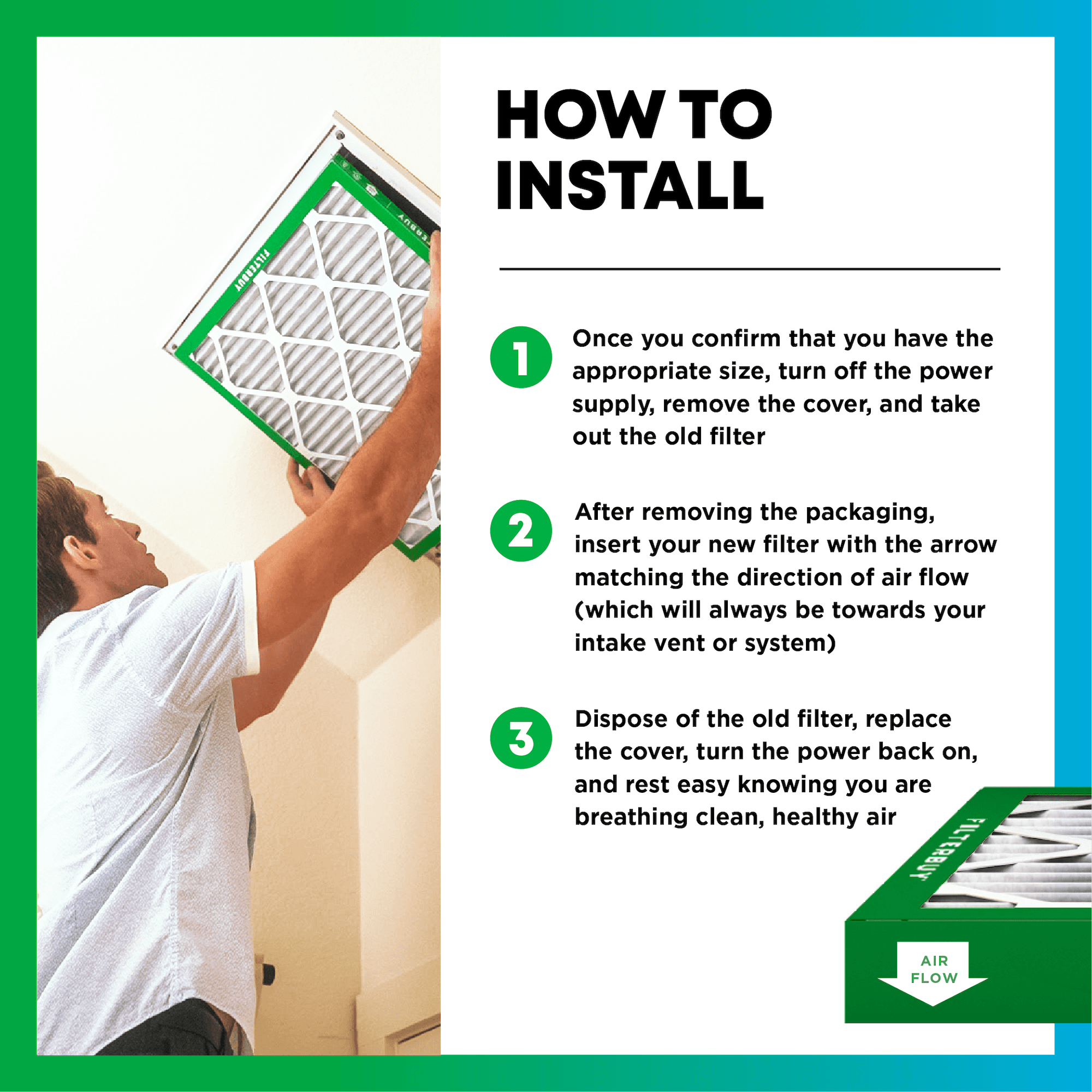
Turn Off Your HVAC SystemSafety first.

Remove The Old FilterLook for the airflow arrow and make note of the direction.

Slide In Your New FilterArrow should point toward the system (same direction as before).

Turn Your System Back OnAnd enjoy the fresh, clean air.

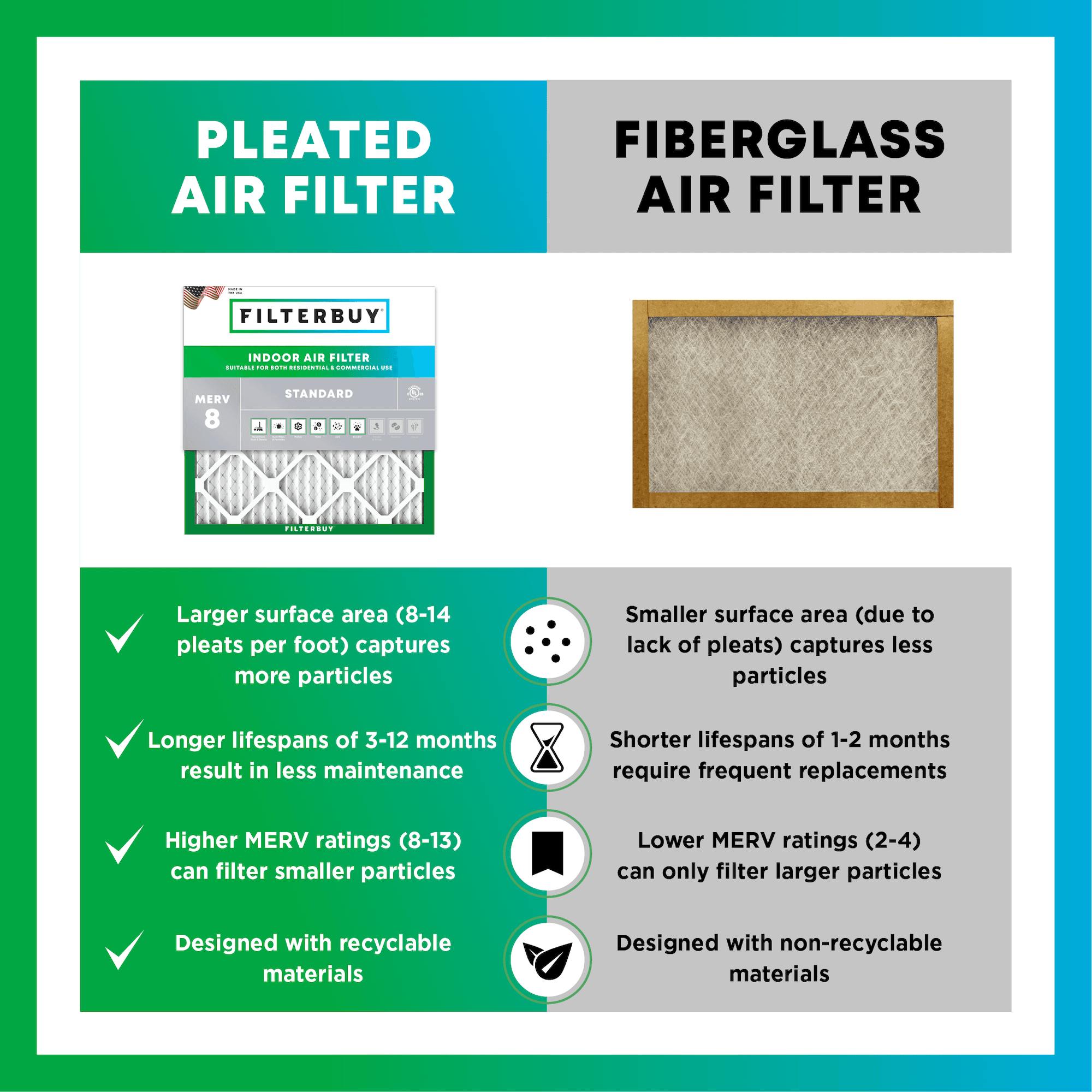
Not all air filters are created equal. Pleated filters don't just last longer—they actually clean your air better. Here's how they stack up:

Efficiency:
High (MERV 8–13) – Traps more particles
Lifespan:
90 days – Long-lasting performance
Air Quality:
Excellent – Cleaner, healthier air
Materials:
Recyclable and durable

Efficiency:
Low (MERV 4 or less) – Misses small stuff
Lifespan:
30 days or less – Replace often
Air Quality:
Minimal – Basic protection only
Materials:
Thin, flimsy, and not recyclable
Pleated filters are a no-brainer—more protection, less hassle, and better air for your home.
Changing your filter on time keeps your HVAC system running efficiently—and helps protect your lungs from dust, allergens, and airborne irritants. Here's how often to swap it out based on your needs:

For most homes without pets or special air quality concerns. Great for general upkeep and energy efficiency.

Shedding fur, dander, and allergy triggers can build up fast. Changing your filter every two months helps keep the air fresher and symptoms at bay.

For households affected by smoke, pollution, or respiratory conditions, monthly changes ensure maximum protection.

| Nominal Size | 20X20X5 |
| Actual Size | 19.63 x 19.88 x 4.38" inches |
| Filter Type | Pleated |
| Media | Electrostatically Charged |
| Frame | Beverage Board |
| MERV Ratings Available | 8, 11, 13 |
| Lifespan | Up to 12 Months |
| Origin | Made in USA |
Your MERV 8 20x20x5 Honeywell filter should deliver 9–12 months of peak performance. Most fail early due to three preventable mistakes.
After manufacturing millions of 20x20x5 replacement filters, we've tracked the patterns. Customers tell us the same story: unexpected airflow drops, rising energy costs, and systems working harder than necessary. The culprit is almost always skipped maintenance—not a defective filter.
This guide shares the exact inspection routine and maintenance steps our team recommends. You'll extend filter life, protect your HVAC system, and know precisely when replacement is actually needed.
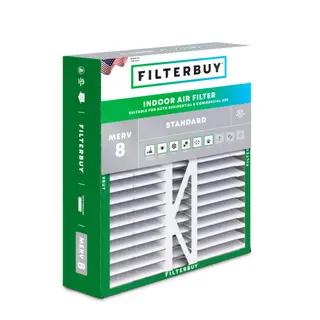
A MERV 8 20x20x5 filter is a 5-inch deep pleated air filter designed for Honeywell whole-home media air cleaners. It captures dust, pollen, mold spores, and pet dander in the 3–10 micron range.
Key specifications:
Nominal size: 20" x 20" x 5"
Actual size: 19.75" x 19.88" x 4.38"
Filtration: MERV 8 (3–10 micron particles)
Lifespan: 6–12 months depending on conditions
What we've learned after manufacturing millions:
Rated lifespan assumes ideal conditions most homes don't meet
Monthly inspection outperforms calendar-based replacement
MERV 8 balances filtration and airflow for typical households
Compatible systems:
Honeywell F100 series
Honeywell F200 series
FC100A1011 filter housing
Bottom line: MERV 8 handles standard residential filtration needs without restricting airflow or straining your HVAC system. Inspect monthly, replace based on condition, and ensure proper seating with no gaps around edges.
Inspect monthly. The 12-month rating assumes ideal conditions. Most homes don't qualify.
Replace based on condition, not calendar. Dark at 6 months means it worked. "Looks fine" at 11 months may be costing you $30/month in energy.
Your environment sets the real lifespan. Pets, household size, and HVAC runtime all accelerate loading. Track 2–3 cycles to learn your pattern.
Never clean synthetic media. Vacuuming damages fiber structure permanently. Replace—don't restore.
A clogged filter costs more than a new one. Dirty filters increase energy use 5–15% and strain your blower motor. The $25 filter protects a system worth thousands.
A MERV 8 20x20x5 Honeywell filter is designed to capture common household airborne particles like dust, pollen, mold spores, and pet dander. However, even a well-built filter loses efficiency when maintenance is neglected. After manufacturing millions of air filters, we can tell you that the most common reason homeowners experience poor indoor air quality isn't a bad filter — it's a forgotten one. Routine maintenance keeps your HVAC system running efficiently, extends equipment lifespan, and ensures your home's air stays clean between replacements.
The 20x20x5 size offers more surface area and a deeper pleat structure than standard one-inch filters, which means longer intervals between replacements. That said, a monthly visual inspection is still essential. Pull the filter out and hold it up to a light source. If little to no light passes through, airflow is restricted and it's time for a replacement. Homes with pets, allergy sufferers, or heavy foot traffic may see buildup faster than the typical six-to-twelve-month replacement window suggests. Customers tell us they're often surprised at how quickly a filter can load up during peak pollen season or after a home renovation project.
One of the most common mistakes homeowners make is attempting to vacuum or wash a disposable MERV 8 filter. These filters use a layered synthetic media engineered to trap particles within the depth of the material, not just on the surface. Washing or vacuuming can damage the media fibers, reduce particle capture efficiency, and even introduce moisture that promotes mold growth inside your ductwork. When the filter is spent, replace it with a fresh one — it's the only way to maintain the rated MERV 8 performance your system needs.
A filter can only do its job if air is actually passing through it rather than around it. When installing your 20x20x5 replacement filter, confirm that it sits snugly in the filter housing with no visible gaps along the edges. Even a quarter-inch gap allows unfiltered air to bypass the media entirely, sending dust and allergens straight into your living space and onto your system's coils. Check the airflow direction arrow printed on the filter frame and make sure it points toward the blower motor. A backwards filter restricts airflow and puts unnecessary strain on your system.
Your system will tell you when the filter needs attention if you know what to look for. Increased energy bills, uneven heating or cooling between rooms, excessive dust on furniture shortly after cleaning, and unusual sounds from the blower motor are all indicators of a restricted or failing filter. Addressing these signs promptly prevents costly repairs down the line. We've seen cases where a single neglected filter led to frozen evaporator coils and compressor damage — problems that cost hundreds of dollars to fix versus a simple filter swap.
The easiest way to stay on top of filter maintenance is to remove the guesswork entirely. Set a recurring calendar reminder for monthly inspections and note your preferred replacement schedule. Buying filters in multi-packs ensures you always have a replacement on hand when it's time. Consistent maintenance is the simplest, most cost-effective thing any homeowner can do to protect both indoor air quality and HVAC system longevity.
"After producing millions of 20x20x5 filters, we've learned that calendar-based replacement fails most homeowners—condition-based monitoring catches problems weeks earlier and prevents the HVAC strain we see reported constantly."
After helping customers select and maintain millions of 20x20x5 filters, we've identified the resources that answer the questions we hear most often. These government and independent sources complement what our manufacturing experience has taught us—and help you make confident decisions about your home's air quality.
EPA: What Is a MERV Rating? Customers frequently ask why we recommend MERV 8 for most households. This EPA guide explains exactly what the rating means and which particle sizes MERV 8 media captures effectively.
URL: https://www.epa.gov/indoor-air-quality-iaq/what-merv-rating
EPA: Care for Your Air – A Guide to Indoor Air Quality We manufacture filters to capture airborne contaminants—this EPA resource explains why that matters for your family's respiratory health and long-term wellbeing.
URL: https://www.epa.gov/indoor-air-quality-iaq/care-your-air-guide-indoor-air-quality
ASHRAE: Filtration and Disinfection FAQ Every filter we produce is tested against ASHRAE Standard 52.2. This resource from the engineers who developed MERV ratings explains the science behind filter performance claims.
URL: https://www.ashrae.org/technical-resources/filtration-and-disinfection-faq
U.S. Department of Energy: Air Conditioner Maintenance Customers tell us they notice higher energy bills before they notice reduced airflow. The DOE confirms what we see constantly—dirty filters can increase energy consumption by up to 15%.
URL: https://www.energy.gov/energysaver/air-conditioner-maintenance
ENERGY STAR: How to Keep Your HVAC System Working Efficiently The monthly inspection routine we recommend aligns with ENERGY STAR's official guidance. This resource reinforces why consistent filter checks protect both your system and your wallet.
URL: https://www.energystar.gov/products/ask-the-experts/how-keep-your-hvac-system-working-efficiently
Building America Solution Center: High-MERV Filters Not every HVAC system handles 5-inch filters the same way. This DOE technical guide helps you confirm your equipment can accommodate deep-pleat media without airflow restrictions.
URL: https://basc.pnnl.gov/resource-guides/high-merv-filters
Consumer Reports: Air Filter Buying Guide We're confident in our manufacturing quality—but independent verification matters. Consumer Reports tests filters for dust, pollen, and smoke removal so you can compare performance objectively.
URL: https://www.consumerreports.org/appliances/air-filters/buying-guide/
Government research validates what we see daily after manufacturing millions of MERV 8 filters. These numbers explain why the maintenance issues customers describe actually happen.
The EPA confirms Americans spend 90% of their time indoors—where pollutant concentrations run 2–5x higher than outdoor air.
What this means for your filter:
Every hour indoors, your filter is working
The "12-month lifespan" assumes average conditions
Most homes aren't average
Conditions that accelerate filter loading:
Pets (especially multiple dogs or cats)
Recent construction or renovation
Smokers in the household
High-traffic homes with frequent door openings
Customers frequently mention these factors when asking why their filter looks dirty at 6 months. The EPA data explains why.
Source: U.S. EPA – Indoor Air Quality
URL: https://www.epa.gov/report-environment/indoor-air-quality
The U.S. Department of Energy confirms: replacing a dirty filter can reduce AC energy consumption by 5–15%.
What we hear from customers:
Utility bills creep up gradually
Airflow problems aren't noticeable yet
The filter "looks okay" through the return grille
What's actually happening:
Restricted airflow forces longer system cycles
Energy consumption increases before comfort decreases
Monthly costs rise $15–$40 during peak cooling season
This is why we recommend monthly inspections—not just calendar-based replacement.
Source: U.S. DOE – Maintaining Your Air Conditioner
URL: https://www.energy.gov/energysaver/maintaining-your-air-conditioner
The American Lung Association reports 35+ million Americans live with chronic lung disease like asthma and COPD.
What MERV 8 filters capture that triggers symptoms:
Dust mites
Pet dander
Pollen
Mold spores
What customers with sensitive family members tell us:
They notice respiratory changes before seeing filter discoloration
Consistent maintenance directly impacts daily comfort
Monthly inspections aren't optional—they're essential
For these households, a "good enough" filter maintenance approach isn't good enough.
Source: American Lung Association – Our Impact
URL: https://www.lung.org/about-us/our-impact
Bottom line: Indoor air degrades faster than expected. Energy costs rise before airflow drops. Respiratory health depends on consistent filtration. Proper MERV 8 maintenance addresses all three.
A filterbuy MERV 8 20x20x5 Honeywell filter can deliver 9–12 months of performance. Whether you reach that lifespan depends on maintenance habits most homeowners overlook.
The fundamentals:
Inspect monthly, regardless of rated lifespan
Monitor environmental factors that accelerate loading
Replace based on condition, not calendar dates
Never clean or vacuum synthetic media
The 12-month rating is a ceiling, not a guarantee.
That lifespan assumes ideal conditions:
Minimal foot traffic
No pets
Moderate climate
Well-sealed ductwork
We estimate fewer than 20% of households meet those criteria. For everyone else, 6–9 months is realistic.
Condition-based replacement beats calendar-based replacement.
What we see from customers who inspect monthly:
Lower annual filter costs
Fewer emergency HVAC calls
Consistent energy bills
The filter that "looks fine" at month 11 may already be costing you $30/month in excess energy. The filter that looks dark at month 5 did its job—replace it and protect your system.
Your filter can't fix what your system creates.
Rapid clogging despite consistent replacement usually signals:
Ductwork leaks
Incorrect air filter sizing
Deferred HVAC maintenance
A quality MERV 8 captures what passes through it. It can't compensate for system issues.
You've got the knowledge. Here's exactly what to do—starting today.
Do this now:
Turn off your HVAC system
Remove your 20x20x5 filter
Examine the intake side under good lighting
What you see determines your action:
Light gray, even color → Reinstall, check in 30 days
Dark black patches → Replace within 2–4 weeks
Light visible through media → Replace immediately
Pick one method and stick with it:
Phone alert (recurring monthly)
Calendar event (first Saturday works well)
Subscription delivery (auto-shipments prompt inspection)
The method matters less than the habit.
Every home loads filters differently. Document yours:
Record:
Number of pets
Household size
Typical HVAC runtime
Nearby construction or renovations
After 2–3 cycles, you'll know:
Your actual filter lifespan
Which seasons accelerate loading
Warning signs specific to your home
Don't let shipping delays extend a dirty filter's life.
Keep 2–3 replacements on hand
Store near your HVAC unit
Reorder when down to one
Running out leads to "just one more week" decisions. Those weeks cost you.
Filter maintenance can't fix everything.
Schedule HVAC service if you notice:
Filters clogging in under 3 months repeatedly
Airflow issues persisting after replacement
Uneven heating or cooling across rooms
Filter not seating properly in housing
These symptoms indicate system problems beyond filtration.
We manufacture MERV 8 20x20x5 filters as direct Honeywell replacements.
What you get:
Exact-fit sizing (19.75" x 19.88" x 4.38")
Consistent MERV 8 filtration
Multi-pack discounts
Fast shipping
A: The box says 9–12 months. Reality is different for most homes.
What we've observed after manufacturing millions of filters:
Ideal conditions (no pets, low traffic, moderate climate) → 9–12 months
Typical conditions (pets, families, regular HVAC use) → 6–8 months
Challenging conditions (multiple pets, renovations, dusty area) → 4–6 months
Our recommendation:
Inspect monthly
Replace based on condition
Track 2–3 cycles to learn your home's actual pattern
A: Nominal size: 20" x 20" x 5" Actual size: 19.75" x 19.88" x 4.38"
This discrepancy confuses first-time buyers. It's standard practice—nominal sizing rounds up for easy identification.
What to do:
Match the nominal size on your current filter
Don't measure the housing and expect exact numbers
Our 20x20x5 filters fit Honeywell media air cleaners without gaps or forcing
A: MERV 8 captures particles in the 3–10 micron range.
What that includes:
Dust and dust mites
Pollen
Mold spores
Pet dander
Household lint
Should you upgrade to MERV 11 or 13?
For most households, no. Here's why:
MERV 8 handles typical residential needs
Higher ratings restrict airflow more
Systems not designed for high-MERV filters can struggle
Upgrade only if household members have severe allergies or respiratory conditions.
A: No. Synthetic MERV 8 media cannot be restored.
What happens when you try:
Vacuuming damages fiber structure
Washing destroys filtration efficiency
"Cleaned" filters clog faster than originals
Signs your filter needs replacement (not cleaning):
Dark, uneven discoloration
Visible light passing through media
Reduced airflow from vents
When capacity is reached, replace. There's no alternative.
A: Yes—if dimensions match and construction quality is adequate.
Compatible Honeywell systems:
F100 series media air cleaners
F200 series media air cleaners
FC100A1011 filter housing
After installation, verify:
Filter seats flush against housing
No visible gaps around edges
Airflow arrow points toward blower unit
Staying on top of filter maintenance starts with having the right replacement ready when you need it. Browse our full selection of MERV 8 20x20x5 Honeywell-compatible filters and enjoy free shipping on every order — because clean air shouldn't come with a hassle.

