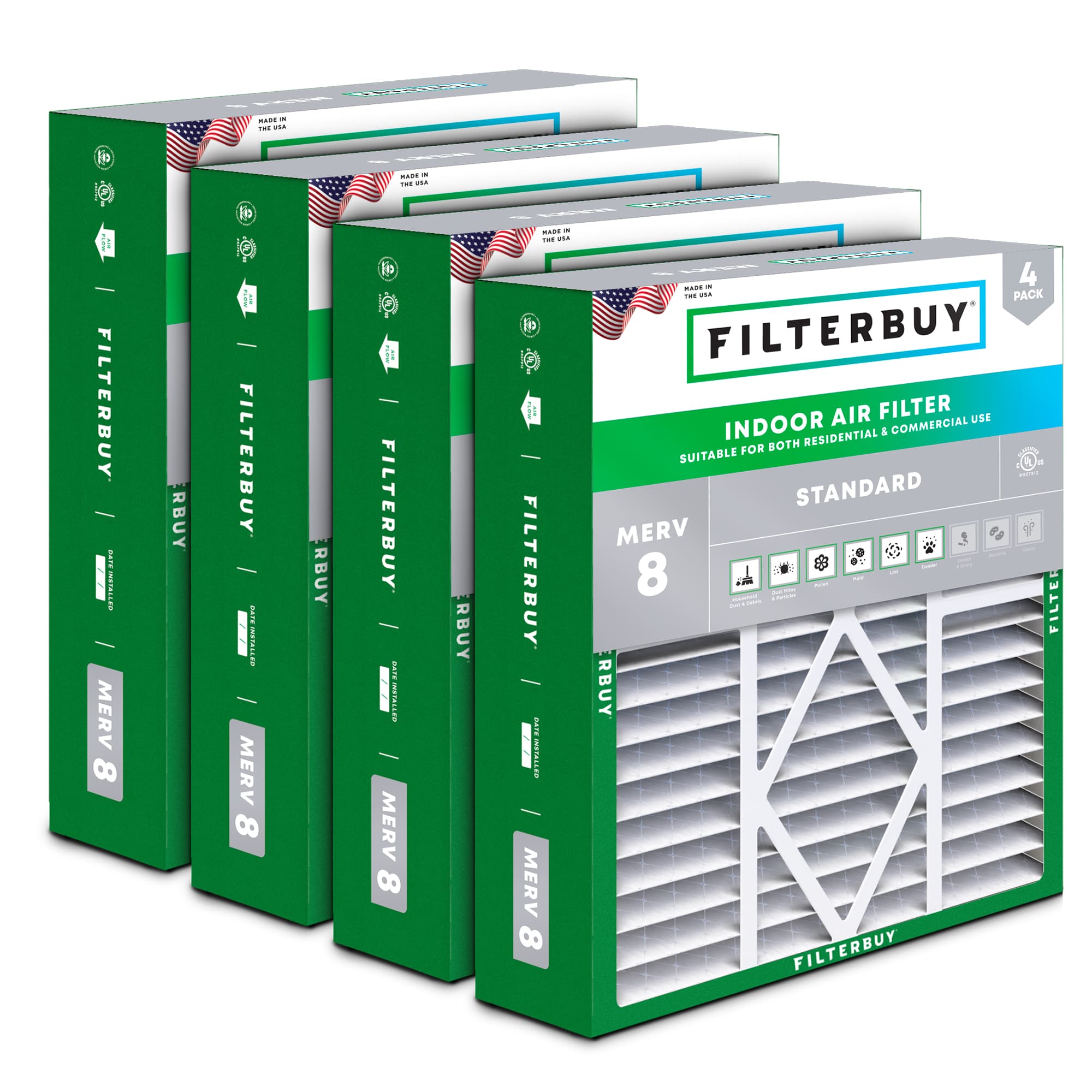
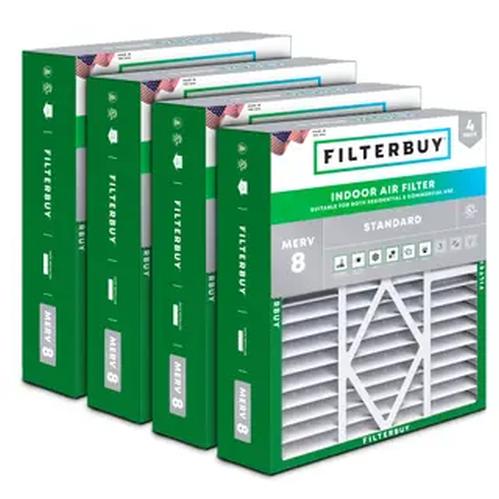
Tip: Ensure you buy the exact air filter size for your system. Certain brands have precise dimensions that only fit their specific models. See related filters
Actual Size: 20.25x20.75x5.25"
 Free Delivery
  Factory-Direct Low Prices, Made in the USA
 Hassle-Free Returns & Free Exchanges
RESIDENTIAL AND/OR COMMERCIAL USE
Change Every 3 Months
Tip: Ensure you buy the exact air filter size for your system. Certain brands have precise dimensions that only fit their specific models. See related filters
Actual Size: 20.25x20.75x5.25"
Free Delivery Factory-Direct Low Prices, Made in the USAHassle-Free Returns & Free ExchangesRESIDENTIAL AND/OR COMMERCIAL USE
Change Every 3 Months
Tip: Ensure you buy the exact air filter size for your system. Certain brands have precise dimensions that only fit their specific models. See related filters
Actual Size: 20.25x20.75x5.25"
Free Delivery Factory-Direct Low Prices, Made in the USAHassle-Free Returns & Free ExchangesRESIDENTIAL AND/OR COMMERCIAL USE
Change Every 3 Months
At Filterbuy, we don't cut corners—we craft high-quality air filters right here in the USA and ship them to your doorstep for free. No delays, no gimmicks—just clean air, made easy. With thousands of five-star reviews and filters built for real life & every HVAC system, it's no wonder why over 4 million families trust Filterbuy.

Proudly Made In The USA

Fast, Free Shipping on Every Order

Premium Materials That Go The Distance

85,000+ 5-Star Reviews From Happy Customers

Save Up to 70% Per Filter with Packs


Measure length × width × depth with a tape measure to find the actual size.

Round up each dimension to the nearest whole number to get the nominal size. Example: 20.25x20.75x5.25" in → 20X20X5 nominal.

Search by nominal size on our site for the best fit.


5″ filters give you maximum filtration with minimal maintenance — lasting up to 12 months while handling higher MERV ratings without restricting airflow.
Sizing note:

If the filter you buy doesn't fit, we'll send you a better size.
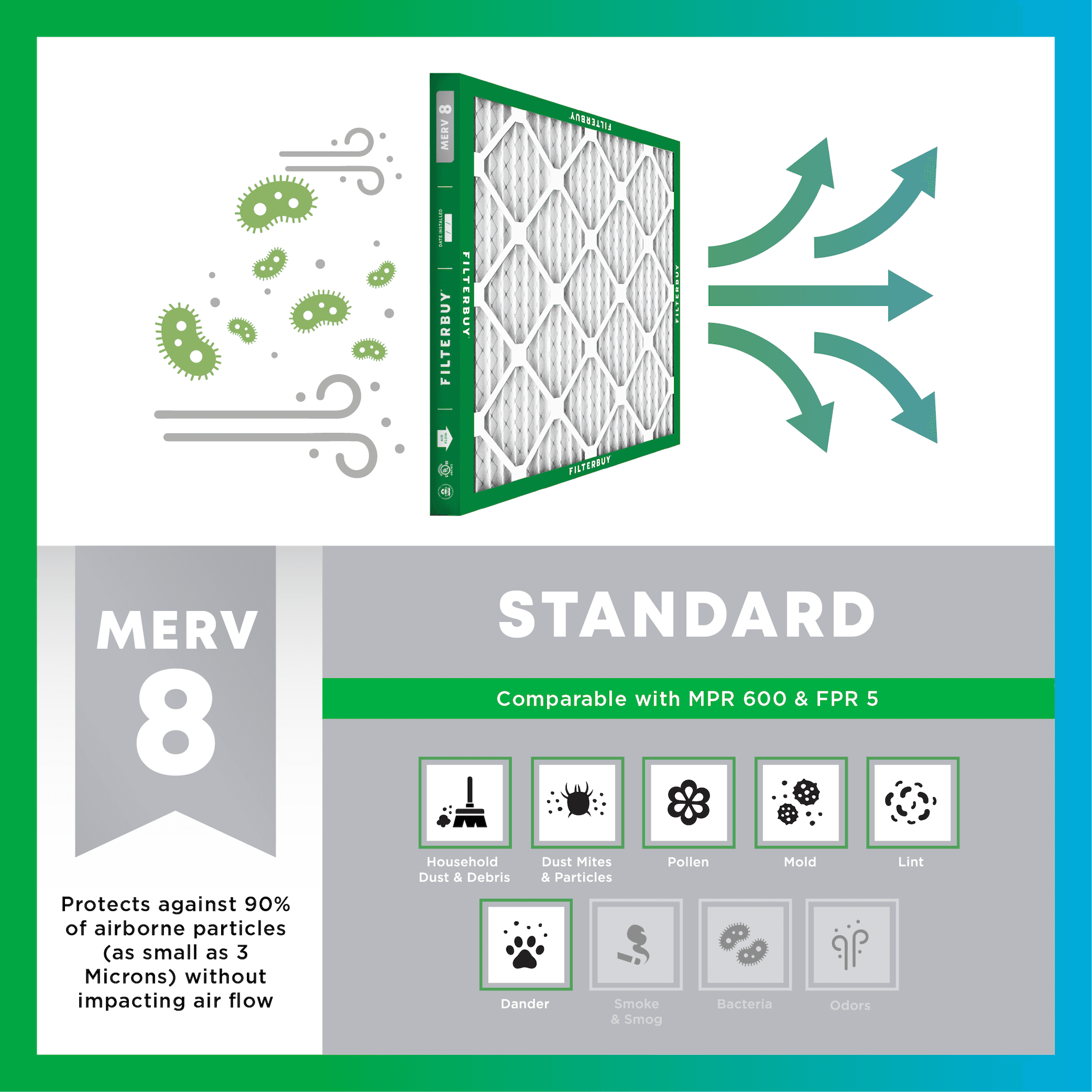
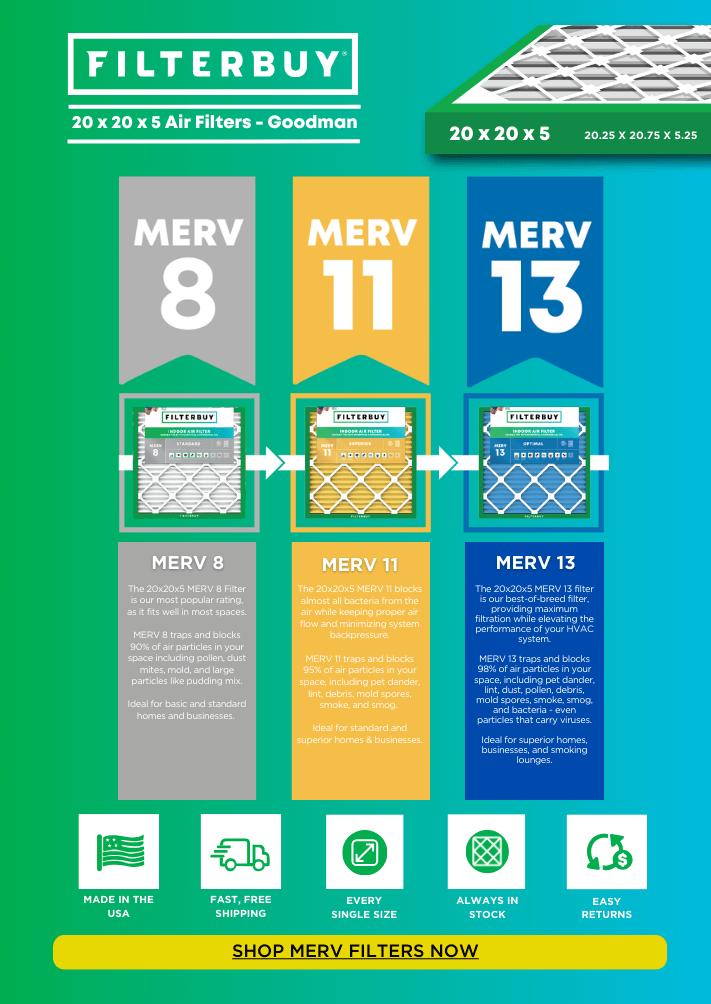
MERV stands for Minimum Efficiency Reporting Value—but don't let the technical name fool you. It's just a way to rate how well an air filter traps stuff like dust, pollen, pet dander, and smoke. The higher the MERV number, the more particles it catches—and the cleaner your air will be.

Comparable to:FPR: 4-7
MPR: 600-1000
 Dust & Debris
 Dust Mites & Particles
 Pollen
 Mold
Mold Lint
Lint Dander
Comparable to:FPR: 6-9
MPR: 1200-1550
Dust & DebrisDust Mites & ParticlesPollenMoldLintDander Smoke & Smog
Comparable to:FPR: 10
MPR: 1900-2800
Dust & DebrisDust Mites & ParticlesPollenMoldLintDanderSmoke & Smog Bacteria


We build every Filterbuy filter to deliver reliable 90-day performance—thanks to smart design and premium materials that do the heavy lifting. Here's what makes the difference:
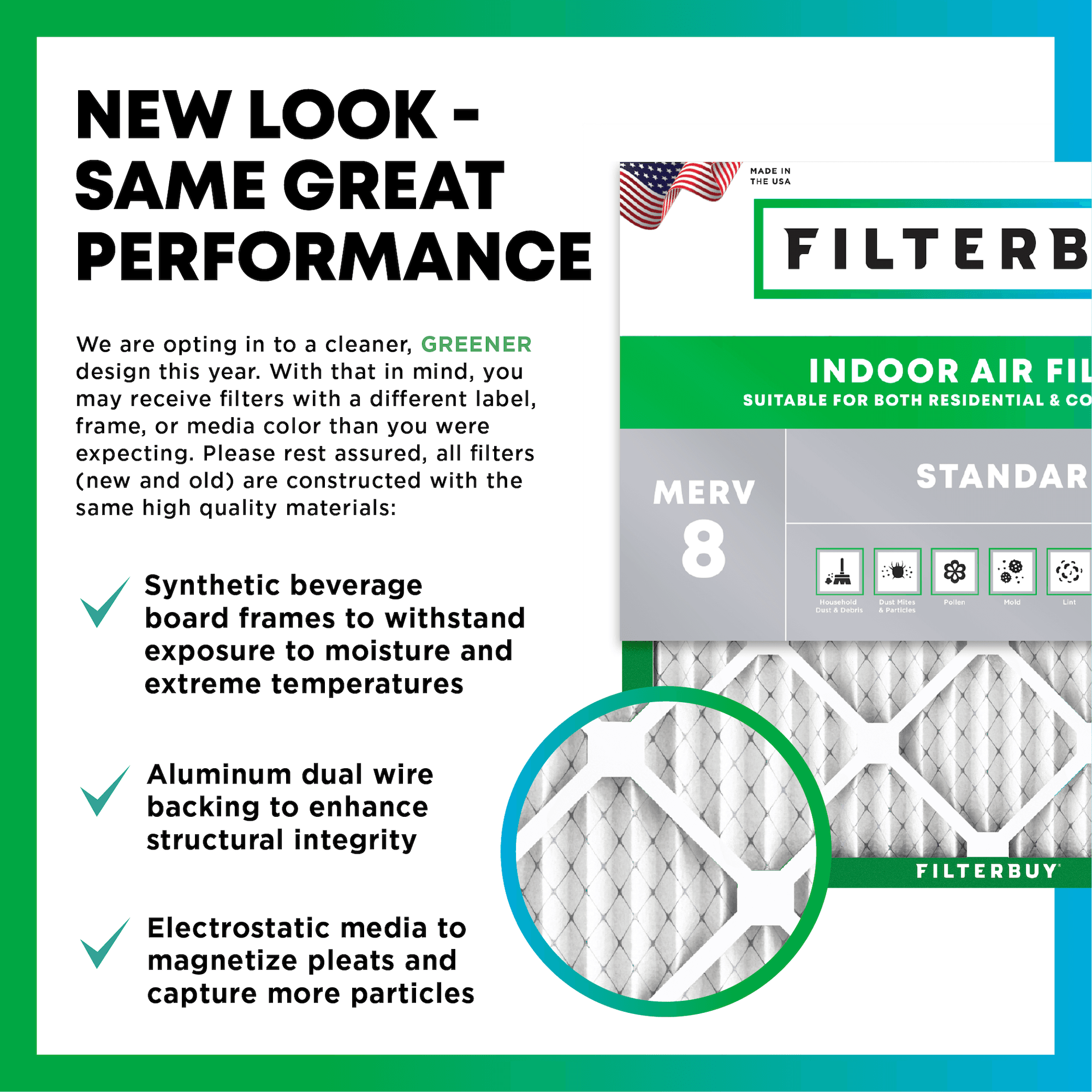
More pleats = more surface area to capture dust and debris, keeping your air cleaner longer.
Pleats are magnetized to attract and trap microscopic particles—like pet dander, pollen, and smoke.
Engineered to resist warping in extreme temperatures and high humidity.

A layer of metal reinforcement keeps pleats evenly spaced and structurally sound—no sagging, even at high airflow.
Assembled with care. Built to perform. Ships fast, free, and reliably from our U.S. facilities.

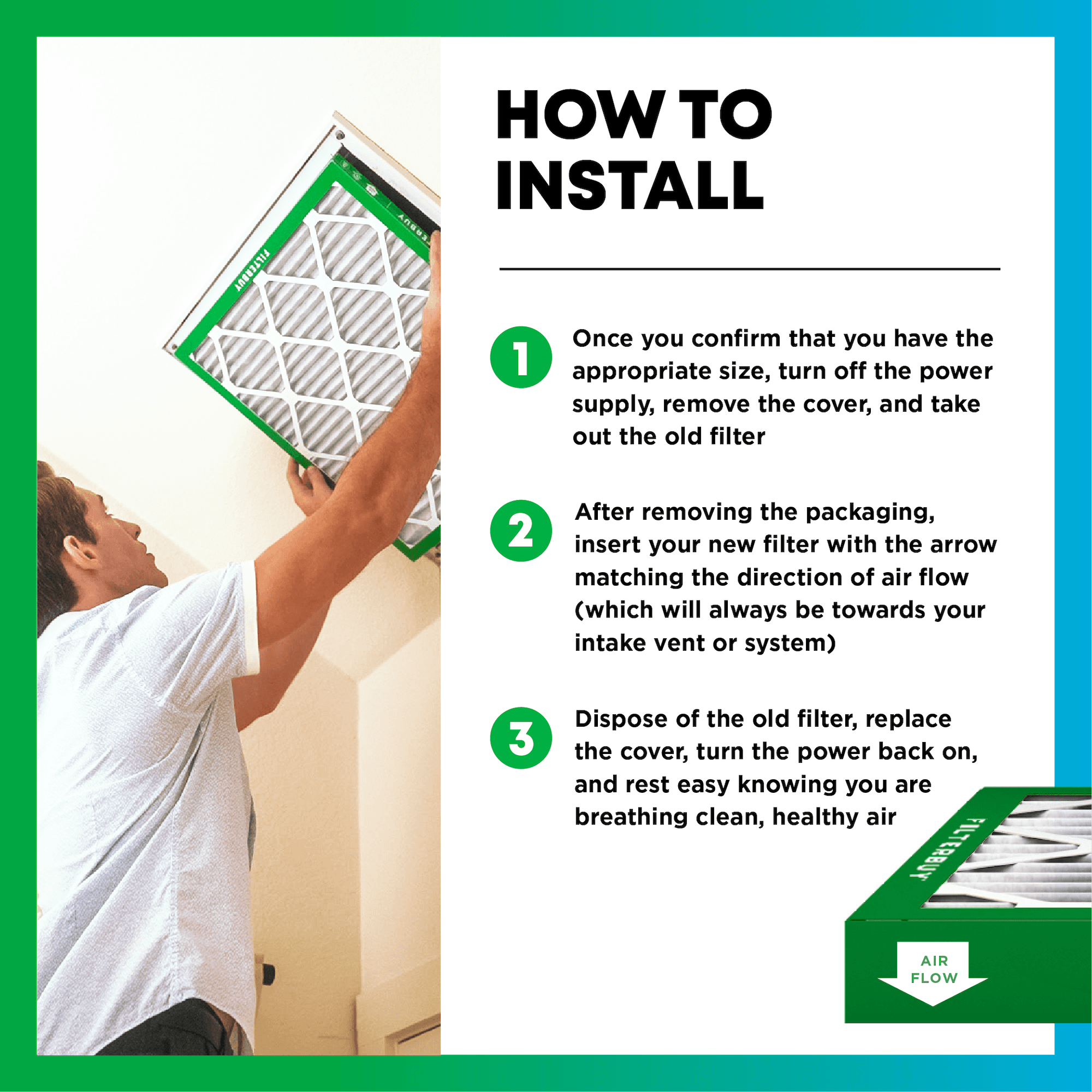
Turn Off Your HVAC SystemSafety first.

Remove The Old FilterLook for the airflow arrow and make note of the direction.

Slide In Your New FilterArrow should point toward the system (same direction as before).

Turn Your System Back OnAnd enjoy the fresh, clean air.

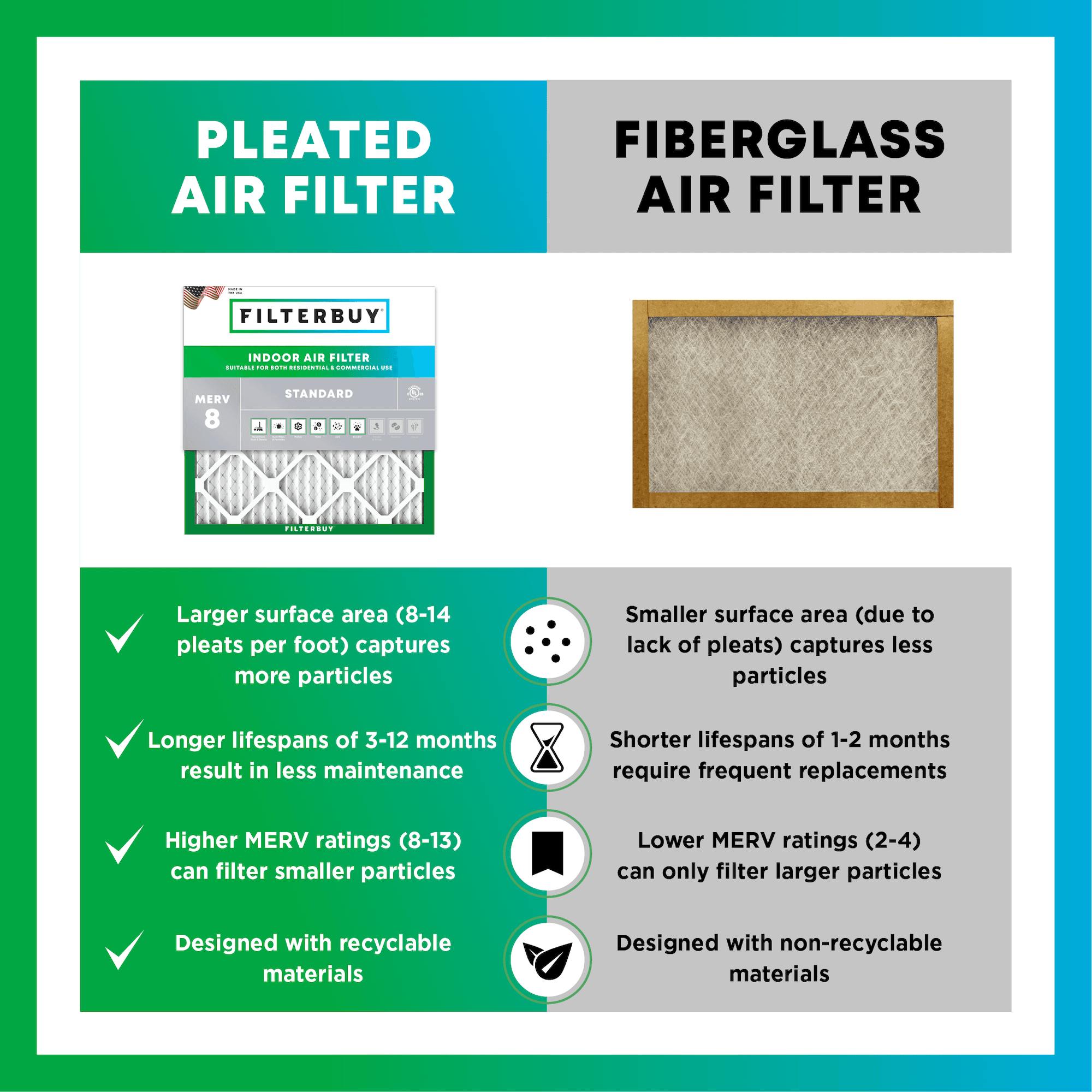
Not all air filters are created equal. Pleated filters don't just last longer—they actually clean your air better. Here's how they stack up:

Efficiency:
High (MERV 8–13) – Traps more particles
Lifespan:
90 days – Long-lasting performance
Air Quality:
Excellent – Cleaner, healthier air
Materials:
Recyclable and durable

Efficiency:
Low (MERV 4 or less) – Misses small stuff
Lifespan:
30 days or less – Replace often
Air Quality:
Minimal – Basic protection only
Materials:
Thin, flimsy, and not recyclable
Pleated filters are a no-brainer—more protection, less hassle, and better air for your home.
Changing your filter on time keeps your HVAC system running efficiently—and helps protect your lungs from dust, allergens, and airborne irritants. Here's how often to swap it out based on your needs:

For most homes without pets or special air quality concerns. Great for general upkeep and energy efficiency.

Shedding fur, dander, and allergy triggers can build up fast. Changing your filter every two months helps keep the air fresher and symptoms at bay.

For households affected by smoke, pollution, or respiratory conditions, monthly changes ensure maximum protection.

| Nominal Size | 20X20X5 |
| Actual Size | 20.25 x 20.75 x 5.25" inches |
| Filter Type | Pleated |
| Media | Electrostatically Charged |
| Frame | Beverage Board |
| MERV Ratings Available | 8, 11, 13 |
| Lifespan | Up to 12 Months |
| Origin | Made in USA |
The wrong filter doesn't just compromise air quality—it shortens your HVAC system's life.
After manufacturing filters for Goodman systems for over a decade, we've learned something most homeowners never hear: filter selection impacts equipment longevity more than almost any other maintenance decision. Our customer service team regularly hears from homeowners who switched to properly sized MERV 8 filtration and noticed their systems running quieter and cycling less frequently within weeks.
A 20x20x5 MERV 8 filter captures airborne contaminants effectively while maintaining the airflow balance Goodman engineers designed for. This protects your blower motor, keeps evaporator coils cleaner longer, and reduces the strain that leads to costly breakdowns.
Here's exactly how the right filtration extends your system's lifespan—and what we've seen work best after helping millions of homeowners protect their HVAC investments.
A MERV 8 20x20x5 filter is a five-inch deep pleated air filter designed for Goodman HVAC systems requiring 20"×20" dimensions. After manufacturing millions of these filters, here's what we know matters most:
What it does:
Captures 70-85% of airborne particles (dust, pollen, mold spores, pet dander)
Maintains optimal airflow for Goodman blower motors
Protects evaporator coils and internal components
Why MERV 8 works for Goodman systems:
Balances filtration efficiency with airflow requirements
Won't strain equipment like higher MERV ratings can
Recommended for most residential applications
Replacement frequency:
Standard homes: 9-12 months
Homes with pets: 4-6 months
Check monthly, replace when visibly loaded
Key benefit: The 20x20x5 size provides significantly more surface area than one-inch filters, extending protection time and reducing replacement frequency while helping your Goodman system reach its full 15-20 year lifespan.
Before purchasing: Verify your Goodman system's filter cabinet accommodates five-inch depth filters. Not all models use this size.
MERV 8 Hits the Sweet Spot Captures 70-85% of particles while maintaining proper airflow. Higher MERV isn't automatically better.
Filtration Directly Impacts HVAC Lifespan Protects blower motors, keeps coils cleaner, reduces strain that causes breakdowns.
The 20x20x5 Size Delivers Real Advantages More surface area means longer protection and precise fit prevents air bypass.
Filter Maintenance Offers the Highest ROI 52% of home energy flows through HVAC. Clean filters save 5-15% on energy costs.
Consistency Beats Perfection A proper filter replaced on schedule outperforms a premium filter that's neglected.
Every HVAC system operates within specific airflow parameters. Push too much resistance through the system with an overly dense filter, and you stress the blower motor. Use filtration that's too weak, and contaminants accumulate on internal components.
MERV 8 hits the sweet spot for most Goodman residential systems. After testing thousands of filter configurations, we've found this rating captures 70-85% of particles between 3-10 microns—dust, pollen, mold spores, and pet dander—without restricting the airflow your system requires.
Customers frequently ask us whether higher MERV ratings offer better protection. Our answer: not necessarily. Higher ratings increase resistance, and many Goodman systems weren't engineered to overcome that added strain continuously.
Your HVAC system contains components that respond directly to air quality passing through them. Here's what we've observed after years of customer feedback and product development:
Blower Motor Protection When filters capture debris effectively, less particulate reaches the blower assembly. This reduces buildup on fan blades and motor housings, allowing the motor to maintain proper RPMs without working harder. Overworked motors fail sooner—often years before their expected lifespan.
Evaporator Coil Preservation Dirty coils reduce heat transfer efficiency and can eventually freeze. A well-matched MERV 8 filter keeps coils cleaner between professional maintenance visits. Homeowners tell us they've gone from annual coil cleanings to every two or three years after switching to properly sized filtration.
Ductwork and System Cleanliness Contaminants that bypass inadequate filters settle throughout your duct system and recirculate continuously. Effective filtration reduces this accumulation, maintaining cleaner air pathways and reducing overall system strain.
Goodman designs specific cabinet configurations that require precise filter dimensions. A 20x20x5 filter offers two advantages over standard one-inch alternatives:
Extended Surface Area The five-inch depth provides significantly more filtration media than thinner filters. More media means more particle capture capacity before airflow restriction begins. In practical terms, this translates to longer intervals between replacements and more consistent protection throughout the filter's lifespan.
Proper Cabinet Fit Gaps around poorly fitted filters allow unfiltered air to bypass the media entirely. We manufacture our 20x20x5 filters to actual Goodman cabinet specifications, ensuring a secure fit that forces all air through the filtration media.
"After manufacturing millions of filters and hearing from countless Goodman system owners, one pattern stands out clearly: homeowners who match their filter's MERV rating and dimensions to their system's specifications consistently report fewer repairs and longer equipment life—it's the most overlooked factor in HVAC longevity."
Your Go-To Resources for Confident Filter Decisions
Don't take your indoor air for granted—and don't make filter decisions without reliable information backing you up.
After helping millions of homeowners protect their HVAC systems, we know that understanding filtration basics makes all the difference. These seven trusted resources give you the knowledge to choose wisely and feel confident you're protecting your greatest assets: your family, your home, and your Goodman system.
EPA: What is a MERV Rating?
Customers ask us all the time which MERV rating they actually need. The EPA breaks it down clearly—explaining how ratings measure particle capture and why MERV 8 hits the sweet spot for most residential systems. This is the foundation every homeowner should understand.
URL: https://www.epa.gov/indoor-air-quality-iaq/what-merv-rating
Goodman Manufacturing: Filter Type Recommendations
Here's something we tell every Goodman owner: your system was engineered with specific airflow requirements. Goodman's official guidance explains which filter types and sizes keep your equipment running as designed. When in doubt, start here.
URL: https://www.goodmanmfg.com/resources/faq/maintenance/what-type-of-filter-should-i-use
ASHRAE: Filtration and Disinfection FAQ
ASHRAE created the MERV rating system we use across the industry. After over a decade of manufacturing filters to these standards, we can tell you their testing methodology matters. This resource helps you understand what those numbers on the filter label actually mean for your home.
URL: https://www.ashrae.org/technical-resources/filtration-and-disinfection-faq
Energy Star: Heating and Cooling Guide
We hear it from customers constantly—they had no idea a dirty air filter was costing them money every month. Energy Star spells it out: clogged filters force your system to work harder, wasting energy and shortening equipment life. Their maintenance checklist is one every homeowner should follow.
URL: https://www.energystar.gov/saveathome/heating-cooling
U.S. Department of Energy: Air Conditioner Maintenance
This is the resource we wish every homeowner would read before their first HVAC repair bill arrives. The DOE explains exactly how dirty filters strain blower motors, damage coils, and lead to premature system failure. The good news? You control this variable completely.
URL: https://www.energy.gov/energysaver/air-conditioner-maintenance
EPA: Care for Your Air – A Guide to Indoor Air Quality
Most people can't see the pollutants floating through their homes—but that doesn't mean they're not there. The EPA's guide reveals what's actually in your indoor air and how proper filtration reduces your family's exposure to dust, allergens, and airborne contaminants. Knowledge is protection.
URL: https://www.epa.gov/indoor-air-quality-iaq/care-your-air-guide-indoor-air-quality
Building America Solution Center: High-MERV Filters
Here's an insight we share after years of helping homeowners: higher MERV isn't always better. This Department of Energy resource explains how filter efficiency relates to airflow resistance—and why choosing a filter your system can handle matters more than chasing the highest rating.
URL: https://basc.pnnl.gov/resource-guides/high-merv-filters
After manufacturing millions of filters and working with homeowners nationwide, certain patterns become impossible to ignore. These federal statistics validate what our team observes daily.
The data: Americans spend approximately 90% of their time indoors, where pollutant concentrations run 2 to 5 times higher than outdoor levels.
What we've seen firsthand:
Families contact us confused about unexplained allergies and persistent dust
Customers who switch to properly matched MERV 8 filtration report noticeable improvements within weeks
Parents tell us their kids stopped waking up congested after upgrading filters
The takeaway: Your Goodman system circulates your home's air multiple times daily. Every particle that filter captures—or misses—gets breathed repeatedly.
Source: U.S. EPA – Indoor Air Quality
URL: https://www.epa.gov/report-environment/indoor-air-quality
The data: Replacing a dirty filter with a clean one can reduce HVAC energy consumption by 5% to 15%.
What we've observed:
Thousands of homeowners couldn't explain rising utility bills—until they saw their neglected filters
Restricted airflow forces blower motors to strain against resistance they weren't designed to overcome
Customers report systems running quieter after switching to properly sized filtration
The compounding effect most homeowners miss:
Clogged filter restricts airflow
Motor works harder to compensate
Strain accelerates component wear
Wear leads to repair bills
Repeated strain shortens system lifespan
The takeaway: The DOE's 5-15% savings estimate is conservative for homeowners running compromised filters without realizing it.
Source: U.S. Department of Energy – Air Conditioner Maintenance
URL: https://www.energy.gov/energysaver/maintaining-your-air-conditioner
The data: Heating and air conditioning account for more than half of household energy consumption—exceeding every other appliance, device, and light combined.
What this means for filtration:
Your filter isn't a disposable accessory—it determines whether your largest energy system runs efficiently
Homeowners consistent with replacement report more stable utility bills year over year
HVAC technicians frequently point to neglected filters as the culprit behind declining performance
The math is simple:
52% of energy bill flows through your HVAC system
Modest efficiency gains translate to real monthly savings
A properly fitted MERV 8 filter is the most cost-effective protection for that investment
Source: U.S. Energy Information Administration – Use of Energy in Homes
URL: https://www.eia.gov/energyexplained/use-of-energy/homes.php
After over a decade of manufacturing filters for Goodman systems, we've reached one conclusion: the filter is the single most undervalued component in your entire HVAC system.
MERV 8 captures 70-85% of harmful particles without restricting airflow
Proper filtration protects blower motors, evaporator coils, and ductwork
The filterbuy 20x20x5 size provides extended surface area and precise cabinet fit
Government data confirms: 90% of time indoors, 5-15% energy savings potential, 52% of home energy through HVAC
Authoritative resources from EPA, DOE, ASHRAE, and Goodman support informed decisions
Most people think about filters backward.
They view filtration as a commodity—grab whatever's cheapest, swap it when they remember, assume all filters perform the same. This mindset costs thousands over a system's lifetime.
Homeowners who get the best results approach it differently:
Match the filter to their system, not their budget
Check monthly and replace based on condition
Understand that higher MERV isn't automatically better
Recognize the filter as protection, not an expense
We've watched this pattern for years. Customers who treat a $15 filter as the guardian of an $8,000 system consistently outperform those who treat it as an afterthought.
A perfectly matched filter won't save a neglected system.
Filtration is powerful but not magic. If your system hasn't been serviced in years, if ductwork leaks, if thermostat settings fight efficiency—a new filter alone won't solve those problems.
What proper filtration will do:
Maximize the return on every other maintenance investment
Serve as the foundation that lets everything else work as designed
Provide the protection you control most directly, affordably, and frequently
Think of it like fuel in a car. Premium gas won't fix worn brakes and bald tires. But you also wouldn't expect peak performance from the cheapest option available.
Understanding why MERV 8 filtration protects your Goodman system is step one. Now apply what you've learned.
Turn off your HVAC system
Locate and remove your current filter
Read the size printed on the frame
Note all three dimensions (length × width × depth)
Pro Tip: Nominal size differs from actual size. Always match the nominal size (20x20x5) when ordering.
Quick checks:
Review your Goodman owner's manual for maximum MERV rating
Verify your filter slot accommodates 5-inch depth
Contact an HVAC technician if uncertain
Consider a different MERV if:
Severe allergies or respiratory conditions → MERV 11
Older system with limited airflow → Confirm MERV 8 first
New high-efficiency system → May handle MERV 13
Household Type
Check
Replace
No pets, low dust
Monthly
9-12 months
1-2 pets
Monthly
6-9 months
Multiple pets or allergies
Monthly
4-6 months
High dust environment
Bi-weekly
3-4 months
Make it automatic:
Set a recurring phone reminder
Write installation date on the filter frame
Consider subscription delivery
Replace immediately if you see:
Gray or brown discoloration
Visible dust buildup
Reduced airflow from vents
System running longer than normal
Sagging or structural damage
Healthy filters show:
Uniform white or off-white color
Light passes through easily
No gaps around edges
Your checklist:
Size: 20x20x5 (verified against current filter)
Rating: MERV 8 for balanced performance
Compatibility: Designed for Goodman cabinets
Construction: Pleated media with sturdy frame
Turn off system at thermostat
Remove old filter carefully
Note airflow arrow on new filter
Insert with arrow pointing toward blower
Ensure snug fit with no gaps
Close access panel
Turn system back on
Avoid these mistakes:
Installing backwards (arrow points toward system)
Forcing incorrect size into slot
Leaving gaps that allow air bypass
Record after each replacement:
Installation date
Filter condition (light, moderate, heavy loading)
Time between replacements
Any performance changes noticed
Use this data to refine your schedule. Every home is different.
A: Most households get 6-12 months from a 20x20x5 filter. However, actual replacement timing depends on your environment.
What customers tell us works best:
Check monthly regardless of schedule
Replace when visibly loaded with debris
Pet owners typically need replacement every 4-6 months
High-dust homes may need more frequent changes
Our experience: Homeowners who replace based on visual condition outperform those following rigid schedules.
A: For most Goodman systems, MERV 8 delivers exactly what's needed.
What MERV 8 captures:
70-85% of common airborne particles
Dust, pollen, mold spores, pet dander
What we've learned after manufacturing filters for over a decade:
MERV 8 maintains airflow without straining equipment
A MERV 8 your system handles easily outperforms a MERV 13 that forces your blower to work overtime
Households with severe allergies may benefit from MERV 11
Bottom line: For most families, MERV 8 hits the mark.
A: No. This is something we clarify with customers daily.
Key facts:
Goodman builds systems with different cabinet configurations
20x20x5 fits only models designed for five-inch media filters
Not all Goodman systems use the same size
Before ordering:
Pull your current filter
Check dimensions printed on the frame
Verify against your owner's manual
Why this matters: Gaps around ill-fitting filters let unfiltered air bypass the media entirely. Two minutes of verification saves headaches later.
A: Higher MERV captures smaller particles—but comes with tradeoffs.
Technical comparison:
Rating
Particle Size
Captures
MERV 8
3-10 microns
Dust, pollen, mold
MERV 11
1-3 microns
Pet dander, dust mites
MERV 13
0.3+ microns
Bacteria, some viruses
The practical reality we've observed:
Higher ratings mean denser media and increased airflow resistance
Many Goodman systems weren't engineered for that added restriction
Customers report higher utility bills after upgrading to MERV 13
Systems run longer to compensate for reduced airflow
Our recommendation: Unless your manual confirms higher MERV compatibility, MERV 8 remains the safer choice.
A: Yes. After helping millions of homeowners, we can say this confidently.
How proper filtration protects your system:
Prevents particulate from reaching blower motors
Keeps evaporator coils cleaner longer
Reduces strain on components
Fewer repairs over system lifetime
What customers tell us:
HVAC technicians frequently identify neglected filtration as the cause of premature failures
Properly maintained systems typically last 15-20 years
Neglected systems fail years earlier
The bottom line: Your filter is the frontline defense you control completely.
Your HVAC lifespan depends on the filtration choices you make now—don't wait until costly repairs force the decision. Find the right MERV 8 20x20x5 filter for your Goodman system and start extending your equipment's life today.

