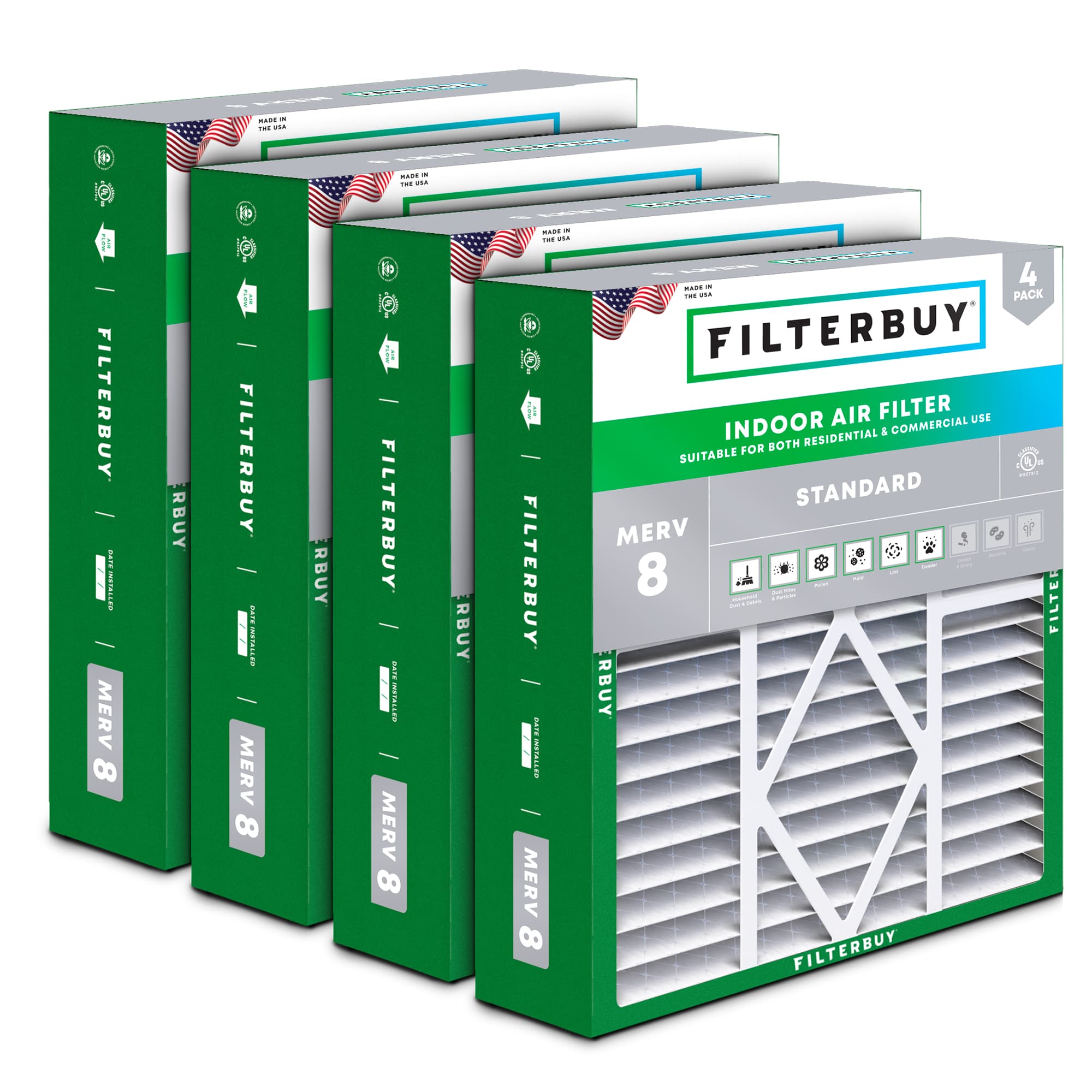
Tip: Ensure you buy the exact air filter size for your system. Certain brands have precise dimensions that only fit their specific models. See related filters
Actual Size: 20.25x25.38x5.25"
 Free Delivery
  Factory-Direct Low Prices, Made in the USA
 Hassle-Free Returns & Free Exchanges
RESIDENTIAL AND/OR COMMERCIAL USE
Change Every 3 Months
Tip: Ensure you buy the exact air filter size for your system. Certain brands have precise dimensions that only fit their specific models. See related filters
Actual Size: 20.25x25.38x5.25"
Free Delivery Factory-Direct Low Prices, Made in the USAHassle-Free Returns & Free ExchangesRESIDENTIAL AND/OR COMMERCIAL USE
Change Every 3 Months
Tip: Ensure you buy the exact air filter size for your system. Certain brands have precise dimensions that only fit their specific models. See related filters
Actual Size: 20.25x25.38x5.25"
Free Delivery Factory-Direct Low Prices, Made in the USAHassle-Free Returns & Free ExchangesRESIDENTIAL AND/OR COMMERCIAL USE
Change Every 3 Months
Many HVAC brands have unique trimmed sizes of their 20x25x5 filters.
For example, a 20x25x5 made for Honeywell systems will not fit other brand systems.
⚠️ This quick step can save you from ordering the wrong size. ⚠️
Find Your Exact Match By Choosing Your Brand Below:
Find Your Exact Match By Choosing the Actual Size (Also known as the trimmed size):
At Filterbuy, we don't cut corners—we craft high-quality air filters right here in the USA and ship them to your doorstep for free. No delays, no gimmicks—just clean air, made easy. With thousands of five-star reviews and filters built for real life & every HVAC system, it's no wonder why over 4 million families trust Filterbuy.

Proudly Made In The USA

Fast, Free Shipping on Every Order

Premium Materials That Go The Distance

85,000+ 5-Star Reviews From Happy Customers

Save Up to 70% Per Filter with Packs


Measure length × width × depth with a tape measure to find the actual size.

Round up each dimension to the nearest whole number to get the nominal size. Example: 20.25x25.38x5.25" in → 20x25x5 nominal.

Search by nominal size on our site for the best fit.


5″ filters give you maximum filtration with minimal maintenance — lasting up to 12 months while handling higher MERV ratings without restricting airflow.
Sizing note:

If the filter you buy doesn't fit, we'll send you a better size.
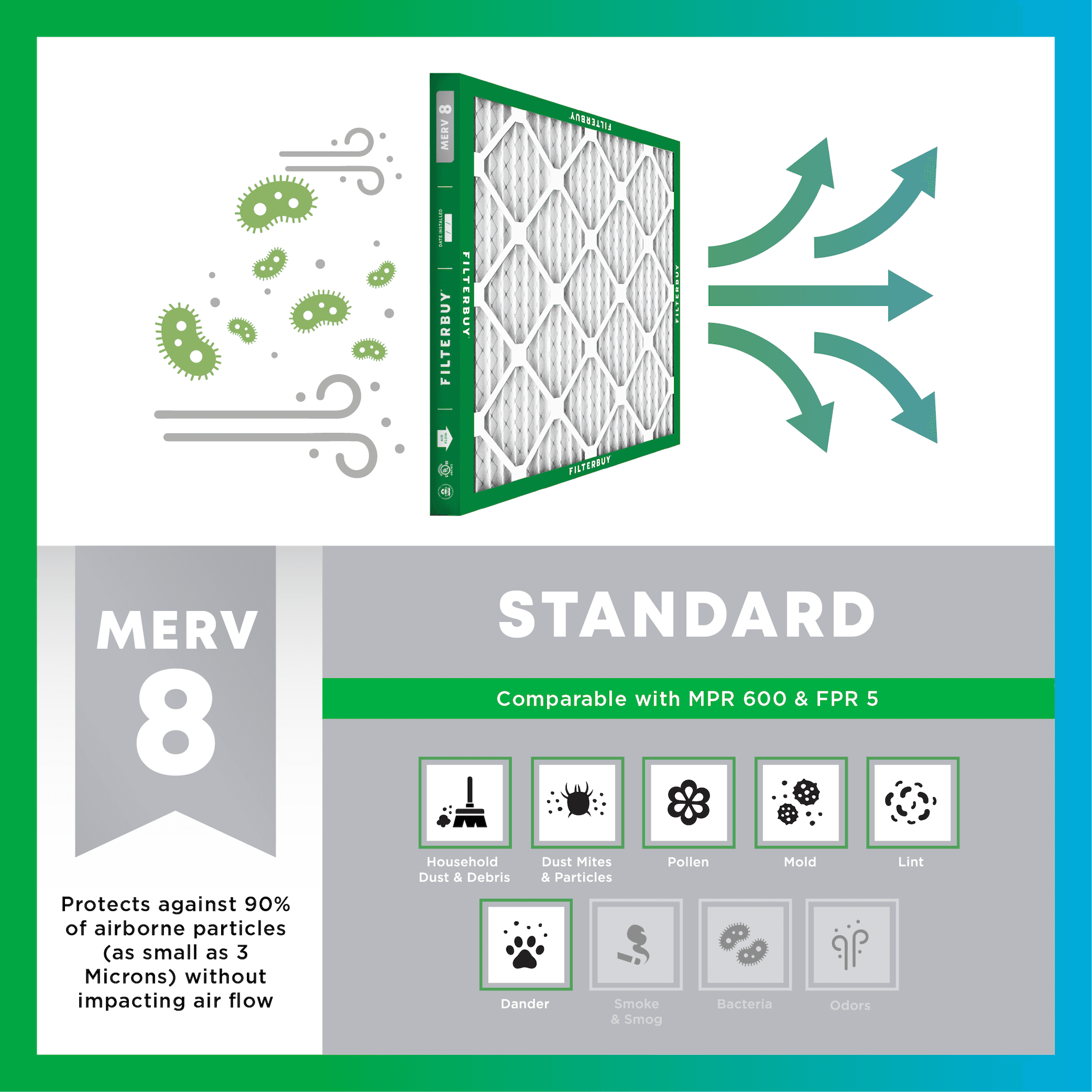
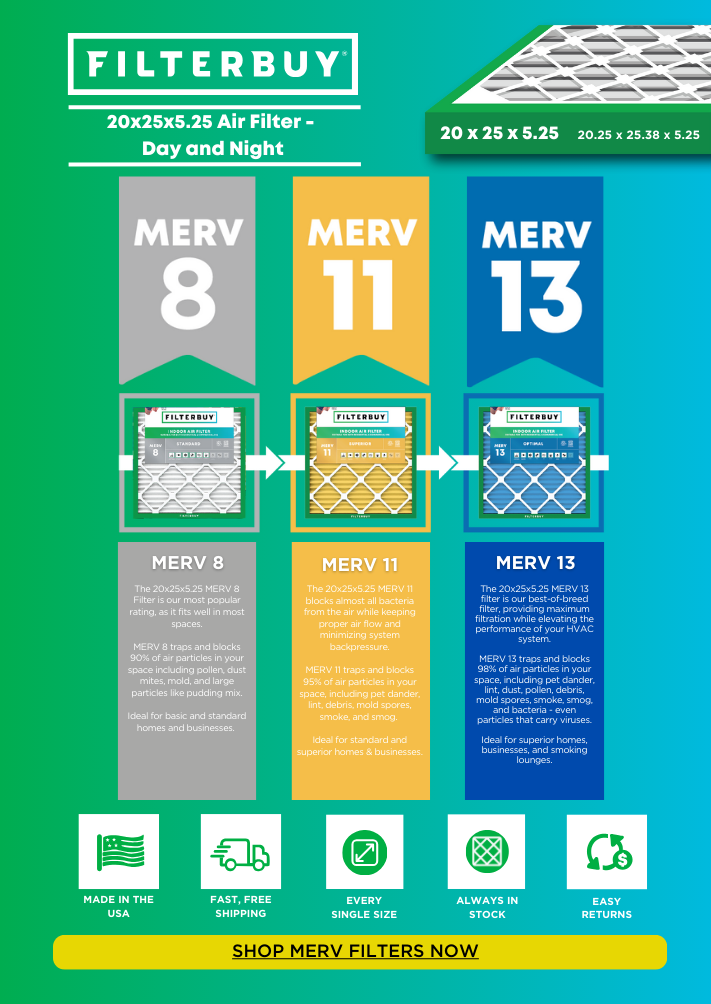
MERV stands for Minimum Efficiency Reporting Value—but don't let the technical name fool you. It's just a way to rate how well an air filter traps stuff like dust, pollen, pet dander, and smoke. The higher the MERV number, the more particles it catches—and the cleaner your air will be.

Comparable to:FPR: 4-7
MPR: 600-1000
 Dust & Debris
 Dust Mites & Particles
 Pollen
 Mold
Mold Lint
Lint Dander
Comparable to:FPR: 6-9
MPR: 1200-1550
Dust & DebrisDust Mites & ParticlesPollenMoldLintDander Smoke & Smog
Comparable to:FPR: 10
MPR: 1900-2800
Dust & DebrisDust Mites & ParticlesPollenMoldLintDanderSmoke & Smog Bacteria


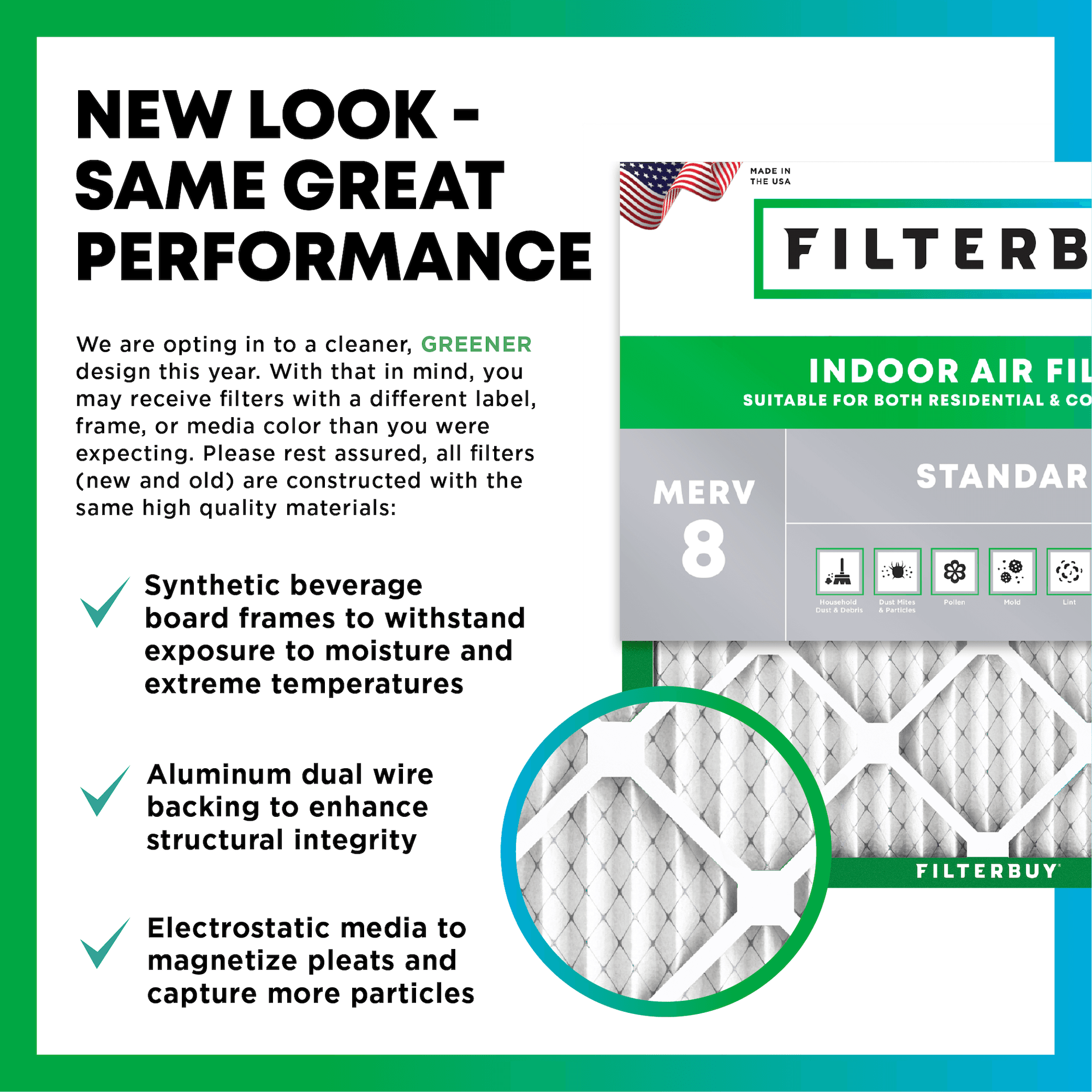
We build every Filterbuy filter to deliver reliable 90-day performance—thanks to smart design and premium materials that do the heavy lifting. Here's what makes the difference:
More pleats = more surface area to capture dust and debris, keeping your air cleaner longer.
Pleats are magnetized to attract and trap microscopic particles—like pet dander, pollen, and smoke.
Engineered to resist warping in extreme temperatures and high humidity.

A layer of metal reinforcement keeps pleats evenly spaced and structurally sound—no sagging, even at high airflow.
Assembled with care. Built to perform. Ships fast, free, and reliably from our U.S. facilities.

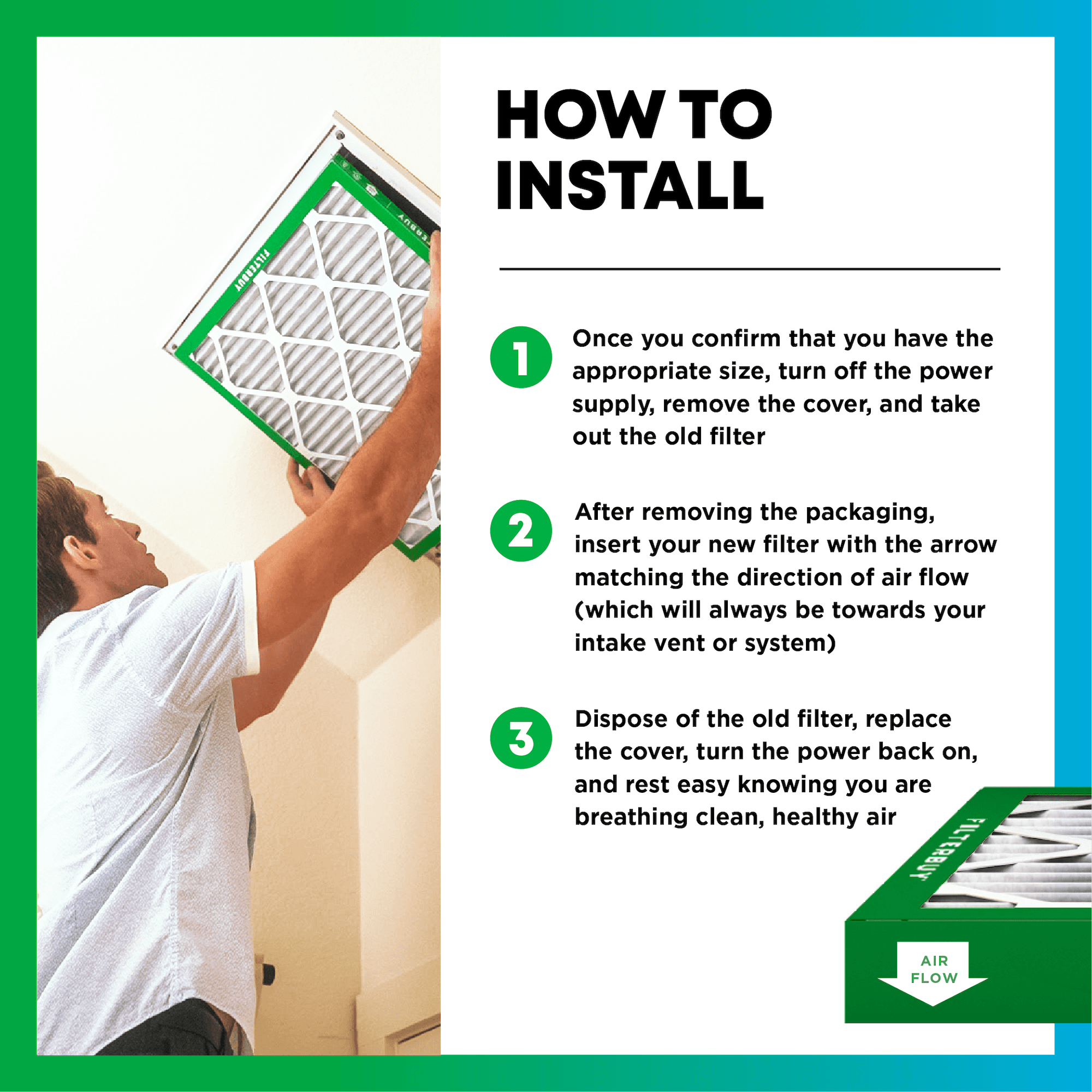
Turn Off Your HVAC SystemSafety first.

Remove The Old FilterLook for the airflow arrow and make note of the direction.

Slide In Your New FilterArrow should point toward the system (same direction as before).

Turn Your System Back OnAnd enjoy the fresh, clean air.

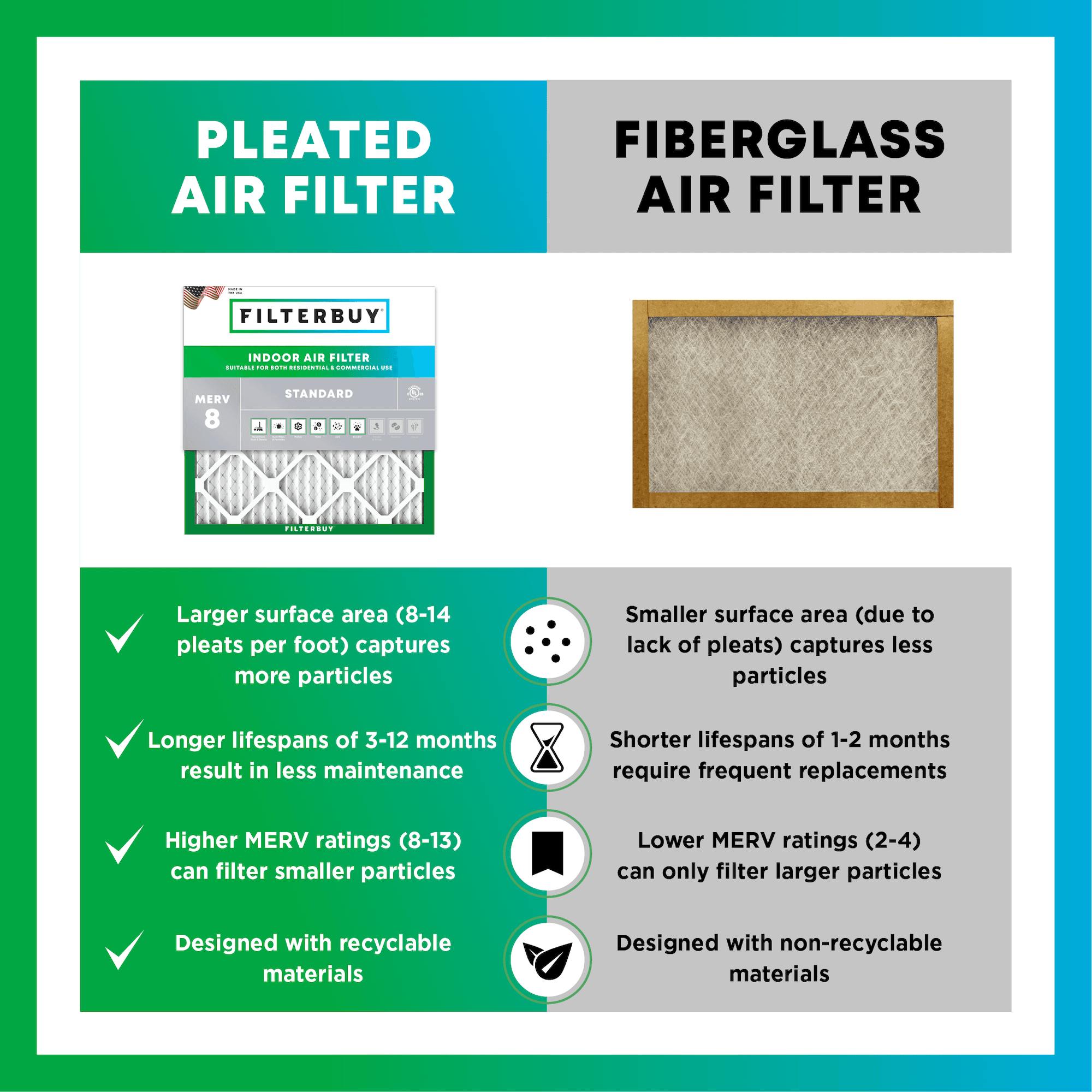
Not all air filters are created equal. Pleated filters don't just last longer—they actually clean your air better. Here's how they stack up:

Efficiency:
High (MERV 8–13) – Traps more particles
Lifespan:
90 days – Long-lasting performance
Air Quality:
Excellent – Cleaner, healthier air
Materials:
Recyclable and durable

Efficiency:
Low (MERV 4 or less) – Misses small stuff
Lifespan:
30 days or less – Replace often
Air Quality:
Minimal – Basic protection only
Materials:
Thin, flimsy, and not recyclable
Pleated filters are a no-brainer—more protection, less hassle, and better air for your home.
Changing your filter on time keeps your HVAC system running efficiently—and helps protect your lungs from dust, allergens, and airborne irritants. Here's how often to swap it out based on your needs:

For most homes without pets or special air quality concerns. Great for general upkeep and energy efficiency.

Shedding fur, dander, and allergy triggers can build up fast. Changing your filter every two months helps keep the air fresher and symptoms at bay.

For households affected by smoke, pollution, or respiratory conditions, monthly changes ensure maximum protection.

| Nominal Size | 20 x 25 x 5 inches |
| Actual Size | 20.25 x 25.38 x 5.25" inches |
| Filter Type | Pleated |
| Media | Electrostatically Charged |
| Frame | Beverage Board |
| MERV Ratings Available | 8, 11, 13 |
| Lifespan | Up to 12 Months |
| Origin | Made in USA |
Here is something most Day and Night homeowners find out the hard way: a saturated deep-media filter does not announce itself. The system runs harder, the energy bill climbs, and the air quality drops. That process is quiet. Most homeowners do not realize what happened until something breaks.
After manufacturing air filters for over a decade and working directly with more than two million households, we know this pattern well. Homeowners with 5-inch thick-media systems often assume the longer lifespan means less monitoring is needed. That assumption is exactly where the problem starts. Longer replacement cycles push more total air volume through fewer changes. When this filter saturates, it has often been working against your system for months before anyone notices.
This guide covers what you need to stay ahead of that: what MERV 8 actually filters in a residential Day and Night system, how to confirm your 20x25x5.25 size is correctly seated, and the replacement schedule that keeps your family's air clean while your equipment runs the way it was designed to. Your filter is working right now. Whether it is doing its job depends on when you last changed it.
The MERV 8 20x25x5.25 is a deep-media replacement air filter for Day and Night residential HVAC systems equipped with a whole-home media air cleaner cabinet. Filterbuy manufactures this filter to OEM-compatible dimensions as a direct fit for Day and Night furnace and air handler units that accept a 5-inch class deep-media filter.
Filter size: 20x25x5.25 is a nominal measurement. Actual media dimensions may vary slightly by manufacturer. Confirm the correct size by reading the dimension printed on the cardboard frame of your current filter before ordering.
MERV 8 rating: Captures a minimum of 70% of airborne particles in the 3-10 micron range, including household dust, pollen, mold spores, and pet dander. MERV 8 provides effective filtration for most residential Day and Night systems without restricting the airflow the equipment needs to operate efficiently.
Replacement schedule: Replace every 6-12 months depending on household conditions. Homes with pets or allergy sufferers should target 6 months or sooner. Light-use households with no pets can extend the cycle up to 12 months.
System compatibility: Built for Day and Night whole-home media air cleaner cabinets. A standard 1-inch or 4-inch filter will not seat correctly in this cabinet and will allow unfiltered air to bypass the media with every cycle.
The 20x25x5.25 Day and Night filter is a deep-media replacement. At roughly five times the depth of a standard 1-inch filter, it holds significantly more particulate matter and lasts longer. It still needs to be replaced on a set schedule.
MERV 8 is the right choice for most residential Day and Night systems, capturing household dust, pollen, mold spores, and pet dander without restricting the airflow the equipment needs to run efficiently.
Most households using this filter should target a 6- to 12-month replacement cycle, adjusted for pets, allergy sensitivities, home size, and local air quality conditions.
Waiting too long to replace a deep-media filter does not just compromise your air. It forces your HVAC system to work harder against restricted airflow, drives up energy costs, and shortens equipment lifespan.
Before ordering, confirm your filter dimensions by reading the size printed on the frame of your current filter. The 20x25x5.25 is a nominal measurement; actual dimensions may vary slightly by manufacturer.
The MERV scale runs from 1 to 20. At the low end, MERV 1 through 4 filters protect your equipment from large debris but do very little for your family's air. MERV 8 sits in a practical middle range: efficient enough to capture the particles that drive allergy and asthma symptoms in most residential settings, without generating the airflow resistance that higher-rated filters place on systems built for standard residential equipment.
Choosing the right air filter for a Day and Night system comes down to that balance. A MERV 8 filter captures at least 70% of particles in the 3- to 10-micron size range. That covers household dust, pollen, mold spores, lint, pet dander, and dust mite debris. In practice, these are the particles most directly linked to the allergy and respiratory symptoms your family experiences indoors.
What a MERV 8 filter does not capture matters equally. Fine particles below 1 micron, including some bacteria, tobacco smoke, and virus-carrying aerosols, pass through MERV 8 media largely unfiltered. Households managing serious respiratory conditions or requiring hospital-grade filtration need MERV 13 or higher. For the typical Day and Night homeowner focused on indoor air pollution at home from everyday allergens and dust, MERV 8 delivers the right filtration without the airflow penalty.
That matters because Day and Night residential air handlers are built to operate within a specific airflow tolerance. Installing a MERV 13 or higher filter in a system not designed for that resistance causes the blower to work harder against the reduced airflow. The result is a pressure drop across the coil, reduced heat transfer efficiency, and in severe cases, a frozen evaporator coil. MERV 8 is not a compromise. For most Day and Night systems, it is the correct choice.
Filter dimensions follow a standard format: length x width x depth. For the 20x25x5.25, that means 20 inches long, 25 inches wide, and 5.25 inches deep. The depth is what separates this filter from the standard 1-inch products on most retail shelves.
The 5.25-inch figure is a nominal measurement. It reflects the approximate size your filter cabinet accepts, not the exact cut dimension of the media inside. In practice, your filter may measure closer to 4.5 or 5 inches in actual depth depending on the manufacturer. This is expected. The nominal size governs fit in the cabinet; the true media dimensions vary slightly.
Pro Tip: Before ordering, physically remove your old filter and read the size printed on the cardboard frame. That printed nominal size is what your cabinet slot was built to accept. Confirm it matches 20x25x5.25 before placing your order.
Deep-media filters like the 20x25x5.25 are made for whole-home media air cleaner cabinets, the filter housing units installed in-line with the main return air duct, adjacent to your furnace or air handler. Day and Night systems with these cabinets require a 5-inch class deep-media filter specifically. A standard 1-inch filter cannot fill the slot and leaves an air bypass gap. A 4-inch filter may partially seat, but creates the same problem at the edges.
The most common size error we see from Day and Night homeowners is ordering from memory rather than measurement. A homeowner who orders a 20x25x4 because it looks close enough ends up with a filter that does not fully seat in the cabinet slot. A filter that does not seat is not filtering. It creates an air bypass path that lets unfiltered air move through every cycle.
The deeper media bed in a 5-inch filter holds significantly more particulate matter than a 1-inch filter before it saturates. That is exactly why these filters last longer between changes. A standard 1-inch MERV 8 filter in a typical household needs replacing every 1 to 3 months. The 20x25x5.25, with its expanded media surface area, handles a far greater dust load before airflow restriction becomes a problem.
A few factors can push your filter toward saturation faster than the table suggests. Local outdoor air quality is one: homes in areas with seasonal wildfire smoke or nearby construction see faster filter loading than the average household profile assumes. HVAC run time is another variable. A system running 12 hours daily processes far more air volume than one running 6, accelerating saturation regardless of household profile. Duct condition matters too. Dusty or partially deteriorated ductwork feeds particulate into the airstream with every cycle.
The cost of waiting too long is not abstract. A saturated filter creates a high pressure drop across the blower, forcing the motor to work harder to push the same volume of air. That sustained strain drives up your monthly energy bill, accelerates wear on the blower motor, and in systems without a bypass, starves the evaporator coil of adequate airflow until it freezes. Standard HVAC warranties do not cover that damage when a neglected filter caused it.
"After more than a decade of manufacturing residential air filters and working directly with homeowners across millions of households, the pattern we see most consistently is this: deep-media filter owners extend their replacement cycle too long because the filter looks fine from the outside. By the time a saturated 5-inch media filter shows visible discoloration on the face, the airflow restriction has already been working against the system for months."
— Filterbuy Team
The EPA's consumer guide to air cleaners and furnace filters explains how MERV ratings translate to real-world particle capture performance and how to select a filter that balances filtration efficiency with the airflow your equipment needs to operate correctly. The most practical starting point for any homeowner selecting or replacing a whole-home filter, including the MERV 8 20x25x5.25 for Day and Night systems.
Source: https://www.epa.gov/indoor-air-quality-iaq/guide-air-cleaners-home
ASHRAE Standard 52.2 is the testing methodology behind every MERV rating on every residential air filter sold in the United States. This FAQ from ASHRAE explains how filter efficiency is measured across particle size ranges, what MERV 8 captures at minimum, and how those ratings apply to residential forced-air systems like Day and Night.
Source: https://www.ashrae.org/technical-resources/filtration-and-disinfection-faq
The EPA's foundational indoor air quality resource documents the sources, particle types, and health effects of the pollutants circulating inside residential buildings every day. Understanding what a MERV 8 filter is working against is what makes the replacement schedule matter.
Source: https://www.epa.gov/indoor-air-quality-iaq/introduction-indoor-air-quality
The EPA's Inside Story guide walks homeowners through combustion byproducts, biological pollutants, building materials, and household products that degrade indoor air quality year-round. It gives the full context for why a correctly sized and timely replaced deep-media filter is one of the most practical tools a homeowner has.
Source: https://www.epa.gov/indoor-air-quality-iaq/inside-story-guide-indoor-air-quality
The CDC's air pollutant resource connects particulate matter exposure to specific health outcomes, including respiratory and cardiovascular effects. It answers the question every filter buyer eventually asks: why does the MERV rating actually matter for my family's health?
Source: https://www.cdc.gov/air-quality/pollutants/index.html
The Asthma and Allergy Foundation of America's indoor air quality guide identifies dust mites, pet dander, pollen, and mold as the primary household allergens affecting the more than 28 million Americans with asthma. A MERV 8 filter targets these same particles, making this resource directly relevant to any household managing allergy or respiratory sensitivities.
Source: https://aafa.org/asthma/asthma-triggers-causes/air-pollution-smog-asthma/indoor-air-quality/
The EPA's guide to improving your indoor environment explains how air filtration works as part of a broader strategy alongside ventilation and pollutant source reduction. It helps homeowners understand where a MERV 8 deep-media filter fits within the full picture of protecting their home's air quality.
Source: https://www.epa.gov/indoor-air-quality-iaq/improving-your-indoor-environment
1. Nearly half of all energy used in a typical American home goes to heating and cooling. A dirty filter will slow down air flow and make the system work harder to keep you warm or cool, wasting energy.
After manufacturing air filters for over a decade, we know exactly what filter saturation does to a system. Here is what happens when a MERV 8 20x25x5.25 filter goes too long without replacement:
The media bed fills with accumulated particulate and airflow resistance climbs
The blower strains against that resistance on every cycle
Run times extend because the system cannot move the air volume it needs
Energy consumption rises to compensate — and the utility bill follows
The filter change skipped in March shows up on the energy bill by July. Staying on a 6- to 12-month replacement schedule is not just an air quality decision. For a Day and Night homeowner, it is an energy cost decision.
Source: https://www.energystar.gov/saveathome/heating-cooling
2. Current asthma prevalence among U.S. adults increased from 6.9% in 2001 to 8.0% in 2021, with indoor allergens including dust mites, pet dander, pollen, and mold remaining among the most common environmental triggers for asthma attacks at home.
After serving more than two million households, we hear a version of the same story regularly. A homeowner contacts us because allergy or asthma symptoms have worsened. Somewhere in the conversation, it comes out that the filter has not been changed in a long time. What we have seen in practice:
Symptom cycles in allergy and asthma households track closely with filter saturation, not just seasonal pollen counts
A saturated MERV 8 filter stops capturing allergens at rated efficiency long before it looks visibly dirty
As the media breaks down under sustained pressure, it can begin releasing captured particles back into the airstream
The filter running to protect the household air becomes a liability inside it
The replacement schedule we recommend is grounded in what we have seen happen inside these filters, in these systems, in real homes.
Source: https://www.cdc.gov/asthma/asthmadata.htm
3. Americans spend approximately 90% of their time indoors, where concentrations of some pollutants are often 2 to 5 times higher than typical outdoor concentrations. Those most susceptible — children, older adults, and people with respiratory or cardiovascular conditions — tend to spend even more time indoors.
Most homeowners think of air quality as an outdoor problem. They check the AQI before a run. They watch the pollen count during allergy season. What they rarely factor in:
The air moving through their Day and Night system right now is the air their family breathes for 90% of their day
Outdoor air quality is largely outside your control. The air inside your home is not
A correctly sized, correctly rated, and timely replaced MERV 8 filter is one of the most direct variables a homeowner can actually manage
That is the invisible made visible. That is the point of what we build.
Source: https://www.epa.gov/report-environment/indoor-air-quality
Here is what more than a decade in this industry has shown us: the homeowners who stay on a consistent filter replacement schedule do not just breathe better air. They also spend less on service calls, experience fewer system breakdowns at peak demand, and extend the working life of equipment that costs thousands of dollars to replace.
The 20x25x5.25 MERV 8 Day and Night filter is a well-matched product for whole-home filtration. It gives you real protection against the particles that most directly affect respiratory health in a household setting. MERV 8 captures what matters for most households: dust, pollen, dander, and mold spores. It does this without the airflow trade-off that comes from using a filter rating beyond what the equipment was designed for.
Our recommendation comes down to this: set a calendar reminder for 6 months from your next filter change, then check the filter at that point. If it is visibly discolored, or if your household has pets or allergy sufferers, replace it. If it looks relatively clean and your household runs light, check again at 9 months. Do not wait 12 months without verifying. The filter does not come with an alarm.
Protecting your home's air is one of the simplest high-impact maintenance tasks available to a homeowner. The Prudent Protector sets a schedule and keeps it. The Prudent Protector replaces the filter before the HVAC system has to send a signal that something has gone wrong.
Ready to get on schedule? Here is what to do right now.
Confirm your filter size. Remove your current filter and read the dimensions printed on the cardboard frame. Confirm 20x25x5.25 matches before placing your order.
Order your replacement. Select the MERV 8 20x25x5.25 Filterbuy filter below. Ordering a multi-pack locks in your supply for the next 12 to 24 months and means a replacement is ready the moment your next interval arrives.
Set a replacement reminder. Add a calendar alert for 6 months from today. At that point, inspect the filter visually and adjust the interval based on what you see.
Mark your change date. Write the installation date on the cardboard frame of the new filter with a permanent marker. It takes 10 seconds and removes all guesswork at your next inspection.
Revisit seasonally. High-pollen spring and peak-use summer cooling are natural checkpoints for filter inspection, even outside your standard interval.
A: The correct replacement is a MERV 8 deep-media filter sized 20x25x5.25. Day and Night residential systems with a whole-home media air cleaner cabinet require a 5-inch class deep-media filter. A standard 1-inch filter will not fill the cabinet slot and allows unfiltered air to bypass the media entirely. Filterbuy manufactures the MERV 8 20x25x5.25 to the OEM-compatible nominal dimensions your Day and Night cabinet accepts.
A: For most residential Day and Night systems, yes. MERV 8 is the manufacturer-recommended range for standard forced-air residential systems. It provides solid filtration of common household allergens and particulates without generating the static pressure resistance that higher-rated filters place on equipment not designed to handle it. Using a MERV 13 or higher in a system built for MERV 8-level resistance restricts airflow, strains the blower motor, and reduces overall system efficiency.
A: It depends on your specific Day and Night system model and its rated static pressure tolerance. Some newer, high-efficiency Day and Night systems can accommodate MERV 11 or MERV 13 filters without airflow issues. Older systems or those with standard blower motors may not handle the added resistance. Before upgrading, check your system's owner manual for the maximum rated filter MERV or consult an HVAC technician. Never install a higher-rated filter and assume it is safe without verifying equipment compatibility first.
A: The most reliable method is to remove your existing filter and read the size printed on the cardboard frame. This printed nominal size should match 20x25x5.25. If you have already discarded the old filter, check your Day and Night system's owner manual or the label on your filter cabinet housing. When in doubt, measure the interior opening of the filter slot (length, width, and depth) and round to the nearest nominal size.
A: The depth of the filter media is the key difference. A 1-inch filter has a thin media bed with limited surface area for capturing particles. It loads quickly under normal household conditions and needs replacing every 1 to 3 months. A 5-inch deep-media filter packs a much larger pleated media surface area into that additional depth, which lets it capture and hold significantly more particulate matter before reaching saturation. That translates to a longer replacement interval (6 to 12 months) and more consistent filtration performance over that period, provided the system uses a deep-media filter cabinet.
You now have everything you need to choose the correct MERV 8 20x25x5.25 replacement filter for your Day and Night system and the replacement schedule to back it up. Order yours today and set the reminder before you close this page — your system is running right now, and what it is running through matters.

