
Tip: Ensure you buy the exact air filter size for your system. Certain brands have precise dimensions that only fit their specific models. See related filters
Actual Size: 20.75x20.25x5.25
 Free Delivery
  Factory-Direct Low Prices, Made in the USA
 Hassle-Free Returns & Free Exchanges
RESIDENTIAL AND/OR COMMERCIAL USE
Change Every 3 Months
Tip: Ensure you buy the exact air filter size for your system. Certain brands have precise dimensions that only fit their specific models. See related filters
Actual Size: 20.75x20.25x5.25
Free Delivery Factory-Direct Low Prices, Made in the USAHassle-Free Returns & Free ExchangesRESIDENTIAL AND/OR COMMERCIAL USE
Change Every 3 Months
Tip: Ensure you buy the exact air filter size for your system. Certain brands have precise dimensions that only fit their specific models. See related filters
Actual Size: 20.75x20.25x5.25
Free Delivery Factory-Direct Low Prices, Made in the USAHassle-Free Returns & Free ExchangesRESIDENTIAL AND/OR COMMERCIAL USE
Change Every 3 Months
At Filterbuy, we don't cut corners—we craft high-quality air filters right here in the USA and ship them to your doorstep for free. No delays, no gimmicks—just clean air, made easy. With thousands of five-star reviews and filters built for real life & every HVAC system, it's no wonder why over 4 million families trust Filterbuy.

Proudly Made In The USA

Fast, Free Shipping on Every Order

Premium Materials That Go The Distance

85,000+ 5-Star Reviews From Happy Customers

Save Up to 70% Per Filter with Packs


Measure length × width × depth with a tape measure to find the actual size.

Round up each dimension to the nearest whole number to get the nominal size. Example: 20.75x20.25x5.25 in → 20X20X5 nominal.

Search by nominal size on our site for the best fit.


5″ filters give you maximum filtration with minimal maintenance — lasting up to 12 months while handling higher MERV ratings without restricting airflow.
Sizing note:

If the filter you buy doesn't fit, we'll send you a better size.
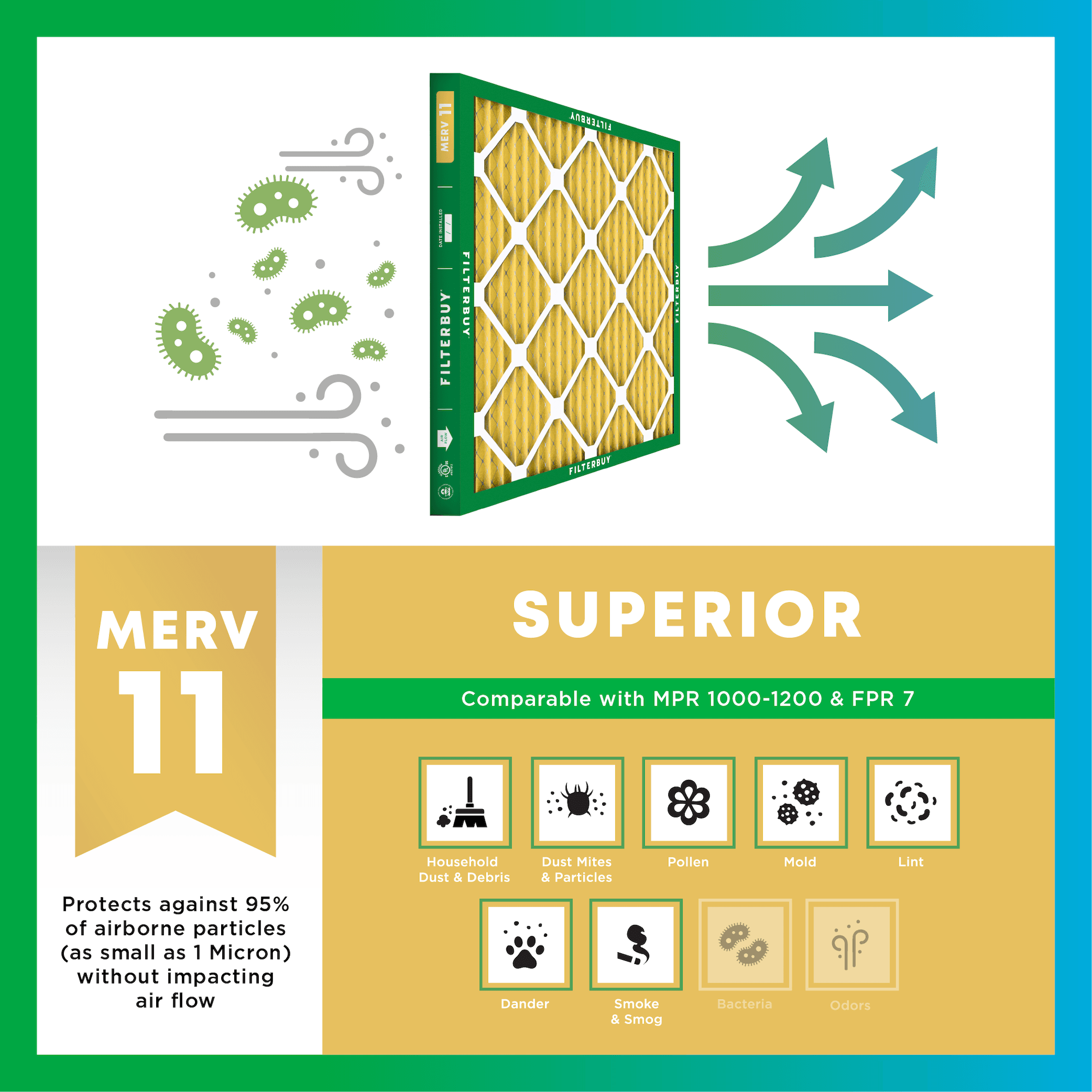
MERV stands for Minimum Efficiency Reporting Value—but don't let the technical name fool you. It's just a way to rate how well an air filter traps stuff like dust, pollen, pet dander, and smoke. The higher the MERV number, the more particles it catches—and the cleaner your air will be.

Comparable to:FPR: 4-7
MPR: 600-1000
 Dust & Debris
 Dust Mites & Particles
 Pollen
 Mold
Mold Lint
Lint Dander
Comparable to:FPR: 6-9
MPR: 1200-1550
Dust & DebrisDust Mites & ParticlesPollenMoldLintDander Smoke & Smog
Comparable to:FPR: 10
MPR: 1900-2800
Dust & DebrisDust Mites & ParticlesPollenMoldLintDanderSmoke & Smog Bacteria


We build every Filterbuy filter to deliver reliable 90-day performance—thanks to smart design and premium materials that do the heavy lifting. Here's what makes the difference:
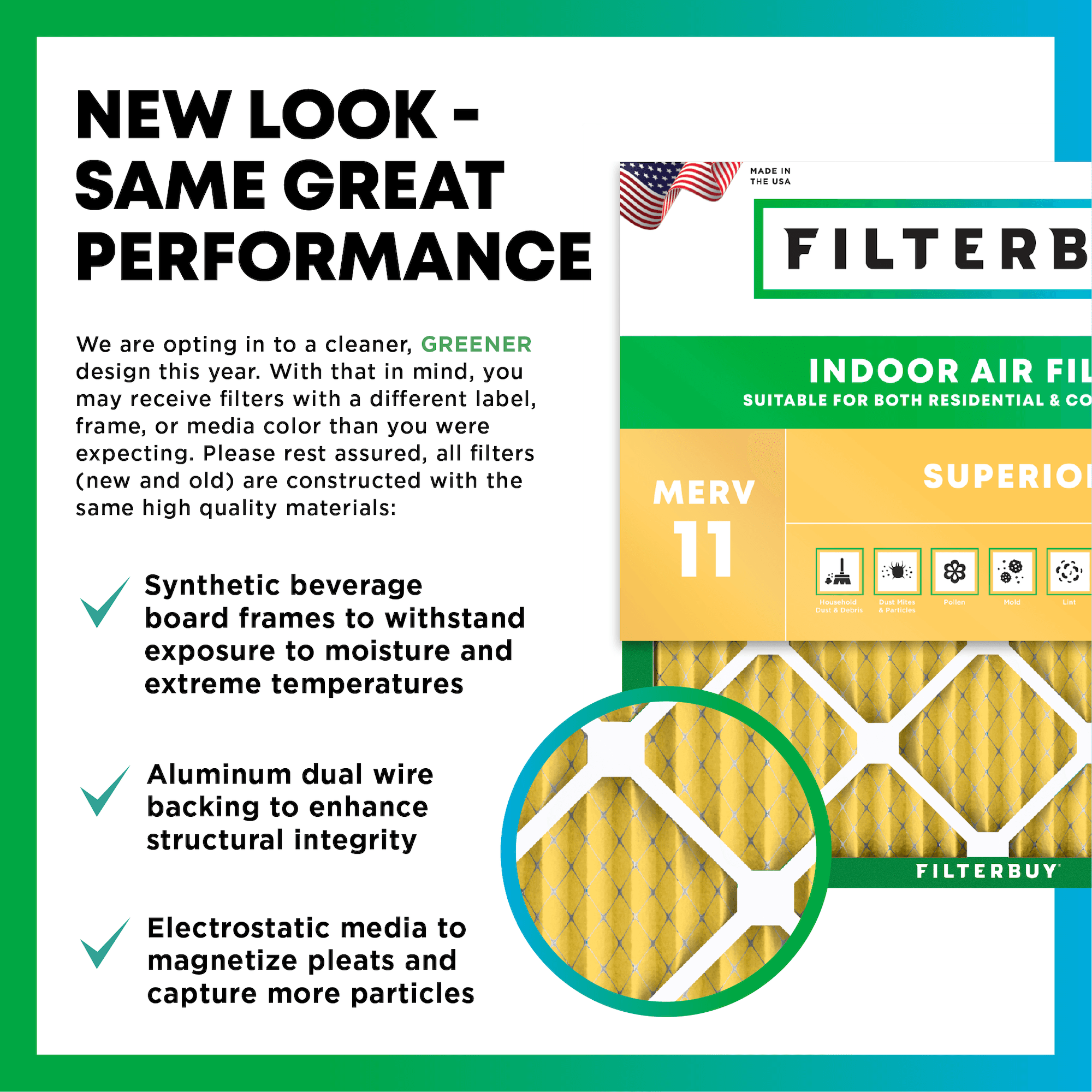
More pleats = more surface area to capture dust and debris, keeping your air cleaner longer.
Pleats are magnetized to attract and trap microscopic particles—like pet dander, pollen, and smoke.
Engineered to resist warping in extreme temperatures and high humidity.

A layer of metal reinforcement keeps pleats evenly spaced and structurally sound—no sagging, even at high airflow.
Assembled with care. Built to perform. Ships fast, free, and reliably from our U.S. facilities.

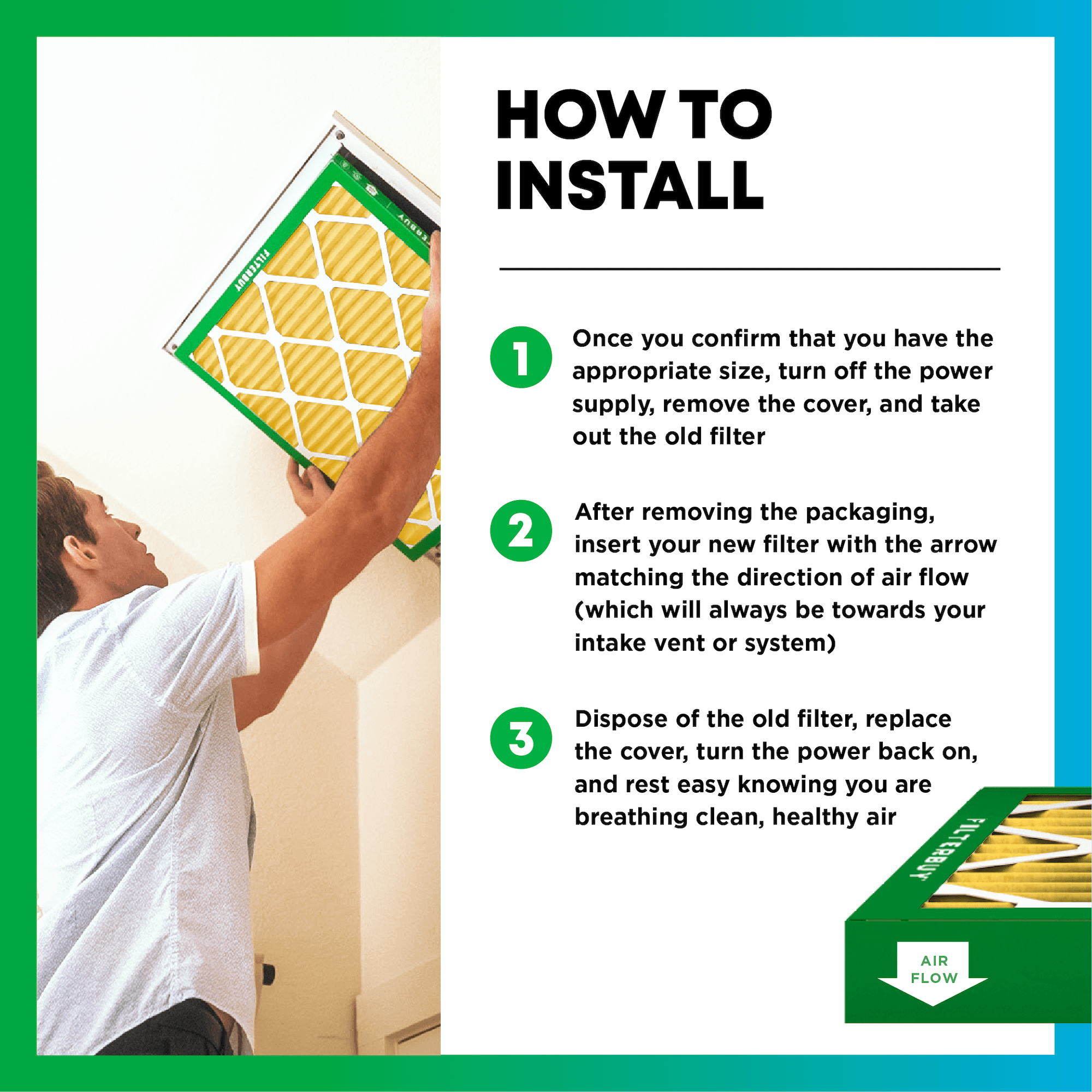
Turn Off Your HVAC SystemSafety first.

Remove The Old FilterLook for the airflow arrow and make note of the direction.

Slide In Your New FilterArrow should point toward the system (same direction as before).

Turn Your System Back OnAnd enjoy the fresh, clean air.

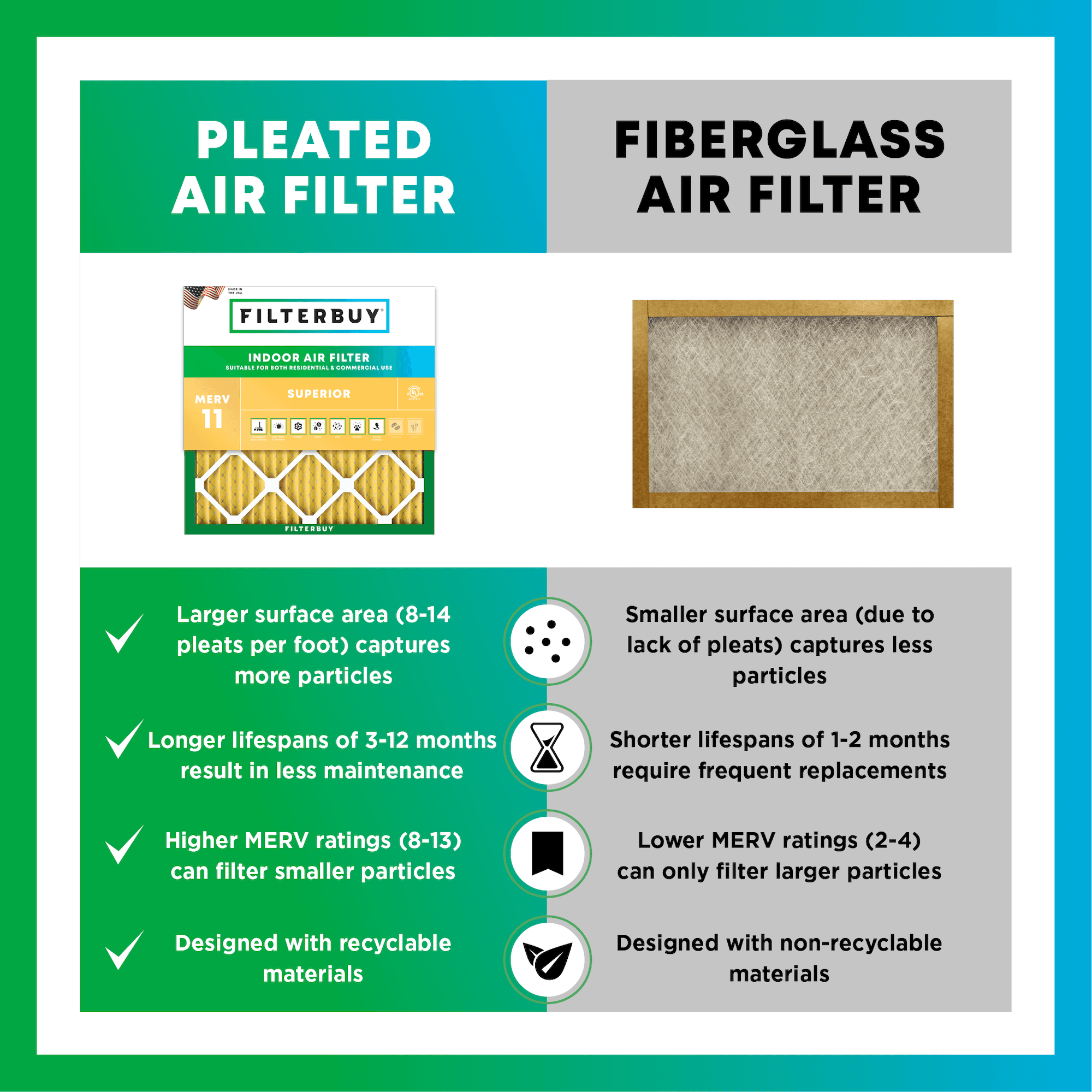
Not all air filters are created equal. Pleated filters don't just last longer—they actually clean your air better. Here's how they stack up:

Efficiency:
High (MERV 8–13) – Traps more particles
Lifespan:
90 days – Long-lasting performance
Air Quality:
Excellent – Cleaner, healthier air
Materials:
Recyclable and durable

Efficiency:
Low (MERV 4 or less) – Misses small stuff
Lifespan:
30 days or less – Replace often
Air Quality:
Minimal – Basic protection only
Materials:
Thin, flimsy, and not recyclable
Pleated filters are a no-brainer—more protection, less hassle, and better air for your home.
Changing your filter on time keeps your HVAC system running efficiently—and helps protect your lungs from dust, allergens, and airborne irritants. Here's how often to swap it out based on your needs:

For most homes without pets or special air quality concerns. Great for general upkeep and energy efficiency.

Shedding fur, dander, and allergy triggers can build up fast. Changing your filter every two months helps keep the air fresher and symptoms at bay.

For households affected by smoke, pollution, or respiratory conditions, monthly changes ensure maximum protection.

| Nominal Size | 20X20X5 |
| Actual Size | 20.75 x 20.25 x 5.25 inches |
| Filter Type | Pleated |
| Media | Electrostatically Charged |
| Frame | Beverage Board |
| MERV Ratings Available | 8, 11, 13 |
| Lifespan | Up to 12 Months |
| Origin | Made in USA |
Pull your current BDP filter out right now and hold it next to something white. If it's gray or streaked brown, your HVAC system has been working against itself — and so has your air quality.
At Filterbuy, we're obsessed with indoor air quality. After manufacturing filters for over a decade and shipping to more than two million households, one pattern shows up constantly: homeowners who switch to a 5-inch deep pleat furnace filter stop treating filtration as a chore. They change it less often, breathe cleaner air day to day, and — this part always surprises people — they stop thinking about filters altogether.
That's what good filtration actually looks like. Not a ritual you dread. A maintenance item you schedule once and forget.
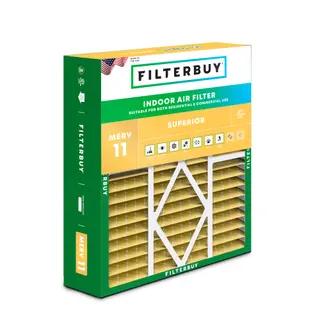
The Filterbuy MERV 11 20x20x5 BDP replacement filter handles whole-home air filtration at a level a standard 1-inch filter can't touch. Its deep-pleat design holds far more electrostatically charged media, which means it traps more particles across a longer service life — without choking the airflow your HVAC needs to run right.
Below, we cover what MERV 11 means in practice, why filter depth matters more than most shoppers realize, and exactly which BDP systems this filter replaces. Everything you need to make a confident call.
The MERV 11 20x20x5 BDP air filter is a 5-inch deep pleat replacement filter that fits BDP, Bryant, Carrier, Payne, and Day & Night media air cleaner housings — including part numbers P102-2020, B2-1056, M2-1056, CMF2020, and P102-MF14B — with no retrofitting required.
After manufacturing filters for over a decade and shipping to more than two million households, we've found that the 5-inch deep pleat format outperforms standard 1-inch filters in three measurable ways:
Filtration: Traps 95% of airborne particles 1–3 microns in size, including dust, pollen, pet dander, mold spores, and smoke
Lifespan: Lasts up to 3 months — roughly three times longer than a standard fiberglass filter — because the deeper pleat holds far more media surface area before reaching capacity
System protection: Maintains lower airflow resistance across its full service life, reducing strain on the blower motor and protecting the evaporator coil
Actual dimensions are approximately 19-11/16 x 20-5/8 x 4-7/8 inches. Replace every 3 months under standard conditions; check at 6–8 weeks in homes with pets, active renovation, or high outdoor pollution.
The Filterbuy MERV 11 20x20x5 BDP air filter traps 95% of airborne particles in the 1–3 micron range, including dust, pollen, pet dander, mold spores, smoke, and auto emissions.
The 5-inch deep-pleat design holds dramatically more media surface area than a 1-inch filter at the same face size, which lowers pressure drop, extends filter life, and keeps filtration efficiency consistent across the full service period.
This filter is a direct, no-modification replacement for BDP, Bryant, Carrier, Payne, and Day & Night media air cleaner housings — part numbers P102-2020, B2-1056, M2-1056, CMF2020, and P102-MF14B.
MERV 11 is the recommended rating for most residential homes, equivalent to MPR 1000–1200 and FPR 7 — the right balance of allergen capture and airflow for households with pets, allergy sufferers, and children.
This filter is rated to last up to 3 months under standard conditions — roughly three times longer than fiberglass models — and is 100% manufactured in the United States.
Replace every 3 months in a typical household. Pets, active renovation, or high outdoor pollution all shorten that window — check at 6–8 weeks in those situations.
Running an HVAC system without a filter — even for 24 hours — deposits debris directly onto the evaporator coil. That debris is hard to remove and shortens equipment life. Don't skip it.
Here's something most filter shoppers miss: the single biggest performance variable in residential air filtration isn't the MERV rating. It's the depth of the media behind it.
A 5-inch deep pleat filter holds far more filtration surface area than a 1-inch pleated filter at the same face dimensions. More surface area means more room to catch particles before the filter hits capacity, lower airflow resistance, and a much longer service life. The physics aren't subtle — a deeper pleat spreads the particle load across a larger media surface, which keeps pressure drop low and airflow steady from the day you install it to the day you pull it out.
In our experience manufacturing filters across every depth and format, the 5-inch consistently delivers what MERV 11 owners expect but rarely get from 1-inch filters: months of steady performance, not weeks of creeping restriction.
That lower pressure drop protects more than your air. A clogged or restrictive filter strains the blower motor, pushes the system harder to move air, and wears out components that cost real money to replace. The Filterbuy MERV 11 20x20x5 is rated to last up to three months — roughly three times longer than a standard fiberglass model — so it earns its cost in air quality and equipment protection both.
MERV 11 is defined by ASHRAE Standard 52.2 as capturing particles in the 1.0–3.0 micron range at 65–79% minimum efficiency — well above what standard filters hit at that particle size. In practice, the Filterbuy MERV 11 20x20x5 traps 95% of common airborne particles. The list includes everything that causes real problems in a typical home:
Dust, lint, and debris
Pollen and outdoor allergens
Pet dander
Mold spores
Smoke and smog particles
Dust mites and their byproducts
Auto emissions entering through your ventilation system
MERV 11 is the right rating for most American homes — strong enough to capture the allergens and pollutants that irritate respiratory systems, while staying compatible with a wide range of HVAC equipment. If someone in your household has severe asthma, is immunocompromised, or you live near heavy traffic or industrial activity, stepping up to MERV 13 is worth the conversation. For most households — pets, allergy sufferers, young kids — MERV 11 in a 5-inch deep pleat format gives you solid protection without the airflow restriction risk that comes with a higher-rated 1-inch filter.
For comparison shoppers: this filter is equivalent to MPR 1000–1200 and FPR 7. Same performance tier, different label.
BDP stands for Bryant, Day & Night, and Payne — three HVAC brands Carrier Corporation brought together under one division in 1974. All three share compatible media air cleaner housing designs, and the Filterbuy MERV 11 20x20x5 replaces the most common BDP part numbers with no retrofitting, modifications, or adapters needed.
Part numbers this filter replaces directly:
P102-2020
P102-2020BB
B2-1056
M2-1056
CMF2020
P102-MF14B
The nominal size is 20x20x5 inches. Actual dimensions run approximately 19-11/16 x 20-5/8 x 4-7/8 inches — the standard industry undercut that lets the filter slide in cleanly without binding. Order by the nominal size printed on your existing filter's frame, not by measuring the housing opening.
If you're not sure whether this filter fits your specific unit, check the part number label on your current filter or pull up your system's user manual. The answer's right there.
One filter handles your entire home's air. That's the whole point of a media air cleaner cabinet.
Every cubic foot of air your system circulates passes through this filter — whether you're running heat in January, AC in July, or just the fan year-round. A portable room purifier cleans one space at a time. The Filterbuy MERV 11 20x20x5 works across the whole house from one location.
The electrostatically charged pleated media catches and holds particles as they move through — not just the large visible dust, but the fine particles in the 1–3 micron range responsible for most respiratory irritants. Reinforced wire backing keeps the pleat structure intact under continuous airflow so it doesn't collapse and lose performance over time. The humidity-resistant frame holds its shape through seasonal temperature swings, keeping a tight seal against the housing and closing off the bypass gaps that let unfiltered air sneak around cheaper filters.
What all that adds up to in a real home: cleaner coils, a protected blower motor, cleaner ducts, and better air quality — from one filter change every three months.
Every 3 months is the standard for typical household conditions. That's not a generic recommendation — it's based on our manufacturing data and feedback from over two million households.
That said, your home isn't average. Adjust your schedule if any of these apply:
Pets: dander load climbs fast — check the filter at 6–8 weeks
Active renovation or construction: dust fills filters quickly — check monthly
High outdoor pollution or wildfire smoke: elevated particle load shortens filter life
Household members with allergies or asthma: fresh filter media matters more here than anywhere
Vacation property or seasonal home: go by calendar dates, not system run time
The check is easy: pull the filter and hold the intake face next to something white. Gray or black means change it, regardless of how recently you installed it. And never run your system without a filter — even 24 hours of unfiltered airflow deposits debris on the evaporator coil that's genuinely difficult and expensive to remove.
"We've tested filter performance across every depth and format we manufacture, and the data points to the same conclusion every time: a 5-inch deep pleat at MERV 11 protects your HVAC equipment and your family's air more cost-effectively than any 1-inch filter at the same rating — and that's not a claim we'd make without a decade of production data behind it."
- Filterbuy Team
You're the one protecting your household's air. Here are seven resources that make sure you're working with the right information.
1. What Is a Pleated Air Filter? — Our Filterbuy Resource Center breaks down how pleated filter media works, why pleat depth changes performance, and what to look for when choosing a MERV rating for your home. Start here if filter specs are new territory.
URL: https://filterbuy.com/resources/air-filter-basics/what-is-a-pleated-air-filter/
2. Air Filter — Wikipedia — A broad reference covering filter types, standards, and applications across residential and commercial use. Good context for where MERV 11 fits in the wider filtration landscape.
URL: https://en.wikipedia.org/wiki/Air_filter
3. EPA: Indoor Air Quality Overview — The U.S. Environmental Protection Agency's resource on indoor air quality risks, pollutant sources, and how filtration reduces exposure. Worth reading if you want to understand what's actually in your home's air.
URL: https://www.epa.gov/indoor-air-quality-iaq
4. American Lung Association: Air Cleaning — Guidance on HVAC filtration and MERV ratings, including filter selection recommendations for households managing respiratory health concerns.
URL: https://www.lung.org/clean-air/indoor-air/protecting-from-air-pollution/air-cleaning
5. ASHRAE Standard 52.2 — The testing standard that defines MERV ratings, published by the American Society of Heating, Refrigerating, and Air-Conditioning Engineers. This is where the 'MERV 11' label gets its meaning.
URL: https://www.ashrae.org/technical-resources/bookstore/standards-52-1-and-52-2
6. EPA: The Inside Story — A Guide to Indoor Air Quality — One of the EPA's most detailed homeowner-facing guides on pollution sources, health effects, and mitigation strategies including ventilation and filtration. Co-published with the U.S. Consumer Product Safety Commission.
URL: https://www.epa.gov/indoor-air-quality-iaq/inside-story-guide-indoor-air-quality
7. Filterbuy Size Finder — Confirming that 20x20x5 is the right size for your system? Use the Filterbuy size finder to verify before ordering. The nominal size is printed on the frame of your current filter.
URL: https://filterbuy.com/air-filters/
The data on indoor air quality has been building for decades. These three numbers from government and public health sources put it in perspective for any American household.
Americans spend approximately 90 percent of their time indoors, where some pollutants reach concentrations 2 to 5 times higher than outdoors — and occasionally more than 100 times higher. The groups most exposed to indoor pollution's effects — children, older adults, and people with cardiovascular or respiratory disease — tend to spend even more time inside than average.
Source: U.S. EPA — Indoor Air Quality (epa.gov/report-environment/indoor-air-quality)
Indoor air concentrations of some pollutants run 2 to 5 times higher than outdoor air — and in certain cases, more than 100 times higher. Factors driving that gap include indoor pollution sources, reduced ventilation in energy-efficient construction, and the accumulation of combustion byproducts, synthetic materials, pet dander, and mold over time.
Source: U.S. EPA — Why Indoor Air Quality Is Important to Schools (epa.gov/iaq-schools)
The American Lung Association Health House recommends MERV 11 or higher for residential HVAC filtration, with filter changes every 3 months under normal household conditions. Stepping up from a MERV 8 default filter to MERV 11 or above captures a significantly broader range of the particles that drive respiratory irritation and allergy symptoms.
Source: American Academy of Allergy, Asthma & Immunology — PMC (pmc.ncbi.nlm.nih.gov/articles/PMC2824428)
Switching to a MERV 11 20x20x5 BDP air filter is one of the simplest calls a homeowner can make for their family's health and their HVAC system's lifespan. You're not overhauling anything. You're not spending hundreds of dollars. You're making a targeted swap that improves the air quality of every room in your home, every day, until the next scheduled change.
Our take: the 5-inch deep pleat at MERV 11 is the strongest fit for most American homes. It captures the full range of common respiratory irritants — pet dander, pollen, mold spores, dust mites, smoke — while keeping the airflow characteristics that protect equipment and hold energy costs down. The longer change interval isn't just a convenience. It's evidence that the filter is performing at rated capacity throughout its service life, not just in the first few weeks after you put it in.
We've shipped these filters to households across every climate zone, home size, and HVAC configuration in the country. The homeowners who get the most out of this filter are the ones who stop treating air filtration as an emergency response and start treating it as a planned investment in the health of their home. This filter makes that straightforward.
Make the invisible visible. Know what's floating in your home's air. Then do something about it.
You've got the information. Here's how to act on it today.
Confirm your filter size. Check the nominal size printed on the frame of your current filter. You're looking for 20x20x5. Different size? Use the Filterbuy size finder at filterbuy.com to find the right one.
Verify your BDP part number. Check your current filter's label or your system's documentation for P102-2020, P102-2020BB, B2-1056, M2-1056, CMF2020, or P102-MF14B. Any of those is a confirmed match.
Choose your quantity. Single filters ship, but multi-packs bring the per-filter price down significantly. On a 3-month schedule, a 4-pack covers a full year at the best price per filter.
Set a reminder the day you install it. The most common reason homeowners run a clogged filter isn't forgetting to change it — it's forgetting when the next one is due. One calendar entry fixes that permanently.
Consider Subscribing & Save. Filterbuy's auto-ship program delivers replacement filters on your schedule — quarterly, bi-monthly, or monthly. Easy to pause, adjust, or cancel. You'll never think about it again.
Check your current filter right now. Pull it, hold it next to something white, and look at the intake face. Gray or black means replace it today — don't wait for a scheduled change. A clogged filter is actively restricting airflow and lowering your air quality as you read this.
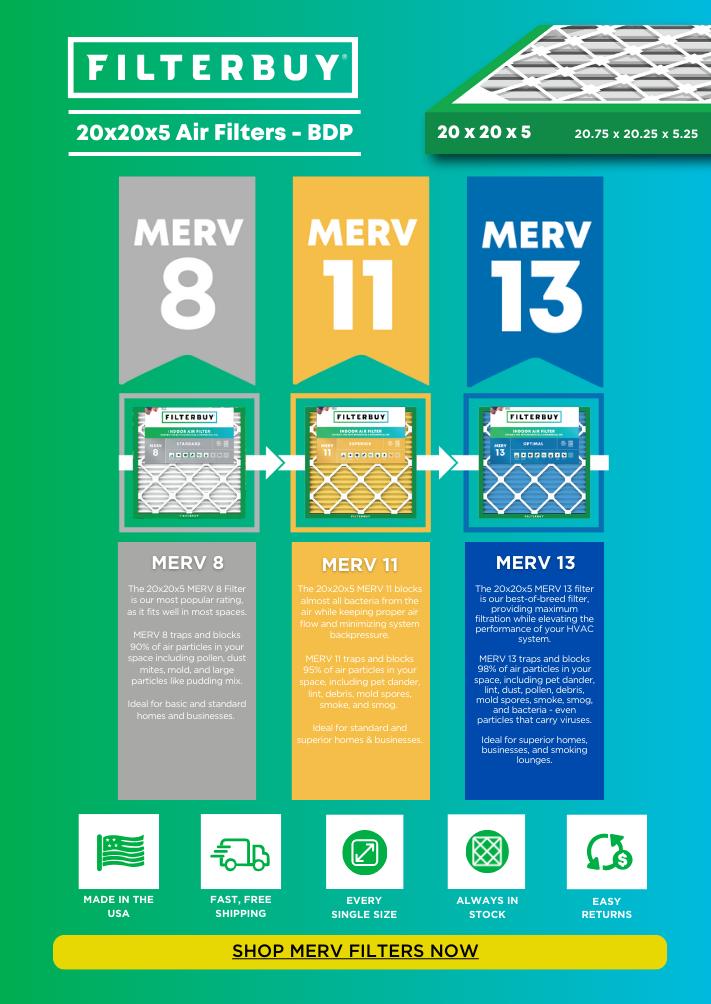
MERV 11 — Minimum Efficiency Reporting Value 11, defined by ASHRAE Standard 52.2 — measures a filter's ability to capture airborne particles. At this rating, the filter catches 65–79% of particles in the 1.0–3.0 micron range, and up to 95% of larger common household particles including dust, pollen, pet dander, mold spores, and smoke. In the 20x20x5 deep pleat format, that rated efficiency comes without the significant pressure drop a 1-inch MERV 11 filter imposes, because the larger media surface spreads the particle load across a much greater area.
Yes. The Filterbuy MERV 11 20x20x5 directly replaces common BDP part numbers: P102-2020, P102-2020BB, B2-1056, M2-1056, CMF2020, and P102-MF14B. It also fits Bryant and Carrier media air cleaner housings using the same housing design. BDP — Bryant, Day & Night, and Payne — is a Carrier Corporation family of brands whose HVAC systems share compatible filter housing specs. Check the part number on your existing filter to confirm.
Up to 3 months under standard household conditions — about three times longer than a 1-inch fiberglass filter. Homes with pets, ongoing renovation, or elevated outdoor air pollution often need a change at 6–8 weeks instead. The easiest check: hold the intake face next to a white surface. Gray or black means it's time.
The nominal size is 20x20x5 inches. Actual dimensions run approximately 19-11/16 x 20-5/8 x 4-7/8 inches. Every filter manufacturer produces filters slightly smaller than their nominal dimensions — that's the standard industry undercut that lets the filter slide into the housing cleanly. Order by the nominal size printed on your existing filter's frame, not by measuring the housing opening.
A 5-inch deep pleat filter holds far more filtration media than a 1-inch filter at the same face size. That extra media capacity means it catches more particles before reaching capacity, maintains lower airflow resistance throughout its service life, and delivers consistent performance over a longer period. The practical result: better air quality, less strain on your HVAC system, and a lower per-month cost once the extended change interval is factored in.
Yes — MERV 11 is the standard recommendation for households with allergy sufferers, and it's the rating the American Lung Association Health House program recommends. It catches pet dander, pollen, dust mites, and mold spores, which are the main triggers for most indoor allergy and asthma symptoms. If your household includes someone with severe asthma, an immunocompromised family member, or you're dealing with significant outdoor pollution, MERV 13 provides additional capture of finer particles. For most homes, MERV 11 in a 5-inch deep pleat is the right starting point.
BDP — Bryant, Day & Night, and Payne — is a group of HVAC brands that Carrier Corporation consolidated under one division in 1974. All three brands, along with related Carrier systems, use compatible media air cleaner housing designs. The Filterbuy MERV 11 20x20x5 fits all of them without modification. If your furnace or air handler came from Bryant, Carrier, Day & Night, or Payne, and your current filter is a 20x20x5, this is the correct replacement.
MERV 11 catches particles 1 micron and larger very effectively. Particles below 1 micron — including some bacteria, ultrafine combustion byproducts, and certain virus carriers — need MERV 13 or higher for meaningful capture. If your primary concern is virus particles or fine combustion byproducts from gas stoves or heavy traffic nearby, step up to MERV 13. For the allergens, pet dander, dust, mold, and smoke that affect most households, MERV 11 in a 5-inch deep pleat covers it well.
The Filterbuy MERV 11 20x20x5 BDP Air Filter is 100% American made, in-stock, and ships fast. Start with a single filter or lock in your best price with a multi-pack. Set up Subscribe & Save and the next one shows up before you need it — nothing to remember.

