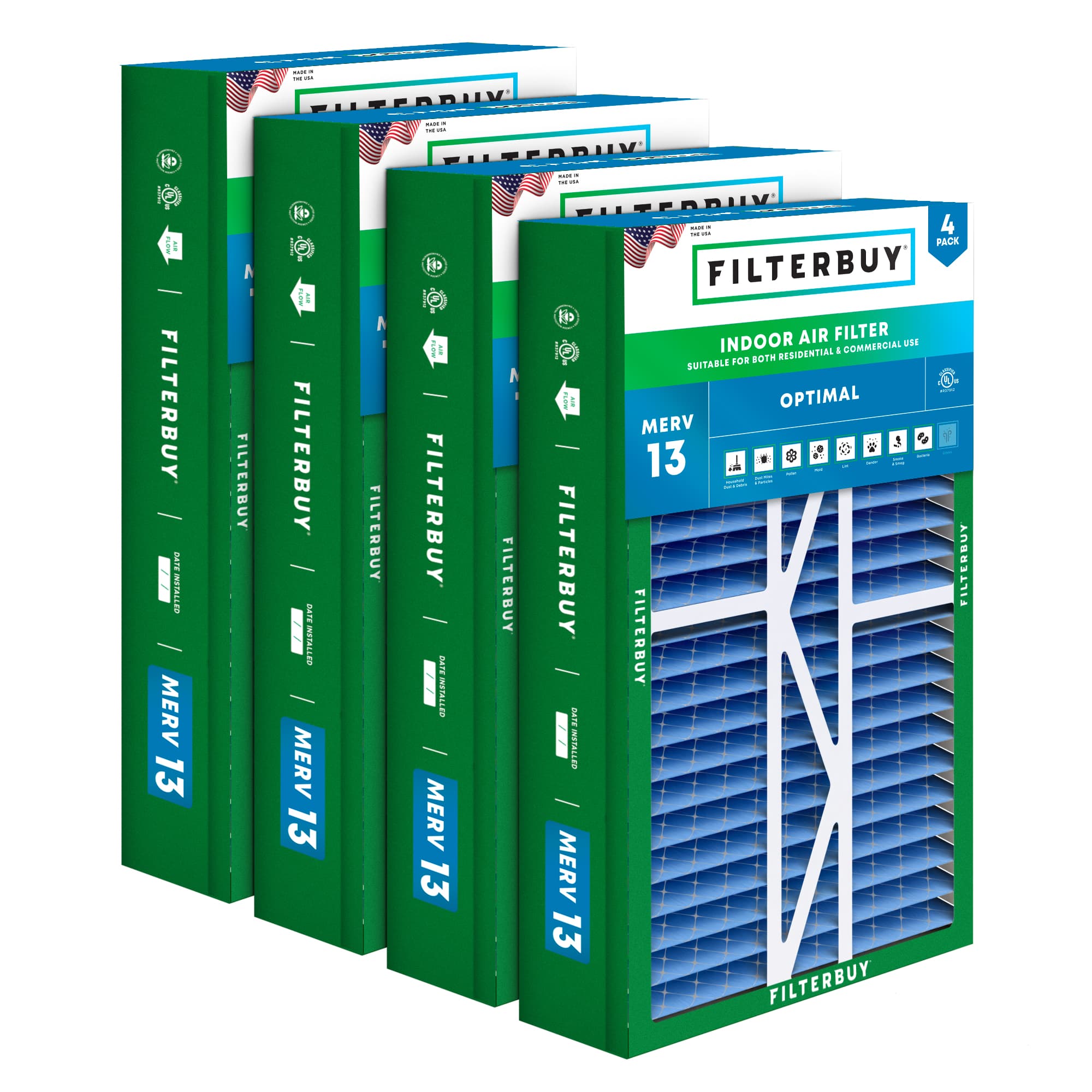
Tip: Ensure you buy the exact air filter size for your system. Certain brands have precise dimensions that only fit their specific models. See related filters
Actual Size: 17.2x26.2x5"
 Free Delivery
  Factory-Direct Low Prices, Made in the USA
 Hassle-Free Returns & Free Exchanges
RESIDENTIAL AND/OR COMMERCIAL USE
Change Every 3 Months
Tip: Ensure you buy the exact air filter size for your system. Certain brands have precise dimensions that only fit their specific models. See related filters
Actual Size: 17.2x26.2x5"
Free Delivery Factory-Direct Low Prices, Made in the USAHassle-Free Returns & Free ExchangesRESIDENTIAL AND/OR COMMERCIAL USE
Change Every 3 Months
Tip: Ensure you buy the exact air filter size for your system. Certain brands have precise dimensions that only fit their specific models. See related filters
Actual Size: 17.2x26.2x5"
Free Delivery Factory-Direct Low Prices, Made in the USAHassle-Free Returns & Free ExchangesRESIDENTIAL AND/OR COMMERCIAL USE
Change Every 3 Months
At Filterbuy, we don't cut corners—we craft high-quality air filters right here in the USA and ship them to your doorstep for free. No delays, no gimmicks—just clean air, made easy. With thousands of five-star reviews and filters built for real life & every HVAC system, it's no wonder why over 4 million families trust Filterbuy.

Proudly Made In The USA

Fast, Free Shipping on Every Order

Premium Materials That Go The Distance

85,000+ 5-Star Reviews From Happy Customers

Save Up to 70% Per Filter with Packs


Measure length × width × depth with a tape measure to find the actual size.

Round up each dimension to the nearest whole number to get the nominal size. Example: 17.2x26.2x5" in → 17.5x27x5 nominal.

Search by nominal size on our site for the best fit.


5″ filters give you maximum filtration with minimal maintenance — lasting up to 12 months while handling higher MERV ratings without restricting airflow.
Sizing note:

If the filter you buy doesn't fit, we'll send you a better size.
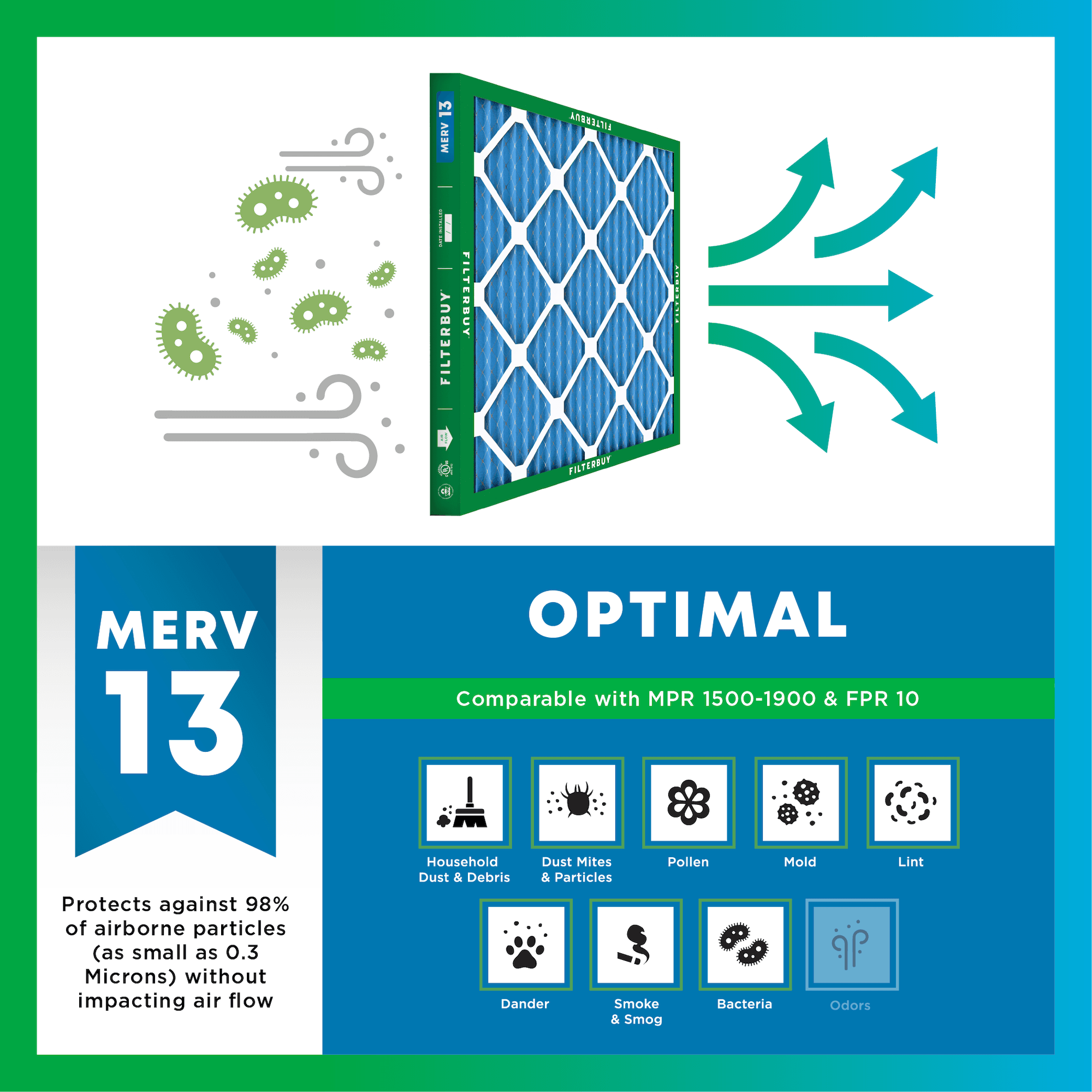
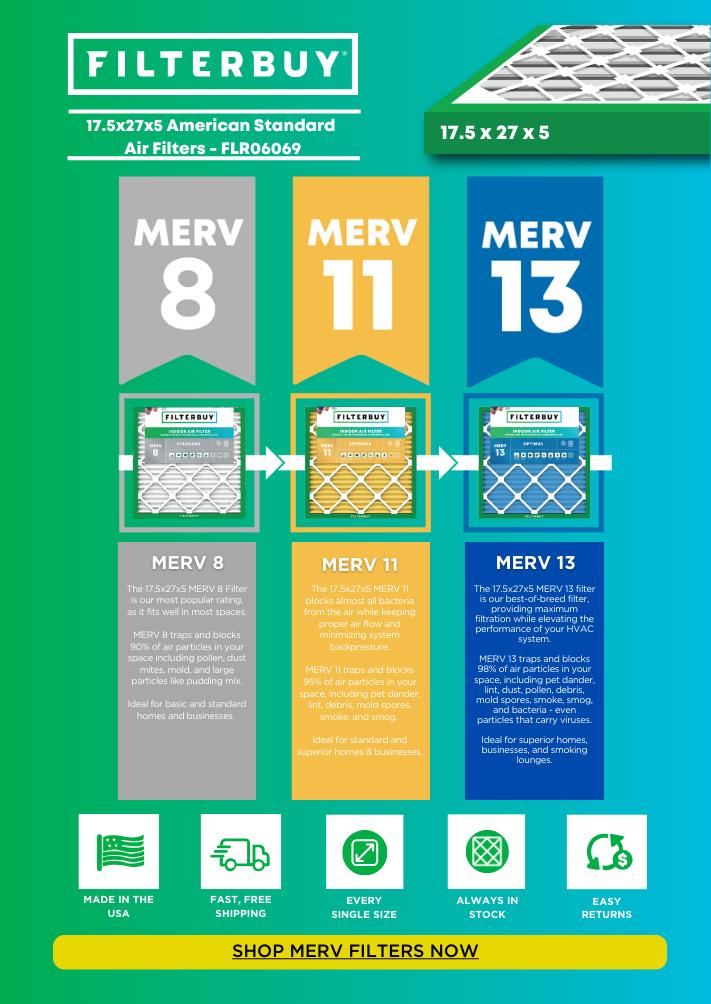
MERV stands for Minimum Efficiency Reporting Value—but don't let the technical name fool you. It's just a way to rate how well an air filter traps stuff like dust, pollen, pet dander, and smoke. The higher the MERV number, the more particles it catches—and the cleaner your air will be.

Comparable to:FPR: 4-7
MPR: 600-1000
 Dust & Debris
 Dust Mites & Particles
 Pollen
 Mold
Mold Lint
Lint Dander
Comparable to:FPR: 6-9
MPR: 1200-1550
Dust & DebrisDust Mites & ParticlesPollenMoldLintDander Smoke & Smog
Comparable to:FPR: 10
MPR: 1900-2800
Dust & DebrisDust Mites & ParticlesPollenMoldLintDanderSmoke & Smog Bacteria


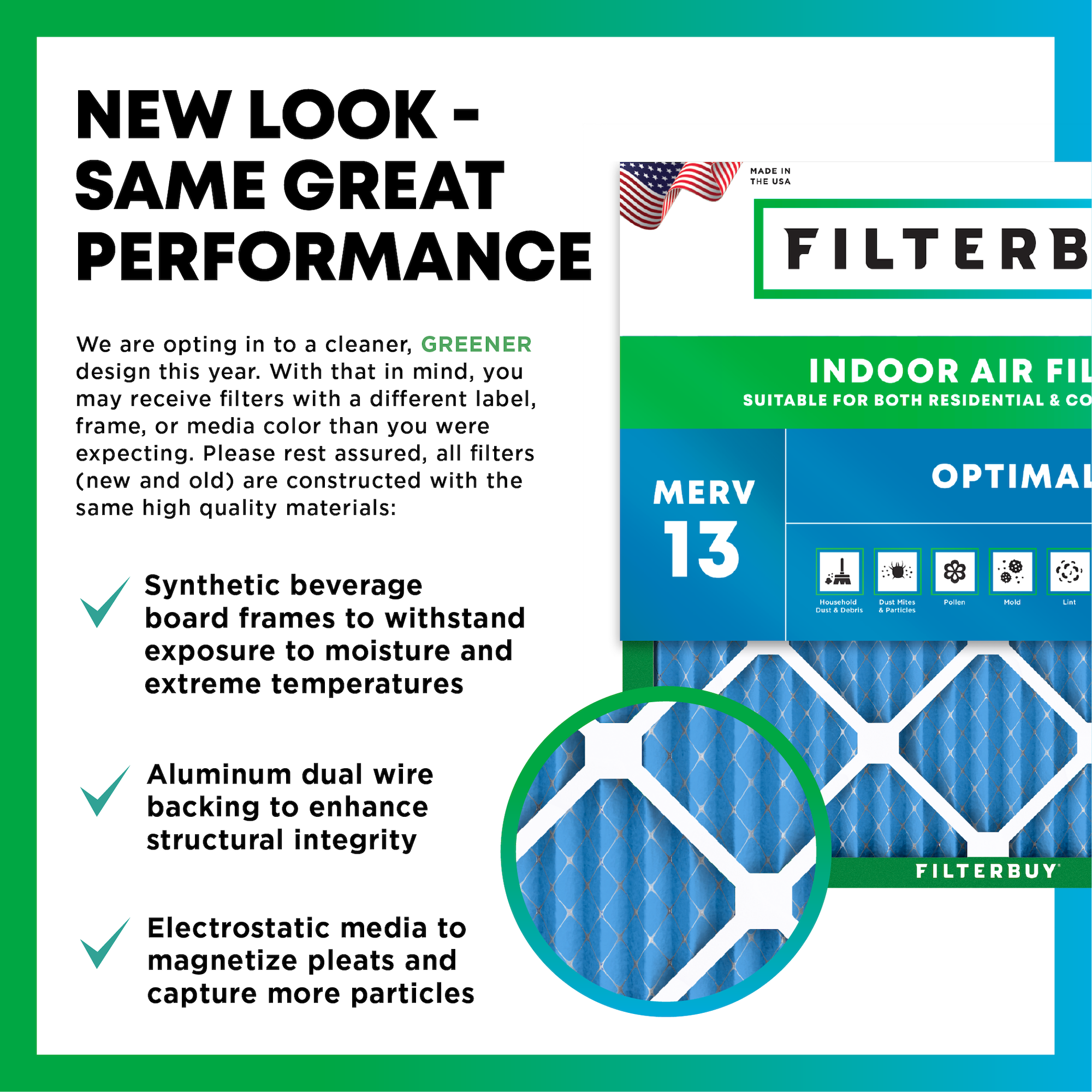
We build every Filterbuy filter to deliver reliable 90-day performance—thanks to smart design and premium materials that do the heavy lifting. Here's what makes the difference:
More pleats = more surface area to capture dust and debris, keeping your air cleaner longer.
Pleats are magnetized to attract and trap microscopic particles—like pet dander, pollen, and smoke.
Engineered to resist warping in extreme temperatures and high humidity.

A layer of metal reinforcement keeps pleats evenly spaced and structurally sound—no sagging, even at high airflow.
Assembled with care. Built to perform. Ships fast, free, and reliably from our U.S. facilities.

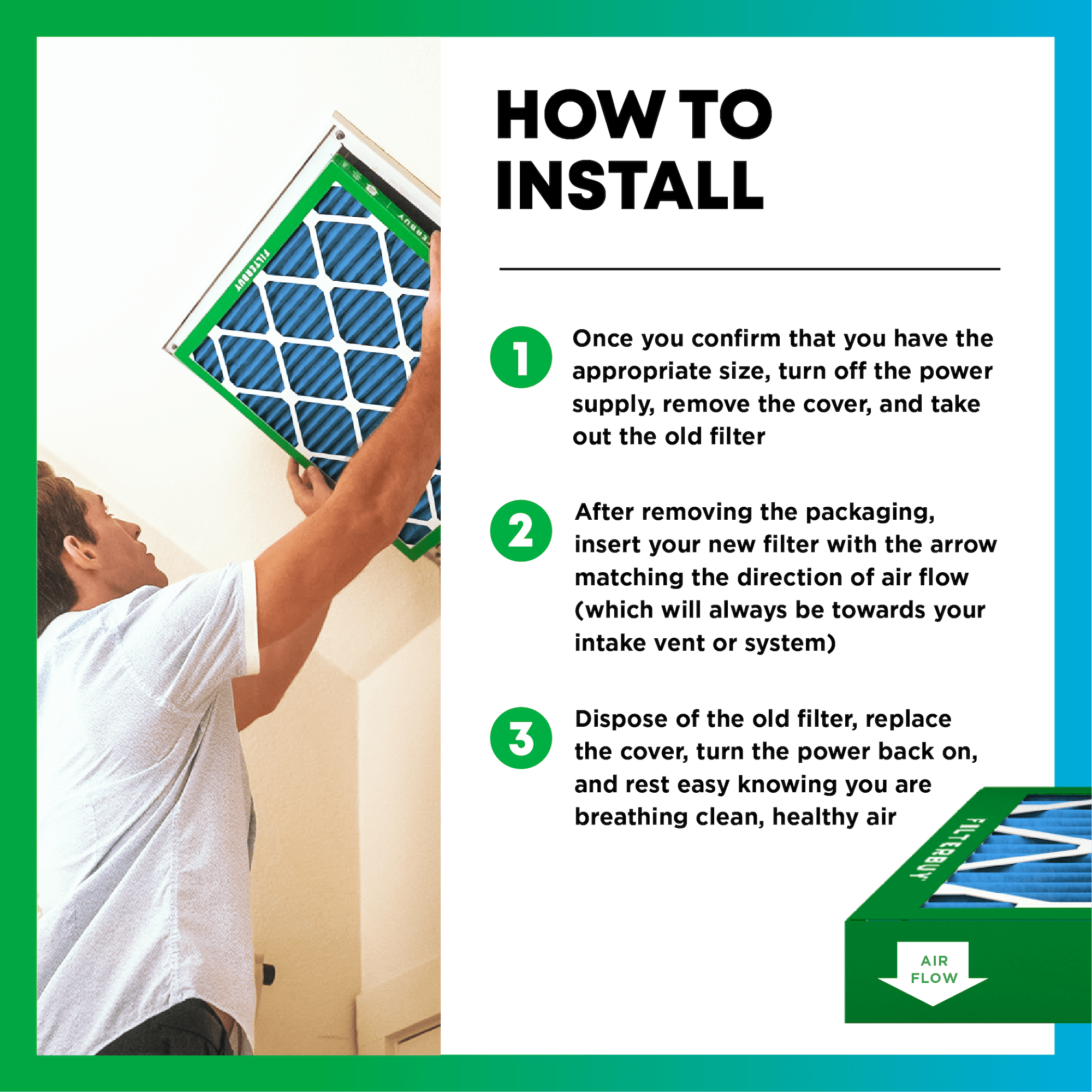
Turn Off Your HVAC SystemSafety first.

Remove The Old FilterLook for the airflow arrow and make note of the direction.

Slide In Your New FilterArrow should point toward the system (same direction as before).

Turn Your System Back OnAnd enjoy the fresh, clean air.

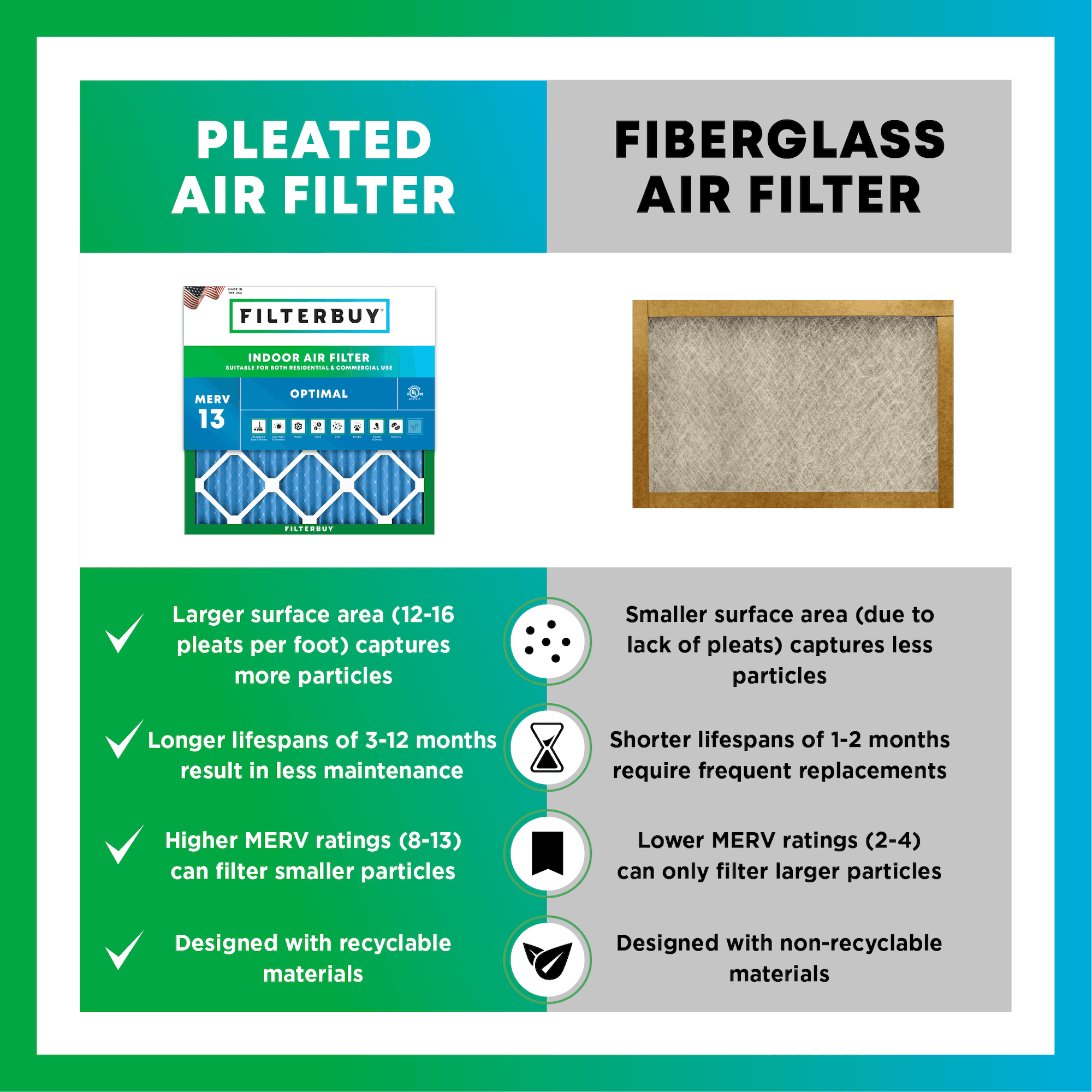
Not all air filters are created equal. Pleated filters don't just last longer—they actually clean your air better. Here's how they stack up:

Efficiency:
High (MERV 8–13) – Traps more particles
Lifespan:
90 days – Long-lasting performance
Air Quality:
Excellent – Cleaner, healthier air
Materials:
Recyclable and durable

Efficiency:
Low (MERV 4 or less) – Misses small stuff
Lifespan:
30 days or less – Replace often
Air Quality:
Minimal – Basic protection only
Materials:
Thin, flimsy, and not recyclable
Pleated filters are a no-brainer—more protection, less hassle, and better air for your home.
Changing your filter on time keeps your HVAC system running efficiently—and helps protect your lungs from dust, allergens, and airborne irritants. Here's how often to swap it out based on your needs:

For most homes without pets or special air quality concerns. Great for general upkeep and energy efficiency.

Shedding fur, dander, and allergy triggers can build up fast. Changing your filter every two months helps keep the air fresher and symptoms at bay.

For households affected by smoke, pollution, or respiratory conditions, monthly changes ensure maximum protection.

| Nominal Size | 17.5 x 27 x 5 inches |
| Actual Size | 17.2 x 26.2 x 5" inches |
| Filter Type | Pleated |
| Media | Electrostatically Charged |
| Frame | Beverage Board |
| MERV Ratings Available | 8, 11, 13 |
| Lifespan | Up to 12 Months |
| Origin | Made in USA |
A MERV 13 17.5x27x5 American Standard filter captures particles as small as 0.3 microns—including dust, pollen, mold spores, pet dander, and smoke—through electrostatically charged synthetic media engineered for both particle capture and airflow efficiency.
After manufacturing millions of MERV 13 filters, we've learned that filtration effectiveness comes down to four mechanisms working together: mechanical interception blocks particles following the airstream, impaction catches larger particles that can't navigate fiber curves, diffusion traps ultra-fine particles through random contact, and electrostatic attraction pulls contaminants from the air like a magnet.
Customers tell us the 5-inch depth is what sets this filter apart—more media surface area means longer filter life and consistent airflow throughout the replacement cycle. Below, we break down exactly how these mechanisms perform at MERV 13 efficiency and why proper sizing matters for your American Standard system.
A MERV 13 17.5x27x5 filter is a 5-inch deep pleated air filter designed for American Standard HVAC systems that captures at least 85% of airborne particles between 1.0 and 3.0 microns.
What it filters:
Dust, pollen, and mold spores
Pet dander and dust mite debris
Bacteria and smoke particles
Some virus-carrying aerosols
Why the 5-inch depth matters:
9-12 month replacement cycle vs. monthly for 1-inch filters
Lower airflow resistance than thinner high-MERV alternatives
Consistent performance throughout the filter's life
What we've learned after manufacturing millions: MERV 13 is the optimal residential rating—high enough to capture fine particles that affect respiratory health, balanced enough to avoid straining your American Standard blower motor. Customers with allergies consistently report noticeable improvement within the first week.
Key specs:
MERV Rating: 13
Nominal Size: 17.5" × 27" × 5"
Replacement Interval: 9-12 months
Compatibility: American Standard air handlers and furnaces
MERV 13 captures what matters. At least 85% of particles in the 1.0 to 3.0 micron range—dust, pollen, mold spores, pet dander, and bacteria. Customers with allergies report noticeable improvements within the first week.
The 5-inch depth is the real advantage. More media surface area means lower resistance, 9-12 month filter life, and consistent performance throughout the cycle. Depth matters more than chasing higher MERV ratings.
Proper sizing prevents wasted filtration. Air bypass through gaps undermines any MERV rating. The 17.5x27x5 is manufactured to precise tolerances for a snug fit in American Standard cabinets.
Clean filters cut energy costs by up to 15%. The Department of Energy confirms it. Customers validate it with lower utility bills. The 5-inch depth compounds those savings over time.
MERV 13 is the sweet spot. Higher ratings strain residential systems with diminishing returns. MERV 13 delivers hospital-grade capture without burning out blower motors.
Not all air filters work the same way, and MERV 13 represents a significant jump in particle capture performance. Standing for Minimum Efficiency Reporting Value, the MERV scale rates a filter's ability to trap airborne contaminants on a scale from 1 to 16 for residential use. At the MERV 13 level, your 17.5x27x5 American Standard compatible filter captures at least 85% of particles between 1.0 and 3.0 microns and over 90% of particles between 3.0 and 10.0 microns. That means common indoor pollutants like dust mite debris, mold spores, pollen, pet dander, and even some bacteria are consistently pulled from your circulating air before they reach your lungs.
Inside every MERV 13 17.5x27x5 filter, layers of tightly engineered synthetic media fibers create a dense web of particle-trapping pathways. After manufacturing millions of filters, we can tell you that the science comes down to three core mechanisms working simultaneously. Interception catches particles that follow an airstream close enough to contact a fiber and stick. Impaction forces larger particles to collide directly with fibers when they can't follow the airstream's curve around them. Diffusion handles the smallest, most erratic particles — those ultrafine contaminants that move in random zigzag patterns until they make contact with a fiber surface. The 5-inch depth of this filter gives air more time and surface area to pass through these mechanisms, which is why deeper filters consistently outperform their 1-inch counterparts in both capture efficiency and filter lifespan.
A filter only performs at its rated MERV level when it fits your system correctly. The 17.5x27x5 is a specific replacement size designed for select American Standard HVAC units, and even a small gap caused by an ill-fitting filter lets unfiltered air bypass the media entirely. Customers tell us this is one of the most commonly mis-ordered sizes because homeowners round up or down rather than measuring their existing filter or cabinet slot precisely. When your 17.5x27x5 filter seats flush in the housing, every cubic foot of air your system moves is forced through the MERV 13 media — no shortcuts, no bypass, no wasted efficiency.
MERV 13 filtration sits at the intersection of high performance and residential practicality. Hospital-grade filters exist at MERV 16 and above, but they demand airflow capacity; most home HVAC systems simply cannot deliver without straining the blower motor. A MERV 13 17.5x27x5 filter gives your American Standard system the highest level of fine particle capture that still allows healthy, unrestricted airflow. For households managing allergies, asthma triggers, or pet-related air quality concerns, that balance between capture rate and system compatibility is where the real improvement in daily breathing comfort happens. With the 5-inch depth extending your replacement interval to roughly 9 to 12 months under normal conditions, you get sustained filtration performance without the monthly maintenance cycle that 1-inch filters require.
"After engineering and manufacturing millions of MERV 13 filters, we've seen firsthand that the 5-inch depth is where filtration science and real-world performance meet—customers get hospital-grade particle capture without the airflow restrictions that strain HVAC systems and drive up energy costs."
After manufacturing millions of MERV 13 filters, we know customers want more than our word—they want independent verification. These resources from government agencies, industry standards organizations, and health authorities will help you confirm that a MERV 13 17.5x27x5 filter is the right choice for your American Standard system.
Customers ask us constantly what MERV 13 actually means. The EPA explains the official testing criteria and why MERV 13 captures particles down to 0.3 microns—the same efficiency level we engineer into every filter we manufacture.
Source: https://www.epa.gov/indoor-air-quality-iaq/what-merv-rating
This EPA consumer guide covers everything from portable air cleaners to whole-house HVAC filtration. We point customers here when they're deciding between MERV ratings—it confirms why MERV 13 hits the residential sweet spot.
Source: https://www.epa.gov/indoor-air-quality-iaq/guide-air-cleaners-home
Every MERV rating we publish comes from ASHRAE 52.2 testing protocols. This is the industry standard that holds manufacturers accountable—and the benchmark our filters are tested against before leaving our facility.
Source: https://www.ashrae.org/technical-resources/standards-and-guidelines
Customers with allergies, asthma, or respiratory concerns tell us air quality is their top priority. The American Lung Association recommends MERV 13 or higher—validation we hear reflected in customer feedback after they make the switch.
Source: https://www.lung.org/clean-air/indoor-air/indoor-air-pollutants/particulate-matter
We've seen firsthand how a clogged filter strains HVAC systems. The DOE confirms what our customers experience: clean MERV 13 filters can improve efficiency by up to 15% while protecting expensive equipment.
Source: https://www.energy.gov/energysaver/air-conditioner-maintenance
Proper sizing matters more than MERV rating alone—we hear this from customers who've dealt with air bypass issues. American Standard's official guidance helps verify that your system can handle MERV 13 filtration without airflow restrictions.
Source: https://www.americanstandardair.com/resources/glossary/merv/
After helping customers troubleshoot fit issues, we always recommend this DOE-supported guide. It covers high-MERV filter installation, pressure drop considerations, and ensuring your 5-inch filter seats properly in the cabinet.
Source: https://www.basc.pnnl.gov/resource-guides/high-merv-filters
We've manufactured millions of MERV 13 filters and heard from thousands of customers about the results. Here's what independent federal research confirms about the filtration performance our customers experience firsthand.
The U.S. Environmental Protection Agency reports:
Americans spend approximately 90% of their time indoors
Indoor pollutant concentrations are often 2 to 5 times higher than outdoor levels
Vulnerable populations (children, elderly, those with respiratory conditions) spend even more time inside
What we've observed: Customers consistently notice immediate improvements after upgrading to MERV 13. The air inside your home circulates through your HVAC system multiple times daily—every pass through MERV 13 media removes contaminants that lower-rated filters miss.
Source: https://www.epa.gov/report-environment/indoor-air-quality
The U.S. Department of Energy confirms:
Replacing a dirty filter can reduce AC energy consumption by 5% to 15%
Clogged filters force HVAC systems to work harder
Regular replacement protects equipment and extends system life
What customers tell us: Those who maintain replacement schedules report lower utility bills alongside improved air quality. This is why we engineered the 5-inch depth—more media surface area means optimal airflow for 9 to 12 months versus monthly replacements for 1-inch filters.
Source: https://www.energy.gov/energysaver/maintaining-your-air-conditioner
Both the EPA and ASHRAE recommend MERV 13 as the minimum for managing airborne contaminants. Here's what MERV 13 captures:
Particle Size
Capture Rate
Examples
1.0–3.0 microns
85%+
Mold spores, dust mite debris, pet dander
0.3–1.0 microns
50%+
Bacteria, smoke particles, fine dust
What we hear regularly: Customers with allergies, asthma, or pets report noticeable air quality improvements within the first week after upgrading from MERV 8. The science confirms what they're experiencing.
Source: https://basc.pnnl.gov/resource-guides/high-merv-filters
Bottom Line: These are federal findings—not marketing claims. They align with what we observe after manufacturing filters for over a decade and validate what customers report about breathing easier, sleeping better, and seeing lower energy bills.
Ready to upgrade to MERV 13 filtration? Follow these five steps to ensure proper fit and optimal performance.
Check your current filter. Look for size markings on the frame edge.
Measure the filter slot. Record length × width × depth to the nearest half-inch.
Consult your manual. American Standard documentation specifies compatible dimensions.
Remember: A filter that's too small allows air bypass. A filter that's too large won't seat properly. Exact sizing matters.
Check your owner's manual for maximum recommended MERV rating
If you're currently using MERV 8 or 11, upgrading to MERV 13 is typically safe
Systems older than 15 years may benefit from HVAC technician assessment
When in doubt: Contact a local professional or reach out to our team.
Select MERV 13—ideal for households with allergies, asthma, pets, or respiratory concerns
Choose quantity—a 2-pack covers most homes for up to two years
Consider auto-delivery—we'll ship before you need it, no reminders required
Turn off your HVAC system
Note the airflow direction arrow—point it toward the blower motor
Slide the filter in until it seats flush
Check for gaps around the edges
Write the installation date on the frame
Standard replacement: Every 9-12 months for 5-inch filters.
Check more frequently if you have:
Multiple pets
Recent construction or renovation
High pollen seasons
Wildfire smoke events
Household members with severe allergies
Pro tip: Inspect every 3 months. Gray or clogged before 9 months? Your environment may need faster replacement.
A: MERV 13 media captures:
At least 85% of particles in the 1.0 to 3.0 micron range
Approximately 50% of particles down to 0.3 microns
Dust, pollen, mold spores, pet dander, bacteria, and smoke
After manufacturing millions of these filters, we've learned real-world performance depends on proper fit and consistent replacement—not just MERV rating. Customers with allergies tell us they notice the difference within days.
A: Replace every 9 to 12 months under normal conditions.
The 5-inch depth extends air filter life because:
More media surface area
Particles spread across a larger filtration bed
Less rapid clogging than 1-inch alternatives
Check more frequently if you have:
Multiple pets
Recent renovation dust
Severe allergy sufferers
Wildfire smoke exposure
Customers tell us the extended cycle is what sold them after years of monthly replacements.
A: This is our most common question—and usually the concern is unfounded.
What we've found after testing across every MERV rating:
5-inch depth actually reduces restriction compared to thinner high-MERV filters
More depth means more surface area for gradual airflow
Most American Standard systems handle MERV 13 without issues
Safe to upgrade if:
Currently running MERV 8 or MERV 11
System is less than 15 years old
No existing airflow problems
We've seen customers damage systems jumping to MERV 16. MERV 13 hits the sweet spot without that risk.
A: The filterbuy 17.5x27x5 is the nominal size. Actual dimensions run 1/4 to 1/2 inch smaller so the filter slides in without forcing.
What matters most: Precise tolerances prevent air bypass.
We manufacture to exact specifications for American Standard systems because:
Even small gaps let unfiltered air pass around the media
Improper fit undermines your MERV 13 investment entirely
A proper seal means you're actually filtering—not just hoping
Customers who've dealt with ill-fitting filters tell us the difference is obvious.
A: After manufacturing filters across every MERV rating, our recommendation: MERV 13 for most homes.
MERV 11 → MERV 13: Meaningful upgrade. You capture bacteria, smoke, and fine allergens that MERV 11 misses.
MERV 13 → MERV 16: Diminishing returns. We've watched customers:
Burn out blower motors
Increase energy bills
Strain systems not designed for that resistance
Customers who switched from MERV 16 back to MERV 13 report the same air quality, lower bills, and less HVAC strain. That's the real-world insight spec sheets won't give you.
Your American Standard system was designed to protect your home's air quality — but only when paired with a filter that fits perfectly and performs at the MERV 13 level. Order your 17.5x27x5 replacement filter today from the manufacturer and experience the difference that precision-built, fine-particle filtration makes in every room of your house.

