
Tip: Ensure you buy the exact air filter size for your system. Certain brands have precise dimensions that only fit their specific models. See related filters
Actual Size: 22.13x24x5.25"
 Free Delivery
  Factory-Direct Low Prices, Made in the USA
 Hassle-Free Returns & Free Exchanges
RESIDENTIAL AND/OR COMMERCIAL USE
Change Every 3 Months
Tip: Ensure you buy the exact air filter size for your system. Certain brands have precise dimensions that only fit their specific models. See related filters
Actual Size: 22.13x24x5.25"
Free Delivery Factory-Direct Low Prices, Made in the USAHassle-Free Returns & Free ExchangesRESIDENTIAL AND/OR COMMERCIAL USE
Change Every 3 Months
Tip: Ensure you buy the exact air filter size for your system. Certain brands have precise dimensions that only fit their specific models. See related filters
Actual Size: 22.13x24x5.25"
Free Delivery Factory-Direct Low Prices, Made in the USAHassle-Free Returns & Free ExchangesRESIDENTIAL AND/OR COMMERCIAL USE
Change Every 3 Months
At Filterbuy, we don't cut corners—we craft high-quality air filters right here in the USA and ship them to your doorstep for free. No delays, no gimmicks—just clean air, made easy. With thousands of five-star reviews and filters built for real life & every HVAC system, it's no wonder why over 4 million families trust Filterbuy.

Proudly Made In The USA

Fast, Free Shipping on Every Order

Premium Materials That Go The Distance

85,000+ 5-Star Reviews From Happy Customers

Save Up to 70% Per Filter with Packs


Measure length × width × depth with a tape measure to find the actual size.

Round up each dimension to the nearest whole number to get the nominal size. Example: 22.13x24x5.25" in → 22X24X5 nominal.

Search by nominal size on our site for the best fit.


5″ filters give you maximum filtration with minimal maintenance — lasting up to 12 months while handling higher MERV ratings without restricting airflow.
Sizing note:

If the filter you buy doesn't fit, we'll send you a better size.
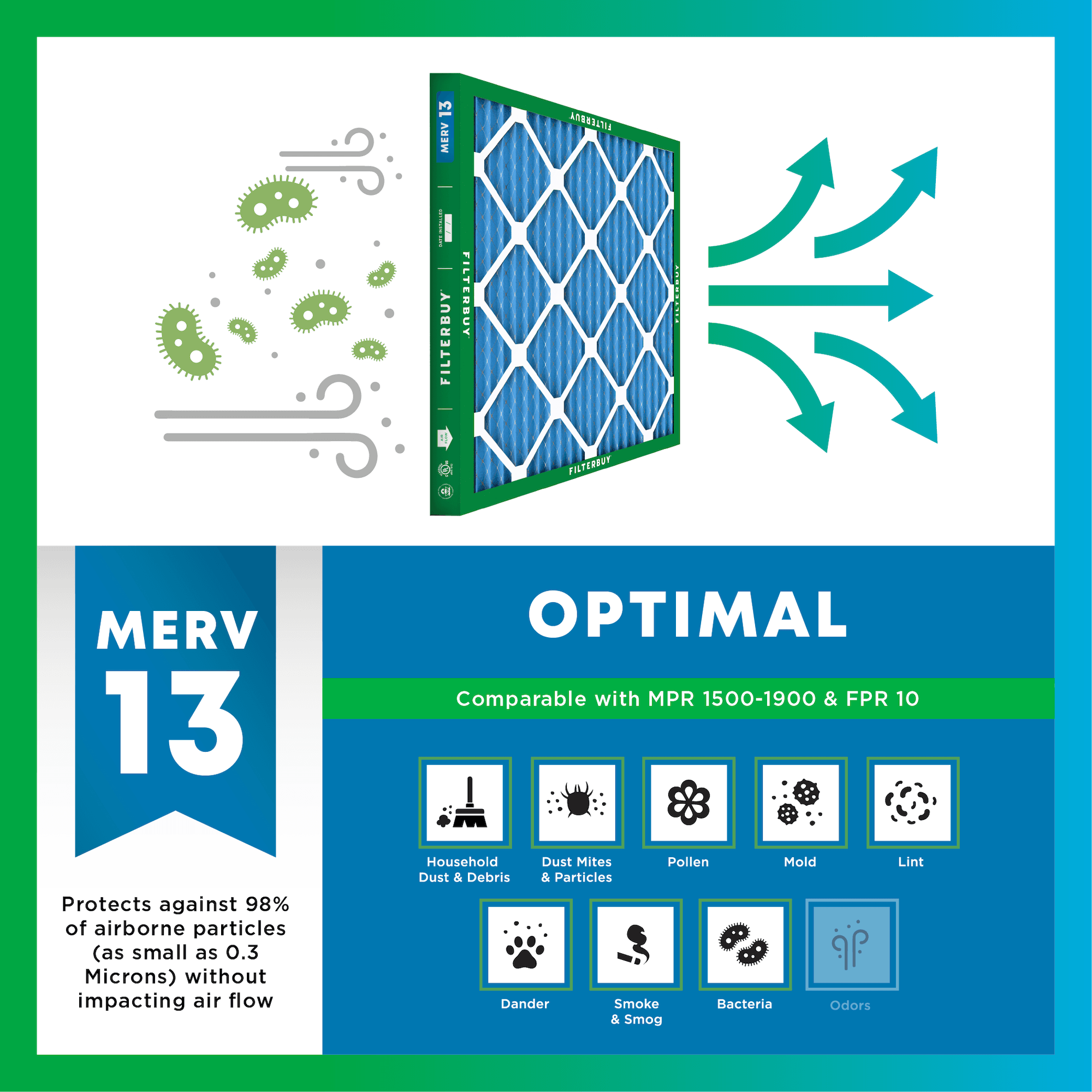
MERV stands for Minimum Efficiency Reporting Value—but don't let the technical name fool you. It's just a way to rate how well an air filter traps stuff like dust, pollen, pet dander, and smoke. The higher the MERV number, the more particles it catches—and the cleaner your air will be.

Comparable to:FPR: 4-7
MPR: 600-1000
 Dust & Debris
 Dust Mites & Particles
 Pollen
 Mold
Mold Lint
Lint Dander
Comparable to:FPR: 6-9
MPR: 1200-1550
Dust & DebrisDust Mites & ParticlesPollenMoldLintDander Smoke & Smog
Comparable to:FPR: 10
MPR: 1900-2800
Dust & DebrisDust Mites & ParticlesPollenMoldLintDanderSmoke & Smog Bacteria


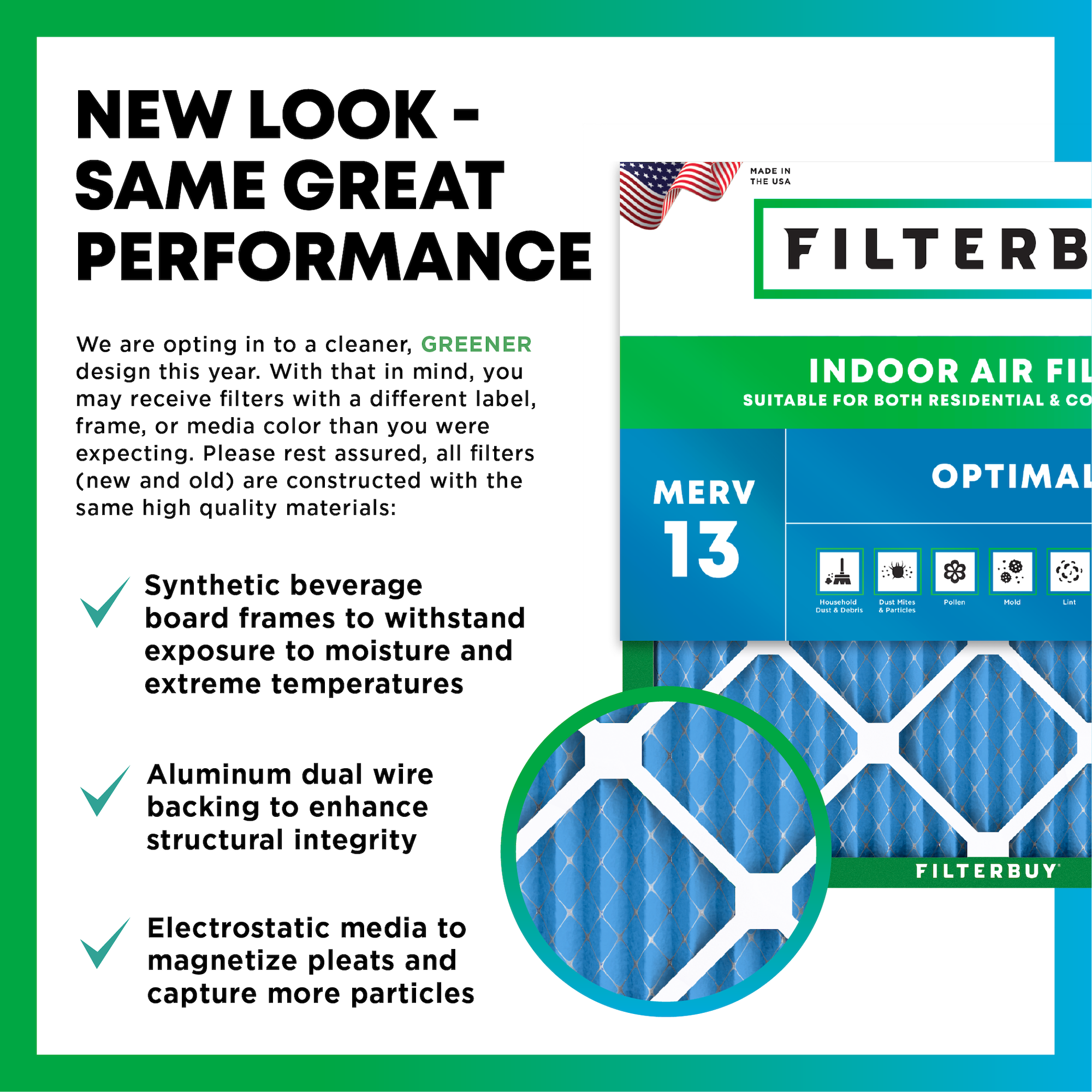
We build every Filterbuy filter to deliver reliable 90-day performance—thanks to smart design and premium materials that do the heavy lifting. Here's what makes the difference:
More pleats = more surface area to capture dust and debris, keeping your air cleaner longer.
Pleats are magnetized to attract and trap microscopic particles—like pet dander, pollen, and smoke.
Engineered to resist warping in extreme temperatures and high humidity.

A layer of metal reinforcement keeps pleats evenly spaced and structurally sound—no sagging, even at high airflow.
Assembled with care. Built to perform. Ships fast, free, and reliably from our U.S. facilities.

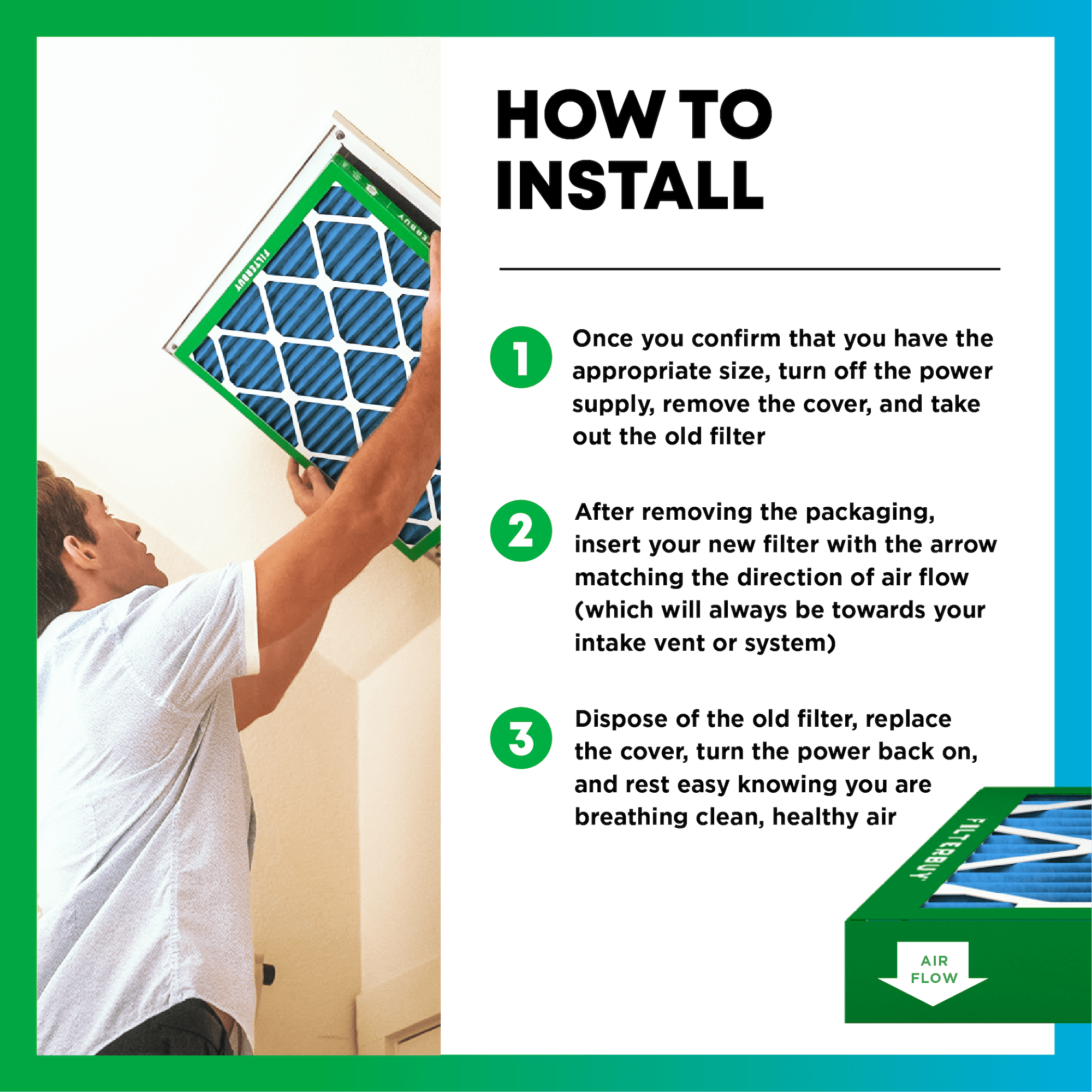
Turn Off Your HVAC SystemSafety first.

Remove The Old FilterLook for the airflow arrow and make note of the direction.

Slide In Your New FilterArrow should point toward the system (same direction as before).

Turn Your System Back OnAnd enjoy the fresh, clean air.

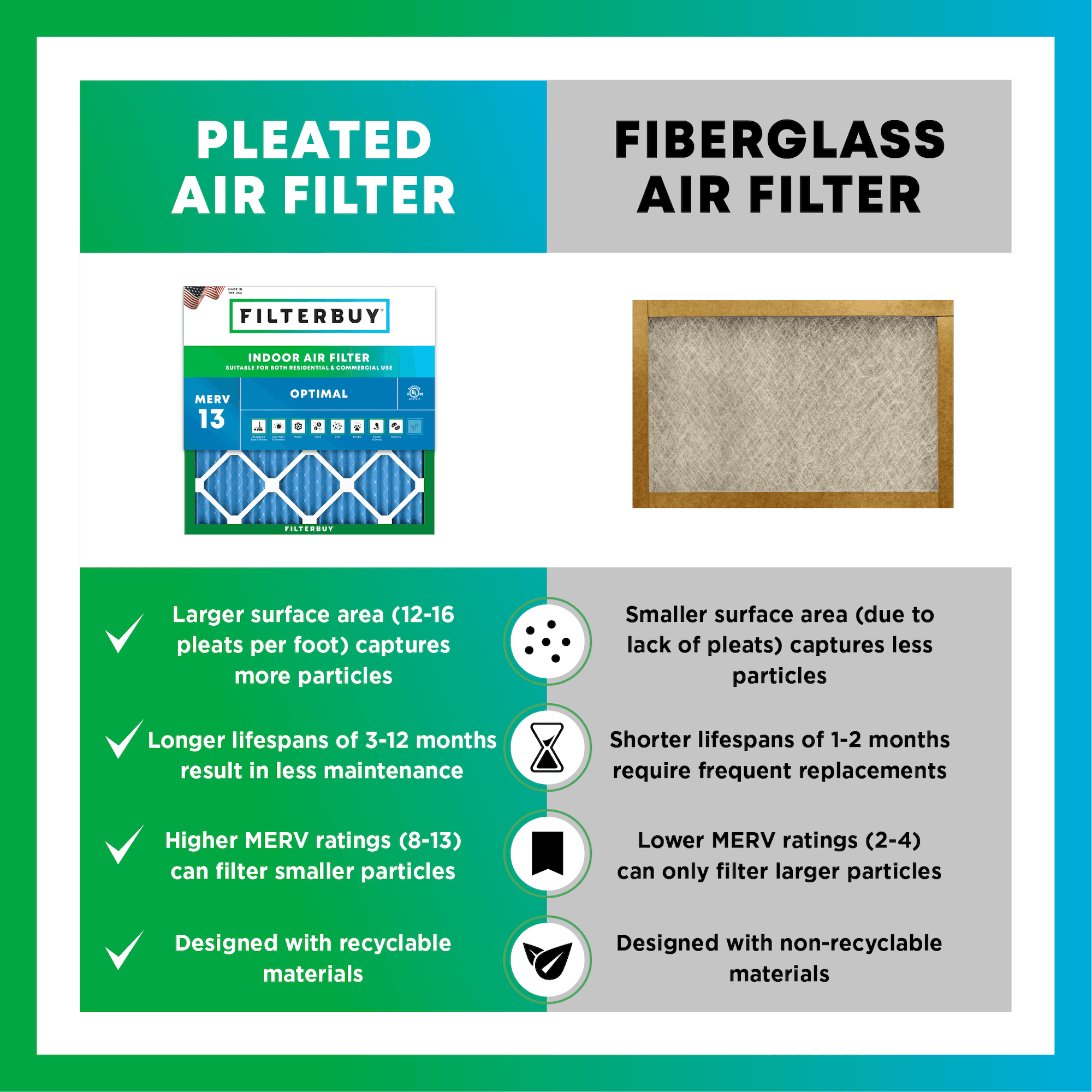
Not all air filters are created equal. Pleated filters don't just last longer—they actually clean your air better. Here's how they stack up:

Efficiency:
High (MERV 8–13) – Traps more particles
Lifespan:
90 days – Long-lasting performance
Air Quality:
Excellent – Cleaner, healthier air
Materials:
Recyclable and durable

Efficiency:
Low (MERV 4 or less) – Misses small stuff
Lifespan:
30 days or less – Replace often
Air Quality:
Minimal – Basic protection only
Materials:
Thin, flimsy, and not recyclable
Pleated filters are a no-brainer—more protection, less hassle, and better air for your home.
Changing your filter on time keeps your HVAC system running efficiently—and helps protect your lungs from dust, allergens, and airborne irritants. Here's how often to swap it out based on your needs:

For most homes without pets or special air quality concerns. Great for general upkeep and energy efficiency.

Shedding fur, dander, and allergy triggers can build up fast. Changing your filter every two months helps keep the air fresher and symptoms at bay.

For households affected by smoke, pollution, or respiratory conditions, monthly changes ensure maximum protection.

| Nominal Size | 22X24X5 |
| Actual Size | 22.13 x 24 x 5.25" inches |
| Filter Type | Pleated |
| Media | Electrostatically Charged |
| Frame | Beverage Board |
| MERV Ratings Available | 8, 11, 13 |
| Lifespan | Up to 12 Months |
| Origin | Made in USA |
If you're searching for a MERV 13 22x24x5 air filter for your Amana system, you've already made one of the smartest decisions for your home's air quality — and we're here to make sure you finish strong.
Most homeowners don't realize that a standard filter only stops what you can see. After manufacturing filters for over a decade and helping more than two million households breathe cleaner air, we've learned that the real threat to your family's health is what you can't see: fine pollen, mold spores, pet dander, smoke particles, and bacteria moving silently through your home every day. MERV 13 stops them. Lower-rated filters don't.
What also separates a quality MERV 13 upgrade from a generic swap is fit. The 22x24x5 format is specific to Amana systems, and in our experience, an imprecise fit — even by a fraction — creates bypass gaps where unfiltered air sneaks through entirely. That's why we manufacture to exact dimensions, so your filter works the way your system was designed to work.
This page covers what MERV 13 actually captures, what Amana compatibility means for performance, and how to get the most out of every filter change.
A MERV 13 22x24x5 air filter is a high-efficiency, 5-inch depth replacement filter designed for Amana whole-home air handler systems. It captures particles as small as 0.3 microns — including pollen, mold spores, pet dander, smoke, and bacteria carriers that lower-rated filters allow to pass through freely.
Key facts:
Rating: MERV 13 — the EPA's recommended minimum for meaningful residential air quality improvement
Size: 22x24x5 nominal (approximately 21.5 x 23.5 x 4.875 inches actual)
Compatibility: Amana air handlers and whole-home systems with a 5-inch filter slot
Replacement interval: Every 6 to 12 months depending on household conditions
Primary benefit: Captures the full range of common indoor air threats while protecting the Amana system's evaporator coil from fine debris buildup
After manufacturing filters for over a decade and serving more than two million households, we've found that MERV 13 in the 22x24x5 format consistently represents the most effective residential upgrade available for Amana systems — delivering superior filtration, longer service intervals, and measurable protection for both your family's health and your HVAC equipment.
MERV 13 is the EPA's recommended minimum for residential air quality improvement. It captures what lower-rated filters miss — pollen, mold spores, pet dander, smoke, and bacteria carriers.
Fit is just as critical as rating. Gaps at the filter frame mean unfiltered air bypasses the filter entirely. The 22x24x5 manufactured to exact dimensions delivers the sealed fit your Amana system requires.
The 5-inch depth means longer life and better performance. Slower loading, intervals up to 12 months, and consistent airflow throughout the full replacement cycle.
Set a calendar reminder — don't trust visual inspection. Five-inch filters load from the inside out. Shorten your interval for pets, allergies, or asthma.
This upgrade protects your HVAC system too. Trapping fine debris before it reaches your evaporator coil reduces efficiency loss, equipment wear, and early system failure.
MERV stands for Minimum Efficiency Reporting Value. It's the industry-standard scale that measures how effectively a filter captures airborne particles, rated from 1 to 16 for residential and commercial use. The higher the rating, the smaller the particles a filter can trap.
A MERV 13 filter captures particles as small as 0.3 to 1.0 microns — a size range that includes:
Fine dust and lint
Pollen and mold spores
Pet dander
Smoke and smog particles
Bacteria and some virus carriers
In our experience manufacturing filters for over a decade, MERV 13 consistently represents the most effective rating for residential use. It delivers hospital-adjacent filtration without creating the airflow strain that higher-rated filters — like MERV 14, 15, or 16 — can place on residential HVAC equipment not designed to handle that resistance.
The 22x24x5 is a thicker, high-capacity filter designed specifically for whole-home air handler systems — the kind Amana builds its equipment around. That extra depth (5 inches versus the standard 1-inch filter slot) gives the filter media significantly more surface area to capture particles without becoming restrictive too quickly.
What that means in practice: a properly sized 22x24x5 MERV 13 filter can last up to 6 to 12 months before needing replacement, compared to 1 to 3 months for a standard 1-inch filter. More surface area means slower loading, longer life, and more consistent airflow across the full replacement cycle.
Fit precision matters just as much as filter depth. After working with thousands of Amana system configurations, we know that a filter even slightly undersized creates bypass gaps at the frame edges — paths where unfiltered air flows around the filter entirely. Our 22x24x5 filters are manufactured to exact nominal dimensions, ensuring a flush, sealed fit every time.
Homeowners often ask whether upgrading from MERV 8 or MERV 11 is worth it. The short answer: for most households, yes — especially those with pets, allergy sufferers, young children, or anyone with respiratory sensitivities.
Here's how the ratings compare in practical terms:
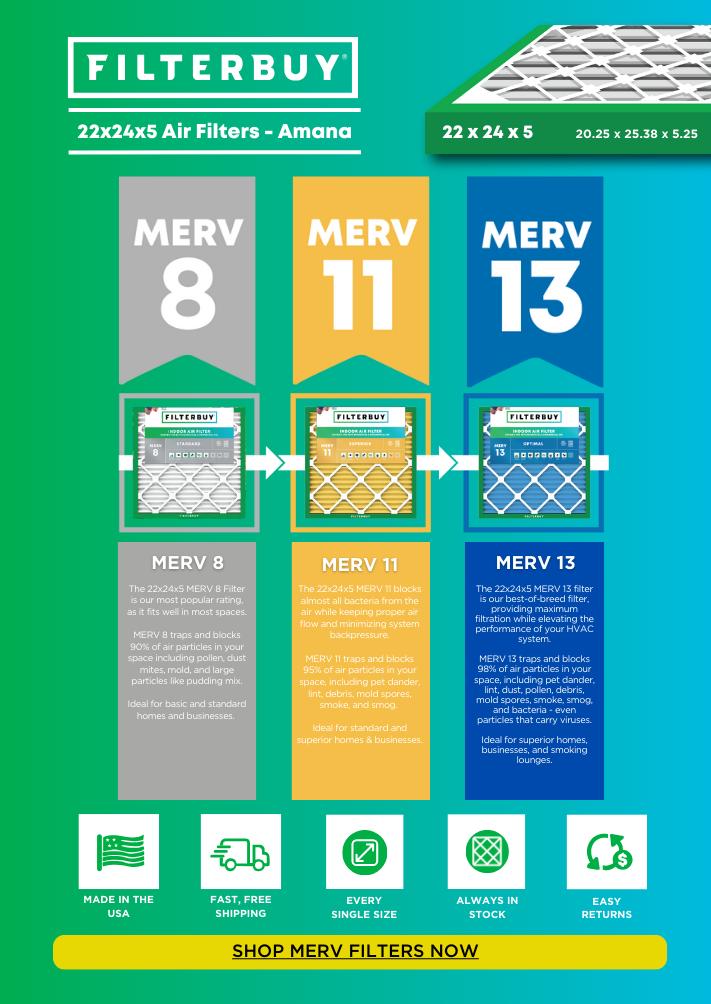
MERV 8: Captures larger particles like dust, pollen, and pet hair. Misses fine particulates, smoke, and bacteria.
MERV 11: Captures most allergens, including mold spores and finer dust. Falls short on smoke particles and ultrafine contaminants.
MERV 13: Captures fine particles across the full range of common indoor air threats — including smoke, bacteria carriers, and airborne respiratory irritants.
The upgrade from MERV 11 to MERV 13 is where the performance difference becomes most meaningful for indoor air quality. It's the point at which your filter stops managing air and starts genuinely cleaning it.
Replacement frequency depends on your household conditions, but a 22x24x5 MERV 13 filter in an Amana system typically performs optimally for 6 to 12 months under normal residential use. Households with higher filtration demand should plan for shorter intervals:
Pets in the home: Every 6 months
Allergy sufferers or asthma: Every 6 months or sooner
High-traffic households or smokers: Every 3 to 6 months
Single occupant, no pets: Up to 12 months
One pattern we've observed consistently: homeowners with 5-inch depth filters tend to wait too long between changes because the filter doesn't show visible loading on the surface the way a thinner filter does. Thick media loads from the inside out. Set a calendar reminder rather than relying on visual inspection.
The change isn't always dramatic on day one — but over the first few weeks, most households notice measurable differences. Dust accumulation on surfaces slows. Allergy symptoms that tend to spike indoors become less frequent. And for homes where cooking smells, pet odors, or smoke have become part of the background, MERV 13's finer filtration begins to interrupt the particulate cycle that carries those irritants through the air.
Your Amana system benefits too. A properly loaded MERV 13 filter traps the fine debris that would otherwise accumulate on the evaporator coil — one of the most common causes of reduced efficiency and early equipment wear. Protecting the coil through consistent, high-quality filtration is one of the most cost-effective things a homeowner can do to extend system lifespan.
"After manufacturing air filters for over a decade and working through thousands of Amana system configurations, the one thing we see homeowners consistently underestimate is how much a precise filter fit matters — because a MERV 13 filter that doesn't seal completely at the frame is just an expensive obstacle for air to go around, not through."
Don't take your indoor air for granted. Making the right filter choice for your Amana system isn't just a maintenance task — it's one of the most direct ways to protect your family's health and extend the life of your equipment. We've pulled together the seven resources that matter most, so you can buy with confidence and get back to being the hero of your household.
Most homeowners don't realize there's a federal standard behind every filter rating on the market — and understanding it changes how you shop. The U.S. Environmental Protection Agency breaks down the MERV scale, what particle sizes each rating captures, and why upgrading to at least MERV 13 is their official recommendation for meaningful indoor air quality improvement in residential systems.
Source: What Is a MERV Rating? — U.S. Environmental Protection Agency
Here's something that surprises a lot of homeowners: not every HVAC system is built to handle every filter rating. The EPA's filter selection guide walks you through how to check your system manual for compatibility, understand airflow resistance, and identify the highest-rated filter your equipment can accommodate without strain — all before you spend a dollar.
Source: Choosing the Right Filter for Your Home HVAC System — U.S. Environmental Protection Agency
When the CDC's National Institute for Occupational Safety and Health formally recommends upgrading central HVAC filters to MERV 13 or better, that's not a marketing claim — that's independent federal public health guidance. This resource confirms that choosing MERV 13 for your Amana system aligns directly with what the nation's leading occupational health authority recommends for cleaner, safer indoor air.
Source: Improving Air Cleanliness — CDC/NIOSH
We can't see the particles moving through our homes, but they're there — and they matter. The CDC explains how upgrading to pleated HVAC filters, combined with simple fan setting adjustments, reduces the concentration of airborne particles linked to respiratory illness inside your home. This is the resource that makes the invisible visible, and reminds you that a filter change is about far more than keeping your system clean.
Source: Steps for Cleaner Air for Respiratory Virus Prevention — CDC
After manufacturing filters for over a decade and working through thousands of Amana system configurations, we know that filter choice directly impacts how hard your equipment has to work — and for how long it lasts. Amana's own learning center resource explains exactly how filtration decisions affect HVAC efficiency, indoor air quality, and system lifespan in their equipment. This is the manufacturer telling you, in their own words, why the filter you choose matters.
Source: Air Filters and MERV Ratings — Amana
You're the protector of your home — and that means making sure every upgrade you make is the right fit for your specific equipment. Amana's FAQ on filter type selection is the fastest way to confirm your system is designed to work with a 5-inch depth, high-efficiency filter like the MERV 13 22x24x5 before your order arrives. One check here prevents a costly mismatch.
Source: What Type of Filter Should I Use? — Amana
We know that when it comes to clean air, there isn't a one-size-fits-all answer. After over a decade of manufacturing filters and serving more than two million households, we built this guide to help every homeowner evaluate their specific situation — pets, allergies, air quality concerns, system compatibility — and arrive at the right MERV rating with complete confidence. If you still have questions after reading this page, start here.
Source: Which MERV Rating Should I Use? — Filterbuy
Here's something most homeowners don't realize: the air quality threat to your family isn't coming from outside. It's already inside your home. These three statistics put that reality into focus.
The U.S. Environmental Protection Agency reports that Americans spend approximately 90 percent of their time indoors, where concentrations of some pollutants are often 2 to 5 times higher than typical outdoor concentrations. After manufacturing air filters for over a decade, this statistic still stands out to us. Here's why it matters:
The air quality battle isn't being fought at your front door
It's being fought inside your ductwork
A properly fitted MERV 13 filter is one of the most direct interventions available
Source: Indoor Air Quality — U.S. Environmental Protection Agency
The Asthma and Allergy Foundation of America reports that more than 100 million people in the U.S. experience various types of allergies each year. What that statistic doesn't show is something we've learned from serving more than two million households — a significant portion of that allergen load doesn't stay on surfaces. It gets pulled into return air vents, passes through a low-rated filter, and recirculates back into your living spaces. MERV 13 breaks that cycle by capturing:
Dust mite debris
Pet dander fragments
Fine allergen particles in the 0.3 to 1.0 micron range — where lower-rated filters fall short
Source: Control Indoor Allergens to Improve Indoor Air Quality — Asthma and Allergy Foundation of America
The Asthma and Allergy Foundation of America documents that more than 28 million people in the U.S. currently have asthma, including nearly 5 million children. The most frequently identified indoor triggers include:
Mold spores
Dust mite debris
Pet dander
In our experience working with households across the country, asthma sufferers are often the first to notice the difference after a MERV 13 upgrade. Not because the filter is doing something dramatic. Because it's quietly doing what lower-rated filters were never designed to do — capturing fine particulates that aggravate sensitive airways before they reach the living space. For families managing asthma, the step from MERV 8 or MERV 11 to MERV 13 isn't an upgrade. It's a measurable shift in daily air quality.
Source: Asthma and Allergy Facts — Asthma and Allergy Foundation of America
Most homeowners approach an air filter purchase like a light bulb replacement — find the right size, grab what's available, move on. After manufacturing filters for over a decade and working with more than two million households, that's the pattern we see most often. It's also the pattern that costs families the most in the long run.
Here's our honest opinion: the MERV 13 22x24x5 Amana filter isn't a premium product. It's the correct product. The distinction matters because a premium choice is optional. The right choice isn't.
Fine particulates that were completing a full recirculation loop through your ductwork are intercepted before they reach your living spaces
The invisible allergen cycle — in through return vents, past an undersized filter, back into your home — stops
Allergy sufferers, asthmatic children, and pet owners feel the difference before they ever see it
A MERV 13 filter that doesn't seal the frame of your Amana system is delivering MERV 13 performance to only a portion of the air passing through it. The rest finds the path of least resistance — around the filter entirely. That's why we manufacture exact nominal dimensions. A filter that almost fits isn't doing the job you're paying for.
Low effort, long replacement intervals
Measurable improvement in indoor air quality
Protection for your HVAC coil against fine debris buildup
Extended system lifespan through consistent, high-quality filtration
You're not just changing a filter. You're protecting your family's health, your HVAC investment, and the air quality of every room in your home — all at once. That's what better air for all actually looks like in practice.
You know why MERV 13 matters, why fit is critical for Amana systems, and what this upgrade means for your family. Here's exactly what to do next.
Verify your system accepts a 5-inch depth filter. Check:
Your Amana owner's manual
The filter slot housing for labeled dimensions
The current filter's printed dimensions on the cardboard frame
Pets or allergy sufferers → 2-pack, replace every 6 months
Standard household, no pets → single filter, replace up to 12 months
Asthma or respiratory sensitivities → 2-pack, replace every 3 to 6 months
Turn your HVAC system off
Remove the old air filter and note the airflow direction arrow
Insert the new filter with the arrow pointing toward the air handler
Check all four frame edges for a flush, gap-free fit
Close the housing and restart the system
Pro Tip: Set a calendar reminder for your next replacement date. Five-inch filters load from the inside out — they won't show visible surface loading like a 1-inch filter will. Waiting too long is the most common mistake we see.
Over the first few weeks, watch for:
Less dust accumulation on surfaces
Fewer allergy or asthma flare-ups indoors
Reduced pet odor recirculation through vents
If symptoms persist after 30 days, shorten your replacement interval based on your household's filtration demand.
A MERV 13 filter is one of the highest-impact steps you can take. These resources help you go further:
What Is a MERV Rating? — U.S. Environmental Protection Agency
Steps for Cleaner Air — CDC
Which MERV Rating Should I Use? — Filterbuy
A: Most Amana air handlers designed for a 5-inch filter slot handle MERV 13 without issue. In our experience working through thousands of Amana configurations, compatibility comes down to two things:
Your system's maximum recommended MERV rating — check your owner's manual
Your system's ability to maintain healthy airflow against a higher-rated filter's resistance
If your manual confirms MERV 13 compatibility, the 22x24x5 will deliver full filtration performance. Still unsure? Check Amana's filter FAQ at amana-hac.com. Never assume compatibility without verifying — a MERV 13 in a system rated for MERV 8 restricts airflow, reduces efficiency, and accelerates wear.
A: Plan for 6 to 12 months under normal residential use. Adjust for your household:
Pets or allergy sufferers → every 6 months
Asthma or respiratory sensitivities → every 3 to 6 months
Single occupant, no pets → up to 12 months
After manufacturing filters for over a decade, the most consistent mistake we see is replacing 5-inch filters too infrequently. Here's why it happens: thick filters load from the inside out. The surface looks clean while the media is well past its effective window. Set a calendar reminder on installation day. Don't wait for the filter to look dirty.
A: The difference is structural, not marginal. Each rating has a ceiling:
MERV 8 → captures large dust, lint, pollen, and pet hair
MERV 11 → adds finer allergens and mold spores
MERV 13 → captures the 0.3 to 1.0 micron range both ratings miss
That critical size range includes:
Fine dust and lint
Pollen and mold spores
Pet dander fragments
Smoke and smog particles
Bacteria and some virus carriers
What years of working with household air quality data taught us: most of the invisible threat lives in that 0.3 to 1.0 micron range. Homeowners consistently underestimate it because they can't see it. MERV 13 is where filtration stops managing air and starts genuinely cleaning it.
A: Not when properly fitted in a compatible system. Our manufacturing experience shows airflow restriction is almost always caused by one of two things:
A MERV 13 filter installed in a system rated only for MERV 8
A filter left in service well past its replacement interval
Here's why the 22x24x5 format handles MERV 13 without strain: the 5-inch depth delivers significantly more filter media surface area than a 1-inch filter. That surface area distributes the filtration load and maintains healthy airflow across a much longer service window. Stay within your system's rated range. Replace on schedule. Airflow restriction won't be a concern.
A: Nominal and actual size are not the same — and the difference matters more than most homeowners realize. Here's how it works:
Nominal size → the labeled dimension used for identification and ordering (22x24x5)
Actual size → slightly smaller to allow the filter to slide into the housing without forcing (approximately 21.5 x 23.5 x 4.875 inches)
What we've seen consistently across thousands of installations: even small gaps at the frame edges from an imprecisely manufactured or undersized filter create bypass zones where unfiltered air travels around the filter media entirely. In those zones, a MERV 13 performs no better than having no filter at all. Our 22x24x5 MERV 13 filters are manufactured to exact nominal dimensions to eliminate that risk and deliver a flush, sealed fit in every Amana system.
Order your Filterbuy MERV 13 22x24x5 Amana air filter today — manufactured to exact dimensions for a flush, sealed fit — and start protecting your family's health and your HVAC investment with every breath.

