

Tip: Ensure you buy the exact air filter size for your system. Certain brands have precise dimensions that only fit their specific models. See related filters
Actual Size: 22.13x24x5.25"
 Free Delivery
  Factory-Direct Low Prices, Made in the USA
 Hassle-Free Returns & Free Exchanges
RESIDENTIAL AND/OR COMMERCIAL USE
Change Every 3 Months
Tip: Ensure you buy the exact air filter size for your system. Certain brands have precise dimensions that only fit their specific models. See related filters
Actual Size: 22.13x24x5.25"
Free Delivery Factory-Direct Low Prices, Made in the USAHassle-Free Returns & Free ExchangesRESIDENTIAL AND/OR COMMERCIAL USE
Change Every 3 Months
Tip: Ensure you buy the exact air filter size for your system. Certain brands have precise dimensions that only fit their specific models. See related filters
Actual Size: 22.13x24x5.25"
Free Delivery Factory-Direct Low Prices, Made in the USAHassle-Free Returns & Free ExchangesRESIDENTIAL AND/OR COMMERCIAL USE
Change Every 3 Months
At Filterbuy, we don't cut corners—we craft high-quality air filters right here in the USA and ship them to your doorstep for free. No delays, no gimmicks—just clean air, made easy. With thousands of five-star reviews and filters built for real life & every HVAC system, it's no wonder why over 4 million families trust Filterbuy.

Proudly Made In The USA

Fast, Free Shipping on Every Order

Premium Materials That Go The Distance

85,000+ 5-Star Reviews From Happy Customers

Save Up to 70% Per Filter with Packs


Measure length × width × depth with a tape measure to find the actual size.

Round up each dimension to the nearest whole number to get the nominal size. Example: 22.13x24x5.25" in → 22X24X5 nominal.

Search by nominal size on our site for the best fit.


5″ filters give you maximum filtration with minimal maintenance — lasting up to 12 months while handling higher MERV ratings without restricting airflow.
Sizing note:

If the filter you buy doesn't fit, we'll send you a better size.
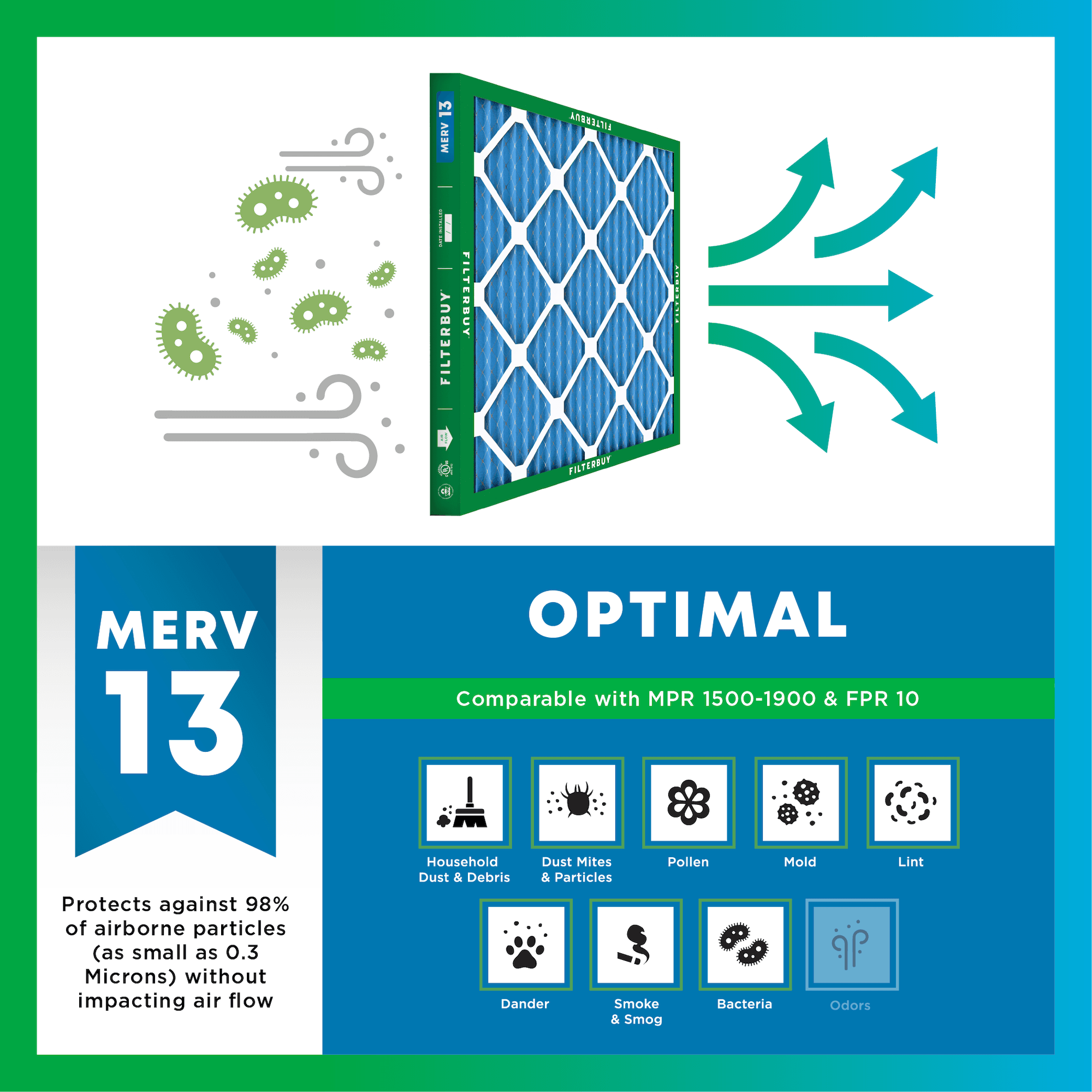
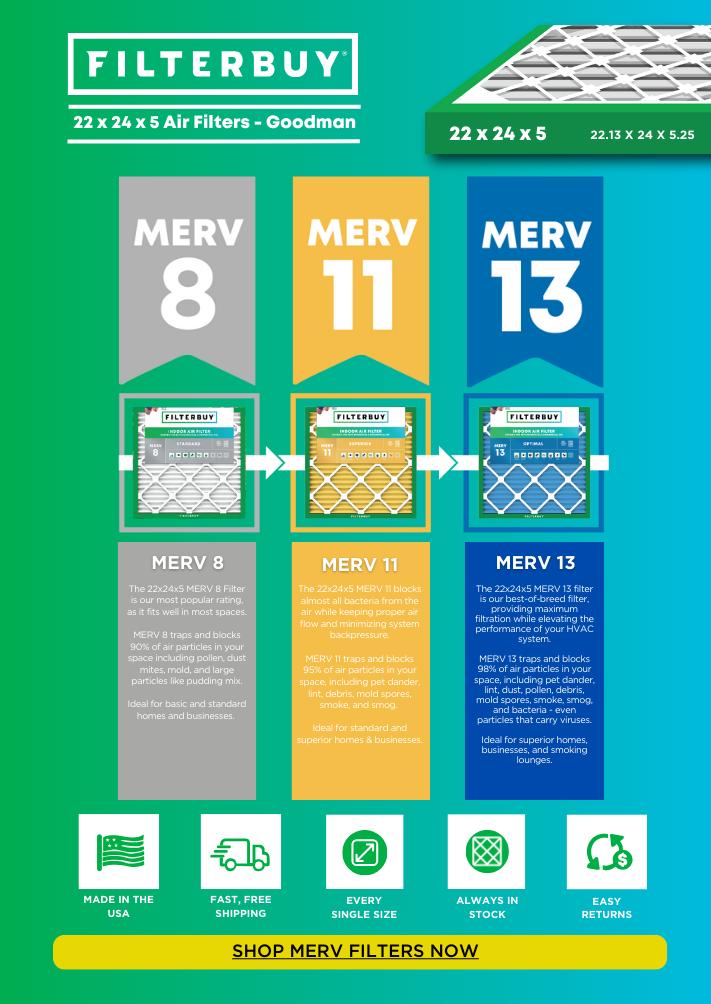
MERV stands for Minimum Efficiency Reporting Value—but don't let the technical name fool you. It's just a way to rate how well an air filter traps stuff like dust, pollen, pet dander, and smoke. The higher the MERV number, the more particles it catches—and the cleaner your air will be.

Comparable to:FPR: 4-7
MPR: 600-1000
 Dust & Debris
 Dust Mites & Particles
 Pollen
 Mold
Mold Lint
Lint Dander
Comparable to:FPR: 6-9
MPR: 1200-1550
Dust & DebrisDust Mites & ParticlesPollenMoldLintDander Smoke & Smog
Comparable to:FPR: 10
MPR: 1900-2800
Dust & DebrisDust Mites & ParticlesPollenMoldLintDanderSmoke & Smog Bacteria


We build every Filterbuy filter to deliver reliable 90-day performance—thanks to smart design and premium materials that do the heavy lifting. Here's what makes the difference:
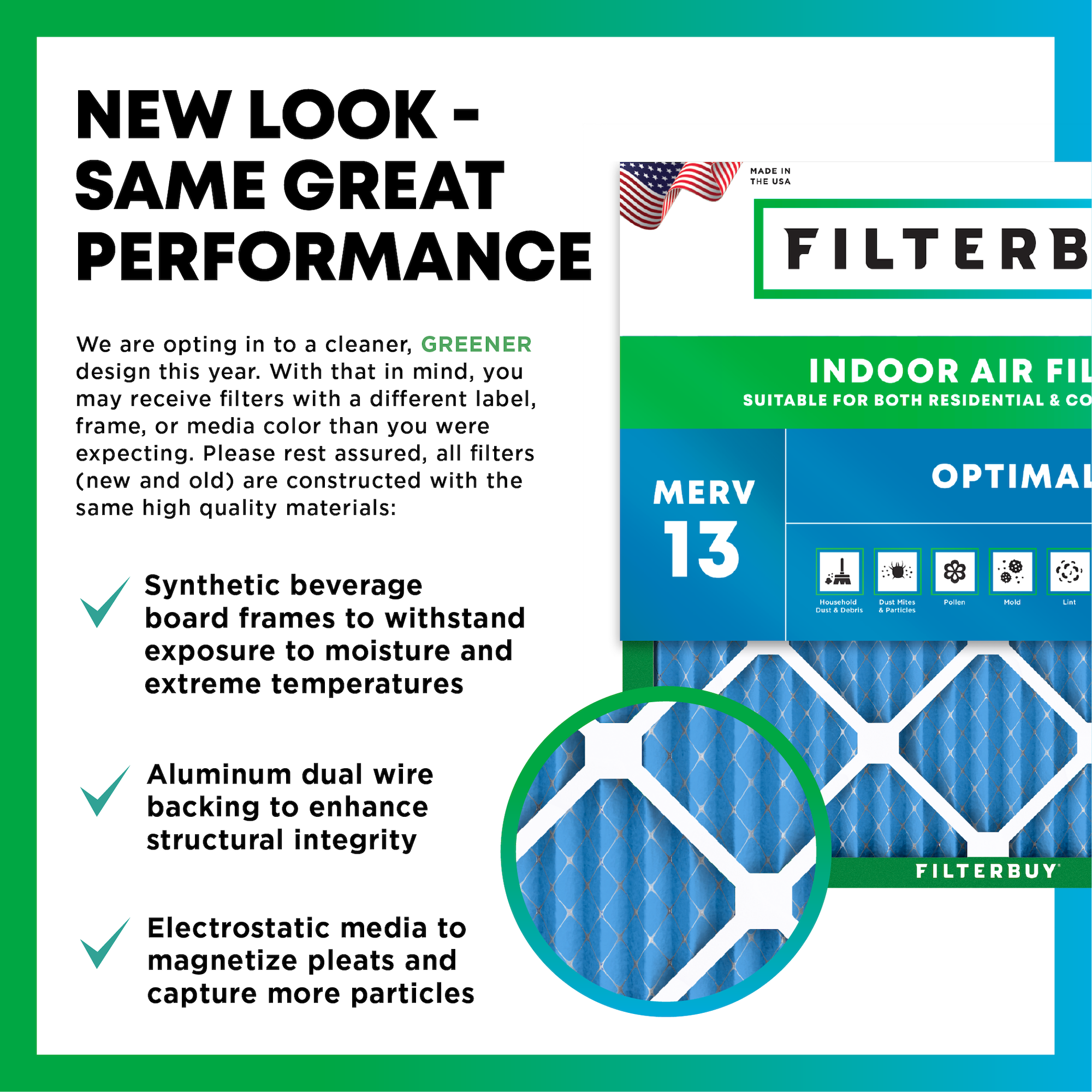
More pleats = more surface area to capture dust and debris, keeping your air cleaner longer.
Pleats are magnetized to attract and trap microscopic particles—like pet dander, pollen, and smoke.
Engineered to resist warping in extreme temperatures and high humidity.

A layer of metal reinforcement keeps pleats evenly spaced and structurally sound—no sagging, even at high airflow.
Assembled with care. Built to perform. Ships fast, free, and reliably from our U.S. facilities.

Turn Off Your HVAC SystemSafety first.

Remove The Old FilterLook for the airflow arrow and make note of the direction.

Slide In Your New FilterArrow should point toward the system (same direction as before).

Turn Your System Back OnAnd enjoy the fresh, clean air.

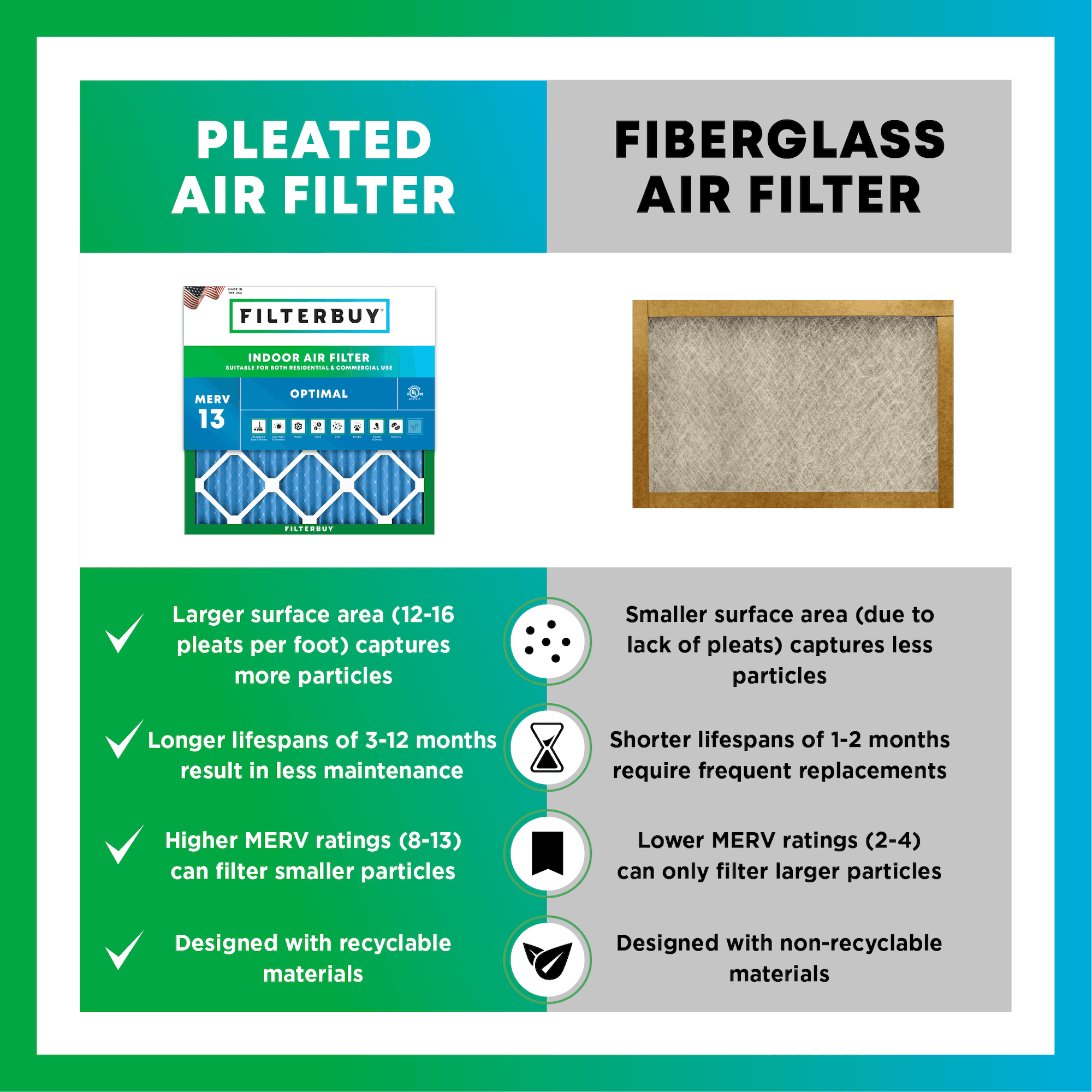
Not all air filters are created equal. Pleated filters don't just last longer—they actually clean your air better. Here's how they stack up:

Efficiency:
High (MERV 8–13) – Traps more particles
Lifespan:
90 days – Long-lasting performance
Air Quality:
Excellent – Cleaner, healthier air
Materials:
Recyclable and durable

Efficiency:
Low (MERV 4 or less) – Misses small stuff
Lifespan:
30 days or less – Replace often
Air Quality:
Minimal – Basic protection only
Materials:
Thin, flimsy, and not recyclable
Pleated filters are a no-brainer—more protection, less hassle, and better air for your home.
Changing your filter on time keeps your HVAC system running efficiently—and helps protect your lungs from dust, allergens, and airborne irritants. Here's how often to swap it out based on your needs:

For most homes without pets or special air quality concerns. Great for general upkeep and energy efficiency.

Shedding fur, dander, and allergy triggers can build up fast. Changing your filter every two months helps keep the air fresher and symptoms at bay.

For households affected by smoke, pollution, or respiratory conditions, monthly changes ensure maximum protection.

| Nominal Size | 22X24X5 |
| Actual Size | 22.13 x 24 x 5.25" inches |
| Filter Type | Pleated |
| Media | Electrostatically Charged |
| Frame | Beverage Board |
| MERV Ratings Available | 8, 11, 13 |
| Lifespan | Up to 12 Months |
| Origin | Made in USA |
Pull your current Goodman filter out right now and look at the frame. That number — 22x24x5 — tells you what size slot you're filling. It says nothing about how well you're protecting your family's air. That part comes down to MERV.
At Filterbuy, we've been obsessed with indoor air quality since we manufactured our first filter in 2013. After more than a decade building filters in our own American facilities and learning from over two million households, we can tell you this plainly: the MERV rating is where most homeowners leave real protection on the table. They match the size. They skip the rating. And the air their families breathe pays for it.
Goodman systems with a 22x24x5 slot are built for deep-media filtration. MERV 13 is what fills that slot correctly. This page shows you exactly why — and gives you every detail you need to buy with confidence.
The MERV 13 22x24x5 is a 5-inch deep-media air filter designed to fit Goodman air handlers and furnaces with a dedicated media cabinet. The nominal size is 22x24x5; the actual cut dimensions are approximately 21.5 x 23.5 x 4.375 inches.
What it filters: At MERV 13, this filter captures particles down to 0.3 microns — including pet dander, mold spores, pollen, smoke particles, bacteria, and virus carriers. That's the filtration range most 1-inch filters never reach.
Why the 5-inch depth matters: After manufacturing Goodman-compatible filters for over a decade, we've learned that depth is what makes MERV 13 practical in a residential system. The extra media surface area keeps static pressure low while delivering genuine high-efficiency filtration — no airflow sacrifice, no system strain.
Replacement interval: Every 90 days for most households. Every 60 days for homes with pets, allergy sufferers, or asthma.
The right fit: A filter that doesn't seal to the cabinet walls allows unfiltered air to bypass the media entirely. Filterbuy cuts every 22x24x5 filter to actual Goodman-compatible dimensions — not just nominal — so the seal holds from day one.
The 22x24x5 MERV 13 filter is the right replacement for Goodman air handlers and furnaces with a 5-inch media slot — high-efficiency filtration without restricting airflow in a system built to handle it.
Nominal filter size (22x24x5) and actual dimensions (approximately 21.5 x 23.5 x 4.375 inches) are not the same. Actual dimensions determine whether a filter seals properly in the Goodman cabinet — air bypass around an ill-fitting filter cancels out the filtration entirely.
MERV 13 captures particles down to 0.3 microns, including mold spores, pet dander, bacteria, virus carriers, and fine combustion byproducts. MERV 8 and MERV 11 let sub-micron particles through without restriction.
The 5-inch media depth in a Goodman-compatible 22x24x5 filter spreads filtration across a much larger surface area than a 1-inch filter — keeping static pressure low and protecting the blower motor.
Replace every 60–90 days for most households, or every 60 days when pets, allergies, or asthma are present. An overloaded filter doesn't just stop filtering — it blocks airflow and strains the system.
Filterbuy's MERV 13 22x24x5 filter is American-made, precision-cut to Goodman cabinet specifications, and built with a rigid frame that holds its seal from install day to replacement day.
More than 85,000 five-star reviews from homeowners across the country back what a decade of manufacturing experience confirms: the right filter, in the right frame, makes a difference you can see and feel.
Goodman builds a dedicated media cabinet into most of their air handlers and furnaces — and that cabinet was engineered around a 5-inch deep-pleat filter, not a standard one-inch panel. The 22x24x5 slot exists for a reason. Use it wrong and you waste everything the rest of your system is doing right.
The 22x24x5 printed on a filter frame is the nominal size — a rounded industry convention used for categorization. The actual cut dimensions are typically 21.5 x 23.5 x 4.375 inches. That difference matters because a filter that's even slightly oversized will bind in the cabinet or bow under pressure. One that's too small leaves gaps.
Those gaps are where the problem starts. In our experience manufacturing Goodman-compatible filters, air bypass — unfiltered air slipping around the filter edges — is one of the most common causes of poor indoor air quality in homes that technically have a filter installed. The filter isn't doing its job if it doesn't seal. Full stop.
Filterbuy cuts every 22x24x5 MERV 13 filter to the actual dimensions that fit Goodman's cabinet specifications. Our rigid beverage-board frame holds that shape through the entire service life of the filter — not just the first week.
ASHRAE created the MERV scale — Minimum Efficiency Reporting Value — to give homeowners and engineers a single, testable number that describes how well a filter stops airborne particles. The scale runs from 1 to 16. A basic fiberglass panel filter rates MERV 1 to 4. The filters used in hospital operating rooms rate MERV 14 to 16. MERV 13 is the top of the residential performance range — and it earns that position.
A MERV 13 filter captures what lower-rated filters miss:
Fine dust and household lint
Mold spores and mildew
Pet dander and hair
Pollen and outdoor particulates
Smoke particles and combustion byproducts
Bacteria in the 0.3–1.0 micron range
Virus carriers and respiratory aerosols
Those last two categories are where the real gap opens up. Under ASHRAE Standard 52.2, a MERV 13 filter must achieve at least 50% removal efficiency on particles in the 0.3–1.0 micron range. A MERV 8 filter has no minimum requirement at all for particles below 1.0 micron. Bacteria, virus carriers, and fine combustion particles travel straight through a MERV 8 — unless you've upgraded.
MERV 8 keeps your HVAC equipment reasonably free of debris. It does not do much for the air your family breathes. MERV 11 improves on that — it catches finer dust, most pet dander, and some mold spores — but still has real gaps below 1.0 micron.
MERV 13 closes those gaps. The reason it's practical in a Goodman system specifically comes down to that 5-inch media slot. A thin 1-inch MERV 13 filter creates enough static pressure to stress systems that weren't built for it. Spread that same filtration work across a 5-inch pleat structure and the pressure drop stays well within range for your Goodman blower. Depth makes it possible.
For more on how MERV 13 ratings interact with airflow, see our guide on MERV 13 CFM ratings and optimal airflow.
A MERV 13 rating tells you the minimum efficiency the filter hit during standardized testing. It says nothing about how the filter was built, how it holds up as it loads with dust, or whether it will actually seal inside your Goodman cabinet. Two filters with the same rating can perform very differently once they're installed.
Here's what goes into ours:
American manufacturing: We make our filters in our own facilities in Alabama, Pennsylvania, Texas, and Utah. No outsourcing. Tighter tolerances and consistent quality from batch to batch.
Electrostatically charged pleated media: The media carries an electrostatic charge that actively pulls fine particles toward the filter fibers, adding to the mechanical filtration from the pleat structure.
High surface area pleat design: More pleat surface means more filtration area in contact with the airstream — and lower resistance to airflow for a given level of filtration.
Rigid beverage-board frame: Standard cardboard frames warp under the pressure differential of a working HVAC system. Ours don't. The seal holds from install day to replacement day.
Precision-cut actual dimensions: We cut to the actual dimensions that match Goodman's cabinet, not just the nominal size on the label. Every order ships to fit.
Over 85,000 five-star reviews from homeowners around the country back that up. So does a decade of manufacturing filters for nothing else. We know what this filter needs to do — and we build it to do exactly that.
A MERV 13 filter captures more particles than a lower-rated one, which means it fills up faster. Replacement intervals depend on how much your system is filtering and for whom.
Single occupant, no pets, low dust: every 6 months
Average household of 2–4: every 90 days
Households with pets: every 60 days
Allergy or asthma sufferers in the home: every 60 days or sooner
Construction or renovation nearby: check monthly
Your system and your home will tell you before the calendar does. Watch for these:
The filter surface is visibly gray, brown, or black
Airflow from vents feels weaker than usual
Your HVAC system runs longer cycles to hit the thermostat setpoint
Dust builds up faster on surfaces near vents
Family members with allergies or asthma start noticing more symptoms
A clogged MERV 13 filter doesn't just stop filtering — it blocks airflow, forces your Goodman blower motor to work harder, and drives up your energy bill. That strain accumulates. Staying on schedule isn't a chore; it's how you protect a system that costs thousands of dollars to replace.
Goodman installs 22x24x5 filter slots across a broad range of product lines — the GSX, GSXC, GMVC, and GMH95 series among them. Before placing your order, run through these four checks:
Open your Goodman media cabinet or pull your current filter. Confirm the nominal size reads 22x24x5 on the frame or the cabinet door sticker.
The nominal and actual sizes are different. A 22x24x5 nominal filter measures approximately 21.5 x 23.5 x 4.375 inches in actual dimensions. Make sure your manufacturer is cutting to actual, not just rounding to nominal.
Most Goodman systems manufactured in the past 15 years handle MERV 13 without issue in a 5-inch slot. If your unit is older, check the blower's CFM rating before upgrading.
When in doubt, call your HVAC technician. The 5-inch format significantly reduces the static pressure impact of a MERV 13 upgrade — but a quick confirmation never hurts.
One more practical note: Filterbuy sells the 22x24x5 MERV 13 filter in multi-pack quantities. If you're replacing every 60–90 days, a 4-pack or 6-pack drops your per-unit cost and means you always have the next filter ready. You'll never scramble for a replacement on a Sunday afternoon.
"In our experience manufacturing Goodman-compatible filters, the most common air quality problem we see isn't a broken system — it's an ill-fitting filter creating air bypass that sends unfiltered air straight around the media; the 22x24x5 MERV 13 closes that gap because it's precision-cut to actual cabinet dimensions, not just nominal size."
- Filterbuy Team
You're the one protecting your family's air. These seven resources give you the knowledge to make that call with confidence — pulled from the most authoritative sources available, not marketing copy.
The EPA's primary IAQ resource explains why indoor air is often more polluted than outdoor air — and what homeowners can do about it. Start here to understand the problem your Goodman MERV 13 filter is solving. epa.gov/indoor-air-quality-iaq
Practical guidance on finding and eliminating indoor pollutant sources, including the role HVAC filtration plays. Worth reading for any Goodman system owner who wants a whole-home air protection approach. epa.gov/iaq/inside-story
This is the industry standard that defines how MERV ratings are tested and assigned. Read it to evaluate filter performance claims the way air quality engineers do — with a specific number and a test protocol behind it. ashrae.org — Standard 52.2
The CDC tracks asthma prevalence nationally. With roughly 25 million Americans currently living with asthma, indoor air quality is a health issue — not just a comfort preference. This data makes that clear. cdc.gov/asthma-data
A well-sourced overview of how air filters work, covering the mechanical and electrostatic principles behind pleated MERV 13 media. A useful reference if you want to understand what the filter is actually doing before comparing options. en.wikipedia.org/wiki/Air_filter
VOCs from household cleaners, paints, and furnishings are among the most common indoor air pollutants. This EPA resource explains their sources and health effects — a strong argument for whole-home filtration beyond just dust and pet dander. epa.gov/iaq/vocs
Our own breakdown of how MERV 13 filters interact with residential HVAC airflow rates, including why filter thickness changes the static pressure equation. If you're asking whether your Goodman system can handle a MERV 13 upgrade, this is where to look first. filterbuy.com/resources/merv-13-cfm-ratings
Every stat below comes from a U.S. government agency or nationally recognized health authority. These aren't marketing claims — they're the public health data behind the case for high-efficiency residential air filtration.
Source: U.S. EPA — epa.gov/report-environment/indoor-air-quality
The EPA found that indoor air concentrations of common pollutants run 2 to 5 times higher than typical outdoor levels — and Americans spend roughly 90% of their time indoors. The air circulating through your Goodman system is the air your family actually breathes. What you filter matters more than most homeowners realize.
Source: ASHRAE Standard 52.2 — ashrae.org
To earn a MERV 13 rating under ASHRAE Standard 52.2, a filter must remove at least 50% of particles in the 0.3–1.0 micron range. A MERV 8 filter carries no minimum requirement for particles below 1.0 micron at all. Bacteria, virus carriers, and fine combustion particles fall in that gap — and a MERV 8 lets them through.
Source: CDC — cdc.gov/asthma-data
The CDC reports roughly 25 million Americans currently live with asthma. Cutting exposure to airborne allergens and fine particulates is one of the most practical things a household can do to manage symptoms. For families with asthma, a MERV 13 Goodman-compatible filter isn't a premium add-on — it's a health decision.
Here's what ten years of manufacturing air filters taught us: the homeowners who understand their filter make better decisions — and their HVAC systems run better for it.
The MERV 13 22x24x5 isn't the most expensive filter on the market. It isn't meant to be. It's meant to be the right one — specifically for the challenge of protecting a Goodman system home from the full range of indoor air pollutants, from coarse debris down to fine bacteria and respiratory aerosols, without overworking the blower motor that keeps your system alive.
That 5-inch media slot is an asset. Goodman engineered it for deep-pleat filtration that changes indoor air outcomes. In our experience, the homeowners who fill it with a properly sized MERV 13 and stay on a replacement schedule are the ones who notice the difference: less dust on surfaces, fewer allergy episodes, a system that runs quieter and holds up longer.
That's not a sales pitch. That's what a decade of making nothing but air filters looks like when it's applied to one specific job.
You're the hero of your household when it comes to the air your family breathes. Give your Goodman system the filter it was built for.
Everything you need to make a confident decision is on this page. Here's exactly what to do next:
Confirm your filter size. Pull out your current filter or open your Goodman media cabinet door. The nominal size — 22x24x5 — will be on the frame or on the cabinet door sticker. If you see it, you're in the right place.
Pick your pack size. A single filter works if you're testing a new product. For most Goodman owners replacing every 60–90 days, a 4-pack or 6-pack saves money per unit and keeps a spare on the shelf.
Order from an American manufacturer. Select Filterbuy's MERV 13 22x24x5 filter. Our filters ship from U.S. facilities in Alabama, Pennsylvania, Texas, and Utah, and arrive ready to install.
Install and date it. Slide the new filter in with the airflow arrow pointing toward the blower. Write the installation date on the frame in marker so you know exactly when the next change is due.
Set a reminder now. Add a calendar alert for 60, 90, or 180 days out depending on your household. Consistent replacement is the single habit that keeps your filtration working and your air quality where it needs to be.
The 22x24x5 you see on the frame is the nominal size — a rounded industry label. The actual cut dimensions are typically 21.5 x 23.5 x 4.375 inches. That difference matters because a filter that doesn't fit the actual cabinet opening leaves gaps for air to bypass the media entirely. Before ordering, confirm your manufacturer cuts to actual dimensions, not just nominal.
For most modern Goodman air handlers and furnaces, MERV 13 in a 5-inch media format is fully compatible. The 5-inch media depth spreads filtration across enough surface area that the static pressure stays well within the design range of most Goodman blowers. If your unit is older, check the blower's CFM rating against MERV 13 requirements, or ask your HVAC technician before upgrading.
Every 90 days covers most households. Homes with pets or allergy sufferers should replace every 60 days. A clogged MERV 13 filter raises static pressure in your Goodman system, which forces the blower motor to work harder and drives up energy costs over time. Staying on schedule protects both the air quality and the equipment behind it.
The GSX, GSXC, GMVC, and GMH95 series are among the Goodman product lines that commonly use a 22x24x5 nominal filter slot. Cross-reference your specific model number against the dimensions in your owner manual or on the sticker inside the media cabinet door before ordering. The model number and filter size are almost always printed there.
Under ASHRAE Standard 52.2, MERV 13 filters must remove at least 50% of particles in the 0.3–1.0 micron range. MERV 11 requires at least 20% in the same range. In practical terms, that gap covers bacteria, fine smoke particles, and virus carriers — the particles most relevant to households with allergy or respiratory concerns. For families with asthma, young children, or persistent allergy symptoms, MERV 13 is the rating our product team recommends without qualification.
We manufacture in our own facilities in Alabama, Pennsylvania, Texas, and Utah — which means tighter dimensional tolerances than most imported alternatives. Our 22x24x5 MERV 13 filters are cut to the actual Goodman-compatible dimensions, built with frames that don't warp under system pressure, and sold in bulk packs with real per-unit savings. After more than a decade of manufacturing and over two million households served, this filter was built specifically for this job.
MERV 16 and HEPA-grade filters create substantially more airflow resistance than MERV 13. Most residential Goodman systems aren't designed to move air against that level of pressure drop — even at 5-inch depth. Forcing a HEPA-level filter into a residential HVAC system can cut airflow enough to reduce heating and cooling efficiency, and it accelerates wear on the blower motor. MERV 13 hits genuine high-efficiency performance within the design limits of your Goodman system. That's the balance that holds up.
American-made. Precision-cut for Goodman air handlers and furnaces. Ships from our own U.S. facilities. Shop MERV 13 22x24x5 Filters.

