
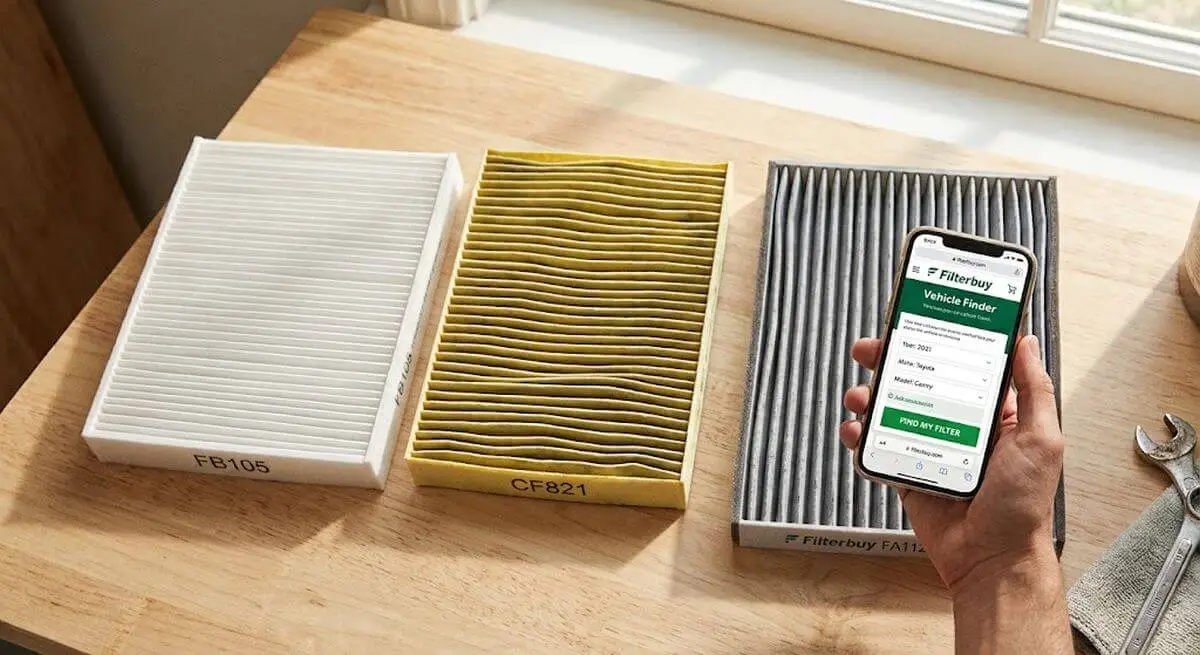
Cabin Air Filter Cross-Reference: Find Your Equivalent Part Number
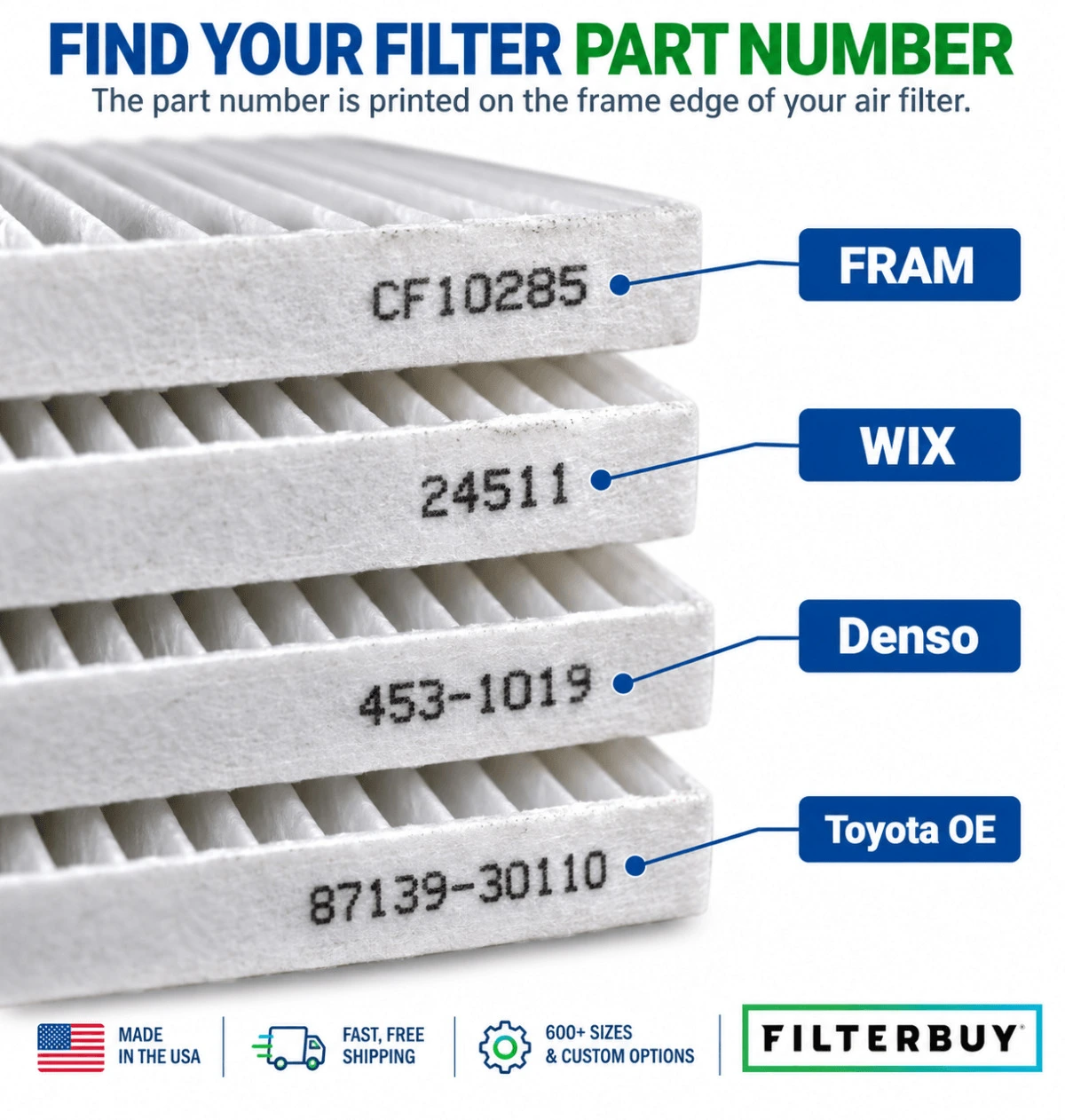
A cabin air filter cross-reference converts one brand's part number into another brand's equivalent for the same filter. FRAM uses a CF prefix, WIX a 24xxx series, Bosch either a legacy P number or a current 60xxC HEPA number, and Denso 453-. The conversion is rarely one to one, and an equivalent number matches fitment rather than filtration.
- Rarely one to one: FRAM CF10285 interchanges to WIX 24483, 24488 and 24511.
- One number covers many: Denso 453-1019 maps to at least nine Toyota and Lexus OE numbers.
- Same number, different filter: four filters that cross-reference to Toyota 87139-02090 publish figures ranging from 98% at 5 microns to 99.97% at 0.3 microns.
Match your vehicle instead of the number. The quiz below does it in a few questions.

Answer a few quick questions and we'll match a cabin air filter to your year, make and model.
Find your cabin filter by year, make and model
Fitments cover Acura, Buick, Cadillac, Chevrolet, GMC, Honda, Lexus, Pontiac, Scion, Subaru and Toyota.
A cabin air filter cross-reference converts one brand’s part number into another brand’s equivalent for the same filter. FRAM, WIX, Bosch, and Denso each number their filters differently, and automakers use a system of their own on top of that. Match the number first, then confirm the dimensions, because one number often converts to several.
Find your vehicle’s cabin filter
TL;DR
FRAM uses a CF prefix, WIX a 24xxx series, Bosch either a legacy P number or a current 60xxC HEPA number, and Denso 453-. A cross-reference converts between those systems, though rarely one to one, and two filters can share a number while filtering very differently.
Key Takeaways
Cross-referencing is not one-to-one. FRAM CF10285 interchanges to WIX 24483, 24488, and 24511.
One aftermarket number replaces many OE numbers. Denso 453-1019 covers at least nine Toyota and Lexus numbers.
Equivalent numbers are not equivalent filters. Four filters cross-referencing to Toyota 87139-02090 publish efficiencies from 98% at 5 microns to 99.97% at 0.3 microns.
Measure before you buy. When two catalogs disagree, the filter you removed is the tiebreaker.
What Is a Cabin Air Filter Cross-Reference?
A cabin air filter cross-reference is a compatibility map linking part numbers from different manufacturers to one physical filter. No universal standard exists, so a filter picks up a different code at every company that sells it.
Bosch and Denso trip people up most. Bosch still sells a legacy P series while its newer line runs on numbers like the HEPA series such as the 6055C, so two Bosch parts can look unrelated. Denso is tidier: every cabin filter starts with 453-, and the digits after the dash tell you the application family. Toyota, meanwhile, files the part as an Air Refiner Element under an 87139- number.
No number yet? Start with the cabin air filter part number lookup.
Cabin Air Filter Cross-Reference Chart
Each row below is one physical filter, read across four catalogs.
Verified against manufacturer listings, September 2026. A dash means none was confirmed. Filterbuy does not fit BMW, Hyundai or Kia, but the conversion is still useful.
Neither the OE number nor the aftermarket one is more correct, since they are two catalogs describing one part. For how they differ, see OEM versus aftermarket cabin air filters.
Why One Filter Has Several Equivalent Numbers
A cabin air filter cross-reference is a many-to-many map, not a one-to-one lookup. It is the most misunderstood thing about interchange charts, and it causes most wrong-filter orders.
Two opposite habits create the mismatch. Automakers split, assigning a fresh number for every application and trim even when the filter is identical, while aftermarket brands do the reverse and cover many vehicles with one SKU. Filterbuy sits on the manufacturing side of that split, cutting to a vehicle’s dimensions rather than to a SKU spanning a dozen.
These counts are minimums, and some catalogs list over a dozen.
You Got Three Results. Now What?
When a cross-reference returns several numbers, stop choosing between them and go back to your vehicle. Several results usually mean one filter covers several applications, so the numbers are alternatives only on paper.
Published dimensions show why. Catalogs put FRAM CF10285 at 8.47 by 7.64 by 1.14 inches, and Denso 453-1019, an equivalent for the same Toyota number, at 8.5 by 7.68 by 1.1 inches. Every figure disagrees, and they describe the same filter.
Those gaps are rounding. Every chart runs into the same limit, Filterbuy’s included, which is why a cross-reference is best used to narrow the field. Confirm the result in the Filterbuy vehicle finder, or against the filter you pulled out.
Does an Equivalent Part Number Mean Equivalent Filtration?
No. A cross-reference matches dimensions and fitment, not performance. Four filters that cross-reference to Toyota OE 87139-02090 publish figures that are nothing alike.
All four cross-reference to Toyota OE 87139-02090, and the figures are not comparable: 98% at 5 microns and 99.97% at 0.3 microns describe very different filters. Manufacturer figures, September 2026.
Read the particle size, not the percentage. FRAM publishes up to 98% for the CF10285 on dust and pollen at 5 to 100 microns, while Bosch publishes 99.97% at 0.3 microns for the 6055C, tested to ISO 29463-3. Ahlstrom, a media supplier, rates its media to DIN 71460-1 at up to 99.97% at 0.5 microns. None of that travels with the part number.
Why We Do Not Just Publish a Bigger Chart
We could list ten thousand numbers, but knowing which one to trust is worth more than having all of them.
Interchange lists get copied from each other, so the same numbers turn up site after site and so do the same disagreements. One catalog lists nine Toyota numbers against Denso 453-1019, another over a dozen, and neither counted them off a real filter.
“A cross-reference is a list of labels. We work in millimeters. When two catalogs disagree about which number fits a car, the numbers never settle it. The part does. That is why we cut every filter to the dimensions of the car it goes in, not to whichever number a chart returned.”
- The Filterbuy Team
It is also why this page tells you which makes we cannot fit. Filterbuy auto cabin air filters use HEPA-certified synthetic media capturing 99.97% of particles at 0.3 microns, cut in our US plants to exact OE tolerances. Fitments cover Acura, Buick, Cadillac, Chevrolet, GMC, Honda, Lexus, Pontiac, Scion, Subaru, and Toyota. Other makes need another brand for now, and we would rather say so than sell you a maybe.
When a Cross-Reference Match Is Not a Real Match
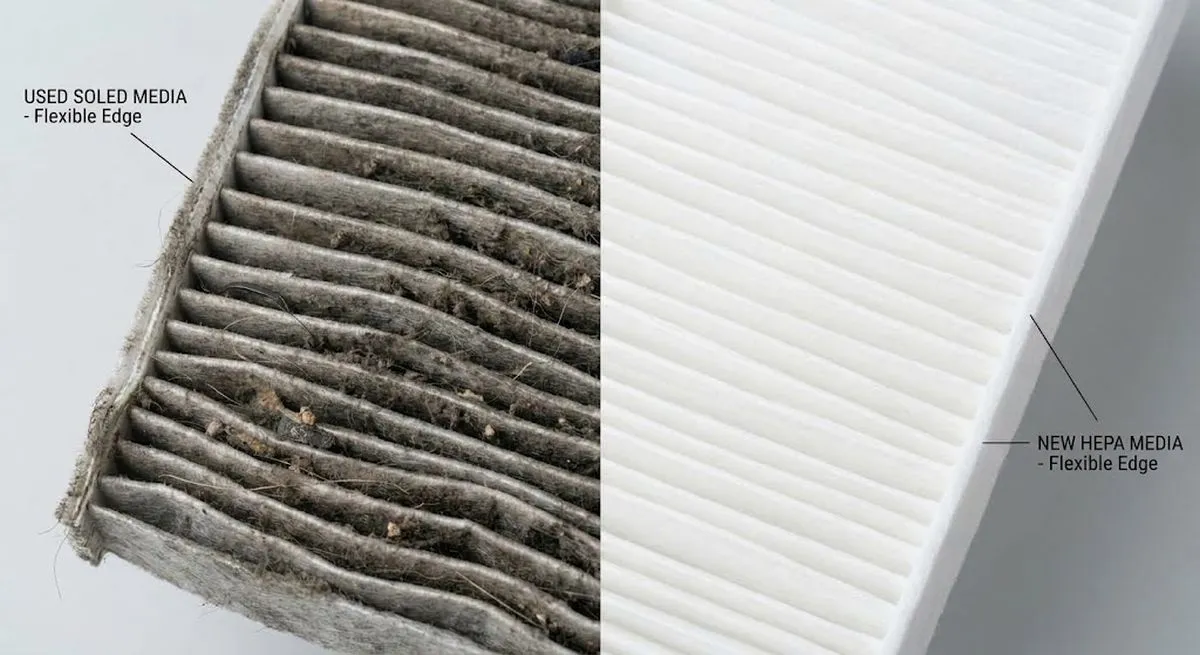
A correct number can still put the wrong filter in your hand. Four more checks will catch the rest, none of them covered above.
Measuring settles any question about fit. For performance, compare the published efficiency figures above.
Supersessions are the easiest of these to miss. Toyota records replacements in its genuine parts catalog, so a number from a 2016 manual can point at a part that no longer exists. The Filterbuy cabin air filter airflow arrow guide covers the last check.
Supporting Statistics
Three federal datasets explain why the numbers multiply, and why results need checking.
1. 284.6 million vehicles were registered in the US in 2023.
96.9 million cars, 177.2 million trucks, and 967,525 buses.
About 275.1 million of them take a cabin filter.
Why it matters: with that many model years on the road, one filter picks up a dozen numbers.
Source: FHWA, Highway Statistics 2023, Table MV-1
2. Filtration cut in-vehicle particles by a third and left gases untouched.
Ultrafine particles down 28%, PM2.5 down 30%, black carbon down 32%.
Nitrogen dioxide, benzene, BTEX and CO: no reduction.
Why it matters: the media does the work, so that is the spec worth checking.
Source: Environmental Science & Technology, 2023, via the U.S. National Library of Medicine (PMC9979657)
3. High-efficiency filters removed 93% of ultrafine particles. OEM filters averaged 50%.
Tested across 12 vehicles, three driving conditions.
Both fit the same cars and cross-reference to each other.
Why it matters: two catalog equivalents landed 43 points apart.
Frequently Asked Questions
Glossary
Cabin air filter. The pleated filter that cleans outside air before it reaches the cabin.
Cross-reference. A lookup that converts one maker’s part number into another’s for the same part.
OEM. Original Equipment Manufacturer. A part built to the vehicle maker’s spec and sold under its brand.
Bypass air. Air slipping around an undersized filter instead of through it.
HEPA. High-Efficiency Particulate Air. Captures 99.97% of particles at 0.3 microns. Filterbuy auto cabin filters use HEPA-certified media.
Activated carbon filter. A filter with a carbon layer that also adsorbs odors and gases.
About the Author
Michelle Wan is Filterbuy’s Brand Manager and air quality writer. She works with the US manufacturing team across plants in Alabama, Florida, Pennsylvania, and Utah, and bases her guidance on how filters are built and fitted rather than how they are cataloged. Reviewed by David Clark, Licensed HVAC Technician and President of Filterbuy HVAC Solutions.
Sources
Figures link to their sources inline, including FHWA and the U.S. National Library of Medicine.