
Charlotte Real-Time AQI Tracker


Get Alerts For Unhealthy AQI In Your Area
When air quality in your area reaches unhealthy levels, we'll send you a quick alert, along with expert tips on how to reduce your exposure.
What's Actually In Charlotte Air Today?
What High AQI Means for Your Lungs in Charlotte
How to Read AQI
The Air Quality Index (AQI) measures how polluted the air is and how it may affect your health.
0–50 (Good): Air quality is satisfactory.
51–100 (Moderate): Acceptable, but some pollutants may pose minor concerns.
101–150 (Unhealthy for Sensitive Groups)
151–200 (Unhealthy)
201–300 (Very Unhealthy)
301+ (Hazardous)
Moderate
Still okay for most, but if you have asthma or allergies, take it easy and avoid long outdoor workouts.
Shop MERV 11 filters→What's the Right Filter for Your AQI Level?
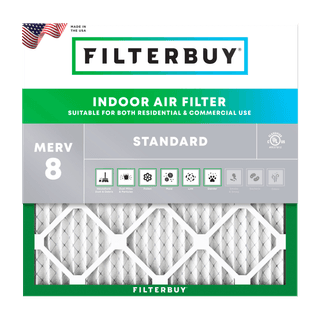
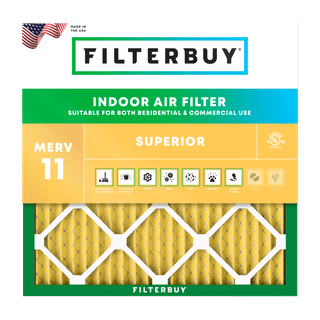
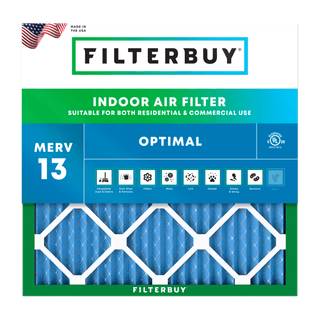



Check Today's Live Real Time Air Quality Index AQI Map in Charlotte, NC Now
Charlotte residents check the weather before stepping outside, but almost nobody thinks to check the air. That gap matters more than people realize, especially during summer when Piedmont ozone tips into Code Orange territory by mid-afternoon. The live map at the top of this page pulls from the five federally-approved monitoring stations Mecklenburg County Air Quality has run since the 1960s. What you see is the actual reading, not a model. After manufacturing air filters for over a decade and serving more than two million households, we know the question most Charlotte residents really want answered: Is the air safe to be outside today?
Most weather apps give you one AQI number and stop there. The number is only half the story. Whatever ozone is forming over Uptown this afternoon and whatever PM2.5 the Remount monitor catches from I-77 traffic, those pollutants don't stop at your front door. They slip through every gap in your building envelope and get recirculated by your HVAC system within hours.
TL;DR Quick Answers
Live Charlotte AQI: Use the map at the top of this page for real-time readings.
Charlotte's biggest summer pollutant: Ground-level ozone, peaking June through August.
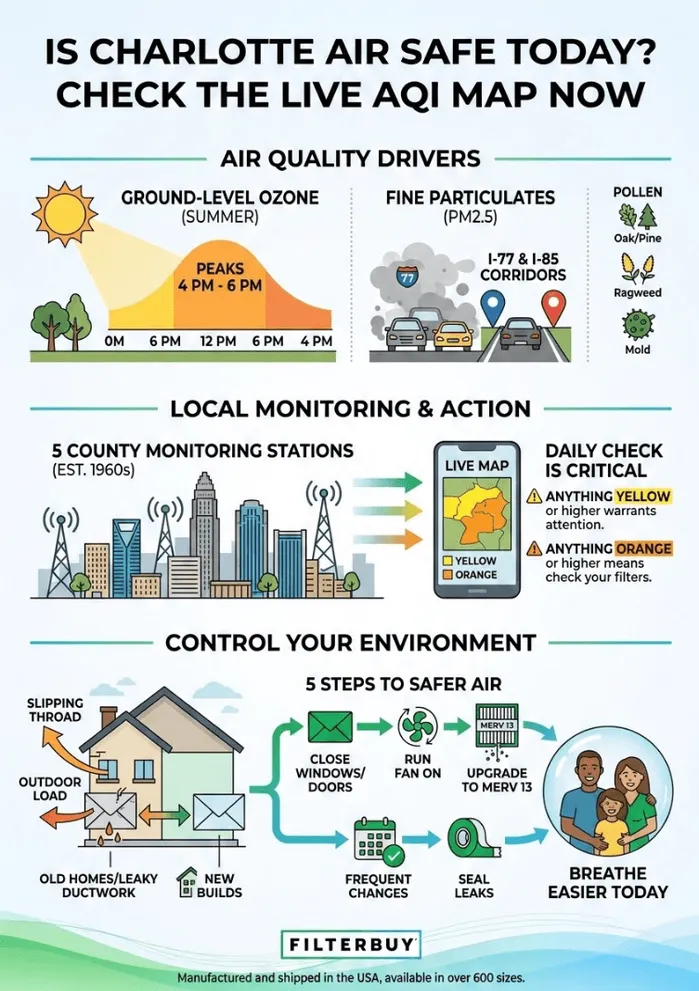
Charlotte's biggest year-round pollutant: Fine particulate matter (PM2.5), worst near I-77 and I-85.
Best protection on poor-air days: Stay indoors, close windows, run your HVAC blower with a MERV 11 or MERV 13 filter.
Top Takeaways
Mecklenburg County Air Quality's five federally-approved monitoring stations update Charlotte's live AQI continuously around the clock.
Ground-level ozone is Charlotte's dominant pollutant from June through August. PM2.5 leads the rest of the year.
The University Meadows and Remount monitors show why ozone and traffic emissions don't affect every neighborhood equally.
Code Orange days are unhealthy for sensitive groups (children, older adults, anyone with asthma or heart disease), even when otherwise healthy adults feel fine.
Indoor air filtration is the lever you actually control. Outdoor AQI tells you when to pull it.
Charlotte Air Quality Map – Live Readings
View Charlotte, NC Current Air Quality MapHow to Read Charlotte's AQI Today
The AQI runs from 0 to 500 across six color-coded categories. Green (0-50) means everyone can play outside without thinking about it. Yellow (51-100) is moderate. If anyone in your household has asthma or a heart condition, that's the threshold to start paying attention to symptoms. Orange (101-150), the Code Orange day, makes the air unhealthy for sensitive groups, even when otherwise healthy adults feel fine. Red (151-200) affects everyone. Purple (201-300) and Maroon (301+) are rare in Charlotte. You only see those numbers during heavy wildfire smoke events or major industrial accidents.
Ozone usually drives Charlotte's worst AQI readings during summer. Particulate matter takes the lead for the rest of the year.
For the technical scoring behind the index, see the Air Quality Index entry, which walks through the methodology the EPA developed and how the categories map to specific pollutants.
Where Charlotte's Air Pollution Actually Comes From
Four sources drive Charlotte's air pollution, each peaking at different times of year.
Ground-level ozone
Ozone forms when nitrogen oxides from vehicles meet volatile organic compounds in hot, sunny air. The University Meadows monitoring station sits along the southwest-to-northeast summer wind vector that sweeps Uptown emissions out into the suburbs, and it records the city's highest ozone readings from June through August every year.
Fine particulate matter (PM2.5)
PM2.5 comes mainly from vehicle exhaust, especially along the I-77 and I-85 corridors. The Remount monitor sits within 100 feet of I-77 South near mile marker 8, giving Mecklenburg County Air Quality its clearest read on what truck and passenger-car emissions are doing to traffic-corridor neighborhoods.
Pollen and biological particles
Pollen isn't on the AQI scale, but Charlotte allergy sufferers will tell you it shapes how the air feels. Oak, pine, and birch peak from March through May. Ragweed takes over in September and stretches into October. Mold spores rise during humid summer stretches and after heavy rain.
Wildfire smoke
Wildfire smoke shows up in Charlotte more often than it used to. Plumes from western North Carolina, the Smokies, and even Canadian fires have all reached the city in recent summers, pushing PM2.5 above safe thresholds for days at a time.

When Charlotte Air Quality Tends to Be Worst
Spring brings rising pollen plus the first ozone days. Summer is the worst stretch by far. Hot, humid, stagnant afternoons in July and August routinely produce the year's highest ozone, especially between 4 and 6 PM. Ragweed takes over in September and pushes well into October. Winter can trap PM2.5 close to the ground during cold snaps when residential wood burning rises, and inversions hold the air still.
Time of day matters too. Ozone climbs through the afternoon and peaks around 4 to 6 PM. Traffic-driven PM2.5 spikes during the rush-hour windows, roughly 7-9 AM and 4-7 PM along I-77, I-85, and I-485.
Protecting Indoor Air When Charlotte's AQI Climbs
Once outdoor AQI hits Yellow or higher, indoor air is where you can actually do something. Here's what we tell Mecklenburg County customers:
Close windows and exterior doors during Code Orange and worse, especially on still afternoons
Run your HVAC blower on the "Fan ON" setting (not Auto) so air keeps cycling through your filter
Upgrade to a MERV 11 or MERV 13 filter rated to capture fine particles down to 1-3 microns
Replace filters more often during peak ozone or smoke events, since loaded filters lose efficiency fast
Seal duct leaks and check for gaps around exterior doors and window frames
Older Charlotte housing stock, including the Dilworth bungalows, NoDa shotguns, and 1960s ranches in Eastover, typically has leakier ductwork than newer Ballantyne or Steele Creek builds. The age and tightness of your home dictate how much outdoor pollutant load actually reaches your living spaces.
For conditions across the state, our live AQI map for Raleigh, NC, gives you a parallel view from the Triangle.
"What we've seen across two million households is that the AQI app on your phone gives you outdoor readings, but your HVAC is the determining factor for what your family actually breathes. On a Code Orange day in Charlotte, your blower is pulling ozone-laden air through gaps you didn't know existed and recirculating it through every room. The right filter, properly sized and changed on time, can dramatically cut indoor PM2.5. Wearing a mask outdoors does almost nothing if the same air is filling your house."
— Filterbuy Team
Essential Resources
Seven sources give you the live data, forecasts, and health guidance you need to track Charlotte's air and protect your family.
EPA AirNow – North Carolina Live Conditions
The federal government's official real-time AQI feed. AirNow pulls from regulatory-grade monitors across the state, including the Charlotte network MCAQ operates. Bookmark this as your primary check before any outdoor activity.
Source: https://www.airnow.gov/state/?name=north-carolina
Mecklenburg County Air Quality – Live Monitoring Data
The county's real-time dashboard pulls from five federally-approved stations: Garinger High School, Friendship Park, University Meadows, Remount, and Ramblewood Park. This is the most granular Charlotte-specific air quality data anywhere.
Source: https://airquality.mecknc.gov/data
NC Division of Air Quality – Daily Forecasts
The state agency publishes daily forecasts covering ozone (March 1 through October 31) and fine particle pollution year-round. Subscribe to EnviroFlash to get email alerts when the daily code for Charlotte is forecast above Yellow.
CDC – Air Quality and Your Health
The public health authority's plainspoken guide to interpreting AQI numbers, with specific guidance for asthma, heart disease, COPD, and outdoor exercise. Indispensable reading if anyone in your household falls into a sensitive group.
Source: https://www.cdc.gov/air-quality/about/index.html
American Lung Association – Charlotte-Concord State of the Air
The annual report card grades the Charlotte metro on ozone, year-round PM2.5, and short-term PM2.5 spikes. Multi-year trend data shows whether Charlotte's air is improving or sliding.
Source: https://www.lung.org/research/sota/city-rankings/msas/charlotte-concord-nc-sc
National Weather Service – Charlotte Forecast & Hazardous Weather Outlook
The NWS Greenville-Spartanburg office issues air quality alerts and special weather statements for the Charlotte area. Combine the forecast view with the hazardous weather outlook to anticipate inversions, stagnation events, and smoke advisories.
Source: https://forecast.weather.gov/MapClick.php?lat=35.2237867&lon=-80.8411413
Pollen.com – Charlotte 5-Day Pollen Forecast
Daily pollen counts for ZIP 28202 (Uptown), with breakdowns by tree, grass, and weed pollen. The most actionable allergy-specific forecast for the Charlotte area.
Source: https://www.pollen.com/forecast/current/pollen/28202
Supporting Statistics
Three numbers worth keeping in mind when you weigh what's happening outside Charlotte against what's happening inside your home.
Indoor exposure is the much bigger story. Americans spend approximately 90 percent of their time indoors, and the EPA reports indoor pollutant concentrations are often two to five times higher than typical outdoor concentrations.
Source: https://www.epa.gov/indoor-air-quality-iaq/inside-story-guide-indoor-air-quality
Outdoor air pollution is a global health emergency. World Health Organization data attributes 4.2 million premature deaths worldwide each year to ambient outdoor air pollution, with PM2.5 driving the majority through cardiovascular and respiratory disease.
Source: https://www.who.int/news-room/fact-sheets/detail/ambient-(outdoor)-air-quality-and-health
Air pollution affects every major body system. NIEHS research links air pollution to health problems across the respiratory, cardiovascular, reproductive, neurological, and immune systems, with the strongest associations for asthma, prenatal exposure, and long-term cancer risk.
Source: https://www.niehs.nih.gov/research/supported/exposure/air_pollution
Final Thoughts and Opinion
Charlotte's air is generally moderate by national standards, but the metro consistently lands in the middle of the pack on the Lung Association's ozone rankings. Summer Code Orange days are a recurring feature of life here. What we tell every Filterbuy customer in Mecklenburg County is the same thing we'd tell our own families: outdoor AQI tells you when to be careful, but the indoor environment is where you can actually move the needle.
A correctly-sized MERV 13 filter, changed on schedule and paired with an HVAC system running its blower continuously during high-AQI days, will cut your family's indoor particulate exposure dramatically. That's far better than wearing a mask on the back patio or telling the kids to play on the side of the house away from the road. Make the live map a daily check before you head out. Same instinct as checking the weather, but for what you're actually breathing.
Next Steps
Bookmark this page and the EPA AirNow page so you can check Charlotte's AQI before outdoor activity each morning.
Sign up for EnviroFlash email alerts through the N.C. Division of Air Quality, so you get notified when Charlotte's daily code is forecast above Yellow.
Check what filter your HVAC system is currently using. If it's anything below MERV 11, you're missing the fine particles that cause the most harm.
Replace your filter on the schedule your manufacturer recommends, and replace it more often during summer ozone season and any wildfire smoke events.
Walk through your home with the doors closed and a smoke pencil to find the gaps where outdoor air is leaking in. Seal what you find.
Frequently Asked Questions
Protect Your Charlotte Home From What's in the Air
When Charlotte's AQI climbs, the right filter makes the difference between fresh indoor air and recirculated pollution. Filterbuy manufactures MERV 11 and MERV 13 air filters in over 600 standard and custom sizes, shipped directly from our American factories to your Charlotte home. Set up an auto-shipping schedule so a fresh filter arrives exactly when you need it, especially heading into ozone season. Browse Filterbuy air filters and protect your family's air today.