May 12, 2026
By February, the couch smells faintly like dog. Your eyes itch when you sit down on it. The kids' rooms feel stuffier by bedtime, and you're vacuuming twice as often as you were in October. That's not random. When heating season kicks in, your furnace pulls every pet hair, every flake of dander, and every odor molecule through the system, then pushes it back out in every room of the house.
Most of it comes down to one decision: the filter sitting in your furnace right now. Upgrade it, change it on a real schedule, and add a short weekly routine on top. You'll feel the difference inside a month, without buying an air purifier for every bedroom and without sending the dog to live with your in-laws.
This guide walks through what's actually in your air, why winter makes it worse, and the moves that'll move the needle most this week.
In winter, the highest-impact move for indoor air in any pet household is a pleated MERV 11 furnace filter, changed every 30 to 60 days during heating season.
• MERV 11: the right default for most single-pet homes
• MERV 13: the upgrade when allergies or asthma are in the house, or when you've got more than one pet
• Odor Eliminator (activated carbon): the right call when litter-box or kennel smell is the main complaint
• Skip true HEPA in your HVAC. The airflow resistance is too high for most home systems to handle safely
• Add one portable HEPA purifier in the bedroom of whoever has the worst allergies. It complements your furnace filter rather than replacing it.
If you only carry a few things out of this article, make it these:
1. Winter indoor air gets worse for pet homes because windows stay shut, the furnace runs constantly, and dry winter air keeps particles suspended longer.
2. Dander, not hair, is what triggers most pet allergies and what hangs in HVAC airflow.
3. Your furnace filter is the cheapest, most-overlooked piece of pet-cleanup equipment in your home.
4. MERV 11 is the right default for most pet households. MERV 13 is the upgrade when allergies or asthma are in the mix.
5. Activated-carbon filters are the only kind that actually pull odors out of the air. Standard pleated filters move smells around.
6. Change cadence matters more than rating. The best filter in the world stops working when it clogs.
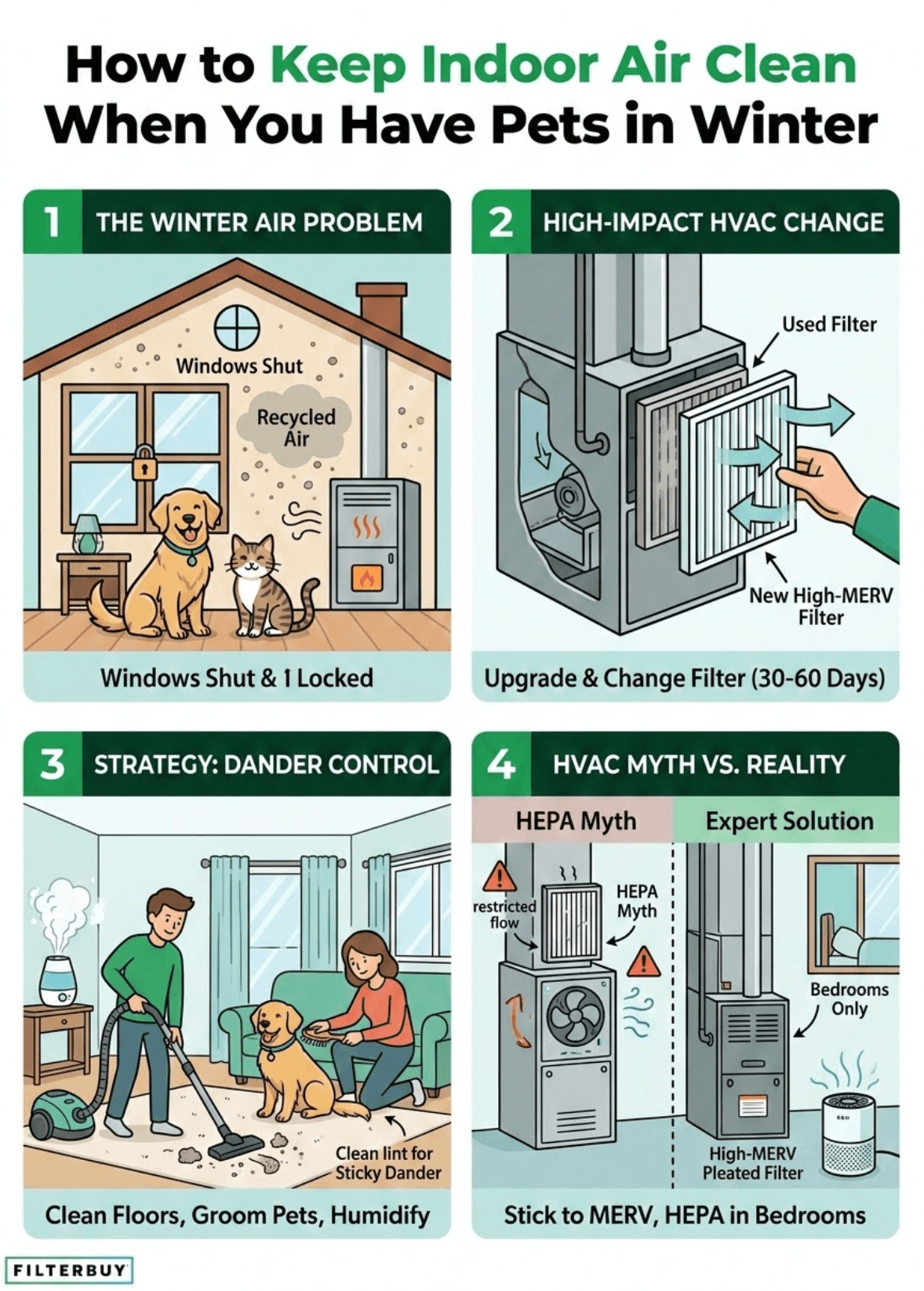
Four things change when heating season starts, and they all stack against pet households. First, the windows stay shut, so fresh air exchange drops to almost nothing. Second, the furnace runs almost continuously, which means every airborne particle in your home gets pulled through the return and pushed back out through the supply vents over and over. Third, winter air's dry, and dry air keeps lighter particles like dander suspended longer. Fourth, your pets are inside more, shedding indoors and tracking in salt, ice melt, and whatever was on the lawn during the morning walk. Layer those four shifts on top of a normal household's indoor air quality baseline and you've got a stuffier, dustier, smellier home by mid-winter.
Pet hair gets all the attention. Dander does most of the damage to your air.
Dander is microscopic: a mix of skin flakes and proteins from saliva, oil glands, and urine. About three-quarters of it sits between 5 and 10 microns across; the rest is 2.5 microns or smaller, light enough to stay airborne for hours and small enough to reach deep into your lungs. Pet allergens are also stickier than most household particles, which is why they cling to upholstery, carpet, and clothes long after the pet has left the room.
Then there's what dander brings along for the ride: tracked-in pollen and salt, litter dust and ammonia from the box, oils from pet bedding, and VOCs (volatile organic compounds) from pet shampoos, sprays, and cleaning products. None of it's visible. You're still breathing it.
Every cubic foot of air your HVAC system moves passes through your furnace filter before anything else. Get that one piece right and you've done most of the cleanup work in the whole house, for the cost of a filter you were going to buy anyway.
Quick refresher on MERV ratings (Minimum Efficiency Reporting Value, the ASHRAE-developed scale that measures what a filter actually catches):
• MERV 8. Dust, lint, pollen. Fine for low-shed households with no allergies in the picture.
• MERV 11. Adds most pet dander, mold spores, and fine dust. The right default for single-pet homes.
• MERV 13. Adds PM2.5, smoke, bacteria, and virus-carrying particles. The right pick when allergies or asthma are in the household, or when you've got more than one pet.
• Odor Eliminator (activated carbon). Pet-level particle capture plus odor and VOC adsorption. The right call when litter box or kennel smell is your number one complaint.
For a deeper, rating-by-rating breakdown for pet homes, check our guide to the best furnace filters for homes with pets.
This is where most pet owners get bad advice from the internet. "Get a HEPA filter for pets" shows up on every blog and product page, and it's only half right.
A true HEPA filter catches 99.97% of particles down to 0.3 microns. That's the gold standard. The catch: HEPA media is dense, and the airflow resistance is high enough that most home HVAC systems weren't built to push air through it. Force the issue and you can starve the blower, ice up the coil, and cut years off your equipment.
The straight answer for whole-home filtration is a high-MERV pleated filter, MERV 11 or 13, sized right for your system. It catches the same pet dander, hair, and dust, and your HVAC was designed to move air through it. A portable HEPA air purifier still earns its keep, just in the right spot: put one in the bedroom of whoever in the house has the worst allergies. It's a complement to good furnace filtration, not a replacement for it.
Eight steps. Even the first three will move the needle in your house this week.
1. Upgrade your furnace filter to MERV 11 or higher.
2. Change it every 30 to 60 days during heating season. Closer to 30 if you've got multiple pets or a heavy shedder.
3. Brush pets outside when the weather lets you, or in one easy-to-clean room inside.
4. Wash pet bedding weekly in hot water.
5. Vacuum carpets, upholstery, and pet sleeping spots twice a week with a HEPA-equipped vacuum.
6. Run bathroom and kitchen exhaust fans in short bursts to bring in fresh air on purpose.
7. Keep humidity between 30 and 50 percent. Too dry, and particles stay airborne longer; too humid, and you grow mold.
8. Wipe paws after every walk to keep salt, pollen, mud, and ice melt outside where they belong.
"After more than a decade of building filters in the U.S. and shipping them direct to families with pets, the move that consistently changes how a home feels in winter is the simplest one: swap a generic MERV 8 for a pleated MERV 11 or 13 and change it every 30 days." — Filterbuy IAQ Team
Primary-source reading for going deeper. None of these are affiliated with Filterbuy — they're the independent government, scientific, and nonprofit references the industry leans on.
1. EPA — Guide to Air Cleaners in the Home The Environmental Protection Agency's plain-language consumer guide to picking portable air cleaners and furnace/HVAC filters, including the recommendation to use at least a MERV 13 rating when your system can handle it.
2. EPA — What Is a MERV Rating? The EPA's explainer on what MERV measures, how the ASHRAE 52.2 test method works, and how to think about choosing a higher-efficiency filter for your specific HVAC equipment.
3. EPA — The Inside Story: A Guide to Indoor Air Quality The federal government's foundational document on residential indoor air quality, including the TEAM studies behind the often-quoted "two to five times more polluted" finding.
4. American Lung Association — Pet Dander The ALA's dedicated page on what pet dander actually is, why it stays in indoor air longer than most allergens, and what households can do to cut exposure.
5. AAFA — Dog and Cat Allergies The Asthma and Allergy Foundation of America's overview of pet allergies, what triggers them at the protein level, and clinical guidance for households who want to keep their pets and cut symptoms.
6. ASHRAE — Position Document on Filtration and Air Cleaning The engineering society that wrote the MERV test standard. Their position document is the technical authority on what residential filtration can and can't do, written plainly enough for a homeowner to follow.
7. American Lung Association — Clean Air Indoors ALA's broader hub on indoor air, with practical guides for ventilation, source control, and filtration. Useful for putting your pet-related concerns inside the bigger IAQ picture.
Three numbers worth keeping in mind when you talk about pet-household air quality in winter.
2–5x — Indoor air pollutant concentrations are often two to five times higher than typical outdoor concentrations, and Americans spend roughly 90% of their time indoors.
Source: U.S. Environmental Protection Agency, Report on the Environment: Indoor Air Quality
62% — Almost 62% of U.S. households have pets, totaling more than 161 million cats and dogs, and pet allergens linger in indoor air longer than most other airborne particles.
Source: American Lung Association, citing the American Academy of Allergy, Asthma and Immunology
10–20% — Allergies to cats and dogs affect an estimated 10 to 20 percent of the world's population, which means in most pet households at least one person reacts to dander.
Source: Asthma and Allergy Foundation of America (AAFA), Pet Allergies
The marketing push to put a portable HEPA purifier in every room of your house is mostly wasted money for the average pet household. We've been building filters in the U.S. since 2013, and we'd rather tell you that and lose a sale than sell you gear you don't actually need.
If you've got a working HVAC system, the cheapest, highest-impact upgrade you can make is the filter you're already paying to use. Swap a MERV 8 for a pleated MERV 11 or 13, change it on a schedule you can keep, and you've cleaned the air in every room of the house with one shopping cart click.
Portable purifiers do earn their place, in two spots specifically: the bedroom of someone with bad allergies, and the corner near a kennel or litter box when smell is the main complaint. Outside those two cases, your dollars go further on filter quality and the change cadence you'll actually keep up.
On the HEPA-for-HVAC question specifically: true HEPA media is the wrong tool for most home systems. A high-MERV pleated filter is the right one. We won't dress that up to sell you something else.
Three things, in this order:
1. Pull your current furnace filter and read the size printed on the frame. It's usually right next to the MERV rating.
2. Pick a rating: MERV 11 for most pet homes, MERV 13 if anyone has allergies or asthma, Odor Eliminator if smell is your biggest complaint.
3. Order a 4-pack or 6-pack on auto-delivery so the next change isn't something you have to remember.
That's the whole project. Twenty minutes today, then it runs itself.
For most pet households, a pleated MERV 11 furnace filter handles things well. Step up to MERV 13 if anyone at home has allergies or asthma, or if you've got multiple shedders. MERV 13 also catches finer particles like smoke and PM2.5.
Not for your whole house. Most home HVAC systems can't safely push air through a true HEPA filter because the resistance is too high. A high-MERV pleated furnace filter catches the same pet dander, hair, and dust. A portable HEPA air purifier is a good complement in a bedroom or other sensitive room.
Every 30 to 60 days in winter, closer to 30 if you've got multiple pets, a heavy shedder, or a higher-MERV filter. Hold the used filter up to a light. If you can't see through it, it's overdue.
Yes, especially in bedrooms. Pair a MERV 11 or 13 furnace filter (whole-home) with a portable HEPA purifier in the room where the allergy sufferer sleeps. That's the setup we recommend most often.
MERV 11 catches most pet dander for the average pet household. Step up to MERV 13 when you want finer particles like PM2.5, smoke, and virus-carrying particles too, or when allergies or asthma are in the home.
Switch to a furnace filter with activated carbon (an Odor Eliminator) and add a weekly bedding wash, regular vacuuming, and short bursts of ventilation when the weather lets you. Activated carbon adsorbs odor molecules; standard pleated filters don't.
Find your filter size, pick MERV 11 for most pet homes (MERV 13 if allergies or asthma are in the mix), and set up auto-delivery so the next change handles itself. One filter swap today, cleaner air in every room by the weekend.
