May 12, 2026

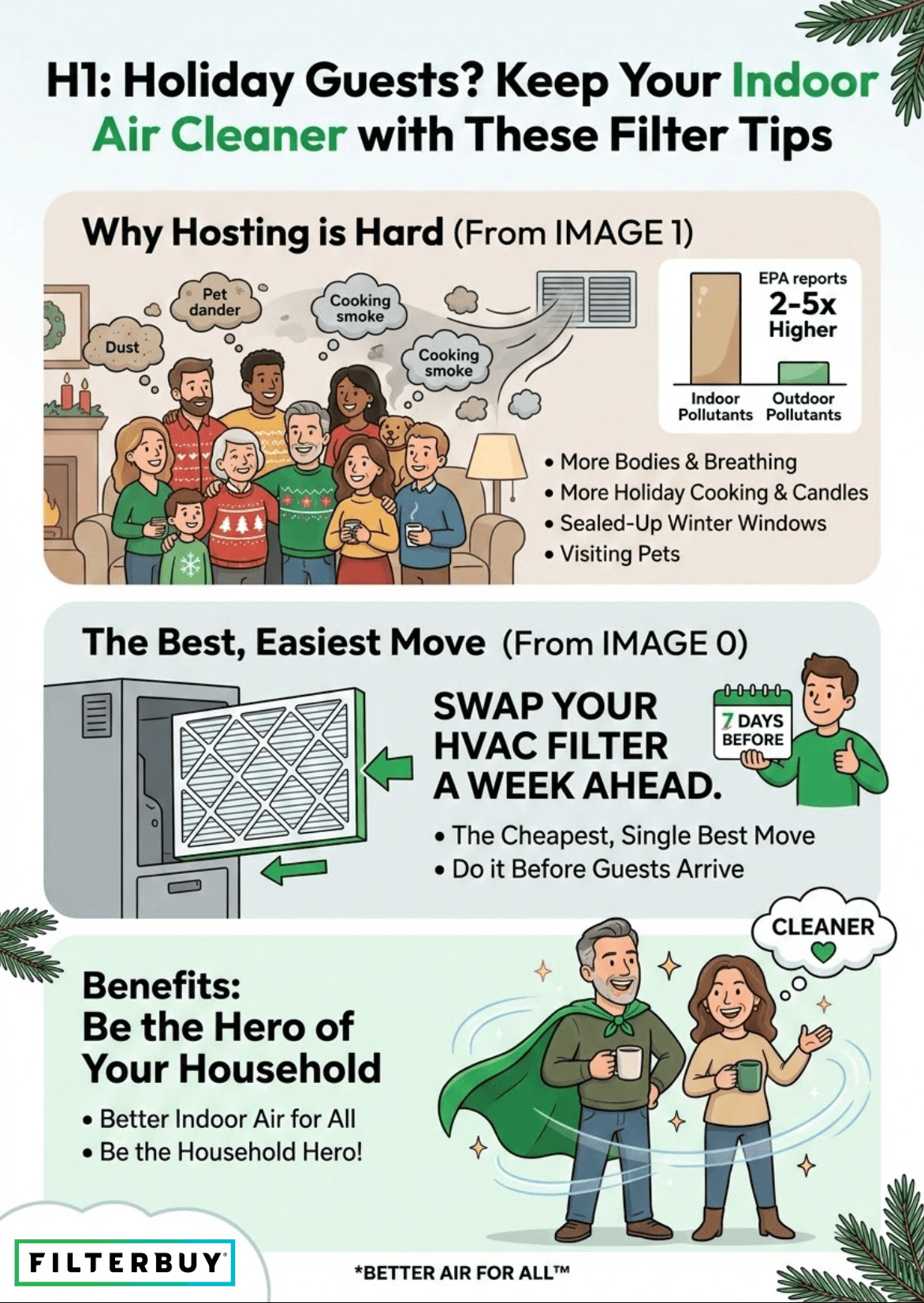
The single best move you can make for your indoor air before company arrives is also the cheapest: swap your HVAC filter a week ahead. We’ve been building filters in U.S. factories since 2013, and every November the orders tell the same story. The hosts who plan their air handle their holidays better.
This guide walks through the holiday air problem, the filter that fits most homes, the upgrade for guests with allergies, and the eight-step checklist we run in our own homes before the doorbell starts ringing.
Holiday guests IAQ gets worse the moment hosting starts. A full house concentrates almost every pollutant your HVAC filter is already working on — more bodies, more cooking, sealed-up rooms, and visiting pets all stack on top of one another. The EPA reports indoor pollutants typically run 2 to 5 times higher than outdoor levels, and the conditions that come with holiday guests push that ratio further. Five moves cover the basics of holiday guests IAQ:
• Swap the filter one to two weeks early. MERV 11 for most homes; MERV 13 if anyone has allergies or asthma; Odor Eliminator (with activated carbon) for heavy cooking and pet smells.
• Set the HVAC fan to "On," not "Auto." The CDC recommends this during visits so air cycles through the filter continuously.
• Run the range hood on high while cooking, and leave it on for ten minutes after the burners go off.
• Crack a window for ten minutes a day to flush built-up overnight pollutants.
• Test your CO detector if you'll be using a fireplace or gas stove. A filter can't help with carbon monoxide.
Plan a second filter swap right after a long visit — big gatherings load a filter faster than you'd expect.
If you only remember seven things from this page, make it these:
• Holidays are the hardest season on indoor air. More bodies, more cooking, sealed-up rooms, and visiting pets all stack on top of one another.
• A fresh, properly rated HVAC filter is the move with the biggest payoff. Nothing else cleans more square footage for less effort.
• MERV 11 is the right starting point for most hosts. Move up to MERV 13 if anyone in your household has allergies or asthma.
• Run your HVAC fan on “On,” not “Auto.” Continuous circulation pulls more air through the filter while company is over.
• Run the range hood while you’re cooking, and crack a window for ten minutes a day. Both flush built-up pollutants the filter can’t reach on its own.
• Plan a second filter swap after a long visit. Big gatherings load a filter faster than you’d expect.
• Filters can’t do everything. Install a working CO detector if you’ll be using a fireplace or a gas stove during the holidays.
Most of us only think about indoor air when a guest sneezes or someone asks why dinner smells like turkey three days later. Hosting amplifies almost every pollutant your filter is already working on.
Cooking aerosols spike fine particulate matter, the same PM2.5 you read about with wildfire smoke. Visiting pets bring dander sized in the exact range a quality HVAC filter is built to capture. Extra foot traffic kicks up dust that’s been settling for weeks. Perfumes, scented candles, and cleaning sprays add VOCs. And in cold months, our homes stay sealed up tight, so all of it has nowhere to go.

An HVAC filter pulls air through pleated, electrostatically charged media that traps particles by size and static cling. Every time your system runs, your home’s whole air volume gets a pass through that filter. That’s why a $20 upgrade can outperform any plug-in purifier in the same room.
Here’s the plain-English MERV breakdown for hosting season:
• MERV 8 is the basic standard. It catches dust and lint but lets allergens through. Fine for normal months; not what you want when company arrives.
• MERV 11 is the sweet spot for holiday guests. It captures most pet dander, pollen, and mold spores. This is our default recommendation for healthy indoor air during family gatherings.
• MERV 13 is the upgrade for sensitive guests. It captures fine particulate matter down to PM2.5, the same size class as cooking smoke and wildfire haze. The right call if anyone has allergies, asthma, or COPD.
• The Odor Eliminator filter handles smells specifically. It pairs pleated media with activated carbon to neutralize cooking odors, pet smells, and many VOCs from candles and cleaning products.
Two parts of the holiday playbook deserve extra attention.
Cooking is the single largest indoor source of PM2.5 most hosts will face all year. Pan-frying, roasting, and sautéing all release fine particles that linger long after the timer goes off. Run your range hood on high the moment you turn on a burner, not when smoke starts rising. Leave it on for ten minutes after the burners go off. If your range hood doesn’t vent outside, crack a window in the kitchen instead.
Open fires are part of the magic and part of the problem. Wood smoke is mostly fine particulate, plus carbon monoxide and a handful of toxic compounds you don’t want indoors. We dig into the trade-offs in our guide to fireplace and indoor air safety, but the short version is this: a clean flue, an open damper, dry seasoned wood, and a quality filter running on “On” will do most of the work. Install a CO detector too. That’s the one thing a filter can’t help with.
“After more than a decade of building filters in our U.S. factories and shipping them straight to American homes, the advice we keep giving family and friends is the same: a fresh pleated filter, installed a week before guests arrive, will outwork any portable purifier on the shelf at a fraction of the cost.”
— The Filterbuy Air-Quality Team
These are the third-party guides we point friends and family to when they ask. Each one is from a federal agency or a leading nonprofit. No marketing, no spin, just useful information.
1. EPA: Indoor Air Quality (IAQ) (https://www.epa.gov/indoor-air-quality-iaq).
The U.S. Environmental Protection Agency’s central hub for sources, pollutants, ventilation, and filtration. Start here for the foundational science.
2. EPA: Improving Your Indoor Environment (https://www.epa.gov/indoor-air-quality-iaq/improving-your-indoor-environment).
A practical, room-by-room walkthrough of common indoor air problems and how to address them. Useful when you’re prepping a guest room.
3. CDC: Taking Steps for Cleaner Air (https://www.cdc.gov/respiratory-viruses/prevention/air-quality.html).
The Centers for Disease Control’s guidance for cleaner air during gatherings. This is where the specific recommendation to switch your HVAC fan to “On” when visitors are over comes from.
4. EPA Burn Wise: Wood Smoke and Your Health (https://www.epa.gov/burnwise/wood-smoke-and-your-health).
Required reading if you’ll use a fireplace or wood stove during the holidays. Covers PM2.5, carbon monoxide, and how to burn cleaner.
5. American Lung Association: Clean Air at Home (https://www.lung.org/clean-air/indoor-air/building-type-air-resources/at-home).
Plain-language tips from the ALA on furnace filters, ventilation, and cutting indoor dust.
6. ACAAI: Avoid the Holiday Sneeze and Wheeze Triggers (https://acaai.org/news/hoping-to-enjoy-your-holidays-avoid-the-sneeze-and-wheeze-triggers/).
The American College of Allergy, Asthma, and Immunology’s holiday-specific guide. Particularly strong on allergen-friendly hosting and food-allergy precautions.
7. AAFA: Healthier Home Indoor Air Quality (https://aafa.org/allergies/prevent-allergies/healthier-home-indoor-air-quality/).
The Asthma and Allergy Foundation of America’s room-by-room IAQ checklist, available as a free printable.
If you need to convince yourself (or a skeptical family member) that holiday IAQ is worth ten minutes of effort, here are three numbers from credible sources.
1. Americans spend roughly 90% of their time indoors, and indoor concentrations of some pollutants run 2 to 5 times higher than outdoor levels. Per the EPA, those concentrations climb further with cooking, combustion, and crowded rooms.
Source: EPA Indoor Air Quality (https://www.epa.gov/report-environment/indoor-air-quality).
2. Residential wood combustion is the second-largest source of wintertime PM2.5 emissions in the United States. EPA’s National Emissions Inventory finds that wood smoke from fireplaces and stoves emits more fine particulate pollution than all on-road and non-road vehicles combined.
Source: EPA Burn Wise: Facts & Figures (https://www.epa.gov/burnwise/burn-wise-facts-figures-health-and-safety-tips).
3. Switching from gas to electric stoves cuts nitrogen dioxide exposure by more than 25% nationally, and by about 50% for the heaviest stove users. A 2025 Stanford study published in PNAS Nexus found that gas and propane stoves expose households to NO₂ levels that often match or exceed outdoor pollution.
Source: Stanford Woods Institute (https://woods.stanford.edu/news/air-inside-your-home-more-dangerous-air-outside-it).
Most homes don’t need an expensive purifier or a complicated plan for the holidays. They need a clean, properly rated HVAC filter, a window cracked once a day, and a range hood running while the oven’s on. That handles the large majority of what hosting throws at your air.
What it can’t handle is what filters were never designed to fix. Filters don’t remove carbon monoxide; install a CO detector for that. Filters don’t fix a clogged dryer vent or a greased-up range hood; those need their own attention. And filters can’t compensate for a fireplace burning wet, unseasoned wood; let your wood dry for at least six months before it goes on the grate.
If we sound a little practical for a brand selling air filters, that’s on purpose. The reader keeps a household running, and they deserve the truth about what works and what doesn’t. Spend ten minutes on the basics, and you’ll have done more for your guests’ lungs than most hosts will all season.
Print this list, screenshot it, or just work down it.
1. Find your filter size. It’s printed on the side of your current filter (e.g., 16x25x1). Write it down.
2. Order a replacement. MERV 11 for most homes; MERV 13 if anyone has allergies or asthma. Aim for delivery one to two weeks before guests arrive.
3. Install the new filter and date the frame. A Sharpie on the cardboard edge takes five seconds and saves the next-cycle guesswork.
4. Switch your HVAC fan from “Auto” to “On.” Per CDC guidance, leave it that way for the duration of the visit.
5. Test (or install) your CO detector. Especially if you’ll be using a fireplace or gas stove. Replace the batteries while you’re at it.
6. Run the range hood high while cooking, and for ten minutes after. If your hood doesn’t vent outside, crack a kitchen window instead.
7. Crack a window for ten minutes the morning of. It flushes built-up overnight pollutants. Yes, even in cold weather.
8. After the visit ends, check the filter. If it looks loaded, swap it again. Long visits cut filter life noticeably.
9. Set up auto-delivery. So next year’s holiday filter swap is already taken care of, no calendar reminders required.
Aim for one to two weeks ahead. That gives the new filter time to start removing settled dust as your HVAC cycles through. If you’re reading this the night before company shows up, change it tonight; it’s still better than waiting.
MERV 11 is our default recommendation for most households. It captures pet dander, pollen, mold spores, and most household dust without restricting airflow. Move up to MERV 13 if anyone in your home has allergies, asthma, or another respiratory condition. MERV 13 captures fine particulate matter down to PM2.5, which is what you want filtering cooking smoke and any wildfire haze that lingers into fall.
A standard pleated filter helps a little; it captures the grease aerosols that carry odors. For serious odor control during big meals, you want activated carbon. Filterbuy’s Odor Eliminator filters pair pleated media with a carbon layer that neutralizes cooking smells, pet odors, and VOCs from candles and cleaning products. Many hosts run an Odor Eliminator filter from Thanksgiving through New Year’s and switch back to MERV 11 in January.
Move up to at least MERV 11 before they arrive. Pet dander particles range from 2.5 to 10 microns, which is exactly what MERV 11 is built to capture. Vacuum carpets, rugs, and upholstery with a HEPA-equipped vacuum the day before. Wash the bedding the visiting pet will sleep on. After they leave, give the house a full vacuum and check the filter; dander loads it faster than normal household dust.
Not bad, exactly, but not free either. Candles release fine particulate matter and small amounts of VOCs while they burn. The American Lung Association recommends limiting indoor combustion when possible. Our take: enjoy them, but don’t leave a dozen burning at once, keep them away from drafts that cause sooting, and pair them with a quality filter so the particulate has somewhere to go.
Yes. The CDC explicitly recommends switching the fan from “Auto” to “On” when you have visitors. “Auto” only runs the fan during heating or cooling cycles, which means your filter only works during those windows. “On” circulates air continuously, giving the filter many more passes per hour. Expect a small bump in your electric bill; for the duration of a visit, it’s worth it.
Plan for two changes between Thanksgiving and New Year’s if you’re hosting overnight guests: once before, once after the longest stay. Pets, candles, fireplaces, and heavy cooking all cut filter life. If you can hold the filter up to a light and barely see through it, it’s done.
Holiday guests are coming. Your filter doesn’t care, but you do.
Filterbuy ships 600+ filter sizes from our U.S. factories straight to your door, including custom sizes most retailers don’t carry. Find your size, choose your MERV (or pick our Odor Eliminator for hosting season), and set up auto-delivery so next year’s filter swap is already handled.
