May 5, 2026
Yes, but the wrong high-efficiency filter can cost you more than it saves. After manufacturing filters across every MERV rating for over a decade, we've seen this firsthand: homeowners upgrade to a higher-efficiency filter expecting cleaner winter air, then call wondering why their energy bills spiked or their furnace started short-cycling. The filter worked exactly as designed, but it just wasn't designed for their system.
Here's what most filter guides won't tell you: efficiency ratings only tell half the story. The other half is pressure drop, how hard your furnace has to work to pull air through denser filter media during the months it runs the most. We test for both because we build these filters ourselves, and we know which combinations protect your air quality without punishing your HVAC system.
This guide shares what we've learned from millions of filters and real customer feedback to help you choose the right high-efficiency filter for winter, or decide whether you need one at all.
High-efficiency furnace filters (MERV 8–13) provide four key benefits during the winter heating season:
Superior particle capture during peak recirculation, your sealed home traps pollutants at 2–5x outdoor concentrations, and a higher-rated filter intercepts significantly more per cycle across months of continuous furnace operation
Reduced allergen buildup, dust, pet dander, mold spores, and fine particulate matter are pulled from circulation faster, which customers with allergies or asthma consistently tell us they notice within the first week
Better HVAC protection, finer filtration keeps your blower motor, heat exchanger, and ductwork cleaner, reducing repair frequency and extending equipment life
Lower energy costs when properly matched, a clean, compatible high-efficiency filter supports furnace performance by preventing the internal component buildup that forces longer run times
The critical caveat from over a decade of manufacturing experience: These benefits only hold when the filter matches your system's airflow capacity. A MERV 13 in a furnace rated for MERV 8 reverses every advantage, increasing energy costs, restricting airflow, and straining equipment. Always verify your system's maximum MERV specification before upgrading, and inspect monthly during heating season because high-efficiency filters load faster under heavy winter use.
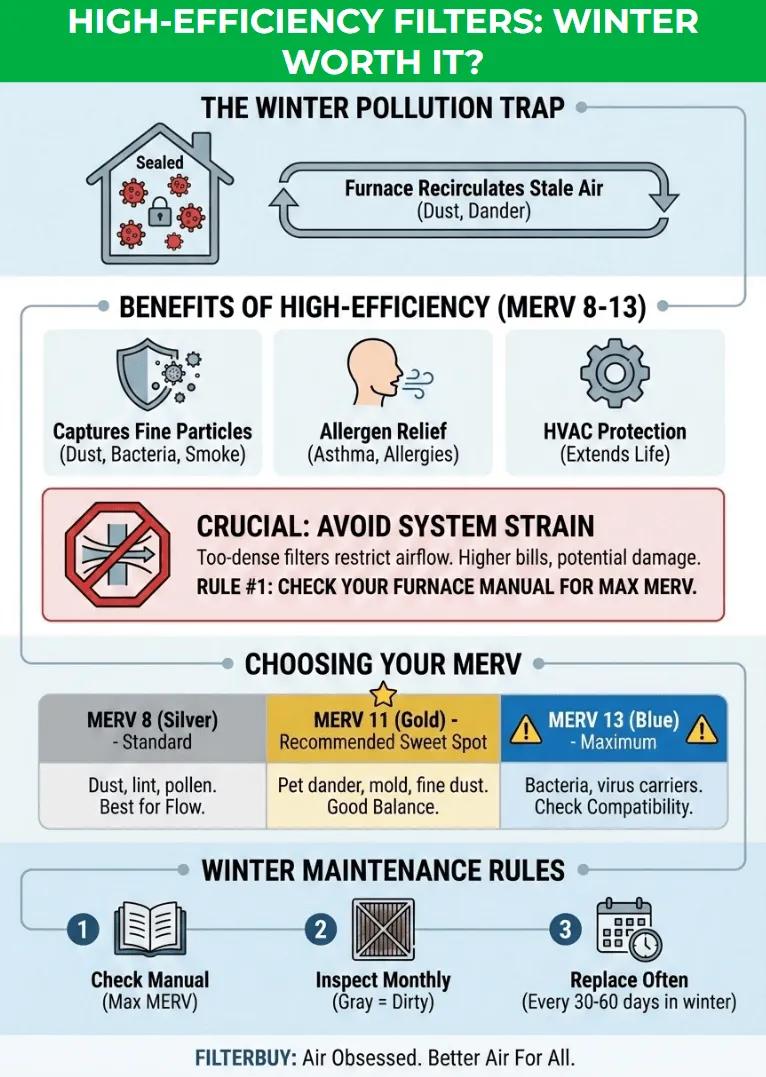
Best MERV rating for most homes in winter: MERV 11, captures the pollutants that matter most in sealed homes without the airflow penalty MERV 13 imposes on systems not built for it.
Match the filter to your system, not your wishlist. A MERV rating that exceeds your furnace's airflow capacity causes higher energy bills, uneven heating, and premature equipment wear. Check your furnace manual before upgrading.
Winter burns through filters faster than any other season. Sealed homes and nonstop furnace operation mean indoor pollutants are 2–5x higher than outdoor levels. Inspect monthly. Replace when loaded, not when the calendar says so.
MERV 11 is the sweet spot for most homes. It captures dust, pollen, pet dander, and mold spores without choking airflow. Only step up to MERV 13 if your system confirms compatibility and health concerns justify it.
A flowing MERV 8 beats a restrictive MERV 13 every time. Efficiency ratings tell half the story. Pressure drop tells the rest. This is the single most important lesson from over a decade of manufacturing and millions of filters shipped.
Your filter choice is a financial decision. Heating and cooling consume nearly 50% of home energy costs. The wrong filter during your highest-use months compounds into real money. The right one protects your air, your furnace, and your budget at the same time.
High-efficiency furnace filters use denser media to capture smaller airborne particles than standard filters. The industry measures this using MERV ratings, Minimum Efficiency Reporting Value, on a scale from 1 to 20. Standard fiberglass filters typically land between MERV 1 and 4. High-efficiency residential filters fall in the MERV 8–13 range, capturing particles as small as 1.0 micron, including dust mites, mold spores, pet dander, and some bacteria.
From our manufacturing floor, we can tell you the difference is visible: hold a MERV 4 panel next to a MERV 13, and you'll immediately see and feel how much tighter the media weave is on the higher-rated filter. That denser construction is what traps more, but it's also what creates the airflow tradeoff every homeowner needs to understand before upgrading.
Winter creates the perfect storm for indoor air quality problems. Your home is sealed tight, windows stay closed, and your furnace recirculates the same air continuously, sometimes for months. Every cycle pushes dust, pet dander, cooking particles, and other pollutants through your system and back into your living spaces.
A higher MERV rating sounds like the obvious fix: catch more of those particles before they complete another loop through your home. And for many households, that logic holds up. But we've heard from enough customers mid-season to know that upgrading without checking system compatibility first can create problems that outweigh the air quality gains.
Better particle capture during peak recirculation. When your furnace runs 8–12 hours a day, a MERV 11 or MERV 13 filter intercepts significantly more allergens, dust, and fine particulate matter per cycle than a basic filter. Over weeks of continuous heating, that difference compounds.
Reduced allergen buildup in sealed homes. Winter's closed-house conditions trap pollutants indoors. High-efficiency filters pull more of those irritants out of circulation, which customers with allergies or asthma consistently tell us they notice within the first week of switching.
Better protection for your HVAC system. Finer filtration means fewer particles reach your blower motor, heat exchanger, and ductwork. We've seen systems that run on MERV 11+ filters maintain cleaner internal components over time, which can extend equipment life and reduce repair frequency.
Improved efficiency when matched correctly. A clean, properly rated high-efficiency filter in a compatible system can actually support furnace performance by keeping internal components cleaner, reducing the strain that particle buildup creates on moving parts.
Airflow restriction is real. Denser filter media means your blower motor works harder to pull air through. If your system wasn't designed for higher-MERV filtration, you may notice uneven heating, longer run times, or increased energy consumption. We've seen customers install a MERV 13 in a system rated for MERV 8 and wonder why their utility bill jumped.
Faster clogging during heavy use. High-efficiency filters trap more particles, which means they fill up faster, especially during winter when your system runs constantly. A filter that lasts 90 days in spring may need replacement in 45–60 days during peak heating season. Ignoring this is one of the most common mistakes we see.
Not every system can handle them. Older furnaces, single-speed blowers, and systems with undersized return ducts may not generate enough static pressure to push air through high-MERV media efficiently. Installing one without checking your system's specifications can cause short-cycling, frozen coils, or premature blower failure.
A high-efficiency filter is likely worth it if your home checks several of these boxes:
Your household includes allergy or asthma sufferers who notice worsening symptoms during winter. You have pets that shed, increasing airborne dander during sealed-house months. Your furnace manual or HVAC technician confirms your system supports MERV 11 or higher. You're willing to check and replace filters more frequently during heating season. Your home is newer construction or has been retrofitted with adequate return ductwork.
A standard MERV 8 filter may be the smarter choice if your furnace is older with a single-speed blower, your return ducts are undersized or limited, or your primary concern is basic dust control rather than fine particle filtration. There's no shame in running a MERV 8 that your system handles well; a properly flowing MERV 8 outperforms a restrictive MERV 13 that's choking your furnace.
Start with your system's specifications, not your air quality wishlist. Check your furnace manual for the maximum recommended MERV rating; this is the ceiling you shouldn't exceed without professional guidance.
For most modern residential systems, MERV 11 hits the sweet spot: meaningfully better particle capture than a MERV 8, without the airflow penalty that MERV 13 can impose on systems not built for it. If your system supports MERV 13 and you have specific health concerns driving the upgrade, go for it, but monitor your system's performance closely during the first few weeks.
Filter depth matters too. A 4-inch or 5-inch high-efficiency filter holds more surface area than a 1-inch filter at the same MERV rating, which means better airflow and longer service life. If your system accepts deeper filters, this is one of the simplest upgrades we recommend; you get the filtration benefit with less airflow compromise.
Winter is the hardest season on any furnace filter. Your system runs for more hours per day, cycling more air and more particles through the media. The general guidelines, 90 days for 1-inch, 6–9 months for 4-inch, assume moderate use. Peak heating season isn't moderate use.
Pull your filter and visually inspect it every 30 days during winter. If it's visibly gray or clogged, replace it regardless of what the calendar says. A saturated high-efficiency filter restricts airflow worse than a clean standard filter, defeating the purpose of the upgrade entirely.
From years of customer feedback, here's our winter replacement guidance: 1-inch high-efficiency filters typically need replacement every 30–60 days during heavy heating. 4-inch filters generally last 2–4 months. Homes with pets, smokers, or ongoing renovation projects should check even more frequently.
Seal your filter housing. Gaps between the filter and the frame let unfiltered air bypass the media entirely. We've seen systems where a quarter-inch gap around the filter negated half the filtration benefit. Make sure your filter fits snugly with no visible light around the edges.
Keep return vents clear. Furniture, curtains, or rugs blocking return air vents force your system to work harder and reduce the volume of air passing through your filter. More airflow across the filter means better capture and more even heating.
Run your fan on "auto," not "on." Continuous fan operation circulates more air through the filter but also recirculates particles that have already settled on surfaces. Unless you have a specific air quality reason to run the fan continuously, "auto" reduces unnecessary wear on both the filter and blower motor.
Don't skip maintenance on the rest of the system. The best filter in the world can't compensate for dirty ductwork, a failing blower motor, or a cracked heat exchanger. Annual furnace maintenance ensures your entire system supports the filtration upgrade you're investing in.
Upgrade your thermostat if you haven't already. A programmable or smart thermostat optimizes run cycles, which directly affects how quickly your filter loads and how evenly your home heats. It's a small investment that extends air filter life and improves overall system performance.
"After manufacturing filters across every MERV rating and hearing from millions of customers through more than a decade of heating seasons, we can tell you the biggest mistake homeowners make isn't choosing the wrong filter, it's choosing the right filter for the wrong system. A MERV 13 that restricts your airflow will always underperform a MERV 8 that lets your furnace breathe."
Don't take your indoor air for granted, especially during winter when your home is sealed tight, and your furnace is recirculating the same air for months. After manufacturing filters across every MERV rating and helping millions of customers through heating season, we know the right information makes the difference between a smart upgrade and a costly mistake. These seven resources give you everything you need to protect your family's air quality, your HVAC system, and your energy budget this winter.
Before you upgrade, you need to understand what the numbers on your filter actually mean.
The EPA's official MERV explainer breaks down how Minimum Efficiency Reporting Values are tested and assigned using the ASHRAE Standard 52.2 method, the same standard we design and manufacture our filters around every day. This is your starting point for making an informed decision.
U.S. Environmental Protection Agency (EPA)
Source: https://www.epa.gov/indoor-air-quality-iaq/what-merv-rating
Here's something we see firsthand every heating season: homeowners install a high-efficiency filter and forget about it until spring. ENERGY STAR's guide explains why checking your filter monthly during heavy winter use prevents the airflow restriction, system strain, and higher utility bills that turn a good upgrade into an expensive problem. Their baseline recommendation to replace at a minimum every three months aligns with what we've learned from real customer feedback, though homes with pets or heavy furnace use often need to replace sooner.
ENERGY STAR (U.S. Department of Energy)
Source: https://www.energystar.gov/saveathome/heating-cooling
We can't stress this enough: the best filter for your home isn't the highest MERV rating available; it's the highest rating your system can handle. The DOE's furnace resource covers AFUE ratings, sealed combustion systems, and how filtration interacts with different furnace designs. We recommend reviewing this alongside your furnace manual before upgrading, because we've seen too many customers install a filter their system wasn't built for and end up with bigger problems than the ones they were trying to solve.
U.S. Department of Energy, Furnaces and Boilers
Source: https://www.energy.gov/energysaver/furnaces-and-boilers
A high-efficiency filter is one piece of the puzzle, not the whole picture. This DOE overview connects filter maintenance to insulation, air sealing, and thermostat settings that can collectively reduce heating costs by up to 30%. After working with millions of customers, we've learned that homeowners who combine a properly rated filter with basic system maintenance see the biggest improvements in both air quality and energy savings. Your filter works hardest when the rest of your system supports it.
U.S. Department of Energy, Home Heating Systems
Source: https://www.energy.gov/energysaver/home-heating-systems
Most people can't see the pollutants floating through their homes, but during winter, those invisible threats multiply. The EPA's indoor air quality guide details how sealed homes trap contaminants from combustion appliances, household products, and biological sources like mold and pet dander. Understanding exactly which pollutants your home faces helps you choose the right MERV rating to address them, rather than overspending on filtration you don't need or underprotecting your family with a filter that doesn't capture what matters most.
U.S. Environmental Protection Agency (EPA)
Source: https://www.epa.gov/indoor-air-quality-iaq/inside-story-guide-indoor-air-quality
We built this guide from over a decade of manufacturing experience and real feedback from millions of customers, because we know that choosing a MERV rating isn't one-size-fits-all. It breaks down the practical performance differences between residential MERV ratings, walks you through system compatibility checks, and matches replacement schedules to real household conditions like pets, allergies, and family size. This is the resource we wish every customer would read before their first winter filter upgrade.
Source: Filterbuy, Which MERV Rating Should I Use?
Source: https://filterbuy.com/resources/air-filter-basics/which-merv-rating-should-I-use/
Because we manufacture filters across the full MERV spectrum, we know exactly where each rating level delivers real-world results and where the airflow tradeoff begins for residential systems. Our detailed MERV chart maps every rating to specific particle sizes, capture efficiency percentages, and practical applications so you can see precisely what a MERV upgrade adds to your home's protection. When it comes to clean air, knowledge is your best filter.
Source: All About Air Filter MERV Ratings, Charts & Scales
Source: https://filterbuy.com/resources/air-filter-basics/all-about-merv-ratings/
We don't just manufacture filters; we track what happens after they're installed. Over a decade of production data, customer feedback, and real-world performance testing confirms what the leading federal agencies report.
When we inspect returned filters during post-season quality reviews, winter filters consistently carry heavier particulate loads than any other season. The EPA's research confirms why:
Indoor pollutant concentrations are often 2 to 5 times higher than typical outdoor levels
Americans spend approximately 90% of their time indoors
During winter, sealed homes eliminate the fresh air exchange that dilutes contaminant buildup
Furnaces recirculate the same trapped air for months without interruption
What we've learned firsthand: We engineered our pleated filters with progressive-density media specifically for this reason, to maintain capture efficiency as particle loading increases over weeks of continuous winter use. A filter that performs well in October but chokes by January fails when it matters most.
Source: U.S. EPA, Report on the Environment: Indoor Air Quality
We hear it every January: a customer upgrades to MERV 13, notices cleaner air for a few weeks, then watches their energy bill spike mid-season. The filter worked, but it filled up faster than expected.
A dirty filter forces the system to work harder to keep you warm, wasting energy
ENERGY STAR recommends checking filters monthly during heavy-use winter months
Denser high-efficiency media clogs faster during peak furnace operation, 8 to 12 hours per day
A loaded MERV 13 creates more airflow resistance than a loaded standard filter
What we've learned firsthand: From our own manufacturing and testing data, the energy penalty on a saturated MERV 13 can exceed general industry estimates, because those estimates assume moderate use, and winter furnace operation is anything but moderate. That's why every filter we ship includes replacement guidance calibrated to seasonal intensity, not just calendar intervals.
Source: ENERGY STAR, Heat & Cool Efficiently
Most homeowners dramatically underestimate how much their furnace drives monthly energy costs. The numbers put filter choice in perspective:
Nearly half of the energy used in a typical home goes to heating and cooling
Your furnace is already the most expensive appliance to operate in your home
The wrong filter increases run times and energy consumption during your highest-cost months
The right filter protects both air quality and energy performance simultaneously
Source: Home Energy Use
What we've learned firsthand: We've watched customers save meaningfully on winter energy costs by moving from a restrictive MERV 13 system that their system couldn't handle down to a MERV 11 that maintained proper airflow. The slightly lower-rated filter delivered cleaner air and lower bills because the furnace wasn't fighting the media to circulate heat. That's insight you only gain from building these filters, testing real-world pressure drop, and hearing back from millions of customers through full heating seasons.
After manufacturing filters across every MERV rating for over a decade and hearing from millions of customers through countless heating seasons, we've arrived at a perspective that might surprise you: the most common winter filter mistake isn't choosing too low, it's choosing too high.
The instinct makes sense. Winter seals your home, your furnace runs nonstop, and indoor pollutant levels climb. Upgrading to the highest-efficiency filter feels like the responsible move. We understand that protecting your family's air quality drives everything we build.
But here's what we've learned from the manufacturing floor, from pressure drop testing, and from customers who call us mid-season: a high-efficiency filter only delivers when your system can sustain the airflow it demands through the hardest-working months of the year.
A MERV 13 filter that restricts your furnace doesn't give you cleaner air. It gives you:
Higher energy bills from longer run times and increased blower strain
Uneven heating from reduced airflow across zones
Faster filter saturation that degrades performance by mid-season
Unnecessary wear on your blower motor and heat exchanger
Meanwhile, a properly matched MERV 11, or even a MERV 8 in older systems, delivers consistent filtration and stable airflow from October through March without punishing your furnace or your wallet.
Start with your system's specifications, check your furnace manual for the maximum supported MERV rating before shopping
Choose MERV 11 as your default; it's the sweet spot for most homes during winter, balancing particle capture with sustainable airflow
Only upgrade to MERV 13 if your system supports it and specific health concerns are driving the decision
Inspect every 30 days during heating season. High-efficiency filters load faster than the packaging suggests when your furnace runs 8–12 hours a day
We're obsessed with indoor air quality. We've built our entire company around making better air accessible to every household. But we'd rather you run a filter your system handles well all winter than install one that looks impressive on paper and underperforms in practice.
Protecting your family means protecting the whole system, the air, the furnace, and the budget that keeps it all running. That's not just our recommendation. It's what we'd do in our own homes.
You've got the knowledge, now put it to work. Five steps to get the right filter running in your system before winter peaks.
Locate your furnace manual and find the maximum MERV or filter specification
Check your existing filter, note the size, depth, and MERV rating printed on the frame
No manual? Look up your furnace model number online or call the manufacturer
Quick rule of thumb:
Systems built in 2010 or newer likely handle MERV 11
Pre-2010 or single-speed blower, stay at MERV 8
Unsure, consult an HVAC technician before upgrading
MERV 8, a solid baseline for older systems or homes without specific allergy concerns
MERV 11, the sweet spot for most modern systems, captures dust, pollen, pet dander, and mold spores
MERV 13, best for asthma, severe allergies, or immunocompromised family members (system must support it)
4-inch or 5-inch depth, choose over 1-inch whenever your system allows for better airflow, higher capacity, and longer life
Inspect your filter monthly once your furnace runs daily
Pull it out and look for visible gray discoloration; replace if loaded, regardless of date
Track your replacement intervals in the first winter to learn your home's actual usage pattern
Check more frequently with pets, smokers, or ongoing renovation dust
Watch for these signs within the first two weeks of a new or upgraded filter:
Unusual blower noise or short-cycling, possible airflow restriction
Weaker output at vents, the filter may be too restrictive for your system
Longer run times to reach set temperature, airflow mismatch
Energy bill spike in the first billing cycle, red flag
Notice any of these? Step down one MERV level. A properly flowing lower-rated filter always outperforms a restrictive higher-rated one.
Measure your current filter or read the dimensions on the frame (length x width x depth)
Search for your exact size at filterbuy.com to see available MERV options
Need an uncommon size? We make custom filters for any dimension, protecting your family shouldn't depend on having a standard filter slot
Set up automatic delivery so replacement filters arrive on schedule, never run a saturated filter through the coldest months
A: We build these filters, so here's the honest answer: it depends on your system.
When the match is right, the results are dramatic:
Customers consistently report noticeably cleaner air within the first week of upgrading
Post-season filter inspections show particle capture on MERV 11 far exceeds MERV 4 from the same home and timeframe
Properly matched filters reduce system strain while improving air quality
When the match is wrong, the opposite happens:
Energy bills increase from restricted airflow and longer run times
Furnace performance degrades instead of improving
The filter works as designed, but the system just can't support it
Our rule before every winter upgrade: Check your furnace manual. Choose the highest MERV your system supports. Treat that number as a ceiling, not a starting point.
A: After manufacturing every MERV level and tracking performance across millions of homes, MERV 11 is the winter workhorse for most residential systems.
MERV 8, solid protection for older furnaces and single-speed blowers without airflow tradeoff
MERV 11, captures dust, pollen, pet dander, and mold spores without the pressure drop problems we see MERV 13 cause in restricted systems
MERV 13, justified for severe allergy or asthma households, but only if your furnace manual confirms compatibility
What our testing shows: The airflow difference between MERV 11 and MERV 13 in restricted systems is significant enough to affect heating performance within days. A clean MERV 8 your system handles well will always outperform a MERV 13 your system fights against.
A: More often than the packaging says. Standard 90-day guidelines assume moderate furnace use. Winter is peak operation, 8 to 12 hours per day.
Our winter replacement guidance based on over a decade of customer data:
1-inch high-efficiency filters, replace every 30–60 days during peak heating
4-inch filters, replace every 2–4 months
Homes with pets, smokers, or renovation dust, check even more frequently
Skip the calendar. Use visual inspections instead. Pull the filter every 30 days. If it's gray and loaded, swap it out. A saturated high-efficiency filter chokes airflow worse than a clean basic filter, meaning you're paying more for less protection.
A: We've seen it happen, and it's one of the most preventable problems in home HVAC maintenance.
The damage isn't caused by the filter. It's caused by the mismatch. Common symptoms we hear from customers who exceed their system's MERV capacity:
Short-cycling within weeks of installation
Frozen coils from restricted airflow
Blower motors running hot and straining
Higher energy bills instead of lower ones
In every case, the fix was the same: Step down to the MERV rating the system was built for.
Our engineering team tests pressure drop across every MERV rating we produce. The resistance curve between MERV 11 and MERV 13 is where most residential systems hit their limit. Always verify your system's maximum spec before upgrading, and monitor for the first two weeks; weaker vent output, unusual noise, or longer run times all signal a mismatch that needs correcting before it becomes a repair bill.
A: They can, when two conditions are met:
The MERV rating matches your system's capacity, so the furnace maintains proper airflow without overworking
The filter is replaced before saturation, because a loaded filter reverses the efficiency gains entirely
What we've seen work across millions of customers and over a decade of heating seasons:
Properly matched filters keep internal components cleaner and reduce mechanical strain
Consistent airflow means shorter run times and lower energy consumption
Customers who stepped down from a restrictive MERV 13 to a compatible MERV 11 saw both cleaner air and lower bills, because the furnace stopped fighting the media
The real savings formula: Choose the right MERV for your system. Replace before saturation. Get both right, and the filter pays for itself multiple times over every heating season.
Shop your exact filter size at filterbuy.com. We manufacture over 600 sizes across every MERV rating, with free shipping direct to your door. Find your size, choose the MERV rating your system supports, and start protecting your family's air quality before winter peaks.
