April 8, 2026

Most homeowners don't price out a heating system until they're forced to. The furnace dies in January, or the contractor stands in your living room with two quotes and asks which direction you want to go. That moment, under pressure, is a terrible time to figure out that installation day is actually the cheapest part of this decision.
We've watched this play out across more than two million households. After manufacturing air filters for over a decade, our team has seen what happens to both heat pumps and furnaces over their full lifespan — not just the first winter after install. The gap between a system that saves you money and one that quietly drains it every month often has nothing to do with which brand you bought. It comes down to whether you understood your total cost of ownership before you signed.
Installation cost is one number. The electricity or gas bill you'll pay every winter for the next 15 to 20 years is a much bigger number — and it compounds. That's the variable most quotes don't show you, and the one this guide exists to explain. We'll walk through installation costs, annual operating costs by climate zone, the dual fuel option that works well for cold-climate homes, and the single ratio that determines which system will cost you less to run. By the time you're done, you'll know what to ask and how to compare.
In cold climates (IECC Zones 5–7), a dual fuel hybrid system, an electric heat pump paired with a gas furnace backup, gives most homeowners the best of both: heat pump efficiency during mild stretches, gas reliability when temperatures drop below -10°F. A cold-climate heat pump alone handles Zones 5–6 well, rated down to -15°F by ENERGY STAR. A high-efficiency gas furnace (96% AFUE) remains the lower-cost install at $3,500–$10,000+, but factor in that it requires a separate AC unit, a heat pump at $3,800–$25,000+ covers both heating and cooling in one system. In moderate climates (Zones 1–4), a heat pump wins on total cost of ownership without debate.
7 Things Every Homeowner Should Know
Heat pumps cost more upfront ($3,800–$25,000+) — but they replace both your furnace and air conditioner, which often brings total system cost in line with or below buying two separate units.
Gas furnace installation is less expensive ($3,500–$10,000+) and may carry lower operating costs in very cold climates with cheap natural gas — but it requires a separate AC unit.
Modern cold-climate heat pumps operate down to -15°F. The old objection about heat pumps failing in winter no longer applies to current equipment.
Dual fuel / hybrid systems pair heat pump efficiency with gas furnace reliability — and remain the strongest all-weather option for homeowners in cold climate zones 5–7.
Your local electricity-to-gas price ratio matters more than anything else in your operating cost comparison. Pull your actual utility rates before evaluating any quote.
New ductwork adds $2,400–$6,600 to either system. If your home lacks existing ducts, build that into your total budget before comparing options.
Filter changes aren't optional — for heat pumps and furnaces alike. Skipping them is the fastest way to compromise efficiency and cut years off system life.
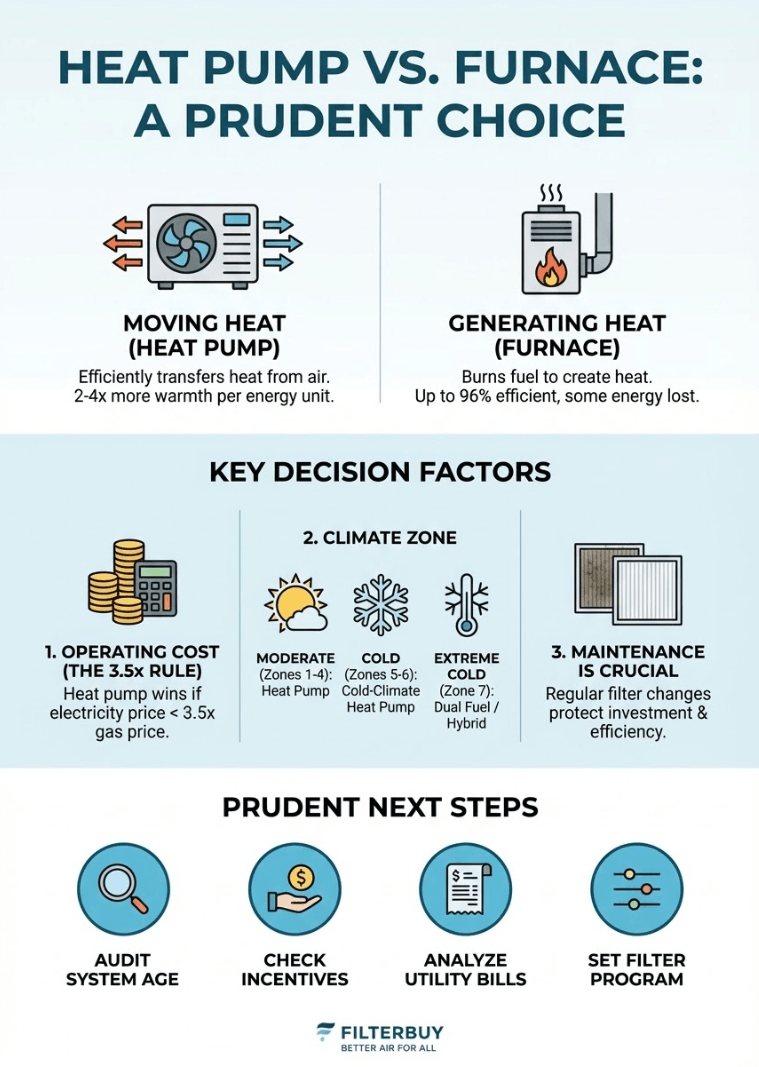
A natural gas or propane furnace generates heat by burning fuel. Combustion happens inside a heat exchanger, warm air moves around it, and your blower pushes that heat through your ductwork. The metric that matters here is AFUE — Annual Fuel Utilization Efficiency. A 96% AFUE furnace converts 96 cents of every fuel dollar into usable heat. The other four cents go up the flue.
An air source heat pump does something fundamentally different: it moves heat instead of making it. Think of your air conditioner running in reverse. Using a refrigeration cycle, it pulls thermal energy out of outdoor air — even air at 20°F holds usable heat — and transfers it inside. Because it's moving heat rather than generating it, a quality heat pump typically delivers 2 to 4 units of warmth for every unit of electricity it consumes. No combustion system touches that efficiency ratio. Learn more about how heat pumps work.
What you pay to install varies with home size, existing infrastructure, region, and efficiency tier. The table below covers general market ranges for a typical single-family home with existing ductwork — with and without the ductwork variable called out separately, because that one catches people off guard.
Air Source Heat Pump
Equipment: $3,800 – $12,000
Installed (existing ducts): $5,000 – $15,000
New ductwork add-on: +$2,400 – $6,600
Total typical range: $3,800 – $25,000+
Natural Gas Furnace
Equipment: $800 – $3,500
Installed (existing ducts): $2,000 – $5,400
New ductwork add-on: +$2,400 – $6,600
Total typical range: $3,500 – $10,000+
Propane Furnace
Equipment: $1,000 – $4,000
Installed (existing ducts): $2,500 – $6,000
New ductwork add-on: +$2,400 – $6,600
Total typical range: $4,000 – $12,000+
Electric Furnace
Equipment: $700 – $2,500
Installed (existing ducts): $1,500 – $4,000
New ductwork add-on: +$2,400 – $6,600
Total typical range: $2,500 – $8,000+
Dual Fuel / Hybrid System
Equipment: $5,000 – $12,000
Installed (existing ducts): $6,000 – $18,000
New ductwork add-on: +$2,400 – $6,600
Total typical range: $8,000 – $25,000+
Worth noting: A heat pump replaces both your furnace and air conditioner. If your AC is also due for replacement, add those costs together before comparing — the heat pump's total range looks very different against two systems than against one.
One thing the sticker price buries: a heat pump replaces both your furnace and your central air conditioner. If your AC is already aging or due for replacement, that changes the comparison considerably. Instead of paying for a furnace plus a separate AC unit down the road, you pay once for a system that covers both functions year-round.
Your monthly utility bill is where this decision actually plays out — not on installation day, but every winter for the next two decades. Heat pumps run on electricity. Furnaces burn gas or propane. Whether electricity or gas is cheaper in your area, and by how much, is the single most important factor in your annual operating cost.
A useful benchmark: if your electricity price per equivalent thermal unit falls below 3.5 times your gas price, the heat pump almost always wins on operating cost. Above that ratio, a high-efficiency gas furnace may hold a seasonal edge in the coldest months.
Annual Heating Operating Cost by System
High-Efficiency Heat Pump (Inverter)
Est. annual cost: $500 – $900/yr
Key variable: Local electricity rate
Best fit: Moderate climates with average or low electricity rates
Natural Gas Furnace (96% AFUE)
Est. annual cost: $700 – $1,200/yr
Key variable: Gas price per therm
Best fit: Cold climates with inexpensive natural gas
Propane Furnace
Est. annual cost: $1,200 – $2,200/yr
Key variable: Propane price volatility
Best fit: Homes without gas line access
Electric Resistance Furnace
Est. annual cost: $1,400 – $2,400/yr
Key variable: Electricity rate
Best fit: Mild climates only — least efficient option on this list
Dual Fuel / Hybrid System
Est. annual cost: $600 – $1,100/yr
Key variable: Balance-point temperature setting
Best fit: Cold climates where you want efficiency and reliability in the same system
Worth noting: These estimates are modeled for a 2,000 sq. ft. home in a moderate U.S. climate using national average energy prices (U.S. Energy Information Administration). Your actual costs will vary based on local utility rates, home insulation, and thermostat habits
Climate is the variable that settles most of this debate. The old objection — that heat pumps don't perform in cold weather — stopped being accurate when cold-climate heat pump technology caught up with northern winters. Modern units work down to -15°F. The colder your winters, though, the more a dual fuel backup earns its keep.
A dual fuel system — also called a hybrid heating system — pairs an electric heat pump with a natural gas furnace for backup. The system runs the heat pump during mild and moderately cold weather, where it's most efficient, and switches automatically to the gas furnace once outdoor temperatures fall below the configured "balance point" — typically 35°F to 40°F. You get heat pump efficiency most of the season, plus the raw heating power of gas exactly when you need it. The upfront cost is higher, but for homeowners in cold-climate zones, it's often the smartest long-term investment on the table.
Heat pump, gas furnace, dual fuel — one thing doesn't change across any of them: a dirty filter costs you money. A clogged filter makes your system work harder, cuts efficiency, and shortens equipment life. Choosing the right MERV rating for your system is the simplest, lowest-cost protection available for whichever heating investment you make. Our guide to heat pump filters covers everything you need to keep yours running clean.
"After servicing filters across more than two million households, the pattern is clear: the homeowners who regret their heating system choice almost never picked the wrong equipment — they picked the right system and then neglected it, and a clogged filter quietly erased years of efficiency gains before anyone noticed."
-Filterbuy Team
We pulled these sources so you don't have to go hunting.
1. U.S. Department of Energy — Heat Pump Savings Overview. If you want to understand why heat pumps use less energy and how federal tax credits actually work, start here. The DOE lays it out in plain language without the sales pitch. energy.gov — Pump Up Your Savings with Heat Pumps
2. ENERGY STAR — Air Source Heat Pumps Product Guide. Before you buy, check this. ENERGY STAR's certified product listings show you which models qualify for tax credits and which cold-climate units have been independently tested at 5°F — so you're not taking a contractor's word for it. energystar.gov — Air Source Heat Pumps
3. ENERGY STAR — Air Source Heat Pumps. Tax Credit Up to $2,000 back on a qualifying installation is worth five minutes of your time. This page tells you exactly which units qualify and how to claim it. energystar.gov — Air Source Heat Pumps Tax Credit
4. U.S. Energy Information Administration — Residential Heating Fuel Use Trends. The numbers behind the shift away from gas are here. If you want to understand why 42% of U.S. households now heat primarily with electricity — and what's driving that — the EIA tracks it without an agenda. eia.gov — Electricity Use Is Becoming More Common for Residential Heating
5. U.S. Energy Information Administration — Winter Fuels Outlook. Gas prices move. So do electricity rates. The EIA's seasonal forecast gives you a current, region-specific read on what fuel costs are doing — which matters more to your annual operating cost than almost anything else in this decision. eia.gov — Short-Term Energy Outlook, Winter Fuels
6. Wikipedia — Heat Pump. Not everything needs a government citation. This is a solid, well-maintained reference for how heat pumps actually work at a physics level — useful if you want to understand the refrigeration cycle before talking to a contractor. en.wikipedia.org — Heat Pump
7. Filterbuy — Everything You Need to Know About Heat Pump Filters. Most homeowners think about the filter after something goes wrong. Don't be that homeowner. This guide covers the right MERV rating for your system, how often to change it, and the early warning signs that your filter is costing you efficiency — written specifically for heat pump owners. filterbuy.com — Everything You Need to Know About Heat Pump Filters
Stat 1 — Heat Pump Market Adoption
As of 2020, more than 17 million U.S. housing units had a heat pump installed — and heat pumps now account for more than half of all residential heating equipment sales nationwide. Source: U.S. Department of Energy (energy.gov/articles/pump-your-savings-heat-pumps)
Stat 2 — Efficiency Advantage vs. Electric Resistance Heating
Modern air source heat pumps can reduce electricity use by up to 50% compared to electric furnaces and baseboard heaters, because they move heat rather than generate it. Source: U.S. Department of Energy (energy.gov/articles/pump-your-savings-heat-pumps)
Stat 3 — Residential Heating Fuel Shift
In 2024, 42% of U.S. households reported electricity as their main space heating fuel, while natural gas fell to 47% — down from 49% in 2010. Technology improvements in air source heat pumps are a primary driver of this shift. Source: U.S. Energy Information Administration (eia.gov/todayinenergy/detail.php?id=66324)
After more than a decade manufacturing air filters for every HVAC system type on the market and working with over two million households, here's the honest view we've landed on: there's no single right answer, but there are some wrong ways to approach the question.
If you're in a moderate or warm climate and your AC unit is already due for replacement, a heat pump is almost always the stronger long-term investment. You consolidate two systems into one, remove combustion from your home, and position yourself well as gas prices continue fluctuating. The math usually works — even before you factor in available tax credits.
If you're in a genuinely cold climate — Zone 5 through Zone 7 — don't write off gas, and don't overlook dual fuel systems. Cold-climate heat pumps have closed the performance gap with northern winters dramatically, but a hybrid system that defaults to gas when temperatures drop below -10°F is still the most pragmatic choice for homeowners who want year-round reliability without compromise.
The position we hold most firmly: whatever system you install, protect it. The homeowners we hear from who are most dissatisfied aren't the ones who chose heat pump over furnace, or furnace over heat pump. They're the ones who skipped filter changes, deferred annual tune-ups, and found themselves looking at a $12,000 system running at diminished capacity by year five — because the filter hadn't been replaced. The cost of regular maintenance is modest. The cost of skipping it is not.
Here's how to move forward without second-guessing yourself:
Audit what you already have. Note the age of your furnace and air conditioner separately. Both over 10 years old? You're replacing both eventually, regardless — a heat pump becomes a cost-consolidation move, not just a system swap.
Find your climate zone. Check the zone table in this guide. If you're in Zones 5–7, ask specifically for cold-climate certified heat pump quotes and dual fuel system pricing — not just the standard heat pump option.
Pull 12 months of utility bills. Find your actual electricity rate in cents per kWh and your gas rate per therm. These two numbers tell you more about your operating cost outcome than any figure a contractor hands you from a brochure.
Get at least three quotes — with the right ask. Request a Manual J load calculation from each contractor to confirm proper system sizing. Ask for side-by-side pricing on heat pump vs. furnace at equivalent efficiency ratings, and confirm whether the unit qualifies for ENERGY STAR federal tax credits.
Check available incentives before you sign anything. Visit energystar.gov's tax credit page and your state energy office website. ENERGY STAR Most Efficient certified air source heat pumps may qualify for a federal tax credit of up to $2,000. State rebates and utility incentives can add thousands more on top of that.
Set up your filter program before installation day. Know your system's filter size, the right MERV rating for your household's air quality needs, and your change schedule. A heat pump or high-efficiency furnace only delivers its rated efficiency with a clean filter in place.
A heat pump typically runs $3,800–$25,000+ installed, depending on type, size, and whether new ductwork is required. A natural gas furnace runs $3,500–$10,000+ under the same conditions. The number that changes the comparison: a heat pump replaces both your furnace and your air conditioner. If your AC is also due for replacement, that combined cost often makes the heat pump the more practical choice. Add $2,400–$6,600 for new ductwork if your home doesn't have existing ducts.
In most U.S. climates, yes. Heat pumps are 2–4x more energy efficient than combustion heating systems because they move heat rather than generate it. The exception is in very cold climates where natural gas prices are low and temperatures regularly fall below 0°F — in those conditions, a high-efficiency gas furnace (96% AFUE) can hold a seasonal operating cost advantage. For most homeowners, the annual savings from a heat pump range from $300 to $700 per year vs. gas.
A dual fuel (hybrid) heating system pairs an electric heat pump with a natural gas furnace for backup. The system runs the heat pump during mild weather and switches automatically to the gas furnace when outdoor temperatures drop below a programmed balance point — typically 35°F to 40°F. You get heat pump efficiency for most of the season, with gas reliability when you need it. Installation typically runs $8,000 to $25,000+, depending on system size, climate zone, and existing infrastructure.
Yes. Modern cold-climate heat pumps work effectively down to -15°F. ENERGY STAR certifies cold-climate units based on third-party performance testing at 5°F. The older concern about heat pumps failing in northern winters applies to older, standard-efficiency equipment — not what's available now. Homes in Climate Zone 7 (Minnesota, North Dakota, northern Maine) often do best with a dual fuel setup that uses gas backup during the most sustained cold periods, when even a cold-climate heat pump benefits from supplemental heat.
For Climate Zones 5–6 — Illinois, Pennsylvania, Colorado, Utah, New York — a cold-climate heat pump or dual fuel hybrid system typically delivers the best combination of efficiency and reliability. For Zone 7 (Minnesota, Wisconsin, Montana, Maine), a dual fuel system or a high-efficiency condensing gas furnace (96%+ AFUE) is generally most cost-effective once you account for extended sub-zero temperatures. Always compare your actual local electricity and gas rates before deciding — that ratio is what determines your real annual operating cost outcome.
For a 2,000 sq. ft. home in a moderate U.S. climate using national average energy prices: a high-efficiency heat pump typically costs $500–$900 annually for heating, while a 96% AFUE gas furnace runs approximately $700–$1,200 annually. Propane furnaces cost significantly more at $1,200–$2,200 per year. A dual fuel system generally falls in the $600–$1,100 range. These figures shift considerably based on local utility rates — homes with low electricity costs or high gas prices will see wider heat pump savings.
A furnace generates heat through combustion, burning natural gas or propane to warm air that moves through your ductwork. An air source heat pump extracts thermal energy from outdoor air and transfers it inside using a refrigeration cycle. Because it moves heat rather than creating it, a heat pump delivers 2–4 units of warmth per unit of electricity consumed. A furnace's efficiency tops out around 96% AFUE — a heat pump in moderate temperatures regularly achieves 200–350% effective efficiency. Learn more about heat pumps.
Yes. An air source heat pump heats in winter and cools in summer in a single system — it runs as an air conditioner when the refrigeration cycle runs forward and reverses that cycle to heat when it runs backward. When both your furnace and AC are aging, replacing them together with a heat pump consolidates two replacement costs into one. In many cases, that makes the heat pump's higher upfront price comparable to or less than buying a furnace and a new AC separately.
You now have the numbers, the climate context, and the cost comparison you need to make the right call between a heat pump and a furnace for your home. Find the right air filter for your new system and keep it performing at its best from Filterbuy — because the system you just chose deserves protection from day one.
