
Air-Purifying Plants: What They Actually Remove From Your Air
September 12, 2026
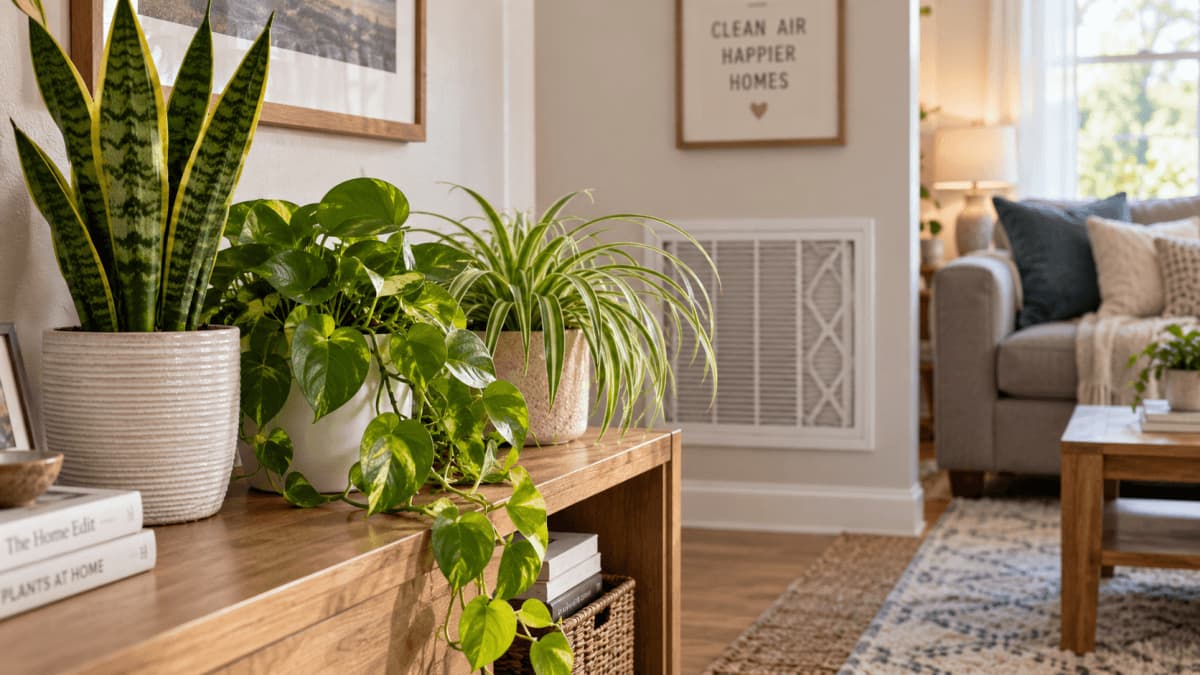
What They Clean and the 10 Most Popular
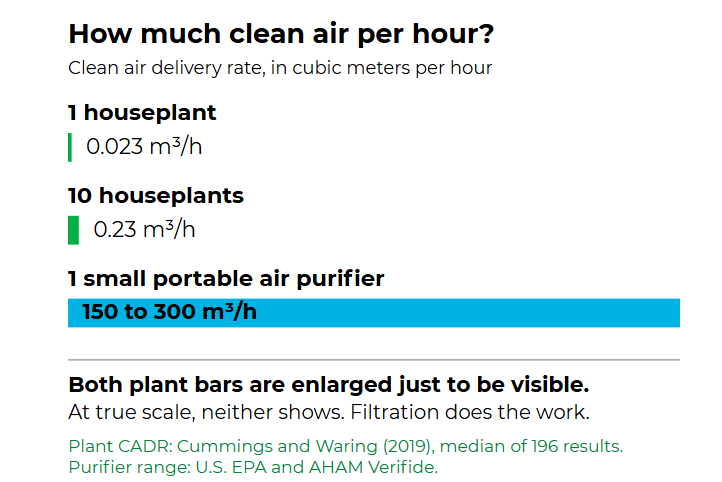
Very little. A houseplant cleans about 0.023 cubic meters of air per hour, which is next to nothing in a room you actually live in. The figure is the median across 196 standardized lab results, thousands of times below what a small air purifier delivers. Plants were tested on gases like formaldehyde and benzene, not on the dust, pollen, and dander a filter captures.
Plants do remove small amounts of certain gases, mostly through soil microbes rather than leaves.
Plants do not remove particles. Dust, pollen, smoke, and pet dander are particles.
What does the work: ventilation, plus an HVAC filter sized and rated for your system.
Here for the plant list? All 10 are below, with light needs, care level, and which ones are safe around cats and dogs.
Answer a few quick questions and we will match you to the right filter for your system.
Know your size already? Shop by size and MERV rating at Filterbuy.com.
TL;DR:
Houseplants have a reputation as natural air purifiers, built largely on a single 1989 NASA study. That study tested plants in sealed, one-cubic-meter chambers with no airflow, conditions nothing like a bedroom or living room.
A 2019 peer-reviewed analysis of 196 experimental results found the median plant clean air delivery rate (CADR) is just 0.023 m³/h.
To compete with the air exchange a real room already has, you would need somewhere between 10 and 1,000 plants per square meter of floor space, depending on species and pollutant. Plants are worth having for their looks and the calm they bring to a room. For cleaning the air you breathe, filtration and ventilation do the actual work.
Key Takeaways
The NASA Clean Air Study (1989) tested plants in sealed, one-cubic-meter chambers, not in houses with doors, windows, and HVAC systems.
A 2019 review of that data (Cummings and Waring, Drexel University) standardized 196 results from twelve chamber studies and found a median plant CADR of 0.023 m³/h, far below what a small HVAC filter or portable air purifier delivers.
Competing with the air exchange a building already has would require somewhere between 10 and 1,000 plants per square meter of floor space, depending on the species.
Plants remove some VOCs through soil microbial activity more than through their leaves, a detail the popular "NASA houseplant" claim usually skips.
Some common houseplants are toxic to cats and dogs, per the ASPCA Animal Poison Control plant database, so pet safety should factor into any plant list, not just air quality.
Filterbuy doesn't sell plants. This guide exists because customers keep asking the question, even though the honest answer doesn't sell filters.
Do Air-Purifying Plants Really Work?
Not at the scale most people assume. Houseplants absorb a small amount of certain VOCs and can support soil microbes that break down pollutants. But the volume of air a single plant processes in an hour is tiny compared to the volume of air in an average bedroom or living room. The idea that a few plants can noticeably clean a room's air comes from lab conditions that don't resemble real homes.
Environmental engineers Bryan Cummings and Michael Waring of Drexel University reviewed twelve chamber studies, standardized 196 published results, and converted them into clean air delivery rate, the metric used to rate air cleaners. They put the conclusion in the title of the paper: potted plants do not improve indoor air quality. As Waring described the finding, plants don't clean indoor air quickly enough to affect the air quality of a home or office.
Why Is a Filter Company Telling You This?
Filterbuy sells HVAC filters, not plants. It would be easy to skip this topic or to spin it in a self-serving direction. Instead, this article lays out what the research actually shows, including the parts that don't help sell filters, like the fact that ventilation and open windows also improve indoor air quality for free. If you want a plant on your desk because you like plants, that's reason enough. If you want a plant instead of a decent HVAC filter, the numbers below explain why that trade doesn't hold up.
Our standard for the rest of this page is simple. We publish the arithmetic behind every figure, we say plainly when something can't be measured, and if we get something wrong, we fix it.
How Do Houseplants Compare to Air Purifiers?
| Air Cleaning Method | Clean Air Delivery Rate (CADR) | Notes | Source |
|---|---|---|---|
|
Single houseplant (median, lab-tested) |
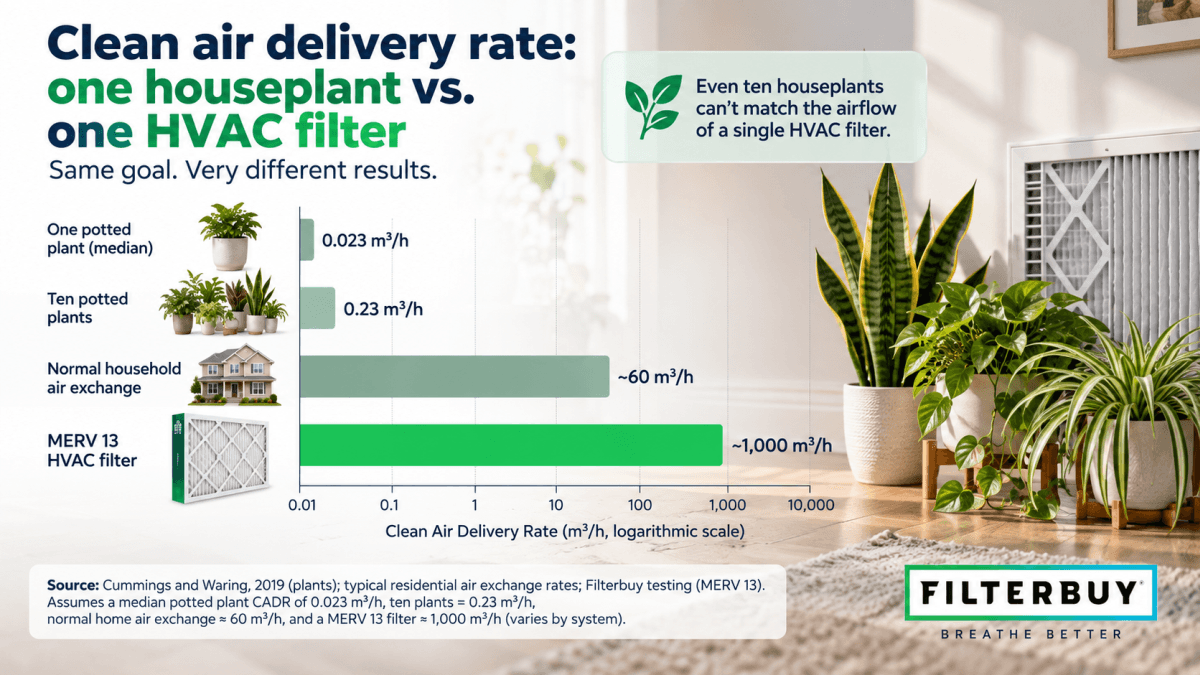
0.023 m³/h (about 0.014 CFM) | Median of 196 standardized chamber results | Cummings and Waring, 2019 |
| Ten houseplants | 0.23 m³/h (about 0.14 CFM) | Median multiplied by ten | Median × 10 |
| Normal air exchange in a home | Orders of magnitude higher | The baseline plants are competing against | Cummings and Waring, 2019 |
| Potted plants, any number | Zero, for particles | Every study behind the claims tested gases | No supporting evidence |
| Small portable HEPA air purifier | Roughly 150 to 300 m³/h | Varies by unit size and fan speed | U.S. EPA; AHAM Verifide |
| HVAC system with a properly rated filter | Depends on system airflow (CFM) and duct design | Always confirm HVAC compatibility before upgrading filter rating | Filterbuy testing |
Filterbuy method note: The plant figure is the median single-plant clean air delivery rate from Cummings and Waring (2019), doi:10.1038/s41370-019-0175-9. Filter figures are pending verified test data from our own engineering team, and we would rather leave them blank than estimate them. The EPA notes that clean air delivery rate is a particle metric, so no equivalent rating exists for gas removal.
A single plant's clean air delivery rate is thousands of times smaller than that of a modest air purifier. That gap is the core reason plants can't substitute for mechanical filtration in a real room.
What Did the NASA Study Actually Prove?
The 1989 NASA Clean Air Study, led by researcher B.C. Wolverton and run with the Associated Landscape Contractors of America tested houseplants in sealed one-cubic-meter chambers with no air exchange. Under those conditions, certain plants reduced concentrations of specific VOCs. That part is accurate.
The compounds in the 1989 panel were exactly three: benzene, trichloroethylene, and formaldehyde. Ammonia, xylene, and toluene turn up on "NASA's five toxins" lists because of Wolverton's later work, which came after that report. Almost every plant list online conflates the two.
What the study didn't test was how plants perform in an actual room, with doors opening, air conditioning running, and a normal exchange of indoor and outdoor air. A sealed box with no airflow is not a bedroom. NASA was studying life support for sealed habitats, where slow removal still beats none. A house is the opposite case. The widely cited 2019 review by Cummings and Waring pointed out that scaling the chamber results up to real-world room sizes would require far more plants than anyone keeps in a house.
The Math: How Many Plants Would You Actually Need?
To compete with the ventilation a typical building already has, a room would need somewhere between 10 and 1,000 plants per square meter of floor space, depending on the species tested and the pollutant in question. Here's what that looks like in practical terms.
| Room Size | Plants Needed (Low Estimate) | Plants Needed (High Estimate) |
|---|---|---|
| 10 m² bedroom (about 108 sq ft) | 100 plants | 10,000 plants |
| 15 m² home office (about 160 sq ft) | 150 plants | 15,000 plants |
| 25 m² living room (about 270 sq ft) | 250 plants | 25,000 plants |
Filterbuy's arithmetic, from the 10 to 1,000 plants per square meter range published in Cummings and Waring (2019). Floor area converted at 10.764 sq ft per square meter; figures rounded. Low estimate applies the low end of the published range, high estimate the high end.
No one is putting 100 to 10,000 plants in a bedroom. This is the gap between the lab result and the marketing claim.
How Do Plants Actually Remove VOCs?
Leaves play a smaller role than most people assume. Much of the VOC breakdown credited to plants happens in the soil, where microbial communities around the roots, in a zone called the rhizosphere, metabolize certain compounds. Wolverton's own experiments pointed this way: exposed soil performed comparably to a full plant. NASA's report describes the leaves, roots, soil, and associated microorganisms working together, with root microbes converting pollutants into new plant tissue.
This detail rarely makes it into the popular version of the NASA story, but it matters: a plant without healthy, active soil biology won't perform the way the original chamber tests suggested, even at the modest scale those tests measured. It's also why the systems that genuinely clean the air with plants, the active biowalls, use a fan to pull air through the root medium. A pot on a shelf has no fan, so the air only reaches the soil by drifting past.
The Top 10 Air-Purifying Plants (And What They're Actually Good For)
These are the plants most frequently cited in VOC studies and houseplant guides. "Best" here refers to ease of care and popularity in this category, not a claim that any of them will meaningfully change your room's air quality. Pet safety is per the ASPCA plant database; compounds listed are those tested in published chamber studies, not a measure of real-world removal.
1. Spider Plant (Chlorophytum comosum)
The one to buy if you have a cat and no confidence. It's non-toxic, it forgives long gaps between waterings, and it throws off baby plantlets you can pot up and give away. Formaldehyde is the compound it's best known for in the chamber literature. Bright indirect light keeps the stripes crisp; too much direct sun scorches the tips.
2. Snake Plant (Dracaena trifasciata, formerly Sansevieria)
Close to unkillable, and the reason it turns up on every bedroom list is its metabolism. It's a CAM plant, so it keeps its leaf pores shut during the day and opens them at night to take in carbon dioxide. That's a real botanical quirk and a negligible air-quality effect, so don't buy it for the overnight benefit. Buy it because it tolerates a dark hallway and a month of neglect. Toxic to pets.
3. Peace Lily (Spathiphyllum wallisii)
The pick for a room with poor light and nothing green in it. White spathes stand out in shade the way foliage doesn't, and the plant tells you plainly when it's thirsty by drooping, then recovers within hours. It wants humidity and consistently moist soil, so a bathroom suits it better than a radiator-warmed living room. Benzene and trichloroethylene are its entries in the chamber record. Toxic to pets.
4. Pothos (Epipremnum aureum, Devil's Ivy)
The most forgiving trailing plant sold. It handles low light, irregular watering, and being forgotten on top of a cabinet, and cuttings root in a glass of water in a week. Its chamber record covers formaldehyde and benzene. Toxic to pets, and worth mentioning that a trailing vine is exactly the kind of thing a cat bats at, so height alone won't keep it out of reach.
5. Boston Fern (Nephrolepis exaltata)
The most demanding plant on this list and the only one that earns its place on looks alone. It wants humidity, steady moisture, and no cold drafts, and it will drop fronds all over the floor to register a complaint. Non-toxic to pets, which is why people persist with it. Formaldehyde is its entry in the research.
6. Bamboo Palm (Chamaedorea seifrizii)
The best option if you want height without risk. It reaches seven feet indoors; it's non-toxic to cats and dogs, and it was part of the original 1989 NASA panel, where researchers recorded formaldehyde and benzene reductions. Give it indirect light and room for air to move around it. Note that it's often sold as, or confused with, the areca palm; they're different species, and this is Chamaedorea seifrizii.
7. Rubber Plant (Ficus elastica)
A structural plant for people who want one thing that looks deliberate. Thick, glossy, dark leaves, an upright habit, and a tolerance for being watered when you remember. Formaldehyde is what shows up in its chamber data. The sap is an irritant, and the plant is toxic to pets, so it belongs somewhere a dog won't chew it.
8. Dracaena (Dracaena marginata and related species)
The broadest chamber record of anything here, covering formaldehyde, benzene, and trichloroethylene, which is why it appears on so many lists. In a house, it's a slow-growing corner plant with narrow red-edged leaves, happy in medium light, and sensitive to fluoride in tap water, so let water stand overnight before using it. Toxic to pets.
9. Philodendron (Philodendron hederaceum)
The low-light workhorse. Heart-leaf varieties trail off a shelf or climb a pole, tolerate a windowless office, and recover quickly from a missed month. Formaldehyde is its entry in the research. Toxic to pets, and like pothos, trailing growth puts the leaves within reach of a curious animal.
10. Garden Mum (Chrysanthemum morifolium, Florist's Mum)
The odd one out, because it's a seasonal flowering plant rather than a houseplant. Buy it for autumn color, keep it a few weeks, and compost it. Its chamber record covers benzene, formaldehyde, and ammonia, though the ammonia result comes from Wolverton's later work rather than the 1989 panel. Toxic to pets, and the pollen makes it a poor choice for anyone with hay fever.
Quick Reference: Top 10 Air-Purifying Plants
| Rank | Plant | VOCs Tested Against | Light Needs | Care Level | Pet-Safe? |
|---|---|---|---|---|---|
| 1 | Spider Plant | Formaldehyde | Bright, indirect | Very easy | Yes |
| 2 | Snake Plant | Formaldehyde, benzene | Low to bright | Extremely low-maintenance | No |
| 3 | Peace Lily | Benzene, trichloroethylene | Low to medium | Moderate | No |
| 4 | Pothos | Formaldehyde, benzene | Low to bright | Very easy | No |
| 5 | Boston Fern | Formaldehyde | Medium, high humidity | Moderate | Yes |
| 6 | Bamboo Palm | Formaldehyde, benzene | Medium, indirect | Moderate | Yes |
| 7 | Rubber Plant | Formaldehyde | Medium to bright | Easy | No |
| 8 | Dracaena | Formaldehyde, benzene, trichloroethylene | Medium to bright | Easy to moderate | No |
| 9 | Philodendron | Formaldehyde | Low to medium | Very easy | No |
| 10 | Chrysanthemum | Benzene, formaldehyde, ammonia | Bright | Moderate | No |
Compiled by Filterbuy. Pet safety per the ASPCA Animal Poison Control plant database. Compounds listed are those tested in published chamber studies, not a measure of real-world removal, and only benzene, trichloroethylene, and formaldehyde were in the 1989 NASA panel. For care requirements, the NC State Extension Plant Toolbox and the Missouri Botanical Garden Plant Finder are free, non-commercial references.
Which Plants Work Best in a Bedroom?
Snake plants and spider plants are common bedroom choices because they're low-maintenance, and the snake plant is a CAM plant, taking in carbon dioxide at night while most plants do it during the day. That nighttime exchange is a minor effect and shouldn't be confused with meaningful air cleaning. Check the pet-safety table before placing either in a room a cat or dog spends time in: spider plant is non-toxic, snake plant is not.
One more thing worth knowing: a damp pot beside your bed is a place for mold to grow, and the EPA identifies mold as an asthma trigger. Keep the pot well drained and empty the saucer.
Which Plants Need Low Light and Low Maintenance?
Pothos and philodendron tolerate low light and irregular watering better than most houseplants, making them reasonable choices for a windowless office or hallway. Both are toxic to pets, so placement matters in homes with cats or dogs.
Nursery tags are generous about what counts as low light. A better test: if you can't read comfortably in that spot at midday without a lamp, most of these plants will struggle there.
What Are the Best Small Air-Purifying Plants?
Philodendron and compact pothos or snake plant varieties fit well on a desk or shelf. Size doesn't change the underlying math. A small plant has an even smaller clean air delivery rate than the already small figures cited above.
Are Air-Purifying Plants Toxic to Pets?
Based on ASPCA data, snake plant (saponins), pothos, peace lily, dracaena, and philodendron (calcium oxalate crystals), rubber plant (irritant sap), and chrysanthemum (pyrethrins) are toxic to cats and dogs in varying degrees, typically causing gastrointestinal upset, drooling, or oral irritation if chewed. Spider plant, Boston fern, and bamboo palm are considered non-toxic. Always confirm with a veterinarian or the ASPCA's plant database before bringing a new plant into a home with pets.
Snake plants have a naming problem that matters in an emergency. They were reclassified from Sansevieria to Dracaena in 2017, but the ASPCA database still files this one under Sansevieria trifasciata. Searching for it as a Dracaena may come up empty. Tell the vet "snake plant, also called Sansevieria."
If a pet chews a leaf, call your veterinarian or the ASPCA Animal Poison Control Center at 888-426-4435.
Are Air-Purifying Plants Good for Asthma or Allergies?
This comes down to a particle-versus-gas distinction. The VOC removal tested in the NASA study concerns gases, compounds like formaldehyde and benzene, that evaporate from furniture, paint, and household products.
Asthma and allergy triggers are often airborne particles: dust, pollen, mold spores, and pet dander. Houseplants aren't tested or designed to capture particles the way a mechanical filter is, and some plants can add to particle load through pollen, mold in overwatered soil, or dust that collects on leaves.
Filtration and humidity control address particles directly; houseplants, at typical household quantities, don't have established evidence behind them for this purpose. If you're managing asthma or allergies at home, your doctor is the right person to ask about what helps. On the filtration side, MERV 11 is our Allergy Sufferers tier and captures 95% of airborne particles.
Where Can You Buy Air-Purifying Plants?
Local nurseries and garden centers are the most reliable sources, since staff can confirm care requirements and current stock health, and they're the only option where you can inspect a plant for pests before you pay.
Filterbuy doesn't sell plants and has no product recommendations to make here, so treat this as neutral advice. Nothing here is an affiliate link. Whichever route you take, check the plant against the ASPCA database before it comes home.
So What Actually Cleans Your Indoor Air?
Mechanical filtration and ventilation. The EPA's guide to air cleaners puts source control and ventilation first and treats filtration as an effective supplement. An HVAC filter captures particles as air moves through your system, and the filter's MERV (Minimum Efficiency Reporting Value) rating determines what size particles it captures. MERV is the 1-to-16 scale set by ASHRAE Standard 52.2.
MERV 8 is a standard choice for typical household dust and debris, capturing 90% of airborne particles.
MERV 11 captures 95% and is a common step up for households managing pet dander or general allergy concerns.
MERV 13 captures 98% of fine particles, including smoke and fine particulate matter. That's a particle size capture rating, not a health outcome claim.
Activated carbon is the right tool for odors, which are gases rather than particles and are not what MERV measures.
Before upgrading the filter rating, check your HVAC system's manual or consult a technician to confirm it can handle the added airflow resistance. A filter rated higher than your system supports can strain the blower motor and reduce airflow.
Filterbuy's MERV rating guide walks through the tiers, and the filter finder tool at Filterbuy.com can help match the correct size and MERV rating to your system. If you're weighing a portable purifier against your HVAC system, Filterbuy compared the two.
Supporting Statistics
Americans spend 90% of their time indoors, and indoor levels of some pollutants run 2 to 5 times higher than outdoors. Source: U.S. EPA, Report on the Environment.
27.8 million Americans have asthma, 8.4% of the population in 2023, and 42.3% of them had an attack that year. Source: CDC, 2023 National Health Interview Survey.
Plants are the 6th most common pet toxin, accounting for 7.5% of the 376,000-plus exposures the ASPCA logged in 2025. Source: ASPCA Animal Poison Control Center, Top 10 Toxins.
Median plant clean air delivery rate: 0.023 m³/h, from 196 standardized chamber results. Source: Cummings and Waring, 2019, doi:10.1038/s41370-019-0175-9.

Frequently Asked Questions
Do Air-Purifying Plants Remove Formaldehyde From A Room?
In sealed lab chambers, some plants reduced formaldehyde concentrations. In a normal room with regular airflow, the effect is too small to measure in practical terms. The median plant delivers 0.023 m³/h of clean air, thousands of times below the air exchange a house already has.
How Many Plants Would I Need To Notice A Difference In Air Quality?
Somewhere between 10 and 1,000 plants per square meter of floor space to compete with normal ventilation, according to the Cummings and Waring analysis. In a 10 m² bedroom, that's 100 plants at the low end and 10,000 at the high end. Not a realistic number for a home.
Are Air-Purifying Plants A Good Alternative To An Air Purifier Or Hvac Filter?
No. A single plant's median clean air delivery rate of 0.023 m³/h is far below what even a small portable HEPA air purifier delivers. Plants and filters aren't interchangeable at these scales.
Do Air-Purifying Plants Remove Dust, Smoke, Or Pet Dander?
No. Every study behind the claim tested gases. Dust, smoke, pollen, and dander are particles, and removing them takes a filter.
Which Houseplants Are Safe For Homes With Cats Or Dogs?
Spider plant, Boston fern, and bamboo palm are considered non-toxic to pets per the ASPCA. Snake plant, pothos, peace lily, rubber plant, dracaena, philodendron, and chrysanthemum are toxic to cats and dogs and should be kept out of reach or avoided.
What Actually Improves Indoor Air Quality If Plants Don't?
Source control, ventilation, and filtration, in that order per the EPA. In practice: reduce pollutant sources, ventilate, and keep a correctly sized HVAC filter at the right MERV rating for your household.
Glossary
CADR (Clean Air Delivery Rate): A measurement of how much fully clean air a device supplies per hour. It's a particle metric standardized by AHAM; the 2019 analysis converted plant VOC removal into equivalent terms so plants and air cleaners could be compared on one scale.
VOC (Volatile Organic Compound): A chemical, such as formaldehyde or benzene, that evaporates into the air at room temperature, often from furniture, paint, or household products.
MERV (Minimum Efficiency Reporting Value): The 1 to 16 scale, set by ASHRAE Standard 52.2, that measures how effectively an air filter captures particles of different sizes.
Air Change per Hour (ACH): A measurement of how many times the total air volume in a room is replaced or filtered in one hour.
CAM plant: A plant using crassulacean acid metabolism, which opens its leaf pores at night rather than during the day.
Rhizosphere: The soil zone immediately around a plant's roots, where the bacteria that break down VOCs live.
PM2.5: Fine particulate matter measuring 2.5 micrometers or smaller, small enough to travel deep into the lungs.
Sources
Cummings, B.E. and Waring, M.S. (2019). "Potted plants do not improve indoor air quality: a review and analysis of reported VOC removal efficiencies." Journal of Exposure Science & Environmental Epidemiology, doi:10.1038/s41370-019-0175-9 · Wolverton, B.C., Johnson, A. and Bounds, K. (1989). Interior Landscape Plants for Indoor Air Pollution Abatement, NASA-TM-101766 · Drexel University news release, 6 November 2019 · ASPCA Animal Poison Control toxic and non-toxic plant database · ASPCA Animal Poison Control Center, Top 10 Toxins · EPA, Guide to Air Cleaners in the Home · EPA, Mold and Health · EPA, Report on the Environment: Indoor Air Quality · CDC, 2023 National Health Interview Survey · ASHRAE Standard 52.2 · AHAM Verifide · NC State Extension Plant Toolbox · Missouri Botanical Garden Plant Finder