2026 Rebates, Costs, and What It Means for Your Air
By Michelle Wan, Brand Manager and Air Quality Writer | Technically reviewed by David Clark, CEO of Filterbuy HVAC Solutions and Licensed HVAC Technician | Published July 28, 2026 | Last updated July 28, 2026
Wisconsin's Focus on Energy pays $400 to $700 off a qualifying mini split heat pump, or $600 to $900 if your household is income-qualified. The discount comes off your contractor's invoice at purchase, so there is no form to mail and no check to wait for.
One catch to know before you shop: every discount tier requires a heating rating (HSPF2), so a cooling-only mini split likely earns nothing. The federal $2,000 tax credit that many articles still mention ended December 31, 2025.
What each tier pays:

Answer a few quick questions and we will match you to the right mini split system for your home.
Ready to look at systems? Browse ductless mini splits sized for single rooms up to whole homes.
Shop Mini Split SystemsBuying the equipment yourself? Talk to a Focus on Energy Trade Ally first. The instant discount is applied by participating distributors, so how you buy affects whether it applies.
Adding a mini split AC system in Wisconsin earns a Focus on Energy instant discount of $400 to $700, or $600 to $900 if your household is income-qualified, taken straight off your contractor’s invoice with no paperwork. Filterbuy has manufactured air filters in the U.S. for over a decade, so we have written this around the question most rebate guides skip: what happens to your air. The federal Section 25C tax credit that most articles still cite expired on December 31, 2025 and does not apply to 2026 installations. Households under 150% of Area Median Income can add a HEAR rebate of up to $8,000.
Focus on Energy pays $400 to $700 as a standard instant discount on a qualifying heat pump, rising to $600 to $900 for income-qualified households.
The federal 25C tax credit is gone. The One Big Beautiful Bill Act terminated it for equipment placed in service after December 31, 2025.
A cooling-only mini split likely earns nothing. Every Focus on Energy tier sets an HSPF2 heating minimum alongside its SEER2 cooling minimum.
Instant discounts need no paperwork. Mail-in rebates do, and the 2026 filing window closes August 31, 2026.
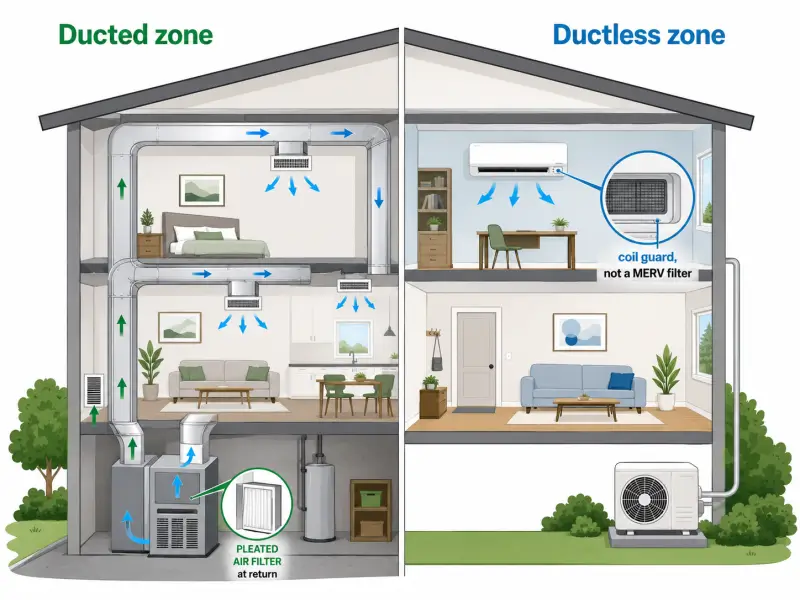
A ductless head does not filter your air the way a furnace does. Its washable mesh screen protects the coil. It is not a MERV-rated air filter.
Wisconsin routes almost all residential HVAC incentives through Focus on Energy, the statewide efficiency program funded by participating Wisconsin utilities. For a ductless mini split heat pump, Focus on Energy pays an instant discount, meaning the money comes off the equipment invoice at purchase. There is no form to mail and no check to wait for. The amount depends on the system’s efficiency tier and your household income.
2026 Focus on Energy heat pump instant discounts
Source: Focus on Energy, Residential Heating & Cooling, retrieved July 28, 2026. Propane-replacement projects follow a separate, lower schedule. Amounts are subject to change – confirm before you sign.
The full spread from Tier 1 to Tier 4 is $300. In most quotes, the equipment price gap between those tiers is larger than $300, which means chasing the top tier for rebate reasons alone can cost you money.
That is not the whole calculation, though. Tier 4 also requires HSPF2 10.0 versus Tier 1’s 8.1, and in a Wisconsin winter that is the difference between a system that carries the load and one that leans on backup heat every cold snap. Buy the efficiency for February. Treat the rebate as a discount on a decision you already made.
Two different mechanisms, two different jobs for you.
Instant discount: the distributor takes it off the equipment invoice at purchase. You file nothing. Your only job is hiring a Trade Ally who buys from a participating distributor. Ask them directly. Do not assume.
Mail-in rebate: you submit an application within 60 days of installation, and the 2026 window closes August 31, 2026. Checks typically arrive 8 to 10 weeks after approval.
Confirm which one your project falls under before the install, because the deadline only bites on one of them.
No. The federal Section 25C Energy Efficient Home Improvement Credit, which paid up to $2,000 toward a qualifying heat pump, was terminated by the One Big Beautiful Bill Act (P.L. 119-21) for equipment placed in service after December 31, 2025. The IRS Instructions for Form 5695 state it plainly: the credit cannot be claimed for property placed in service after that date. The agency’s fact sheet on the OBBB energy credit terminations lists every affected provision and its cutoff. A mini split installed in your Wisconsin home in 2026 does not qualify. If your system was installed and running by the end of 2025, you can still claim it on your 2025 return using Form 5695.
This matters because a great many mini split and HVAC pages, including several updated this year, still advertise the $2,000 credit as though it were live. Budgeting around a credit that no longer exists leaves a $2,000 hole in a project estimate. Section 25D, which covered geothermal, expired on the same date.
Yes. Wisconsin received $149 million in federal Inflation Reduction Act funding for Home Energy Rebates, delivered by Focus on Energy. The HEAR program, short for Home Electrification and Appliance Rebates, pays up to $8,000 toward an ENERGY STAR electric heat pump for space heating and cooling, within a $14,000 per-household program cap.
Source: Focus on Energy, Home Electrification and Appliance Rebates (HEAR), retrieved July 28, 2026. Heat pump work must be completed by an IRA Registered Contractor, and income qualification must be approved before installation begins.
HEAR heat pump work must be done by an IRA Registered Contractor, and income qualification has to be approved before installation begins. One address cannot claim both HOMES and HEAR for the same upgrade type, though either can be combined with standard Focus on Energy rebates.
Focus on Energy’s 2026 rebate applications close August 31, 2026, and any mail-in rebate must be filed within 60 days of installation.
The tricky part is worth planning around.
Income qualification has to be approved before installation begins. There is no retroactive approval.
Approval takes time. Installation takes more time.
Both have to happen before the filing window closes.
If you think your household might qualify under 150% AMI, start the income paperwork first, not the contractor search. Homeowners who call for quotes first and discover the income program second can end up qualified for money they can no longer claim this program year.
If that window has already closed by the time you are reading this, do not rush a bad install to beat a date. Program years reset. A properly sized heat pump you live with for fifteen years matters more than one rebate cycle.
Confirm your utility participates in Focus on Energy. Most Wisconsin investor-owned utilities do. A few municipal utilities and co-ops do not.
Check income qualification first if you think you may fall under 150% AMI. Retroactive approval is not available, so this step has to happen before the install.
Hire a Focus on Energy Trade Ally, and for HEAR specifically an IRA Registered Contractor. Ask directly whether they buy from a participating distributor, because that is what triggers the instant discount.
Confirm the exact model’s SEER2 and HSPF2 against the tier table above, and get the qualifying tier written into your quote.
File any mail-in rebate within 60 days of installation, ahead of the August 31, 2026 deadline.
This is the part almost nobody explains, and it is the part Filterbuy thinks about hardest. Filterbuy has manufactured air filters in the U.S. for over a decade and shipped them to millions of households, so our starting question with any HVAC change is always the same: what happens to the air after this?
With a ductless mini split, the honest answer is that filtration mostly goes away. Each indoor head has a thin washable mesh screen. Its job is protecting the evaporator coil. It is a coil guard, not a MERV-rated media filter, and it captures almost none of the fine particles that a pleated furnace filter is built to trap. Filterbuy’s mini split cleaning guides say the same thing: that screen is a comfort filter, not a health filter.
Filterbuy pushes back on the wider conversation here. Almost every mini split article treats filtration as a footnote under maintenance. We think it belongs in the buying decision. You are choosing a heating system, and you are also deciding which rooms of your house keep whole-home filtration and which ones quietly lose it.
That creates three practical situations in a Wisconsin home.
The mini split serves an addition or bonus room. That room now has no MERV-rated filtration at all. Rinse the mesh screens on the schedule your manufacturer sets, and consider a portable HEPA unit in the space.
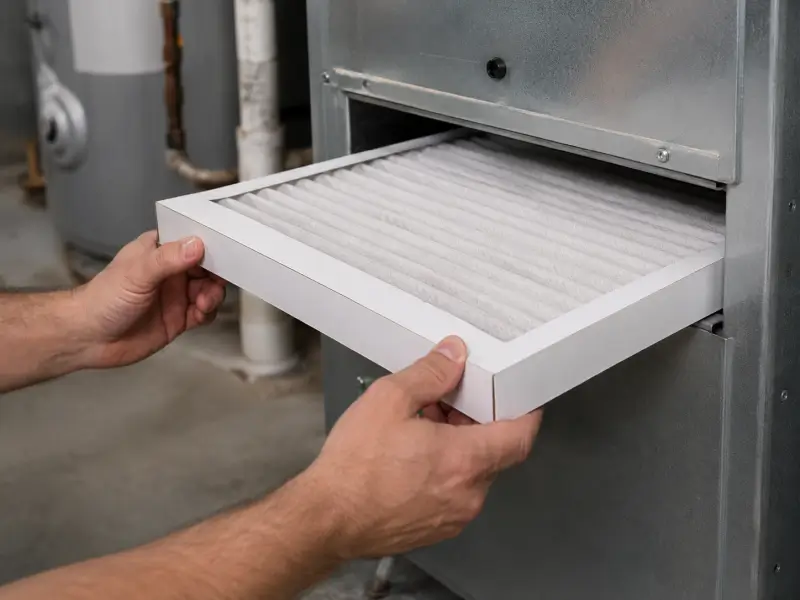
You keep the furnace for winter heat. Your furnace filter is still your whole-home filtration system, so stay on top of how often to change it. The blower is what cleans the air, and it only cleans while it runs.
The mini split handles the shoulder seasons. In spring and fall your furnace fan may barely cycle, which means your MERV-rated filter is barely working during peak Wisconsin pollen. Running the furnace fan on circulate restores whole-home filtration, and it is the same move we recommend during an air quality alert.
"Homeowners are usually thrilled with the comfort after a ductless install. The conversation I end up having is about the room that used to be on the ducted system and is not anymore, because nobody told them their filtration changed."
The Filterbuy filtration audit takes five minutes and a phone. Go room by room.
List every room and write down what will heat and cool it after the install: mini split head, existing ducts, or both.
Circle the rooms served only by a ductless head. Those rooms just lost MERV-rated filtration. There is no filter to change there, because there is no filter.
Note where people actually spend time. Bedrooms and home offices matter more than a spare room.
Check for overlap. Rooms with both a head and a supply register keep whole-home filtration whenever the blower runs.
Count your circled rooms. If a bedroom is on that list, that is where a portable HEPA earns its keep.
Do this before the quote, not after. Head placement is far easier to change on paper than on drywall.
Filtration note: a mini split head uses a washable mesh screen that guards the coil. It is not a MERV-rated air filter.
For the 1950s to 1970s ranches and pre-war bungalows that make up so much of Wisconsin’s housing stock, homes built with boilers or baseboard heat and no ducts at all, a mini split usually wins on disruption alone. What the table makes plain is the trade-off: you gain zoning and efficiency, and you give up the central filter.
Every number here traces to a federal source.
About 90% of your time is spent inside, where some pollutants run 2 to 5 times higher than typical outdoor levels.
U.S. Environmental Protection Agency, Report on the Environment. epa.gov/report-environment/indoor-air-quality
Your mini split conditions the room you use most.
No ductwork means no MERV-rated filter.
The air you breathe most gets cleaned least.
DOE puts duct losses above 30% of air conditioning energy use. The same page notes that minisplits "generally have lower MERV filters that are not typically able to capture small particles."
U.S. Department of Energy, Energy Saver. energy.gov/node/1265871
Ductless saves real money in a Wisconsin home.
DOE names the trade-off in the same breath.
Space heating accounts for 53% of all energy use in Midwest homes. Among midwestern homes built before 1970, 27% report poor or no insulation, versus 11% of newer homes.
U.S. Energy Information Administration, 2020 Residential Energy Consumption Survey, 18,496 households. eia.gov/todayinenergy/detail.php?id=57321
Wisconsin’s older housing stock is exactly this population.
Heating matters more here than in a mild climate.
Weigh HSPF2 over SEER2.
These seven sources cover the whole decision, in the order you will need them. Confirm the money first. Then make sure the unit you are quoted qualifies for it. Then check it will hold up in February.
Focus on Energy, Residential Heating & Cooling. focusonenergy.com/residential/heating-and-cooling
This is where the money lives: current discount tiers, the efficiency minimums, and the August 31 deadline. The discount comes straight off your contractor’s invoice, so read the tier table before you start collecting quotes.
Focus on Energy, Home Electrification and Appliance Rebates. focusonenergy.com/ira-hear
If your household falls under 150% of Area Median Income, you can add up to $8,000 toward a heat pump. One catch worth circling: you have to get qualified before the install, because there is no going back for it afterward.
IRS, Instructions for Form 5695 (2025). irs.gov/instructions/i5695
The federal Section 25C credit ended for equipment placed in service after December 31, 2025, and this is the IRS saying it directly. Plenty of articles and a few contractors have not caught up yet, so it is handy to have the source on your phone.
AHRI, Directory of Certified Product Performance. ahrinet.org/certification/ahri-directory
Search any matched system and you will get its third-party certified SEER2 and HSPF2 ratings. Your rebate tier depends on those two numbers, so it is worth the two minutes it takes to look them up.
NEEP, Cold Climate Air Source Heat Pump Product List. neep.org/heating-electrification/ccashp-specification-product-list
This database flags the heat pumps that keep real heating capacity at 5°F and below. That is the difference between a system that gets you through a cold snap and one that quietly hands the job back to your furnace.
ENERGY STAR, Ductless Heating & Cooling. energystar.gov/products/ductless_heating_cooling
Solid, plain-English guidance on Manual J sizing, cold-climate certification, and unit placement. Fair warning: this page still mentions a federal tax credit running through 2032, which is no longer accurate. Trust the sizing advice, skip the credit figure.
DSIRE, Wisconsin Programs. programs.dsireusa.org/system/program/wi
NC State runs this database of every incentive in the state, filterable down to energy efficiency. It is the one place to catch programs from municipal utilities and co-ops, since not all of them participate in Focus on Energy.
Yes. Cold-climate ductless heat pumps are rated to produce useful heat well below 0°F, which covers most Wisconsin conditions. Many homeowners still keep the existing furnace or boiler as backup for the deepest cold snaps. Look for a high HSPF2 rating, since it is both the cold-weather performance number and the rebate qualifier. Our guide to choosing a mini split system walks through BTU sizing and zone counts.
Generally yes. Focus on Energy states that projects receiving HOMES or HEAR rebates may also be eligible for standard Focus on Energy rebates. Confirm the specific combination with your contractor before you sign.
Yes, as long as the furnace runs at all. The mini split’s own mesh screen is washable and reusable, so it needs cleaning rather than replacing. See how often to service a mini split for that schedule. The filter you still buy is the one in your furnace, which is doing the real air cleaning.
Focus on Energy, Residential Heating & Cooling (retrieved July 28, 2026)
Focus on Energy, Home Electrification and Appliance Rebates (retrieved July 28, 2026)
U.S. Department of Energy, Energy Saver: Ductless Minisplit Air Conditioners
Mini split (ductless mini split): a heating and cooling system with an outdoor compressor connected to one or more wall-mounted indoor heads by a small refrigerant line, requiring no ductwork.
Focus on Energy: Wisconsin’s statewide energy efficiency program, funded by participating Wisconsin utilities, which administers the state’s residential HVAC rebates.
Trade Ally: an independent contractor registered with Focus on Energy and able to deliver its instant discounts.
HSPF2: Heating Seasonal Performance Factor 2, the current U.S. heating efficiency metric for heat pumps. Higher is better, and it is the metric the Wisconsin rebate tiers hinge on.
HEAR: Home Electrification and Appliance Rebates, the IRA-funded program for households at or below 150% of Area Median Income.
MERV: Minimum Efficiency Reporting Value, the 1 to 16 scale rating how effectively an air filter captures particles.