R410A vs. R32 vs. R454B:
What the Refrigerant Transition Means for You
R410A Vs R32 Refrigerant: What Is The Difference For Your Mini Split?
R32 is the newer refrigerant replacing R410A in mini splits, and it does the same job with a much smaller environmental footprint. R32 carries a 68% lower global warming potential than R410A, needs less refrigerant to run, and moves heat more efficiently. R410A is being phased out across the industry, so most new mini split systems now ship with R32.
- R410A: the older refrigerant, reliable for years, now being phased out industry-wide
- R32: the newer refrigerant, 68% lower global warming potential, needs less refrigerant, transfers heat more efficiently
Answer 3 quick questions below and we will match you to your perfect mini split system.

Take the quiz below to find your match.
TL;DR
R410A has not been banned. New manufacturing stopped on January 1, 2025, and a May 2026 EPA rule removed the installation deadline for equipment built before that date, so pre-2025 R410A mini splits stay legal to buy and install while supplies last. Every mini split built after the cutoff runs on R32 or R454B, two mildly flammable A2L refrigerants with a much lower global warming potential than R410A. Your decision comes down to proven R410A hardware at clearance pricing versus a new A2L system, and how each path affects your service costs over time.
Key Takeaways
Manufacturing of new R410A residential mini splits stopped January 1, 2025, under the EPA's AIM Act Technology Transitions Rule.
A May 21, 2026 EPA final rule removed the original 2026 installation deadline, so pre-2025 R410A inventory can be installed until it sells out.
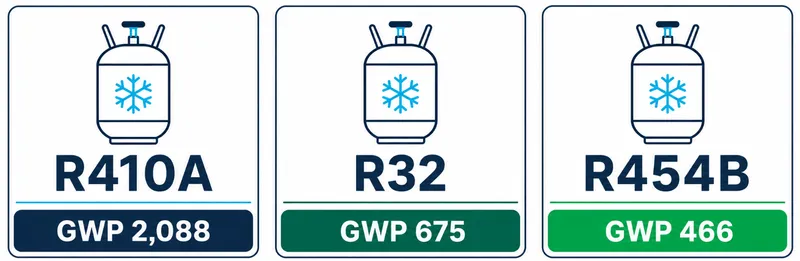
R32 (GWP 675) and R454B (GWP 466) are the two EPA-compliant replacements, both carrying an A2L "mildly flammable" rating under ASHRAE Standard 34.
Daikin, LG, and Fujitsu build most current R32 mini splits. Carrier, Trane, Lennox, and Rheem lean on R454B.
Federal tax credits under Sections 25C and 25D expired December 31, 2025, and cannot offset a refrigerant-related purchase right now.
An existing R410A mini split is unaffected. It stays legal to run and service for its entire working life.
New York State is the exception. Its own Part 494 regulation kept the January 1, 2026 deadline even after the EPA lifted it federally.
Why This Guide Reflects The Current Rule
Many pages online still describe a hard January 2026 cutoff for installing R410A equipment. That cutoff no longer exists. The EPA erased it in a final rule on May 21, 2026, and this guide reflects that rule. David Clark, a Licensed HVAC Technician, reviewed this guide line by line before publication.
What Is Actually Changing With Your Mini Split's Refrigerant
New mini splits sold after January 1, 2025 can no longer use R410A. That line, drawn by the EPA's AIM Act, applies to manufacturing and import, not to the system already cooling your home. Your existing mini split keeps running as it always has, and a technician can still recharge it with R410A for the rest of its service life.
The American Innovation and Manufacturing Act, passed in December 2020, directs the EPA to phase down high-GWP HFCs like R410A. No residential air conditioner or heat pump made or imported after January 1, 2025 can use a refrigerant with a GWP above 700. R410A carries a GWP of 2,088, so manufacturers stopped building it for the U.S. market. The rule never required homeowners to touch a working system.
Not sure what refrigerant your system uses? Check the manufacturer's data plate on the outdoor unit, or ask a technician to confirm it.
R410A Vs. R32 Vs. R454B At A Glance
GWP figures per the EPA Technology Transitions GWP Reference Table. ASHRAE safety classes per ASHRAE Standard 34.
The EPA's 2026 Rule Change, Explained
On May 21, 2026, the EPA finalized changes to its 2023 Technology Transitions Rule that removed the original January 1, 2026 installation deadline. A contractor can still sell and install a pre-2025 R410A mini split today, as long as that unit was manufactured or imported before January 1, 2025 and remains in distributor inventory. The AIM Act, now Public Law 116-260, is bipartisan legislation aligning the United States with the Kigali Amendment's global HFC phasedown schedule.
Timeline current as of July 2026. Confirm dates against the EPA Technology Transitions Program page before publish, since further rulemaking may follow.
One Regional Exception Worth Knowing: New York State
Everything above describes federal rules. Under its own New York State Department of Environmental Conservation Part 494 regulation, New York kept the original January 1, 2026 installation deadline even after the EPA's May 2026 rule removed it federally. If you are shopping for a mini split in New York, pre-2025 R410A inventory is off the table for new installations, regardless of what a distributor has in stock. Ask your contractor which rule governs your job.
Which Refrigerant Fits Your New Mini Split?
Your chosen brand decides your refrigerant, not you. R32 is a single-component refrigerant common among manufacturers with a global ductless strategy. R454B is a blend engineered to closely match R410A's pressure and capacity, which is why brands with large ducted-system lineups adopted it first. Neither is objectively better. Both meet the same 700 GWP ceiling and carry the same A2L classification, so your equipment's engineering and your installer's experience matter more than the refrigerant name on the spec sheet.
Is An A2L Mini Split Safe For Your Home?
Yes. A2L refrigerants like R32 and R454B are mildly flammable, not flammable in the way propane or gasoline vapor is. ASHRAE Standard 34 places them in a subclass defined by a slow burning velocity and a high ignition energy requirement, so a leak alone does not create a fire risk without a sustained ignition source at a concentration far above what a small leak would produce indoors. Manufacturers build safeguards into A2L equipment that R410A never needed, including leak detection and charge limits tied to room size. Confirm your installer has A2L-rated recovery equipment and training before you sign.
SEER2 Efficiency And Your Energy Bills
Refrigerant type and system efficiency are related but separate questions. ENERGY STAR notes that mini split heat pumps move heat rather than generate it, letting certified ductless systems use up to 60% less energy than electric baseboard or radiator heat. That advantage comes from the inverter-driven, ductless design, not from whether it runs on R32 or R454B. Both refrigerants support the SEER2 and HSPF2 standards, so compare ratings on a model's spec sheet rather than assuming one refrigerant outperforms the other.
What Contractors And Builders Are Saying About The 2026 Rule Change
The National Association of Home Builders reported that the amended rule lets builders keep installing pre-2025 R410A equipment in new homes until supply runs out. The Air Conditioning Contractors of America had warned that stranded R410A inventory could exceed $500 million industry-wide if the original cutoff had taken effect, which is why the lifted deadline mattered so much to distributor and contractor pricing.
Cost And Long-Term Service Considerations
A pre-2025 R410A mini split and a new A2L mini split solve the same comfort problem through different cost paths. R410A equipment is a mature platform with a deep bench of trained technicians and stocked parts, and remaining inventory is often priced to move. A new A2L system costs more upfront in equipment and installer training, in exchange for a lower-GWP refrigerant and a longer runway before your next regulatory transition. Either way, budget for refrigerant service costs to rise as R410A production quotas tighten and A2L pricing works through the volatility of a new national product.
Questions To Ask Your Contractor Before You Sign
Is this a pre-2025 R410A unit or a new A2L system, and can you show me the manufacture date on the nameplate?
If it is R410A, how much longer do you expect factory inventory to last for this exact model?
If it is R32 or R454B, are you certified and equipped to handle A2L refrigerant on this specific job?
What are the SEER2 and HSPF2 ratings for this exact model, not just the product line it belongs to?
Does my state or local code add any restriction beyond the federal rule, the way New York's does?
7 Essential Resources
1. EPA Technology Transitions Program. The rule behind every GWP limit and compliance date in this guide, with current deadlines.
2. ASHRAE Standard 34 Safety Classification. The rulebook defining R32 and R454B's A2L rating and what mildly flammable means.
3. ENERGY STAR Ductless Heating and Cooling Guide. Explains how a mini split heat pump moves heat instead of generating it, with real efficiency numbers.
4. Senate EPW Committee AIM Act Summary. Explains why Congress passed the AIM Act's 85% HFC phasedown.
5. NAHB Analysis of the 2026 Final Rule. Covers what the final rule means for new construction and how long pre-2025 R410A inventory can be used.
6. ACCA Contractor Advocacy Update. Documents the inventory crunch and pricing pressure contractors felt during the EPA's reconsideration.
7. FTC Guide to the EnergyGuide Label. Walks through the label on a new mini split, including annual energy cost, for comparing quotes.
3 Supporting Statistics Behind This Guide
Source: National Institute of Standards and Technology About 10% of a refrigerant system's charge leaks into the atmosphere each year, so a higher-GWP refrigerant does more damage per leaked pound.
Source: U.S. Energy Information Administration 88% of U.S. households used air conditioning in 2020, and half of Northeast homes primarily cool with individual units like mini splits.
Source: Air-Conditioning, Heating, and Refrigeration Institute In testing, common ignition sources including lit cigarettes and tool sparks did not ignite A2L refrigerants like R32 and R454B.
Frequently Asked Questions
Glossary
AIM Act: The 2020 federal law (Public Law 116-260) directing the EPA to phase down HFC refrigerants.
A2L: An ASHRAE Standard 34 classification meaning a refrigerant is mildly flammable.
GWP: How much a substance warms the atmosphere relative to carbon dioxide. R410A is 2,088. R32 is 675. R454B is 466.
SEER2 / HSPF2: The Department of Energy test standards rating a system's cooling and heating efficiency.
Mini Split: A ductless system with an outdoor condenser connected to one or more indoor units, requiring no ductwork.
Part 494: New York's own regulation, which kept the January 1, 2026 R410A installation deadline in force after the EPA removed it federally.