Installation, Costs & Filter Guide (FL Climate)
By Michelle Wan · Technically reviewed by David Clark, Licensed HVAC Technician · Published August 5, 2026 · Updated August 2026
A ductless mini split costs $1,500 to $14,500 installed in Jacksonville, and most single-room jobs land between $1,300 and $3,300. Sizing matters more than brand here, because Jacksonville dew points stay above 65°F from June through September and a unit sized off a national calculator usually comes in too small. JEA pays a $200 rebate on ENERGY STAR-certified systems, due within 90 days of installation.
Start with the room you are trying to cool:
Take the quiz below and we will point you to the size that fits your room. You can also compare Filterbuy mini split systems, which run 12,000, 18,000, and 24,000 BTU as variable-speed inverter heat pumps on R-32 refrigerant.

Answer 3 quick questions and we will match you to the right mini split size.
A ductless mini split in Jacksonville runs $1,500 to $14,500 installed in 2026, depending on zone count and BTU size. JEA pays a $200 rebate on ENERGY STAR-certified ductless systems, due within 90 days of install and no later than October 10, 2026. The federal tax credit older guides still cite expired December 31, 2025. Duval County requires a mechanical permit. And because Jacksonville's oak-and-pine pollen season is among the longest in the Southeast, your indoor head filters need cleaning far more often here than the manual suggests.
A Jacksonville mini split install costs $1,500 to $14,500 in 2026. Single-zone jobs sit at the bottom of that range; four- and five-zone whole-home setups at the top.
JEA pays $200 per ENERGY STAR-certified ductless mini split, plus $50 for a qualifying smart thermostat. Limit two rebates per product type per premise every seven years.
The federal Section 25C tax credit expired December 31, 2025. Systems placed in service in 2026 do not qualify, making JEA's rebate the primary local incentive.
Duval County requires a mechanical permit for mini split installation, filed through JaxEPICS. Jacksonville Beach, Atlantic Beach, and Neptune Beach permit separately.
A mini split is the wrong answer if your ducts are sound and your system is under about ten years old. Sealing ducts and upgrading the filter is far cheaper and often fixes the same complaint.
Clean your mini split filters every 2 weeks from late February through April. Live oak pollen peaks in March and April here, and a clogged mesh filter is the fastest way to lose airflow and grow mold inside the head.
A ductless mini split costs $1,500 to $14,500 installed in Jacksonville in 2026. Zone count and BTU size drive most of that spread, whether you are pricing a single ductless AC head or a whole-home system. A single-zone unit for a bedroom or Florida room runs $1,300 to $3,300; a four- or five-zone whole-home system runs $7,800 to $14,800. Permit fees and electrical panel condition are the line items homeowners most often forget.
2026 fully installed estimates for Duval County. Add $50 – $200 for the required mechanical permit, and $75 – $200 for a coastal wind-load bracket at Beaches addresses. Older homes may need a 240V circuit or panel upgrade at $300 – $1,500.
Three cost factors are specific to Duval County:
Mechanical permit: $50 to $200, filed by your contractor through JaxEPICS.
Coastal wind-load bracket: $75 to $200 at Jacksonville Beach, Atlantic Beach, Neptune Beach, Mayport, and Intracoastal addresses.
Electrical: older Riverside, Avondale, Springfield, and Murray Hill homes often need a new 240V circuit. Panel upgrades run $300 to $1,500.
One local wrinkle worth knowing: Jacksonville is the largest city by land area in the contiguous United States. Technicians log real drive time between jobs, which tightens July and August scheduling and can nudge pricing up for outlying Duval addresses. Booking November through March gets shorter waits and better leverage. One note on where these figures come from: Filterbuy sells ductless equipment but not installation labor, so the labor half of every range above reflects Florida market rates rather than our own price sheet. For the national picture, see our mini split installation cost guide.
A mini split earns its keep when you need to condition a space your ductwork was never built to reach. That is most of the ductless work in this city. It is a worse answer when your central system is healthy and your ducts are sound, and we would rather say so here than after you have three quotes in hand.
A room the ducts never reached. The far bedroom at the end of the trunk line, or the bonus room over the garage that runs eight degrees warm every August.
A garage conversion or room addition. Tapping an existing air handler for new square footage usually starves the rest of the house instead of fixing the new room.
A Florida room or enclosed porch. All that glass is a solar load your central system was never sized for.
An older home with no ductwork at all. Riverside, Avondale, Springfield, and Murray Hill are full of pre-1960 houses running window units. Ductless is usually cheaper than retrofitting ducts into plaster and heart pine.
A detached office, ADU, or workshop. Its own zone, its own thermostat, no effect on the main house.
Your ducts are sound and your system is under about ten years old. Sealing the ducts and stepping up the filter costs a fraction of a ductless install and often fixes the comfort complaint outright.
You need four or more zones. At that point the quote starts to rival a full central replacement. Price both before you commit.
A wall head would bother you. Aesthetics is the regret we hear about most. Look at a mounted head in person before you sign.
You are moving within two or three years. Efficiency payback in Florida generally runs four to six years, so you would be buying comfort rather than savings. That can still be worth it, but go in knowing which one you are buying.
You want it to fix whole-home humidity. One head dehumidifies one room. It will not rescue a damp house.
Worth saying plainly: Filterbuy sells mini split systems. If you land in that second list, we would rather you seal your ducts and keep your money, because a ductless head installed in the wrong house becomes a complaint, not a comfort upgrade. You just saved several thousand dollars.
Yes. JEA pays a $200 rebate on ENERGY STAR-certified ductless mini split systems for residential electric customers, plus $50 on a qualifying ENERGY STAR smart thermostat. The system must appear in the AHRI database, and the AHRI certificate has to list every installed component exactly as it appears on your invoice.
JEA's published minimums for split systems:
Tier 1: SEER2 of 16 or higher, EER2 of 11.0 or higher, HSPF2 of 8.0 or higher.
Tier 2: SEER2 of 16.9 or higher, EER2 of 12 or higher, HSPF2 of 8.2 or higher.
Three details trip people up:
Component ratings do not count. A condenser advertised at "up to 16 SEER" can fall below the threshold once AHRI rates it as a matched pair. Ask for the certificate before you sign.
Limits apply. Two rebates per product type per premise every seven years, and conditioned living space only.
The deadline is fixed, not rolling. Apply within 90 days of installation, and no later than October 10, 2026.
Confirm current figures on JEA's heating and cooling rebates page before you buy. Our 2026 mini split tax credit guide covers the federal picture, and the statewide Florida mini split guide compares JEA against Duke Energy, TECO, OUC, and FPL.
Size a Jacksonville mini split about 20 to 25% above what a national BTU calculator recommends. Humidity is a genuine cooling load, and Jacksonville sits above a 65°F dew point from June through September. An undersized unit holds a room at 72°F while leaving humidity near 65%. Cool but clammy, and exactly what mold likes.
Bedroom or small office, 100–150 sq ft: 9,000 BTU
Medium room, 150–250 sq ft: 12,000 BTU
Large living area, 250–400 sq ft: 15,000–18,000 BTU
Open floor plan, 400–700 sq ft: 18,000–24,000 BTU
Glass-walled Florida room or sunroom: add 30–50% for solar heat gain
Oversizing is its own mistake. A unit that is too large short-cycles, never runs long enough to pull moisture down, and leaves the room damp. A variable-speed inverter compressor matters more here than the raw BTU number, because long low-output cycles are what actually dehumidify. See the National Weather Service Jacksonville climate records for the local load and ENERGY STAR's ductless heating and cooling overview for why inverter systems handle it well.
For reference, the Filterbuy ductless lineup runs 12,000, 18,000, and 24,000 BTU, which covers most single-room Jacksonville jobs once you apply the humidity bump above. Every unit is a variable-speed inverter heat pump on R-32 refrigerant, which is the configuration JEA rebates require. Browse Filterbuy mini split systems if you want to compare specs against a contractor quote.
Have a Florida-licensed contractor run a Manual J load calculation before buying. For coastal addresses, specify corrosion-protected coils; salt air degrades standard copper within a few miles of the Atlantic. Our mini split sizing guide has the room-by-room math, and the buyer's guide covers SEER2, zone count, and brands.
Every ductless system sold today is a mini split heat pump, meaning it heats as well as cools by running the refrigerant cycle in reverse. That matters more here than people expect. Jacksonville drops below freezing most winters, and a heat pump costs far less to run than the electric resistance strips in an older air handler. If the room you are conditioning is one you actually use in January, check the HSPF2 rating and not just SEER2. JEA sets a Tier 1 minimum of HSPF2 8.0.
Yes. Installing a ductless mini split requires a mechanical permit in Jacksonville and Duval County. The City of Jacksonville Building Inspection Division enforces the Florida Building Code and issues the permit through JaxEPICS, the city's online permitting system, where electronic submission is required for all permit types. Your contractor should pull the permit, include the fee in the quote, and schedule the inspection before commissioning.
The Beaches permit separately. Jacksonville Beach, Atlantic Beach, and Neptune Beach maintain their own permitting. Confirm which jurisdiction your address falls under before work starts.
An issued permit is not a closed permit. Search the address in JaxEPICS for a final inspection or closed status. Open permits surface later at closing and at insurance renewal.
Under the City of Jacksonville residential permit rules, unpermitted work is unlawful and carries a fine. The permit itself has to be posted where it is visible from the street. If a contractor offers to skip it, get another quote.
Verify the license, then verify the permit history. Florida licenses HVAC contractors through the Department of Business and Professional Regulation. That is step one. Step two is the one almost nobody does: look the company up in JaxEPICS and check whether their past Duval County jobs actually closed.
Before you sign:
Verify the license with DBPR. An AC contractor license carries a CAC prefix. A certified license is valid statewide; a registered one covers only named jurisdictions, so confirm Duval is included.
Search JaxEPICS for the contractor's recent permits and confirm they reached final inspection.
Ask for three line-item quotes: unit, labor hours, line set length, electrical, and permit broken out separately. A single total is not comparable to anything.
Check EPA Section 608 certification. 2026 systems use A2L refrigerants (R-32, R-454B) that require updated handling.
Confirm the AHRI certificate matches your exact indoor and outdoor pairing if you are claiming the rebate.
One JEA-specific caution: JEA's contractor portal says rebates are deducted from your invoice by a pre-qualified contractor and that JEA does not pay customers directly, while JEA's program page also describes a self-apply path. The two read differently. Hiring from the pre-qualified list removes the ambiguity. If you prefer your own contractor, call JEA first and confirm your path in writing.
Filterbuy sells mini split systems and USA-made replacement filters nationwide, including to Jacksonville, but not installation labor. Filterbuy HVAC Solutions crews cover South Florida and Greater Orlando, not Duval County. For an install here, use the checklist above to hire a local licensed contractor.
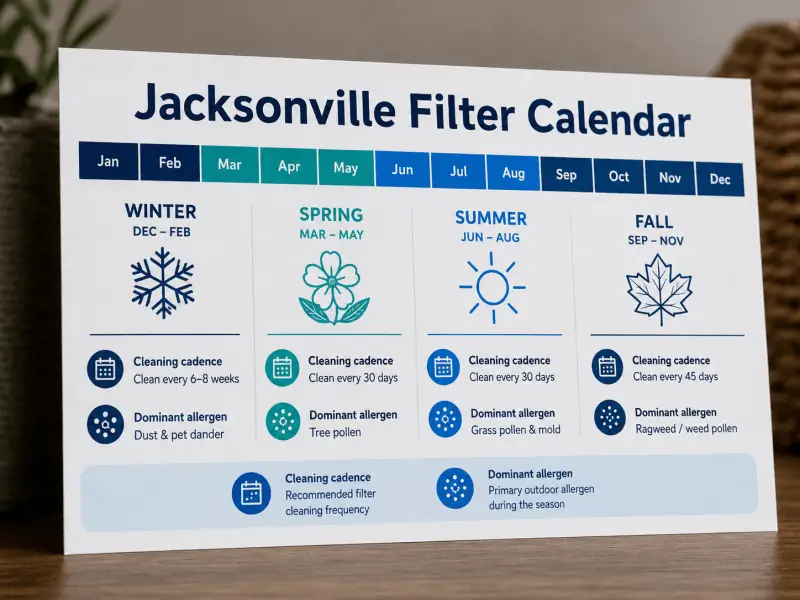
Clean your mini split's mesh filters every two weeks from late February through April, and monthly the rest of the year. Jacksonville's tree pollen season starts earlier and runs longer than in most U.S. cities, and a ductless head pulls room air through a thin screen with no ductwork buffering it. That screen loads fast here.
For most homeowners, filter cleaning is the whole of mini split maintenance. Jacksonville's air changes character by season, so your schedule should follow it:
Cadence assumes a washable mesh filter in a wall-mounted head. Homes with pets, or anyone in the home with asthma, should hold the 2-week schedule year round. Check the condensate drain line during the July – September storm season.
The counterintuitive part: pine pollen is what you see coating your car in April, but live oak pollen is finer, invisible, and travels deeper into airways. A visibly clean filter is not necessarily a clean filter. The UF/IFAS guide to North Florida's worst pollen trees rates oak at 8 on the Ogren Plant-Allergy Scale with a February-to-May season, and red cedar at 10 starting in December. That overlap is why a generic 90-day interval fails here.
Power the unit off at the remote and at the breaker.
Lift the front panel of the indoor head and remove the mesh filters.
Vacuum with a brush attachment, or rinse with lukewarm water.
Dry completely in the shade. Reinstalling a damp filter invites mold.
Reinstall and close the panel.
Self-cleaning coil modes do not replace this. They dry the coil; they do not clear the filter. For the full multi-stage breakdown, see how mini splits affect indoor air quality.
Ducted, cassette, and floor-console heads often use a replaceable filter element rather than a washable mesh. If that is what you have, measure it and order the exact size instead of trimming a generic one. Filterbuy cuts to any dimension, so there is no reason to settle for close enough. See our guide to mini split replacement filters, check whether you can add a HEPA filter, or order custom-size air filters. If central ducts serve the rest of the house, keep that system on a MERV 13 air filter through pollen season and put filter auto-delivery on the change you keep forgetting.
Shut the system down at the breaker before a storm makes landfall, and never restore power to a condenser that has been underwater. Those two habits protect more equipment in Jacksonville than any accessory you can buy. Hurricane season runs June through November here, and the outdoor unit is the part exposed to all of it.
Kill the power at the breaker, not just the remote. A surge on restoration is a common way to lose a control board.
Clear the area around the condenser. Loose planters and patio furniture turn into projectiles.
Do not tarp the unit. A wrapped condenser traps moisture against the coil and does nothing against wind-driven debris.
Confirm the mount is code-compliant. Florida Building Code anchoring exists for exactly this. Coastal Duval addresses should already have a rated bracket or pad.
If water reached the unit, leave the breaker off. HVAC manufacturers and Florida contractors are consistent on this: energizing a submerged condenser can short it out or cause a failure weeks later. Have it inspected first.
Saltwater is a different problem than rainwater. Brackish storm surge that reaches the compressor terminals usually means replacement rather than repair. Fresh rainwater around the base is normally fine.
Document damage before you clean up. Standard homeowners policies often exclude flood while covering wind. Photograph debris impact and displacement separately from any water line.
Clean the filters once power is back. Storm debris and the mold spore spike that follows a wet week both land on that mesh screen within days.
One practical habit: keep a spare set of filters in the house before June. Shipping slows across Northeast Florida after a named storm, and that is exactly the week you want a clean filter. A Filterbuy auto-delivery schedule set to arrive in late May covers it without you thinking about it.
Salt air corrodes standard copper coil, which is why we keep pointing at corrosion-protected coils for Jacksonville Beach, Atlantic Beach, Neptune Beach, and Mayport. If your unit is already installed and unprotected, a periodic rinse of the outdoor coil with fresh water slows the damage. It does not stop it, and no rinse substitutes for the right coil in the first place.
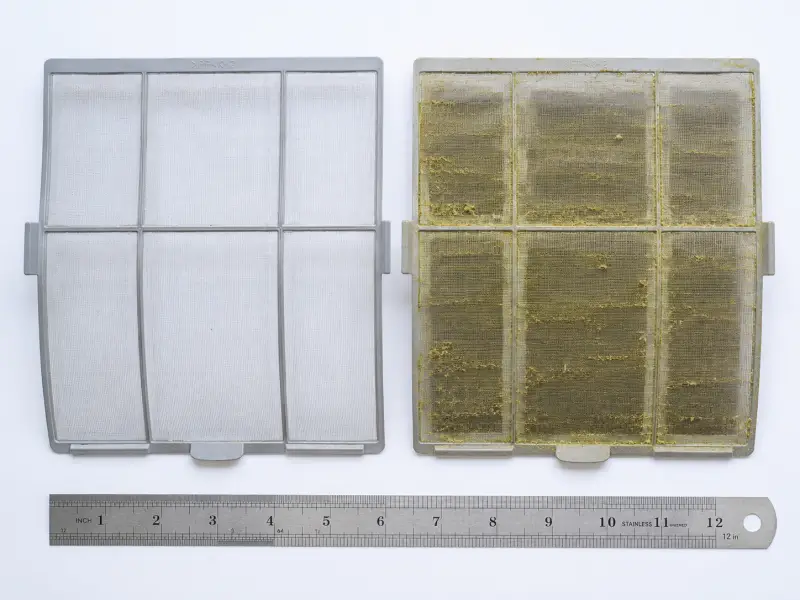
The mesh screen in your mini split is coil protection, not air cleaning. That is the single thing we would change about how ductless systems get sold. The screen exists to keep lint and hair off the evaporator coil so the unit keeps running. It was never engineered to capture the fine oak pollen that defines a Jacksonville spring. So "my mini split filters the air" is about half true, and the half that is missing matters most in March.
Two things follow from that, and neither shows up in a typical spec sheet:
Head filters are almost never a standard size. Filterbuy stocks more than 600 nominal sizes and still cuts custom for ductless heads, because manufacturers do not standardize them. That is why so many homeowners keep rinsing a screen that has gone soft instead of replacing it. If yours is a replaceable element, measure it once and order to that measurement.
Your MERV conversation belongs to whatever else moves air. A mini split recirculates one room. If central ductwork still serves the rest of the house, that filter is doing the real particle capture during pollen season, and it is where a step up to MERV 13 pays off.
Our perspective is shaped by two things. Filterbuy has manufactured air filters in the United States since 2013, in plants across Alabama, Florida, Pennsylvania, and Utah. We sell ductless systems as well as the filters that go in them. Separately, Filterbuy HVAC Solutions runs licensed service crews in Florida's heat and humidity, in South Florida and Greater Orlando. That is real Florida field experience with the same climate physics Jacksonville deals with. It is not Duval County experience, and we are not going to claim it is.
"Undersizing is the mistake we see most in Florida. A unit that is too small will hold a room at 72 degrees and leave the humidity near 65 percent. The homeowner says it feels clammy, and they blame the brand. It was the load calculation."
David Clark, CEO of Filterbuy HVAC Solutions and Licensed HVAC Technician
Three numbers explain why a mini split, and the filter inside it, work harder in Jacksonville. All three come from a federal agency or a national nonprofit. Filterbuy pulled and checked each one on August 5, 2026.
The number: 20 to 30 percent of conditioned air in a typical house is lost to leaks, holes, and poorly connected joints.
Why it hits harder here: Most Jacksonville ductwork runs through attics that bake all summer.
What it means for you: A ductless head has no duct run. No duct, no duct loss.
Source: ENERGY STAR Duct Sealing, from the U.S. EPA and U.S. Department of Energy
The number: Number 53 in the 2026 Allergy Capitals report. Middle of the pack, and we are not going to pretend otherwise.
What the score measures: Days with high or very high pollen counts, allergy medicine sales, and how many allergists practice nearby.
What it misses: Season length. Live oak alone runs February through May here.
Source: Asthma and Allergy Foundation of America, 2026 Allergy Capitals
The number: Americans spend roughly 90 percent of their time indoors, where some pollutants run two to five times higher than outside.
Why it hits harder here: A ductless head recirculates the air already in the room. Whatever it misses stays with you.
What it means for you: A mesh screen loaded with April oak pollen catches very little.
Source: U.S. EPA Report on the Environment, Indoor Air Quality
Here is where to double-check everything on this page. These seven are the folks who actually set the rules around here: your utility, the city permit office, the state licensing board, and the groups that certify the equipment. Filterbuy checked every link on this list. None of them is selling you anything, and that includes us, which is exactly why they are worth ten minutes before you sign a contract.
1. Get Your $200 Back From JEA
JEA gives you $200 on an ENERGY STAR-certified ductless system, plus another $50 if you add a smart thermostat at the same time. Read this page yourself rather than taking anyone's word for it, because the efficiency minimums and the October 10, 2026 deadline reset every program year.
Where to look: JEA Heating and Cooling Rebates
Every ductless install in Duval County needs a mechanical permit, and your contractor files it through the city's JaxEPICS portal. Here is the part most homeowners miss: you can search any address yourself and see whether a contractor's past jobs passed final inspection or are still sitting open.
Where to look: City of Jacksonville Building Inspection Division
Florida's licensing board keeps the only official record, and air conditioning licenses start with the letters CAC. One thing worth catching: a certified license works anywhere in Florida, but a registered one only covers certain areas, so make sure Duval is on the list.
Where to look: Florida DBPR, Verify a License
Where to look: AHRI Directory of Certified Product Performance
ENERGY STAR certification is required for the JEA rebate, so a model that misses it quietly costs you $200. Two minutes here saves you that surprise later.
Where to look: ENERGY STAR Ductless Heating and Cooling
The EPA requires Section 608 certification for anyone connecting refrigerant lines on a mini split, including the pre-charged kind sold as DIY-friendly. Worth knowing before you order a kit, especially now that 2026 systems run on A2L refrigerants that call for updated training.
Where to look: EPA Refrigerant Management Program, Section 608 Q and A
Our dew point sits above 65°F from June through September, and pulling that moisture down is real work for your system. National BTU calculators do not account for it, which is how rooms end up cool but clammy.
Where to look: NWS Jacksonville Area Climate Graphs
$1,500 to $14,500 fully installed in 2026. A single-zone system runs $1,300 to $3,300; a four- or five-zone whole-home setup runs $7,800 to $14,800. Add $50 to $200 for the Duval permit and $75 to $200 for a coastal wind-load bracket.
Yes. JEA pays $200 on ENERGY STAR-certified ductless mini splits for residential electric customers, plus $50 on a qualifying smart thermostat. Tier 1 split systems must hit SEER2 16, EER2 11.0, and HSPF2 8.0. The current program year closes October 10, 2026.
No. The Section 25C Energy Efficient Home Improvement Credit expired December 31, 2025. Systems placed in service in 2026 do not qualify. Only those placed in service on or before that date can still be claimed on a 2025 return via IRS Form 5695.
Every two weeks during Jacksonville's peak pollen months of late February through April, and monthly the rest of the year. Homes with pets or anyone with asthma should stay on the two-week cadence year round.
Yes, when properly sized. An inverter-driven mini split runs long low-output cycles that pull moisture from the air, holding humidity in the 30–50% range that discourages mold. Oversized units short-cycle and leave rooms cool but damp.
Only with corrosion protection. Standard copper coils degrade in salt air within a few miles of the Atlantic. Specify corrosion-protected coils and a hurricane-rated bracket for Jacksonville Beach, Atlantic Beach, Neptune Beach, and Mayport addresses.
When your ductwork is sound and your central system is under about ten years old, sealing the ducts and upgrading the filter usually fixes the same comfort complaint for a fraction of the cost. Also think twice if you need four or more zones, if a visible wall head would bother you, or if you are moving within two or three years, since efficiency payback in Florida runs roughly four to six years.
Shut it down at the breaker rather than just the remote, clear loose debris from around the outdoor unit, and leave it uncovered, since a tarp traps moisture against the coil. After the storm, if floodwater reached the condenser, leave the breaker off until a licensed technician inspects it. Saltwater that reaches the compressor terminals usually means replacement rather than repair.
No. Filterbuy sells mini split systems and replacement filters nationwide, including to Jacksonville, but not installation labor. For a Duval County install, hire a Florida-licensed contractor, ideally one on JEA's pre-qualified list.
The right replacement filter, cleaned or changed on a Jacksonville schedule, is the cheapest thing you can do for a mini split.
A mini split is only as good as the air it can pull through. Where oak pollen runs February to May and mold season follows right behind, the filter is the maintenance item that decides whether your system still performs like new in year three. Filterbuy has manufactured filters in the United States since 2013, in more than 600 standard sizes plus custom cuts for ductless heads, shipped free and factory-direct.
Find your filter size · Set up auto-delivery · Explore Filterbuy mini split systems
Michelle Wan is Filterbuy's Brand Manager and Air Quality Writer. She works directly with the U.S. manufacturing team, which means her filter advice comes from how these things are actually built and used rather than from a spec sheet. "I do not want anyone to feel like they need an HVAC license just to pick the right filter," she says. "My job is to give you the straight answer and explain why it is the answer." This guide was reviewed for technical accuracy by David Clark, CEO of Filterbuy HVAC Solutions and a licensed HVAC technician.
AHRI certificate: Documentation verifying tested performance of a matched indoor and outdoor pairing. JEA requires it for rebates and rejects component-level ratings.
A2L refrigerant: Mildly flammable refrigerants (R-32, R-454B) standard on 2026 systems, requiring EPA Section 608 certified handling.
CAC license: The prefix on a Florida air conditioning contractor license. Certified is valid statewide; registered covers only named jurisdictions.
Dew point: The temperature at which air saturates with moisture. Jacksonville exceeds 65 degrees F from June through September, which is why humidity is a real cooling load.
JaxEPICS: The City of Jacksonville portal for permit applications, inspections, and permit history lookup.
SEER2: Seasonal Energy Efficiency Ratio 2, the federal cooling efficiency metric. JEA sets a Tier 1 minimum of SEER2 16 for split systems.