
New Jersey Live Wildfire Smoke Map
Get Alerts For Wildfires In Your Area
The moment a wildfire starts near you, you'll get an instant alert and simple tips to reduce your smoke exposure.
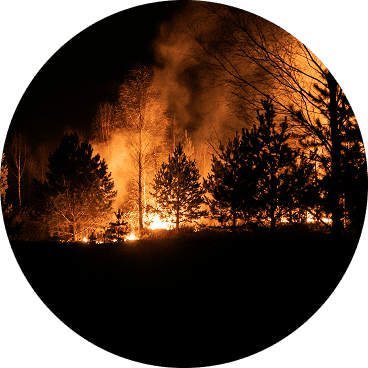
What's In The Smoke
30xSmaller than a human hair
Fine enough to reach deep into the lungs. A MERV 13 is built to capture it.
How Far It Travels


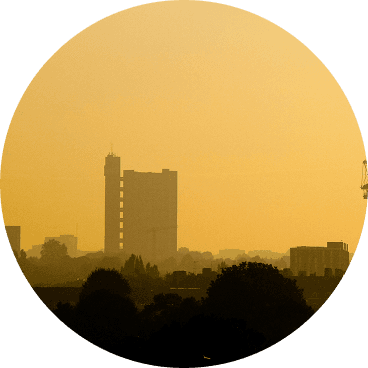
It Doesn't Stay Local
Smoke rides the wind far downwind — you can get smoky air with no fire nearby.
What To Do During A Smoke Event
Simple steps to reduce indoor exposure.
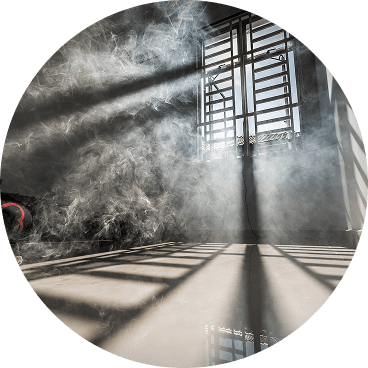
- Stay In, Close UpShut windows and doors to keep smoke out.
- Set Fan To "On"Keeps air cycling through your filter, not just when heating or cooling.
- Recirculate AirSwitch off fresh-air intake so you're not pulling smoke in.
- Run A MERV 13Built to capture the fine PM2.5 in smoke.
- Add A PurifierExtra filtration for the room you use most.
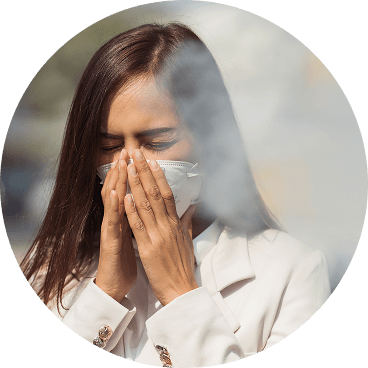
- Wear an N95 if OutsideFits snug to block fine particles — a cloth mask won't.


The Best Air Filter For Wildfire Smoke
During smoke events, the EPA recommends upgrading to a MERV 13 filter — or the highest-rated filter your system can handle — to help reduce the fine particles smoke brings indoors. MERV 13 is the level most home HVAC systems can run while still capturing PM2.5, the fine particulate that makes up the bulk of wildfire smoke.
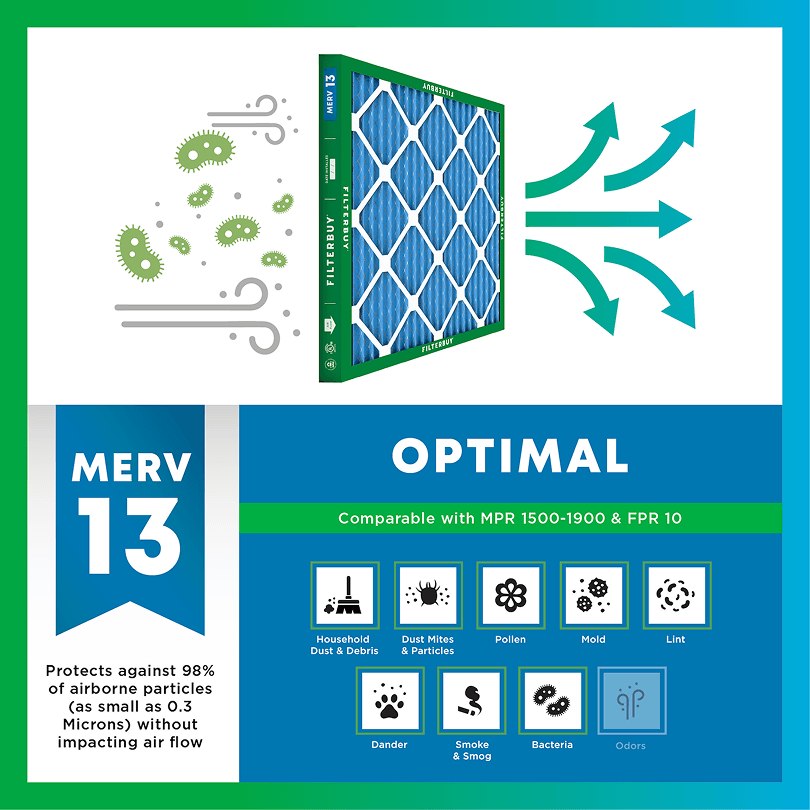
- Captures PM2.5 particles
- Blocks ash, soot, and smoke odor
- Keeps your indoor air safe—even when the outdoor air is dangerous
- Meets the EPA's recommended rating for filtering fine wildfire smoke particles.

Wildfire Smoke FAQs
Facts About Wildfires
Over 70,000 wildfires burn in the U.S. every year.
Wildfire smoke can travel 1,000+ miles, affecting states that aren't even near the blaze.
Exposure to wildfire smoke can worsen asthma, trigger heart issues, and lead to ER visits.
Indoor air can hold more fine particles during wildfire events unless it's properly filtered.
The EPA advises using MERV 13 filters or portable HEPA air cleaners during wildfire smoke events.
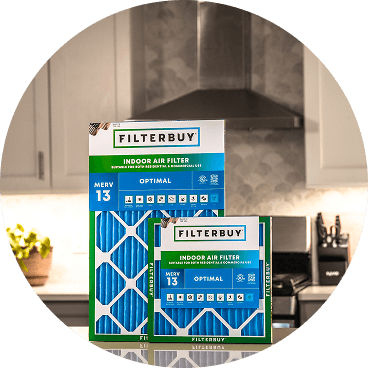
Don't Wait Until The Smoke's Inside.
Use the live wildfire smoke tracker and upgrade your air filters today to protect your lungs and your home.
Shop Filters For Smoke Protection
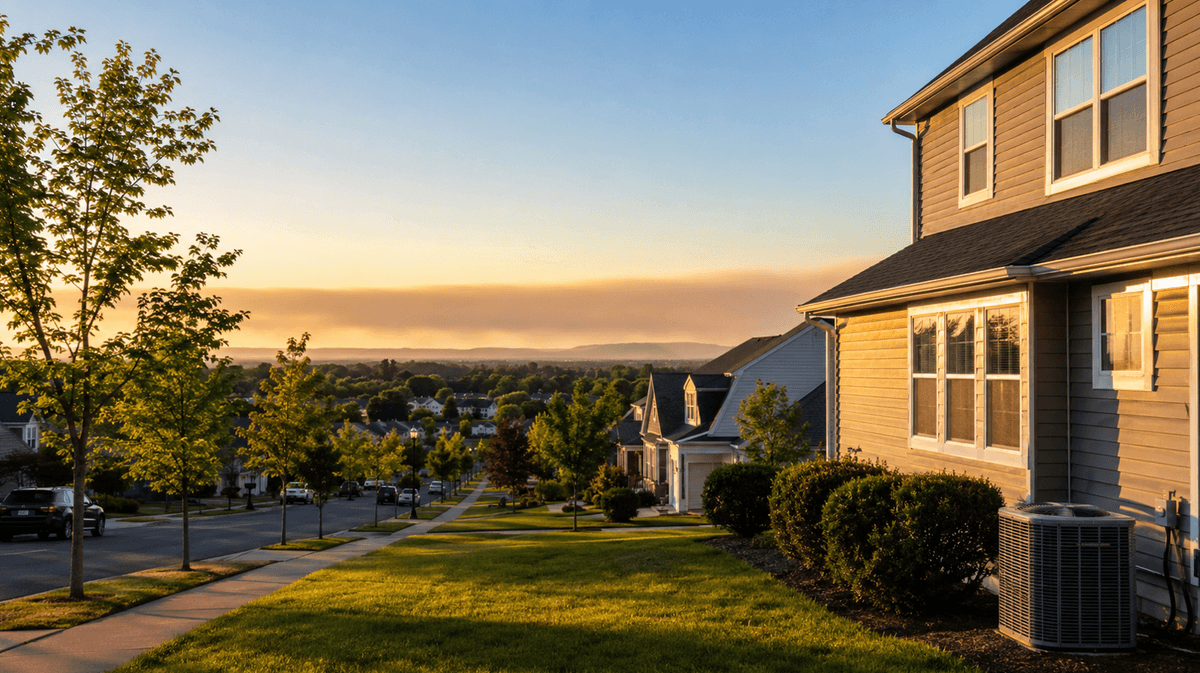
Wildfires Don't Stay Out West Anymore. Current Live Forest Wildfire and Smoke Map Today in New Jersey – Track Pine Barrens Fires and Cross-Country Smoke Plumes
By Michelle Wan, Brand Manager and Air Quality Writer | Reviewed by David Clark, Licensed HVAC Technician | Published and updated July 29, 2026
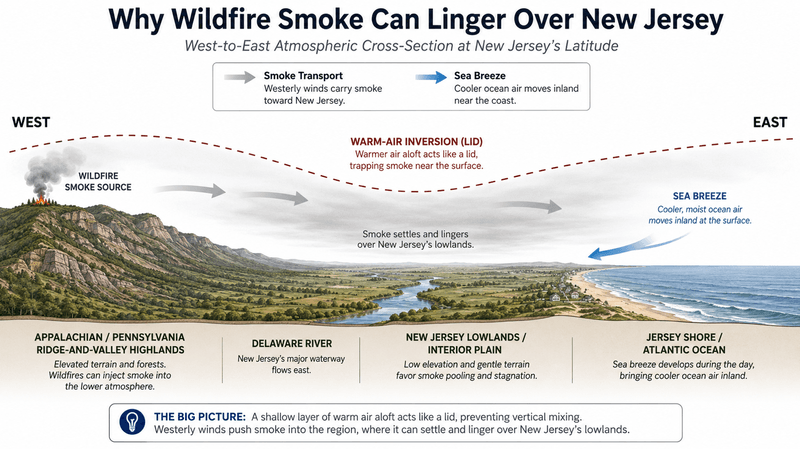
Most New Jersey smoke advisories have nothing to do with New Jersey. On July 15, 2026, the state went Code Red on a wildfire outbreak in Ontario, hundreds of miles upwind, weeks after its own Pine Barrens season had passed. Filterbuy builds these maps for states nationwide, and New Jersey is the unusual case: two wildfire risks on two calendars. Track one, and you are blind for half the year.
TL;DR
New Jersey needs two maps. In-state fires, most of them in the Pine Barrens, are tracked by the New Jersey Forest Fire Service. Drifting Canadian smoke shows up on the EPA's AirNow Fire and Smoke Map, which Filterbuy embeds at the top of this page. Check both, then your county's AQI. Smoke routinely pushes New Jersey into the unhealthy range on days when nothing here is burning.
Key Takeaways
New Jersey averages 1,100 wildfires a year burning 5,000 acres. 2025 was the worst modern year: 1,322 fires, 27,229 acres, up 116% on the 20-year average.
People started 99.6% of those fires. Lightning caused six.
The worst smoke days come from fires hundreds of miles away. New Jersey's AQI hit 458 during the June 2023 Canadian smoke event.
EPA recommends a MERV 13 or higher HVAC filter during smoky periods. Install it before the smoke arrives, not during.
Where to Check the Live New Jersey Wildfire and Smoke Map Today
Four free government tools cover New Jersey, each answering a different question. Use the AirNow Fire and Smoke Map from the EPA and U.S. Forest Service to see where smoke is and how thick, the NJFFS Response Dashboard for live detail on fires burning inside the state, the NJ Fire Danger Dashboard for county fire danger and burn restrictions, and NJDEP air monitoring for regulatory AQI from 29 state stations. NWS Philadelphia/Mount Holly issues New Jersey air quality alerts. AirNow is the only one layering fires, satellite smoke, and ground readings on one screen, and it is what the Filterbuy map above pulls from.
The Two-Map Rule: Why One Map Is Never Enough
The Two-Map Rule is simple: check the fire map for property and evacuation risk, the smoke map for breathing risk, and never assume one covers the other. New Jersey needs both because its smoke sources are geographically decoupled. A Pine Barrens fire is a local emergency; a Canadian plume is a statewide exposure event.
A fire in Ocean County can leave Bergen County untouched; compare Toms River air quality to see how sharply conditions vary. A plume from Ontario degrades all 21 counties at once, as it did in July 2026 when NJDEP held Code Red through July 17.
New Jersey's Fire Season Peaks in Spring, Not Summer
New Jersey's wildfire season peaks from mid-March through mid-May, according to Forest Fire Service Chief Bill Donnelly, because leaves have not emerged to hold moisture while humidity is low and winds are strong. The Jones Road Wildfire proved it: 14,949 acres in Ocean County in April 2025, the state's second-largest in two decades, started by an illegal bonfire. Campfires burned more 2025 acreage than any other cause, per NJDEP's 2025 Wildfire Report. "New Jersey is seeing a shift in wildfire risk beyond the traditional spring season," said NJDEP's Greg McLaughlin. Climate Central data in that report shows annual fire weather days up 13 in North Jersey and 8 in South Jersey since 1973.
By the time someone calls me about smoke, the filter in their return has already been loading for two days. The homes that ride these events out comfortably are the ones that changed filters in March, not the ones that ordered during the Code Red.
David Clark, Licensed HVAC Technician, Filterbuy HVAC Solutions
The New Jersey Air Year: What to Expect, Month by Month
New Jersey does not have one air quality season. It has four, and no single agency publishes them together, because fire timing sits with the Forest Fire Service and ozone data with NJDEP.
Compiled by Filterbuy from NJ Forest Fire Service and NJDEP data. Windows overlap; the driver named is dominant.
New Jersey has no clean off-season, only a narrow gap in late spring after wildfire season eases and before ozone and Canadian smoke take over.
What Today's AQI Number Means for Your Household
The Air Quality Index runs 0 to 500 across six color-coded categories; during smoke events, the driver is PM2.5, particles small enough to reach deep lung tissue and the bloodstream. The row that matters most in New Jersey is 101 to 150. Both the June 2023 and July 2026 events blew past it, so treat orange as the moment to close up and switch the fan on.
Scale: U.S. EPA Air Quality Index. During smoke events the driving pollutant is PM2.5.
How to Protect Your Indoor Air When the Smoke Arrives
Your HVAC filter, not the outdoor air, sets your exposure. The EPA recommends MERV 13 or higher during smoky periods, noting most systems accommodate one if replaced frequently.
Install MERV 13 before the smoke arrives. Ordering mid-event means breathing unfiltered air while you wait.
Set the thermostat fan to ON, not AUTO. Air is only filtered when it moves.
Close windows and switch fresh-air intakes to recirculate. Air is forced through the filter, not around it.
Check the filter weekly during smoke events. Replace it when it looks dark brown or black.
Skip candles, frying, and vacuuming while AQI is high. Do not add indoor smoke to imported.
Set up one cleaner-air room. See EPA on creating a clean room, or build a Corsi-Rosenthal box if your system cannot take MERV 13.
Older system? Check the manual or ask a licensed technician; the airflow question is real. Our guides on the best MERV rating for wildfire smoke and MERV 13 versus HEPA.
Essential Resources for New Jersey Wildfire and Smoke
Seven free government tools, each answering a question the map cannot.
AirNow Fire and Smoke Map. EPA and U.S. Forest Service. Fires, smoke plumes and PM2.5 readings nationwide.
NJFFS Response Dashboard. Live status of active NJ wildfires: location, acreage, containment.
NJ Fire Danger Dashboard. Daily fire danger by county, plus burn restrictions in force. The risk where you live, before a fire exists.
NJDEP Air Quality. Regulatory AQI from 29 state stations. Use it when a low-cost sensor reading looks implausible.
Prescribed Fire Notifications Map. NJFFS planned burns, October through March. Answers the winter question: emergency, or scheduled?
NJ Wildfire Risk Assessment Portal. Risk Explorer maps wildfire risk to your area. The only tool here about your property, not today.
EnviroFlash Alerts. Free EPA alerts when your area is forecast to hit unhealthy air.
What the Research Shows About Smoke Days in New Jersey
Wildfire smoke is a measurable health event here, not a weather inconvenience.
New Jersey asthma ER visits rose 112% in one day.
On June 7, 2023, state emergency departments logged 199 asthma-primary visits against a two-week average of 94 (p<0.01), and the surge hit adults aged 18 to 40, not the elderly.
Source: NJ Department of Health, March 2025
Nationwide, asthma ER visits ran 17% above expected.
Across 19 smoke days in 2023, CDC found asthma-associated emergency visits 17% above expected.
Source: CDC, Morbidity and Mortality Weekly Report 72(34)
Indoor pollutant levels run 2 to 5 times higher than outdoor.
Americans spend about 90% of their time indoors, so outdoor AQI is the headline, but indoor air is where exposure accumulates.
Frequently Asked Questions
Wildfires Don't Stay Out West Anymore. Neither Should Your Filter Schedule.
Check the live map above for today's conditions, then get a MERV 13 in place before the next Code Red rather than during one. Find your size, or set up auto-delivery so the right filter is already in the closet when the smoke arrives.
Glossary
PM2.5: Fine particulate matter 2.5 micrometers or smaller, the main health hazard in wildfire smoke.
MERV: Minimum Efficiency Reporting Value, the ASHRAE 52.2 scale for particle capture.
Code Red: An NJDEP alert level meaning the air is unhealthy for everyone, including healthy adults.
Pine Barrens: A pitch pine and oak forest across much of South Jersey, dependent on periodic fire.
Wildland-urban interface: Where development meets forest. About a quarter of NJ homes sit in one.
About the Author, Reviewer and Publisher
Michelle Wan is Brand Manager and Air Quality Writer at Filterbuy, covering AQI trends, wildfire smoke and indoor air quality. She holds a B.A. from UC Santa Cruz and has worked in air quality since 2021.
David Clark is a Licensed HVAC Technician and CEO of Filterbuy HVAC Solutions. He reviewed this article for technical accuracy, including the MERV 13 airflow guidance.
Filterbuy is a family-owned American manufacturer of pleated HVAC filters, made in the U.S. since 2013 across four states, and publishes live air quality and wildfire smoke maps nationwide.
Subscribe to wildfire smoke alerts for New Jersey to get a heads-up before the next event reaches your area.