
San Francisco, CA Live Wildfire Smoke Map
Get Alerts For Wildfires In Your Area
The moment a wildfire starts near you, you'll get an instant alert and simple tips to reduce your smoke exposure.
What's In The Smoke
30xSmaller than a human hair
Fine enough to reach deep into the lungs. A MERV 13 is built to capture it.
How Far It Travels


It Doesn't Stay Local
Smoke rides the wind far downwind — you can get smoky air with no fire nearby.
What To Do During A Smoke Event
Simple steps to reduce indoor exposure.
- Stay In, Close UpShut windows and doors to keep smoke out.
- Set Fan To "On"Keeps air cycling through your filter, not just when heating or cooling.
- Recirculate AirSwitch off fresh-air intake so you're not pulling smoke in.
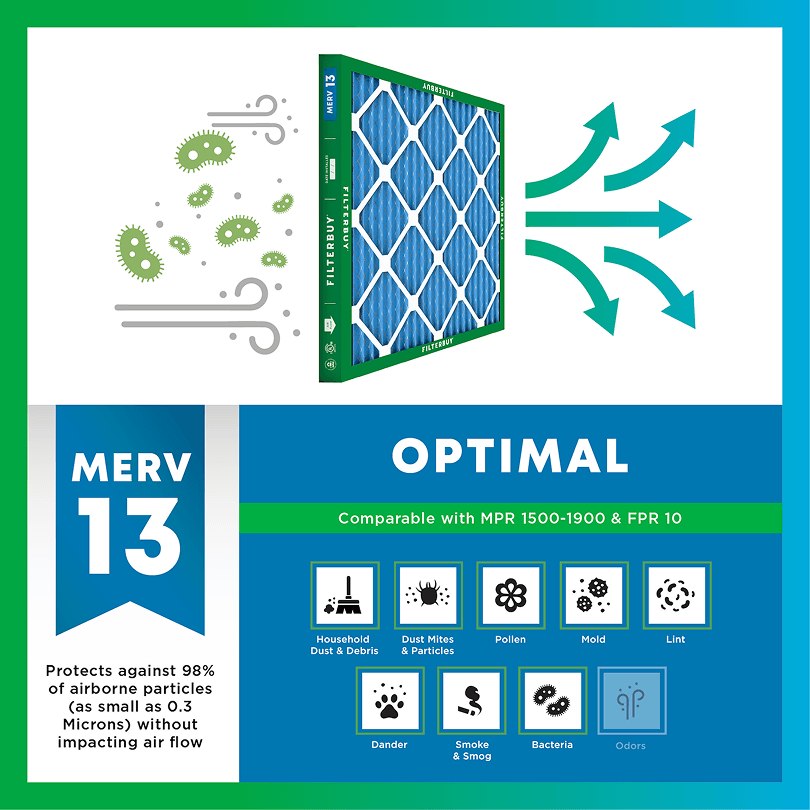
- Run A MERV 13Built to capture the fine PM2.5 in smoke.
- Add A PurifierExtra filtration for the room you use most.
- Wear an N95 if OutsideFits snug to block fine particles — a cloth mask won't.


The Best Air Filter For Wildfire Smoke
During smoke events, the EPA recommends upgrading to a MERV 13 filter — or the highest-rated filter your system can handle — to help reduce the fine particles smoke brings indoors. MERV 13 is the level most home HVAC systems can run while still capturing PM2.5, the fine particulate that makes up the bulk of wildfire smoke.
- Captures PM2.5 particles
- Blocks ash, soot, and smoke odor
- Keeps your indoor air safe—even when the outdoor air is dangerous
- Meets the EPA's recommended rating for filtering fine wildfire smoke particles.

Wildfire Smoke FAQs
Facts About Wildfires
Over 70,000 wildfires burn in the U.S. every year.
Wildfire smoke can travel 1,000+ miles, affecting states that aren't even near the blaze.
Exposure to wildfire smoke can worsen asthma, trigger heart issues, and lead to ER visits.
Indoor air can hold more fine particles during wildfire events unless it's properly filtered.
The EPA advises using MERV 13 filters or portable HEPA air cleaners during wildfire smoke events.
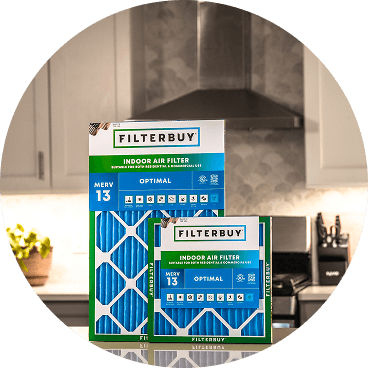
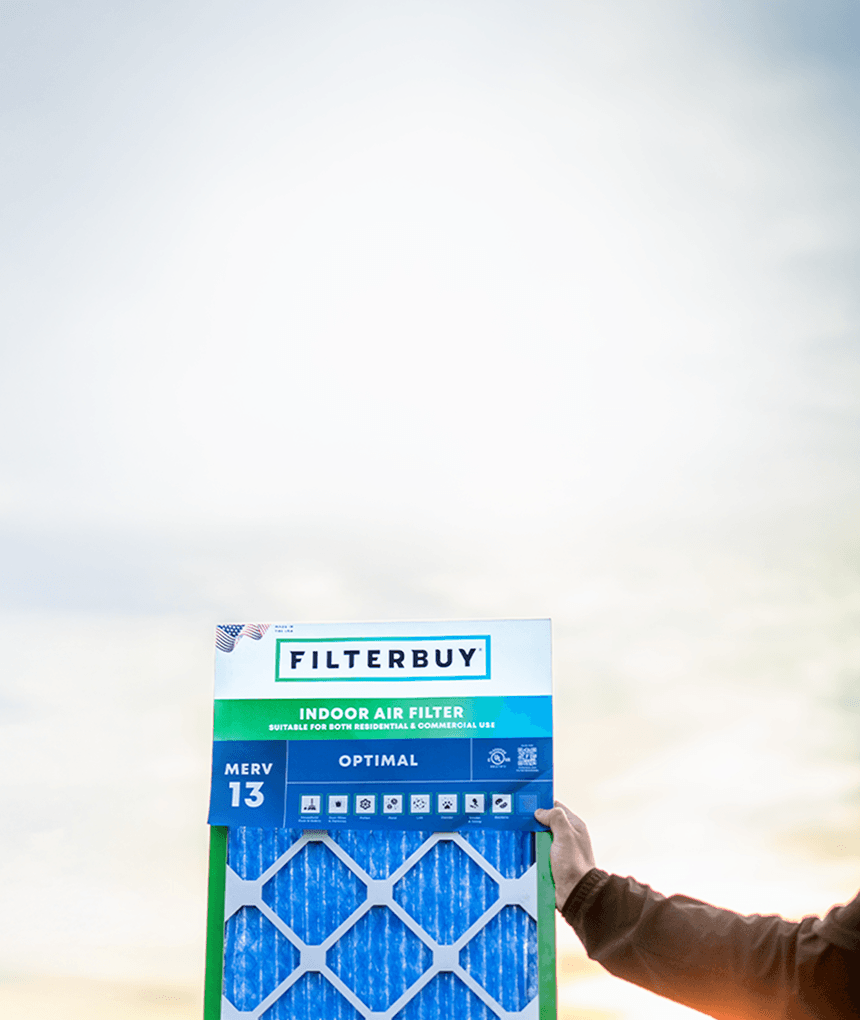
Don't Wait Until The Smoke's Inside.
Use the live wildfire smoke tracker and upgrade your air filters today to protect your lungs and your home.
Shop Filters For Smoke Protection
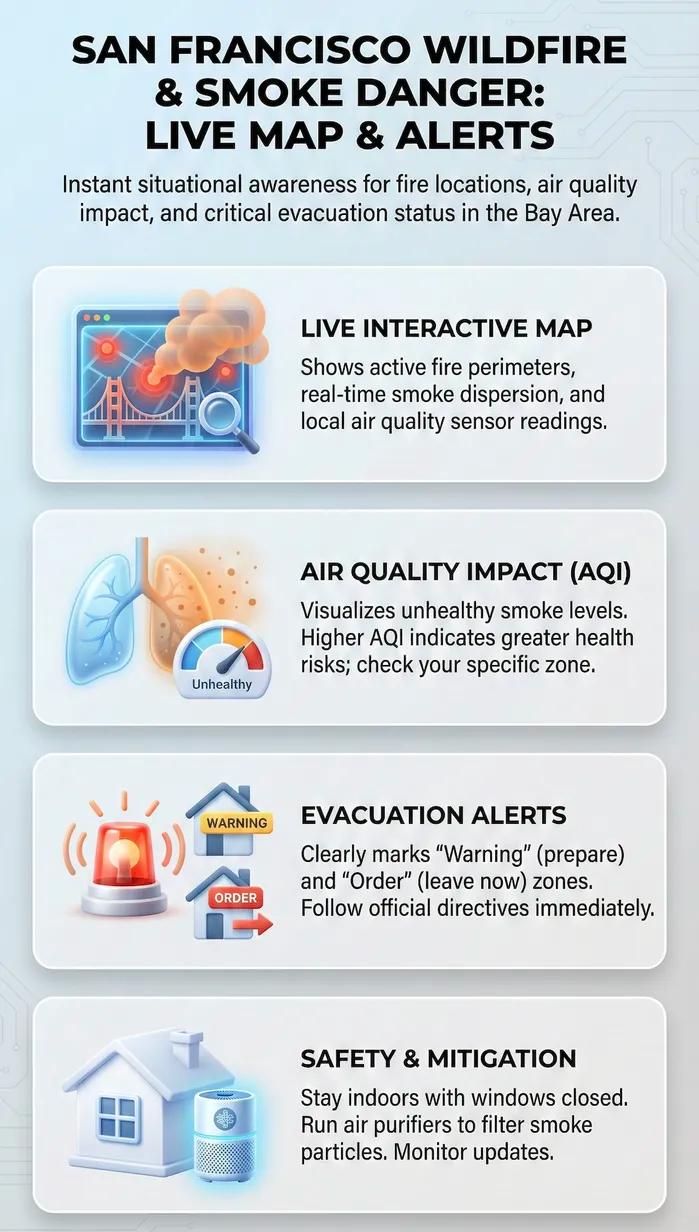
Are You in the Danger Zone? Current Live Forest Wildfire and Smoke Map Today in San Francisco, CA | Evacuation Alerts
San Francisco residents — wildfire smoke doesn't stop at your front door. At Filterbuy, we've spent over a decade obsessing over indoor air quality, and after helping millions of homeowners navigate wildfire seasons, we can tell you firsthand that what you can't see in your air is often more dangerous than what you can. When active fires push smoke into the Bay Area, fine particulate matter ($PM_{2.5}$) infiltrates your home through every gap, vent, and air return — overwhelming standard HVAC filters within hours.
This page delivers what you need right now: a current live wildfire and smoke map for San Francisco updated in real time with active fire perimeters, smoke drift patterns, AQI readings, and official evacuation alerts. We've paired these critical safety tools with direct links to Cal Fire, the Bay Area Air Quality Management District, and San Francisco emergency management resources.
But we go further than most wildfire tracking pages. Based on our experience manufacturing air filters and analyzing how wildfire smoke impacts HVAC systems, we've included actionable guidance on protecting your indoor air quality when outdoor conditions turn hazardous — because knowing where the smoke is is only half the battle. Keeping it out of your home is where we come in.
TL;DR Quick Answers
Are You in the Danger Zone? Current Live Forest Wildfire and Smoke Map Today in San Francisco, CA | Evacuation Alerts
Check these sources right now to find out:
Live Wildfire & Smoke Map: EPA AirNow Fire and Smoke Map — real-time $PM_{2.5}$ readings, active fire perimeters, and smoke plume tracking for San Francisco and the Bay Area.
Evacuation Alerts: Text your zip code to 888-777 to register for AlertSF emergency notifications.
Fire Status: Cal Fire Incidents page for active fires, containment updates, and official evacuation orders by county.
Air Quality Advisories: Bay Area Air Quality Management District for Spare the Air Alerts and health advisories.
What most wildfire pages won't tell you: After manufacturing air filters for over a decade, we've learned that tracking the smoke outside your home is only half the equation. Research from the San Francisco Bay Area confirmed indoor $PM_{2.5}$ more than doubles during wildfire events — even with windows and doors closed. Your HVAC system pulls smoke particles directly into your home through air returns, where standard filters offer little to no resistance.
Protect your indoor air now:
Upgrade to a MERV 13 air filter before smoke arrives.
Switch your thermostat fan to "on" for continuous filtration.
Check your filter every 1–2 weeks during active smoke events.
Seal gaps around windows, doors, and air returns.
Stay informed. Stay prepared. Your outdoor awareness combined with indoor air protection is what keeps your family breathing safely during San Francisco's wildfire season.
Top Takeaways
Wildfire smoke gets inside your home — even with windows closed. Bay Area research confirmed that indoor $PM_{2.5}$ more than doubles during smoke events.
Without proper filtration, your HVAC system circulates those dangerous particles into every room. MERV 13 is your best indoor defense. After manufacturing millions of filters, we've seen this single upgrade outperform every other action a family can take during smoke events.
Prepare before you smell smoke. Filters installed ahead of a smoke event capture particles from the start. Waiting means $PM_{2.5}$ is already in your ductwork and lungs.
Live monitoring and alerts save lives. Bookmark wildfire maps. Sign up for AlertSF and Watch Duty. Keep Cal Fire and BAAQMD resources one tap away.
Your HVAC needs extra attention during wildfire season. Run the fan continuously. Check filters every 1–2 weeks. Seal gaps around air returns. A clogged or low-rated filter turns your air handler into a smoke distribution system.
Understanding the Current Wildfire Threat in San Francisco
In Northern California, the wildfire season is now something that is an issue throughout the year. This season, which was once a summer forecast, is now extending deep into fall and winter, caused by drought, wind changes, and dry plants around the hillsides and open areas of the Bay Area.
The geographical peculiarity of San Francisco between the Pacific coast and inland valleys is such that the smoke of fires that are dozens or even hundreds of miles further away can reach the city within hours. The actual threat is not necessarily the fire. The smoke of wildfires contains a small amount of air pollution in the form of fine particulates (PM2.5) that get deep into your lungs and find their way into your home ventilation system, open windows, and cracks in the structure. We have witnessed at Filterbuy the rapid degradation of the indoor air quality by wildfire events.
How To Use the Live Wildfire and Smoke Map for San Francisco
The interactive map follows the live perimeter of active fires, movement of smoke plumes, and the air quality situation in San Francisco and the Bay Area in general. To maximize it, here is how:
Fire Perimeter Tracking displays the borders of active wildfires nearest to San Francisco, which is updated with new containment information released by Cal Fire and federal agencies. Zoom on to find the names of fires, their acreages, and containment percentage.
Smoke and Air Quality Overlay shows the real-time $PM_{2.5}$ levels and AQI indices in neighborhoods across San Francisco. Color-coded areas are categorized into green (good) and maroon (hazardous), which provides at a glance a visual representation of the air safety in outdoor locations.
Wind and Drift Patterns show the direction that smoke is moving in the next 24-48 hours, to be able to take some preparation before the situation is aggravated and not to respond when already aggravated.
Current Evacuation Alerts and Emergency Resources for San Francisco, CA
Efforts to evacuate orders and warnings may vary quickly during active wildfire incidents. These are the official channels that the residents of San Francisco should follow to keep up with the latest updates:
The official resource of emergency preparedness in San Francisco is SF72, which offers real-time alerts, evacuation routes, and shelter locations specific to residents of this city.
Cal Fire Incident Page monitors all the ongoing wildfires in California with specific updates on the status of the fire, its containment, and county-issued evacuation orders.
The Bay Area Air Quality Management District (BAAQMD) sends Spare the Air alerts and health warnings when smoke drives the levels of AQI to unhealthy levels throughout San Francisco and nearby counties.
WEA are emergency notifications sent to your phone when immediate evacuation is needed in your location, and will allow you to receive them without having to open any apps.
What Wildfire Smoke Does to Your Indoor Air Quality
Here's what most wildfire tracking pages won't tell you — even when you stay indoors, your home isn't automatically safe. Based on our experience manufacturing millions of air filters, we've learned that wildfire smoke is one of the most aggressive threats to indoor air quality a homeowner can face.
$PM_{2.5}$ particles from wildfire smoke are roughly 30 times smaller than a human hair. They bypass standard fiberglass filters rated at MERV 1 through MERV 4 almost entirely, circulating through your ductwork and recirculating through every room in your home. During heavy smoke events, your HVAC system essentially becomes a distribution network for the very particles you're trying to avoid.
A filter rated MERV 13 or higher captures the vast majority of $PM_{2.5}$ particles before they reach your living spaces. At Filterbuy, we manufacture MERV 13 filters in over 600 sizes specifically for situations like this — because protecting your family from wildfire smoke shouldn't depend on whether your local store happens to carry your filter size during an emergency.
How To Protect Your Home During a San Francisco Smoke Event
The moment the AQI reaches the unhealthy levels, a few actions can help you significantly decrease the amount of smoke exposure that your family will have at home:
Install an air filter with an MERV of 13 or more before the smoke comes. It is already hazy, and this means that the particles are already in your system and are being circulated in your home. If you have a common filter size, replace it as soon as the AQI drops.
Keep the HVAC fan operating when there is smoke. By adjusting the thermostat fan to be on, rather than auto, the air will continue to recycle through your filter even when your heating or cooling is not on, and mop up as many particles as possible during the day.
Seal gaps around windows and doors that allow the best entry of smoke. Minor drafts are considered sources of $PM_{2.5}$ even when the smoke is heavy.
Check your filter more frequently during active wildfire events. What normally lasts 90 days can become saturated in as little as two to three weeks under sustained smoke exposure. Even small air filters can become quickly clogged. A clogged filter restricts airflow, forces your HVAC system to work harder, and lets particles bypass the filter media entirely.
Create a clean air room in your home by closing off a single room, running a portable air purifier, and keeping the door shut. This gives your family a reliable, safe zone when outdoor conditions are at their worst.
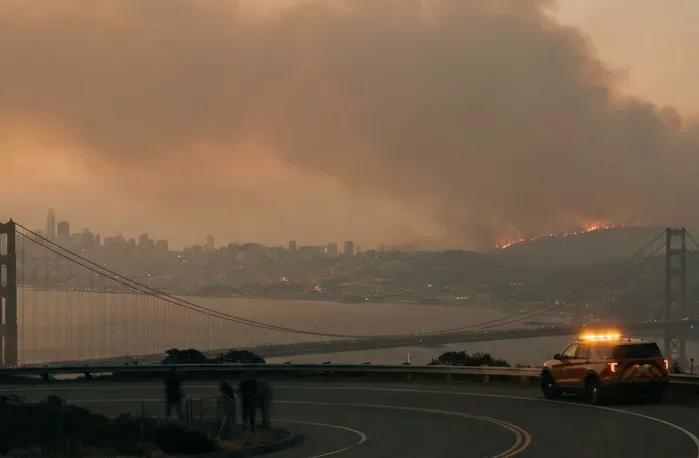
"After manufacturing air filters for over a decade and helping millions of homeowners through California's worst wildfire seasons, we've learned that the families who prepare their indoor air defenses before the smoke arrives — not after — are the ones who breathe easiest when conditions turn dangerous."
7 Essential Resources Every San Francisco Resident Needs During Wildfire Season
1. EPA AirNow Fire and Smoke Map — Real-Time Air Quality at Your Fingertips
Track live $PM_{2.5}$ concentrations, active fire locations, and smoke plume movement across San Francisco and the entire Bay Area from one interactive dashboard. This EPA and U.S. Forest Service tool pulls data from thousands of permanent monitors and low-cost sensors to give you the most accurate, up-to-the-minute AQI readings available. Knowing these details is as important as understanding tips for cleaner air during any high-particle season.
🔗 https://fire.airnow.gov/
2. Cal Fire Active Incidents Page — Know Exactly Where Fires Are Burning Right Now
The official wildfire tracking system of the state gives real-time updates on all the active fires that are greater than 10 acres, the perimeters of the fires, the percentages of containment, and the acreages burned. It is the main source of official evacuation orders and warnings by the county.
🔗 https://www.fire.ca.gov/incidents
3. San Francisco Department of Emergency Management — Get City-Specific Alerts
Sign up for AlertSF text notifications and Wireless Emergency Alerts to receive real-time emergency broadcasts specific to San Francisco neighborhoods, including evacuation orders, shelter locations, and route guidance. Residents in other areas, such as those looking for Boca Raton HVAC replacement, should also check their local emergency management pages.
🔗 https://sfdem.org/public-alerts
4. BAAQMD (Bay Area Air Quality Management District) — Spare the Air Alerts
The BAAQMD is your local authority on air quality regulations and health advisories. During wildfire season, they issue Spare the Air alerts when air quality is forecast to be unhealthy. Their site provides specific health recommendations for children and the elderly, similar to knowing what to do during a Florida heatwave event.
🔗 https://www.baaqmd.gov/
5. SF72 — San Francisco’s Hub for Emergency Preparedness
SF72 is the city’s official resource for emergency preparedness. It provides a comprehensive guide on how to prepare for wildfires and smoke, including how to build an emergency kit and a family plan.
🔗 https://www.cdc.gov/wildfires/safety/how-to-safely-stay-safe-during-a-wildfire.html
6. Watch Duty — Citizen-Powered Wildfire Tracking
Watch Duty is a non-profit app that provides real-time wildfire alerts. It often provides the first notification of new fire starts and rapid updates that can supplement official government sources.
🔗 https://www.watchduty.org/
7. Filterbuy Wildfire Preparation Guide — Hardening Your Home’s Air Defenses
Our guide focuses specifically on the "Indoor" half of the wildfire battle. Much like a preventative maintenance plan for AC systems, preparing your air filters is vital for long-term health.
🔗 https://www.sf.gov/resource--2022--san-francisco-emergency-plans
Supporting Statistics: Why Wildfire Smoke and Indoor Air Quality Demand Your Attention
1. Wildfires Are Now the Largest Source of Dangerous Airborne Particles in the Country
Wildland fires produced an estimated 52% of all PM2.5 fine particulate matter emitted nationwide, according to the U.S. EPA's 2020 National Emissions Inventory. We see this impact firsthand at Filterbuy every wildfire season:
Our customer service team fields a surge of calls during smoke events
Homeowners report filters turning dark gray or black within days instead of months
After manufacturing filters for over a decade, we know thatthe level of discoloration means dangerous particulate is flooding your home's air supply
Without proper filtration, your family breathes every particle that the filter would have caught
🔗 Source: U.S. EPA — Wildland Fire Research: Reducing Exposures https://www.epa.gov/air-research/wildland-fire-research-reducing-exposures
2. Decades of Clean Air Progress Are Being Undone — And Your HVAC System Feels It First
Research published by Nature found wildfire smoke has reversed air quality gains across the U.S. since 2016:
Nearly 75% of U.S. states have seen air quality improvements eroded by wildfire smoke
Roughly 25% of the decades-long PM2.5 reduction has been wiped out nationally
Western states like California have lost more than 50% of their clean air gains
We've watched this trend unfold through our own order data at Filterbuy:
Customers in wildfire-prone regions now replace filters 2–3x more frequently than a decade ago
More homeowners are proactively upgrading from standard MERV 8 to MERV 13
Lower-rated filters simply can't keep up with the particle loads that wildfire seasons now produce
🔗 Source: Nature — The Contribution of Wildfire to PM2.5 Trends in the USA https://www.nature.com/articles/s41586-023-06522-6
3. Closing Your Windows Isn't Enough — Indoor Pollution Still Doubles During Smoke Events
A PNAS study analyzed air sensor data from San Francisco Bay Area homes during the 2020 wildfire season and confirmed what we warn customers about at Filterbuy:
Indoor PM2.5 concentrations more than doubled during wildfire events
This occurred even in homes with every window and door sealed shut
PM2.5 particles at 2.5 micrometers and smaller don't need an open window to get inside
From our manufacturing experience, we know exactly how smoke infiltrates your home:
Micro-gaps in weatherstripping and door seals allow particle entry
HVAC air returns pull smoke directly into your duct system
Standard low-rated filters offer virtually no resistance to PM2.5 particles
MERV 13 is the minimum effective rating we recommend during wildfire events — anything lower lets the most dangerous particles pass straight through
🔗 Source: PNAS — Wildfire Smoke Impacts on Indoor Air Quality https://www.pnas.org/doi/10.1073/pnas.2106478118
Final Thought: Why Tracking Wildfire Smoke Is Only Half the Battle
Knowing where the fire is matters. Knowing where the smoke is heading matters even more. But after manufacturing air filters for over a decade and helping millions of homeowners navigate California's wildfire seasons, we've learned something most tracking pages won't tell you — monitoring the threat outside means very little if you haven't prepared for what's already getting inside.
The data is clear:
Wildfires now produce over 52% of all dangerous fine particulate pollution in the U.S.
Clean air progress is being reversed across nearly 75% of the country
Indoor air pollution more than doubles during smoke events — even with windows shut tight
Here's our honest take from the manufacturing floor: The families who fare best during wildfire season aren't the ones with the most expensive HVAC systems or the newest homes. They're the ones who took 10 minutes to swap in a MERV 13 filter before the smoke arrived.
That single step consistently makes a bigger difference than any other indoor air quality action we've seen in over a decade of working with California homeowners.
We built this page because real protection starts with real information:
Live fire maps and AQI readings help you monitor the threat in real time
Evacuation alerts and emergency resources help you act fast when conditions change
Proactive indoor air quality preparation helps you protect your family before the smoke arrives
That combination is what separates families reacting to wildfire smoke from families genuinely prepared for it.
At Filterbuy, we're not just watching the skies — we're obsessed with making sure what's in those skies doesn't end up in your lungs. Stay informed. Stay prepared. And don't wait until you can smell the smoke to protect the air your family breathes every day.
Next Steps: Protect Your Family Before the Next Smoke Event
Don't wait until the air turns hazy. Take these steps now so your home is ready when wildfire smoke reaches San Francisco.
Step 1: Bookmark This Page
Save this page for instant access to live wildfire maps, smoke tracking, AQI readings, and evacuation alerts. Seconds matter during wildfire events — keep your resources in one place.
Step 2: Sign Up for Emergency Alerts
Register for these free notification systems:
AlertSF — Text your zip code to 888-777 for San Francisco-specific alerts
Watch Duty App — Real-time wildfire notifications from first responder volunteers
Wireless Emergency Alerts (WEA) — Confirm your phone's emergency alert settings are enabled
Step 3: Upgrade Your Air Filter to MERV 13 or Higher
This is the single most impactful step for protecting indoor air during smoke events:
MERV 13 captures the vast majority of PM2.5 wildfire particles
Standard MERV 1–4 fiberglass filters let smoke pass through almost entirely
Install before smoke arrives — filters work best ahead of particle loads spiking
👉 Find your size at Filterbuy.com — Over 600 sizes manufactured and shipped directly to your door.
Step 4: Prepare Your HVAC System
Switch the thermostat fan from "auto" to "on" for continuous air circulation
Inspect your filter every 1–2 weeks during active smoke events
Seal visible gaps around air returns and ductwork to prevent unfiltered bypass
Step 5: Create a Clean Air Room
Designate one room as your family's safe zone when AQI reaches unhealthy levels:
Choose a room with minimal windows and doors
Close it off from the rest of the house
Run a portable air purifier with the door shut
Keep water, medications, and phone chargers accessible
Step 6: Build a Wildfire Emergency Kit
Prepare a go-bag in case evacuation orders are issued:
N95 respirator masks for every family member
Copies of important documents in a waterproof container
72-hour supply of medications and basic first aid
Phone chargers and battery-powered radios
Pet supplies and carriers, if applicable
Step 7: Share This Page With Your Neighbors
Wildfire preparedness works best when your whole community is informed. Send this page to family, friends, and neighbors so they have the same access to live maps, emergency resources, and indoor air quality guidance before the next smoke event hits.
Frequently Asked Questions
Q: Can I see the smoke on the map before I can smell it?
A: Yes. The smoke and air quality overlay on the live map uses satellite data and ground sensors to track smoke plumes. Often, high concentrations of $PM_{2.5}$ are detected at higher altitudes or moving toward San Francisco before the scent of smoke reaches ground level. It's always best to have a plan, like knowing the things to do before an HVAC emergency.
Q: Is it safe to run my AC when it’s smoky outside?
A: Yes, provided you have a high-quality filter (MERV 13) and your system is set to "recirculate" rather than pulling in outdoor air. Most residential AC systems do not pull air from the outside. If you notice issues, you may need a local HVAC repair specialist to check your intake seals.
Q: Why is my thermostat saying "Auxiliary Heat" during a smoke event?
A: This usually happens if your system is struggling with airflow or if there is a sensor error. Check our guide on auxiliary heat troubleshooting for common thermostat issues that can arise when systems are running under heavy load.
Q: How often should I change my air filter during wildfire season in San Francisco?
A: Check your filter every 1–2 weeks during active smoke events. We've seen across thousands of customers in wildfire-affected areas that filters rated for 90 days can become fully saturated in as little as 2–3 weeks.
Don't Let Wildfire Smoke Win — Protect Your Indoor Air Before the Next San Francisco Smoke Event
Check the live wildfire and smoke map above, sign up for evacuation alerts, and upgrade to a MERV 13 air filter at Filterbuy.com so your home is ready before dangerous particles reach your doorstep. With over 600 filter sizes manufactured and shipped directly, protecting your family's air is one step you can take right now — don't wait until you can smell the smoke.
Would you like me to help you create a custom maintenance schedule for your specific HVAC model to ensure it survives the smoke season?