filterbuy
 

Shop by

Home
>
fire smoke
>

Current Live Forest Wildfire and Smoke Map Today in San Bernardino CA – Where Are the Fires Now and How Is Smoke Impacting Air Quality?

If you're looking for active wildfires and real-time smoke conditions in San Bernardino right now, you're in the right place. Below you'll find live fire maps, current AQI readings, and smoke forecasts so you can take action to protect your family today.

San Bernardino County is one of the most wildfire-prone regions in the country. But here's what we've learned after manufacturing air filters for over a decade and serving more than two million households: the flames aren't the only threat to your family. Wildfire smoke carries fine particulate matter (PM2.5) that drifts hundreds of miles and quietly infiltrates your home through gaps around windows, doors, and your HVAC system, often long before you can see or smell it. During heavy smoke events, we've seen customers pull filters from their systems after just one week, only to find they look like they've been installed for months. That accelerated buildup isn't just a filter problem. It's a signal that dangerous particles are cycling through the air your family is breathing right now.

San Bernardino County already ranks worst in the nation for ozone pollution, according to the American Lung Association. When wildfire smoke compounds those baseline conditions, indoor air quality can deteriorate fast. We built this page to give you the real-time fire and smoke information you need alongside the practical indoor air protection strategies we've developed from working directly with homeowners in wildfire-affected communities. Whether you're tracking an active fire nearby or getting your home ready before smoke arrives, everything below is designed to help you stay one step ahead.

TL;DR: Quick Answers

Current Live Forest Wildfire and Smoke Map Today in San Bernardino, CA

The best real-time wildfire and smoke map for San Bernardino County is the EPA and U.S. Forest Service AirNow Fire and Smoke Map at fire.airnow.gov. It displays active fire locations, smoke plume movement, and current AQI readings using data from EPA monitors, temporary fire-deployed sensors, and nearly 15,000 PurpleAir sensors nationwide.

For San Bernardino-specific smoke advisories broken down by sub-region, check South Coast AQMD. For active fire incident details, including acreage, containment, and evacuation orders, visit CAL FIRE.

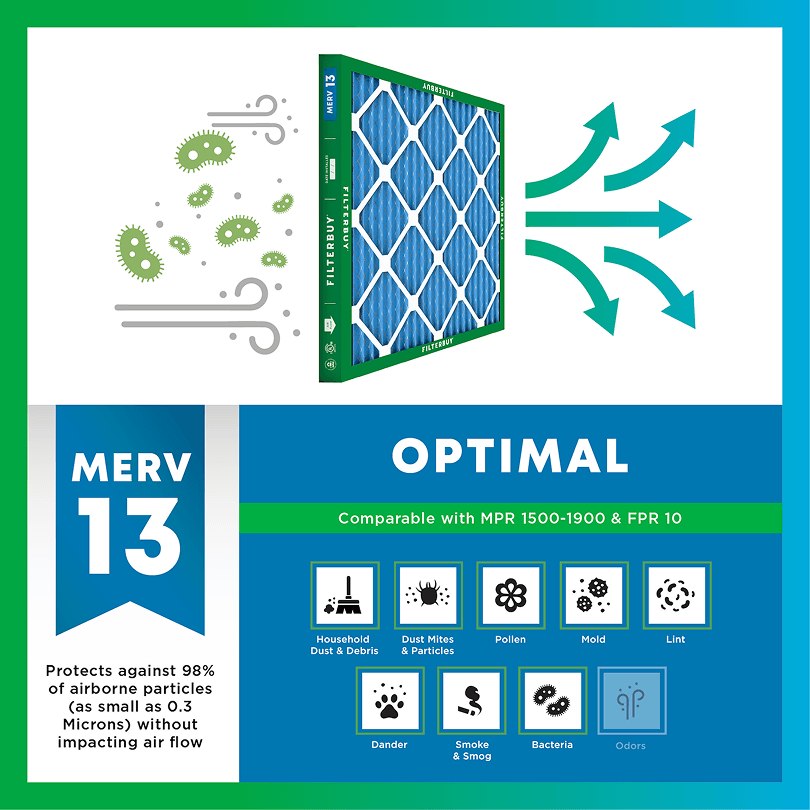
What most wildfire maps won't tell you: Tracking outdoor smoke is only half the equation. After manufacturing air filters for over a decade and serving more than two million households, we've learned that wildfire smoke infiltrates homes through HVAC systems, door gaps, and window seals, often raising indoor particle levels to 83%–95% of outdoor concentrations in homes without proper filtration. A MERV 13 filter, which is the EPA-recommended minimum for wildfire PM2.5, can reduce that indoor exposure to just 13%–18% of outdoor levels.

Bottom line: Monitor outdoor conditions with the tools above. Protect indoor conditions with a MERV 13 filter, your HVAC set to recirculate, and a clean air room equipped with a portable HEPA purifier. The smoke you can't see inside your home is the smoke that matters most.

Top Takeaways

Where Are the Fires Burning in San Bernardino County Right Now?

The live wildfire map above shows all currently active fires in and around San Bernardino County, updated in real time using data from CAL FIRE and the National Interagency Fire Center. You can zoom into your specific neighborhood, view fire perimeters, and track how close active flames are to residential areas.

San Bernardino County spans over 20,000 square miles, making it the largest county in the contiguous United States, and much of that land falls within or borders the San Bernardino National Forest. The U.S. Forest Service classifies this forest as one of the most wildfire-prone in the entire country due to its combination of arid climate, steep slopes, dense flammable brush, and seasonal Santa Ana winds that can push fires across ridgelines in hours. In 2025 alone, the county saw significant fire activity, including the Ranch Fire near Apple Valley that exploded from 80 acres to over 4,200 acres in just four hours.

CAL FIRE's newly updated Fire Hazard Severity Zone maps, adopted by the San Bernardino County Board of Supervisors in June 2025, now classify local areas into three risk tiers: moderate, high, and very high. Approximately 53% of buildings in San Bernardino County are considered at high risk of wildfire damage. If you're unsure whether your home falls within one of these zones, you can check your address directly through CAL FIRE's interactive Fire Hazard Severity Zone Viewer.

Click here to view the live wildfiire and smoke map today in San Bernardino, Ca.

Fire & Smoke Map

View live fire and smoke conditions on AirNow (San Bernardino, CA).

Open the map

How Is Wildfire Smoke Affecting Air Quality in San Bernardino Today?

Even when fires are burning miles from your home, smoke doesn't respect property lines. The current Air Quality Index (AQI) readings for San Bernardino are displayed above, pulling real-time data from EPA monitoring stations and PurpleAir sensors throughout the region. These readings update continuously, so you can track conditions throughout the day.

San Bernardino County already faces some of the worst baseline air quality in the nation. The American Lung Association's 2025 "State of the Air" report gave the county failing grades across all three pollution measures: ozone, short-term particle pollution, and year-round particle pollution, ranking it worst in the entire country for ozone. When wildfire smoke layers on top of those existing conditions, AQI levels can spike from moderate to hazardous within hours, particularly during Santa Ana wind events that trap smoke in the inland valleys where most residents live.

What makes wildfire smoke especially dangerous is its composition. Unlike typical air pollution, wildfire PM2.5 contains a cocktail of burned organic material, chemicals, and ultrafine particles that peer-reviewed research has found to be up to 10 times more harmful to respiratory health than particulate matter from other sources. These particles are small enough to bypass your body's natural defenses, penetrate deep into lung tissue, and even enter the bloodstream. Children, adults over 65, pregnant women, and anyone with asthma, COPD, or heart conditions face the greatest risk.

What Does Wildfire Smoke Do to Your Home's Air — Even When You Can't See It?

Here's where our experience manufacturing millions of air filters gives us a perspective most wildfire tracking sites can't offer. We've heard from customers across Southern California who assumed their homes were sealed tight during smoke events, only to pull their HVAC filters weeks later and find them packed with dark, sooty particulate that wasn't there before. That visible buildup tells a clear story: smoke was getting inside and cycling through the air their families were breathing.

Wildfire smoke infiltrates homes through every gap your house has around window frames, door sweeps, electrical outlets, plumbing penetrations, attic vents, and most critically, through your HVAC system's fresh air intake. Once inside, those fine particles don't just float around temporarily. They recirculate through your ductwork every time your system cycles, passing through the same filter again and again. If that filter is a basic fiberglass panel rated MERV 4 or lower, it's catching lint and not much else. The smoke particles pass straight through and keep circulating.

This is why we consistently see filter replacement rates double or even triple among our customers in wildfire-prone areas during active smoke events. A filter that normally lasts 90 days can become visibly loaded in 30 days or less when smoke is in the air. That accelerated degradation isn't cosmetic; it directly signals reduced filtration efficiency at the exact moment your family needs maximum protection.

How to Protect Your Indoor Air Quality During Wildfire Smoke Events

Protecting your home during a smoke event doesn't require a full HVAC overhaul. It starts with a few practical steps that, based on what we've seen working with homeowners in fire-prone regions, make the biggest difference in real-world conditions.

Upgrade to a MERV 13 filter before smoke arrives. The EPA recommends MERV 13 as the minimum rating for capturing wildfire smoke PM2.5. At this rating, filters can block approximately 85–95% of fine particulate matter that passes through your system. Most modern HVAC systems can handle a MERV 13 without airflow issues. If you're unsure, check your system manual or consult an HVAC technician before upgrading. We manufacture MERV 13 filters in over 600 sizes right here in the U.S., so if your system takes an unusual dimension, there's a strong chance we have it or can make it.

Switch your thermostat to recirculate mode. If your HVAC system has a fresh air intake, close the outdoor damper or set the system to recirculate. This prevents your system from actively pulling smoky outdoor air into your home. Running the fan in "on" mode rather than "auto" keeps air cycling through your filter continuously, even when the system isn't actively heating or cooling.

Seal the obvious gaps. Walk through your home and check for daylight or drafts around windows, exterior doors, and any openings to the outside. Temporary weatherstripping, door sweeps, and even damp towels along door bases can meaningfully reduce smoke infiltration during an active event.

Check and replace your filter more frequently. During heavy smoke periods, inspect your filter every two weeks. If it looks visibly dark or loaded, replace it immediately rather than waiting for your normal schedule. A clogged filter restricts airflow, forces your HVAC system to work harder, and actually reduces its ability to clean the air when your family needs it most.

Create a clean air room. If you have a portable HEPA air purifier, set it up in the room where your family spends the most time, typically the bedroom. Close the doors and let the purifier run continuously. This creates a concentrated zone of cleaner air for sleeping and recovery, which is especially important for children and anyone with respiratory sensitivities.

Why San Bernardino Homeowners Need a Wildfire Smoke Plan — Not Just a Fire Evacuation Plan

Most families in San Bernardino County have thought about what they'd do if fire reached their neighborhood. Far fewer have planned for what happens when smoke reaches their home without flames ever getting close. Yet smoke events affect exponentially more households than the fires themselves exponentially. During the 2024 Line Fire, which burned nearly 44,000 acres in the San Bernardino National Forest, the South Coast Air Quality Management District issued health advisories that reached communities far beyond the fire's perimeter.

With CAL FIRE forecasting above-normal large fire potential for Southern California driven by persistent drought, below-average precipitation, and active Santa Ana wind patterns, the reality is that wildfire smoke has become a recurring seasonal challenge for every household in the region, not just those in designated fire hazard zones.

Having a smoke plan means keeping spare MERV 13 filters on hand before fire season starts, knowing how to set your HVAC to recirculate, having a portable air purifier ready for your clean air room, and monitoring AQI readings daily during active fire periods. These aren't emergency measures. For San Bernardino County residents, they're becoming part of routine home maintenance the same way you'd prepare for extreme heat or seasonal allergens.

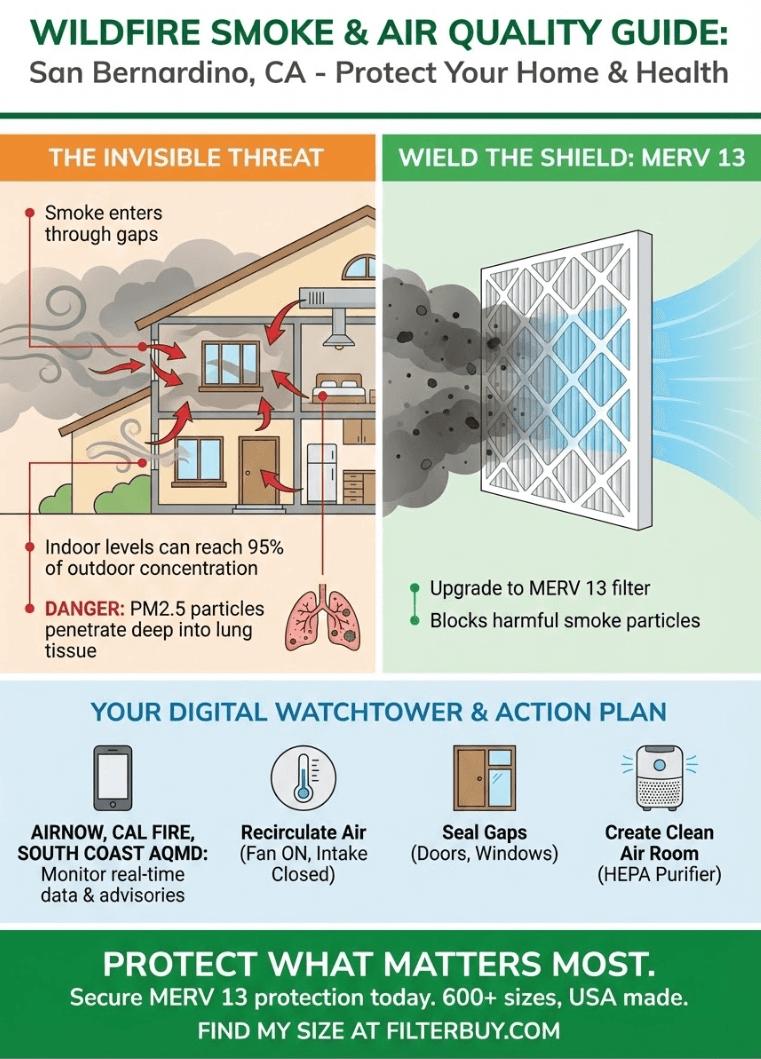
Infographic showing wildfire smoke and air quality guide for San Bernardino, Ca.

"At Filterbuy, we've spent over a decade manufacturing air filters and working with homeowners in the communities most affected by wildfire smoke. That experience has taught us that the families who stay ahead of smoke events, rather than reacting after the air already smells wrong, are the ones who keep their indoor air safe. You don't need to wait for a red flag warning to start protecting your home. The best time to prepare is right now."

7 Resources That Help You Stay Ahead of Wildfire Smoke in San Bernardino — So You Can Protect What Matters Most

Don't wait until you smell smoke to start looking for answers. One of the most important things we've learned after manufacturing air filters for over a decade and working with more than two million households is this: the homeowners who protect their families best during wildfire season aren't the ones who react fastest, they're the ones who already know where to look before conditions change.

San Bernardino County faces some of the most persistent wildfire and air quality challenges in the country. That means having reliable, real-time resources isn't optional. It's part of protecting your greatest assets, your family, your home, and your HVAC system.

Here are the seven tools we consistently recommend to homeowners in fire-prone communities, and exactly how each one helps you take action when it counts.

1. EPA & U.S. Forest Service AirNow Fire and Smoke Map — See What's Really in Your Air Right Now

You can't protect your family from what you can't see. The AirNow Fire and Smoke Map makes the invisible visible by pulling real-time PM2.5 data from EPA regulatory monitors, temporary fire-deployed sensors, and nearly 15,000 PurpleAir sensors across the country, all displayed in the familiar AQI color coding you can read at a glance. Zoom into your San Bernardino neighborhood to track active fire locations, smoke plume movement, and Smoke Forecast Outlooks, so you know what's heading your way before it arrives. Available on desktop and through the free AirNow mobile app, this is the tool we tell every customer to check first.

Source: U.S. Environmental Protection Agency & U.S. Forest Service

URL: https://fire.airnow.gov/

2. CAL FIRE Active Incidents Page — Know Exactly Where Fires Are Burning Near You

When a fire breaks out in or around San Bernardino County, this is the official source for what's happening on the ground. CAL FIRE's incident tracker gives you live updates on every active wildfire in California, including acreage, containment percentage, evacuation orders, interactive incident maps, and which agency is managing the response. During the 2025 fire season, this page tracked fast-moving local fires like the Ranch Fire near Apple Valley, which exploded from 80 acres to over 4,200 in just four hours. Having this page bookmarked means you're never guessing about how close a fire really is.

Source: California Department of Forestry and Fire Protection (CAL FIRE)

URL: https://www.fire.ca.gov/incidents

3. South Coast AQMD Advisories and Real-Time AQI Map — Get Localized Smoke Alerts for Your Specific Area

Here's something most people don't realize: air quality during a smoke event can vary dramatically from one side of San Bernardino County to the other. South Coast AQMD breaks the county into specific sub-regions from the Northwest Valley to the East San Bernardino Mountains, and issues smoke advisories at that localized level. That precision matters because a neighborhood five miles from you might be in the "Unhealthy" AQI range while yours is still reading "Moderate." Download their mobile app to get push notifications the moment a smoke advisory is issued for your specific area, so you can adjust your HVAC settings and close up your home before conditions worsen.

Source: South Coast Air Quality Management District

URL: https://www.aqmd.gov/home/air-quality/air-quality-advisories

4. San Bernardino County Fire Protection District — Your First Source for Evacuations and Emergency Alerts

During a fast-moving fire, local updates from San Bernardino County Fire often arrive before state and federal sources can publish them. This is where you'll find evacuation orders, the county's high-speed mass notification system, and the officially adopted Fire Hazard Severity Zone map, the hyper-local information that directly affects your family's immediate safety. We always tell our customers in the area: know your national tools for smoke and AQI, but rely on your county fire district for the emergency decisions that hit closest to home.

Source: San Bernardino County Fire Protection District

URL: https://sbcfire.org/

5. CAL FIRE Fire Hazard Severity Zone Viewer — Find Out What Wildfire Risk Zone Your Home Is In

Protecting your home starts with understanding what you're up against. This interactive map lets you enter your specific San Bernardino address to find out whether your property falls within a moderate, high, or very high fire hazard severity zone. The maps were updated in March 2025 using modern climate data and advanced fire modeling, replacing assessments that hadn't been refreshed since 2007–2011. Knowing your zone isn't just informational. It determines the building codes, defensible space requirements, and real estate disclosures that apply to your property, and it helps you make smarter decisions about how aggressively to prepare your indoor air filtration for smoke season.

Source: California Office of the State Fire Marshal

URL: https://osfm.fire.ca.gov/what-we-do/community-wildfire-preparedness-and-mitigation/fire-hazard-severity-zones/fire-hazard-severity-zones-maps

6. U.S. EPA Wildfires and Indoor Air Quality Guide — Practical Steps to Keep Smoke Out of Your Home

This is where preparation turns into action. The EPA's dedicated indoor air quality resource walks you through exactly how to protect the air inside your home during a smoke event, from setting your HVAC system to recirculate mode and building a DIY air cleaner with MERV 13 filters and a box fan, to creating a dedicated clean air room where your family can sleep and recover. It also includes specific guidance for evaporative coolers, which are common across San Bernardino's inland communities. We recommend downloading the fact sheets now and keeping them somewhere accessible so you're not searching for instructions when the AQI is already climbing.

Source: U.S. Environmental Protection Agency

URL: https://www.epa.gov/emergencies-iaq/wildfires-and-indoor-air-quality-iaq

7. Filterbuy — Your Guide to Choosing the Right MERV-Rated Filter for Wildfire Smoke

We built this guide because we kept hearing the same question from customers in wildfire-prone areas: "Which filter actually stops smoke?" The answer, backed by EPA guidance and our own experience manufacturing filters for over two million households, is MERV 13, the minimum rating capable of capturing the fine PM2.5 particles that make wildfire smoke so dangerous to breathe. Our guide covers how to verify your HVAC system can handle the upgrade, how often to replace filters during active smoke events (hint: much more frequently than you think), and how to pair HVAC filtration with a portable air purifier for maximum protection. And because we know San Bernardino homes come in all sizes with all kinds of systems, we manufacture MERV 13 filters in over 600 sizes right here in our U.S. facilities — so even if your system takes an uncommon dimension, there's a strong chance we have it ready to ship.

Source: Filterbuy

URL: https://filterbuy.com/resources/air-filter-basics/best-merv-filter-for-wildfire-smoke/

What the Data Tells Us — And What We've Seen Firsthand in Homes Across Southern California

We track this data closely because it shapes the advice we give and the products we manufacture. When you've spent over a decade making air filters for more than two million households, you see patterns the statistics alone don't capture.

Here's what the research says and what it actually looks like from where we sit.

1. Over Half of All U.S. Fine Particle Pollution Now Comes From Wildfire Smoke

The EPA's 2020 National Emissions Inventory found that 52% of all PM2.5 emitted nationwide originated from wildland fires. That makes wildfire smoke the single largest source of the fine particles most harmful to human health.

That number didn't surprise us. Here's what we see in practice:

Source: U.S. Environmental Protection Agency — Wildland Fire Research: Reducing Exposures

URL: https://www.epa.gov/air-research/wildland-fire-research-reducing-exposures

2. San Bernardino County Ranks #1 Worst in the Nation for Ozone Pollution

The American Lung Association's 2025 "State of the Air" report gave San Bernardino County failing grades in every pollution category: ozone, short-term particle pollution, and year-round particle pollution.

The key numbers:

What this means for your filter is something we see reflected in our own order data:

Source: American Lung Association — "State of the Air" 2025 Report

URL: https://www.lung.org/research/sota/city-rankings/states/california/san-bernardino

3. Indoor Smoke Levels Can Reach 95% of Outdoor Concentrations — But the Right Filter Changes Everything

Research from Lawrence Berkeley National Laboratory measured indoor PM2.5 during wildfire events and found a dramatic range depending on filtration:

That gap between 95% and 13% is staggering, and it's exactly the gap we work to close for every customer.

The most common thing we hear from homeowners after their first smoke event with a MERV 13 installed isn't about technical specs. It's what they see when they pull the old filter out. A filter packed with dark, sooty particulate after just a few weeks tells a story no statistic can. Once you see what was cycling through your family's air, you never go back to a basic filter.

Source: Lawrence Berkeley National Laboratory — Indoor Air Quality Scientific Findings Resource Bank: Wildfires

URL: https://iaqscience.lbl.gov/wildfires

What These Numbers Mean for Your Home

Statistics tell part of the story. Our customers tell the rest.

After manufacturing millions of filters and hearing directly from San Bernardino County homeowners who've lived through smoke events, the pattern is consistent:

A properly rated filter, a system set to recirculate, and a clean air room aren't overreactions for San Bernardino households. Given what the air quality data and our own decade-plus of manufacturing experience both point to, they're the starting point.

Final Thought: The Biggest Threat to Your Family's Air Isn't Always the Fire You Can See

After more than a decade of manufacturing air filters and working with over two million households, we've arrived at an opinion that might sound counterintuitive: the families most at risk during wildfire season aren't the ones closest to the flames. They're the ones who assume distance means safety.

We've seen it play out the same way, season after season. A fire ignites 40 or 50 miles away. Homeowners check whether evacuations affect their neighborhood, and when they don't, life continues as normal. Windows stay cracked. The HVAC runs its usual cycle with the same basic filter that's been in for months.

Then the filter comes out two weeks later, dark, heavy, packed with particulate that wasn't there before. That's the moment it clicks. The smoke was inside the whole time.

What This Page Gives You

Everything a San Bernardino homeowner needs in one place:

Our Honest Take

We'll say it plainly: San Bernardino County homeowners need a smoke plan just as much as a fire evacuation plan. The data makes the case:

But you don't need a statistic to understand the problem. You just need to pull a filter out of your system after two weeks of smoking and hold it up to the light.

We're not going to pretend we're unbiased; we manufacture air filters. But our conviction doesn't come from wanting to sell more filters. It comes from a decade of watching the difference between a prepared home and an unprepared one. That difference is visible on the filter, measurable in the air, and felt by everyone breathing inside that house.

What We'd Tell Our Own Families

If we lived in San Bernardino County and many of our team members face these same challenges here's exactly what we'd do before fire season:

  1. Install a MERV 13 filter now. Not when the first advisory drops. Your system is already working harder than most against baseline pollution. You want maximum filtration in place before smoke adds to the load.

  2. Bookmark the monitoring tools. Save the AirNow Fire and Smoke Map, South Coast AQMD advisories, and CAL FIRE incidents page, where you can reach them in seconds.

  3. Learn your HVAC's recirculate setting. Know how to close the fresh air intake and switch modes before you need to do it under pressure. Practice it once.

  4. Keep a spare filter on hand. Heavy smoke can load a filter in half the normal time. A replacement standing by means you're never running a clogged filter when it matters most.

  5. Set up a clean air room. Pick one room, ideally a bedroom,m with a portable HEPA purifier. Close the doors during smoke events and let it run continuously. This gives your family the cleanest air in the house for sleeping and recovery.

Next Steps: What to Do Right Now to Protect Your Home From Wildfire Smoke

You've seen the data. You understand the risk. Now it's time to act.

These steps are in priority order. Start at the top and work down. Each one builds on the last.

Step 1: Check Your Current Air Filter

Pull your HVAC filter out and look at it. If it's visibly gray, dark, or loaded, replace it immediately.

Then check the MERV rating on the frame:

Not sure what size you need? Check the dimensions printed on your current filter's frame. We manufacture MERV 13 filters in over 600 sizes, including uncommon dimensions most retailers don't carry.

👉 Find your MERV 13 filter at Filterbuy.com

Step 2: Learn Your HVAC's Recirculate Setting

This takes two minutes. Do it now so it's automatic when conditions change fast.

  1. Locate your thermostat's fan setting - look for "On," "Auto," or "Recirculate."

  2. Switch the fan to "On" to keep air cycling through your filter continuously.

  3. Find and close your fresh air intake damper to stop pulling outdoor smoke inside.

  4. Practice the full switch once. Don't figure it out for the first time during a smoke event.

Step 3: Bookmark Your Monitoring Tools

Save these three resources where you can reach them in seconds:

  1. AirNow Fire and Smoke Map - Real-time AQI and smoke tracking. https://fire.airnow.gov/

  2. South Coast AQMD Advisories - Localized smoke alerts for San Bernardino sub-regions. https://www.aqmd.gov/home/air-quality/air-quality-advisories

  3. CAL FIRE Active Incidents - Live updates on every California wildfire. https://www.fire.ca.gov/incidents

Download the AirNow and South Coast AQMD mobile apps and enable push notifications. Alerts that come to you beat having to go looking every time.

Step 4: Seal the Gaps

Smoke doesn't need an open window. It finds every crack your home has. Walk through and check:

You don't need a full weatherization project. Even temporary measures during a smoke event meaningfully reduce infiltration.

Step 5: Set Up a Clean Air Room

Designate one room, ideally a bedroom, as your family's clean air zone.

Step 6: Stock Up Before Fire Season

The worst time to buy air filters is when everyone else is buying them. During major smoke events, standard sizes sell out fast, and uncommon sizes become nearly impossible to find locally.

Build your wildfire smoke kit now:

👉 Set up a Filterbuy subscription ad replacement filters ship automatically — so you're never caught without one when smoke arrives.

Step 7: Create a Household Smoke Plan

You have a plan for when fire reaches your neighborhood. Make one for when smoke reaches your home without flames ever getting close.

Your smoke plan should cover:

Write it down. Post it on the refrigerator. Make sure everyone in the household knows the plan.

FAQ on "Current Live Forest Wildfire and Smoke Map Today in San Bernardino, CA"

Q: Where can I find a real-time wildfire and smoke map for San Bernardino County?

A: The tool we point every customer to first is the EPA and U.S. Forest Service AirNow Fire and Smoke Map at fire.airnow.gov. Here's why:

For even more localized detail, use South Coast AQMD's advisories. They break San Bernardino County into specific sub-regions, which matters because we've seen smoke conditions vary dramatically within just a few miles during the same event.

Both are available as mobile apps with push notifications. From working with homeowners through multiple fire seasons, we can tell you: the families who had alerts coming to them automatically always responded faster than those searching manually.

Q: How does wildfire smoke affect indoor air quality in San Bernardino homes even when fires are miles away?

A: This is the question we hear most, and the answer surprises nearly every homeowner we talk to.

Wildfire smoke carries fine particulate matter (PM2.5) that drifts hundreds of miles and infiltrates through gaps you'd never think about:

Lawrence Berkeley National Laboratory found that homes without effective filtration can see indoor particle levels reach 83%–95% of outdoor concentrations during smoke events.

We don't need to look at the research to know this is true. Every fire season, customers across Southern California pull filters after just two to three weeks of smoke exposure that look like they've been installed for six months. Dark, heavy, and packed with particulate that was cycling through their family's air the entire time.

San Bernardino County is especially vulnerable. The county already ranks worst in the nation for ozone pollution. Meaning your filter is fighting baseline pollution long before smoke adds to the load.

Q: What type of air filter should I use to protect my home from wildfire smoke in San Bernardino?

A: The EPA recommends MERV 13 as the minimum for capturing wildfire PM2.5. After manufacturing filters for over a decade, we agree. It's the threshold where real protection begins.

Here's what the research shows:

That's not an incremental improvement. It's the difference between mostly clean air and air nearly as bad as standing outside.

What to know before upgrading:

The most common thing we hear from customers after their first smoke season with a MERV 13: they wish they'd switched sooner.

Q: How often should I replace my air filter during wildfire season in San Bernardino County?

A: More often than you'd expect. We learned this from our own customer data before the research confirmed it.

Normal conditions vs. smoke season:

Our recommendation:

Why this matters beyond air quality:

Keep at least two spare MERV 13 filters on hand before fire season. The customers who stock up early are never scrambling when smoke arrives and demand spikes.

Q: What should I do right now to prepare my San Bernardino home for wildfire smoke?

A: After working with homeowners in Southern California's most fire-affected communities for over a decade, we've narrowed it down to five actions that make the biggest real-world difference. They take less than an hour combined.

  1. Check your filter and upgrade to MERV 13. Pull your current filter. Check its rating. If it's below 13, upgrade now. Not when the first advisory drops.

  2. Learn your HVAC's recirculate setting. Find the fresh air intake and practice closing it. Switch the fan to "On." Do it once now so it's automatic when you need it.

  3. Bookmark your monitoring tools. Save the AirNow Fire and Smoke Map (fire.airnow.gov), South Coast AQMD advisories (aqmd.gov), and CAL FIRE incidents page (fire.ca.gov/incidents) on your phone for instant access.

  4. Seal obvious gaps. Walk around your home and check exterior doors, windows, and unused fireplace dampers. Even temporary weatherstripping or a damp towel along a door base helps during an active event.

  5. Set up a clean air room. Place a portable HEPA purifier in the bedroom where your family sleeps. Close the doors during smoke events and run it continuously for the cleanest overnight air in the house.

The pattern we've seen over and over is clear: the families who take these steps before the first smoke advisory keep their indoor air cleanest from start to finish. It's never the size of the budget. It's the timing of the preparation.

Don't Just Track the Smoke Outside, Stop It From Getting Inside

Now that you know where wildfires are burning and how smoke is impacting San Bernardino's air quality, take the next step and make sure your home is ready. Find your MERV 13 filter at Filterbuy.com — over 600 sizes, made in our U.S. facilities, and shipped directly to your door before the next smoke event hits.