
Tip: Ensure you buy the exact air filter size for your system. Certain brands have precise dimensions that only fit their specific models. See related filters
Actual Size: 15.75x19.75x4.38"
 Free Delivery
  Factory-Direct Low Prices, Made in the USA
 Hassle-Free Returns & Free Exchanges
RESIDENTIAL AND/OR COMMERCIAL USE
Change Every 3 Months
Tip: Ensure you buy the exact air filter size for your system. Certain brands have precise dimensions that only fit their specific models. See related filters
Actual Size: 15.75x19.75x4.38"
Free Delivery Factory-Direct Low Prices, Made in the USAHassle-Free Returns & Free ExchangesRESIDENTIAL AND/OR COMMERCIAL USE
Change Every 3 Months
Tip: Ensure you buy the exact air filter size for your system. Certain brands have precise dimensions that only fit their specific models. See related filters
Actual Size: 15.75x19.75x4.38"
Free Delivery Factory-Direct Low Prices, Made in the USAHassle-Free Returns & Free ExchangesRESIDENTIAL AND/OR COMMERCIAL USE
Change Every 3 Months
At Filterbuy, we don't cut corners—we craft high-quality air filters right here in the USA and ship them to your doorstep for free. No delays, no gimmicks—just clean air, made easy. With thousands of five-star reviews and filters built for real life & every HVAC system, it's no wonder why over 4 million families trust Filterbuy.

Proudly Made In The USA

Fast, Free Shipping on Every Order

Premium Materials That Go The Distance

85,000+ 5-Star Reviews From Happy Customers

Save Up to 70% Per Filter with Packs


Measure length × width × depth with a tape measure to find the actual size.

Round up each dimension to the nearest whole number to get the nominal size. Example: 15.75x19.75x4.38" in → 16X20X5 nominal.

Search by nominal size on our site for the best fit.


5″ filters give you maximum filtration with minimal maintenance — lasting up to 12 months while handling higher MERV ratings without restricting airflow.
Sizing note:

If the filter you buy doesn't fit, we'll send you a better size.
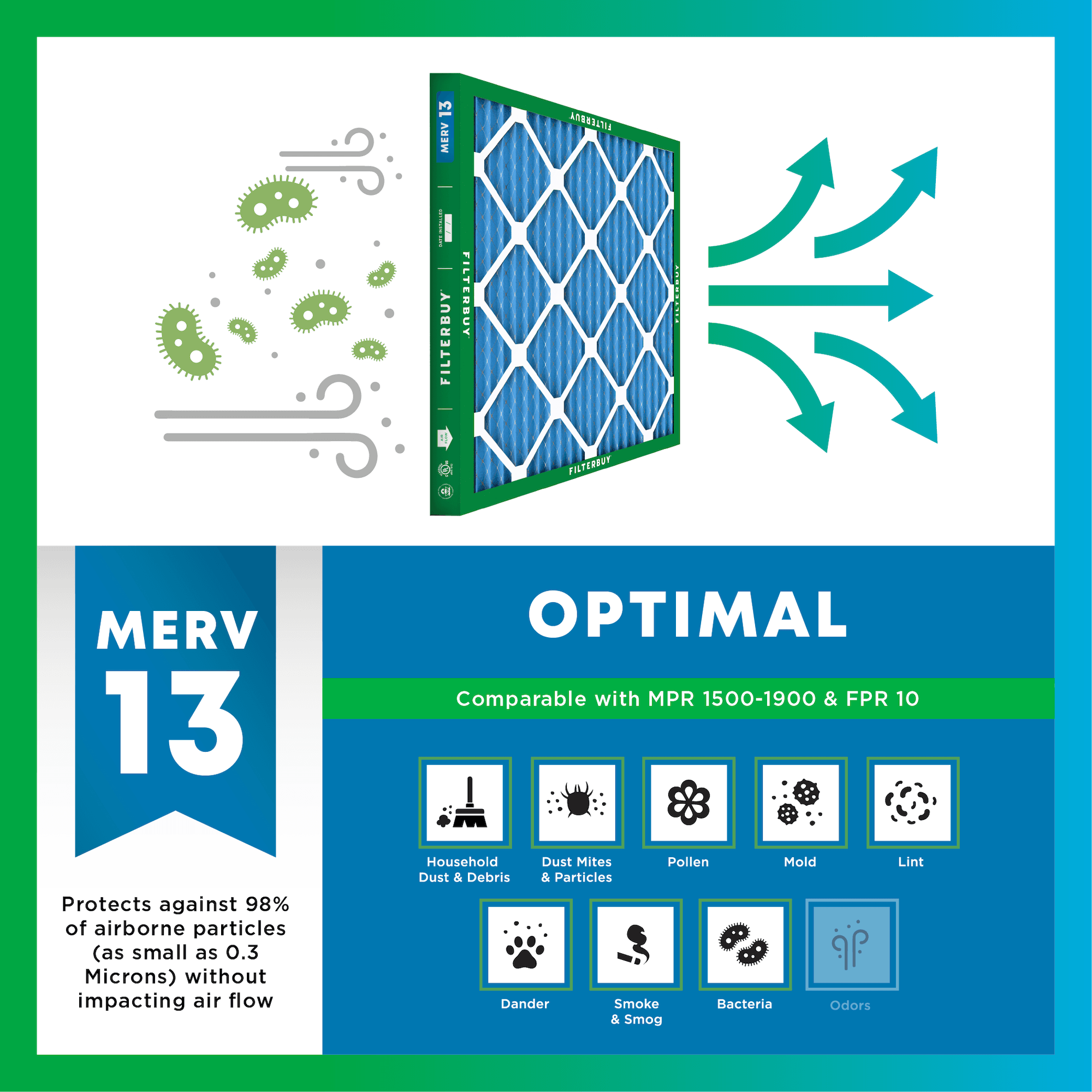
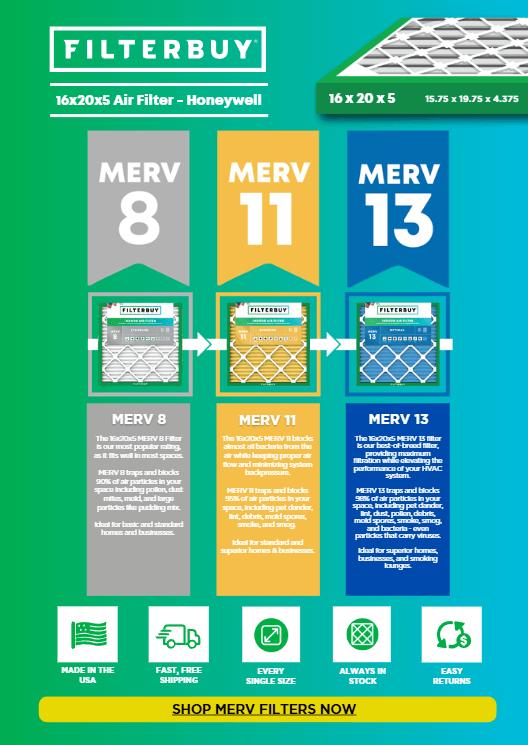
MERV stands for Minimum Efficiency Reporting Value—but don't let the technical name fool you. It's just a way to rate how well an air filter traps stuff like dust, pollen, pet dander, and smoke. The higher the MERV number, the more particles it catches—and the cleaner your air will be.

Comparable to:FPR: 4-7
MPR: 600-1000
 Dust & Debris
 Dust Mites & Particles
 Pollen
 Mold
Mold Lint
Lint Dander
Comparable to:FPR: 6-9
MPR: 1200-1550
Dust & DebrisDust Mites & ParticlesPollenMoldLintDander Smoke & Smog
Comparable to:FPR: 10
MPR: 1900-2800
Dust & DebrisDust Mites & ParticlesPollenMoldLintDanderSmoke & Smog Bacteria


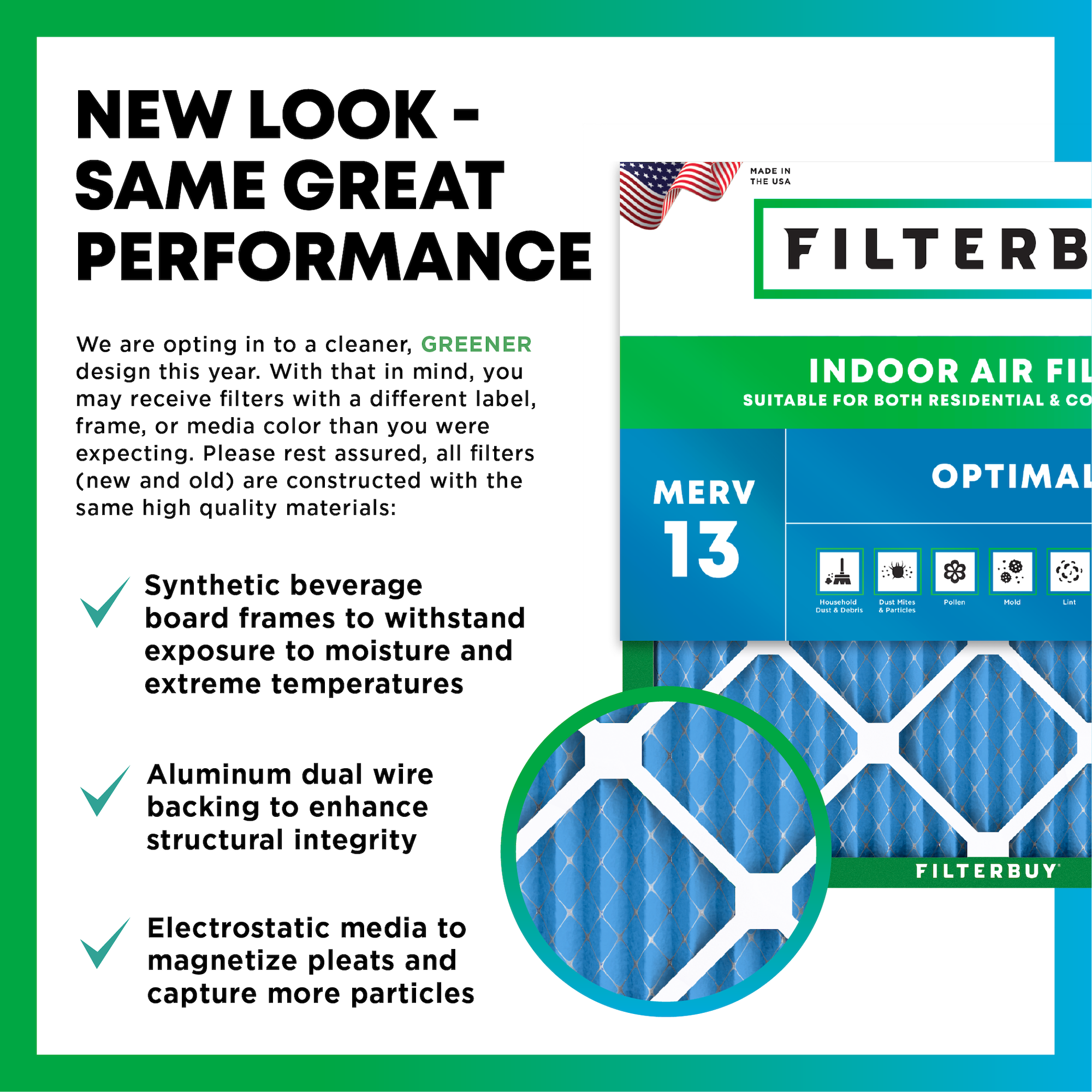
We build every Filterbuy filter to deliver reliable 90-day performance—thanks to smart design and premium materials that do the heavy lifting. Here's what makes the difference:
More pleats = more surface area to capture dust and debris, keeping your air cleaner longer.
Pleats are magnetized to attract and trap microscopic particles—like pet dander, pollen, and smoke.
Engineered to resist warping in extreme temperatures and high humidity.

A layer of metal reinforcement keeps pleats evenly spaced and structurally sound—no sagging, even at high airflow.
Assembled with care. Built to perform. Ships fast, free, and reliably from our U.S. facilities.

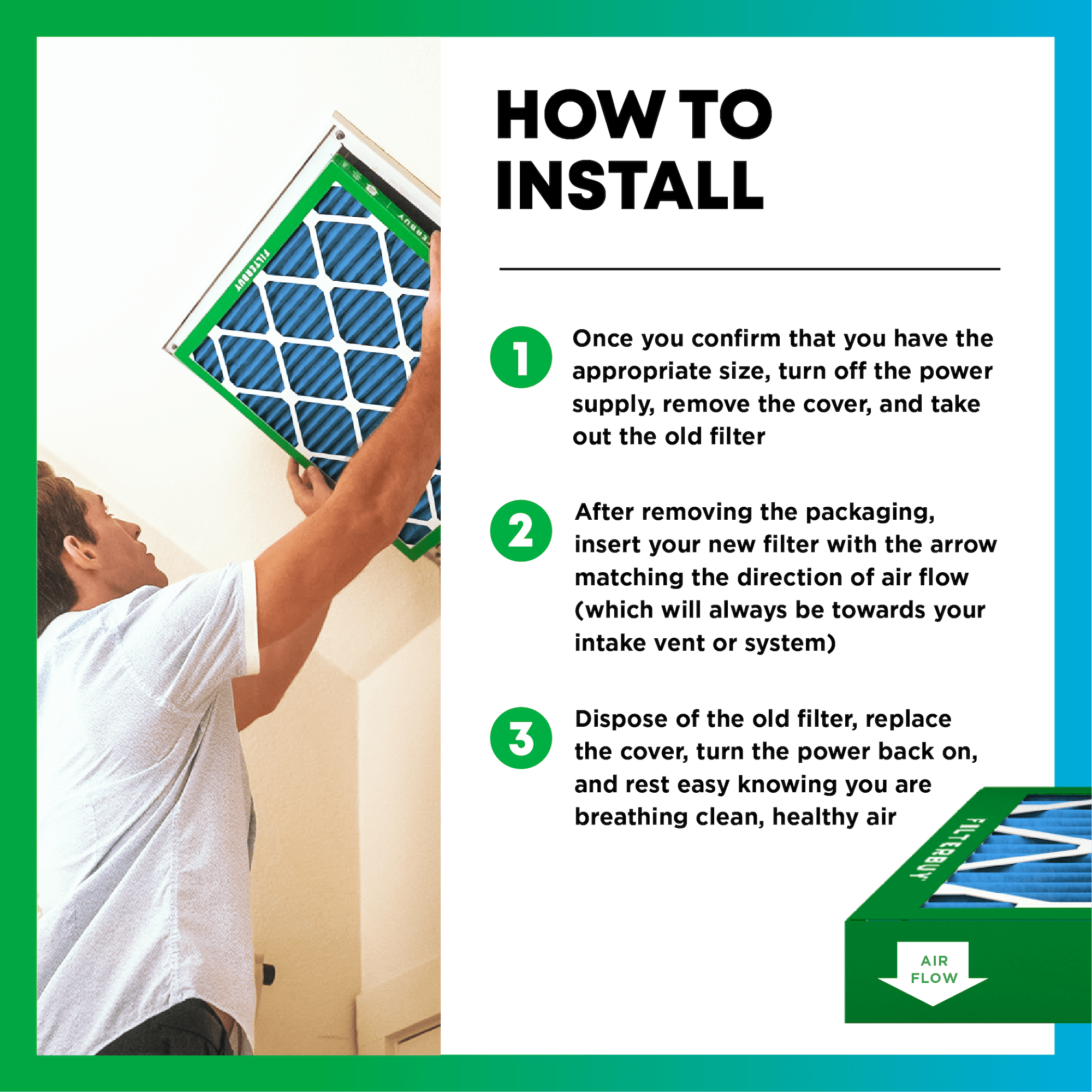
Turn Off Your HVAC SystemSafety first.

Remove The Old FilterLook for the airflow arrow and make note of the direction.

Slide In Your New FilterArrow should point toward the system (same direction as before).

Turn Your System Back OnAnd enjoy the fresh, clean air.

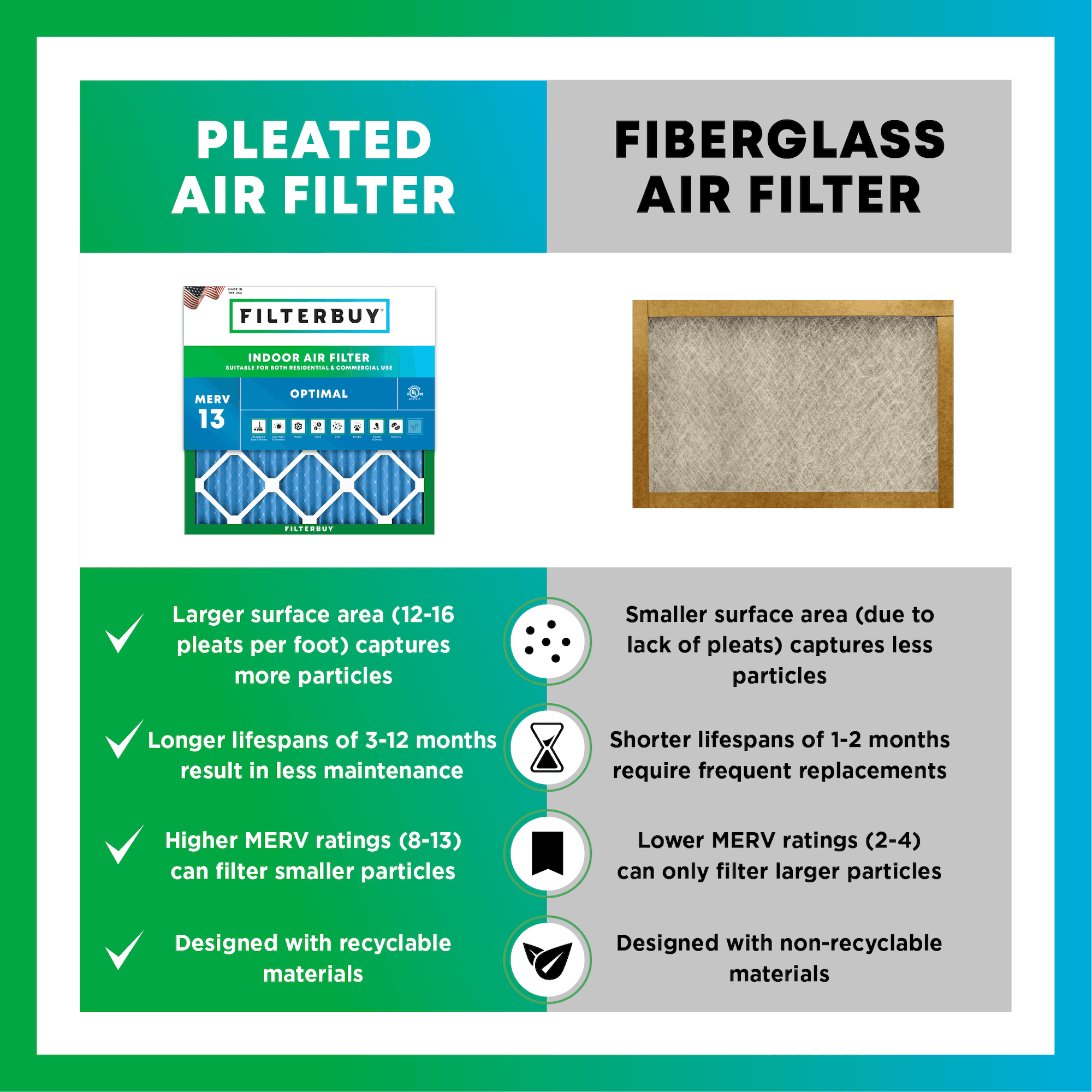
Not all air filters are created equal. Pleated filters don't just last longer—they actually clean your air better. Here's how they stack up:

Efficiency:
High (MERV 8–13) – Traps more particles
Lifespan:
90 days – Long-lasting performance
Air Quality:
Excellent – Cleaner, healthier air
Materials:
Recyclable and durable

Efficiency:
Low (MERV 4 or less) – Misses small stuff
Lifespan:
30 days or less – Replace often
Air Quality:
Minimal – Basic protection only
Materials:
Thin, flimsy, and not recyclable
Pleated filters are a no-brainer—more protection, less hassle, and better air for your home.
Changing your filter on time keeps your HVAC system running efficiently—and helps protect your lungs from dust, allergens, and airborne irritants. Here's how often to swap it out based on your needs:

For most homes without pets or special air quality concerns. Great for general upkeep and energy efficiency.

Shedding fur, dander, and allergy triggers can build up fast. Changing your filter every two months helps keep the air fresher and symptoms at bay.

For households affected by smoke, pollution, or respiratory conditions, monthly changes ensure maximum protection.

| Nominal Size | 16X20X5 |
| Actual Size | 15.75 x 19.75 x 4.38" inches |
| Filter Type | Pleated |
| Media | Electrostatically Charged |
| Frame | Beverage Board |
| MERV Ratings Available | 8, 11, 13 |
| Lifespan | Up to 12 Months |
| Origin | Made in USA |
When wildfire smoke pushes hazardous particles into your home, homeowners often ask us the same question we hear every fire season at Filterbuy: Is a MERV 13 16x20x5 Honeywell filter strong enough to handle it? Based on what we’ve seen in real homes and HVAC systems during peak smoke events, the answer is yes—with the right setup. Here, we break down how MERV 13 filtration performs against wildfire smoke, where its limits are, and the practical steps we recommend to get the most protection when air quality outside takes a turn for the worse.
A MERV 13 16x20x5 Honeywell filter is a high-efficiency HVAC filter designed to capture fine particles like wildfire smoke (PM2.5), pollen, mold spores, and pet dander—without sacrificing airflow in systems built for 5-inch filters. Based on what we see in real homes, it’s the ideal balance of strong filtration and system-friendly performance, especially during wildfire season or for households focused on cleaner, healthier indoor air.
Wildfire smoke needs better filtration. PM2.5 particles easily bypass standard filters.
MERV 13 hits the sweet spot. It captures smoke particles without sacrificing airflow.
5-inch depth performs better. Thicker filters handle heavy smoke loads longer.
Usage matters. Consistent runtime and timely replacements improve results.
Act early. Install the right filter before smoke levels spike.
Wildfire smoke is made up of microscopic PM2.5 particles that easily infiltrate homes and linger in indoor air. Based on what we see each wildfire season at Filterbuy, standard filters simply aren’t built to handle this level of contamination—which is where a MERV 13 16x20x5 Honeywell filter makes a meaningful difference.
MERV 13 filtration is specifically designed to capture fine smoke particles, soot, and airborne irritants before they recirculate through your HVAC system. The 5-inch depth provides added surface area, allowing the filter to trap more pollutants while maintaining proper airflow—something thinner, high-MERV filters often struggle to do during heavy smoke conditions.
That said, a MERV 13 filter works best as part of a broader indoor air strategy. When wildfire smoke is present, keeping windows closed, limiting outdoor air intake, and running your HVAC system consistently helps maximize filtration. In real homes we’ve supported during smoke events, this combination leads to noticeably clearer air, reduced odors, and improved comfort—without overworking the system.
Wildfire smoke particles typically range from 0.4 to 0.7 microns in diameter. A MERV 13 filter captures at least 85% of particles between 1.0 and 3.0 microns and roughly 50% of particles in the 0.3 to 1.0 micron range — the sweet spot for meaningfully reducing smoke infiltration without restricting airflow enough to strain your HVAC system. Standard MERV 8 filters offer almost no protection against fine wildfire particulates.
The 5-inch depth is what separates this filter from standard 1-inch options during extended smoke events. After manufacturing millions of filters, we know that a 1-inch MERV 13 can clog in days under heavy smoke conditions. The deeper media bed provides greater surface area, longer effective lifespan, and lower pressure drop — keeping your system running efficiently even when air quality stays poor for weeks. Customers tell us this is the single biggest reason they upgrade to a 5-inch filter before fire season hits.
This size fits common Honeywell whole-house air cleaner models including the F100, F200, and FC100A series. Exact fit matters. A poorly seated filter allows unfiltered air to bypass the media entirely — defeating the purpose during the conditions when protection matters most.
Under normal conditions, a 16x20x5 filter lasts 6 to 12 months. During active wildfire smoke events, that timeline compresses dramatically. When AQI stays above 150, inspect your filter every 2 to 3 weeks. Visible discoloration, reduced airflow from vents, increased dust on indoor surfaces, and unusual HVAC cycling patterns all signal it's time to swap in a fresh filter. Having a replacement on hand during fire season isn't optional — it's essential.
A few additional steps amplify your protection beyond the filter itself. Set your HVAC fan to "ON" rather than "AUTO" to keep air cycling through the filter continuously. Seal gaps around doors and windows with weatherstripping to reduce unfiltered smoke entry. Avoid adding to your indoor particulate load by skipping candles, wood-burning fireplaces, and heavy stovetop cooking. Monitor real-time air quality readings at AirNow.gov so you can adjust your inspection schedule as conditions change.
A MERV 13 16x20x5 Honeywell-compatible filter won't eliminate every smoke particle from your indoor air — but it captures the vast majority of the fine particulate linked to respiratory distress and cardiovascular strain. During wildfire season, that level of filtration is a necessity.
“Every wildfire season, we see firsthand how quickly smoke particles overwhelm standard HVAC filters. In homes using a properly fitted MERV 13 16x20x5 filter, the difference is immediate—cleaner airflow, less lingering odor, and a system that can keep up without being strained.”
When it comes to protecting your home’s air—especially during wildfire season—good decisions start with clear, trustworthy information. These resources combine federal guidance, academic research, and Filterbuy’s real-world HVAC experience to help you choose and use a MERV 13 16x20x5 air filter with confidence.
Why it matters: This EPA guide breaks down how HVAC air filters actually work and what MERV ratings mean in plain language. It’s a solid foundation for understanding why MERV 13 filters strike the right balance between particle capture and airflow.
Source: https://www.epa.gov/indoor-air-quality-iaq/guide-air-cleaners-home
Why it matters: Wildfire smoke is a different beast, and the EPA explains exactly why higher-efficiency filters are recommended when outdoor air turns hazardous. This resource reinforces when MERV 13 filtration becomes a smart, proactive choice.
Source: https://www.epa.gov/wildfire-smoke-course/wildfire-smoke-and-your-patients-health
Why it matters: Drawing from what we see in real homes during smoke events, this guide explains why MERV 13 is often the sweet spot for wildfire season—and how to get the most out of it when air quality drops fast.
Source: https://filterbuy.com/resources/air-filter-basics/best-merv-filter-for-wildfire-smoke/
What we see in homes during wildfire season is backed up by national data. These key statistics explain why MERV 13 16x20x5 air filters are so effective when smoke levels rise.
The U.S. EPA reports that wildland fires account for ~52% of PM2.5 emissions in the U.S.
This aligns with what we see every fire season: outdoor air quality can degrade fast, overwhelming standard HVAC filters.
Source: https://www.epa.gov/air-research/wildland-fire-research-reducing-exposures
Nearly 90% of wildfire smoke particle mass is PM2.5, according to EPA and AirNow data.
These fine particles easily bypass basic filters but fall squarely within what MERV 13 filters are designed to capture.
The EPA states that MERV 13–16 HVAC filters can reduce indoor particulate concentrations by up to 95% under proper conditions.
In our experience, deeper 5-inch filters maintain airflow better while handling heavy smoke loads.
Source: https://www.epa.gov/sites/default/files/2018-11/documents/indoor_air_filtration_factsheet-508.pdf
After supporting homeowners through multiple wildfire seasons, one lesson stands out: wildfire smoke overwhelms standard filters fast. When that happens, filtration has to be both effective and practical.
From what we see in real homes, a MERV 13 16x20x5 Honeywell filter consistently delivers where it matters most:
Captures smoke-sized PM2.5 particles
Maintains airflow without overworking the HVAC system
Reduces lingering smoke odors more reliably than thinner filters
Our perspective: smarter filtration beats extreme filtration. Instead of pushing systems to their limits, a properly sized MERV 13 filter provides dependable protection when outdoor air quality is out of your control—giving families a simple, proven way to breathe easier during wildfire season.
When wildfire smoke threatens your indoor air, these quick actions can make an immediate difference:
Verify fit and compatibility Confirm your HVAC system supports a MERV 13 16x20x5 filter without airflow issues.
Install a fresh filter early Replace your filter before smoke peaks so it’s ready to work immediately.
Run your system consistently Use the “fan on” setting or run your HVAC regularly to keep air moving through the filter.
Check and replace more often Smoke particles clog filters faster. Inspect every few weeks during wildfire season.
Limit smoke entry points Keep windows and doors closed. Reduce outdoor air intake when air quality is poor.
A:
Wildfire smoke (PM2.5)
Pollen and fine dust
Mold spores and pet dander These are the particles most likely to circulate and linger indoors.
A:
Rarely, if your system is designed for 5-inch filters
Deeper filters offer more surface area
Airflow is typically better than with thin high-MERV filters
A:
Check every 30 days
Replace sooner if smoke is heavy
Smoke loads filters faster than normal dust
A:
Yes, by capturing smoke particles
No, it does not remove gases or VOCs
Carbon filters may help with persistent odors
A:
Strong smoke particle capture
Maintains HVAC airflow
Works for most residential systems
Protect your indoor air before the next smoke event hits — browse our MERV 13 16x20x5 Honeywell-compatible replacement filters and have them delivered straight to your door. Order today so you're ready when air quality drops.

