
Tip: Ensure you buy the exact air filter size for your system. Certain brands have precise dimensions that only fit their specific models. See related filters
Actual Size: 15.75x19.75x4.38"
 Free Delivery
  Factory-Direct Low Prices, Made in the USA
 Hassle-Free Returns & Free Exchanges
RESIDENTIAL AND/OR COMMERCIAL USE
Change Every 3 Months
Tip: Ensure you buy the exact air filter size for your system. Certain brands have precise dimensions that only fit their specific models. See related filters
Actual Size: 15.75x19.75x4.38"
Free Delivery Factory-Direct Low Prices, Made in the USAHassle-Free Returns & Free ExchangesRESIDENTIAL AND/OR COMMERCIAL USE
Change Every 3 Months
Tip: Ensure you buy the exact air filter size for your system. Certain brands have precise dimensions that only fit their specific models. See related filters
Actual Size: 15.75x19.75x4.38"
Free Delivery Factory-Direct Low Prices, Made in the USAHassle-Free Returns & Free ExchangesRESIDENTIAL AND/OR COMMERCIAL USE
Change Every 3 Months
At Filterbuy, we don't cut corners—we craft high-quality air filters right here in the USA and ship them to your doorstep for free. No delays, no gimmicks—just clean air, made easy. With thousands of five-star reviews and filters built for real life & every HVAC system, it's no wonder why over 4 million families trust Filterbuy.

Proudly Made In The USA

Fast, Free Shipping on Every Order

Premium Materials That Go The Distance

85,000+ 5-Star Reviews From Happy Customers

Save Up to 70% Per Filter with Packs


Measure length × width × depth with a tape measure to find the actual size.

Round up each dimension to the nearest whole number to get the nominal size. Example: 15.75x19.75x4.38" in → 16X20X5 nominal.

Search by nominal size on our site for the best fit.


5″ filters give you maximum filtration with minimal maintenance — lasting up to 12 months while handling higher MERV ratings without restricting airflow.
Sizing note:

If the filter you buy doesn't fit, we'll send you a better size.
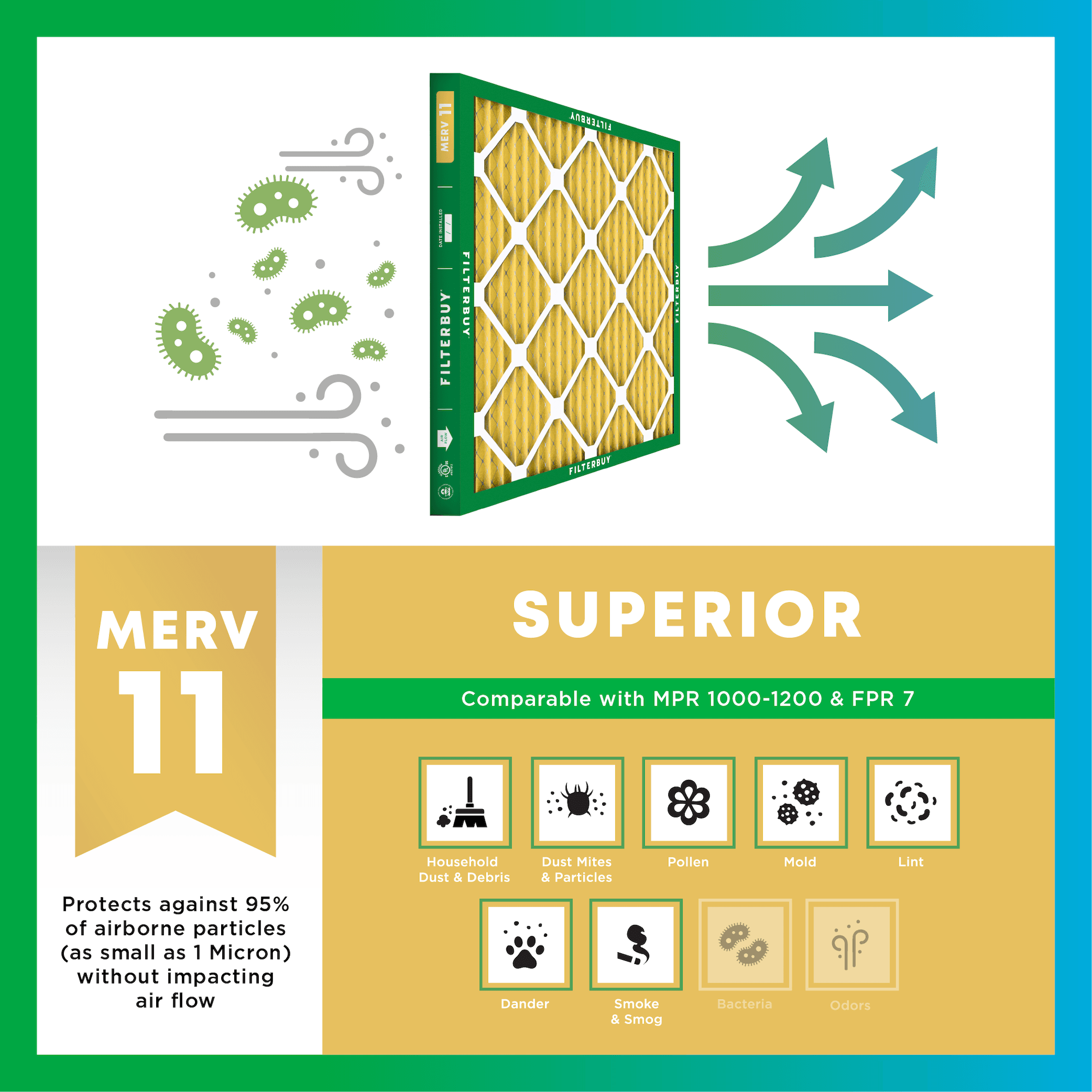
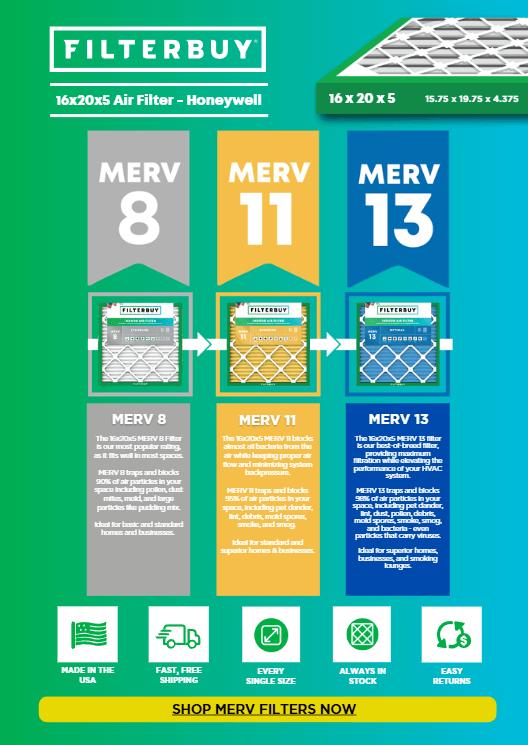
MERV stands for Minimum Efficiency Reporting Value—but don't let the technical name fool you. It's just a way to rate how well an air filter traps stuff like dust, pollen, pet dander, and smoke. The higher the MERV number, the more particles it catches—and the cleaner your air will be.

Comparable to:FPR: 4-7
MPR: 600-1000
 Dust & Debris
 Dust Mites & Particles
 Pollen
 Mold
Mold Lint
Lint Dander
Comparable to:FPR: 6-9
MPR: 1200-1550
Dust & DebrisDust Mites & ParticlesPollenMoldLintDander Smoke & Smog
Comparable to:FPR: 10
MPR: 1900-2800
Dust & DebrisDust Mites & ParticlesPollenMoldLintDanderSmoke & Smog Bacteria


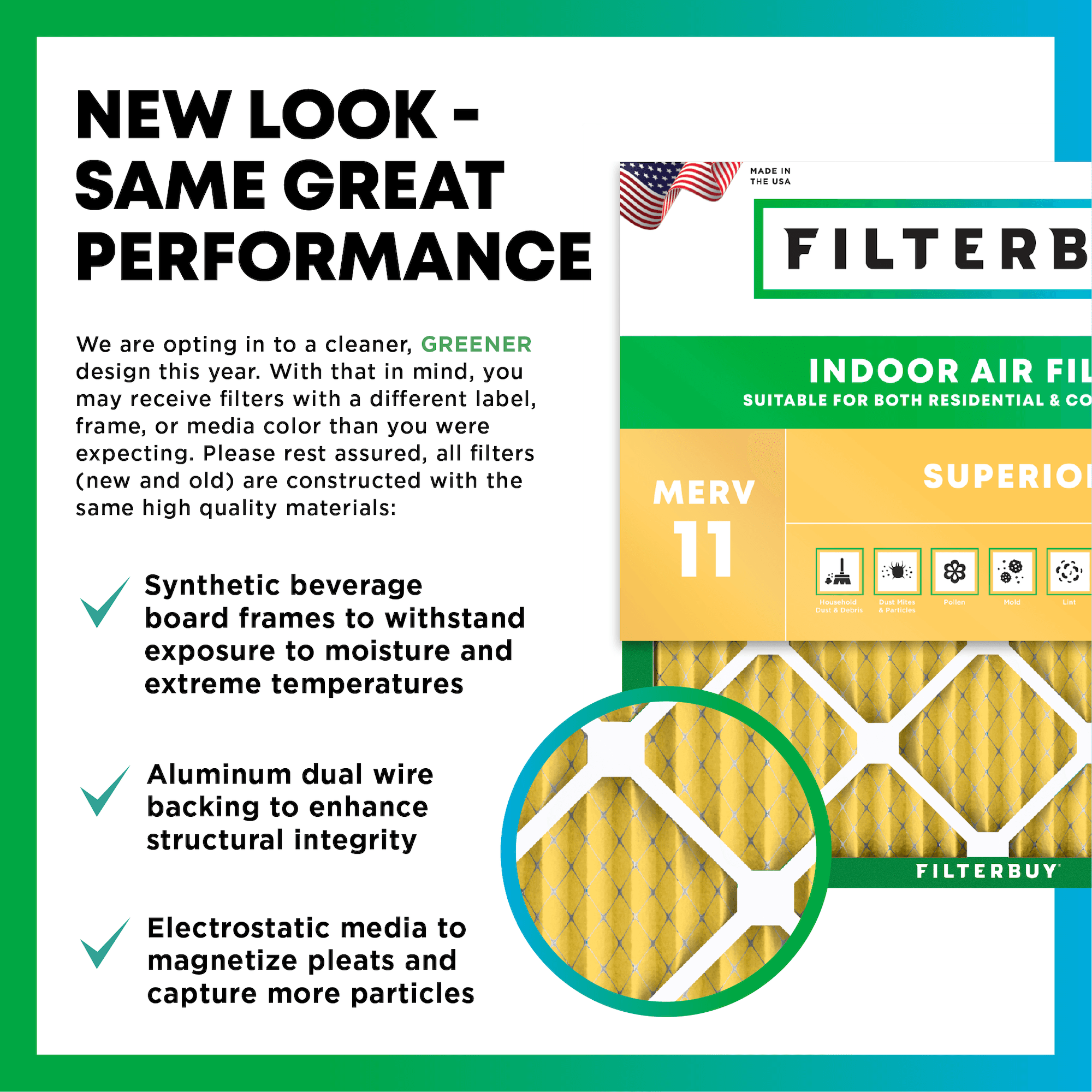
We build every Filterbuy filter to deliver reliable 90-day performance—thanks to smart design and premium materials that do the heavy lifting. Here's what makes the difference:
More pleats = more surface area to capture dust and debris, keeping your air cleaner longer.
Pleats are magnetized to attract and trap microscopic particles—like pet dander, pollen, and smoke.
Engineered to resist warping in extreme temperatures and high humidity.

A layer of metal reinforcement keeps pleats evenly spaced and structurally sound—no sagging, even at high airflow.
Assembled with care. Built to perform. Ships fast, free, and reliably from our U.S. facilities.

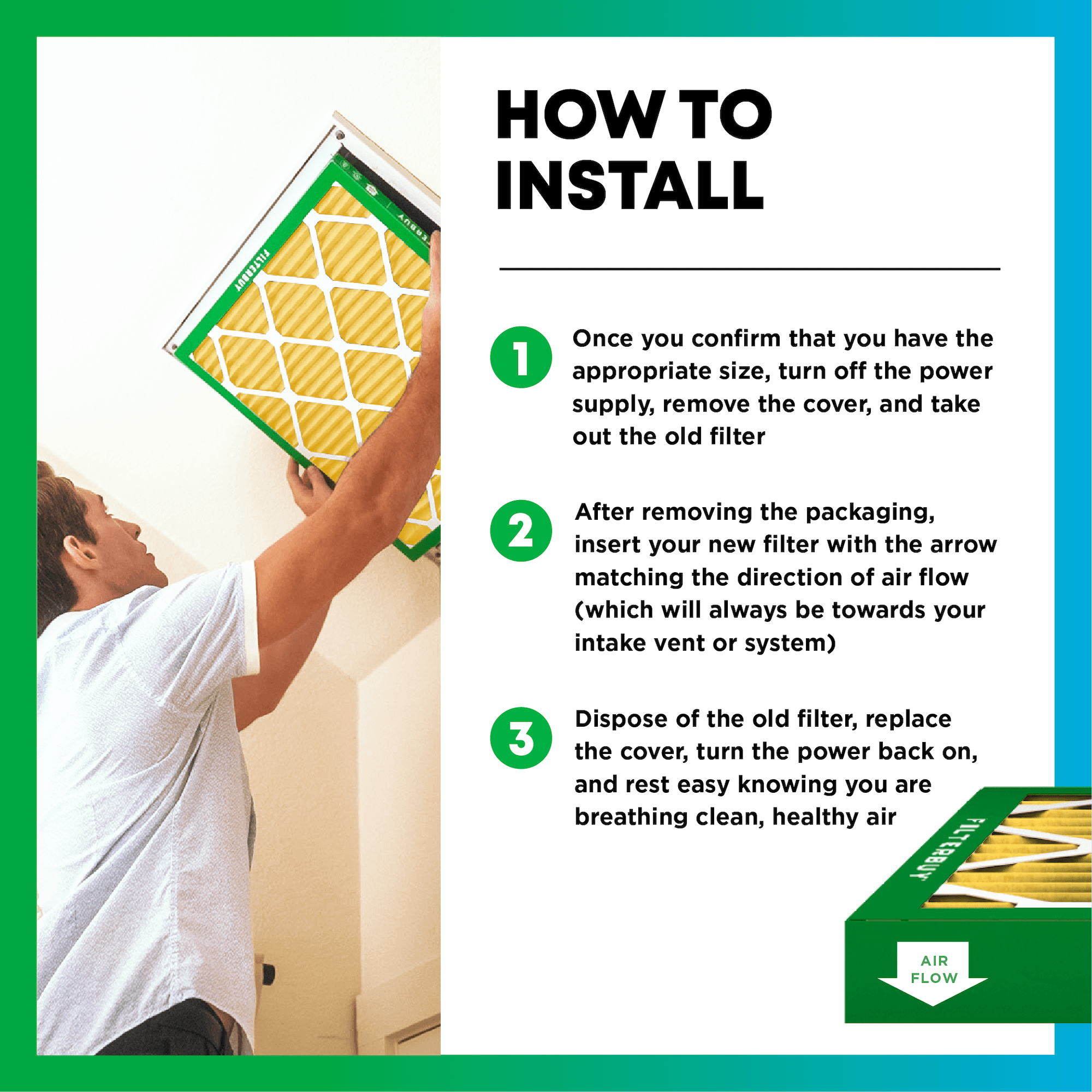
Turn Off Your HVAC SystemSafety first.

Remove The Old FilterLook for the airflow arrow and make note of the direction.

Slide In Your New FilterArrow should point toward the system (same direction as before).

Turn Your System Back OnAnd enjoy the fresh, clean air.

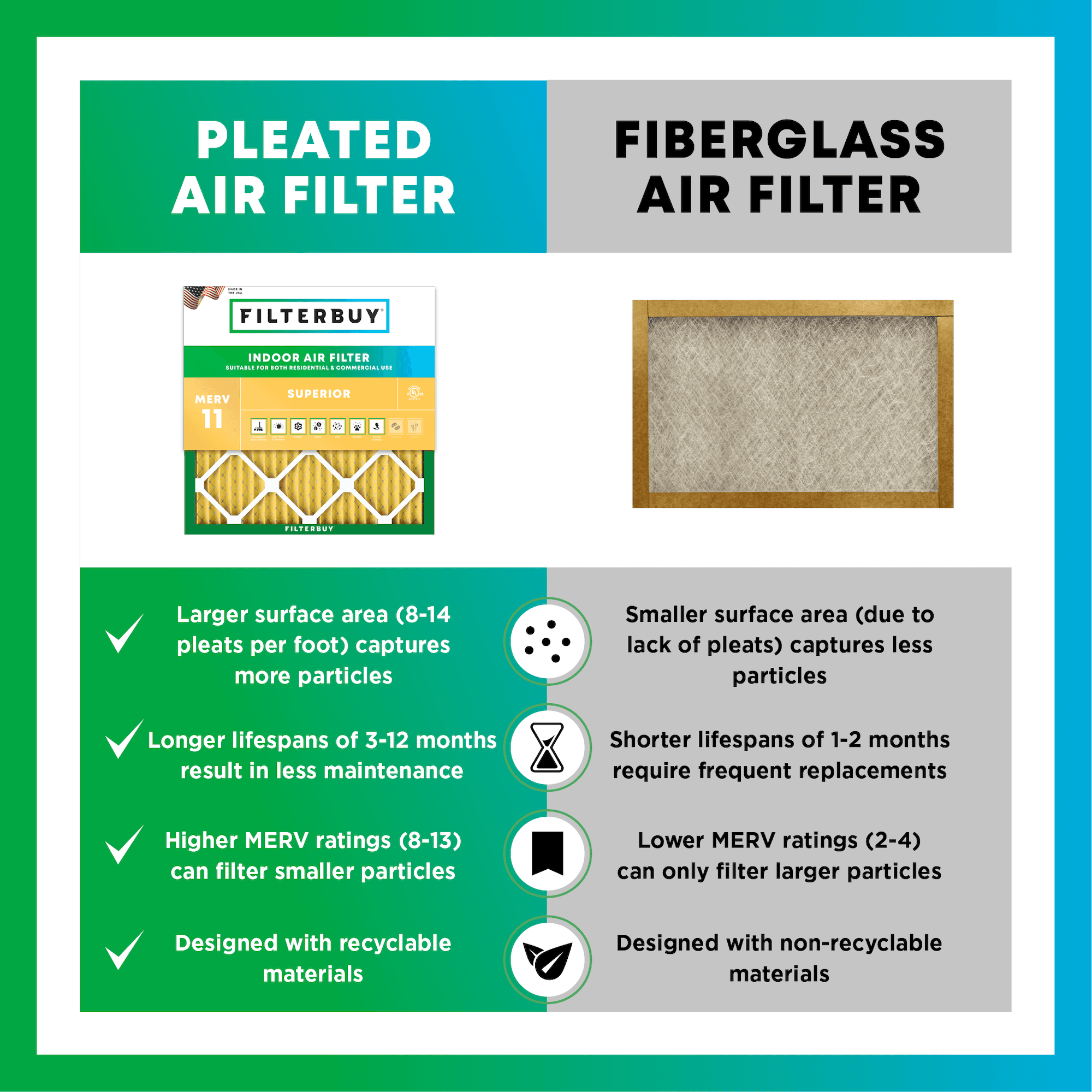
Not all air filters are created equal. Pleated filters don't just last longer—they actually clean your air better. Here's how they stack up:

Efficiency:
High (MERV 8–13) – Traps more particles
Lifespan:
90 days – Long-lasting performance
Air Quality:
Excellent – Cleaner, healthier air
Materials:
Recyclable and durable

Efficiency:
Low (MERV 4 or less) – Misses small stuff
Lifespan:
30 days or less – Replace often
Air Quality:
Minimal – Basic protection only
Materials:
Thin, flimsy, and not recyclable
Pleated filters are a no-brainer—more protection, less hassle, and better air for your home.
Changing your filter on time keeps your HVAC system running efficiently—and helps protect your lungs from dust, allergens, and airborne irritants. Here's how often to swap it out based on your needs:

For most homes without pets or special air quality concerns. Great for general upkeep and energy efficiency.

Shedding fur, dander, and allergy triggers can build up fast. Changing your filter every two months helps keep the air fresher and symptoms at bay.

For households affected by smoke, pollution, or respiratory conditions, monthly changes ensure maximum protection.

| Nominal Size | 16X20X5 |
| Actual Size | 15.75 x 19.75 x 4.38" inches |
| Filter Type | Pleated |
| Media | Electrostatically Charged |
| Frame | Beverage Board |
| MERV Ratings Available | 8, 11, 13 |
| Lifespan | Up to 12 Months |
| Origin | Made in USA |
If you’re asking what a MERV 11 16x20x5 Honeywell filter actually captures, here’s the real-world answer we’ve learned from manufacturing and testing thousands of filters at Filterbuy: it’s built to stop far more than visible dust. Its deep 5-inch media is designed to capture allergy-driving pollen, pet dander, and fine airborne debris that continuously cycle through your HVAC system—often long before you ever notice them. In this guide, we’ll break down what this filter reliably captures, where its limits are, and how that performance translates to healthier air in a real home, not just on a spec sheet.
A MERV 11 16x20x5 Honeywell filter captures the particles homeowners deal with most—pollen, pet dander, mold spores, and fine dust—while maintaining healthy airflow. From real-world use and filter evaluations, the 5-inch depth provides more surface area, which means strong filtration without overworking your HVAC system. It’s a practical “sweet spot” for cleaner air in everyday homes, especially those with pets or allergies.
MERV 11 targets the right particles. Captures pollen, pet dander, mold spores, and fine dust.
5-inch depth improves performance. More surface area. Better airflow balance.
MERV 11 hits the sweet spot. Cleaner air without HVAC strain.
Indoor air needs attention. It’s often more polluted than outdoor air.
Consistency delivers results. Proper sizing and timely replacement matter.
A MERV 11 16x20x5 Honeywell filter is designed to capture the airborne particles that most commonly impact comfort, cleanliness, and respiratory health inside a home. From hands-on experience manufacturing and testing deep-pleated filters at Filterbuy, the added 5-inch depth plays a critical role—it increases surface area, allowing the filter to trap more particles while maintaining steady airflow.
At the MERV 11 level, this filter captures 85% or more of particles between 1–3 microns, including:
Pollen and outdoor allergens that enter through doors, windows, and ductwork
Pet dander and fine hair fragments that continuously recirculate
Household dust and dust mite debris stirred up by daily movement
Mold spores commonly present in humid environments
Fine debris from fabrics, carpets, and building materials
What it doesn’t capture is just as important. MERV 11 filters are not designed for ultrafine particles like viruses, smoke, or combustion gases—those require higher filtration levels or supplemental air cleaning. In real homes, this makes MERV 11 a practical middle ground: strong enough to noticeably improve air quality, yet breathable enough to protect HVAC performance.
For households managing allergies, pets, or persistent dust, a MERV 11 16x20x5 filter delivers consistent, everyday protection—quietly cleaning the air you breathe every time your system runs.
Most homeowners install a filter and never think twice about what it's actually pulling out of the air. A MERV 11 rated 16x20x5 filter does significantly more work than a standard fiberglass filter — and the difference is measurable.
MERV 11 captures particles between 1.0 and 3.0 microns at 65%–79% efficiency. That range covers some of the most common indoor air quality offenders circulating through your HVAC system every day.
Here's what a MERV 11 16x20x5 Honeywell-compatible filter actively traps:
Dust and dust mite debris — the single most reported allergen trigger among customers who switch to MERV 11
Pollen particles — including ragweed, grass, and tree pollen that infiltrate homes through doors, windows, and clothing
Mold spores — captured before they circulate and settle on damp surfaces throughout your home
Pet dander — microscopic skin flakes that stay airborne for hours in homes with dogs or cats
Lint and textile fibers — shed constantly from clothing, bedding, and upholstery
Smog and auto emission particles — especially relevant for homes near busy roads or highways
After manufacturing millions of filters, we can confirm that the 5-inch depth of this filter is a major performance advantage. The thicker media bed gives air more contact time with the filtration material, which increases capture rates without strangling airflow the way a thinner, high-MERV filter might.
What MERV 11 does not capture: Ultrafine particles below 0.3 microns — including some bacteria, tobacco smoke compounds, and virus-carrying droplets — require MERV 13 or higher ratings. MERV 11 sits in a practical sweet spot for most residential systems. It delivers noticeably cleaner air than a MERV 8 without the static pressure concerns that come with hospital-grade filtration.
Customers tell us they notice the difference within the first week — less dust settling on furniture, fewer allergy flare-ups in the morning, and a cleaner-smelling home overall. That feedback tracks with what EPA data shows: indoor air can carry 2 to 5 times the concentration of certain pollutants compared to outdoor air, making effective filtration more than a comfort upgrade.
The 16x20x5 size fits Honeywell whole-house systems including the F100, F200, and FC100A models. A proper fit means no air bypass around the edges — every cubic foot of air your system moves passes through the filter media where those particles get trapped.
Filter thickness isn't just about replacement frequency — it directly impacts capture performance. A standard 1-inch MERV 11 filter uses tightly packed media to hit that rating, which restricts airflow and forces your blower motor to work harder. The 5-inch depth spreads that same filtration work across a much larger surface area of media.
The result is a filter that captures the same particle sizes with less resistance. Your system maintains proper airflow velocity, which actually improves filtration efficiency because particles have more opportunity to contact and embed in the media fibers. Customers with older HVAC systems tell us this is the difference between a filter that works on paper and one that works in practice — their systems run quieter, cycle less frequently, and the filter comes out visibly loaded with captured debris at the 6 to 12 month replacement mark rather than looking barely used after 90 days.
From a manufacturing standpoint, the extended-depth pleat design in a 16x20x5 provides roughly 5 to 6 times the usable media surface compared to a 1-inch filter of the same face dimensions. More surface area means more total particle capture over the filter's lifespan before static pressure builds to the point of diminished performance.
One of the most common questions customers ask is how they'll know the filter is actually doing its job. There are a few reliable indicators that go beyond just pulling the filter out and looking at it.
Signs your MERV 11 is performing as expected:
Noticeably less dust accumulation on horizontal surfaces like shelves, TV screens, and ceiling fan blades within 7–10 days of installation
Reduced allergy symptoms during peak pollen seasons — particularly morning congestion and eye irritation
Consistent airflow from your vents with no whistling, rattling, or reduced output
A visibly gray or loaded filter at the recommended replacement interval, which confirms it's trapping particles rather than letting them pass through
Signs something isn't right:
Dust buildup returns to pre-filter levels quickly, which often indicates an improper fit allowing air bypass around the filter edges
Your system short-cycles or runs constantly, suggesting the filter may be loaded prematurely due to unusually high particulate conditions like nearby construction or wildfire smoke
The filter looks nearly clean after several months, which can mean it was installed backwards — airflow direction arrows on the frame should always point toward the blower
We recommend checking your 16x20x5 filter every 3 months and replacing it when visible light no longer passes through the media when held up to a light source. Most households get 9–12 months from a 5-inch filter, but homes with multiple pets, smokers, or high-dust environments may need replacement closer to 6 months.
“From what we see in real-world filter testing and manufacturing, a MERV 11 16x20x5 filter captures the particles homeowners actually struggle with every day—pollen, pet dander, and fine dust—without restricting airflow. That balance is why it consistently delivers noticeable air quality improvements in lived-in homes, not just in lab ratings.”
When you’re serious about protecting your home’s air, facts matter. These trusted, authoritative resources help make invisible air quality issues visible, so you can choose a MERV 11 16x20x5 Honeywell filter with confidence—without guesswork or over-filtering.
Understand How Filtration Improves Everyday Air Quality The EPA explains how HVAC filters reduce common indoor pollutants like dust, pollen, and mold—reinforcing why MERV 11 is often the practical sweet spot for homes.URL: https://www.epa.gov/indoor-air-quality-iaq/guide-air-cleaners-home
Balance Clean Air With System Efficiency This resource breaks down how filter efficiency and thickness affect airflow, energy use, and HVAC longevity—helping homeowners avoid choices that strain their system.URL: https://www.energy.gov/energysaver/maintaining-your-air-conditioner
Validate Claims With Independent Testing Consumer Reports provides an unbiased, consumer-first look at air filters, helping homeowners compare filtration levels based on real-world performance—not hype.URL: https://www.consumerreports.org/appliances/air-filters/buying-guide/
At Filterbuy, we compare lab data with what we see inside used filters every day. The following three data points align most closely with real-world performance in lived-in homes.
According to ASHRAE, MERV 11 filters capture 85% or more of particles between 1–3 microns.URL: https://www.epa.gov/indoor-air-quality-iaq/what-merv-rating
These particles include:
Pollen
Mold spores
Pet dander
Fine household dust
What we see: These particles consistently embed deep within 5-inch filters because they stay airborne and recirculate through HVAC systems.
The EPA reports that indoor air can be 2–5× more polluted than outdoor air.URL: https://www.epa.gov/indoor-air-quality-iaq/introduction-indoor-air-quality
Common sources include:
Pets and daily foot traffic
Cooking and cleaning
Fabrics and carpeting
What we see: Even well-kept homes generate a constant particle load that HVAC filters must manage.
The CDC links airborne particulate matter to worsened asthma and allergy symptoms, while the U.S. Department of Energy notes that proper filtration can reduce HVAC energy use by up to 15%.URL: https://www.energy.gov/energysaver/maintaining-your-air-conditioner
From our hands-on experience at Filterbuy, a MERV 11 16x20x5 Honeywell filter consistently proves to be one of the most practical filtration choices for real homes.
Why it works so well:
Captures common indoor troublemakers like pollen, pet dander, mold spores, and fine dust
Cleans the air without restricting HVAC airflow
Supports comfort, efficiency, and long-term system health
Our perspective: Better air isn’t about choosing the highest MERV rating available. It’s about choosing the right balance for how a home is actually lived in.
In most households, MERV 11:
Improves everyday air quality
Helps reduce allergy and dust issues
Avoids unnecessary strain on the HVAC system
Bottom line: A properly sized, well-made MERV 11 16x20x5 filter delivers consistent, behind-the-scenes protection. It may not be the most extreme option—but in real homes, it’s often the smartest one.
Use these simple steps to turn insight into action.
Confirm Your Filter Size
Verify you need a 16x20x5 filter
Check the current air filter or HVAC manual
Confirm MERV 11 Is the Right Fit Ideal for homes with:
Allergies
Pets
Ongoing dust or pollen
Standard residential HVAC systems
Choose a Quality 5-Inch Filter
Deep pleats for better surface area
Designed to balance airflow and filtration
Replace on Schedule
Check every 6 months
Replace sooner in homes with pets or heavy HVAC use
Watch for Results Look for:
Less visible dust
Fewer allergy symptoms
Steady airflow
A: From real-world filter inspections, it captures:
Pollen
Pet dander
Mold spores
Fine airborne dust
These particles stay airborne and recirculate—making MERV 11 especially effective.
A: In systems built for 5-inch filters:
Airflow remains stable
Surface area reduces resistance
Performance improves over thinner filters
A: Typical replacement guidance:
Check every 6 months
Replace sooner if you have pets, allergies, or heavy system use
A: Yes, for most households:
MERV 11 captures smaller allergens
Less dust buildup over time
Better allergy support
A: Not always:
Higher MERV = more resistance
Only upgrade if your system supports it
MERV 11 is the everyday “sweet spot” for many homes
Now that you know exactly what a MERV 11 16x20x5 filter pulls from your air — from pollen and pet dander to mold spores and dust mite debris — the next step is making sure your Honeywell system has a fresh one working for you. Browse our manufactured-in-the-USA 16x20x5 MERV 11 replacement filters and get cleaner air delivered straight to your door.

