
Tip: Ensure you buy the exact air filter size for your system. Certain brands have precise dimensions that only fit their specific models. See related filters
Actual Size: 16x25.88x4.88"
 Free Delivery
  Factory-Direct Low Prices, Made in the USA
 Hassle-Free Returns & Free Exchanges
RESIDENTIAL AND/OR COMMERCIAL USE
Change Every 3 Months
Tip: Ensure you buy the exact air filter size for your system. Certain brands have precise dimensions that only fit their specific models. See related filters
Actual Size: 16x25.88x4.88"
Free Delivery Factory-Direct Low Prices, Made in the USAHassle-Free Returns & Free ExchangesRESIDENTIAL AND/OR COMMERCIAL USE
Change Every 3 Months
Tip: Ensure you buy the exact air filter size for your system. Certain brands have precise dimensions that only fit their specific models. See related filters
Actual Size: 16x25.88x4.88"
Free Delivery Factory-Direct Low Prices, Made in the USAHassle-Free Returns & Free ExchangesRESIDENTIAL AND/OR COMMERCIAL USE
Change Every 3 Months
At Filterbuy, we don't cut corners—we craft high-quality air filters right here in the USA and ship them to your doorstep for free. No delays, no gimmicks—just clean air, made easy. With thousands of five-star reviews and filters built for real life & every HVAC system, it's no wonder why over 4 million families trust Filterbuy.

Proudly Made In The USA

Fast, Free Shipping on Every Order

Premium Materials That Go The Distance

85,000+ 5-Star Reviews From Happy Customers

Save Up to 70% Per Filter with Packs


Measure length × width × depth with a tape measure to find the actual size.

Round up each dimension to the nearest whole number to get the nominal size. Example: 16x25.88x4.88" in → 16x26x5 nominal.

Search by nominal size on our site for the best fit.


5″ filters give you maximum filtration with minimal maintenance — lasting up to 12 months while handling higher MERV ratings without restricting airflow.
Sizing note:

If the filter you buy doesn't fit, we'll send you a better size.
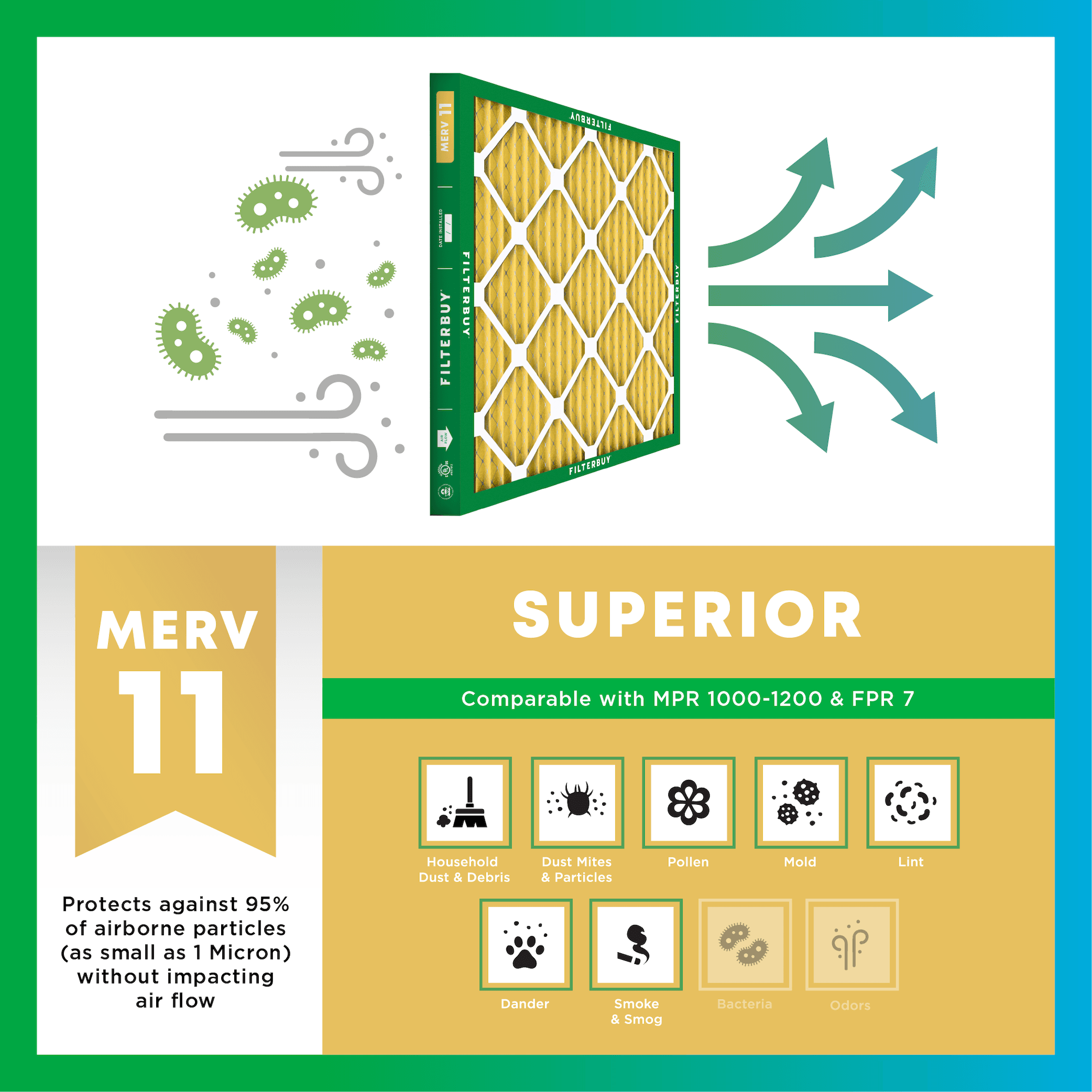
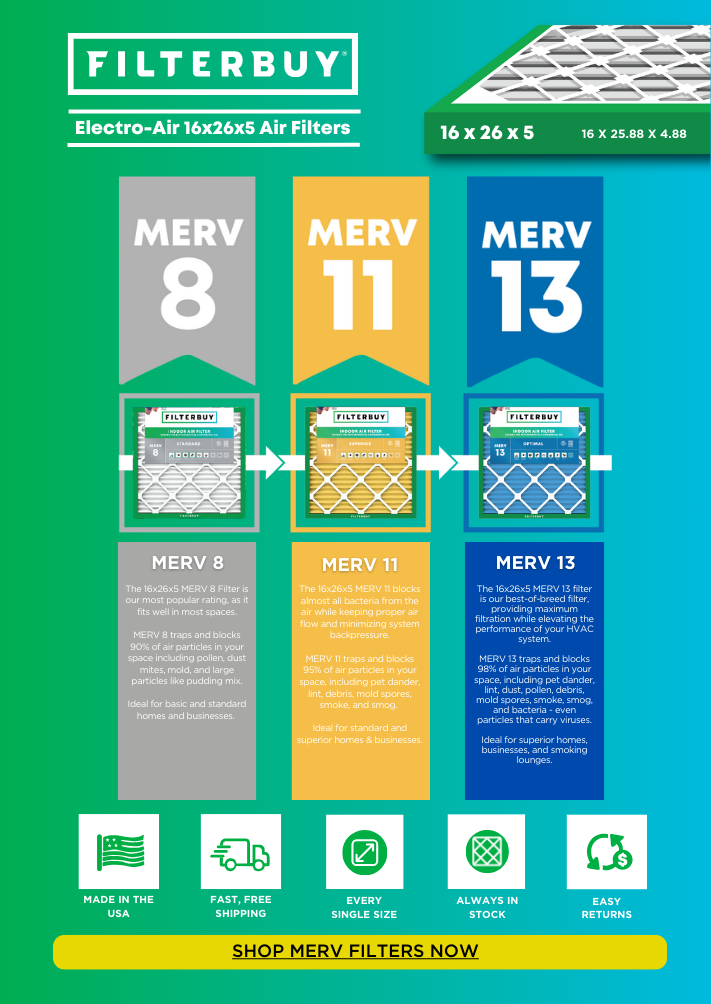
MERV stands for Minimum Efficiency Reporting Value—but don't let the technical name fool you. It's just a way to rate how well an air filter traps stuff like dust, pollen, pet dander, and smoke. The higher the MERV number, the more particles it catches—and the cleaner your air will be.

Comparable to:FPR: 4-7
MPR: 600-1000
 Dust & Debris
 Dust Mites & Particles
 Pollen
 Mold
Mold Lint
Lint Dander
Comparable to:FPR: 6-9
MPR: 1200-1550
Dust & DebrisDust Mites & ParticlesPollenMoldLintDander Smoke & Smog
Comparable to:FPR: 10
MPR: 1900-2800
Dust & DebrisDust Mites & ParticlesPollenMoldLintDanderSmoke & Smog Bacteria


We build every Filterbuy filter to deliver reliable 90-day performance—thanks to smart design and premium materials that do the heavy lifting. Here's what makes the difference:
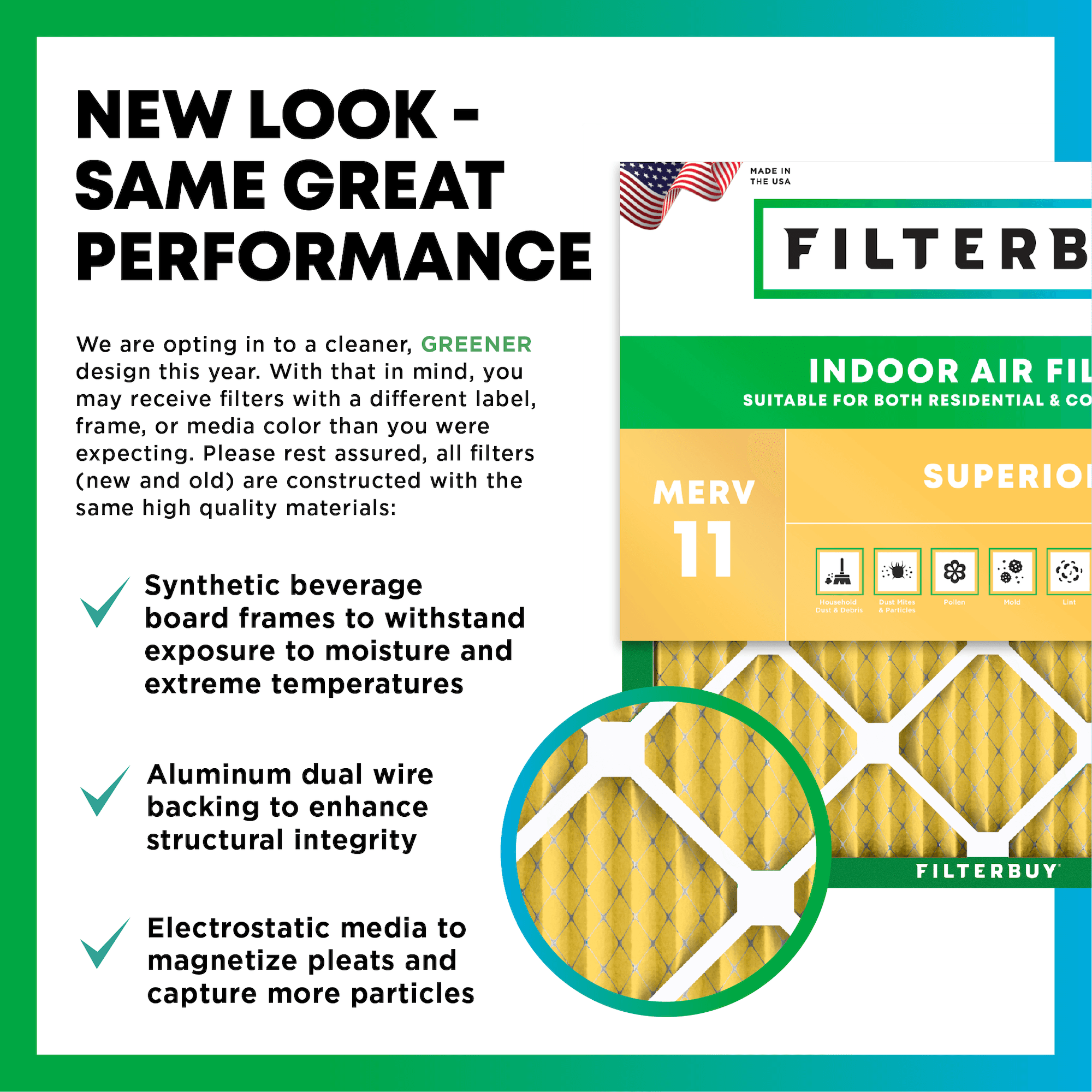
More pleats = more surface area to capture dust and debris, keeping your air cleaner longer.
Pleats are magnetized to attract and trap microscopic particles—like pet dander, pollen, and smoke.
Engineered to resist warping in extreme temperatures and high humidity.

A layer of metal reinforcement keeps pleats evenly spaced and structurally sound—no sagging, even at high airflow.
Assembled with care. Built to perform. Ships fast, free, and reliably from our U.S. facilities.

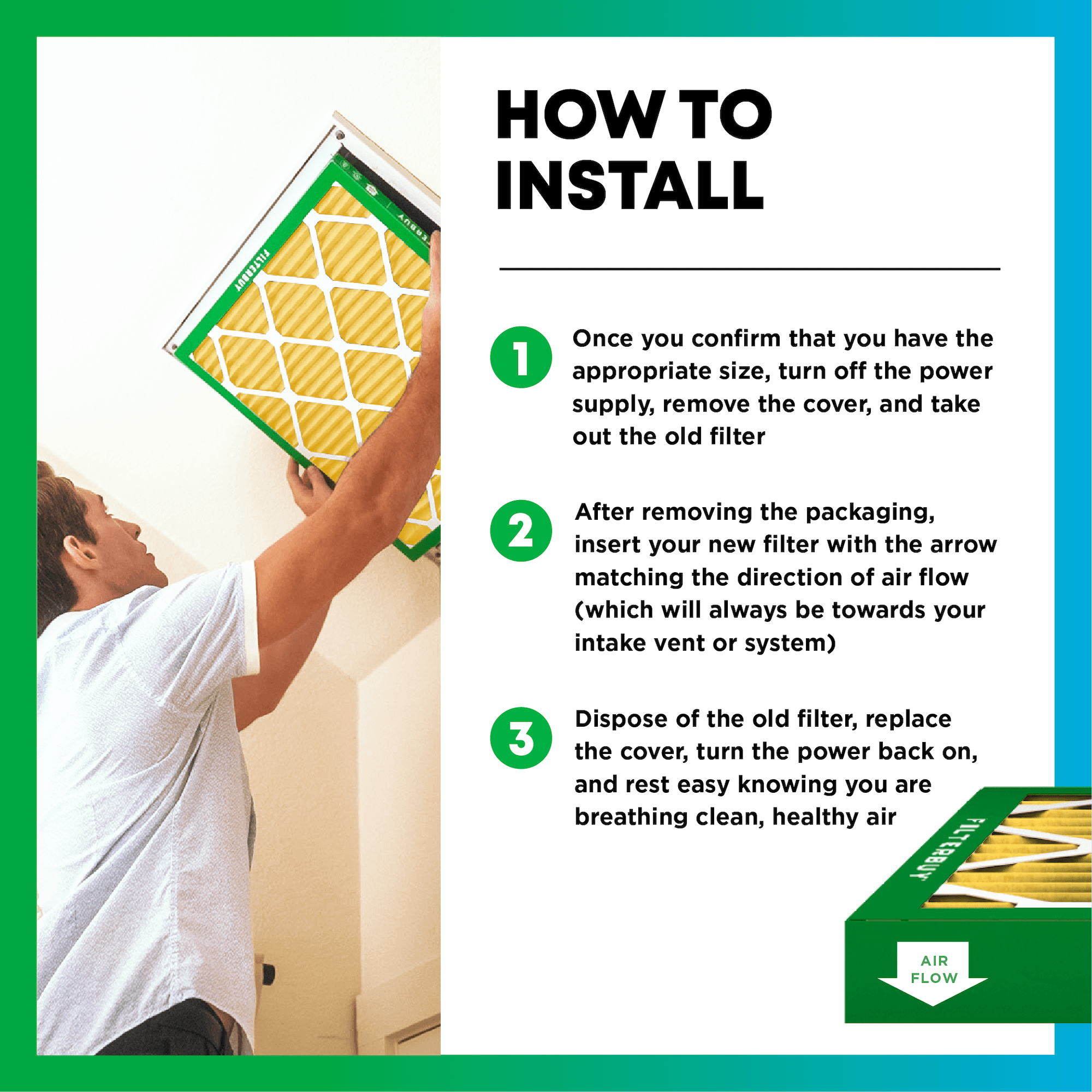
Turn Off Your HVAC SystemSafety first.

Remove The Old FilterLook for the airflow arrow and make note of the direction.

Slide In Your New FilterArrow should point toward the system (same direction as before).

Turn Your System Back OnAnd enjoy the fresh, clean air.

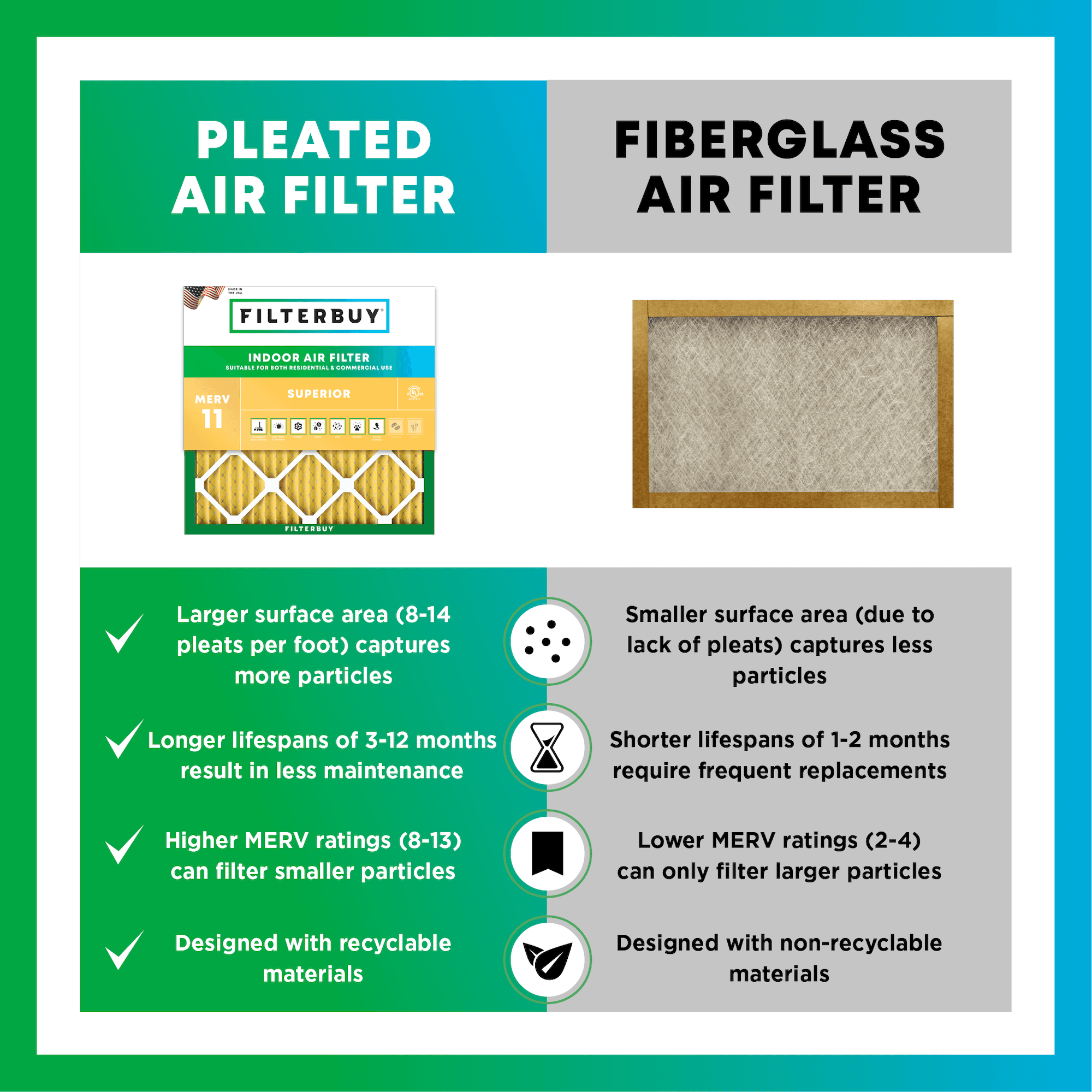
Not all air filters are created equal. Pleated filters don't just last longer—they actually clean your air better. Here's how they stack up:

Efficiency:
High (MERV 8–13) – Traps more particles
Lifespan:
90 days – Long-lasting performance
Air Quality:
Excellent – Cleaner, healthier air
Materials:
Recyclable and durable

Efficiency:
Low (MERV 4 or less) – Misses small stuff
Lifespan:
30 days or less – Replace often
Air Quality:
Minimal – Basic protection only
Materials:
Thin, flimsy, and not recyclable
Pleated filters are a no-brainer—more protection, less hassle, and better air for your home.
Changing your filter on time keeps your HVAC system running efficiently—and helps protect your lungs from dust, allergens, and airborne irritants. Here's how often to swap it out based on your needs:

For most homes without pets or special air quality concerns. Great for general upkeep and energy efficiency.

Shedding fur, dander, and allergy triggers can build up fast. Changing your filter every two months helps keep the air fresher and symptoms at bay.

For households affected by smoke, pollution, or respiratory conditions, monthly changes ensure maximum protection.

| Nominal Size | 16 x 26 x 5 inches |
| Actual Size | 16 x 25.88 x 4.88" inches |
| Filter Type | Pleated |
| Media | Electrostatically Charged |
| Frame | Beverage Board |
| MERV Ratings Available | 8, 11, 13 |
| Lifespan | Up to 12 Months |
| Origin | Made in USA |
Six months ago felt recent until you opened the Electro-Air cabinet and pulled out a filter that had turned gray all the way through. That is not surface dust. Fine particles, pet dander, and mold spores packed into the media over months, cutting airflow while the blower worked harder to push air through the restriction.
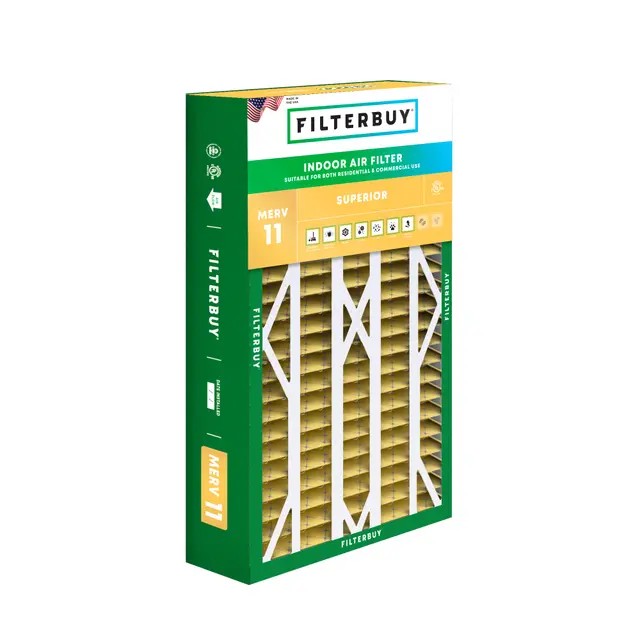
The Filterbuy MERV 11 16x26x5 is the direct replacement for that Electro-Air cabinet. At MERV 11, Filterbuy’s Superior filtration tier, it captures fine dust, mold spores, pet dander, and lead dust down to one micron. Those are the particles a MERV 8 passes. For allergy households and anyone running a whole-house system, the gap between a fresh MERV 11 and an overdue one is not subtle.
The Filterbuy MERV 11 16x26x5 is a direct replacement filter for Electro-Air whole-house media cleaner cabinets. Here is what you need to know:
• What it is: A 5-inch deep pleated media filter rated MERV 11 — Filterbuy's Superior filtration tier.
• What it captures: Fine dust, pet dander, mold spores, pollen, smoke particles, and lead dust down to 1 micron in size.
• What it replaces: Standard Electro-Air EAC whole-house media filters sized 16x26x5.
• Who it is for: Homeowners with an Electro-Air whole-house air cleaner cabinet that accepts a 16x26x5 media filter.
• How long it lasts: 6 to 12 months, depending on household conditions such as pets, allergies, and dust load.
• Where it is made: In the USA, manufactured by Filterbuy across domestic production facilities.
To confirm fit, remove your existing filter and check that the nominal size printed on the frame reads 16x26x5. If it does, this is your filter.
• MERV 11 captures the allergy-driving particles that MERV 8 misses, while keeping static pressure at the level Electro-Air whole-house systems were designed to handle.
• The 5-inch filter depth is specific to whole-house media cleaner cabinets. Standard 1-inch return filters are not interchangeable with this format, so measure your existing filter before ordering.
• Beyond reducing air quality, a clogged filter forces your HVAC blower to work harder, raising energy costs and shortening equipment life.
• Filterbuy manufactures this filter domestically, with quality controls applied at the production line rather than outsourced to third-party converters.
• Replace every 6 to 12 months. Allergy households and homes with pets should inspect at the 6-month mark.
A MERV 8 filter stops what most homeowners notice — visible dust on a return grille, larger debris on a filter face. A whole house media air filter at MERV 11 stops what they do not. Tested per ASHRAE Standard 52.2, the MERV 11 pleated air filter captures 65 to 79.9% of particles in the 1.0 to 3.0 micron range, including fine dust, pet dander, mold spores, pollen, smoke particles, and lead dust from aging paint or plumbing fixtures. These are the particle sizes that pass through a MERV 8 uninterrupted and recirculate through every room the system serves. That gap in performance is where household air quality actually lives.
Electro-Air whole-house media cleaners install in the return air path, beside the furnace or air handler, and rely on a 5-inch deep cabinet-mounted filter rather than the standard 1-inch filters found at supply registers. The 16x26x5 designation is the nominal size used for ordering, and the actual dimensions will differ slightly, as they do across all filter manufacturers. Before placing an order for an Electro-Air 16x26x5 replacement filter, pull the existing filter from the cabinet and confirm the nominal size on its frame reads 16x26x5. If it does, the Filterbuy MERV 11 is the correct Electro-Air compatible air filter for that cabinet.
MERV 13 captures more than MERV 11, but the upgrade comes with a static pressure cost most residential whole-house systems were not designed to absorb. Electro-Air EAC media cleaner cabinets were engineered around the airflow resistance profile of MERV 8 to MERV 11 filters. Running a denser MERV 13 media in a system not rated for the added restriction reduces airflow, loads the blower motor, and can shorten equipment life. The MERV 11 5-inch deep air filter reaches the capture performance that matters most for allergy households — fine particulates, pet dander, and mold spores — without pushing the system outside its design range.
Most people measure indoor air quality by what is visible: dust on furniture, a gray filter face, debris near a vent. The particles that actually affect respiratory health are smaller than any of those signals. The EPA documents indoor air concentrations of some pollutants running 2 to 5 times higher than typical outdoor levels, and the particle sizes driving those numbers fall in the 1 to 3 micron range, well below the threshold of human vision but well within what a MERV 11 air filter for allergies intercepts. The Filterbuy MERV 11 16x26x5 gives an Electro-Air system the tools to address the pollutant load that affects health, not only the one that is easy to see.
The 5-inch media bed in a whole-house cabinet holds considerably more captured material than a standard 1-inch filter, which is why 16x26x5 HVAC filter replacement intervals run 6 to 12 months rather than 30 to 90 days. That extended service life is real, but it is not a guarantee for every home. Households with indoor pets, allergy sufferers, or any recent renovation activity should inspect the filter at the 6-month mark. A filter surface that has turned uniformly dark gray or shows any structural deformation in the pleated media needs to come out, calendar or not. Beyond filtration loss, a clogged media bed restricts airflow, increases blower load, and raises energy costs across every heating and cooling cycle the system runs.
“The 5-inch media bed in a whole-house cabinet does most of its work in the first few months — after that, the progressive restriction on airflow starts working against the system rather than for it. We build the MERV 11 pleated media specifically to hold its structure through a full replacement cycle without collapsing under the pressure drop, which is the failure mode most competitive filters hide until it’s too late.”
These government, academic, and nonprofit sources inform the indoor air quality science behind MERV 11 filtration. Each is free to access and cited here for independent verification.
https://www.epa.gov/indoor-air-quality-iaq
The EPA’s primary resource on indoor air quality, covering pollutant types, health effects, and ventilation standards for residential buildings.
https://www.epa.gov/pm-pollution
Explains how particle size determines health risk and why fine particles at PM2.5 and below penetrate deeper into the respiratory system.
https://www.ashrae.org/technical-resources/bookstore/52-2
The standard that defines the MERV rating scale. ASHRAE 52.2 establishes the test protocol used to assign MERV ratings to residential and commercial filters.
https://www.cdc.gov/asthma/data-statistics/
CDC surveillance data on asthma prevalence, emergency visits, and mortality — context for understanding what is at stake in indoor air quality decisions.
https://www.niehs.nih.gov/health/topics/agents/air-pollution
National Institute of Environmental Health Sciences overview of indoor air pollutants, their sources, and documented health effects.
https://www.lung.org/clean-air/indoor-air
Practical guidance on reducing indoor air pollutants, including filtration recommendations for allergy and asthma households.
https://www.aafa.org/allergies/
AAFA’s resource library on allergen triggers including pet dander, dust mites, and mold spores, plus the HVAC filtration strategies most relevant to reducing them.
• Indoor concentrations of some pollutants run 2 to 5 times higher than outdoor levels.
• In some cases that gap exceeds 100 times.
Source: U.S. Environmental Protection Agency — Indoor Air Quality — https://www.epa.gov/indoor-air-quality-iaq
Why it matters: Most homeowners focus on outdoor air quality. The dominant exposure happens inside, in the air the HVAC system pulls, filters, and redistributes. A maintained MERV 11 whole-house filter addresses that pathway directly.
• Pet dander, dust mites, and mold spores are among the most common indoor asthma triggers.
• All three fall within the particle size range a MERV 11 is rated to capture.
Source: CDC — Asthma Data and Statistics — https://www.cdc.gov/asthma/data-statistics
Why it matters: For households with asthma sufferers, moving from MERV 8 to MERV 11 meaningfully reduces the airborne trigger load the system recirculates on every cycle.
• That is where the exposure happens — not outside.
• Whole-house filtration is not a comfort upgrade. It is the primary defense against the air quality environment where people actually live.
Source: EPA — Indoor Air Quality Introduction — https://www.epa.gov/indoor-air-quality-iaq
Why it matters: The case for a properly rated, regularly replaced whole-house media filter is not theoretical. It is a straightforward response to where people spend their time and what they breathe while they are there.
Whole-house media cleaners are the right tool for the job. In most cases they outperform the 1-inch filter approach that standard forced-air systems rely on by default. The deeper media bed, the longer service interval, and the direct integration with existing ductwork are meaningful performance advantages. But all of them depend on what is inside the cabinet.
A MERV 8 running in an Electro-Air system does adequate work for basic debris capture. At MERV 11, the same system starts capturing the particle sizes that actually affect respiratory health: fine dust, pet dander, and mold spores that ride air currents and settle wherever airflow carries them. That upgrade costs nothing in pressure drop or blower strain at the system design level. The difference is the price between a MERV 8 and a MERV 11 on a 6-to-12-month cycle.
After manufacturing filters for over a decade, Filterbuy’s position is consistent. For allergy households running a 16x26x5 whole-house system, MERV 11 is the right specification. MERV 13 offers incremental capture gains but introduces static pressure risk for systems not rated for it. MERV 8 leaves too many of the relevant particles in circulation, and the math on MERV 11 works out better for most homes.
1. Here is the sequence that gets your Electro-Air system running a clean filter by the end of today.
2. Confirm your filter size. Pull out the existing filter or check the label on your Electro-Air cabinet. If it reads 16x26x5, this is your filter.
3. Verify actual dimensions. Nominal and actual sizes differ slightly. Measure the existing filter’s depth, width, and height before ordering if you want a precise fit.
4. Order with auto-delivery. Set a 6- or 12-month delivery cadence so the next replacement arrives before the current one fails.
5. Install immediately. Remove the old filter, slide in the new MERV 11 with the airflow arrow pointing toward the blower, and seal the cabinet. No break-in period required.
6. Log the change date. Write it on the filter frame or set a calendar reminder. Six months pass faster in a pet household than the calendar suggests.
If your Electro-Air whole-house media cleaner cabinet accepts a 16x26x5 media filter, this Filterbuy MERV 11 is the correct replacement. Electro-Air EAC units use a deep media filter in the return air cabinet rather than a standard 1-inch filter at the register. To be certain, remove your current filter and confirm the nominal size printed on its frame reads 16x26x5.
Every 6 to 12 months, depending on household conditions. A 5-inch deep media filter holds significantly more captured material than a standard 1-inch filter, so replacement intervals are longer. Homes with indoor pets, allergy sufferers, or recent construction activity should inspect the filter at the 6-month mark. If the filter surface has turned uniformly dark gray or the media shows any structural deformation, replace it regardless of the calendar.
MERV 8 filters effectively stop larger particles, including visible dust, pollen, and textile fibers. MERV 11 captures all of those plus the smaller particles that drive most allergy and asthma symptoms: fine household dust in the 1 to 3 micron range, mold spores, pet dander, and lead dust shed from aging paint or plumbing. The efficiency difference is significant — MERV 8 captures roughly 20 to 34.9% of particles in the 1 to 3 micron range, while MERV 11 captures 65 to 79.9%.
MERV 13 captures a higher percentage of the smallest particles, including some bacteria and virus carriers, and suits households with severe respiratory conditions or immunocompromised members. The trade-off is static pressure. MERV 13 media is denser, which restricts airflow more than MERV 11. Many residential HVAC systems, including a number of Electro-Air EAC configurations, were designed around the lower static pressure of MERV 8 to MERV 11 filters. Running a MERV 13 in a system not rated for it can reduce airflow, increase energy consumption, and stress the blower motor. For most allergy households with a standard Electro-Air setup, MERV 11 delivers the right balance of performance and system compatibility.
This filter is made in the USA. Filterbuy operates manufacturing facilities across Alabama, Florida, Pennsylvania, and Utah. The filters are produced domestically, and quality control runs at the production line. That means problems get caught before the filter ships, not after it arrives.
Your Electro-Air system was built to clean whole-house air, and the Filterbuy MERV 11 16x26x5 gives it the filter rated to do exactly that. Replace yours today and know what your home is — and is not — breathing.

