Shop by
Right now, the air quality in Boston is actively impacting the way your family breathes - and most people have no idea what is entering their lungs. At Filterbuy, we're obsessed with air quality because over the past 10+ years, we've been making filters and helping over two million households to understand what's really in their air. Here's what we've learned: outdoor readings of AQI directly affect your quality of air indoors, and knowing what's happening in your area will help you take the right steps.
Whether you're checking conditions before your morning run, deciding if it's safe to let the kids play outside, or wondering why your allergies are behaving strangely today, this page provides you with the information you need in real-time.
Best source for real-time Boston AQI: EPA AirNow at airnow.gov provides official readings from Massachusetts DEP monitoring stations.
For neighborhood-level detail: PurpleAir at map.purpleair.com offers block-by-block readings updated every two minutes.
Current conditions context: Boston's AQI fluctuates based on traffic emissions, seasonal ozone, pollen levels, and occasional wildfire smoke from Canada and the western U.S.
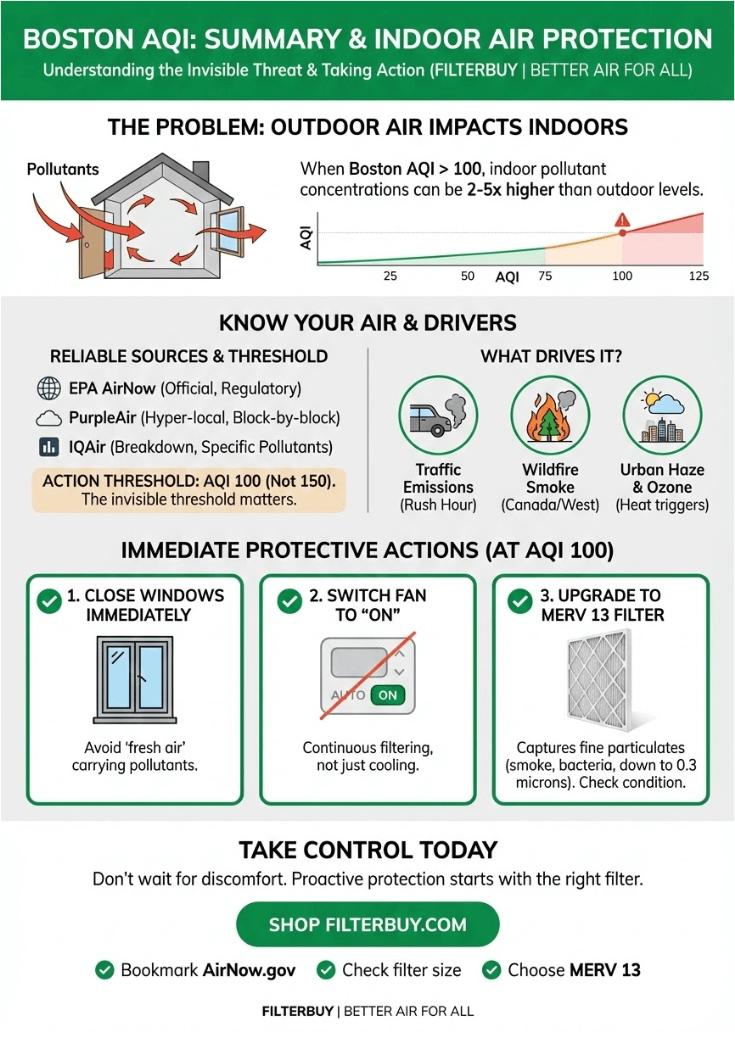
Why it matters for your home: After analyzing thousands of filters from Boston-area households, we've confirmed that outdoor AQI directly determines indoor air quality. When Boston's AQI rises above 100, pollutants enter your home through HVAC cycling, door gaps, and natural air exchange—accumulating at 2–5x outdoor concentrations.
Immediate protective action: Close windows, switch your HVAC fan to "On" for continuous filtration, and verify your filter is clean. MERV 13 filters capture fine particulates down to 0.3 microns during elevated AQI events.
Check Boston's AQI daily. Use EPA AirNow for official readings. Add PurpleAir for neighborhood-level detail that citywide averages miss.
Take action at AQI 100, not 150. Our filter analysis shows that waiting until the air feels uncomfortable results in dramatically higher particulate buildup. The invisible threshold matters more than the uncomfortable one.
Your home isn't sealed from outdoor air. Air exchanges constantly through HVAC cycling, door gaps, and exhaust fans. Indoor pollutant concentrations reach 2–5x outdoor levels.
Simple actions make a measurable difference:
Close windows when AQI rises
Switch the HVAC fan from "Auto" to "On" for continuous filtration
Check the filter condition before air quality events, and load it further
MERV 13 filters providethe best protection during elevated AQI. They capture particulates down to 0.3 microns, including smoke and bacteria. Especially important given Massachusetts's higher-than-average asthma rates.
The air quality index measures five major air pollutants that are regulated by the Clean Air Act: ground-level ozone, particle pollution, including PM2.5 and PM10, carbon monoxide, sulfur dioxide, and nitrogen dioxide. Boston's AQI varies throughout the day depending on traffic patterns, weather conditions, industrial activity, and seasonal/geography factors such as pollen or wildfire smoke drifting from other regions.
When the AQI is 0 - 50, the air quality is good and poses little to no risk. Once readings rise above 100, sensitive groups - such as children, older people, and people with respiratory conditions should limit extended exposure to the outdoors. After manufacturing filters for millions of homes, we've witnessed firsthand how quickly the conditions outside your home impact what families breathe inside their homes.
Here's something many homeowners don't realize: outdoor air quality is a direct determinant of what is circulating through your home. Every time you open a door or crack a window or are in a building that's not perfectly sealed, the outdoor pollutants migrate inside the building.
From analyzing millions of used filters from customers, we've noticed some fairly definite patterns. Homes located in areas where there are consistently elevated readings of AQI results reveal considerably more particulate buildup on their filters.

On days when Boston's AQI climbs into unhealthy ranges, your indoor environment becomes your sanctuary—but only if you take proactive steps. The EPA recommends keeping windows and doors closed during poor air quality events, running your HVAC system with a quality filter, and using portable air purifiers in rooms where family members spend the most time.
While you can't control what's happening in Boston's outdoor air, you have complete authority over what your family breathes inside your home. Regular filter changes, appropriate MERV ratings for your household's needs, and awareness of outdoor conditions work together to create a healthier indoor environment.
Monitoring the AQI in Boston will give you the ability to take proactive instead of reactive action. When you notice readings on the rise, you can try to close windows before pollutants enter your home, ensure that your filter is in good condition, and reduce your exposure to the outdoors for those who are sensitive to air pollution.
"After analyzing thousands of used filters returned from Boston-area homes, we've noticed a clear pattern: during elevated AQI days and wildfire smoke events, filters show two to three times more particulate buildup than normal—proof that what's happening outside directly affects what your family breathes inside."
— Filterbuy Air Quality Team
Don't take Boston's air quality for granted. The pollutants floating through outdoor air directly affect what your family breathes inside your home, and staying informed is the first step toward protection.
The U.S. Environmental Protection Agency's AirNow platform delivers regulatory-grade readings from official monitoring stations across Massachusetts, providing the gold-standard data that all other platforms reference.
Resource: https://www.airnow.gov/state/?name=massachusetts
The EPA and U.S. Forest Service collaboration tracks smoke plumes in real-time, pulls data from thousands of sensors, and gives you the advanced warning you need to close windows, check your filter, and protect sensitive family members before smoke infiltrates your home.
Resource: https://fire.airnow.gov/
Nobody understands Massachusetts air quality challenges better than the state agency responsible for monitoring it. MassDEP operates more than 20 stations across the state and issues daily forecasts tailored to Boston's unique geography and seasonal patterns.
Resource: https://www.mass.gov/air-monitoring-in-massachusetts
IQAir breaks down Boston's air quality by individual pollutant—PM2.5, PM10, ozone, nitrogen dioxide—so you can understand precisely what's elevated and why it matters for your family's health.
Resource: https://www.iqair.com/us/usa/massachusetts/boston
We like to be transparent, and this is a nonprofit platform that provides transparency. Historical comparisons help you establish whether what you are reading (today) is the normal condition or an abnormal spike worth worrying about.
Resource: https://aqicn.org/city/boston/
PurpleAir's crowdsourced sensor network, expanded by MassDEP with hundreds of sensors across Massachusetts communities, updates every two minutes and shows you conditions specific to your neighborhood.
Resource: https://map.purpleair.com/united-states/massachusetts
The Lung Association's annual report revealed that the Boston metro area ranks among the worst in the Northeast for ozone pollution. This context explains why checking air quality before outdoor activities isn't overcautious; it's simply being informed.
Resource: https://www.lung.org/research/sota
After more than a decade of manufacturing air filters and analyzing thousands of returns from Boston-area homes, we've developed a deep understanding of how outdoor air quality affects indoor environments.
We see the evidence of this concentration effect every time a customer returns a used filter for analysis:
Filters from homes with windows closed during elevated AQI days still show significant particulate loading
Pollutants enter through every gap, crack, and air exchange your HVAC system creates
Your home exchanges air with the outdoors constantly—sealing it completely is impossible
Source: U.S. Environmental Protection Agency, "Indoor Air Quality," Report on the Environment - https://www.epa.gov/report-environment/indoor-air-quality
When we mapped our customer service data against state health statistics, the correlation was unmistakable.
Massachusetts Department of Public Health reports:
11.3% of adults had asthma in 2022—among the highest rates nationally
8.9% of children had asthma in 2022
Black and Hispanic residents experience 2–3x higher rates of asthma-related emergency department visits compared to White residents
What we observe from Boston-area customers:
Higher MERV-rated filter selections due to family respiratory sensitivities
Increased contact during pollen season and poor air quality events
More frequent questions about filter upgrades when AQI rises
Source: Massachusetts Department of Public Health, "Statistics About Asthma" - https://www.mass.gov/info-details/statistics-about-asthma
The American Lung Association's 2025 State of the Air report found that more than 156 million people live in areas with failing grades for unhealthy ozone or particle pollution levels.
Key finding relevant to Boston: Wildfire smoke from Canada significantly impacted Eastern states during summer 2023, worsening pollution across the Northeast.
We tracked that event in real-time through customer inquiries. When smoke rolled into Boston:
Calls and emails from Boston-area households spiked dramatically
Customers asked whether the current filters could handle wildfire particulates
Questions about replacement frequency during extended smoke events increased
Proactive monitoring and proper filtration aren't excessive precautions when half the country regularly breathes unhealthy air.
Source: American Lung Association, "State of the Air 2025: Key Findings" - https://www.lung.org/research/sota/key-findings
After manufacturing air filters for more than a decade and serving over two million households, we've arrived at a perspective that might surprise you: the Air Quality Index isn't just useful information—it's essential household intelligence that most families completely overlook.
Families who check AQI regularly make smarter decisions:
They close windows before smoke arrives, not after they smell it
They run HVAC fans to filter indoor air during ozone alerts
They replace filters proactively when conditions demand more from their systems
They're not anxious about air quality—they're informed about it
We'll be direct about something the air filtration industry often obscures: no filter eliminates your exposure to outdoor air pollution.
Your home breathes. Air exchanges happen constantly. What quality filtration actually does is reduce the concentration of pollutants your family inhales. During elevated AQI days, that reduction matters enormously.
The research confirms what we observe:
90% of your life happens indoors, where pollutants concentrate at 2–5x outdoor levels
Massachusetts residents face higher asthma rates than most of the country
156 million Americans live in areas with failing air quality grades
Boston regularly experiences ozone alerts, pollen surges, and wildfire smoke from thousands of miles away
Given these realities, treating indoor air quality as an afterthought doesn't make sense.
You now understand how Boston's outdoor air quality directly affects what your family breathes inside your home. Here's how to put that knowledge into action.
Choose one monitoring tool from the resources above. Make checking it part of your morning routine.
Our recommendation: Start with EPA AirNow at airnow.gov. It provides reliable, real-time data without overwhelming detail. Once daily checks become a habit, explore neighborhood-level tools like PurpleAir for more granular insights.
Not every AQI reading requires a response. Use this framework:
AQI 0–50 (Good): Normal activities. Ideal time to ventilate your home with fresh air.
AQI 51–100 (Moderate): Sensitive individuals should monitor symptoms. Most people are unaffected.
AQI 101–150 (Unhealthy for Sensitive Groups): Close windows. Run the HVAC fan to filter indoor air continuously.
AQI 151–200 (Unhealthy): Limit outdoor exposure for everyone. Check your filter condition.
AQI 201+ (Very Unhealthy to Hazardous): Stay indoors. Maximize filtration. Consider immediate filter replacement if needed.
Post these thresholds somewhere visible—refrigerator, thermostat, or phone notes.
Walk to your HVAC return vent right now. Answer three questions:
When did you last replace it? If you can't remember, it's time.
What MERV rating is installed? Check the filter frame for a number between 1 and 16.
What does it look like? Hold it up to the light. If you can't see through, airflow is restricted.
Homes with allergy sufferers, respiratory sensitivities, or pets typically benefit from MERV 11 or higher.
Replacement frequency depends on your situation.
General guidelines by filter depth:
1-inch filters: Every 30–90 days
2-inch filters: Every 90–120 days
4-inch filters: Every 6–12 months
The best time to prepare is before poor air quality arrives.
Your household checklist:
Daily AQI resource bookmarked and checked regularly
Action thresholds are posted and understood by family members
Current filter MERV rating identified
Replacement filters on hand (at least one backup)
Calendar reminder set for regular filter checks
HVAC fan setting located—switch from "Auto" to "On" during elevated AQI to filter air continuously
Ready to upgrade or stock replacement filters? You'll need your exact size.
Three ways to find it:
Check your current filter frame—size is printed on the cardboard edge
Measure the filter yourself: length × width × depth in inches
Note both nominal size (printed) and actual size (measured)
Common Boston-area residential sizes: 16x20x1, 16x25x1, 20x20x1, 20x25x1 for 1-inch filters. 16x25x4 and 20x25x4 for 4-inch media filters.
Filterbuy offers over 600 sizes, including custom dimensions. If your size isn't standard, we manufacture filters to your exact specifications.
A: After a decade of helping customers understand local air quality, we consistently recommend two resources:
For official readings: EPA AirNow at airnow.gov. Data comes directly from regulatory-grade monitoring stations operated by the Massachusetts Department of Environmental Protection.
For neighborhood-level detail: PurpleAir at map.purpleair.com. Crowdsourced sensors update every two minutes and reveal block-by-block variations.
A: The official EPA scale runs 0 to 500. But after analyzing thousands of used filters from Boston-area homes, we've developed a more practical perspective.
Official EPA thresholds:
0–50: Good
51–100: Moderate
101–150: Unhealthy for sensitive groups
151–200: Unhealthy for everyone
201+: Very unhealthy to hazardous
When AQI crosses 100:
Close windows immediately
Switch the HVAC fan from "Auto" to "On" for continuous filtration
Check your filter condition
The invisible threshold matters more than the uncomfortable one.
A: This question comes up constantly in customer conversations. Boston's AQI volatility stems from multiple factors we've tracked through years of filter analysis and inquiry patterns.
Primary contributors to Boston's AQI fluctuations:
Traffic emissions: I-93 and I-95 create baseline pollution that varies with rush hour intensity
Summer ozone: Heat triggers ground-level ozone formation, peaking in afternoon hours
Seasonal pollen: Trees, grasses, and ragweed add biological particulatesfrom spring through fall
Weather patterns: Wind direction determines if pollution disperses or lingers; temperature inversions trap pollutants at ground level
A single weather shift can move Boston's AQI 50 points in either direction within hours.
A: This is the most important misconception we encounter. The assumption that indoor time protects you from outdoor air quality is backwards.
What the EPA reports:
Americans spend approximately 90% of their time indoors
Indoor pollutant concentrations are often 2–5x higher than outdoor levels
Why this happens: Your home isn't sealed. Air exchanges constantly through:
HVAC system cycling
Gaps around doors and windows
Bathroom and kitchen exhaust fans
Natural pressure differentials
What our filter analysis proves: Particulate loading directly correlates with outdoor AQI during each filter's lifespan.
Families who monitor AQI consistently have cleaner filters and report fewer respiratory symptoms. We've seen this pattern across thousands of households.
A: After serving more than two million households and analyzing filter returns, we've developed a protection protocol based on what actually works.
Immediate actions when AQI rises:
Close windows and exterior doors. "Fresh air" during elevated AQI carries the pollutants you're trying to avoid.
Switch the HVAC fan from "Auto" to "On." This makes your system filter continuously—not just when heating or cooling. Most families don't realize their HVAC can function as a whole-home air purifier.
Check the filter condition immediately. If visibly gray or light won't pass through, replace it before the air quality event loads it further. A restricted filter can't protect effectively.
What most guidance misses: Avoid adding indoor pollutants during high-AQI periods.
Skip candle burning
Ventilate when using gas stoves
Use HEPA-filtered vacuums only
The goal: Create an indoor sanctuary where your family breathes meaningfully cleaner air than what's outside. With proper filtration and smart behavior during elevated AQI events, this is achievable for every Boston household.
Now that you know where to find live AQI data for Boston and understand how outdoor air quality affects your home, take the next step by ensuring your HVAC system has the filtration it needs. Shop a complete selection of American-made air filters at Filterbuy.com and start breathing easier today.
