
Washington Real-Time AQI Tracker


Get Alerts For Unhealthy AQI In Your Area
When air quality in your area reaches unhealthy levels, we'll send you a quick alert, along with expert tips on how to reduce your exposure.
What's Actually In Washington Air Today?
What High AQI Means for Your Lungs in Washington
How to Read AQI
The Air Quality Index (AQI) measures how polluted the air is and how it may affect your health.
0–50 (Good): Air quality is satisfactory.
51–100 (Moderate): Acceptable, but some pollutants may pose minor concerns.
101–150 (Unhealthy for Sensitive Groups)
151–200 (Unhealthy)
201–300 (Very Unhealthy)
301+ (Hazardous)
Moderate
Still okay for most, but if you have asthma or allergies, take it easy and avoid long outdoor workouts.
Shop MERV 11 filters→What's the Right Filter for Your AQI Level?
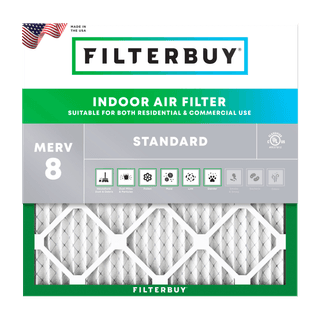
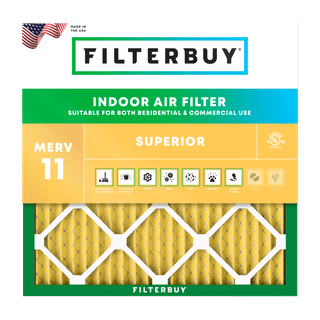
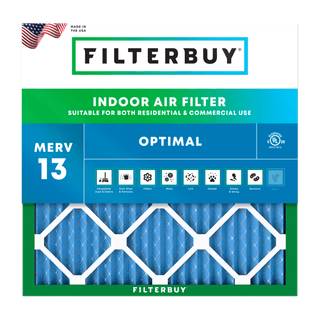

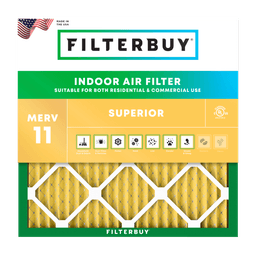
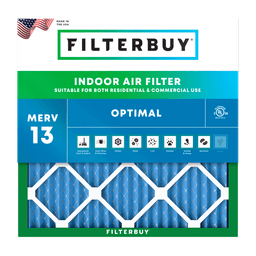


Red Zone in Your Neighborhood? Live AQI Map for Washington DC Today: Air Quality Index Now
On June 7, 2023, Washington, DC's air quality index climbed to 412. The sky over K Street turned orange that morning, the sun dimmed at noon, and the smell of woodsmoke hung in a city a thousand miles from the nearest fire. Canadian wildfire smoke had settled over the District for almost a week. Our DC customers ordered three times their normal volume of MERV 13 filters that month — an honest reaction from people who realized that the air outside their windows had turned hazardous and the air inside their homes was about to follow.
That summer changed how a lot of DC residents think about checking the air. The live AQI map above does the heavy lifting now. Today's reading reflects whatever is drifting across Foggy Bottom, settling along the Anacostia waterfront, or climbing along the Beltway corridor at this exact moment. If you've got kids playing outside this weekend or anyone in the house who reacts to pollen and smoke, the number on that map is the first thing worth knowing.
TL;DR Quick Answers
What Is the Live Air Quality Index (AQI) Map for Washington, DC Today?
The live AQI map for Washington, DC, shows real-time air quality readings sourced from EPA AirNow monitoring stations across the District. Today's reading reflects the highest concentration of a single criteria pollutant — most often ozone in summer or PM2.5 during wildfire smoke events — at the station nearest your neighborhood.
Here's what each AQI band means for your household.
0 to 50 (Green, Good). Open the windows. Outdoor air is satisfactory.
51 to 100 (Yellow, Moderate). Acceptable for most. Sensitive family members may want to limit prolonged outdoor exertion.
101 to 150 (Orange, Unhealthy for Sensitive Groups). Children, older adults, and anyone with asthma should reduce outdoor activity.
151 to 200 (Red, Unhealthy). Everyone limits outdoor exposure. Keep windows closed and make sure your HVAC filter is fresh.
201 to 300 (Purple, Very Unhealthy). Stay indoors and run the HVAC on recirculate. Health emergency conditions for sensitive groups.
301+ (Maroon, Hazardous). Serious effects for everyone. Indoor air quality control becomes critical.
Pro tip: when DC's outdoor AQI hits orange or higher, your HVAC filter is doing the heavy lifting. A clean MERV 13 filter captures about 90 percent of wildfire smoke particles and 85 percent or more of the fine particulates that drive elevated AQI readings, well before they reach your family's lungs.
Top Takeaways
DC's AQI shifts by neighborhood and by pollutant. The live map is your first read, not your last.
Summer ozone and Canadian wildfire smoke are the two highest-impact AQI events DC households should plan for.
Indoor air can run two to five times worse than outdoor air, so the number outside is only half the picture.
MERV 13 is the residential filter the EPA points to for wildfire smoke and elevated AQI episodes.
Filter replacement every 60 to 90 days protects performance during DC's high-pollen and high-smoke months.
Why Washington, DC's Air Quality Is Different From What You'd Expect
Washington sits in a tough spot for air quality. The District absorbs vehicle exhaust from one of the densest commuter regions in the country, summer humidity that traps fine particles close to the ground, federal-fleet diesel idling outside government buildings, and a tree canopy that releases some of the heaviest spring pollen loads on the East Coast.
Four pollutants drive most of the District's AQI variability.
Ground-level ozone. Summer heat and sun cook nitrogen oxides from vehicles and stationary sources into ozone. DC has been in nonattainment of the federal ozone standard for years, which is why code orange and code red ozone action days are now a regular feature of June through August.
Fine particulate matter (PM2.5). Regional power plants, transportation exhaust, and construction sites add a steady baseline of PM2.5 across the city, and winter inversion days trap it close to the ground for hours at a time.
Tree pollen. Oak and birch make DC one of the most pollen-heavy capitals in the country during late March through May, and allergy-driven AQI proxies often spike independently of ozone or particles.
Wildfire smoke from Canada. The June 2023 smoke event wasn't an outlier. Smoke from Canadian wildfires now reaches the Mid-Atlantic most summers, and forecasters track multi-day plumes routinely.

What Today's AQI Number Actually Means for Your DC Household
The Air Quality Index (AQI) translates concentrations of six federal-criteria pollutants into a single 0-to-500 scale. The number you see on the live map for the District is the highest single pollutant reading at the nearest monitoring station, which is why a yellow ozone day can still mean green PM2.5 (or vice versa).
Here's what each AQI band means for your family.
0 to 50 (Green, Good). Outdoor air is satisfactory. Open windows, run errands, let kids play outside without worry.
51 to 100 (Yellow, Moderate). Acceptable for most. People who are unusually sensitive to ozone or particles, including some children and older adults, may want to limit prolonged outdoor exertion.
101 to 150 (Orange, Unhealthy for Sensitive Groups). Anyone with asthma, COPD, heart disease, or pollen sensitivity should reduce outdoor activity. Across DC, this is the band where Beltway commuters and outdoor school activities deserve a second look.
151 to 200 (Red, Unhealthy). Everyone limits outdoor exposure. Keep windows closed and make sure your HVAC filter is fresh.
201 to 300 (Purple, Very Unhealthy). Health emergency conditions for sensitive groups. Stay indoors and run the HVAC on recirculate.
301+ (Maroon, Hazardous). Serious health effects for everyone. Indoor air quality control becomes critical.
How DC's Outdoor Air Quality Affects the Air Inside Your Home
The biggest misconception we hear from DC homeowners is that an elevated outdoor AQI is purely an outdoor problem. It isn't. Outdoor pollution travels indoors through window and door leakage, HVAC outside-air intake, and particulates tracked in on shoes, clothing, and pets. By the time a smoke event or ozone spike settles in, the air inside your home often carries the same pollutants at meaningful concentrations.
Older DC row homes and brick walk-ups, especially the ones built before modern envelope sealing standards, are particularly vulnerable. Drafts that feel charming in cold weather become liabilities when the AQI climbs past 100.
This is why HVAC filtration is your household's first line of defense. The EPA points to MERV 13 as the residential filter rating that meaningfully reduces wildfire smoke particles and elevated PM2.5 indoors. For a national overview of how each region is tracking, you can view the full live air quality index map for North America and see how DC compares to other major markets.
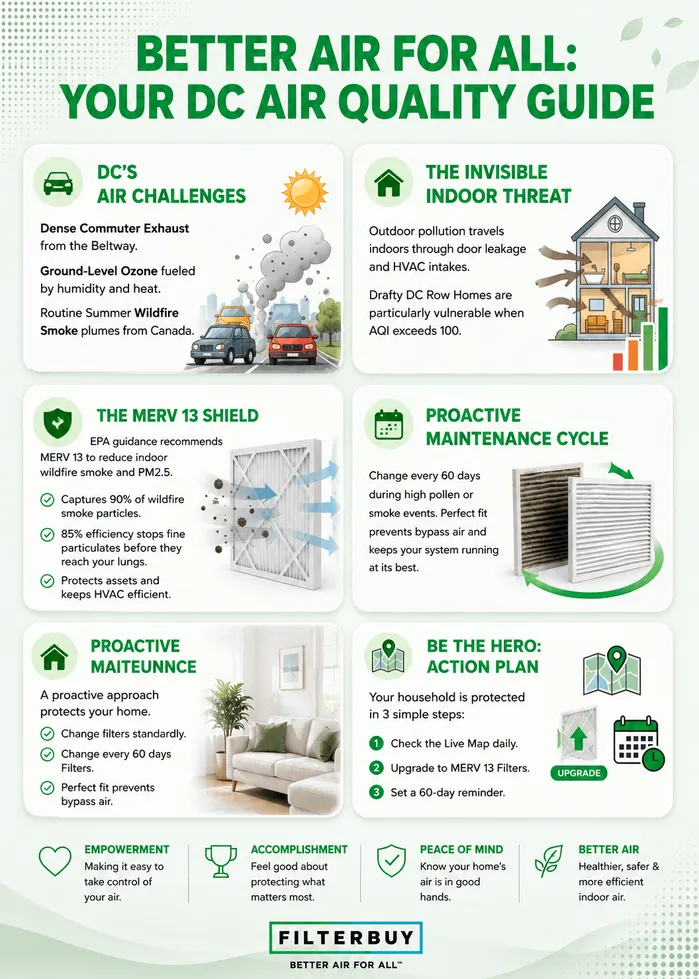
DC residents call us during every summer wildfire smoke event with the same question: is my current filter going to be enough? After manufacturing filters for over a decade and serving more than two million households, my answer is the same one I'd give my own family. If you live anywhere in the District and the AQI is approaching the orange band, you should already be running a MERV 13. The cost difference per month is pennies. The protection for your kids, your parents, and anyone in the home with respiratory sensitivity is everything. Treat it like sunscreen, not like an optional upgrade.
— Filterbuy Team
7 Essential Resources for Tracking Air Quality in Washington, DC
Knowing the right resources makes the difference between reacting to bad air and getting ahead of it. The seven sources below are the ones we recommend to DC customers who want to track air quality the way local environmental scientists do.
1. Get the EPA's Official Live AQI Reading for the DC Region in Less Than Ten Seconds
AirNow is the federal AQI data source that every other map and app pulls from. Type "Washington, DC" into the site, and you'll see the live reading from the closest monitoring station along with which pollutant is driving the number and a plain-language health note for the day. This is the source of truth when other apps disagree.
Source: EPA AirNow AQI Basics
2. Find Out What the District Itself Recommends When Air Quality Turns Code Orange or Worse
The Department of Energy and Environment publishes the District's Healthy Air Actions guidance. It covers what residents should do during ozone action days, how transportation choices affect your neighborhood's air, and which protective steps to take indoors. It's written by the people who actually monitor DC's air every day.
Source: DOEE Healthy Air Actions
3. Check Tomorrow's Air Quality Forecast Before You Plan Outdoor Activities in the DMV
The Metropolitan Washington Council of Governments runs the regional air quality forecast for DC, Maryland, and Virginia. It's the same forecast local news stations use when they announce a code orange day, with the added value of multi-day projections so you can plan exercise and outdoor activities ahead of time.
Source: MWCOG Air Quality Forecast
4. See How Washington's Air Pollution Ranks Against Every Other Metro in the Country
The American Lung Association's annual State of the Air report grades every US metro on ozone and on short- and year-round particle pollution. The Washington-Baltimore-Arlington metro consistently ranks near the bottom for ozone, and recent reports dropped DC's particle pollution grade to an F after the 2023 wildfire smoke events.
Source: American Lung Association State of the Air
5. Learn How Outdoor Air Pollution Triggers Asthma Attacks at Home
The CDC's Asthma and Community Health Branch tracks how outdoor pollutants like ozone and PM2.5 worsen asthma symptoms and trigger attacks. Their guidance also explains the indoor-outdoor connection, which matters when DC's outdoor AQI climbs and your home's air becomes the next line of defense for someone managing asthma.
Source: CDC Asthma and Community Health
6. Track the Air and Climate Data the Park Service Watches Across the National Capital Region
The National Park Service operates an air quality monitor near the National Mall on Hains Point and tracks pollutants like ozone, nitrogen, and sulfur deposition, and visibility across DC-area parks. NPS data feeds into the broader regional air quality picture and gives you a different vantage point than the agency-run street-level monitoring stations.
Source: NPS National Capital Region Air and Climate
7. Watch Where Canadian Wildfire Smoke Is Drifting Before It Reaches DC
NOAA's HRRR-Smoke model forecasts where wildfire smoke is moving across North America in 36-hour increments. When Canadian fires are active in summer, this is the tool that tells you a day in advance whether a plume will reach the Mid-Atlantic and how dense it'll be when it gets here.
Source: NOAA HRRR-Smoke Forecast
3 Supporting Statistics That Reframe How You Think About Your DC Home's Air
These are the three numbers that change how most homeowners think about indoor air quality once they see them in context.
1. The Air Inside Your DC Home Can Be Five Times More Polluted Than the Air Outside
EPA research shows that indoor levels of some pollutants run two to five times higher than outdoor concentrations, and occasionally more than 100 times higher during peak activities. For DC residents who spend most of the day indoors, the AQI reading outside is only half the picture. The other half is what's recirculating through your HVAC system right now.
Source: US EPA Indoor Air Quality
2. Nearly 28 Million Americans Live With Asthma, and DC's Outdoor Pollution Puts Them at Risk
The Asthma and Allergy Foundation of America reports that nearly 28 million people in the United States have asthma, or roughly 1 in 12. In a city with chronic ozone nonattainment and recurring summer smoke events, every elevated AQI day is a day when those neighbors are more likely to reach for an inhaler, miss work, or end up in an emergency department.
Source: AAFA Asthma Facts
3. Wildfire Smoke Doesn't Just Hurt Your Lungs, a Harvard Study Shows It Also Affects Mental Health
A 2025 Harvard T.H. Chan School of Public Health study linked exposure to wildfire-specific PM2.5 with increased emergency department visits for depression, anxiety, and other mood disorders for up to seven days after the smoke event. For a region now seeing regular summer Canadian smoke episodes, the health stakes go well beyond breathing.
Source: Harvard T.H. Chan School of Public Health Study
Final Thoughts: Why DC Households Should Treat Air Quality as a Year-Round Concern, Not a Summer Surprise
The hard truth about DC air quality is that it's no longer a problem you can outrun by waiting for fall. Summer ozone, spring pollen, winter PM2.5 inversions, and the new annual reality of Canadian wildfire smoke mean that some part of every year is going to push your household's air into a range that affects sensitive family members. Checking a live AQI map handles the awareness side. The harder part is running a high-MERV filter, sealing the leaks you can find, and replacing filters every 60 to 90 days during smoke and pollen months. Air quality in the District is going to remain unpredictable for the foreseeable future, but with the right setup at home, your indoor air can stay steady anyway.
Next Steps: Five Things to Do Right Now to Protect Your DC Home's Air Quality
Bookmark this page and check the live AQI map before you open windows or send kids outside on hazy, hot, or smoky days.
Sign up for air quality alerts from Clean Air Partners or AirNow so code orange and code red days reach you before you walk out the door.
Use the Filterbuy filter sizing tool to find the right MERV 13 filter for your specific HVAC system.
Set a 60-to-90-day filter replacement reminder on your phone or smart home assistant, with extra changes during heavy pollen or smoke months.
Share this page with one neighbor who has young kids, an elderly parent, or anyone living with asthma or COPD.
Frequently Asked Questions
Call to Action: Don't Just Watch the AQI Number, Do Something About It in Your DC Home
Watching the outdoor AQI is the easy part. Protecting the air your family actually breathes inside your home takes one decision and one purchase. A fresh, properly sized MERV 13 filter is the single highest-impact change most DC households can make right now, before the next ozone action day, smoke plume, or pollen surge.