When air quality in your area reaches unhealthy levels, we'll send you a quick alert, along with expert tips on how to reduce your exposure.
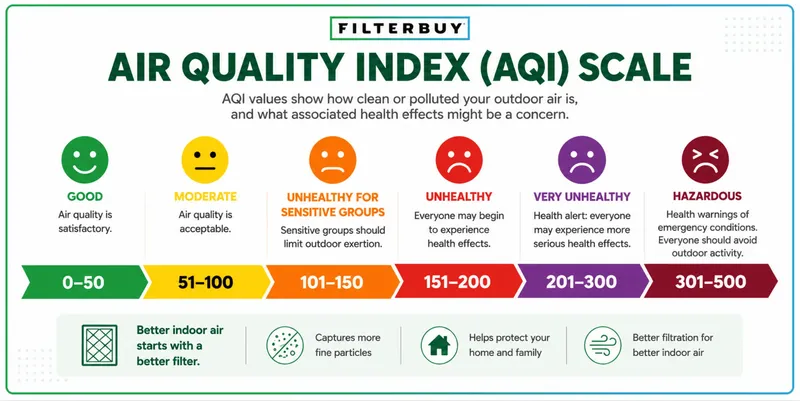
The Air Quality Index (AQI) measures how polluted the air is and how it may affect your health.
0–50 (Good): Air quality is satisfactory.
51–100 (Moderate): Acceptable, but some pollutants may pose minor concerns.
101–150 (Unhealthy for Sensitive Groups)
151–200 (Unhealthy)
201–300 (Very Unhealthy)
301+ (Hazardous)
Still okay for most, but if you have asthma or allergies, take it easy and avoid long outdoor workouts.
Shop MERV 11 filters→
Author: Michelle Wan, Brand Manager & Air Quality Writer | Filterbuy · Reviewer: David Clark, Licensed HVAC Technician · Publish Date: July 19, 2026 · Updated Date: July 19, 2026
Today's AQI in Little Rock is 70, which falls in the Moderate category, driven mainly by fine particulate matter (PM2.5). No Ozone Action Day is in effect today, and there is no active wildfire smoke advisory for Arkansas. Sensitive groups, including kids, older adults, and people with asthma or heart conditions, should still check the live map below before spending extended time outside.
Little Rock's Air Quality Index (AQI) is calculated from five pollutants, carbon monoxide, nitrogen dioxide, ozone, sulfur dioxide, and particulates, and the highest reading sets the final number.
An AQI of 100 or below is generally considered satisfactory. Above 100 means sensitive groups should start limiting prolonged outdoor exertion.
Central Arkansas runs its own Ozone Action Days advisory program from May 1 through September 30 each year, separate from the national AirNow map.
Today's AQI in Little Rock is 70 (Moderate), driven mainly by fine particulate matter (PM2.5).
PM2.5, fine particle pollution, is the pollutant most likely to drive Little Rock's AQI during summer months when there is no active wildfire smoke.
Ozone builds through the day and peaks in the late afternoon, so mornings before 10 a.m. are typically the cleanest window to be outside during ozone season.
This page updates regularly. Check the timestamp above before relying on the numbers for same-day planning.
I check AQI feeds for cities across the Filterbuy network every morning, and Little Rock always stands out for what it isn't. It isn't a wildfire-smoke story like Seattle or Portland, where the number can jump 100 points overnight when smoke rolls in from hundreds of miles away. Little Rock's air problem is slower and more local: ground-level ozone building through a still, sunny afternoon. That's a different thing to plan around, which is why this page leans on the Ozone Action Days program instead of a fire and smoke map. Most Little Rock residents I've talked with don't know the program exists until the first orange day of the summer.
Michelle Wan, Brand Manager and Air Quality Writer, Filterbuy

Use the map to check Little Rock's air quality right now, and refer back throughout the day since conditions can shift with wind, temperature, and traffic patterns. For a broader view that layers in active wildfire locations and smoke plumes nationwide, see Filterbuy's live wildfire and smoke map.
Today's AQI in Little Rock is 70, which falls in the Moderate category. The Air Quality Index (AQI) turns pollutant concentrations into a single number between 0 and 500 and a color-coded category system, so residents can tell at a glance whether the air is safe to be active in. Arkansas's Division of Environmental Quality calculates the official local AQI from continuous monitoring of five major pollutants, and the index is set by whichever pollutant reads highest that day. See the Essential Resources section below for direct links to the official sources behind these numbers.
That single number is an average, not a guarantee for every block. ADEQ pulls its readings from monitors positioned around the metro, including sites on the west side near Kanis Road and closer to downtown along Daisy Gatson Bates Drive, so a reading a few miles away doesn't always match the air right outside your door, especially near a busy highway. If you live or work close to I-30, I-40, or I-630, treat the citywide number as a starting point and check the live map above for the station nearest you.
Today's dominant pollutant is fine particulate matter (PM2.5), with an AQI of 70. Ozone is close behind at an AQI of 60. In central Arkansas, summer air quality is typically shaped by a mix of vehicle emissions, regional haze, and, from May through September, ground-level ozone formed when sunlight reacts with pollution. Wildfire smoke can occasionally drift in from other regions. As of today, there is no active wildfire smoke impacting Arkansas, and statewide fire activity remains minimal thanks to recent rain and high humidity. For the fuller picture of what typically drives a bad-air day, see Filterbuy's guide to why air quality is bad today.
When the AQI is at or below 100, air quality is generally considered satisfactory for normal outdoor activity.
Children, older adults, and people with asthma, COPD, or heart disease are advised to limit prolonged or heavy outdoor exertion once the AQI passes 100, and to plan around forecast peaks whenever possible. This is also the threshold where Filterbuy hears from the most Little Rock customers asking whether their filter is doing enough, which is exactly what the filtration section below is built to answer.
Early morning tends to bring lower ozone levels than afternoon, so shifting a run or workout earlier in the day is a simple way to reduce exposure on higher-AQI days.
Ozone needs sunlight to form, so it builds through the day and typically peaks in the late afternoon and early evening, roughly 2 to 7 p.m. during ozone season. Mornings, especially before 10 a.m., are almost always the cleanest window. If you're planning a run, a walk, or an afternoon at the park on a day the forecast calls Moderate or higher, moving it earlier is a real way to cut your exposure without waiting for a cleaner day entirely.
May through September is ozone season, when hot, still, sunny afternoons push the AQI into Moderate or higher on the toughest days. Fall and winter bring a different pattern. Ozone drops off, but calm, cold mornings can trap wood smoke and vehicle exhaust close to the ground in a temperature inversion, so particle pollution becomes the bigger concern instead. Wildfire smoke drifting in from other states is uncommon in central Arkansas, but it's not impossible, and it tends to show up in late summer or fall when fires are active out west. It's also the stretch when Filterbuy sees the most Little Rock customers switching filters before heating season starts, right as the pollution profile changes.
Today's forecast from ADEQ calls for an AQI of 70 (Moderate), driven by fine particulate matter (PM2.5), with ozone close behind at an AQI of 60 (Moderate). Arkansas's air quality forecast is typically posted by 3:00 p.m. each day during ozone season, giving residents a heads-up before the next day's conditions set in. It's one of the numbers Filterbuy checks every morning alongside every other city we cover, right next to Little Rock's.
Central Arkansas runs its own Ozone Action Days program, coordinated by Metroplan alongside the Arkansas Department of Health, the Division of Environmental Quality, and the state highway department. An Ozone Action Day is declared when weather conditions, typically high heat, light wind, and strong sunlight, are forecast to push ground-level ozone in the Little Rock/North Little Rock metro area past federal health standards. It's also one of the first things Little Rock customers ask Filterbuy about each summer, usually right after the first orange day of the season.
The program uses two precise thresholds: an orange Ozone Action Advisory is declared when the 8-hour average ozone concentration is expected to reach or exceed 85 parts per billion, and a red Ozone Action Alert is declared at 105 parts per billion or higher. The season runs May 1 through September 30 each year, which lines up with when Arkansas typically sees its highest ozone readings.
On declared Action Days, residents are encouraged to combine errands, defer gas-powered lawn equipment, refuel vehicles after dusk, and choose carpooling, biking, or transit over solo driving. Each of these cuts the emissions that react with sunlight to form ozone.
Source: Arkansas Ozone Action Days program (Metroplan, Arkansas Division of Environmental Quality, and Arkansas Department of Health). Season runs May 1 through September 30.
The table below shows the six official AQI categories and the fine particle (PM2.5) concentrations behind each one, based on the EPA's current breakpoints.
Source: U.S. EPA Air Quality Index breakpoints. Little Rock's live AQI is calculated by the Arkansas Division of Environmental Quality from continuous local monitoring.
On days when outdoor AQI climbs into Moderate or higher, keeping windows closed and running your HVAC system with a higher-MERV filter can reduce how much outdoor particulate matter makes it indoors. For the full breakdown of which rating fits which AQI level, see Filterbuy's guide to MERV ratings for high-AQI days.
If you're deciding what to change, Filterbuy's MERV 13 air filters can help you match the right size and rating to your system.
Ground-level ozone doesn't show up on the news the way wildfire smoke does, so people underestimate it. A quiet, sunny afternoon in Little Rock can still be a bad-air day. We built this page because the number matters, but knowing what's actually driving it matters more.
David Heacock, Founder and CEO, Filterbuy
After manufacturing filters for over a decade and serving more than two million households, we've noticed the same pattern every ozone season. Filter orders from central Arkansas climb in the days right after an Ozone Action Day, not before it. That gap, between the day the air turns bad and the day people actually do something about it, is exactly what this page is built to close.
A number on a screen doesn't protect anyone by itself. We lean on these same seven sources when we build our own air quality guides. Each one is a real agency or program behind Little Rock's data, not a site repeating someone else's numbers, so you get seven independent checks instead of one number echoed back seven times. Bookmark them before the next bad-air day arrives.
ADEQ posts the real observed and forecast AQI for the Little Rock metro area every day, broken down pollutant by pollutant. It's the same number Arkansas's own regulators use, not someone else's estimate of it.
Central Arkansas runs its own ozone alert program, and Metroplan is the group behind it. Bookmark their Ozone Action Days page and you'll know when an Advisory or Alert is in effect before it hits the evening news.
The Arkansas Department of Health breaks down what ground-level ozone actually does to your lungs, then gives you real moves to make on an Action Day instead of a vague warning to be careful.
Most sites simply tell you an Ozone Action Day happened. The National Weather Service's Little Rock office tells you the exact 8-hour thresholds, 85 parts per billion for an Advisory and 105 for an Alert, that meteorologists use to call one.
AirNow is the EPA's national backbone for real-time AQI. Learn how to read it here, and you can read it the same way in any city you travel to.
We can tell you Little Rock's number, but the EPA decided where Good ends and Hazardous begins, and why. Their explainer is the source behind every color on the dial.
Not every household faces the same risk on a bad-air day. The CDC lays out exactly who needs to pay closer attention, kids, older adults, anyone with asthma, COPD, or heart disease, and what to do differently.
Three numbers. Three different institutions. Here's what backs up everything above.
C grade, 7 years running. Pulaski County ranks 110th worst out of 226 U.S. metro areas for ozone pollution.
Source: American Lung Association, 2026 “State of the Air” Report
1.3 to 10 percent more hospitalizations. That's the jump in respiratory hospitalizations for every 10 µg/m³ rise in wildfire-specific PM2.5. Regular PM2.5 only drives a 0.67 to 1.3 percent increase.
Source: National Institutes of Health (Aguilera et al., 2021)
300,000+ deaths a year. That's how many premature deaths wildfire smoke is linked to worldwide, annually. Your HVAC filter is doing more work than it gets credit for.
A: Today's AQI in Little Rock is 70, which falls in the Moderate category. As a general rule, an AQI at or below 100 is considered acceptable for most people, while readings above 100 call for extra caution from sensitive groups.
A: An AQI between 0 and 50 is classified as Good, meaning air pollution poses little or no health risk.
A: Ozone Action Days are declared on an as-needed basis during the May 1 through September 30 season, whenever forecast heat, sunlight, and light wind are expected to push ozone above federal health standards.
A: Wildfire smoke can drift into Arkansas from other regions during active fire seasons elsewhere, but it is not a constant issue. Check the live map above, or Filterbuy's live wildfire and smoke map further up this page, rather than assuming smoke is present.
A: Early morning, ideally before 10 a.m. Ozone needs sunlight to form, so it builds through the day and is typically at its worst in the late afternoon and early evening during ozone season.
AQI (Air Quality Index): An EPA scale from 0 to 500 that converts pollutant concentrations into a single number and color-coded health category.
PM2.5: Fine particulate matter smaller than 2.5 micrometers, small enough to be inhaled deep into the lungs.
PM10: Coarse particulate matter up to 10 micrometers, which includes dust and pollen-sized particles.
Ground-Level Ozone (O3): A pollutant formed when sunlight reacts with vehicle and industrial emissions near the earth's surface. Distinct from the protective ozone layer higher in the atmosphere.
Ozone Action Day: A central Arkansas advisory, issued by Metroplan and state partners, warning that ground-level ozone is forecast to exceed federal health standards.
ADEQ: The Arkansas Division of Environmental Quality, the state agency that monitors pollutants and calculates the official local AQI.
AirNow: A joint EPA and state/local partnership site providing real-time AQI data and forecasts for cities across the U.S.