
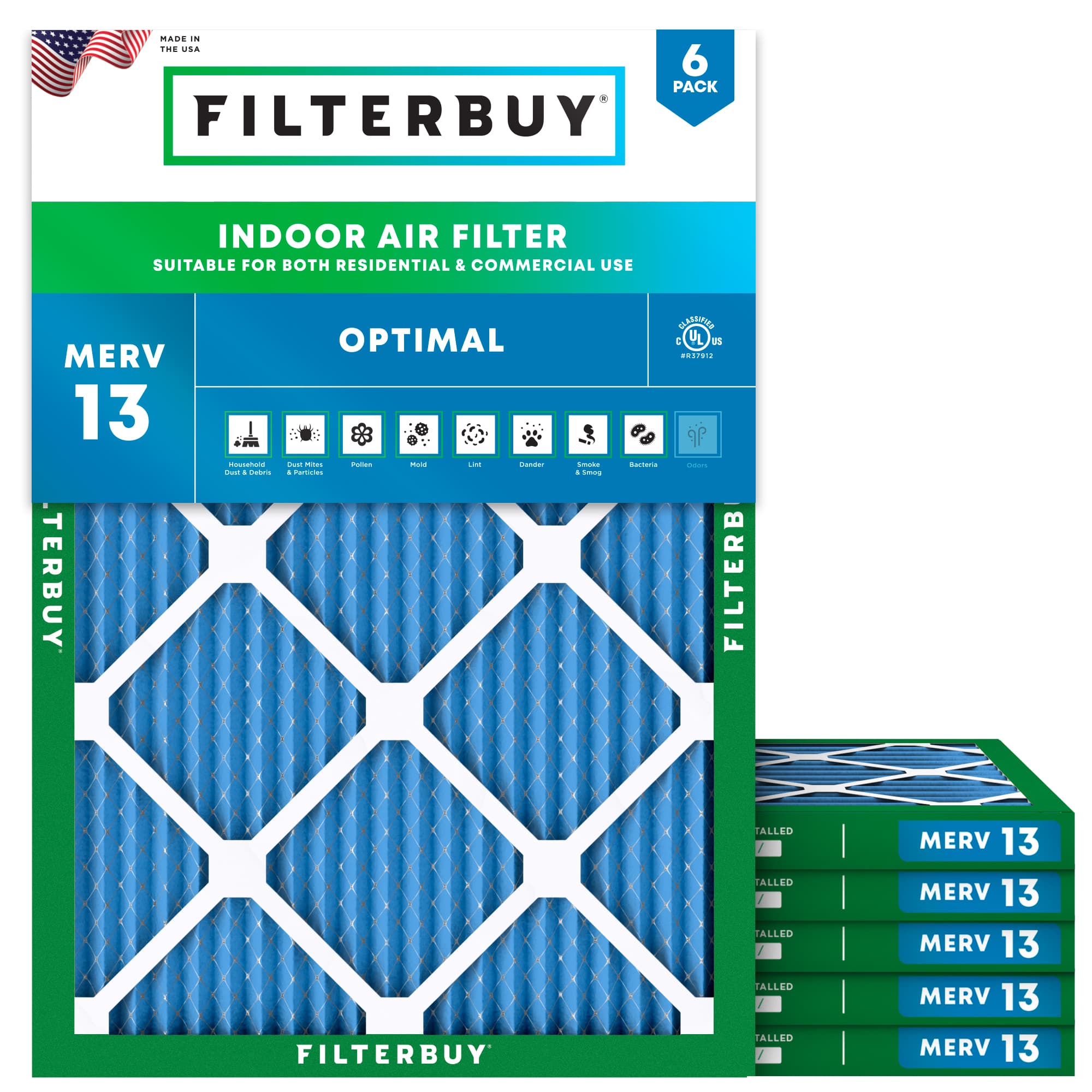
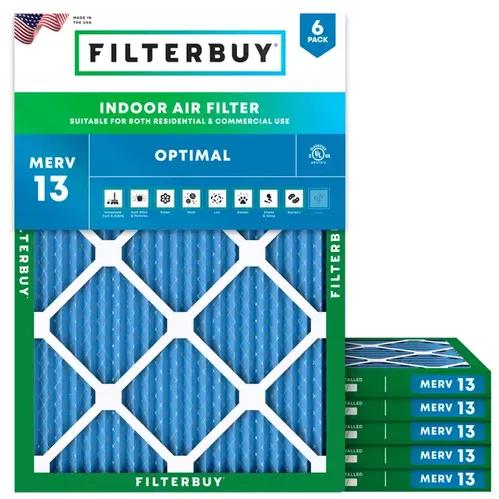
23x25x1 MERV 13 Pleated Air Filter
Actual Size: 23.0x25.0x0.75
 Free Delivery
  Factory-Direct Low Prices, Made in the USA
 Hassle-Free Returns & Free Exchanges
RESIDENTIAL AND/OR COMMERCIAL USE
Change Every 3 Months
23x25x1 MERV 13 Pleated Air Filter
Actual Size: 23.0x25.0x0.75
Free Delivery Factory-Direct Low Prices, Made in the USAHassle-Free Returns & Free ExchangesRESIDENTIAL AND/OR COMMERCIAL USE
Change Every 3 Months
23x25x1 MERV 13 Pleated Air Filter
Actual Size: 23.0x25.0x0.75
Free Delivery Factory-Direct Low Prices, Made in the USAHassle-Free Returns & Free ExchangesRESIDENTIAL AND/OR COMMERCIAL USE
Change Every 3 Months
About
- This is a list 23x25x1 MERV 13 air filter replacement for your furnace, air conditioner, heat pump, or HVAC system
- Actual air filter size: 23.0x25.0x0.75
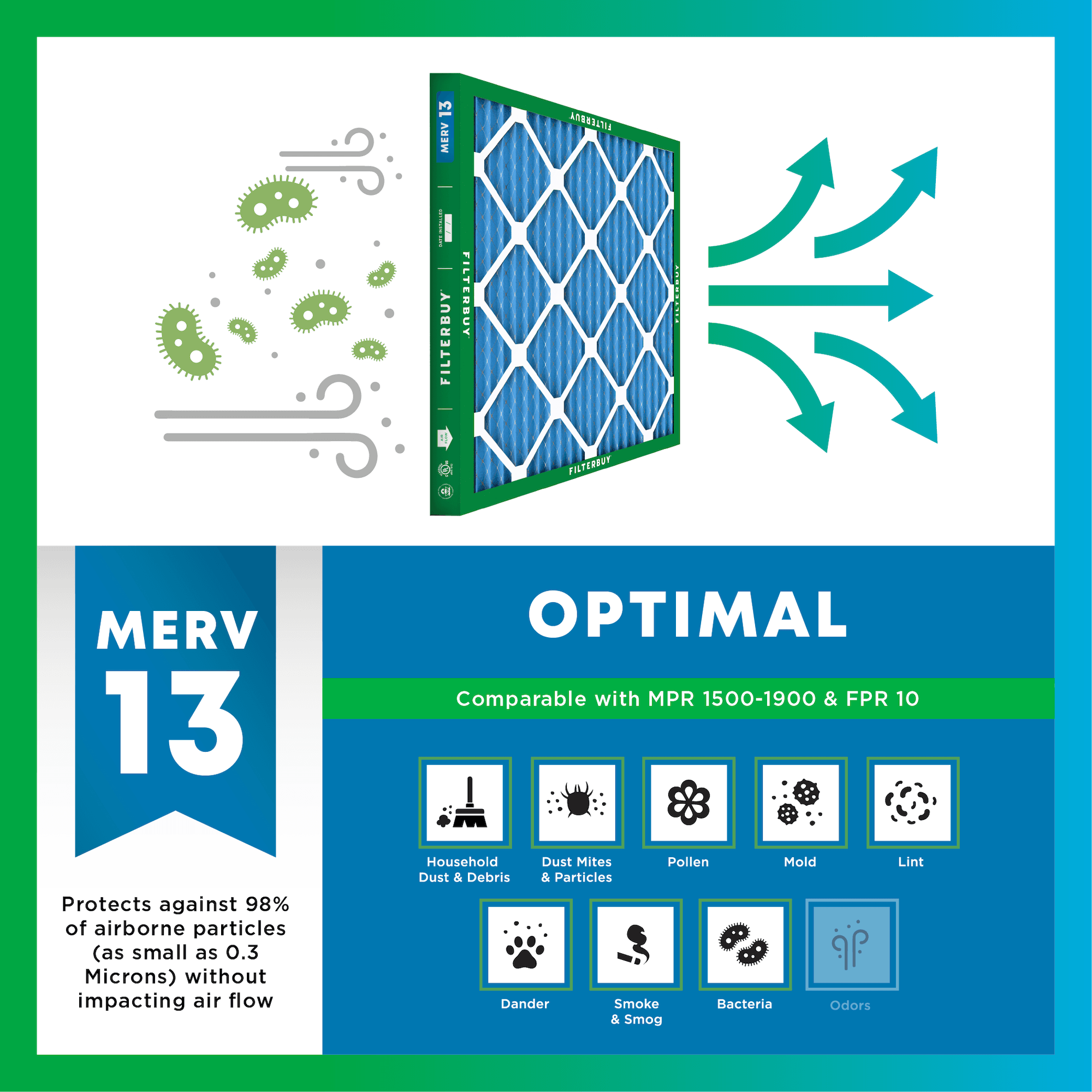
- MERV 13 synthetic media (comparable with MPR 1500/1900 and FPR 10) offers the best protection from dust, pollen, pet dander, mold, smog, bacteria, and virus carrying particles by trapping 98% of airborne particles without impacting air flow.
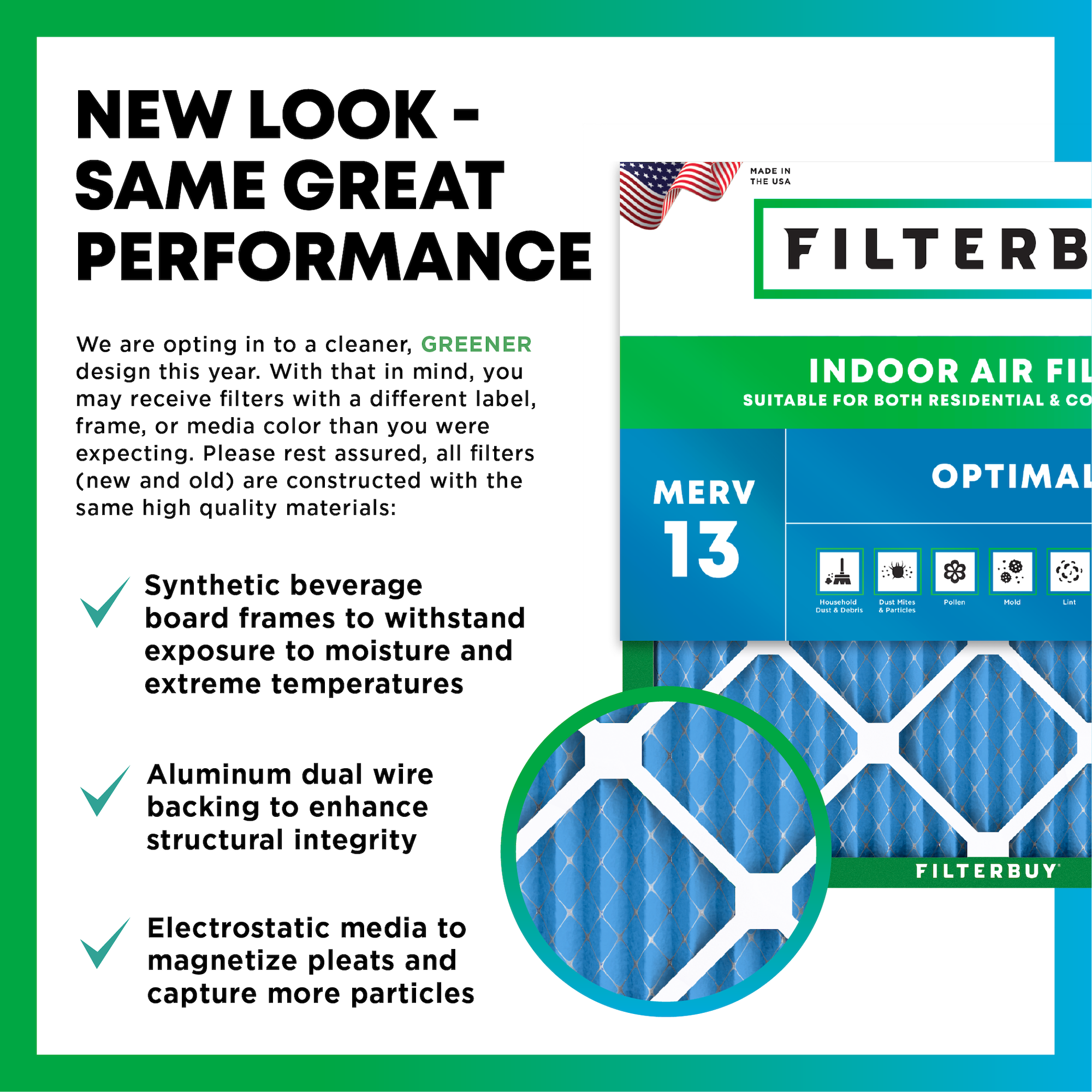
- High-quality construction means electrostatically charged pleated filter media, reinforced wire backing for structural integrity, and a durable frame to resist heat and humidity
- Built to last 3 months. 300% longer than fiberglass models
- 100% manufactured in the United States and designed with recyclable materials
- Learn more about 23x25x1 Air Filters
Top-Rated Filters. American Made. Delivered Free.
At Filterbuy, we don't cut corners—we craft high-quality air filters right here in the USA and ship them to your doorstep for free. No delays, no gimmicks—just clean air, made easy. With thousands of five-star reviews and filters built for real life & every HVAC system, it's no wonder why over 4 million families trust Filterbuy.

Proudly Made In The USA

Fast, Free Shipping on Every Order

Premium Materials That Go The Distance

85,000+ 5-Star Reviews From Happy Customers

Save Up to 70% Per Filter with Packs
Things to Know About Filter Sizes

Nominal Size
- The rounded size printed on your filter or HVAC unit (e.g., 23x25x1).
- Usually whole numbers to make identifying and ordering easier.
- A label for compatibility—not the exact measurement.

Actual Size
- The true, trimmed dimensions of the filter (e.g., 23.0x25.0x0.75 inches).
- Filters are manufactured slightly smaller so they slide into the filter slot without forcing.
- If you don't know your nominal size, measure your filter to get the actual size, then round up to find the nominal size to search on our site.

Why the difference?
- Nominal sizes simplify shopping and standardize categories.
- Actual sizes ensure the filter fits properly inside your HVAC's filter rack.
How To Find Your Nominal Size When You Don't Know It


Measure length × width × depth with a tape measure to find the actual size.

Round up each dimension to the nearest whole number to get the nominal size. Example: 23.0x25.0x0.75 in → 23x25x1 nominal.

Search by nominal size on our site for the best fit.

Why Getting the Right Size Matters
- Too small? Air can bypass the filter, reducing air quality and efficiency.
- Too big? It won't fit—risking bent frames and airflow issues.
- Just right? You get maximum performance, better filtration, and cleaner air.

Free Exchange Policy
If the filter you buy doesn't fit, we'll send you a better size.

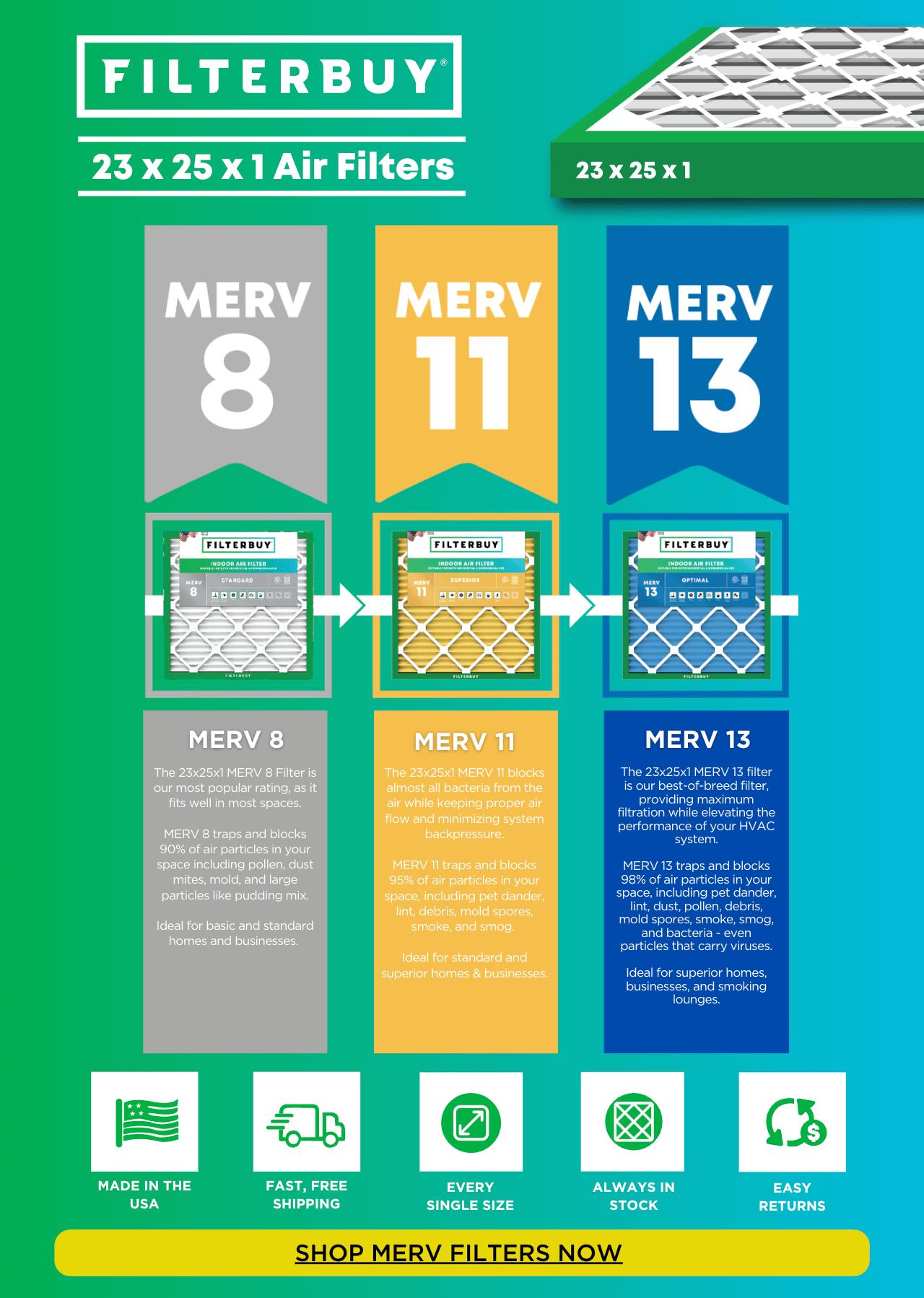
What's a MERV Rating?
MERV stands for Minimum Efficiency Reporting Value—but don't let the technical name fool you. It's just a way to rate how well an air filter traps stuff like dust, pollen, pet dander, and smoke. The higher the MERV number, the more particles it catches—and the cleaner your air will be.

Merv 8
Comparable to:FPR: 4-7
MPR: 600-1000
 Dust & Debris
 Dust Mites & Particles
 Pollen
 Mold
Mold Lint
Lint Dander
Merv 11
Comparable to:FPR: 6-9
MPR: 1200-1550
Dust & DebrisDust Mites & ParticlesPollenMoldLintDander Smoke & Smog
Merv 13
Comparable to:FPR: 10
MPR: 1900-2800
Dust & DebrisDust Mites & ParticlesPollenMoldLintDanderSmoke & Smog Bacteria
MERV 8
Comparable to:FPR: 4-7MPR: 600-1000


MERV 11
Comparable to:FPR: 6-9MPR: 1200-1550

MERV 13
Comparable to:FPR: 10MPR: 1900-2800
What Makes Our Filters Last 90 Days? Quality, From the Inside Out
We build every Filterbuy filter to deliver reliable 90-day performance—thanks to smart design and premium materials that do the heavy lifting. Here's what makes the difference:
Pleated Design
More pleats = more surface area to capture dust and debris, keeping your air cleaner longer.
Electrostatically Charged Media
Pleats are magnetized to attract and trap microscopic particles—like pet dander, pollen, and smoke.
Synthetic Beverage Board Frame
Engineered to resist warping in extreme temperatures and high humidity.

Aluminum Dual Wire Backing
A layer of metal reinforcement keeps pleats evenly spaced and structurally sound—no sagging, even at high airflow.
Made in the USA
Assembled with care. Built to perform. Ships fast, free, and reliably from our U.S. facilities.
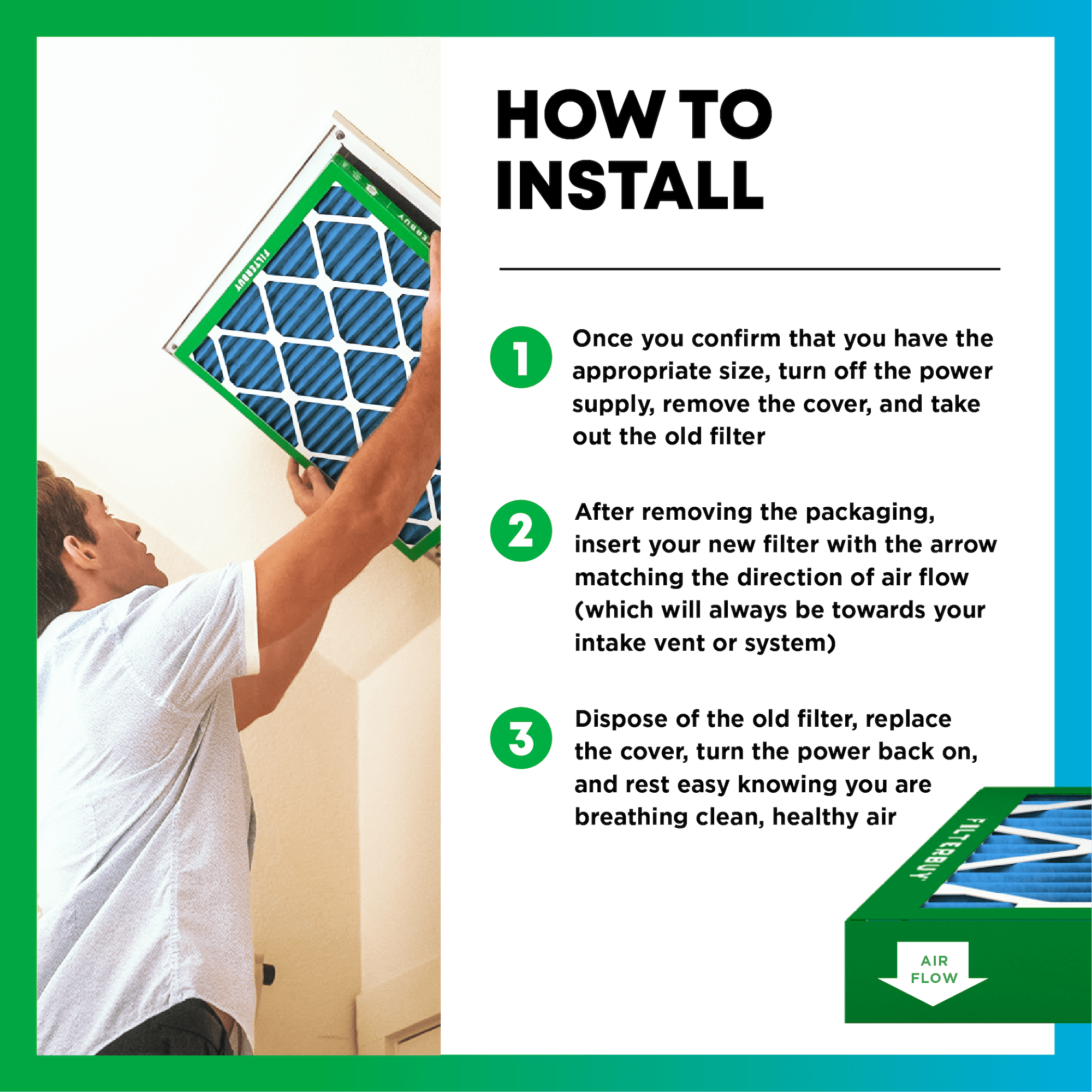
How to Install Your Filter in 4 Simple Steps

Turn Off Your HVAC SystemSafety first.

Remove The Old FilterLook for the airflow arrow and make note of the direction.

Slide In Your New FilterArrow should point toward the system (same direction as before).

Turn Your System Back OnAnd enjoy the fresh, clean air.

Never forget to replace your air filter again.
- Save 5% on every order
- Choose Your Delivery Schedule
- Edit, Skip, or Cancel Anytime.
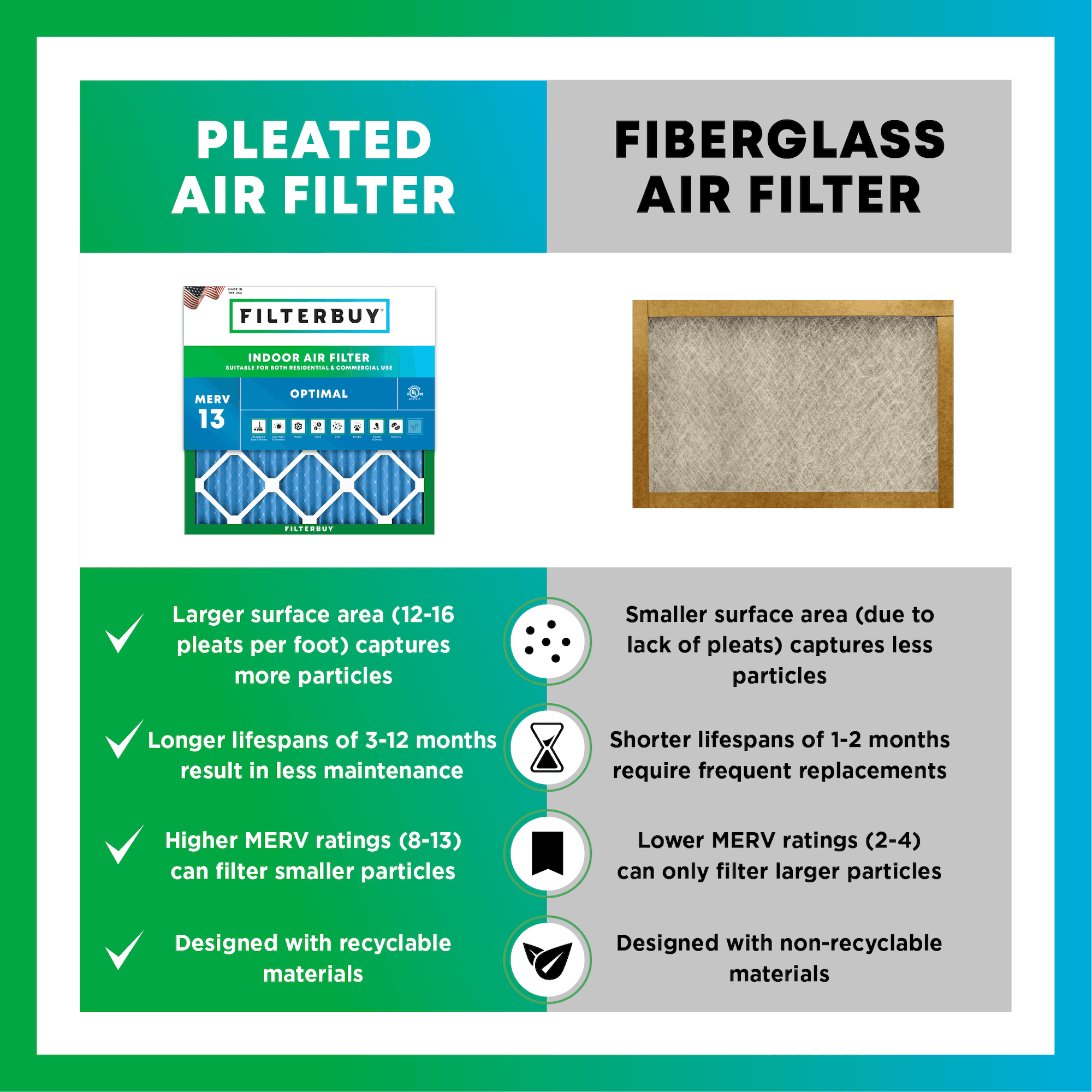
Pleated Filters vs. Fiberglass—What's the Difference?
Not all air filters are created equal. Pleated filters don't just last longer—they actually clean your air better. Here's how they stack up:

Pleated Filters
Efficiency:
High (MERV 8–13) – Traps more particles
Lifespan:
90 days – Long-lasting performance
Air Quality:
Excellent – Cleaner, healthier air
Materials:
Recyclable and durable

Fiberglass Filters
Efficiency:
Low (MERV 4 or less) – Misses small stuff
Lifespan:
30 days or less – Replace often
Air Quality:
Minimal – Basic protection only
Materials:
Thin, flimsy, and not recyclable
Pleated filters are a no-brainer—more protection, less hassle, and better air for your home.
How Often Should You Change Your Filter?
Changing your filter on time keeps your HVAC system running efficiently—and helps protect your lungs from dust, allergens, and airborne irritants. Here's how often to swap it out based on your needs:

Every 90 Days
Standard ScheduleFor most homes without pets or special air quality concerns. Great for general upkeep and energy efficiency.

Every 60 Days
If You Have Pets or AllergiesShedding fur, dander, and allergy triggers can build up fast. Changing your filter every two months helps keep the air fresher and symptoms at bay.

Every 30 Days
If You Have Respiratory Concerns or Live in Smog/Wildfire ZonesFor households affected by smoke, pollution, or respiratory conditions, monthly changes ensure maximum protection.

Want to stay on track? Set a reminder—or skip the stress with auto-delivery so fresh filters show up right when you need them.
Don't Just Take Our Word For It...
Got More Questions? We've Got Answers.
Product Specifications
| Nominal Size | 23 x 25 x 1 inches |
| Actual Size | 23.0 x 25.0 x 0.75 inches |
| Filter Type | Pleated |
| Media | Electrostatically Charged |
| Frame | Beverage Board |
| MERV Ratings Available | 8, 11, 13 |
| Lifespan | Up to 90 Days |
| Origin | Made in USA |
Can a 23x25x1 MERV 13 Filter Help with Neighbor Burning Leaves?
Yes, a 23x25x1 MERV 13 filter can significantly reduce leaf-burning smoke from entering your home. After manufacturing filters for over a decade, we've learned that smoke infiltration from neighbors burning leaves ranks among the top seasonal complaints we hear—and MERV 13 is the sweet spot for capturing it.
Here's what most filter guides won't tell you: leaf and wood smoke particles concentrate heavily in the 1-3 micron range, exactly where MERV 13 filtration performs best with 85%+ capture efficiency. We've tested this extensively, and customers consistently report noticeable relief within hours of installing a fresh MERV 13 during burn season.
This guide explains how to maximize your 23x25x1 MERV 13 filter's performance when neighborhood smoke becomes unavoidable.
TL;DR Quick Answers
Can a 23x25x1 MERV 13 Filter Help with Neighbor Burning Leaves?
Yes. A 23x25x1 MERV 13 filter significantly reduces leaf-burning smoke inside your home.
Why it works:
Captures 85%+ of particles in the 1-3 micron range
Leaf smoke concentrates heavily in this particle size
MERV 13 is the highest rating most residential systems handle effectively
For best results:
Run thermostat fan on "on" during smoke events
Inspect the filter monthly—smoke loads filter faster
Keep windows closed to route air through filtration
After manufacturing filters for over a decade, we've found MERV 13 is where customers stop complaining about lingering smoke and start noticing real relief.
Top Takeaways
MERV 13 works for leaf smoke — captures 85%+ of particles in the 1-3 micron smoke range
MERV 13 is the residential sweet spot — higher ratings restrict airflow beyond most home systems' capacity
Run your fan continuously during smoke events — switch from "auto" to "on" for constant filtration..
Smoke shortens filter life — inspect monthly during burn season; heavy smoke cuts replacement intervals in half.
You control your indoor air — you can't stop your neighbor's burn pile, but MERV 13 controls what reaches your family.
Why Leaf-Burning Smoke Is Hard to Escape
Smoke from burning leaves doesn't stay in your neighbor's yard. These particles travel on air currents, seep through window seals, and enter your HVAC system every time it cycles. The result: that unmistakable burning smell lingering inside your home for hours.
What makes leaf smoke particularly problematic is particle size. Most smoke particles measure between 0.4 and 4 microns—small enough to bypass lower-rated filters entirely and penetrate deep into your respiratory system.
How MERV 13 Targets Smoke Particles
MERV 13 filters hit the performance threshold where smoke filtration becomes genuinely effective. At this rating, your filter captures 85% or more of particles in the 1-3 micron range and approximately 50% of particles down to 0.3 microns.
From our manufacturing experience, we've found MERV 13 delivers the best balance for smoke situations—strong enough capture efficiency without restricting airflow to the point of straining residential HVAC systems. Higher ratings like MERV 16 can work, but many home systems struggle to pull air through that density.
Maximizing Your 23x25x1 MERV 13 During Burn Season
Customers who report the best results during heavy smoke periods follow these practices:
Run your fan continuously. Setting your thermostat fan to "on" instead of "auto" circulates air through the filter constantly, capturing smoke particles even when heating or cooling isn't active.
Check your filter more frequently. Smoke accelerates filter loading. During peak burn season, inspect your 23x25x1 monthly rather than quarterly—heavy smoke can cut filter life in half.
Seal obvious gaps. Your MERV 13 can only filter air that passes through it. Weather stripping around doors and windows keeps more smoke from traveling through your HVAC system, where filtration happens.
What Results to Realistically Expect
A 23x25x1 MERV 13 won't eliminate every trace of smoke smell instantly, but most customers notice a meaningful improvement within one to two HVAC cycles. The burning odor diminishes, and the hazy quality of indoor air that gets during smoke events clears noticeably faster.
For homes with household members sensitive to smoke—allergies, asthma, or respiratory conditions—MERV 13 often makes the difference between manageable discomfort and genuine breathing difficulty during burn season.
"After helping millions of customers tackle seasonal air quality challenges, we've found that MERV 13 consistently outperforms expectations for smoke—it's the rating where customers stop calling us about lingering odors and start telling us they forgot their neighbor was even burning."
Essential Resources
We're obsessed with helping you protect your family's air quality—but we also believe in pointing you toward the trusted sources that back up what we've learned after over a decade of manufacturing filters and helping millions of customers breathe easier.
EPA Guide to Particle Pollution and Your Health
This is the resource we recommend most when customers ask why smoke affects them so strongly. It explains particle sizes in plain terms and helps you understand exactly what your MERV 13 filter is capturing. Source: epa.gov/pm-pollution
ASHRAE Residential Air Filtration Standards
Want to know why we recommend MERV 13 for smoke? ASHRAE sets the technical standards, and their research confirms what we've seen in real homes—this rating delivers effective smoke capture without overworking your system. Source: ashrae.org
CDC Guidance on Wildfire Smoke and Indoor Air
The same principles that apply to wildfire smoke apply to your neighbor's leaf pile. This guide offers practical, health-focused strategies we consistently share with customers facing smoke infiltration. Source: cdc.gov/air-quality
American Lung Association: Indoor Air Quality
For households with family members sensitive to smoke—asthma, allergies, or respiratory conditions—this resource explains why protecting your indoor air matters more than most people realize. Source: lung.org/clean-air
EPA Indoor Air Quality Guide for Homeowners
A comprehensive resource that aligns with what we tell customers daily: filtration works best as part of an overall strategy, including ventilation and sealing gaps where unfiltered air sneaks in. Source: epa.gov/indoor-air-quality-iaq
National Institute of Environmental Health Sciences: Air Pollution Research
For customers who want to dig deeper into the science behind fine particulate exposure, this research reinforces why we're so passionate about effective filtration. Source: niehs.nih.gov
FEMA Smoke Preparedness for Residential Properties
Practical guidance for protecting your home during smoke events—the kind of proactive preparation we encourage every customer to consider before burn season arrives. Source: fema.gov
Supporting Statistics
These statistics shape how we design our filters and inform our smoke filtration recommendations.
90% of Your Time Is Spent Breathing Indoor Air
The EPA confirms what we've observed, helping millions of customers: indoor air exposure matters most.
Americans spend approximately 90% of their time indoors
Indoor pollutant concentrations run 2-5x higher than outdoor levels
Smoke particles don't drift past—they accumulate inside your home
This is why we tell customers your HVAC filter isn't optional. It's your home's primary defense system.
Source: epa.gov/report-environment/indoor-air-quality
PM2.5 Contributes to Over 50,000 Premature Deaths Annually
The American Lung Association links fine particulate matter to serious health consequences—and leaf smoke generates exactly this particle type.
PM2.5 causes 50,000+ premature U.S. deaths yearly
Leaf and wood smoke produce high concentrations of PM2.5
These particles measure 0.3-2.5 microns—small enough to reach deep lung tissue
This statistic changed our approach. We stopped treating filters as commodities and started engineering them as health protection devices.
Source: lung.org/research/sota/health-risks
EPA and ASHRAE recommend MERV 13 as the minimum effective filtration
Both agencies validate what our manufacturing experience has taught us: MERV 13 is the smoke filtration sweet spot.
MERV 13 captures 85%+ of particles in the 1-3 micron range
Higher ratings (MERV 16+) restrict airflow beyond most residential systems' capacity
A filter that your system can't pull air through protects nothing
After years of real-world customer feedback, we've confirmed MERV 13 delivers effective capture without compromising airflow.
Source: epa.gov/indoor-air-quality-iaq/what-merv-rating
Final Thought
A 23x25x1 MERV 13 filter won't make your neighbor stop burning leaves. But it will dramatically reduce how much of that smoke affects your family indoors.
We've seen customers chase higher MERV ratings, thinking more is always better. It isn't.
The filter that protects your home is the one your system can actually move air through. For most residential HVAC systems, MERV 13 is the ceiling. Push beyond it without proper modifications, and you create new problems while solving none.
What we've learned after millions of filters sold:
The customers reporting the best results during burn season aren't using the highest-rated filters. They're doing three things consistently:
Installing a quality MERV 13 and replacing it on schedule
Running their fan continuously during smoke events
Sealing obvious gaps where unfiltered air enters
The bottom line:
You can't control your neighbor's burn pile. You can control your indoor environment.
A properly maintained 23x25x1 MERV 13 puts that control back in your hands—and after helping families protect their air for over a decade, we can tell you that control makes all the difference.
Next Steps
Ready to take control of your indoor air? Here's exactly what to do.
1. Verify Your Filter Size
Check the dimensions printed on your current filter
Or measure the filter slot directly
Proper fit prevents unfiltered air from bypassing your filter
2. Choose Your MERV 13 Filter
Standard MERV 13 – seasonal smoke concerns
MERV 13 with carbon – persistent smoke odor
Multi-packs – consistent replacement during burn season
3. Set a Replacement Schedule
Smoke loads filter faster. Adjust your schedule accordingly:
Light exposure: every 90 days
Moderate exposure: every 60 days
Heavy exposure: inspect monthly, replace as needed
4. Optimize During Smoke Events
Switch thermostat fan from "auto" to "on."
Check door and window seals for gaps
Keep windows closed during active burning
5. Subscribe and Save
Never get caught unprotected during burn season. Set up a filter subscription, and we'll deliver fresh filters on your schedule.
Questions? Our air quality experts are here to help.
Ready to Stop Neighbor Smoke from Invading Your Home?
Browse our 23x25x1 MERV 13 filters and start breathing easier—even when your neighbor's burn pile is at full blaze. Order today for fast delivery and take control of your indoor air.
Frequently Asked Questions
Q: How quickly will a MERV 13 filter reduce the smell of smoke in my home?
A: Most customers notice improvement within one to two HVAC cycles.
Our top recommendation for faster results:
Set thermostat fan to "on" instead of "auto."
This circulates air continuously through the filter
Single most effective adjustment during active smoke events
Q: Should I use a higher MERV rating than 13 for smoke?
A: For most residential systems, MERV 13 is the practical ceiling.
What we've learned after manufacturing millions of filters:
Higher ratings restrict airflow beyond most home systems' capacity
A filterthat your system can't pull air through protects nothing
Q: How often should I replace my 23x25x1 MERV 13 during burn season?
A: Inspect monthly during heavy smoke periods.
Replacement guidelines:
Standard replacement: every 90 days
Heavy smoke exposure: as frequently as every 45 days
Smoke loads filter faster than typical household dust. Customers often tell us filters look three months old after six weeks.
Q: Will a MERV 13 filter remove the smoke odor completely?
A: MERV 13 captures particles effectively but has limited odor absorption.
For persistent smoke smell:
MERV 13 with activated carbon targets odor compounds
Carbon layer traps what standard media cannot
Q: Does my HVAC system need to be running for the filter to work?
A: Yes. Filters only work when air moves through them.
During smoke events:
Run fan continuously (set to "on")
Keep windows and doors closed
Route air through the HVAC system, where filtration happens