May 5, 2026

Every winter, homes become tightly sealed environments where carbon monoxide and smoke don't just linger — they travel. And the system responsible for moving them? Your HVAC.
Most safety guides stop at "install CO detectors and maintain your fireplace." That's important, but it misses a bigger picture. Your forced-air system controls how contaminants circulate, where they concentrate, and how fast they reach dangerous levels. A restricted filter or leaky ductwork doesn't just reduce comfort — it can turn your heating system into a distribution network for the very gases you're trying to avoid.
At Filterbuy, we've manufactured millions of air filters and heard directly from customers dealing with smoke odors, back-drafting fireplaces, and unexplained headaches during heating season. What we've learned is that airflow isn't just an efficiency issue — it's a safety issue. Here's how to make sure your HVAC system is protecting your family this winter, not working against it.
Carbon monoxide and smoke become significantly more dangerous in winter because sealed homes trap contaminants that would otherwise dissipate through open windows and natural ventilation. Your HVAC system plays a central role — it either dilutes and filters these threats or circulates them to every room in your house.
What every homeowner needs to know:
CO is invisible and odorless. You won't detect it without a working alarm. Symptoms like headaches, fatigue, and nausea mimic the flu and are easy to dismiss.
Your HVAC airflow is your first line of defense. A clean filter and sealed ductwork prevent the negative pressure that pulls CO into living spaces. A clogged filter does the opposite.
Winter demands more frequent filter changes. Replace every 30–60 days during heating season — not the standard 90 days. Systems run harder, and filters load faster in cold months.
Detectors and airflow work as a team. CO alarms are reactive — they alert you after the problem exists. Proper airflow is preventive — it reduces the conditions that create the problem.
Three things to do right now:
Check your air filter and replace it if overdue.
Test every CO detector and smoke alarm in your home.
Inspect all vents and registers for blockages.
After manufacturing millions of filters and hearing from customers every heating season about the same preventable issues, we can say this with confidence: most winter CO and smoke problems aren't caused by faulty equipment. They're caused by restricted airflow that nobody checked until symptoms appeared.
Airflow is a safety issue — not just a comfort issue. Your HVAC system controls how CO and smoke move through your home. Clogged filters and leaky ducts create negative pressure that pulls dangerous gases into living spaces.
Winter multiplies the risk. Sealed homes, longer heating cycles, and no natural ventilation mean contaminants build up faster. Indoor pollutant levels can reach 2–5x higher than outdoor air — and that gap grows in winter.
Detection and prevention are a team. CO detectors alert you after the problem exists. Proper airflow prevents the conditions that trigger those alarms in the first place. You need both layers working together.
The most common fix is the simplest. Most winter airflow problems we see trace back to one thing: an overdue filter replacement. Two minutes. One swap. Measurable reduction in CO risk and system strain.
A few minutes now can prevent an emergency later. Check your filter. Inspect your vents. Test your detectors. Schedule an HVAC inspection. Small steps — big difference between a system protecting your family and one working against it.
Carbon monoxide is odorless, colorless, and responsible for hundreds of deaths and thousands of emergency room visits every year in the United States, with the highest concentration of incidents occurring during winter months. Unlike smoke, which you can often see or smell, CO gives no warning until symptoms like headaches, dizziness, and fatigue set in.
During winter, the risk compounds. Furnaces run longer cycles, fireplaces burn more frequently, and homes stay buttoned up tight with minimal fresh air exchange. Smoke from wood-burning stoves, cooking, and even candles doesn't dissipate the way it does in warmer months when windows are open. Instead, it recirculates — and your HVAC system determines where it goes.
Your forced-air heating system is the lungs of your home. When it's working properly, it dilutes contaminants, promotes ventilation, and helps CO detectors pick up threats faster by moving air past sensors. When it's not, the opposite happens.
A clogged or restricted filter forces your system to pull air from wherever it can — including gaps around flue pipes, attached garages, and combustion appliance zones where CO concentrations are highest. This creates negative pressure that can actually draw carbon monoxide into your living spaces. Leaky ductwork compounds the problem by depositing contaminated air into rooms far from the original source, spreading smoke particles and gases throughout the house before anyone notices.
We see this pattern repeatedly in customer feedback during heating season: lingering smoke smells in rooms nowhere near the fireplace, persistent dust despite regular cleaning, and family members experiencing headaches that disappear when they leave the house. In many cases, the root cause isn't the heating appliance itself — it's how the HVAC system is handling the air around it.
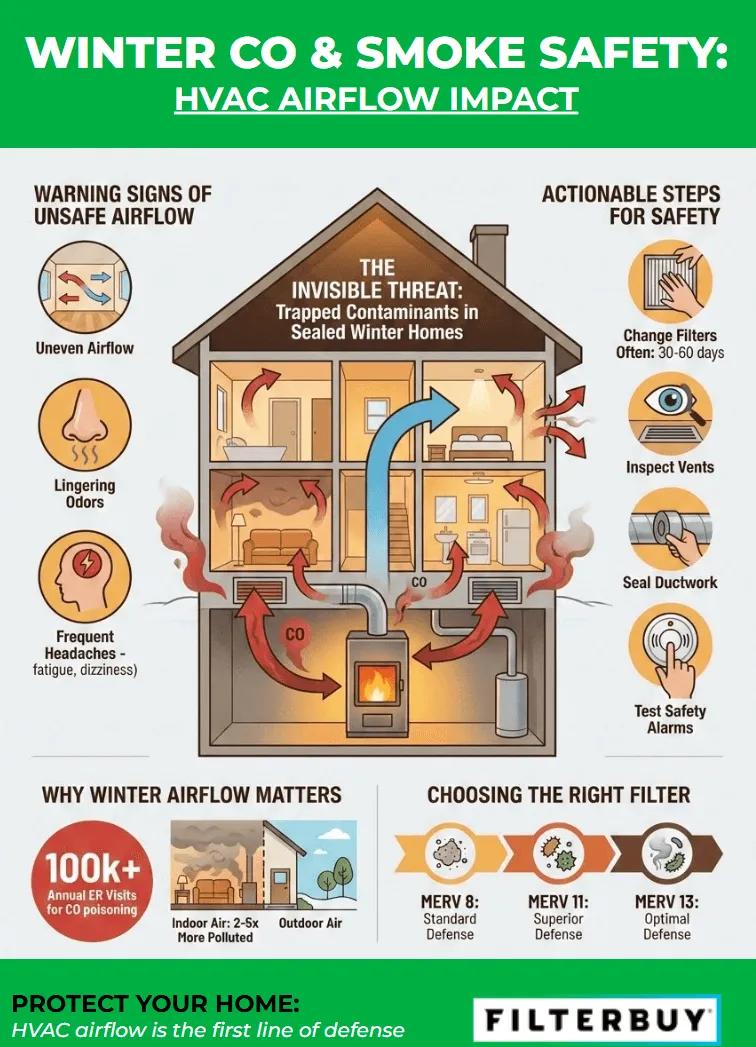
Your home often tells you when airflow has become a safety concern. Here are the signals most homeowners miss:
Uneven or weak airflow from registers — some rooms get strong output while others barely move air, indicating blockages or duct issues that create pressure imbalances.
Lingering odors and visible haze — smoke or cooking smells that hang in the air for hours instead of clearing suggest your system isn't exchanging air effectively.
Frequent headaches, fatigue, or nausea — especially symptoms that improve when you step outside, which can indicate CO exposure or poor ventilation.
Fireplace or stove back-drafting — smoke pushing back into the room instead of going up the chimney is a direct sign of negative pressure caused by HVAC imbalance.
Ice forming around exterior vents or exhaust pipes — this can signal blocked exhaust that forces combustion byproducts back into your home.
If you notice any combination of these, don't wait. Address your airflow first — it's often the fastest path to resolving the underlying safety issue.

The good news is that most airflow problems have straightforward solutions. Based on what we've learned from over a decade of manufacturing filters and working with HVAC professionals, these are the highest-impact steps homeowners can take:
Change your filters on schedule — or more often in winter. Heating systems run harder and longer during cold months, which means filters load up faster. A filter that lasted 90 days in summer may need replacing in 60 days or less during peak heating season. A restricted filter is the single most common cause of airflow problems we hear about from customers.
Choose the right efficiency level for your system. Higher-MERV filters capture more smoke particles and fine contaminants, but they also require your system to work harder to push air through. The key is matching filter efficiency to what your HVAC system can handle. Most residential systems perform well with MERV 8 to MERV 13 filters — enough to capture smoke particles without starving the system of airflow.
Inspect and seal ductwork. Leaky ducts don't just waste energy — they create pathways for contaminated air to enter and spread. Even small gaps at duct joints can pull in CO from utility closets, attics, or crawl spaces and distribute it throughout your home.
Ensure proper ventilation in high-risk areas. Rooms with gas appliances, fireplaces, or wood stoves need adequate makeup air. If your HVAC system is competing with these appliances for air, negative pressure builds, and back-drafting becomes a real risk.
Schedule a professional HVAC inspection before winter. A technician can check for cracked heat exchangers — one of the most common sources of CO leaks in forced-air systems — along with duct integrity, proper venting, and overall system performance.
Proper airflow is one layer of protection, but it works best alongside these fundamentals:
Install CO detectors on every level of your home, especially near bedrooms and within 15 feet of any fuel-burning appliance. Test them monthly and replace batteries at least once a year. Ensure smoke alarms are positioned correctly and functioning — test those monthly as well. Practice safe fireplace and appliance use by never running unvented gas heaters indoors and always confirming flues are open before lighting a fire. Have an emergency ventilation plan that your household knows: if CO alarms sound, open windows and doors immediately, get everyone outside, and call 911 before re-entering.
Addressing airflow isn't just a winter safety measure — it pays dividends year-round. Properly flowing systems reduce respiratory irritant concentrations, lower the strain on your HVAC equipment (extending its lifespan and reducing repair costs), and maintain more consistent temperatures throughout your home.
From a safety perspective, good airflow means contaminants get diluted and moved past detection sensors faster, giving you an earlier warning when something is wrong. It means your system isn't creating the negative pressure zones that pull CO into living spaces. And it means your filters can actually do their job — capturing smoke particles, dust, and allergens instead of being bypassed by air finding the path of least resistance through gaps and leaks.
Customers tell us that once they get their airflow right, everything else improves: fewer odors, less dust, better comfort, and the peace of mind that comes from knowing their HVAC system is working with them — not against them.
"After manufacturing millions of filters and hearing from customers every winter about smoke odors they can't explain and headaches that disappear when they leave the house, we've learned that airflow isn't just a comfort issue — it's the most overlooked safety factor in winter home protection." — Filterbuy Team
At Filterbuy, we're obsessed with what's in your air — and during winter, that includes invisible threats like carbon monoxide and smoke that most homeowners don't think about until it's too late. After working with millions of customers and hearing firsthand how airflow problems contribute to CO and smoke issues during heating season, we know that good information is your first line of defense.
We've pulled together the most trusted resources from the agencies that set the standard for home safety. Use these to take control of your indoor air and protect what matters most — your family, your home, and the HVAC system that connects them.
Most people don't realize that CO poisoning symptoms look a lot like the flu — and by the time you notice, dangerous levels may already be in your home. The CDC's guide breaks down how carbon monoxide is produced, who's most at risk, and the detection and prevention steps every household should have in place before you turn on the heat.
Why this matters for your air: Carbon monoxide is the definition of an invisible threat. You can't see it, smell it, or taste it — but your HVAC system can move it to every room in your house if airflow isn't managed properly.
Source: Centers for Disease Control and Prevention (CDC) — Carbon Monoxide Poisoning Basics
The EPA explains how CO concentrations develop in indoor environments, with links to OSHA exposure guidelines, CPSC alarm recommendations, and published research on both short-term and prolonged health effects. This is the science behind why sealed-up winter homes are particularly vulnerable.
Why this matters for your air: When we tell customers that airflow is a safety issue and not just a comfort issue, this is the research that backs it up. Tight homes with poor ventilation trap exactly the contaminants this resource helps you identify.
Source: U.S. Environmental Protection Agency (EPA) — Carbon Monoxide's Impact on Indoor Air Quality
epa.gov/indoor-air-quality-iaq/carbon-monoxides-impact-indoor-air-quality
This EPA resource explains how source control, ventilation, and air filtration work together to reduce contaminant levels indoors. One key takeaway: most residential forced-air heating systems don't bring in fresh outdoor air on their own — which makes filter maintenance and duct integrity absolutely critical during winter months.
Why this matters for your air: This is the resource that connects directly to what we see every day at Filterbuy. A clean, properly rated filter is one of the most accessible ways homeowners can improve ventilation efficiency and keep pollutants from recirculating through their homes.
Source: U.S. Environmental Protection Agency (EPA) — Improving Indoor Air Quality
epa.gov/indoor-air-quality-iaq/improving-indoor-air-quality
The CPSC's winter safety guidance covers where CO alarms should be placed, how to maintain fuel-burning appliances, generator safety rules, and the emergency steps to take immediately if an alarm sounds. Think of this as your household's CO action plan.
Why this matters for your air: Detectors and filters work as a team. Your CO alarm tells you when something is wrong — but proper HVAC airflow helps move air past those sensors faster, giving you an earlier warning when contaminant levels rise.
Source: U.S. Consumer Product Safety Commission (CPSC) — Protect Your Family from Carbon Monoxide Poisoning
cpsc.gov/safety-education — Carbon Monoxide Information Center
Nearly half of all U.S. home heating fires occur between December and February. The NFPA provides data-backed safety recommendations for furnaces, fireplaces, wood stoves, and space heaters — along with chimney inspection and maintenance guidance that every homeowner should review before winter starts.
Why this matters for your air: Heating equipment fires produce massive amounts of smoke and toxic gases. Keeping your heating system properly maintained — including regular filter changes — reduces the strain that leads to malfunctions, overheating, and fire risk.
Source: National Fire Protection Association (NFPA) — Home Heating Safety
nfpa.org/education-and-research/home-fire-safety/heating
FEMA's CO prevention page provides free downloadable materials, alarm installation guidelines, and community awareness resources designed to help households detect carbon monoxide early and respond safely. Their guidance on alarm placement is especially valuable for multi-story homes.
Why this matters for your air: We always tell customers that protection works in layers. CO alarms are your detection layer. Proper HVAC airflow and clean filters are your prevention layer. Together, they give you the best chance of catching problems before they become emergencies.
Source: U.S. Fire Administration (FEMA) — Carbon Monoxide Poisoning Prevention
usfa.fema.gov/prevention/life-safety-hazards/carbon-monoxide
The ALA provides health-focused guidance on recognizing CO poisoning symptoms, understanding who is most vulnerable, and taking preventive action — with particular emphasis on protecting children, older adults, and people with existing respiratory conditions.
Why this matters for your air: The symptom patterns the ALA describes — headaches, fatigue, nausea that improve when you leave the house — are exactly what customers report to us when they have restricted airflow and undetected CO movement in their HVAC systems. Knowing these warning signs could save your family's life.
Source: American Lung Association — How to Stay Safe from Carbon Monoxide Poisoning This Winter
lung.org/blog/carbon-monoxide-poisoning-safety
We don't cite these numbers to alarm you — we cite them because after manufacturing millions of air filters and hearing from customers every heating season about the same preventable problems, we know the gap between awareness and action is where the real danger lives.
The CDC reports that each year, more than 400 Americans die from unintentional CO poisoning not linked to fires, over 100,000 visit an emergency department, and more than 14,000 are hospitalized.
What we see at Filterbuy:
Many of these cases trace back to fuel-burning heating equipment in homes with restricted airflow and poor ventilation.
A furnace filter that's months overdue for replacement can create the negative pressure that pulls CO from utility spaces into bedrooms.
Customers regularly report unexplained winter headaches and lingering fatigue — symptoms that often resolve once airflow is restored with a fresh filter.
This statistic isn't abstract. It's happening in real homes, often because of something as fixable as a dirty filter.
Source: Centers for Disease Control and Prevention — Carbon Monoxide Poisoning Basics
The NFPA reports that nearly half of all U.S. home heating equipment fires — 46 percent — occur during December, January, and February. Between 2020 and 2024, fire departments responded to an average of 37,365 heating fires per year, resulting in 417 deaths, 1,260 injuries, and $1.2 billion in property damage.
What our manufacturing experience tells us:
When heating systems run extended cycles through a clogged filter, blower motors overwork and components overheat.
Our own order data reflects this — customers who wait until mid-January to replace filters are often reacting to problems that started weeks earlier.
Homeowners who swap filters at the start of heating season and again midway through winter rarely face these issues.
One filter change. Two minutes of effort. A measurable reduction in system strain and fire risk.
Source: National Fire Protection Association — U.S. Home Heating Fires Peak During Winter Months
nfpa.org/press-room/news-releases/2025
The EPA reports that Americans spend approximately 90 percent of their time indoors, where certain pollutant concentrations are often 2 to 5 times higher than typical outdoor levels.
Why does this change everything about how we make filters:
During winter, sealed homes with closed windows have no natural way to dilute pollutants.
Your HVAC system becomes the only mechanism — either capturing contaminants or recirculating them through every room.
Customers often tell us they assumed outdoor air was the bigger threat. Learning their indoor air can be significantly worse changes how they think about filter replacement entirely.
That shift — from seeing a filter as an HVAC part to understanding it as a frontline health defense — is something we witness with homeowners every day. It's exactly why we're obsessed with making this information accessible.
Source: U.S. Environmental Protection Agency — Indoor Air Quality
epa.gov/report-environment/indoor-air-quality
Most winter safety advice focuses on what to install — CO detectors, smoke alarms, and carbon monoxide monitors. That advice is correct. Those devices save lives every year, and every home should have them.
But after over a decade of manufacturing air filters and working with millions of homeowners, we've reached a conclusion most safety guides don't address: your HVAC system is either your strongest safety asset or your biggest blind spot, and the difference usually comes down to airflow.
A CO detector tells you when something has already gone wrong. Proper airflow helps prevent the conditions that trigger that alarm in the first place.
A clean filter and sealed ductwork keep your system from creating negative pressure zones that pull CO into living spaces.
Good airflow moves air past detector sensors faster, giving you an earlier warning when contaminant levels rise.
Reduced system strain means less risk of overheating, malfunction, and dangerous combustion byproducts.
Detection is reactive. Airflow management is preventive. You need both — but the preventive layer is the one most homeowners overlook entirely.
The same patterns come up year after year:
Smoke smells, they can't locate
Headaches that only happen when the heat is running
Fireplaces that suddenly back-draft into the living room
Almost every time, the root cause isn't a broken appliance or a faulty detector. It's restricted airflow — a filter that should have been changed weeks ago, ductwork leaking into the attic, or blocked vents creating invisible pressure imbalances.
Replace your filter. If it's been 60+ days during heating season, it's likely overdue.
Inspect your vents. Make sure nothing is blocking the supply or return registers.
Check your ductwork. Look for visible gaps, disconnected joints, or signs of leakage.
These aren't major renovations. They take minutes and cost a fraction of a single HVAC service call.
If you do one thing before winter hits full stride, make it an airflow check. Your CO detectors and smoke alarms are your last line of defense. Your HVAC airflow is your first. Make sure both are working for you — not against you.
You don't need to overhaul your HVAC system to make your home safer this winter. The most effective steps take minutes, and most cost less than a trip to the hardware store.
Check your air filter right now. Pull it out and hold it up to the light. If light isn't passing through, it's restricting airflow and needs immediate replacement. During heating season, most filters need to be swapped every 60 days or sooner.
Inspect every vent in your home. Look for furniture, rugs, curtains, or storage blocking supply or return registers. Even one blocked return vent can create pressure imbalances that lead to CO backdrafting.
Test all CO detectors and smoke alarms.
Press the test button on every unit.
Replace batteries if needed.
Replace any detector older than 5–7 years entirely.
Confirm placement on every level and near all sleeping areas.
Schedule a professional HVAC inspection. A technician can identify issues you can't see on your own:
Cracked heat exchangers
Duct leaks and disconnections
Improper venting of combustion byproducts
Set a filter replacement reminder. Don't rely on memory during the busiest season. Set a calendar alert or sign up for subscription delivery so your next filter arrives before you need it — not after problems start.
Not all filters perform the same during the heating season. Match the MERV rating to your household needs:
MERV 8 — Captures common dust and debris. Solid baseline for homes without specific air quality concerns.
MERV 11 — Traps finer particles, including pet dander, mold spores, and some smoke. Strong choice for most households in winter.
MERV 13 — Captures fine smoke particles, bacteria, and virus carriers. Ideal for homes with fireplaces, wood stoves, or respiratory sensitivities.
Pro Tip: Always confirm your system can handle the MERV rating you choose. A filter too restrictive for your equipment creates the same airflow problems you're trying to prevent. Check your owner's manual or ask your HVAC technician.
We manufacture over 600 filter sizes — including hard-to-find and custom dimensions — so you're never stuck waiting or settling for a fit that's not right. A properly sized, regularly replaced filter is the simplest step you can take to keep airflow working for your family's safety all winter.
Shop HVAC Air Filters at Filterbuy.com
A: This is one of the most common questions we get at Filterbuy. The short answer: no filter can capture CO — it's a gas, not a particle. But the filter's real safety role is maintaining the airflow that keeps CO from becoming dangerous.
Here's what we've learned after manufacturing millions of filters:
A clean filter keeps pressure balanced throughout your system.
Balanced pressure prevents backdrafting — the process that pulls CO from utility spaces into bedrooms and living areas.
Customers who experience CO-related symptoms in winter almost always have one thing in common: a filter that's long overdue for replacement.
The filter doesn't stop CO directly. It prevents the airflow conditions that allow CO to spread.
A: Yes — and this is something we wish more homeowners understood before heating season. CO can enter your air supply through:
A cracked heat exchanger in your furnace
Leaky duct connections near gas appliances
Negative pressure pulls gases from utility closets or garages
Once CO is in the system, your forced-air HVAC pushes it to every connected room. We hear from customers every winter who can't explain fumes or headaches in rooms far from the furnace. The answer is almost always the ductwork.
Two things reduce this risk most: sealed ducts and a properly maintained filter.
A: The standard 90-day schedule doesn't hold up during heating season. Based on millions of filter orders and direct customer feedback, most homes need replacement every 30–60 days in winter.
Why winter is different:
Systems run longer cycles.
Filters load up with contaminants faster.
Airflow restriction happens sooner than homeowners expect.
Our recommendation:
Check your filter monthly during heating season.
Replace when light no longer passes through easily.
Homes with pets, fireplaces, or respiratory sensitivities should lean toward every 30 days.
We see the pattern in our own order data — customers on a summer schedule are the ones calling about restricted airflow and strange odors in January.
A: After over a decade of manufacturing every MERV rating and working with HVAC professionals, our answer: MERV 11 to MERV 13 for most residential systems.
Here's the breakdown:
MERV 11 — Captures pet dander, mold spores, and some smoke particles. Strong all-around winter choice.
MERV 13 — The sweet spot for fine smoke from fireplaces, wood stoves, and cooking. Best protection most residential systems can handle.
The mistake we see most often: customers upgrading to MERV 13 in a system designed for MERV 8, then experiencing worse airflow than before.
The rule we tell every customer:
A properly maintained MERV 8 with good airflow will always outperform a MERV 13 that's choking your blower motor.
Check your HVAC manufacturer's specifications first.
When in doubt, ask your technician. The right filter for your system beats the highest-rated filter on the shelf.
A: After years of hearing from customers during heating season, we've found the earliest signs are the ones most easily dismissed. Here's what to watch for:
Headaches, dizziness, or fatigue that improve when you step outside — the number one symptom customers describe before discovering a CO or airflow issue
Lingering smoke or cooking odors — a sign your system isn't exchanging air effectively
Uneven airflow between rooms — strong in some, barely any in others — indicating blockages or pressure imbalances
Fireplace smoke pushing back into the room — a direct indicator of negative pressure from HVAC imbalance
Excess window condensation or ice around exterior vents — signals of restricted exhaust and poor ventilation
Our advice to every customer: don't ignore the combination.
One symptom alone might be nothing.
Two or more together warrant immediate action.
Start with a filter check and vent inspection.
If symptoms include headaches or fatigue, open windows, get everyone outside, and call a professional before going back in.
These are the situations where minutes matter.
Your HVAC system's airflow is the difference between a home that's protected from CO and smoke hazards and one that's quietly circulating them. Find your filter size at Filterbuy.com and take the simplest, most effective step toward safer winter air today
