
Best Furnace Filters for Asthma Relief This Winter
March 5, 2026
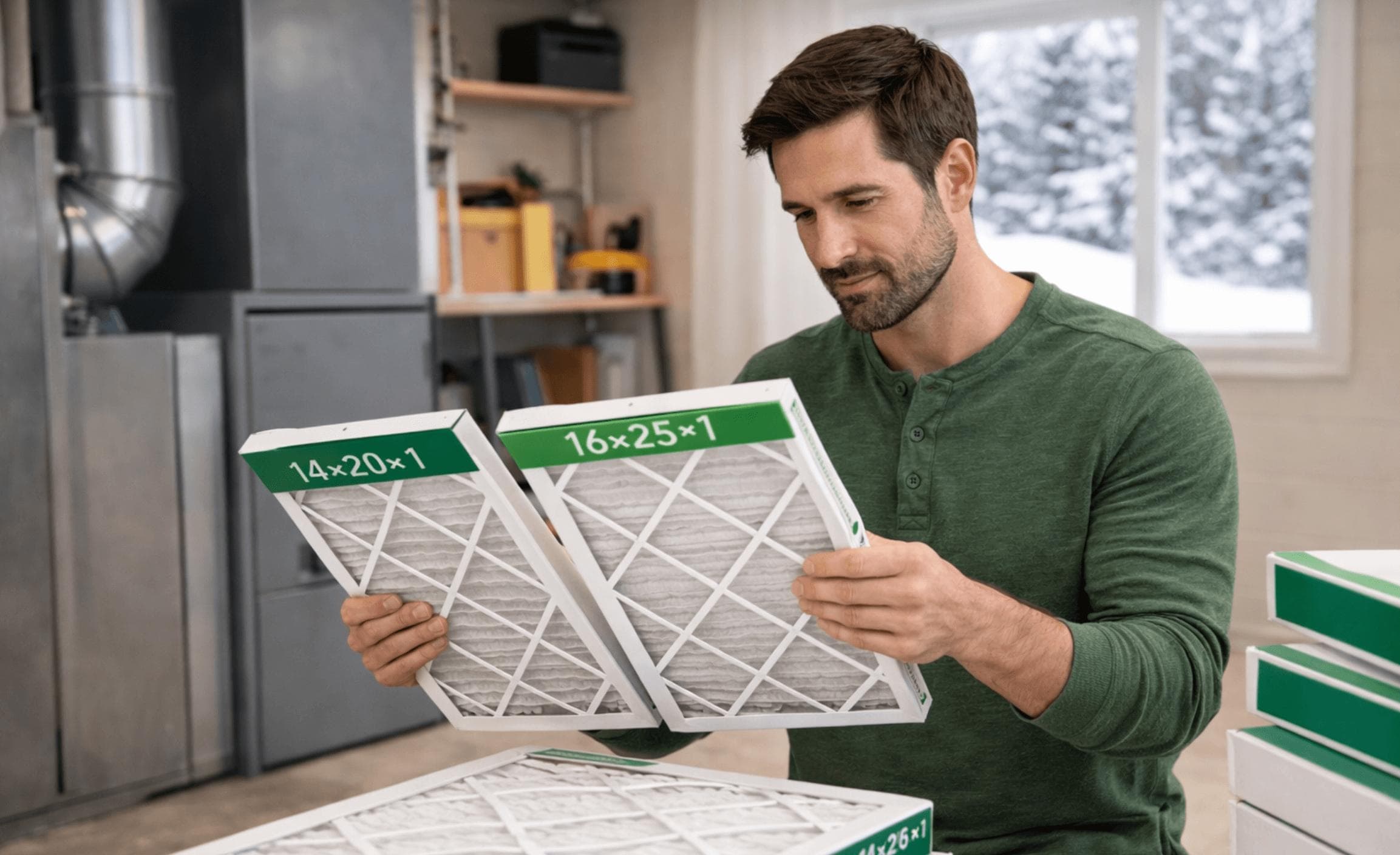
As winter settles in, you might find yourself retreating indoors to stay warm. But for around 25 million Americans living with asthma, closing the windows doesn't always mean keeping the danger out. Indoor air can sometimes be more polluted than outdoor air, especially when poor ventilation and heating systems trap dust, dander, and other irritants inside. If you or a loved one is wheezing, coughing, or experiencing shortness of breath this season, your furnace filter might be the culprit.
While it's not the cure, choosing the best furnace filters is a practical, effective step toward reducing the airborne triggers that worsen winter asthma. In this guide, we'll explain why winter is tough on asthma, how the right furnace filter can help, and which MERV ratings offer the best relief without overcomplicating your HVAC maintenance.
TL;DR Quick Answers
Best Furnace Filters for Asthma Relief This Winter
The best furnace filters for asthma relief this winter are pleated MERV 13 filters — the rating the EPA recommends for ducted residential systems and the threshold where fine particulate matter, bacteria carriers, smoke, and micro-allergens are actively captured.
Quick reference:
MERV 13 → Best for diagnosed asthma or respiratory conditions
MERV 11 → Best for pets, moderate allergies, or older HVAC systems
MERV 8 → Best for mild sensitivities and basic air quality improvement
Why it matters in winter specifically:
Sealed homes trap airborne irritants with nowhere to escape
Furnaces recirculate the same air repeatedly — spreading whatever the filter didn't catch
Indoor pollutant concentrations can be 2–5x higher than outdoor air, per the EPA
What to do right now:
Pull out your current filter and check the MERV rating
Match your rating to your household's needs using the guide above
Order the correct size at Filterbuy.com — 600+ standard sizes, custom sizes available
Set up auto-delivery so a fresh filter arrives before the current one stops working
Bottom line: For asthma relief this winter, a fresh, correctly fitted MERV 13 pleated filter from Filterbuy is the most effective, EPA-backed step you can take to reduce airborne triggers in your home — starting today.
Top Takeaways
Everything you need to know from this page — in under a minute.
Winter is the hardest season on your indoor air. Closed windows plus a constantly running furnace means dust, dander, mold spores, and irritants have nowhere to go. The EPA confirms indoor air can be 2–5x more polluted than outdoor air — and winter makes that worse.
Your filter is your home's only active defense against the air it keeps reusing. A standard fiberglass filter protects your furnace. A pleated MERV 8–13 filter protects the people inside it.
MERV 13 is the EPA's recommended standard for asthma relief — and there's data behind it. MERV 13 filters must demonstrate at least 50% removal efficiency for the smallest, most lung-irritating particles. That's a federally documented performance threshold, not a marketing claim.
Fit and freshness matter as much as MERV rating. A clogged or ill-fitting filter isn't working — regardless of its rating. Check your filter today and replace every 60–90 days. More often with pets or active asthma in the home.
The easiest win this winter costs less than you think. The right pleated filter → your exact size → shipped free → set to auto-deliver. Clean air without the guesswork or the hardware store run.
Why Winter Makes Asthma Symptoms Worse
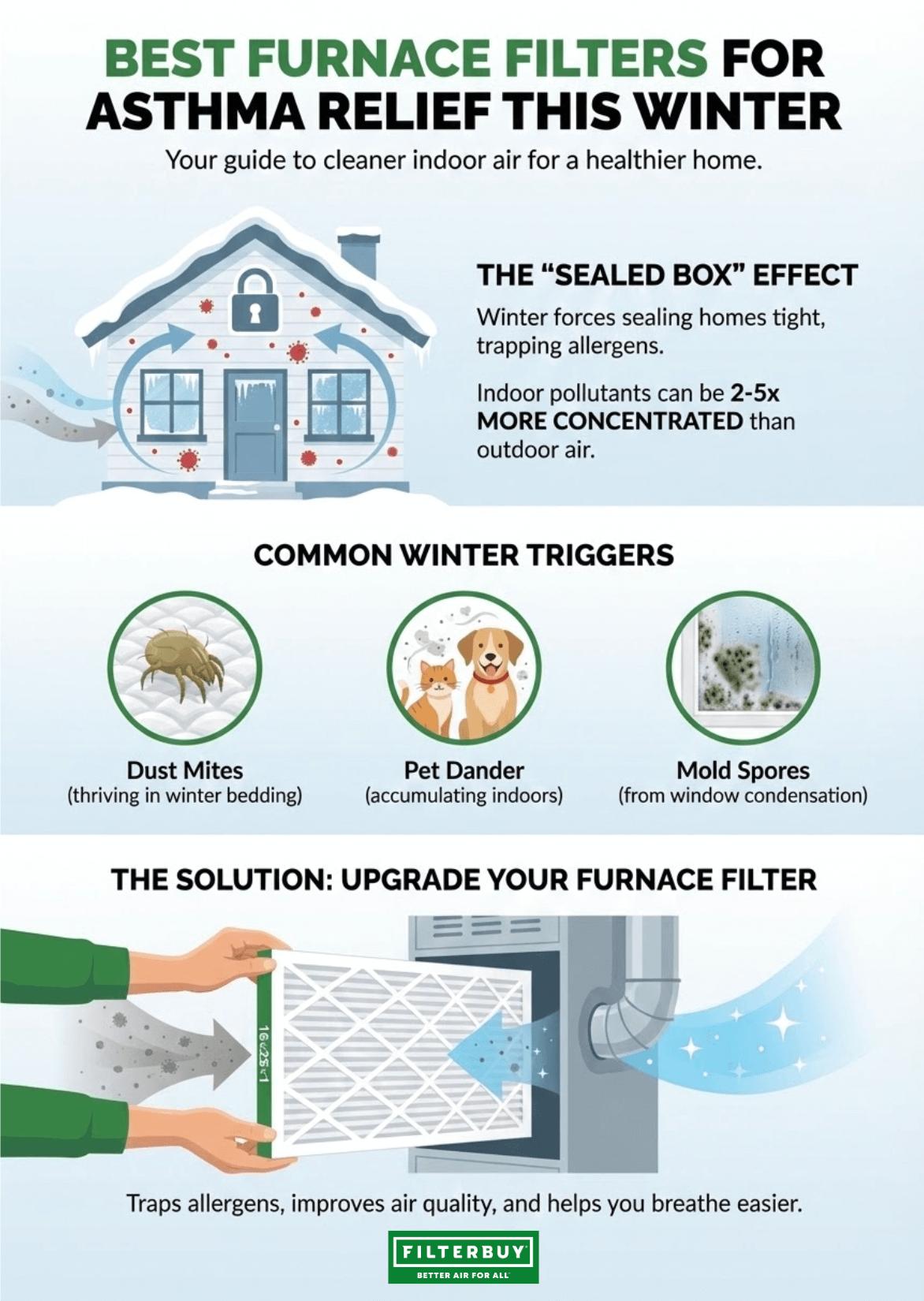
It's not just the cold air that triggers asthma; it's what happens inside your home when the temperature drops. To conserve heat, we seal our homes tight. We shut windows, close vents, and rely on our central heating systems to keep us comfortable. While this is great for energy bills, it creates a "sealed box" effect that traps pollutants inside.
When your furnace kicks on, it pulls air from your home, heats it, and pushes it back out through the vents. If that air isn't properly filtered, your system is essentially recirculating dust, pet dander, mold spores, and other irritants over and over again.
According to the EPA Indoor airPLUS program, managing indoor pollutants is a key strategy for reducing asthma risks. Common winter triggers include:
Dust mites: These microscopic pests thrive in bedding and carpet, and their waste is a potent allergen.
Pet dander: With pets spending more time indoors, dander accumulates faster.
Pollen: While we think of pollen as a spring issue, it can be tracked indoors on shoes and coats and remain in your carpet and ductwork.
Mold spores: Damp basements or condensation on windows can encourage mold growth, releasing spores into the air.
Smoke and VOCs: Wood-burning fireplaces and volatile organic compounds (VOCs) from household products can linger longer in unventilated spaces.
Do Furnace Filters Really Help With Asthma?
The short answer is yes, when they are the right type.
While a standard, cheap fiberglass filter is designed merely to protect your furnace from large debris, high-performance filters are built to protect you. The EPA Indoor airPLUS guidelines highlight high-performance filtration as a recommended strategy for creating an asthma-friendly home environment.
This is where pleated filters come in. Unlike flat fiberglass filters, pleated filters are made of synthetic materials folded into an accordion shape. This design drastically increases the surface area available to trap particles. More surface area means better particle capture and more stable airflow, ensuring that clean air continues to circulate throughout your home.
Why Pleated Filters Are Safe and Recommended
For asthma sufferers, the difference between a flat filter and a pleated one is night and day. Pleated filters offer:
More filtration surface: The folds allow the filter to hold more dust and debris without clogging as quickly.
Better fine particle capture: They are dense enough to trap smaller, lung-irritating particles that flat filters miss.
Balanced performance: EPA recommends high-quality pleated filters (specifically those in the MERV 8–13 range) as they offer an excellent balance between protecting your health and maintaining proper airflow for your HVAC system.
Safety: They are typically made without fiberglass, which can sometimes shed and become an irritant itself.
Understanding MERV Ratings for Asthma Relief
When shopping for the best furnace filters for asthma, you will see the term "MERV." This stands for Minimum Efficiency Reporting Value, a rating system that tells you how effective a filter is at trapping particles. The scale runs from 1 to 16 for residential use.
For asthma relief, you want to look at the "sweet spot" of MERV 8 to MERV 13.
MERV 8: Great Starting Point
A MERV 8 filter is a significant upgrade from standard fiberglass filters. It is capable of capturing:
Dust mites
Pollen
Mold spores
Lint and household dust
For standard homes with mild sensitivities, a high-quality pleated MERV 8 filter is often sufficient to keep the air noticeably cleaner.
MERV 11: Strong Allergen Defense
If you have pets or moderate allergies, moving up to MERV 11 is a smart choice. These filters are denser and more efficient, trapping:
Pet dander
Fine dust particles
Auto emissions and smog
This level of filtration is excellent for families who want to reduce the load of allergens circulating through the vents.
MERV 13: The Best Option for Winter Asthma Relief
For those with asthma, MERV 13 is often considered the gold standard for residential systems. It captures everything MERV 8 and 11 do, plus:
Bacteria and virus carriers
Smoke
Microscopic allergens
Fine particulate matter
Both the EPA and the middle ground help reduce airborne asthma triggers. In the winter, when fresh air ventilation is low, a MERV 13 filter can act as a crucial line of defense against the smallest, most irritating particles.
The Best Furnace Filters for Asthma Relief This Winter
At Filterbuy, we understand that clean air isn't a luxury—it's a necessity for health. Our pleated filters are engineered specifically to support cleaner indoor environments and are available in the MERV ratings recommended for asthma relief.
Filterbuy MERV 8 Pleated Filters
These are ideal for standard homes where the primary goal is removing common household dust and debris. If your asthma is very mild or triggered mostly by larger particles like dust mites, this is a solid, economical choice that won't restrict airflow in older systems.
Filterbuy MERV 11 Pleated Filters
Designed for allergen-heavy environments, our MERV 11 filters are a great middle ground. If you have a dog or cat, this filter helps trap the dander that often triggers respiratory issues. It captures smaller particles than the MERV 8, offering a higher degree of protection.
Filterbuy MERV 13 Pleated Filters
This is our top recommendation for asthma sufferers. By trapping fine smoke particles, bacteria, and micro-allergens, the MERV 13 provides the highest level of residential protection. It is particularly recommended for winter use, when the air inside your home is being recirculated constantly.
What to Look for When Choosing a Furnace Filter
Choosing the best furnace filters for allergies and asthma isn't just about the highest number; it's about fit and consistency.
Correct Sizing: A filter that doesn't fit perfectly allows air to bypass the filtration material entirely. Filterbuy offers custom sizes to ensure a snug fit for any system, preventing unfiltered air from sneaking through gaps.
Filter Lifespan: For asthma relief, you cannot wait until the filter looks dirty. Change it every 90 days at a minimum.
HVAC Compatibility: While MERV 13 is excellent, ensure your system can handle the airflow resistance. Most modern systems handle MERV 13 pleated filters just fine, but checking your manual is always a safe bet.
Consistency: The EPA Indoor airPLUS guidance emphasizes maintaining filters to reduce pollutant buildup. A high-quality filter only works if it's fresh.
How Often Should You Replace Filters for Asthma Relief?
Standard advice says to change filters every 3 months. However, if you are managing asthma:
Standard homes: Every 3 months is a good baseline.
High-pet, high-dust homes: Consider changing them every 1–2 months.
Winter Season: During winter, check your filter monthly. Because your heating system runs more frequently, the filter loads up with debris faster. A clogged filter not only hurts your furnace efficiency but also stops cleaning the air effectively.
Breathe Easier This Winter With Filterbuy
Winter shouldn't be a season of suffering. By taking control of your indoor air quality with the right filtration strategy, you can create a safer, more comfortable home for everyone.
Don't let dust and dander dictate your health this season. Find your perfect MERV 8–13 pleated filter in just seconds and get cleaner, healthier indoor air delivered right to your door.
"After shipping millions of filters to families across the country, we've consistently seen that asthma sufferers get the most meaningful relief when they move to a MERV 13 pleated filter in winter—because that's when sealed homes recirculate the smallest, hardest-to-trap particles the most."
Essential Resources: The Straight-Talk Guide to Cleaner Air This Winter
We're not just going to tell you which filter to buy — we want you to actually understand why it matters. These are the seven most trusted sources we rely on to back up everything we say about MERV ratings, asthma triggers, and indoor air quality. No fluff, no filler. Just the resources that give you real answers.
1. Not Sure What MERV Even Means? Start Here.
Source: U.S. Environmental Protection Agency What you'll learn: What the MERV scale actually measures — and why it matters for your family's health
The EPA breaks it down without the engineering jargon. MERV ratings measure how well a filter captures particles between 0.3 and 10 microns — that's the size range covering everything from pet dander and mold spores to bacteria. Once you understand the scale, choosing the right filter goes from confusing to obvious.
2. Here's Why the EPA Recommends MERV 13 for Asthma — Straight From the Source
Source: U.S. Environmental Protection Agency — Indoor airPLUS Program What you'll learn: The clinical link between better filtration and fewer asthma attacks at home
This is the page we point to when people ask, "Is upgrading my filter actually going to help?" The EPA's Indoor airPLUS program names MERV 13 as the recommended standard for ducted home systems and explains exactly which indoor pollutants — dander, mold, combustion byproducts — it's designed to stop. Worth a read before you decide on a MERV level.
🔗 EPA: Indoor airPLUS and Asthma
3. What Can a Furnace Filter Actually Do — and What Can't It?
Source: U.S. Environmental Protection Agency What you'll learn: How filtration fits into a complete indoor air quality plan (and where its limits are)
This is one of the most honest guides out there. The EPA's consumer resource explains how furnace filters reduce indoor air pollution, what the research says about their impact on allergy and asthma symptoms, and — importantly — what a filter alone can't fix. If you want a realistic picture of what cleaner air actually takes, this is your starting point.
🔗 EPA: Guide to Air Cleaners in the Home
4. Want the Data Behind the MERV 13 Recommendation? It's All Here.
Source: U.S. Environmental Protection Agency — Indoor airPLUS Technical Bulletin What you'll learn: The particle-level performance proof that separates MERV 13 from every tier below it
If you're the kind of person who wants to see the numbers before you commit, this is your resource. The EPA's technical bulletin shows exactly how each MERV tier performs against specific particle sizes — including the data point that MERV 13 achieves at least 50% removal of the smallest, hardest-to-trap particles that irritate lungs most. It also covers how to confirm your HVAC system can handle the upgrade without sacrificing airflow.
🔗 EPA: Indoor airPLUS Filtration Technical Bulletin (PDF)
5. Why Is Winter So Much Harder on Your Airways? The AAFA Explains It.
Source: Asthma and Allergy Foundation of America (AAFA) What you'll learn: Why sealed-up winter homes are an asthma trigger waiting to happen — and what to do about it
The AAFA is the largest and oldest asthma and allergy patient organization in the country, and this resource is exactly the kind of practical guidance they're known for. It explains how cold, dry air causes airway narrowing, why indoor allergens pile up fast when windows stay shut all season, and which household steps — including upgrading your filter — can meaningfully reduce winter flare-up risk.
🔗 AAFA: Weather Triggers Asthma
6. Don't Just Take the Manufacturer's Word for It — Check the Independent Certification.
Source: Asthma & Allergy Friendly® Certification Program What you'll learn: The third-party standard that tells you a filter has been clinically tested — not just labeled
Any filter can make claims on its packaging. This program tests them. The Asthma & Allergy Friendly® certification evaluates HVAC and furnace filters against independent clinical standards for allergen capture and fiber shedding — because the last thing an asthma sufferer needs is a filter that sheds material back into the air it's supposed to be cleaning. Use this as your manufacturer-neutral checkpoint.
🔗 Asthma & Allergy Friendly® Certified Air Filters
7. Curious Who Actually Invented the MERV Scale? Here's What They Recommend for Your Home.
Source: American Society of Heating, Refrigerating and Air-Conditioning Engineers (ASHRAE) What you'll learn: Filter guidance from the engineers who literally built the rating system
ASHRAE created the MERV rating system, which means this is about as close to going to the source as you can get. Their filtration FAQ covers how different MERV levels perform inside real home HVAC systems, their own recommendation of MERV 13 for managing airborne particle concentrations, and how to balance a higher-rated filter against your system's airflow requirements so your furnace doesn't have to work overtime.
🔗 ASHRAE: Filtration and Disinfection FAQ
The Numbers Don't Lie: Why Your Filter Matters More This Winter
We've been manufacturing air filters in the U.S. since 2013 and shipping them to millions of families. The data consistently backs up what we see every season: most people don't realize how hard their indoor air is working against them — especially in winter.
1. We Ship More Filters in Winter for a Reason — and This CDC Statistic Explains Why
After more than a decade of tracking order patterns across millions of households, we see the same thing every year: filter demand spikes when heating season starts.
It's not a coincidence. Here's what the CDC confirms:
About 25 million Americans — roughly 7.7% of the U.S. population — are currently living with asthma
A significant share reach a breaking point when windows close for good and indoor air stops moving
When customers tell us why they finally upgraded to a higher MERV filter, the answer is almost always the same: winter forced their hand
Don't wait for a flare-up to make the call. The numbers tell you it's coming.
📊 Source: CDC — Asthma Surveillance in the United States, 2001–2021
2. The Stat That Changes How Our Customers Think About "Fresh Air" Forever
The most consistent thing we hear after customers upgrade their filter: "I had no idea how bad our air actually was."
That reaction makes complete sense once you see what the EPA has documented:
Americans spend approximately 90% of their time indoors, where the concentrations of some pollutants are often 2 to 5 times higher than typical outdoor concentrations
In winter, that gap widens — your home becomes a sealed box, your furnace runs for longer stretches, and every airborne irritant gets recirculated with nowhere to escape
Pet dander, dust mite waste, mold spores, and VOCs don't leave on their own — they just keep cycling through your vents
We built our entire MERV 8–13 filter line around this reality. In winter, your furnace filter isn't a minor maintenance item. It's the only active defense your home has against the air it keeps reusing.
📊 Source: EPA — Indoor Air Quality
🔗 epa.gov/report-environment/indoor-air-quality
3. Why We Recommend MERV 13 for Asthma — and Why the EPA Backs Us Up
We don't recommend MERV 13 because it's the highest rating we carry. We recommend it because years of working with asthma-sensitive households has shown us it's the threshold where customers actually notice a difference in how they feel at home.
The EPA's performance data aligns with exactly that:
Filters with a MERV of 13 and above are required to demonstrate at least 50% removal efficiency for the smallest particles tested— the fine particulate matter that reaches deepest into your airways
In practical terms: every time your heating system cycles on with a MERV 13 installed, it's actively pulling the most lung-irritating particles out of the air your family breathes
That's not a marketing claim — it's the EPA's documented performance standard
We make sure the filter that meets it ships to your door, fits perfectly, and gets replaced before it stops doing its job.
📊 Source: EPA — Guide to Air Cleaners in the Home 🔗 epa.gov/indoor-air-quality-iaq/guide-air-cleaners-home
Our Final Thought on the Best Furnace Filters for Asthma Relief This Winter
We've been manufacturing air filters in the U.S. since 2013 — built in Alabama, Florida, Pennsylvania, and Utah, and shipped to millions of households. After more than a decade in this space, we have a strong opinion on this topic. Here it is, straight.
The buying guide industry gets this topic half right.
Everyone focuses on which filter to buy. Almost nobody talks about what happens after.
Here's what we see consistently across our customer base:
Homeowner researches best filter for asthma ✔
Upgrades to MERV 13 ✔
Leaves that same filter in place for eight months ✘
A fresh MERV 11 changed every 60 days outperforms a MERV 13 that hasn't been touched since last spring. Freshness and fit are the unglamorous variables most buying guides skip — and they're the ones that actually determine whether your air gets cleaner.
Winter asthma is too often treated as a medical problem when part of it is an environmental one.
Consider what's actually happening:
25 million Americans are managing asthma right now
Most have a furnace running 5–6 months a year
That furnace is recirculating the same indoor air through whatever filter was last installed
That's not a pharmaceutical gap. That's a maintenance gap — and one homeowners can close themselves, today, for the cost of a quality filter.
Our belief after 10+ years in this space:
Clean indoor air isn't a luxury for people who've researched MERV ratings and EPA guidelines. It's a baseline every household deserves — and more achievable than most people realize.
The formula is straightforward:
The right pleated filter
The right size
Replaced on schedule
We built Filterbuy to make that as frictionless as possible. Because when it's simple, people actually do it. And when people actually do it, the air in their homes gets measurably better.
That's what Better Air for All means to us — not just a tagline, but the reason we show up every day.
Your Winter Air Checklist: Four Steps to a Healthier Home Right Now
You've done the research. Here's exactly what to do next — in order, no guesswork required.
Step 1: Check What's Currently in Your Furnace
Pull out your existing filter. This takes 60 seconds and tells you everything.
MERV 7 or below → It's protecting your furnace, not your lungs
MERV 8–10 → Solid start, but likely not enough for active asthma management in winter
Gray, visibly clogged, or you can't remember the last change → Replace it today, regardless of MERV rating
⚠️ A dirty filter — even a high-rated one — stops cleaning your air entirely. This is the step most people skip.
Step 2: Match Your MERV Rating to Your Household
Not every home needs the same filter. Use this as your quick reference:
MERV 8 — Standard home with mild sensitivities
MERV 11 — Pets, moderate allergies, or young children in the home
MERV 13 — Diagnosed asthma or respiratory conditions
Not sure? — Start with MERV 11, the safe middle ground for most modern systems
💡 Check your HVAC manual for your system's maximum MERV rating. Most systems built after 2010 handle MERV 13 without issue.
Step 3: Find Your Exact Size and Order It
A filter that almost fits doesn't work. Unfiltered air bypasses the edges — and goes straight into your home.
Check your old filter frame — dimensions are printed directly on it (e.g., 16x25x1)
Measure the slot yourself if the label is worn — length, width, and depth in inches
Visit Filterbuy.com — 600+ standard sizes, plus custom sizes for non-standard systems
Check out — fast, free shipping, factory-direct, no hardware store run required
➡ Shop MERV 13 Filters for Asthma Relief at Filterbuy.com
Step 4: Set a Replacement Schedule — Then Put It on Autopilot
Winter runs your heating system harder. Your filter loads up faster. Stay ahead of it.
Standard home → Every 90 days
Pets or higher dust levels → Every 60 days
Active asthma in the household → Check monthly, replace every 60 days or sooner
Easiest option → Set up auto-delivery through Filterbuy — a fresh filter arrives exactly when you need it, no reminders required
Frequently Asked Questions
Q: What is the best furnace filter MERV rating for asthma relief this winter?
A: Based on our experience manufacturing filters for millions of households — including many managing asthma — MERV 13 is the clear recommendation. It's also the rating the EPA specifically recommends for ducted residential systems.
Why MERV 13 works for asthma:
First tier required to demonstrate at least 50% removal efficiency for the smallest, most lung-irritating particles
Captures fine particulate matter, bacteria carriers, smoke, and micro-allergens
Consistently the threshold where our asthma-sensitive customers report actually noticing a difference at home
Not sure your system can handle MERV 13?
Start with MERV 11 — strong allergen protection, compatible with virtually all modern HVAC systems
MERV 8 is a meaningful upgrade over fiberglass for mild sensitivities, but generally not sufficient for active asthma management in winter
Q: Do furnace filters actually help with asthma symptoms?
A: Yes — with two conditions.
Condition 1: It has to be the right type.
Standard fiberglass filters protect your furnace equipment, not your lungs
Pleated MERV 8–13 filters are engineered to capture asthma triggers: dust mite waste, pet dander, mold spores, pollen residue, and fine particulate matter
The EPA identifies high-efficiency HVAC filtration as a recommended strategy for reducing asthma triggers at home
Condition 2: It has to fit correctly and be replaced on schedule.
A filter that isn't seated properly allows unfiltered air to bypass the edges entirely
A clogged filter stops cleaning your air — regardless of its MERV rating
These aren't edge cases — they're the most common reasons a good filter underdelivers
Q: Why is winter specifically harder on asthma than other seasons?
A: We track order patterns across millions of households — filter demand spikes every single year when heating season starts. Winter creates compounding conditions that make indoor air genuinely harder to manage:
Sealed homes trap pollutants — closed windows prevent fresh air circulation, so dander, dust, mold spores, and VOCs accumulate with nowhere to escape
Furnaces recirculate the same air repeatedly — every heating cycle redistributes whatever the filter didn't capture on the last pass
More time spent indoors — the EPA documents Americans spend ~90% of their time inside already; winter pushes that even higher
Cold air is an independent trigger — dry, cold air causes airway narrowing regardless of allergen exposure, layering a physical trigger on top of the pollution problem
💡 Most people blame the season for worsening winter symptoms. Often it's a MERV 8 filter unchanged since September running in a sealed house. That's a fixable problem.
Q: How often should I change my furnace filter if someone in my home has asthma?
A: More often than standard advice suggests — and more often in winter than any other time of year.
Recommended replacement schedule:
Standard home, no pets → every 90 days minimum
Pets in the home → every 60 days
Active asthma in the household → check monthly, replace every 60 days or sooner
Winter specifically → check monthly regardless — longer heating cycles load filters faster than any other season
💡 The most effective habit we've seen: remove the decision entirely with auto-delivery. Set your interval once. A fresh filter arrives automatically. The households on a consistent replacement schedule report the most sustained improvement in how their home feels to breathe in.
Q: Will a higher MERV filter damage my HVAC system?
A: The concern is legitimate — but easy to manage and frequently overstated. Here's the straight answer based on shipping to millions of homes:
Systems built after 2010 → handle MERV 13 pleated filters without issue in most cases
Systems built before 2010 → MERV 11 is generally the safer upper limit
Most reliable check → your HVAC system manual lists the maximum recommended MERV rating under filter specifications
When genuinely unsure → choose MERV 11; it delivers strong asthma and allergen protection while maintaining healthy airflow in virtually all residential systems
⚠️ The perspective shift that surprises most people: a properly fitted MERV 13 pleated filter typically creates less airflow resistance than a clogged MERV 8 filter left in place for six months. We've seen more HVAC strain caused by neglected filters than by upgrading to MERV 13. Rating, fit, and freshness all matter equally.
Find the Best Furnace Filter for Asthma Relief This Winter — in Seconds
Choose from 600+ standard sizes and custom options, with fast, free shipping straight from our factory to your door. Shop Filterbuy MERV 13 Filters Now!