
Home Heat Pump Advantages & Disadvantages: Make the Switch?
April 7, 2026

Your HVAC bills don’t lie. If your system is aging out, running hard, and still not keeping up, the idea of a heat pump home upgrade has probably already crossed your mind. Good. Because the math has shifted in the last few years, and what used to be a complicated decision has gotten a lot clearer.
A home heat pump is one system built around heat pump heating and cooling working together year-round. Think of it like an air conditioner that runs in reverse during winter: in summer, it pulls heat out of your home, in winter, it extracts heat from outdoor air and moves it inside. It doesn’t burn fuel. It moves heat that already exists, which is why it uses so much less energy than traditional heating systems.
For a lot of homeowners, that case is already compelling enough. But whether a heat pump belongs in your home depends on your climate, your current setup, and your budget. We’re not here to sell you on one. We’re here to give you the full picture: the advantages, the trade-offs, and the questions worth asking before you commit to a decision in the $5,000 to $15,000 range.
Brand new to this? Our heat pumps for dummies guide is the right place to start. And for the technical foundation, Wikipedia’s heat pump overview covers the mechanics well. Ready? Let’s get into it.
TL;DR: What Are the Advantages and Disadvantages of a Home Heat Pump?
A home heat pump heats and cools your home in one electric system, no furnace required. Here's the honest breakdown from a team that has shipped filters to millions of heat pump households since 2013.
Advantages of a Home Heat Pump
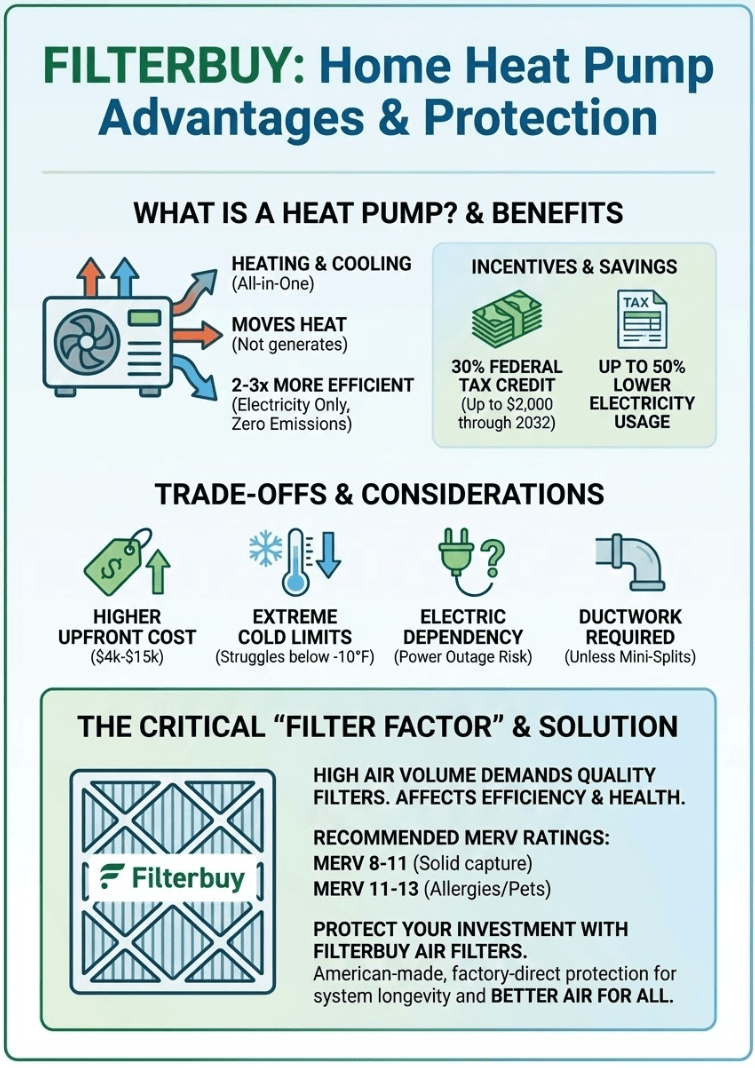
● 2–3x more efficient than electric resistance heat — delivers 2 to 3 units of heat per 1 unit of electricity consumed
● One system replaces two — eliminates the need for a separate furnace and air conditioner
● 30% federal tax credit (up to $2,000) through 2032 — the Inflation Reduction Act makes the math more favorable than it's ever been
● Works in cold climates — modern cold-climate models operate efficiently down to -13°F
● No ductwork required — ductless mini split systems work in any home, including older builds and additions
● Better indoor air quality — continuous airflow through a properly rated MERV filter removes pollen, dander, and fine dust year-round
Disadvantages of a Home Heat Pump
● Higher upfront cost — installation typically runs $4,000–$15,000, more than replacing a single furnace or AC unit
● Performance drops in extreme cold — sustained temps below -13°F to -20°F may require a gas backup in a dual-fuel setup
● Electricity-dependent — no power means no heat; high local utility rates can narrow the efficiency advantage over gas
● Requires ductwork for standard systems — retrofitting ducts in an existing home adds cost and complexity
● Payback period of 5–15 years — depends heavily on your climate, utility rates, and current system efficiency
Bottom Line: For most homeowners in moderate climates replacing an aging system, the advantages outweigh the trade-offs, especially with current federal incentives. The exceptions are sustained extreme cold climates, very high electricity rates, and homes with newer efficient gas systems already running well. Run your local utility numbers before you commit. The equipment decision is secondary to the math.
Top Takeaways
1. One system, two jobs. A heat pump heats and cools your home year-round — no separate furnace needed.
2. Efficiency that shows up on your bill. Heat pumps deliver 2 to 3 units of heat for every 1 unit of electricity consumed. Electric resistance heating delivers one-for-one.
3. The upfront cost is real — so are the incentives. Installation runs $4,000 to $15,000, but the 30% federal tax credit (up to $2,000) through 2032 changes the math.
4. Cold weather isn't the dealbreaker it used to be. Modern cold-climate models work down to -13°F. If your contractor says otherwise, ask which year their data is from.
5. No ductwork? Not a problem. Ductless mini split systems make a heat pump retrofit possible without tearing a wall open.
6. The filter matters more than most guides admit. Heat pumps move more air, more often. Use MERV 8–11 for most homes, MERV 11–13 for allergy or pet households.
7. Run your local numbers before you decide. The equipment choice is secondary. Your climate, utility rates, and current system age determine whether the switch actually pays off.
What Is a Home Heat Pump — and What Does It Actually Look Like?
Recognize the outdoor unit of a central air conditioner? A heat pump looks just like it. Same metal cabinet, same footprint on a pad outside your house, same condenser fan on top. Inside, there’s an air handler that pushes conditioned air through your ductwork. On ductless mini split setups, wall-mounted units in each room replace the air handler entirely.
The technology running it all is a refrigerant cycle, the same basic process your refrigerator uses to stay cold. A heat pump uses that cycle to move thermal energy in both directions: out of your home in summer, into your home in winter. That reversibility is what sets it apart from a standard AC unit.
Your AC shuts off in winter. A heat pump keeps working. If you see the outdoor unit running when it’s cold outside, that’s exactly how it’s supposed to work.
How Does a Home Heat Pump Work?
The process is easier to follow than it looks on paper. Walk through it in five steps:
1. Refrigerant absorbs heat energy from the air on one side, inside or outside depending on the season.
2. The compressor pressurizes the refrigerant, raising its temperature significantly.
3. The hot refrigerant releases that heat through coils on the other side of the system.
4. The cooled refrigerant expands and cycles back to absorb more heat.
5. A reversing valve switches the direction of this entire cycle between heating and cooling modes.
Even at 20°F, outdoor air still contains heat energy a pump can use. Modern cold-climate units extract it efficiently well below freezing. The two numbers that tell you how well: HSPF2 for heating efficiency, SEER2 for cooling efficiency. Our guide to heat pump efficiency ratings walks through what those ratings mean and what to look for when comparing models.
Heat Pump Advantages: The Case for Making the Switch
The case for heat pumps holds up when you look at the actual numbers, not just the headlines.
● Energy output beats input by 2 to 3 times. For every unit of electricity a heat pump consumes, it delivers two to three units of heat. An electric furnace delivers one-for-one at best. That ratio shows up directly on your monthly utility bill.
● One system replaces two. A heat pump handles both heating and cooling. One installation, one service contract, one filter to manage. For full HVAC replacements, that simplicity adds up fast.
● No combustion, no direct emissions. Run it on solar or a cleaner grid and the carbon footprint drops further.
● The federal math is working in your favor right now. The Inflation Reduction Act offers a 30% tax credit, up to $2,000, on qualifying installations. Many state utility programs add rebates on top.
● Room-by-room control with ductless mini splits. Each indoor unit runs independently, so you’re not conditioning empty rooms or fighting over a single thermostat.
● Continuous air circulation means your filter is doing real work year-round. Pair a heat pump with a properly rated MERV filter and the air quality improvement inside your home is measurable.
●Modern cold-climate models work well below freezing. The claim that heat pumps fail in winter is based on equipment from years ago. Current-generation units have largely put that concern to rest.
Heat Pump Disadvantages: The Honest Case Against
Heat pumps aren’t right for every home. Here’s what the honest trade-offs look like.
● Installation cost runs higher upfront. Professional heat pump installation typically lands between $4,000 and $15,000, depending on system type, size, and any ductwork changes needed. That’s often more than replacing a standalone furnace or AC unit, even if long-term operating savings offset it.
● They can struggle in sustained extreme cold. When temperatures stay below -10°F to -20°F for weeks at a stretch, even cold-climate models may need backup. A dual-fuel setup, heat pump plus a gas furnace, is often the practical answer in the northern U.S. and Canada.
● They run on electricity. If the power goes out, so does the heat. In areas with unreliable grid power or electricity rates well above the national average, that matters.
● The payback math doesn’t work everywhere. High electricity costs can narrow the efficiency advantage over a gas furnace. Run your local utility numbers before you commit.
● Standard ducted systems need ductwork. If your home doesn’t have it, you’re either adding it, going ductless with mini splits, or reconsidering. Retrofitting ducts isn’t a small expense.
● The payback window can stretch out. Depending on climate, current system efficiency, and utility rates, payback can take anywhere from 5 to 15 years. This is a long-term investment, not a quick win.
●Some outdoor units are louder than others. Worth checking decibel ratings if the unit will sit near a bedroom window or a property line.
The heat pump vs air conditioner question comes up constantly, and it’s worth answering directly before you look at the comparison table. For anyone replacing a full system, the heat pump vs central air and furnace comparison often changes the conversation. Both are worth reading before you call a contractor.
How a Heat Pump Compares to Central AC Furnace
One of the most useful things you can do before calling a contractor is look at both systems side by side.
The biggest functional difference is simple: a heat pump handles both heating and cooling in one system, running on electricity only. Central AC paired with a furnace splits that job across two separate units, with the AC running on electricity and the furnace typically burning gas, oil, or electric resistance heat.
On efficiency, heat pumps carry a clear edge when they're sized and installed correctly. Their HSPF2 and SEER2 ratings reflect a system built for efficiency from the ground up. A central AC and furnace combination is harder to generalize — performance depends heavily on the age and condition of each unit, and older systems often drag those numbers down significantly.
Cold climate performance is where the furnace setup holds its ground. Gas furnaces aren't affected by outdoor temperatures the way heat pumps can be in extreme cold. Modern cold-climate heat pump models have narrowed that gap considerably, but in regions that regularly see sustained temperatures well below zero, a furnace still has the reliability advantage.
The cost picture is counterintuitive. A heat pump costs more upfront as a single system, but replacing a furnace and AC separately adds up faster than most homeowners expect. Over time, lower operating costs on the heat pump side tend to close that gap.
Ductwork is a requirement for both standard options. Heat pumps offer a ductless path through mini split systems, which the traditional furnace-and-AC combination doesn't. Both setups need a quality HVAC filter to run cleanly and efficiently — that part doesn't change regardless of which system you choose.
Bottom line on fit: heat pumps tend to make the most sense for moderate climates and new construction. Central AC with a furnace remains the stronger choice for extreme cold regions and homes with existing duct systems already in place.
Air Source vs. Geothermal: Choosing the Right Type
Air source heat pumps cover the vast majority of residential installs. They’re cost-effective, widely available, and increasingly capable in cold climates. Subtypes include standard ducted air source, ductless mini splits, and cold-climate models that major manufacturers market under names like “hyper heat.”
Geothermal systems run more efficiently because ground temperatures stay constant year-round. But installation runs $15,000 to $40,000 or more, and you need land for the underground loops. For most homeowners, air source is the practical place to start.
Ductless Mini Splits: The Heat Pump Option for Homes Without Ductwork
If your home doesn’t have existing ductwork, a heat pump is still on the table. A heat pump for home without ductwork is one of the most common questions we field, and ductless mini splits are almost always the answer.
A mini split heat pump connects a compact outdoor compressor to one or more wall-mounted indoor units. Each indoor head handles its own room independently, which gives you room-level temperature control without any ductwork. Installation is far less invasive than retrofitting ducts into an existing home, and these systems work well in older homes, additions, garages, and apartments.
One maintenance note most people skip: each indoor head has an internal mesh filter that needs cleaning monthly. It takes about two minutes. Most owners forget it entirely, and their air quality and efficiency both pay for it.
Heat Pumps for New Construction vs. Existing Homes
Planning a new build? A heat pump for new construction gives you the cleanest setup. You can size the system right from day one, spec the electrical panel for it, and design ductwork for optimal airflow. The return on investment starts accumulating from the first utility bill.
Retrofitting is a different situation. A heat pump for existing home means taking stock of your current ductwork condition, your electrical panel capacity, and your insulation. Many older homes need a panel upgrade before installation can happen. The payback timeline is longer, but for most aging systems in moderate climates, the switch still makes sense, especially with current incentives in play.
Before you get quotes, run through this list: your current system’s age, ductwork condition, insulation R-values, electrical panel capacity, local utility rates, and what state rebates stack on top of the federal tax credit. That information shapes your payback math significantly.
Heat Pumps, Air Quality, and the Filter Most Guides Skip
Most heat pump guides never mention filtration. We want to make sure you don’t overlook it.
Heat pumps move a high volume of air through your home, often more continuously than a traditional heating system. That puts more demand on your air filter, and what it captures, or doesn’t, affects both system efficiency and the air your family breathes every day.
Choosing the right HVAC heat pump filter matters. For most ducted systems, MERV 8 to 11 gives you solid particle capture without choking the airflow your heat pump needs to run efficiently. If you have allergy sufferers or pets at home, MERV 11 to 13 makes a noticeable difference. Check your system specs before going higher, because a filter that’s too restrictive strains the motor over time.
The connection between heat pump air quality and your filter is direct. A heat pump running with a clean, correctly rated filter keeps pollen, pet dander, fine dust, and mold spores out of your living spaces. One that’s been neglected pushes them right back through. The air quality benefit you’re counting on from a heat pump upgrade starts with the filter protecting it.
On the broader maintenance side, good heat pump maintenance tips to keep in your routine: change or replace filters every one to three months, clean the outdoor coils seasonally, keep the area around the outdoor unit clear, and schedule an annual refrigerant check and thermostat calibration. A certified technician should inspect the full system every year or two. Most of this is low-cost and takes under an hour. Skip it and the repair bills won’t be.
"In 13 years of residential installation, the homeowners who regret switching to a heat pump almost always made the same mistake: they bought the system without running their local utility numbers first, and the ones who regret staying with a furnace-and-AC setup almost always did the same thing. The equipment decision is secondary. The math has to come first."
-Filterbuy Team
7 Essential Resources for Heat Pump Research
These are the sources we rely on. No padding, no affiliate lists. Just the destinations that will actually move your research forward.
1. U.S. Department of Energy — Heat Pump Systems
The DOE’s Energy Saver portal is the clearest, most unbiased source for efficiency guidance available. Their heat pump section covers types, ratings, sizing, and operating tips without the sales angle. Start here for the “why” behind efficiency claims. → energy.gov/energysaver/heat-pump-systems
2. ENERGY STAR — Certified Heat Pumps
ENERGY STAR’s certified product list is the fastest way to find high-efficiency models and verify federal tax credit eligibility before you buy. Bookmark this before any contractor conversation. → energystar.gov/products/heat_pumps
3. Wikipedia — Heat Pump
If you want the full technical picture, how the refrigerant cycle works, the thermodynamic principles behind it, and the history, Wikipedia’s heat pump article is well-maintained and well-cited. Good for the “how does this actually work” side of your research. → en.wikipedia.org/wiki/Heat_pump
4. Filterbuy — Heat Pump Basics Guide
Our own step-by-step explainer for anyone starting from scratch. No jargon, no assumptions — just a plain walkthrough of what a heat pump is, how it differs from what you have now, and what to expect. Read this one first. → filterbuy.com/resources/heat-pumps-basics/
5. Environmental Protection Agency — Indoor Air Quality
The EPA’s IAQ hub is the authoritative source on what’s in your home’s air and why it matters. Especially useful when you’re thinking through how your HVAC choice affects the health of the air inside your home day to day. → epa.gov/indoor-air-quality-iaq
6. International Energy Agency — Heat Pumps
The IEA carries the best global data on heat pump adoption trends, climate impact, and the policy momentum behind the shift. If you want to understand why heat pumps are getting so much attention right now, this is where the numbers live. → iea.org/energy-system/buildings/heat-pumps
7. Filterbuy HVAC Solutions
Once you’ve done your research, finding the best heat pump for home use means matching system specs to your home’s actual load requirements, climate zone, and existing infrastructure. Our HVAC Solutions hub pulls the tools and guidance together in one place. → filterbuy.com/hvac-solutions/
3 Statistics That Put Heat Pump Efficiency in Perspective
Around 50% lower electricity use for heating
The U.S. Department of Energy reports that heat pumps cut electricity use for heating by approximately 50% compared to electric resistance heaters like furnaces and baseboard heaters. For homes currently running on electric heat, that’s the kind of gap that often pays back within five years. Significant, not marginal.
Source: U.S. Department of Energy — Heat Pump Systems
In 2022, heat pump sales in the U.S. topped gas furnace sales for the first time
U.S. heat pump sales exceeded 4.3 million units in 2022, outpacing gas furnace sales for the first time on record, according to the International Energy Agency. Heat pumps aren’t a niche product anymore. More trained installers, more competitive pricing, and a wider model selection have all followed that shift.
Source: International Energy Agency — Heat Pumps
30% federal tax credit, up to $2,000, runs through 2032
The Inflation Reduction Act’s Energy Efficient Home Improvement Credit offers a 30% tax credit on qualifying heat pump installations, capped at $2,000 per year. Many state utility programs stack additional rebates on top. The credit runs through 2032, so there’s time to plan the upgrade properly rather than rush it.
Source: ENERGY STAR — Federal Tax Credits for Air Source Heat Pumps
Final Thoughts: Our Honest Take on Heat Pumps
We’ve been making and shipping HVAC filters since 2013. Millions of homeowners, every system configuration you can think of: old gas furnaces in aging homes, newer AC setups, mini splits in coastal apartments, cold-climate heat pumps in Vermont. That breadth gives us a perspective you don’t get from a single contractor’s sales conversation.
The efficiency argument used to be mostly theoretical. Now it’s backed by real install data, confirmed market numbers, and federal incentives that actually affect the purchase decision. For homeowners in the Sun Belt, Mid-Atlantic, Pacific Northwest, and increasingly the Midwest, a modern air source heat pump is a sound choice.
Where we’d urge caution: climates that see sustained temps below -15°F for weeks at a stretch, homes with electricity rates well above the national average, and situations where a newer efficient gas system is already running well. In those cases, a dual-fuel approach or staying the course may be smarter, at least until the numbers shift your way.
We’ll say this without hedging: if you’re replacing an aging HVAC system anyway, get a heat pump quote before you decide. The gap between a heat pump and a traditional replacement is often smaller than people expect once incentives factor in. And the air quality improvement from a well-maintained heat pump with the right filter is something your family notices every day.
Heat pumps aren’t right for everyone. But they’re right for more homeowners than the industry conversation used to acknowledge. Get the quotes. Run your local numbers. Whatever system you end up with, make sure the filter protecting it is rated for the job.
Frequently Asked Questions About Home Heat Pumps
What is a heat pump, in plain terms?
A heat pump moves heat from one place to another instead of generating it by burning fuel. In summer, it pulls heat out of your home and exhausts it outside. In winter, it extracts heat energy from outdoor air and moves it inside. One system handles both, year-round. That’s the whole concept.
What does a home heat pump look like?
The outdoor unit looks nearly identical to a central AC condenser: a rectangular metal cabinet, typically 2 to 3 feet tall, sitting on a pad outside your home. Inside, there’s either a traditional air handler for ducted systems, or wall-mounted head units for ductless mini splits. If you’ve seen a central AC setup, you’ve seen most of what a heat pump looks like.
What are the main disadvantages of a heat pump?
Five to know upfront: (1) higher installation cost compared to replacing a furnace or AC individually; (2) reduced performance in extreme cold below -13°F for standard models; (3) full dependence on electricity, which matters in areas with unreliable power or high utility rates; (4) standard ducted systems require existing or new ductwork; and (5) longer payback periods in some climates and markets. None of these are dealbreakers for most homeowners, but they’re worth factoring in from the start.
How does a home heat pump work?
Refrigerant absorbs heat energy from the air on one side, the compressor pressurizes it to raise its temperature, that heat releases through the coils on the other side, and the cooled refrigerant cycles back. A reversing valve switches the direction between heating and cooling modes. The key thing to understand: this process delivers 2 to 3 units of heat energy for every 1 unit of electricity consumed. That ratio is why heat pumps run so much more efficiently than traditional electric heating.
What’s the difference between a heat pump and an air conditioner?
An air conditioner only cools. A heat pump cools and heats, using the same core hardware. Mechanically, they’re nearly identical. The heat pump adds a reversing valve and runs efficiently in both directions. If your climate rarely drops below freezing, a heat pump can fully replace both your AC and your furnace.
Can a heat pump work in cold climates?
Yes, with the right equipment. Modern cold-climate air source heat pumps operate efficiently down to -13°F, and some models reach -22°F. Brands like Mitsubishi, Bosch, and Daikin make certified cold-climate units. Check the specific model’s rated low-temperature performance, not just the general product category. For the coldest regions, a dual-fuel system, heat pump plus backup gas, is a smart hedge.
What HVAC filter should I use with my heat pump?
For most ducted heat pump systems, MERV 8 to 11 gives you solid particle capture without restricting the airflow the system needs. If you have allergy sufferers or pets at home, MERV 11 to 13 makes a real difference. Check your system’s airflow specs before going higher, because too restrictive a filter strains the motor over time. For ductless mini splits, clean the internal mesh filter monthly and follow the manufacturer’s replacement schedule. We carry 600+ sizes at Filterbuy. Finding yours takes about 30 seconds.
Is a heat pump worth it for my home?
For most homeowners in moderate to mild climates replacing aging HVAC equipment, yes, especially with the 30% federal tax credit available through 2032. The long-term savings, single-system simplicity, and air quality improvements are real and well-documented. The main exceptions: sustained extreme cold, high electricity rates, or a newer efficient gas system already in place. The answer isn’t always yes, but it’s yes for more homes than the conversation used to suggest.
Ready to Protect Your Heat Pump Investment?
We’ve been making filters in the U.S. since 2013, and we’ve shipped to millions of homeowners. Over 600 standard sizes. Custom cuts for the odd measurements. Factory-direct to your door, free shipping. And if you want to set it and forget it, our auto-delivery option keeps your filter schedule on autopilot so you never have to think about it again. Find Your Heat Pump Filter in 30 Seconds. Tell us your filter size. We’ll handle the rest. American-made filters, 600+ sizes, free shipping, factory-direct pricing.