Shop by

Last month, a homeowner in Charlotte paid $5,400 for a 3-ton Carrier heat pump, installed start to finish in a day and a half. Six miles away, another homeowner received a quote for the same job at $8,900 and nearly signed it. The difference wasn’t the equipment. It was knowing which questions to ask before the contractor arrived.
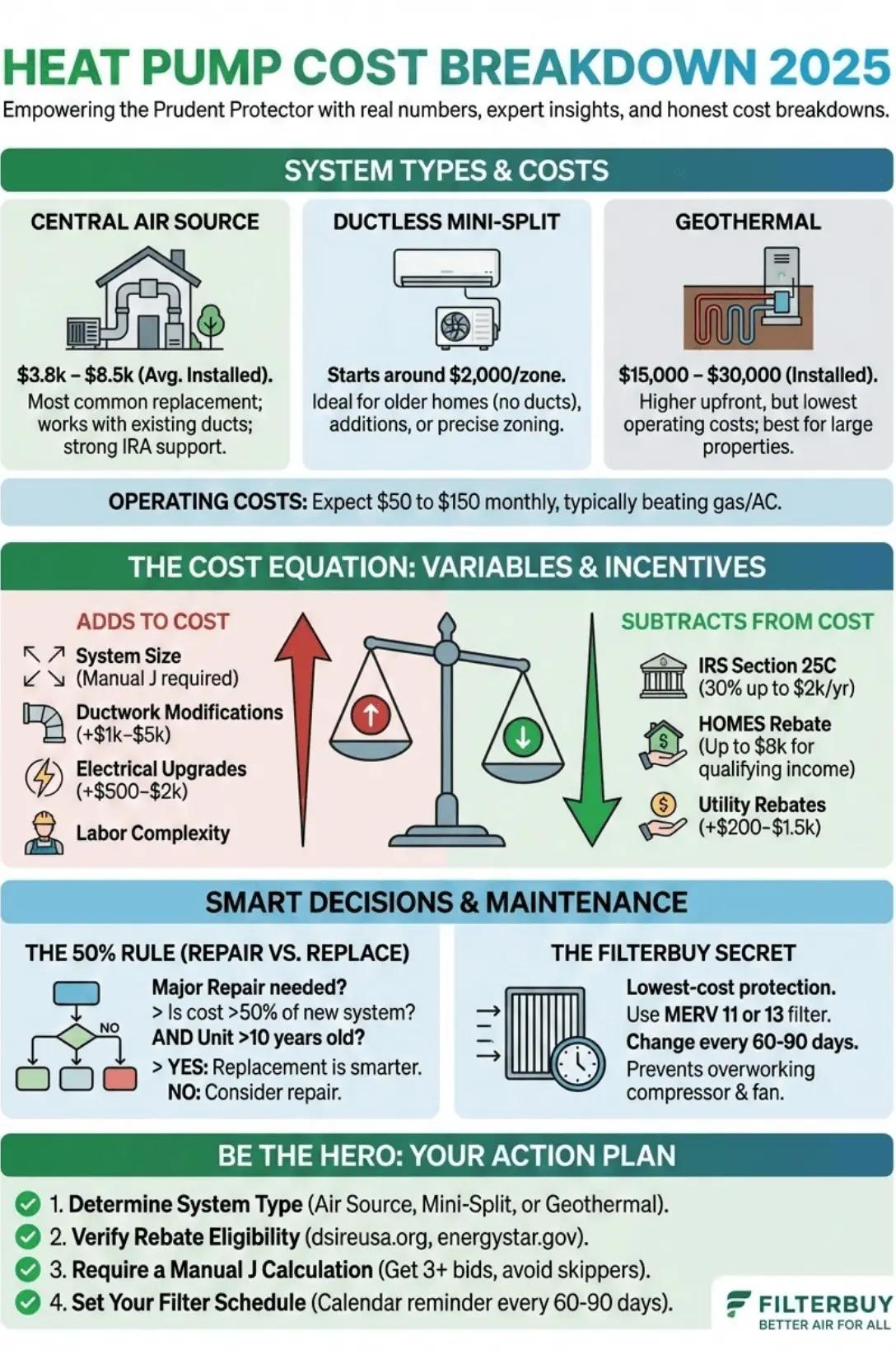
Most homeowners pay between $3,800 and $8,500 for a new central heat pump, fully installed in 2025. Mini-splits start around $2,000 per zone. Geothermal runs $15,000 to $30,000. Those are the starting numbers. What actually moves the final bill is where most guides stop short.
We make air filters for virtually every heat pump on the market. We work with installation data, talk to HVAC contractors regularly, and hear from homeowners on both ends of the quote spread. This guide reflects that: real cost ranges, the specific factors that move them, the rebates worth claiming, and the one maintenance step that determines whether your new system runs well for 12 years or 20.
Most homeowners pay $3,800 to $8,500 for a central air source heat pump, fully installed in 2025. Here's how the main system types compare:
Air source (central): $3,800 – $8,500 installed
Ductless mini-split: $2,000 – $14,500 installed (per zone)
Geothermal: $15,000 – $30,000 installed
The federal IRA Section 25C tax credit covers 30% of equipment cost, up to $2,000 per year through 2032, which brings the real out-of-pocket cost down for most buyers. Monthly operating costs run $50 to $150, typically less than a gas furnace and central AC running separately.
What moves the final number most: system size (tonnage), whether ductwork needs modification ($1,000–$5,000), and whether your electrical panel needs an upgrade ($500–$2,000). Always require a Manual J load calculation from your contractor before signing anything.
Once your system is in, a MERV 11–13 air filter changed every 60–90 days is the single most cost-effective way to protect it.
• Most homeowners pay $3,800 to $8,500 for a central air source heat pump, fully installed.
• Mini-split systems start around $2,000 per zone and are the best fit for homes without ductwork.
• Geothermal systems run $15,000 to $30,000 and deliver the highest long-term efficiency.
• The IRA Section 25C tax credit covers 30% of equipment cost, up to $2,000 per year through 2032.
• Most homeowners save $30 to $100 per month on energy compared to gas furnace operation in moderate climates.
• Cold-climate heat pumps maintain efficiency down to -13°F. They work in northern states.
• Repair vs. replace threshold: if repair cost exceeds 50% of replacement cost on a 10-plus-year-old unit, replace.
The type of system you choose sets the floor and ceiling on your total project cost more than any other single factor. Here’s where each category lands:
Air Source (Central): Unit cost $1,500 to $4,500. Installed cost $3,800 to $8,500. Best for most homes with existing ductwork.
Ductless Mini-Split: Unit costs $700 to $3,500. Installed cost $2,000 to $14,500. Best for additions, older homes, and zone-by-zone control.
Geothermal: Unit cost $3,000 to $8,000. Installed cost $15,000 to $30,000. Best for maximum efficiency on large properties.
Water Source: Unit cost $2,000 to $5,000. Installed cost $8,000 to $20,000. Best for properties near water or with wells.
Air source heat pumps are the most common replacement choice because they work with existing ductwork, ship from multiple manufacturers, and carry the strongest rebate support under the IRA. Mini-splits are the right fit when there’s no ductwork, or when you want zone-by-zone control. Geothermal costs more upfront, but its operating efficiency cuts energy bills sharply over a 20-to-25-year lifespan.
The quote you receive isn’t just for the unit. Several variables determine the installed price, and knowing them before the first contractor visit changes how those conversations go.
Heat pump capacity is measured in tons, where one ton equals 12,000 BTUs per hour. Most homes need between 1.5 and five tons. A well-matched system for a 2,000 square foot home typically runs 3 to 3.5 tons. Oversizing wastes money upfront and causes short-cycling. Undersizing means the system strains to hold comfort. Proper sizing requires a Manual J load calculation, which any licensed HVAC contractor should provide. Each additional ton of capacity adds roughly $400 to $600 to the project.
Labor accounts for $500 to $2,500 of most installed costs, depending on location and job difficulty. A straight swap of an existing heat pump sits near the lower end. Installing a multi-zone mini-split with five or more indoor heads, or adding HVAC to a home with none, pushes costs toward the top of that range. Get at least three bids from licensed, insured contractors before you commit.
Undersized, leaky, or poorly routed ductwork can add $1,000 to $5,000 to the project. Heat pumps move more air volume than gas furnaces, which sometimes means upgrading trunk lines or expanding return air capacity. A good contractor performs a duct leakage test before the install and shows you what they found.
Heat pumps run entirely on electricity. Homes built before 1990 often have panels already at capacity, and an upgrade runs $500 to $2,000. This comes up most often when switching from a gas or oil system. Get an electrician to assess your panel early in the process, not the morning of installation day.
Higher-efficiency units cost more upfront and less to run each month. Current DOE standards rate systems by SEER2 for cooling and HSPF2 for heating. The gap between a 15 SEER2 and an 18 SEER2 unit can run $1,000 to $1,500 at purchase. The higher-rated unit typically pays that difference back within five to seven years in most markets. In Zone 5 and colder, look specifically for cold-climate models. The Mitsubishi Hyper Heat and Bosch IDS series both maintain efficiency at temperatures as low as -13°F.
Replacing an existing system is typically the lowest-cost path. Here’s what each scenario runs:
Like-for-like heat pump replacement: $4,000 to $7,500
Switching from a gas furnace and central AC to a heat pump: $5,500 to $10,000 or more (ductwork and electrical upgrades may apply)
Adding a mini-split to supplement existing heat: $2,000 to $5,500 per zone
Full system replacement, including air handler or furnace coil: add $1,000 to $2,500
One thing we hear from homeowners regularly: if your heat pump is 12 to 15 years old and facing a compressor replacement (which runs $800 to $2,800), replacement usually makes more financial sense than repair, particularly given current rebate availability.
Heat pumps move heat rather than generate it. That's why they consistently outperform combustion-based systems on monthly operating cost. A heat pump with a COP of 3.0 delivers $3 of heating for every $1 of electricity it consumes — no gas furnace can match that ratio. Most air source units achieve a COP between 2.5 and 4.5, depending on outdoor temperature, with efficiency climbing in milder conditions and tapering as temperatures drop.
Real-World Monthly Cost Example 1,600 sq ft home | Atlanta, Georgia (Climate Zone 3) | 3-ton air source heat pump, 17 SEER2 / 9.5 HSPF2 | Based on Georgia's current residential electricity rate of $0.15/kWh (EIA, 2025)
Monthly heating cost (winter avg.): $72
Monthly cooling cost (summer avg.): $88
Annual electricity cost for HVAC: ~$960
Equivalent gas furnace + central AC: ~$1,400–$1,600/year
Estimated annual savings with heat pump: ~$440–$640
In colder markets like Minnesota, Michigan, and upstate New York, the math gets tighter. Standard heat pumps lose efficiency as outdoor temperatures drop. ENERGY STAR-certified cold-climate models are required to maintain a COP of 1.75 or higher even at 5°F — but monthly costs will still run meaningfully higher than in southern markets. A hybrid setup pairing a heat pump with a gas furnace backup is often the smartest cost-efficiency balance in Climate Zones 5 and 6.
Every heat pump needs service at some point. Here’s what common repairs cost in 2025:
Refrigerant recharge (R-410A or R-32): $150 – $450
Capacitor replacement: $120 – $300
Reversing valve replacement: $250 – $650
Fan motor replacement: $200 – $700
Compressor replacement: $800 – $2,800
Defrost board replacement: $200 – $600
Annual maintenance tune-up: $75 – $200
If the repair cost exceeds 50% of the installed cost of a new comparable system,
and your unit is more than 10 years old, replacement is almost always the smarter
financial call, especially with current IRA rebates still available.
One factor that cuts repair frequency significantly: a clean, properly rated air filter. A clogged filter forces the heat pump to work harder, which puts extra wear on the compressor and fan motor, the two most expensive parts to replace. At Filterbuy, we make MERV 11 and MERV 13 filters designed for heat pump systems that need strong filtration without restricting airflow. Keeping a fresh filter in the system is one of the highest-return maintenance decisions you can make.
The Inflation Reduction Act made heat pumps considerably cheaper to own. Three programs apply directly to most homeowners buying in 2025.
Homeowners can claim 30% of qualifying heat pump equipment costs as a direct credit against federal income taxes, up to $2,000 per year. The credit runs through 2032, which means homeowners making multiple efficiency upgrades over time can use it across different years. File IRS Form 5695 with your annual return.
Low-to-moderate income households may qualify for direct rebates of up to $8,000 for heat pump installation. States administer the funds, so availability varies. Check with your state energy office for the current status before counting on it.
Many utilities offer additional rebates of $200 to $1,500 for qualifying heat pump installations. The DSIRE database (dsireusa.org) tracks state and utility incentive programs across the country. Search by ZIP code to see what’s available where you live.
Tax credits reduce what you owe in taxes. They are not a rebate check. A $2,000 tax
credit lowers your tax liability by $2,000. If your total tax liability is less than the
credit amount, you do not receive the difference as a refund. Confirm eligibility with
a tax professional before factoring the full credit into your budget.
The comparison most homeowners are actually running. Here’s how the two systems stack up:
Installed Cost: Heat Pump $3,800 – $8,500 / Gas Furnace + AC $4,000 – $10,000 (combined)
Handles Heating & Cooling? Heat Pump: yes, one system / Gas Furnace: no, two systems needed
Monthly Operating Cost: Heat Pump $50 – $150 / Gas Furnace + AC $80 – $200+
Fuel Type: Heat Pump: electricity / Gas Furnace: natural gas + electricity
Avg. Lifespan: Heat Pump 15–20 years / Gas Furnace 20–25 years
Federal Tax Credit (2025): Heat Pump: up to $2,000 / Gas Furnace: none
Best Climate: Heat Pump: all climates (cold-climate models for Zone 5+) / Gas Furnace: very cold climates, Zone 6+
Carbon Footprint: Heat Pump: low (especially with a clean grid) / Gas Furnace: higher (combustion-based)
In a moderate climate with serviceable existing ductwork, a heat pump almost always wins on total cost of ownership once you factor in the IRA credit and lower monthly bills. In the coldest climates, a cold-climate heat pump or hybrid system is the right call, not a gas-only setup.

"In over a decade of working with HVAC systems across the country, the heat pump installations that hold up longest share one thing in common — the homeowner treated the air filter as part of the system, not an afterthought. A $25 filter changed on schedule has saved more compressors than any extended warranty I've seen."
— Filterbuy HVAC Editorial Team
These are the sources our editorial team used to verify the data in this guide. A well-informed contractor or energy auditor will reference most of them too.
1. U.S. Department of Energy — Heat Pump Systems
The DOE’s primary resource on heat pump types, efficiency ratings, and energy savings potential. Start here.
https://www.energy.gov/energysaver/heat-pump-systems
2. IRS Energy Efficient Home Improvement Credit (Form 5695)
Official IRS guidance on the Section 25C tax credit, including qualifying equipment requirements, credit amounts, and how to claim it on your federal return.
https://www.irs.gov/credits-deductions/energy-efficient-home-improvement-credit
3. ENERGY STAR — Certified Heat Pump Products
The complete database of ENERGY STAR-certified heat pumps. Search by type, efficiency rating, and brand to confirm which units qualify for federal tax credits.
https://www.energystar.gov/products/heat_pump_systems
4. DSIRE — Database of State Incentives for Renewables & Efficiency
The most complete database of state, utility, and local incentive programs for energy-efficient equipment in the U.S. Search by state or ZIP code.
5. Wikipedia — Heat Pump (Technical Overview)
A solid technical foundation covering how heat pumps work, thermodynamic principles, history, and system configurations. Useful for understanding the reasoning behind efficiency claims.
https://en.wikipedia.org/wiki/Heat_pump
6. Filterbuy — Heat Pump Installation Cost: Factors, Types, Pricing, Labor, Ductwork & Rebates Guide
Filterbuy’s full breakdown of heat pump installation cost, covering every cost driver with contractor-sourced data and region-specific pricing context.
7. ACCA — Air Conditioning Contractors of America
The professional trade association for HVAC contractors. Use the ACCA contractor locator to find certified professionals in your area, and confirm that any contractor you hire uses ACCA Manual J for load calculations.
Three numbers worth knowing before you get your first quote.
65% reduction in electricity use for heating compared to electric resistance heating, according to the DOE. That efficiency gap is why heat pumps are the default recommendation for most homes.
Source: U.S. Department of Energy — Energy Saver
$2,000 maximum annual federal tax credit available under IRS Section 25C for qualifying heat pump equipment installed in 2025. Claimable every year through 2032 under the Inflation Reduction Act.
Source: IRS.gov — Energy Efficient Home Improvement Credit
#1 heat pumps outsold gas furnaces in U.S. sales volume for the first time in 2022 and have held that position since, according to AHRI shipment data. That’s a significant shift in how America heats its homes.
Source: AHRI — 2022 U.S. Shipment Data
For most homeowners, yes. But the math only holds if the quote you’re evaluating is complete.
The heat pump industry has a communication problem. The headline cost, that “installed for $4,500” number, too often excludes ductwork modifications, electrical upgrades, and permit fees that can add $2,000 to $6,000 to the final bill. Nearly every homeowner who feels burned by a heat pump installation started with an incomplete quote.
The flip side is just as consistent. Homeowners who collect three bids, require a Manual J load calculation from each contractor, understand their IRA credits, and pick a system sized for their climate zone almost always come out ahead within six to eight years. They’re also not calling for emergency repairs at year three.
Our honest recommendation: don’t choose a heat pump because it’s the popular answer right now or because a contractor pushed a brand they happen to stock. Choose it because the numbers work for your specific home, climate, and timeline. In a moderate climate with an existing forced-air system, they almost always do. In Zone 6 with a drafty 1960s ranch, a cold-climate heat pump paired with proper air sealing and a consistent filter schedule is still probably the right call, but get a full energy audit before you commit.
Once the system is running, the lowest-cost thing you can do to protect it is change the air filter on schedule. Not because we sell filters, though we do and we’re proud of them, but because every HVAC technician who has ever pulled a heat pump compressor ahead of schedule will tell you the same thing: airflow is what keeps these systems alive.
Seven steps, in order.
Determine your system type. Use the cost and climate guidance above to narrow down whether air source, mini-split, or geothermal fits your home size, ductwork situation, and climate zone.
Check your rebate eligibility before you talk to a contractor. Visit dsireusa.org, enter your ZIP code, and identify state and utility rebates upfront. Knowing what’s available changes how you evaluate quotes.
Get at least three bids from licensed, insured HVAC contractors. Require a Manual J load calculation with every quote. Walk away from any contractor who skips this step.
Confirm your equipment qualifies for IRA credits. Before signing, cross-reference the unit your contractor proposes against the ENERGY STAR certified heat pump list at energystar.gov. High efficiency doesn’t automatically mean federal credit eligibility.
Sort your electrical situation early. Have a licensed electrician assess your panel before installation day. If an upgrade is needed, build that cost into your total project budget from the start.
Set up your filter schedule before the first day of operation. Choose a MERV 11 or MERV 13 filter compatible with your new system’s airflow specs and set a calendar reminder to change it every 60 to 90 days. Your compressor will thank you in year twelve.
File IRS Form 5695 with your next tax return. Keep your installation invoice and equipment certification documentation. Your tax professional will need both.
The questions homeowners ask us most, answered straight.
Most homeowners pay $3,800 to $8,500 for a central air source heat pump, fully installed in 2025. Mini-split systems run $2,000 to $14,500 depending on the number of zones. Geothermal systems range from $15,000 to $30,000. Federal tax credits under the Inflation Reduction Act can reduce your out-of-pocket cost by up to $2,000.
Plan for $50 to $150 per month to operate a heat pump, depending on your home size, local electricity rates, and climate zone. In moderate climates, most homeowners save $30 to $100 per month compared to running a natural gas furnace. In colder climates the savings margin narrows, but stays positive for most homes with a cold-climate-rated unit.
A direct, like-for-like replacement typically runs $4,000 to $7,500 installed. Switching from a gas furnace to a heat pump can cost $5,500 to $10,000 or more if ductwork modifications or an electrical panel upgrade are required. Ask for itemized bids that break out equipment, labor, ductwork, and electrical costs separately.
Yes. The IRS Section 25C Energy Efficient Home Improvement Credit lets homeowners claim 30% of qualifying heat pump equipment costs as a direct credit against federal income taxes, up to $2,000 per year. The credit is available each year through 2032 and requires ENERGY STAR certification on the equipment. File on IRS Form 5695.
For most homeowners in moderate to cold climates, yes. A heat pump handles both heating and cooling in one system, typically at lower monthly operating costs than running a gas furnace and a separate central AC unit. The payback period, including the IRA tax credit, is typically five to eight years. In very cold climates (Zone 6 and above), a cold-climate heat pump or a hybrid heat pump and gas system is the right approach.
Most air source heat pumps last 15 to 20 years with proper maintenance. Geothermal systems last 20 to 25 years for indoor components, with ground loops often lasting 50 or more years. Correct sizing at installation and consistent filter maintenance are the two biggest drivers of longevity. A heat pump running against a restricted filter works harder, runs longer, and fails earlier. Change your filter every 60 to 90 days.
The right air filter keeps your new heat pump running efficiently from day one, and Filterbuy makes it easy to find yours: 600+ sizes, made in the USA, shipped free direct to your door.

