
Which Way Does a Furnace Filter Go?
September 24, 2025
By Michelle Wan, Brand Manager and Air Quality Writer, Filterbuy | Reviewed for technical accuracy by David Clark, Licensed HVAC Technician and President of Filterbuy HVAC Solutions
Updated September 15, 2026
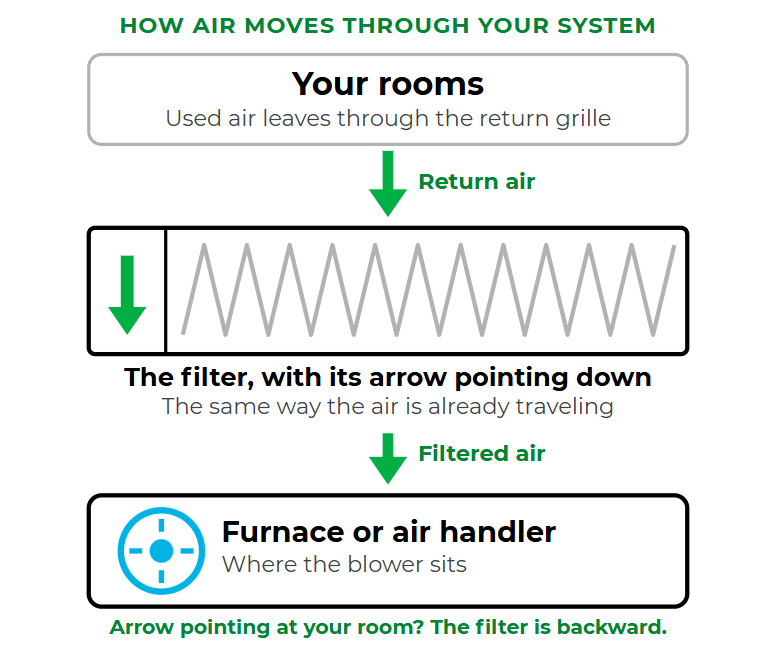
The airflow arrow on a furnace filter points toward the furnace, air handler, or blower motor. It never points back toward the room. Air leaves your rooms through the return grille, passes through the filter, and enters the blower, and the arrow just follows it.
That holds in summer and winter, because one indoor blower moves the air in both modes. What changes is where the arrow ends up aimed:
Upflow furnace — up, into the unit
Downflow furnace — down, into the unit
Horizontal furnace or air handler — sideways, toward the blower end
Wall, ceiling, or floor return grille — away from the room, into the ductwork
The check takes a second: if your arrow is aimed at your living room, it is backward. Not sure which filter belongs in that slot? The quick match below sorts it out.
Shop air filters made in the USA
Find your filter match
Answer a few quick questions and we will match you to the filter your system takes. Have a ductless mini split? Those filters snap into a fixed frame with no arrow at all, so start here.
TL;DR
The airflow arrow on a furnace filter frame points toward the furnace, air handler, or blower motor. It doesn’t point back toward the room. Air leaves your rooms through the return grille, passes through the filter, and enters the blower. The arrow just follows it. That holds for upflow, downflow, and horizontal systems, and it holds in summer as well as winter. What changes is where the arrow ends up aimed.
Filterbuy prints that arrow. We’ve cut, pleated, and framed filters to order in our own US plants for over a decade, so this guide comes from the side of the product where the arrow gets printed.
Key Takeaways
The airflow arrow points toward the furnace or air handler, in the direction the air is already moving.
In a horizontal furnace it points sideways toward the blower end: right if air moves left to right, left if it moves right to left.
Direction doesn’t change between heating and cooling, because one indoor blower moves the air in both modes.
Fit beats direction. Air routes around a loose filter instead of through it, and Filterbuy testing puts the cost of a half-inch gap at 20 to 30 percent of filtration effectiveness.
Which Way Does The Arrow On An Air Filter Point?
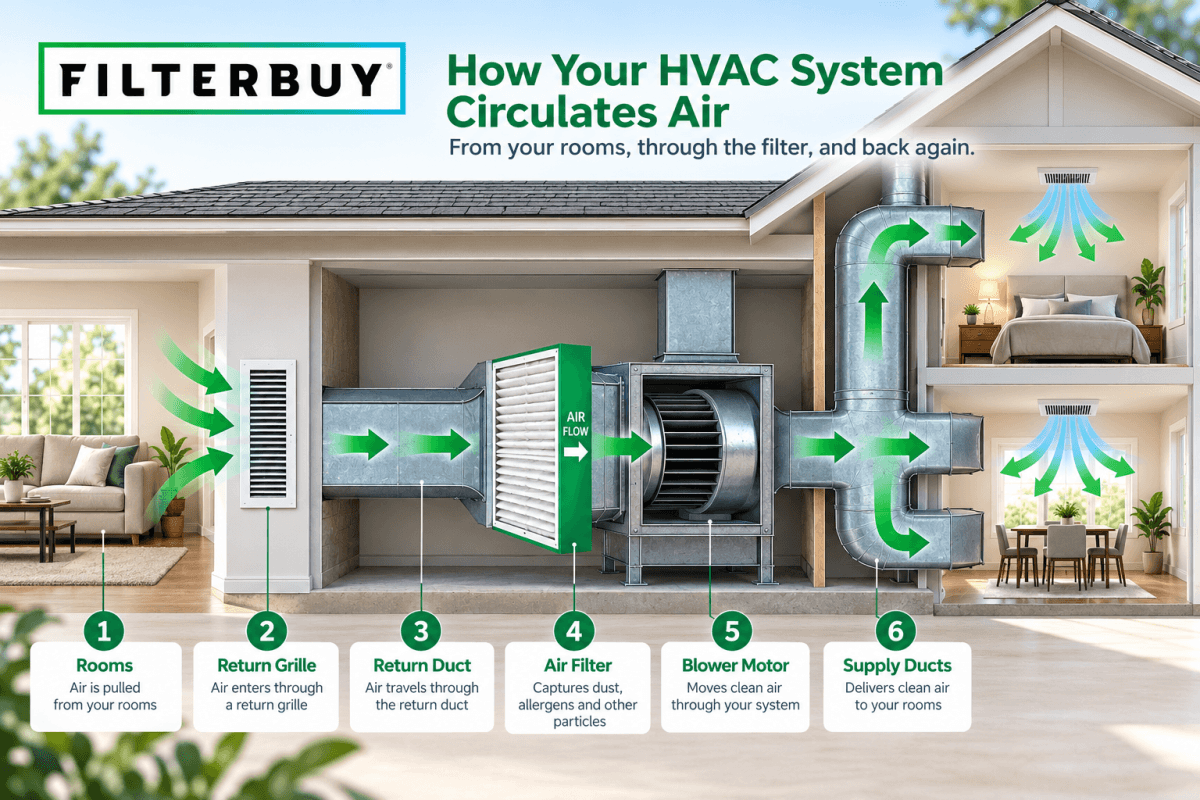
The arrow on an air filter points toward the blower motor, the fan that sits inside your furnace or air handler. Air leaves your rooms through the return grilles, travels down the return duct, passes through the filter, and enters the blower before it’s pushed back out through the supply ducts. Your filter sits at one point on that loop, so the arrow has one place to point.
Easiest way to hold onto it: the arrow flies toward the fan. The U.S. Department of Energy describes filters as sitting on the return side of the air handler, where they keep dust off the blower.
Which Way Should The Arrow Point In Your System?
The rule stays the same. What changes is where the arrow physically ends up, and that depends on your equipment.
Return grilles trip people up most, and the check takes a second: if your arrow is aimed at your living room, it’s backward.
Horizontal Furnace Filter Direction: Which Way Does The Arrow Point?
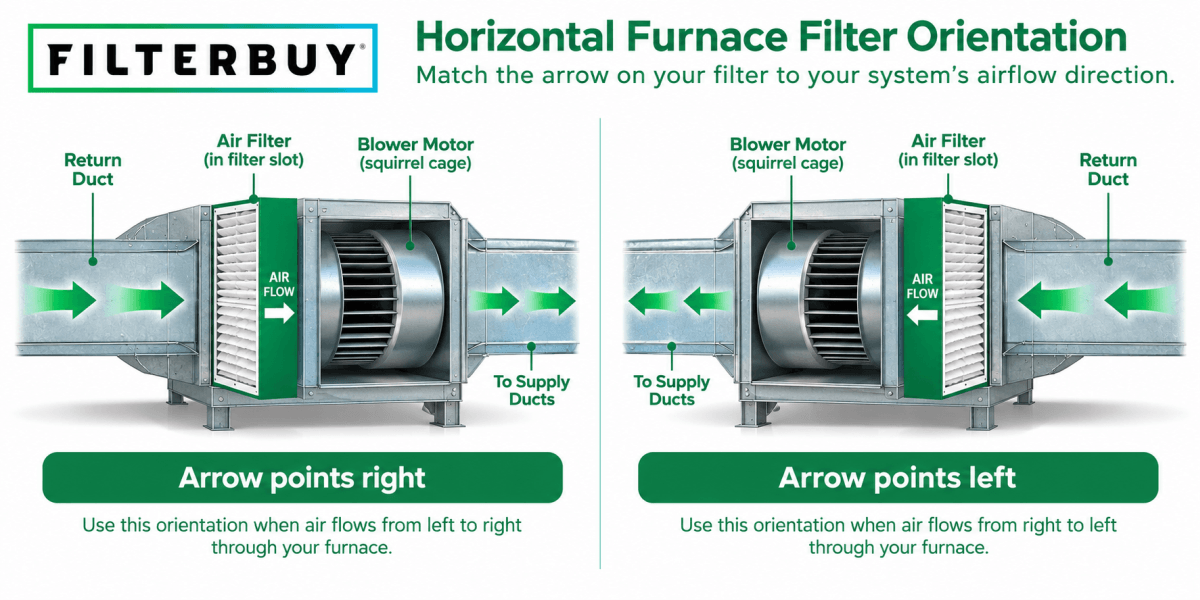
In a horizontal furnace or air handler, the airflow arrow points sideways, toward the end of the cabinet that holds the blower. If air moves left to right the arrow points right. If it moves right to left, the arrow points left. These units lie on their side in an attic, crawl space or garage, so “up” and “down” stop being useful. Think return side versus blower side.
Three ways to find the blower end, and you won’t need tools for any of them:
Look for the squirrel cage. Shut the system off, open the access panel, and find the large drum-shaped fan wheel. The arrow points at it.
Follow the ducts. The larger duct feeding the slot is the return. The arrow points away from it, into the cabinet.
Do the tissue test. With the filter out, set the thermostat fan to ON and hold a tissue at the open slot. It pulls in the direction the air is traveling, and that’s where the arrow points. Turn the system off within a minute.
Two setups catch people out. In closet-mounted units the slot faces the room, so the arrow ends up pointing away from you. In attic units gravity works against the seal, so check the fit as well as the direction.
Once you’ve worked it out, draw the arrow on the cabinet with a permanent marker. You won’t have to work it out again.
Does Air Filter Direction Change For Air Conditioning Vs. Heating?
No. The airflow arrow points the same way year-round. In a split system, the indoor unit (a furnace or an air handler) holds the one blower that circulates air in both modes, so the path through your filter doesn’t reverse.
The outdoor condenser moves refrigerant around, so there’s no filter out there to orient. In a heat pump the refrigerant flow does reverse, but the indoor airflow doesn’t, and the indoor airflow is all your filter cares about. The one exception is a ductless mini split, whose filters snap into a fixed frame with no arrow.
Which Way Does The Filter Go In A Wall Or Ceiling Return Vent?
At a return grille the arrow points away from the room and into the ductwork: up at a ceiling, down at a floor, into the wall in a hallway.
Four Situations That Catch People Out
More than one return grille usually means more than one filter. Change one, leave the rest, and airflow stays restricted while you think the job’s done. Walk the house before you order.
“THIS SIDE UP” is not the airflow arrow. Some frames carry both. The arrow tells you which way the air travels. Any orientation text is just about handling. Follow the arrow.
Some cabinets hold two filters in a V. Deep media racks and certain downflow furnaces take a pair angled toward each other, and both arrows point the same way: into the blower.
A correctly installed filter can still whistle. That’s usually a gap or a restriction, and the Filterbuy guide to furnace filter whistles covers it.
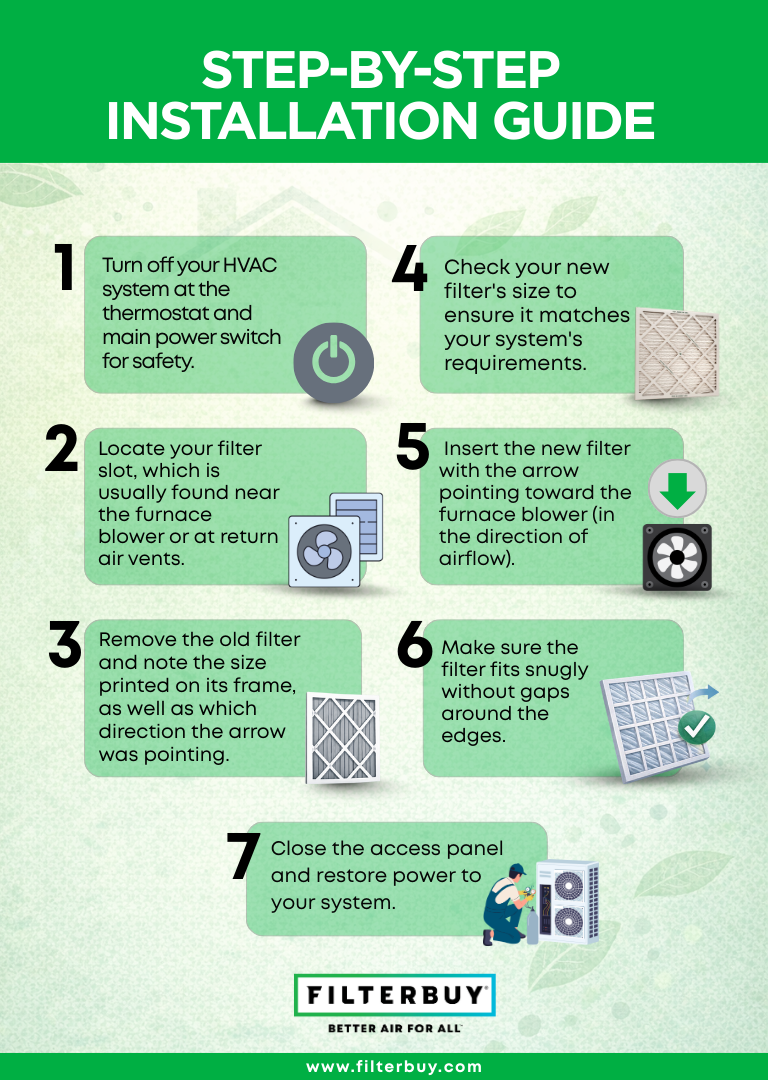
How To Install An Air Filter, Step By Step
Turn the system off at the thermostat, and at the service switch if you can reach it.
Find the filter slot. It sits in the furnace cabinet, in a return-duct rack, or behind a return grille.
Photograph the old filter before you pull it, capturing both the size and the arrow direction.
Match the size exactly. It’s printed right on the old frame, as length × width × thickness, for example 16x25x1. If it’s worn off, how to measure your air filter size takes a minute.
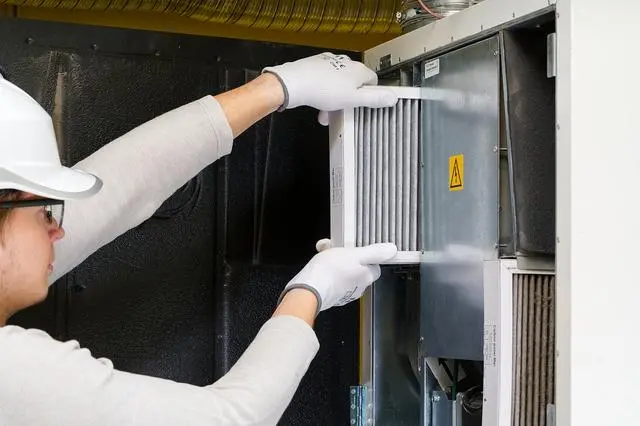
Slide it in with the arrow toward the blower: up in an upflow, down in a downflow, sideways in a horizontal unit, into the duct at a return grille. It should sit snug, with no daylight around the frame.
Close the panel and restore power.
How Do You Know If Your Air Filter Is In Backwards?
Three checks, and you won’t need tools. Read the frame: if the arrow points at the room, it’s backward. Read the dirt: the gray, loaded face should be the side the arrow points away from. Read the pleats: a reversed filter tends to bow toward the blower, because the media is being pushed against its unsupported side.
Found one backward? Flip it. A few months reversed is no emergency. If it ran that way for a year or more and airflow feels weak, have a technician check the blower and coil. Weak airflow has other causes too, including signs of a clogged furnace filter.
What Happens If You Install A Furnace Filter Backwards?
Nothing dramatic happens on day one, which is exactly the problem. Reversed, air hits the filter’s dense downstream layer first, and the media wasn’t built to take air from that side.
The blower runs longer. The U.S. Department of Energy finds that replacing a clogged filter with a clean one can lower a central air conditioner’s energy use by 5 to 15 percent. Restricting airflow on purpose pushes the other way.
That hits your largest energy line. Space heating and cooling are about 52 percent of a U.S. household’s annual energy use (U.S. Energy Information Administration, RECS 2020).
Filtration drops, and the motor pays for it. You’re not getting the MERV rating you paid for, and months of extra load can turn a $20 filter into a service call.
What If The Filter Has No Arrow, And Do The Pleats Matter?
No arrow? Face the open pleated side toward the return air and the denser, wire-backed side toward the blower. Filterbuy builds dual wire backing over the media to hold the pleats steady against airflow, so the mesh side tells you which way we meant the filter to load. The direction of the pleats themselves doesn’t matter.
The Mistake That Beats Direction: Fit
A correctly oriented filter that doesn’t fill its slot is worse than a backward one that does. A gap at the frame lets unfiltered air stream past the media and onto your blower and coil, and no MERV rating stops it. Filterbuy sizing testing finds that a half-inch gap can cut filtration effectiveness by 20 to 30 percent. ASHRAE, the body that writes the MERV standard, gives the same instruction: seal the filter so the air goes through it, not around it.
So the whole job comes down to two things: arrow toward the furnace, and no daylight around the frame. Finding your size is usually easy, because it’s printed on the old frame, and Filterbuy stocks 600-plus of them. If yours isn’t one, we cut custom air filter sizes to the eighth of an inch, which beats taping a gap.
Supporting Statistics
Americans spend about 90 percent of their time indoors. Concentrations of some pollutants run 2 to 5 times higher indoors than outdoors, according to the U.S. EPA. Your filter is the part of the system that captures particles as air passes through it.
20 to 30 percent of duct-system air is lost to leaks in a typical house, per ENERGY STAR. A filter leaking at the frame adds to a loss that’s already happening downstream.
Dust builds up on evaporator coils enough to double their airflow resistance in about 7.5 years, against an expected coil life of 15 to 30 years, in modelling by Lawrence Berkeley National Laboratory. How well the filter fits and captures were the biggest factors.
Direction Sorted. Two Things To Check Next.
Once the arrow is right, two things are left: the rating and the schedule. The EPA recommends a filter rated MERV 13 or higher, MERV being the industry scale for how much a filter captures. Check your HVAC manual to confirm which ratings your system takes, the same quick check you’d do for size. Then plan on a fresh filter every 60 to 90 days.
Compare ratings in MERV 8 vs. MERV 11 vs. MERV 13, or read the full technical version in which way does a furnace filter go in: the complete airflow guide.
Stop thinking about the schedule: set up air filter auto-delivery.

Frequently Asked Questions
Does Air Filter Direction Change Between Heating And Cooling?
No. One indoor blower moves the air in both modes, so the path through the filter doesn’t reverse.
Which Side Of The Air Filter Faces The Furnace?
The denser side, or the side with wire backing. The open pleated face takes the incoming return air.
Can I Run My Furnace Without A Filter?
Not as a habit. Unfiltered air puts dust on the blower wheel and the coil, and that eventually needs a professional to clean.
Glossary
Airflow arrow. The arrow printed on an air filter frame. It shows which way air travels through the filter, and points toward the furnace or air handler.
Air handler. The indoor unit that circulates air through a home’s ducts. Without a furnace, it holds the blower and filter.
Blower motor. The fan inside a furnace or air handler that pulls return air through the filter. Installers call it the squirrel cage, after its drum shape.
Return duct and return grille. The vent and ductwork carrying used air from your rooms back to the equipment. The filter sits on this side.
MERV. Minimum Efficiency Reporting Value, the industry scale for how much a filter captures, set under ASHRAE Standard 52.2. Higher numbers capture finer particles.
Filter bypass. Air that travels around a filter through gaps at the frame rather than through it. It never gets cleaned.
Sources
U.S. Department of Energy, Energy Saver 101: Home Cooling · U.S. EPA, Guide to Air Cleaners in the Home; Indoor Air Quality · ENERGY STAR, Duct Sealing · ASHRAE, Filtration and Disinfection Guidance · Siegel, Walker & Sherman Lawrence Berkeley National Laboratory, Dirty Air Conditioners, ACEEE 2002 · U.S. Energy Information Administration, Use of Energy in Homes, RECS 2020.