The Rebates That Actually Pay Out In 2026
Author: Michelle Wan
Technically reviewed by: David Clark, Licensed HVAC Technician
Published: July 28, 2026
Updated: July 28, 2026
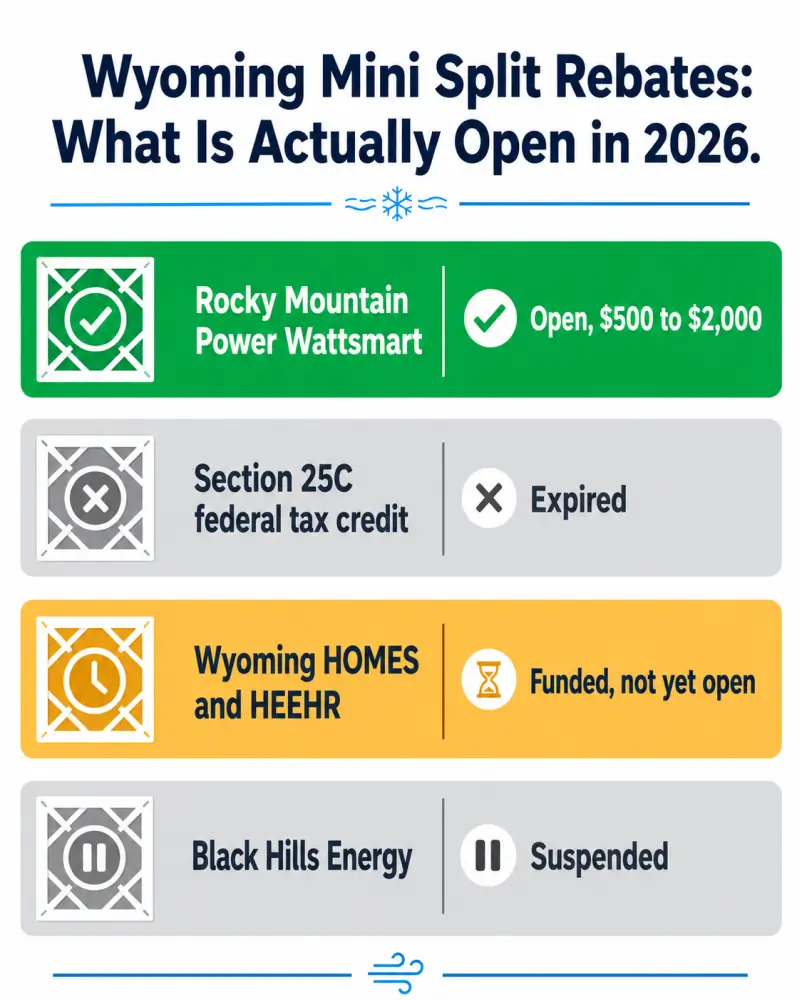
Only one rebate is paying out in Wyoming right now: the Rocky Mountain Power Wattsmart Homes ductless heat pump rebate, worth $500 to $2,000. The federal tax credit expired on December 31, 2025, so a 2026 install earns nothing from the IRS.
Installed cost runs about $1,800 to $3,500 per zone. Here is where each program stands as of July 28, 2026:
Which one you qualify for depends on your utility, your current heat source, and how many indoor heads you install. The quiz below sorts that out in under a minute.

Answer 3 quick questions and we will match you to the right mini split for your space.
Already know your size? Shop Filterbuy mini split systems.
Adding a mini split AC system in Wyoming costs most homeowners roughly $1,800 to $3,500 per zone installed, and in 2026 exactly one rebate is reliably paying out: Rocky Mountain Power’s Wattsmart Homes ductless heat pump rebate, worth $500 to $2,000. The federal $2,000 tax credit ended December 31, 2025. Wyoming’s $69 million federal rebate allocation is funded but not yet open, and Black Hills Energy has suspended its Wyoming rebates entirely.
Rocky Mountain Power pays $500 to $2,000 for a qualifying ductless heat pump in Wyoming, depending on what you are replacing and how many indoor heads you install.
The federal Section 25C tax credit is gone. It expired December 31, 2025 under the One Big Beautiful Bill Act, so a 2026 installation earns no federal tax credit.
Black Hills Energy customers in Cheyenne and Laramie County currently have no rebate. The utility asked the Wyoming Public Service Commission to dismiss its 2026 efficiency plan.
Wyoming’s $69 million HOMES and HEEHR rebates are funded but not live. The Wyoming Energy Authority has no firm launch date and the application site is still being built.
Do-it-yourself installation disqualifies you. Wattsmart requires a program-participating contractor and rejects self-installs, and applications must be filed within 90 days.
Rebate pages go stale quietly, so the Filterbuy editorial team did not take anyone’s word for this one. On July 28, 2026 we opened every program named on this page and recorded what it actually said that day: the Wattsmart ductless heat pump page for Wyoming, the Black Hills Energy page for Cheyenne and Laramie County, the Wyoming Energy Authority’s Home Energy Savings Program page, and the IRS page for Form 5695.
Three of the four contradicted what the top-ranking rebate roundups were telling homeowners that same afternoon. Every figure below is dated and linked, and where we could not confirm something we say so.
One. As of July 2026, the only mini split rebate a Wyoming homeowner can apply for and receive is the Rocky Mountain Power Wattsmart Homes ductless heat pump rebate, worth $500 to $2,000. Three other incentives get cited constantly and none of them pays out today: the federal tax credit, the state’s federal rebate allocation, and Black Hills Energy’s suspended utility rebates. One is expired, one has not opened, and one is suspended.
Here is the honest status of all four.
Status verified July 28, 2026. Rebate programs change without notice; confirm with the administering utility or agency before you sign an installation contract.
Contractors and calculator sites still quote an $8,000 Wyoming heat pump rebate. That figure comes from the program caps, not from anything you can apply to today. Budget on the Wattsmart rebate and treat the rest as a bonus.
Rocky Mountain Power’s Wattsmart Homes ductless heat pump program pays Wyoming homeowners $500 for a supplemental ductless heat pump, $1,000 for a single-head system replacing electric resistance heat, and $2,000 for a multi-head system replacing electric resistance heat. Equipment must hit 8.1 HSPF2 and 16 SEER2, and you must buy electricity from Rocky Mountain Power on a qualifying residential rate schedule, which is printed on your bill.
Rocky Mountain Power residential customers on qualifying rate schedules only. Confirm yours on your bill or by calling 1-888-221-7070. Existing single-family homes; manufactured homes and new construction excluded. Equipment must be listed on the AHRI Certified Directory. Rebates and qualifications are subject to Wyoming Public Service Commission approval.
Most Wyoming homeowners are told a rebate range and left to guess where they land. Work these four questions in order and you will know your number before a contractor quotes you one.
Question 1. Who bills you for electricity?
Rocky Mountain Power, and your rate schedule qualifies → keep going. Black Hills Energy → stop; there is nothing to claim right now. A rural co-op or municipal utility → call them directly, because Wattsmart rules do not apply to you.
Question 2. What heats the home today?
Electric baseboard, electric ceiling or wall heat, or an electric furnace → you are in the conversion tier, worth $1,000 or $2,000. Natural gas → you are limited to the $500 supplemental rebate, and the furnace has to stay in service. Propane, oil, wood, or pellets → read the next paragraph carefully, because this is where Wyoming homeowners get caught.
Question 3. One indoor head, or more than one?
Converting from electric resistance heat, a single head pays $1,000 and a multi-head system pays $2,000. Adding a second head roughly doubles the rebate, so price the two-head option before you assume one is the cheaper project. It often is not, once the rebate is netted out.
Question 4. Who is doing the work, and where is it going?
The installer must be on the program-eligible contractor list, and the head must land in fully conditioned living space. Do-it-yourself work and garages are both disqualified, and neither can be fixed after the fact.
Rocky Mountain Power states plainly that gas, oil, wood heating, pellet stoves, and propane system conversions do not qualify for the ductless conversion rebate.
The $500 supplemental rebate is written for homes heated with natural gas, which most rural Wyoming homes are not.
Net effect: a propane-heated house outside a gas service area can fall between both definitions and collect nothing.
This lands hardest on the homes with the most to gain. Propane properties around Big Piney, Dubois, and Ten Sleep carry some of the highest heating costs in the state and the weakest rebate access. If that is you, stop budgeting around a utility rebate and watch the Wyoming Energy Authority program instead. Its income-based structure does not care what fuel you burn today.
Your rate schedule is printed on your bill. Confirm it qualifies by calling Rocky Mountain Power at 1-888-221-7070 before you sign a contract, not after. This single line decides whether you get paid at all.
The federal Section 25C Energy Efficient Home Improvement Credit paid 30% of project cost up to $2,000 for a qualifying heat pump. It expired December 31, 2025 under the One Big Beautiful Bill Act, Public Law 119-21. A mini split placed in service in Wyoming during 2026 earns no federal tax credit. If your system was running before that date, you can still claim it on your 2025 return using IRS Form 5695, Residential Energy Credits. Our full breakdown of mini split tax credits and rebates in 2026 covers how the other states compare.
The Wyoming Energy Authority manages $69 million in federal Home Energy Rebates funding, covering measures such as heat pump installation, electrical wiring, and insulation. The U.S. Department of Energy released the money in June 2026 after an 18-month hold, but the program is not accepting applications. State Energy Program Manager Patrick Millin told Wyoming Public Radio there is no firm date and the program website still has to be built.
Eligibility is expected to reach households under 150% of Area Median Income, with the lowest-income tier potentially covered in full. If your income may qualify, ask your contractor whether waiting is realistic, then watch the Wyoming Energy Authority Home Energy Savings Program page to track it.
A single-zone mini split runs about $1,800 to $3,500 fully installed for budget-tier equipment. That range comes from Filterbuy’s own pricing and install data, not a third-party survey. Electrical work is the biggest swing factor. Wyoming’s low power prices, roughly 14 cents per kWh against a national average near 19 cents, stretch payback periods compared with high-rate states. That makes the equipment and installation quote matter more than the efficiency spec sheet.
Read every quote as four separate numbers: equipment, labor, electrical, and permits. The electrical line is where Wyoming projects go sideways. Older homes in Sheridan, Casper, and Laramie often have no 230V capacity in living spaces, and running a new 230V circuit can cost more than the mini split itself. That is why the voltage a unit runs on deserves as much attention as its efficiency rating.
That constraint is the reason Filterbuy builds larger capacities to run on standard household voltage. Filterbuy is a family-owned American manufacturer that has built air filters in Alabama, Florida, Pennsylvania, and Utah since 2013, and now builds ductless systems. The 18,000 BTU mini split on 115V plugs into the wiring an older Wyoming home already has, which removes the electrical line from the quote entirely on many jobs.
Rocky Mountain Power has also proposed a rate increase that would raise bills roughly 8.8% for about 150,000 customers. That shifts the payback math slightly in favor of a heat pump, since a mini split typically delivers two to three times the heat per kilowatt-hour of electric baseboard.
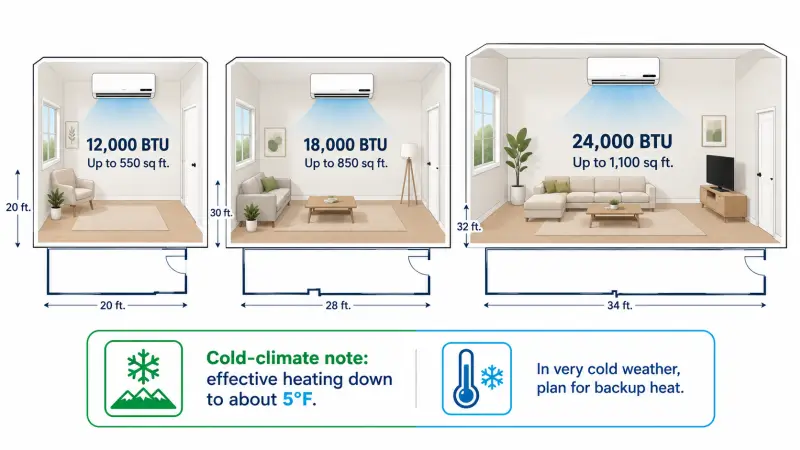
Partly. A modern inverter mini split like Filterbuy’s R-32 lineup produces useful heat down to roughly 5°F, which covers most Wyoming shoulder-season days and a good share of winter. It does not cover a Big Horn Basin cold snap on its own. In Wyoming, a mini split should be specified as a primary system for most of the year with a backup heat source for the coldest nights, not as a one-for-one furnace replacement.
We have not seen this stated anywhere else. Wyoming’s rebate minimum and the recognized cold-climate standard are not the same bar, and they disagree in both directions.
To earn the rebate, Rocky Mountain Power requires 8.1 HSPF2 and 16 SEER2.
To be listed as cold-climate equipment, NEEP requires HSPF2 of 8.5 or better and SEER2 of 15 or better for non-ducted systems, plus a COP above 1.75 at 5°F.
The rebate asks for more cooling efficiency than the cold-climate standard, and less heating efficiency. A mini split can collect the full $2,000 and still sit below the bar written for climates like ours.
Treat 8.1 HSPF2 as a paperwork threshold, not a specification. Ask for the rated capacity and COP at 5°F, then check the model against the NEEP product list. A system can be rebate-eligible and still leave you cold in February.
Size it to the room, not the house. Filterbuy builds the 12,000 BTU ductless mini split, the 18,000 BTU mini split on 115V, and the 24,000 BTU ductless mini split on low-GWP R-32 refrigerant.
Coverage assumes average insulation and ceiling height. High ceilings, single-pane windows, and heavy west-facing sun exposure all reduce effective coverage, which is common in older Wyoming housing stock. When you are between sizes, size up.
Confirm your utility and rate schedule. Find Rocky Mountain Power and your rate schedule on your bill, then confirm that schedule qualifies by calling 1-888-221-7070. Black Hills Energy customers have no active rebate to claim.
Identify what you are replacing. Electric baseboard or an electric furnace opens the $1,000 to $2,000 conversion rebate. A gas-heated home qualifies only for the $500 supplemental rebate.
Pick a program-participating contractor from the Wattsmart contractor directory before any work starts. This step is not optional and it cannot be fixed later.
Spec the equipment to the rebate: 8.1 HSPF2, 16 SEER2, inverter-driven compressor, variable-speed indoor blower, listed on the AHRI Certified Directory.
Install in conditioned living space. Garages and unconditioned bonus spaces are excluded.
Apply within 90 days through the Wattsmart rebate portal with your account number and the itemized contractor invoice.
Keep filtering. A mini split mesh pre-filter catches lint, not fine particulate. During Wyoming wildfire smoke season, whole-home filtration still does the heavy lifting.
Not today. The $8,000 figure comes from the federal HEEHR program cap. Wyoming’s allocation is funded, but the state has not opened applications and has announced no launch date.
No. Rocky Mountain Power excludes do-it-yourself installations, and self-installation also voids Filterbuy equipment warranties.
Usually not for the whole house. A single zone is the standard fix for the room your ducts never reached, such as a bonus room over the garage or a finished basement.
Only slightly, and this is the part we know best. The filter inside a mini split head is a washable mesh screen built to protect the coil from lint, not to capture fine particulate. Filterbuy has manufactured air filters in the USA since 2013, and the honest answer is that smoke-season filtration is a job for a MERV 13 filter in your central system, not for the mini split.
Propane conversions are explicitly excluded from the electric resistance conversion rebate. You may still qualify for the $500 supplemental rebate if your primary system stays operational.
We do not make claims we cannot back up. Three sources sit underneath the advice on this page.
1. Heat pumps use about half the electricity of baseboard heat.
Source: U.S. Department of Energy, Energy Saver: Electric Resistance Heating
Resistance heat returns one unit of heat per unit of power. A heat pump returns several.
This is why Rocky Mountain Power pays the most, $1,000 to $2,000, for exactly this swap.
Heat with gas instead? Your rebate drops to $500.
2. Wyoming power runs 9.14 cents per kWh, 47th in the nation.
Source: U.S. Energy Information Administration, Wyoming Electricity Profile 2024
Cheap power is good news monthly, bad news on payback.
Buy for the room that is never comfortable. Treat the energy savings as a bonus.
Note: this is an all-sector average, not a residential rate. Your bill runs higher.
3. Cold-climate ductless units must beat a COP of 1.75 at 5°F.
Source: Northeast Energy Efficiency Partnerships, ccASHP Specification and Product List
Plain English: at 5 degrees, it still returns 1.75 units of heat per unit of power.
Non-ducted systems also need HSPF2 of 8.5 or better and SEER2 of 15 or better.
Ask your contractor for the 5-degree number, not just the headline rating.
Below that, plan on a backup heat source. One box does not do everything in Wyoming.
Most homeowners skip the rebate pages and take the contractor’s word for it. That is usually where the money gets lost. Seven pages worth ten minutes, in the order we would open them.
1. Start Here: See What Rocky Mountain Power Will Actually Pay You
Rocky Mountain Power: Wattsmart Homes, Ductless Heat Pumps (Wyoming)
Your real number, $500 to $2,000, plus the efficiency ratings your unit has to hit and the approved-contractor rule that trips up the most people.
Best for: knowing what you get back before you accept a bid.
2. Find Out If Wyoming’s Big Rebate Program Has Opened Yet
Wyoming Energy Authority: Home Energy Savings Program
There is $69 million sitting behind this page. If it is live, a household that qualifies on income could get back far more than the utility pays.
Best for: deciding whether waiting is worth it. No application link means it has not opened.
3. In Cheyenne or Laramie County? Read This Before You Budget
Black Hills Energy: Cheyenne Electric and Laramie County Residential Rebates
If Black Hills sends your electric bill, rebates are paused while the programs are redesigned. Better to know now than after you have built it into the budget.
Best for: Cheyenne and Laramie County, where the honest answer today is zero.
4. Check Whether a Federal Tax Credit Still Has Your Name on It
Internal Revenue Service: About Form 5695, Residential Energy Credits
The credit ended December 31, 2025, so a 2026 install earns nothing. If yours ran before that date, this is where you claim it.
Best for: settling it when someone says the $2,000 credit is still around.
5. The Real Story Behind That $8,000 Rebate You Keep Seeing
Wyoming Public Media: Wyoming Energy Savings Program Rebooted by the Department of Energy
The June 2026 report quoting the state program manager saying there is still no firm date. That is the difference between a number on paper and money in your pocket.
Best for: sanity-checking any Wyoming rebate figure you find.
6. See How Rising Power Bills Change Your Payback Math
WyoFile: Rocky Mountain Power Asks for $71M Rate Increase
An 8.8% increase affecting roughly 150,000 customers, phased into 2027. Pricier power means a heat pump pays for itself faster than baseboard.
Best for: weighing whether to convert now or wait.
7. The Actual Law, for When Someone Swears the Credit Still Exists
Congress.gov: H.R. 1, Public Law 119-21 (full text)
The statute that ended the $2,000 federal credit after December 31, 2025.
Best for: backing yourself up with a salesperson.
Michelle Wan writes about home heating, cooling, and indoor air quality for Filterbuy. This article was technically reviewed by David Clark, Licensed HVAC Technician.
If you are researching this from across the state line, adding a mini split in Montana runs the same analysis for a neighbouring cold-climate market. For equipment selection, see the best mini split air conditioners of 2026 and our breakdown of what mini splits actually cost. For the federal picture, read mini split tax credits and rebates in 2026.
Mini split (ductless heat pump): An electric heating and cooling system with an outdoor compressor and one or more wall-mounted indoor heads, connected by a refrigerant line through the wall, requiring no ductwork.
Wattsmart Homes: Rocky Mountain Power’s residential energy-efficiency rebate program, operating in Wyoming, Utah, and Idaho.
HSPF2: Heating Seasonal Performance Factor 2, the current federal measure of heat pump heating efficiency. Wattsmart requires 8.1 or higher.
SEER2: Seasonal Energy Efficiency Ratio 2, the current federal measure of cooling efficiency. Wattsmart requires 16 or higher.
Section 25C: The federal Energy Efficient Home Improvement Credit, which paid 30% up to $2,000 for qualifying heat pumps and expired December 31, 2025.
HEEHR / HEAR: The High-Efficiency Electric Home Rebate program, Inflation Reduction Act Section 50122, a point-of-sale rebate for income-qualified households.
AHRI Certified Directory: The Air-Conditioning, Heating, and Refrigeration Institute public database of rated equipment. Wattsmart requires listed equipment.