Installation, Costs & Filter Guide (FL Climate)
Written by Michelle Wan, Brand Manager and Air Quality Writer at Filterbuy. Reviewed by David Clark, Licensed HVAC Technician. Michelle works with Filterbuy's U.S. manufacturing team across factories in Alabama, Florida, Pennsylvania, and Utah, so her guidance is grounded in how filters are built, tested, and used. Published August 5, 2026. Last updated August 5, 2026.
A mini split in Tampa costs $1,600 to $5,900 for a single zone, or $4,200 to $14,800 for a multi-zone system. Zone count moves the price more than any other factor. Tampa Electric's $550 rebate is written for ducted systems, so confirm ductless eligibility before you budget for it.
Not sure how many zones your space needs? The quiz below sorts it out in about a minute.

Answer 3 quick questions and we'll match you to the right mini split for your space.
Rather browse on your own? See Filterbuy mini split systems.
A ductless mini split installed in Tampa costs $1,600 to $5,900 for a single zone and $4,200 to $14,800 for a multi-zone system in 2026. Tampa Electric's top HVAC rebate is $550 at 16.2 SEER2, but its published program language specifies a ducted system, so confirm ductless eligibility before you budget for it. The federal tax credit most guides still cite expired December 31, 2025.
A mini split is a ductless system pairing one outdoor compressor with one or more wall-mounted indoor heads, and it suits Tampa because it dehumidifies while it cools. Expect $1,600 to $14,800 installed depending on zone count. Two things most Tampa guides get wrong: the Tampa Electric rebate everyone points to is written for ducted systems, and the washable mesh screen in a mini split head is not a MERV-rated air filter, so a ductless room loses the particle filtration a central system provides.
Tampa mini split installation costs $1,600 to $5,900 per single zone in 2026; 3-to-5-zone systems run $7,800 to $14,800.
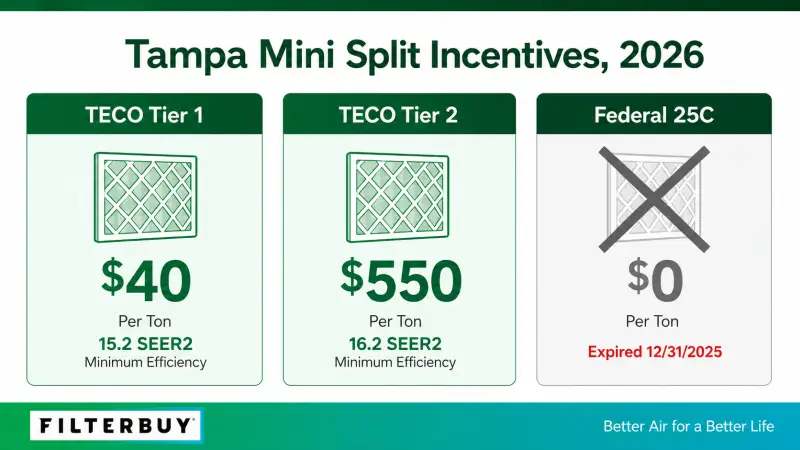
Tampa Electric pays $550 per qualifying unit at 16.2 SEER2 or higher, versus $40 at 15.2 SEER2, but its program page specifies a ducted system. Confirm ductless eligibility with TECO before you count on the money.
Federal Section 25C was terminated for property placed in service after December 31, 2025. No federal credit applies to a 2026 Tampa install.
Tampa's mid-summer dew points average in the mid-70s degrees F, so Florida-adjusted sizing typically calls for about 25% more BTU capacity than a national calculator suggests.
A mini split's mesh filter is washable and reusable, not MERV-rated. In Tampa, clean it every two weeks through pollen season and peak cooling.
A single-zone mini split installation in Tampa runs $1,600 to $5,900 fully installed; a multi-zone system runs $4,200 to $14,800. Zone count and BTU capacity drive most of the price, and Tampa Bay labor rates and the age of your electrical panel account for the rest. For the statewide picture, see our guide to adding a mini split AC system in Florida; for national ranges, see mini split installation cost.
Ranges reflect 2026 Tampa Bay contractor pricing and Filterbuy's Florida field experience. Get three itemized quotes.
Four line items move a Tampa quote more than the equipment does. Electrical: older Seminole Heights and Sulphur Springs homes often need a new 240V circuit, adding $300 to $1,500. Permits: Hillsborough County mechanical permits run $150 to $340, plus Florida's 2.5% surcharge. Line set: standard installs include 25 feet of copper; each extra 10 feet adds $50 to $150. Timing: book March, April, October, or November, since summer emergency demand pushes Tampa Bay labor rates 15 to 25% higher.
If Filterbuy HVAC Solutions holds Tampa-market install or service records, replace these ranges with a proprietary table (median installed cost by BTU, sample size, date range). Original local cost data is the strongest AI-citation asset this page could carry.
Tampa Electric's Heating & Cooling rebate pays $550 per qualifying unit at SEER2 16.20 or higher and $40 at SEER2 15.20. Read the program page closely, though: TECO describes it as replacing an old system with a new, ducted, energy-efficient system, and the qualifying categories it lists are heat pumps, straight-cool with natural gas heat, and geothermal.
This is where a lot of Tampa mini split advice goes wrong. Several rebate-aggregator sites state flatly that ductless mini splits qualify for the $550. TECO's published program language does not say that, and a ductless system is by definition not ducted. Before you budget the rebate into a ductless project, call TECO at 813-275-3909 and get the answer for your specific model. A concealed-duct or ducted mini split air handler may be treated differently from a wall-mounted head.
If you do qualify, the mechanics matter. The rebate is calculated on the number of condensing units. Your contractor must hold an eight-digit TECO vendor number, deduct the rebate as a separate line item on your invoice, and submit the AHRI reference sheet plus the paid invoice within 90 days of installation. TECO pays the contractor, not you.
The federal Section 25C Energy Efficient Home Improvement Credit was terminated by the One Big Beautiful Bill Act for property placed in service after December 31, 2025, per Treasury and IRS guidance. A 2025 install can still be claimed via Form 5695. For a 2026 install, utility rebates are the incentive. Worth knowing: some government efficiency pages still describe the credit as running through 2032 and have not been updated, so check the IRS guidance rather than the marketing page.
Know which utility serves you. Tampa Electric serves roughly 800,000 customers across Tampa and much of Hillsborough County. Duke Energy Florida serves other parts of Tampa Bay, including much of Pinellas County, and runs a separate program. Check the name on your bill first.
Size a Tampa mini split for moisture, not just square footage. Mid-summer dew points here average in the mid-70s degrees F and annual relative humidity averages about 74%, peaking near 78% in August. Latent load, the energy spent wringing water out of the air, is why national BTU calculators tend to undersize Florida rooms by roughly 25%.
Oversizing is the more expensive mistake. An oversized unit satisfies the thermostat fast, shuts off, and never runs long enough to dehumidify. The result is the classic Tampa complaint: a room that reads 72 degrees F and still feels clammy, with humidity above 60%, the range where mold and dust mites thrive.
Ask your contractor for a Manual J load calculation in writing. It is the ACCA-standard sizing method, ENERGY STAR tells homeowners to insist on it, and Florida permit offices commonly expect it on residential work. The clammy-at-72-degrees complaint is the one Filterbuy's HVAC Solutions team gets called about most in Florida homes, and it is almost always a sizing problem rather than a broken unit. Two Tampa-specific adjustments: west-facing Florida rooms and sunrooms need 30 to 50% more capacity than square footage suggests, because glass loads spike from noon to 4 p.m.; and within five miles of the Bay or Gulf, specify corrosion-protected coils, because salt air shortens the life of standard copper.
Mini split installation in Tampa requires a mechanical permit, and your licensed contractor should pull it. Which office issues it depends on your address, and this trips up more homeowners than any other step.
City of Tampa addresses permit through the City of Tampa Construction Services Center.
Unincorporated Hillsborough County, including Brandon, Riverview, Valrico, and Carrollwood, permits through Hillsborough County Development Services on HillsGovHub.
Plant City and Temple Terrace run their own departments.
Simple mechanical permits in Hillsborough County are typically approved online in three to seven business days, and a Notice of Commencement is required once a mechanical-only project reaches $15,000. One Tampa-specific detail worth asking about: Hillsborough County publishes a Pressure Test A2L Refrigerant Affidavit that the installer signs for refrigerant pressure testing. A contractor who has never heard of it is a contractor who has not done a 2026-code ductless install here.
Verify the license before you sign. Florida requires a state HVAC license from the Department of Business and Professional Regulation (DBPR). A Class A contractor may work on systems of any size statewide; a Class B is capped at 25 tons and also works statewide; a registered contractor may work only in specific jurisdictions. Look up any Tampa mini split contractor through the state's DBPR license verification portal. Also confirm EPA Section 608 certification for refrigerant handling, which is federal and separate from state licensure. A contractor who will not pull a permit is the clearest disqualifying signal there is.
This is the question we field most often, and it is why we wrote a Tampa page instead of a generic one. Filterbuy has manufactured air filters in the United States since 2013, more than 50 million of them, and our HVAC Solutions team services ductless systems in Florida and Texas homes. The filters described here are the ones we actually see come back: clogged, mildewed, or worn past saving.
The mesh screen inside a mini split head is a washable pre-filter, not a MERV-rated air filter. Its primary job is protecting the evaporator coil from dust, not scrubbing fine particles from your home's air. The EPA makes the same point in its Guide to Air Cleaners in the Home: wall-mounted ductless units filter mainly to keep the equipment clean.
That matters more in Tampa than almost anywhere else. Tampa's live oak and laurel oak canopy produces one of the longest tree pollen seasons in the country, December through May and peaking March through May. Bahia, Bermuda, and St. Augustine grasses then pollinate April through October. And sustained humidity keeps mold spores active year-round; the inside of a mini split head, dark and cool and condensing water, is exactly what mold prefers.
What that means practically: if your home has both a central system and mini splits, the central filter still carries the whole-home particle load, and a MERV 11 or MERV 13 filter is the right specification for Tampa pollen and mold. If you have a ductless-only room, a converted garage, an ADU, a Florida room, that room has no whole-home filtration at all. Plan for a portable air cleaner or your unit's optional carbon or ion filter, and keep the mesh clean. Our guide to mini splits and indoor air quality covers where a ductless head fits alongside the rest of your setup.
In Filterbuy's service data, a dirty filter cuts a mini split's efficiency by 5 to 30%, and restoring a dust-coated coil runs roughly $350 to $600, against a mesh screen you rinse in ten minutes for free. Filterbuy learned something in its factories that applies directly here: when we tested particle capture, fine dust under 10 microns proved harder on a system than visible dirt, because it settles deeper and is far tougher to clean off later. Oak pollen is coarse enough to see on your car. The part that reaches the coil is the part you cannot. The full ductless routine, including coils and the condensate drain, is in our guide to maintaining your mini split.
“The number-one callback we could prevent is the damp-filter mold call. A mesh that goes back in even slightly wet is how mold gets started inside the head. Give it the full drying time. A few extra minutes beats a service visit.”
David Clark, Licensed HVAC Technician
In a climate already sitting near 74% average humidity, that margin for error basically disappears. A mesh that would air-dry in an hour in Phoenix can still be damp in a Tampa laundry room at bedtime.
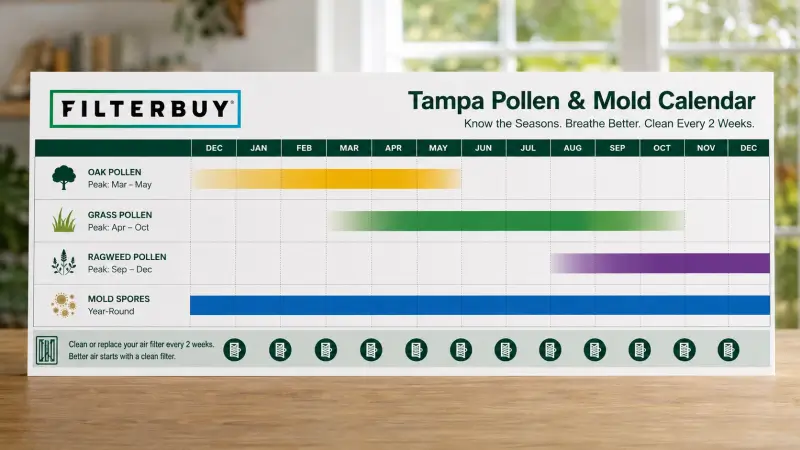
Clean a Tampa mini split's mesh filter every two weeks from December through October, and monthly in November. That is tighter than the manufacturer default because Tampa stacks a nine-month pollen calendar on a cooling season that barely stops.
Filterbuy-built schedule combining published Tampa Bay pollen seasons with manufacturer cleaning intervals.
Here is our read, and we have not seen anyone else make this connection. Three things collide in Tampa that rarely collide together anywhere else: a metro scoring worse than average on pollen, a filter design the Department of Energy itself calls low-capture, and humidity high enough to keep a blower wheel damp year-round. Any one of those is manageable. Stacked, they are why the manufacturer's four-week interval is the wrong number for this city, and why we built the calendar above around Tampa's pollen seasons instead of a generic default.
Two habits do most of the work. Dry the mesh completely before reinstalling, since a damp screen is the leading cause of that musty smell right after cleaning. And run Dry mode after cooling on humid afternoons to dry the coil before mold takes hold. Full method: how to clean mini split filters.
We would rather you check us than take our word for it. These are the seven sources Filterbuy points Tampa homeowners to, and they are the actual originals, not somebody else's summary. Each one answers a different question you will run into.
We checked all seven on August 5, 2026. Rebate and tax rules shift, so give them a fresh look before you count on the money.
Here is the part the sales brochure skips. The U.S. Department of Energy found that mini split mesh filters catch very little fine dust, and that wall-mounted heads tend to grow mold on the blower wheel in humid air. Worth knowing before someone tells you a ductless unit will clean the air in your house. That job still belongs to your central filter.
Source: U.S. Department of Energy, Building America Solution Center
ENERGY STAR keeps the running list of certified mini split heat pumps, and it tells you plainly to ask your contractor for a Manual J load calculation. Ten minutes here saves you an hour of sales pitch. One heads-up: their tax-credit section is stale and still shows 2032, so skip that part.
Source: ENERGY STAR, Ductless Heating & Cooling
This is the page that ends the debate. Tampa Electric spells out both rebate tiers, the SEER2 numbers, the 90-day deadline, and the ducted-system wording that most rebate articles quietly leave out. Read it before a contractor promises you the money, then call 813-275-3909 with your model number in hand.
Source: Tampa Electric, Heating & Cooling Program
Treasury and the IRS lay out which energy credits ended early and exactly when, with the details in Fact Sheet 2025-05. If anyone tells you there is a federal credit waiting on your 2026 install, this is the page that settles it. Better to find out now than at tax time.
Source: Internal Revenue Service
Florida's DBPR portal is the one place to check an HVAC license, and it takes about two minutes. You will see the license class, whether it is current, and whether it covers your address. Do it anyway, even if the truck looks legitimate: in Florida, a contract with an unlicensed contractor is not enforceable.
Source: Florida Department of Business and Professional Regulation
This one trips people up constantly. Hillsborough County handles Brandon, Riverview, Valrico, and Carrollwood, and posts every form you need, including the $15,000 Notice of Commencement trigger and the A2L refrigerant affidavit your installer signs. City of Tampa addresses go through the city instead. Check yours before your contractor pulls anything.
Source: Hillsborough County Development Services
Tampa Electric wants an AHRI reference sheet with your rebate application, and the AHRI Directory is where that comes from. Confirm your indoor and outdoor units are listed as a certified match before install day, not after a rebate check gets denied. It is a two-minute look-up that protects real money.
Source: Air-Conditioning, Heating, and Refrigeration Institute
Most pages on this topic assume you have already decided. We would rather save you the money. A mini split is the wrong call more often than the industry admits, and here is when we would tell a neighbor to skip it.
Your ducts already run inside conditioned space. The duct-loss argument is the biggest reason to go ductless in Florida. If your air handler and runs sit in a conditioned attic or interior chase, that loss is already gone. Sealing and insulating existing ducts costs far less than a new system.
You want whole-home coverage and your ductwork is sound. At four or five zones, a mini split project starts bumping into the price of a high-SEER2 central replacement. Price both before you commit.
Air quality is your only reason. This is the one Filterbuy sees most, and we will say it against our own interest: a mini split will not clean your air. The Department of Energy is blunt about the mesh filter. If cleaner air is the goal, a better central filter or a portable air cleaner costs a fraction of an install.
You cannot control the outdoor unit location. Condo rules, HOA restrictions, tight lot lines, and setback requirements kill more Tampa projects than budget does. Confirm placement before you shop equipment.
A visible wall head is a dealbreaker. Ceiling cassettes and floor consoles exist, but they cost more. If the look matters, price those options up front rather than discovering them at the quote.
None of that is us talking you out of a mini split. In the right room, a converted garage, an addition, a west-facing Florida room, it is the best tool available. It is just not the answer to every question, and a contractor who says otherwise is selling.
Tampa sits in a storm surge zone, and this is the part almost no mini split guide covers. Here is the counterintuitive piece worth remembering.
A split system usually survives being submerged. What it often does not survive is being moved.
The refrigerant loop is sealed, so long contact with flood water frequently leaves it intact, according to AHRI.
But if flood water shifts the indoor or outdoor unit even slightly, the refrigerant system can be breached. That means major repair or full replacement.
So the question after a surge is not just how deep the water got. It is whether anything moved.
What to do, in order:
Do not switch it back on. Leave the breaker off until a licensed tech inspects it.
Photograph everything before cleanup, including the water line on the wall and the unit serial numbers. Insurance and FEMA claims both need it.
Get the refrigerant circuit and every electrical and control connection checked by a licensed contractor, not a handyman.
Expect replace, not repair, on flood-damaged equipment. That is AHRI guidance, not a sales pitch.
Dry the space within 24 to 48 hours. Standard flood policies do not cover mold damage, so the clock matters.
Source: Air-Conditioning, Heating, and Refrigeration Institute, Floods and HVACR Equipment
One smaller thing worth doing while the house dries out: replace every central system filter that was in place during the storm, and wash the mini split mesh twice. Storm air carries mold spores and debris that a filter holds onto. Filterbuy ships replacement filters free in 600+ sizes, which is usually faster after a storm than finding your size on a picked-over big-box shelf.
Three numbers explain why a mini split behaves differently in Tampa.
Air conditioning eats 28% of the average Florida home's site energy.
U.S. average: 9%. Maine: 2%.
Your system runs harder here, so efficiency pays back faster.
That is why TECO's $550 tier beats its $40 tier on the math.
Source: U.S. Energy Information Administration, 2020 Residential Energy Consumption Survey
Tampa scored 88.46 in AAFA's 2026 Allergy Capitals report.
Pollen score: worse than average.
Medicine use: average. Allergist access: average.
Translation: the pollen itself drives the rank, not thin health care.
Neighbors on the list: Lakeland #20, Sarasota #28.
Source: Asthma and Allergy Foundation of America, 2026 Allergy Capitals
Ducts running through unconditioned space can lose over 30% of heating and cooling energy.
In Tampa, that space is usually a vented attic that bakes all summer.
A ductless head sits in the room it cools. No duct run, no loss.
Best case for going ductless: Florida rooms, garage conversions, additions.
Source: U.S. Department of Energy, Building America Solution Center
A single-zone mini split installation in Tampa costs $1,600 to $5,900 fully installed in 2026; multi-zone systems run $4,200 to $14,800. Electrical panel work is the most common surprise on older Tampa homes.
Tampa Electric pays $550 per qualifying unit at SEER2 16.20 or higher and $40 at SEER2 15.20, but its program page describes replacing a system with a new ducted one, and lists heat pumps, straight-cool with gas heat, and geothermal as the qualifying categories. It does not state that wall-mounted ductless heads qualify. Call TECO at 813-275-3909 to confirm before counting on it.
No. Section 25C was terminated for property placed in service after December 31, 2025 under the One Big Beautiful Bill Act. Systems installed during 2025 can still be claimed on a 2025 return using IRS Form 5695. Some efficiency sites still show the old 2032 date and are out of date.
Every two weeks from December through October, and monthly in November. Oak pollen runs December through May and grass April through October, so the mesh loads faster here than manufacturer defaults assume.
No. If your ducts already run inside conditioned space, sealing them costs far less. If air quality is your only goal, a better central filter or a portable air cleaner is cheaper and more effective. And at four or five zones, a mini split starts approaching the cost of a central replacement.
Leave the breaker off and have a licensed contractor inspect it. A sealed refrigerant loop often survives submersion, but if flood water shifted either unit even slightly, the refrigerant system may be breached. AHRI advises replacing flood-damaged equipment rather than repairing it.
No. The mesh screen is a washable pre-filter that protects the coil, not a MERV-rated air filter. Keep a MERV 11 or MERV 13 filter in your central system; ductless-only rooms need a separate air cleaner.
“I don't want anyone to feel like they need an HVAC license just to pick the right filter. My job is to give you the straight answer, explain why it matters, and let you get back to your day.”
Michelle Wan, Brand Manager & Air Quality Writer, Filterbuy
That is the idea behind this page. We are not the ones installing your mini split, and we will not pretend otherwise. What we know cold is the filter side, and in Tampa that side carries more weight than the brochures let on. Mini splits, central air, or both, we'll help you get Tampa's pollen and humidity handled.
Find your filter size - 600+ sizes, made in the USA, shipped free
Shop MERV 13 filters for oak pollen and mold spores, rated to trap 98% of airborne particles
Set up auto-delivery so the right filter arrives on schedule
Browse Filterbuy mini split systems with built-in filter reminders
Mini split (ductless mini split): A heating and cooling system pairing an outdoor compressor with one or more wall-mounted indoor heads, conditioning a room without ductwork.
SEER2: The current U.S. cooling-efficiency rating. Tampa Electric's top rebate tier requires 16.2 SEER2 or higher.
Manual J: The ACCA-standard residential load calculation used to size HVAC equipment for a specific home.
Latent load: The share of cooling work spent removing moisture rather than lowering temperature, a large part of the job in Tampa.
Mesh filter: The washable, reusable pre-filter in a mini split's indoor head. It protects the coil and is not MERV-rated.
MERV: Minimum Efficiency Reporting Value, the standard scale rating how effectively a filter captures airborne particles.
DBPR: The Florida Department of Business and Professional Regulation, which licenses HVAC contractors statewide.
TECO: Tampa Electric Company, the utility serving Tampa and much of Hillsborough County.