
Houston, TX Live Wildfire Smoke Map
Get Alerts For Wildfires In Your Area
The moment a wildfire starts near you, you'll get an instant alert and simple tips to reduce your smoke exposure.
What's In The Smoke
30xSmaller than a human hair
Fine enough to reach deep into the lungs. A MERV 13 is built to capture it.
How Far It Travels


It Doesn't Stay Local
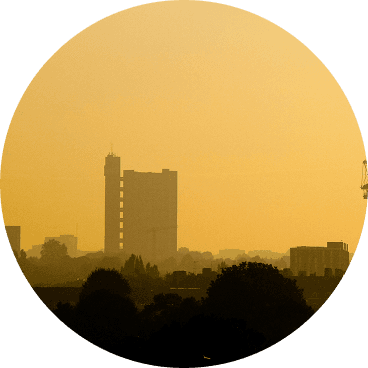
Smoke rides the wind far downwind — you can get smoky air with no fire nearby.
What To Do During A Smoke Event
Simple steps to reduce indoor exposure.
- Stay In, Close UpShut windows and doors to keep smoke out.
- Set Fan To "On"Keeps air cycling through your filter, not just when heating or cooling.
- Recirculate AirSwitch off fresh-air intake so you're not pulling smoke in.
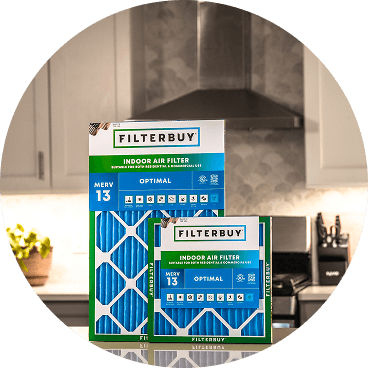
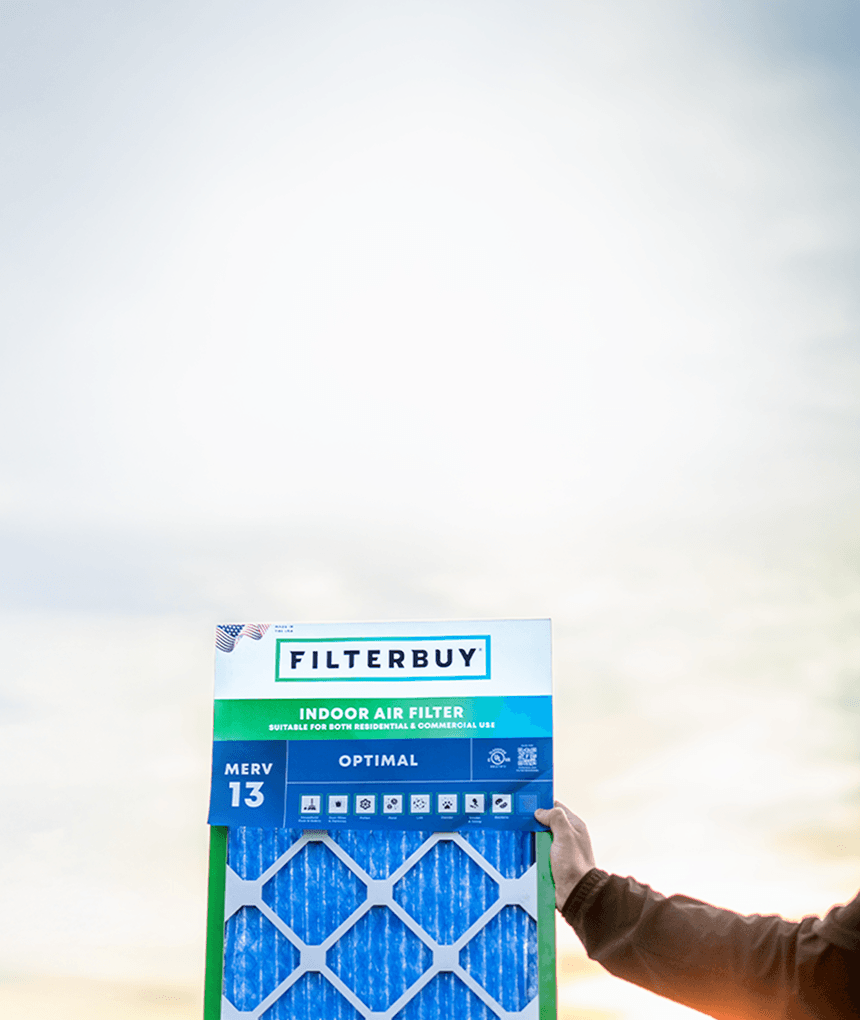
- Run A MERV 13Built to capture the fine PM2.5 in smoke.
- Add A PurifierExtra filtration for the room you use most.
- Wear an N95 if OutsideFits snug to block fine particles — a cloth mask won't.


The Best Air Filter For Wildfire Smoke
During smoke events, the EPA recommends upgrading to a MERV 13 filter — or the highest-rated filter your system can handle — to help reduce the fine particles smoke brings indoors. MERV 13 is the level most home HVAC systems can run while still capturing PM2.5, the fine particulate that makes up the bulk of wildfire smoke.
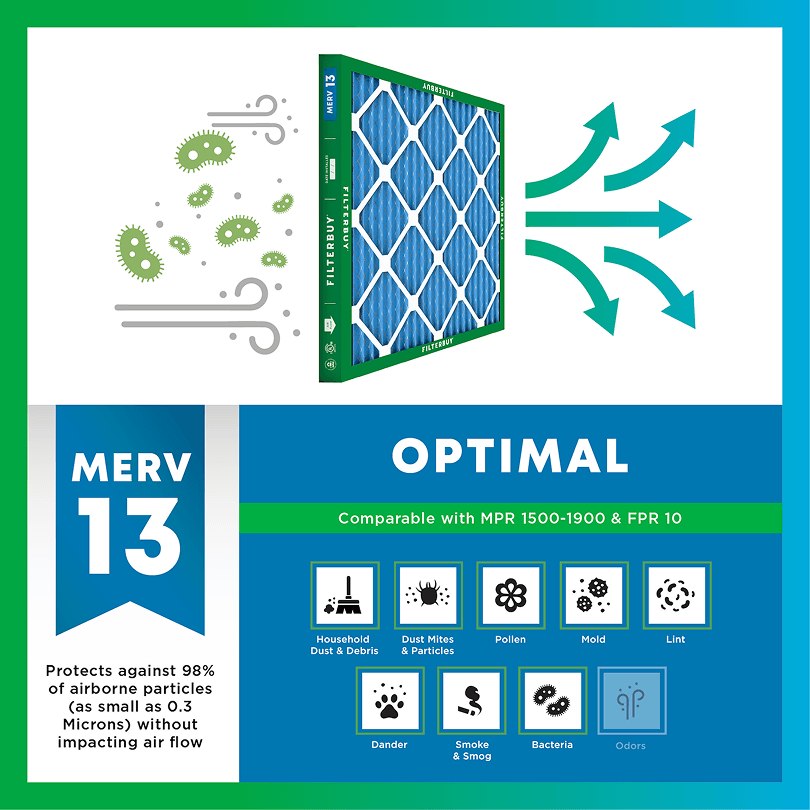
- Captures PM2.5 particles
- Blocks ash, soot, and smoke odor
- Keeps your indoor air safe—even when the outdoor air is dangerous
- Meets the EPA's recommended rating for filtering fine wildfire smoke particles.

Wildfire Smoke FAQs
Facts About Wildfires
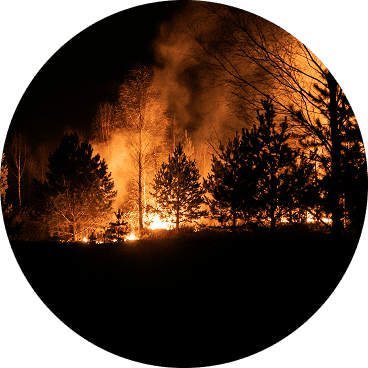
Over 70,000 wildfires burn in the U.S. every year.
Wildfire smoke can travel 1,000+ miles, affecting states that aren't even near the blaze.
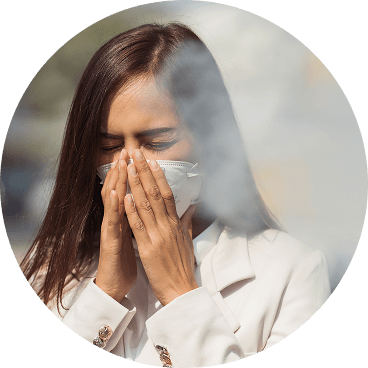
Exposure to wildfire smoke can worsen asthma, trigger heart issues, and lead to ER visits.
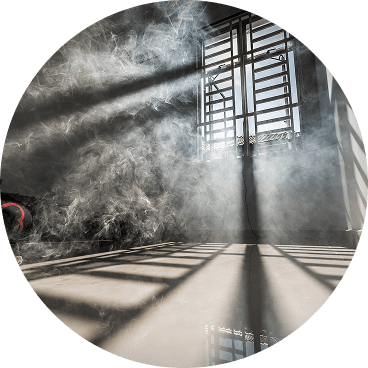
Indoor air can hold more fine particles during wildfire events unless it's properly filtered.
The EPA advises using MERV 13 filters or portable HEPA air cleaners during wildfire smoke events.
Don't Wait Until The Smoke's Inside.
Use the live wildfire smoke tracker and upgrade your air filters today to protect your lungs and your home.
Shop Filters For Smoke Protection
Where Is the Smoke Coming From in Houston Today — and Is It Safe?
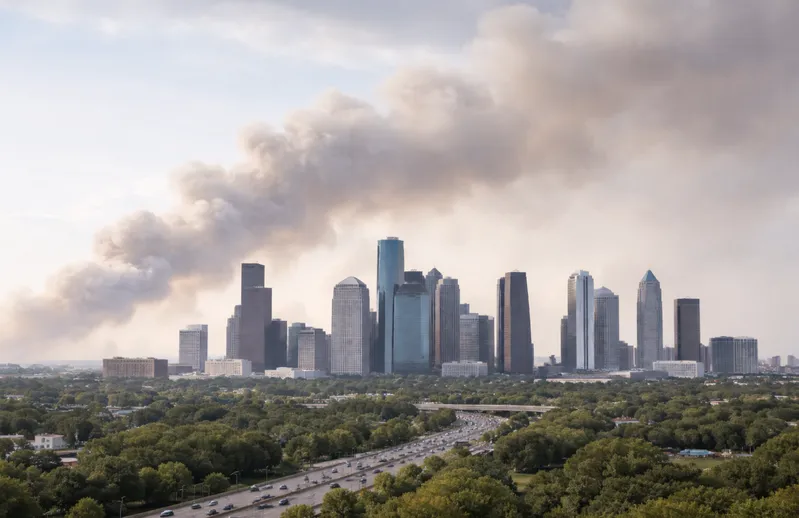
On the worst smoke days in Houston, the fire responsible may be burning two states over. That's what most households miss. East Texas pine country, Louisiana agricultural burns, and Ship Channel industrial flares can all push identical-looking haze into the metro on the same afternoon, but each source carries a different risk level and calls for a different response. After manufacturing filters for over a decade and serving more than two million households, we know the first protective decision you make is figuring out what is actually in your air.
Pull up the EPA AirNow Fire and Smoke Map for your live Houston AQI reading, then use the guidance below to act on it.
TL;DR Quick Answers
Current Live Forest Wildfire and Smoke Map Today in Houston, TX
Check the EPA AirNow Fire and Smoke Map at fire.airnow.gov for Houston's live wildfire smoke tracking and current AQI reading. If the AQI is above 100, sensitive groups should move indoors. Above 150, everyone in Houston should limit outdoor time and take active steps to protect indoor air quality. Upgrading your HVAC filter to MERV 11 or higher and running a HEPA air purifier in primary living spaces are the two most effective actions available right now.
Top Takeaways
Houston wildfire smoke can originate from East Texas forests, Louisiana agricultural burns, or local industrial sources. The source determines the pollutant mix and the appropriate response.
Use the EPA AirNow Fire and Smoke Map (fire.airnow.gov) and the NOAA Hazard Mapping System together to track fires near Houston and smoke plume movement in real time.
An AQI above 100 (Orange) means sensitive groups should limit outdoor time. Above 150 (Red) applies to all Houston residents regardless of health status.
Indoor PM2.5 levels reach 55–60% of outdoor concentrations in a closed home without filtration. A MERV 11 or MERV 13 filter and a HEPA purifier reduce that exposure meaningfully.
HVAC recirculate mode, a filter upgrade, and a running HEPA purifier are the three most effective smoke protection steps. The setup takes under thirty minutes and should happen before the smoke arrives.
Where Is the Smoke Coming From in Houston Today?
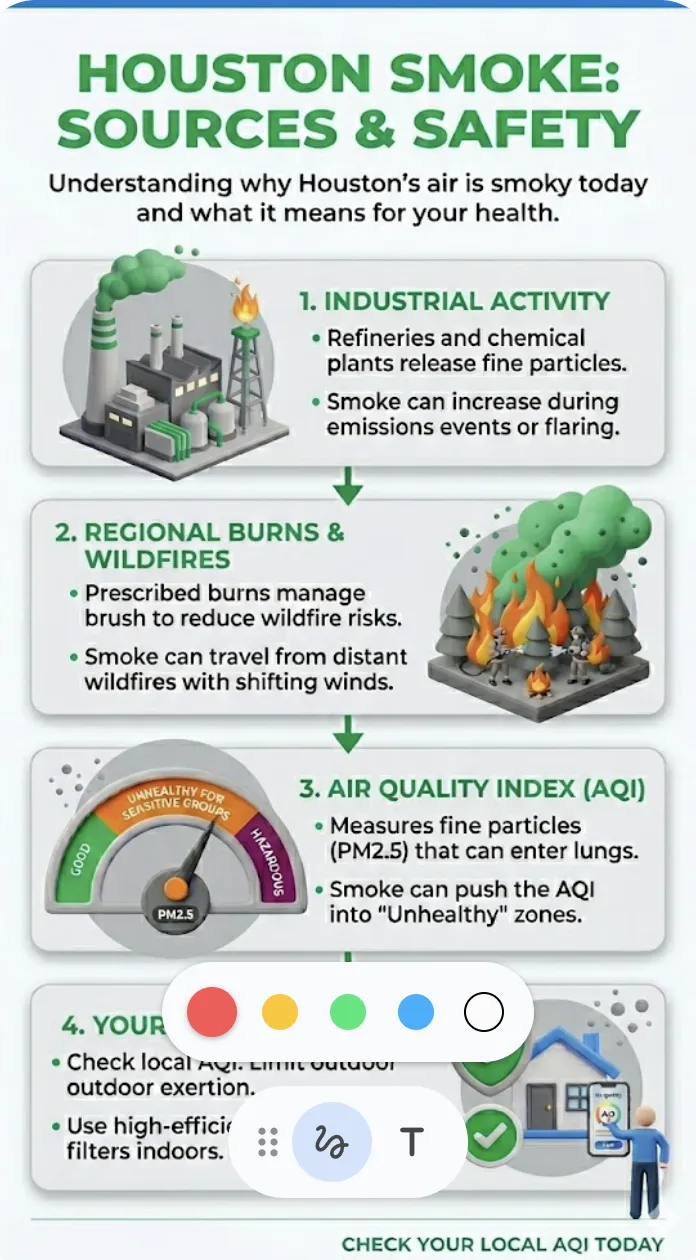
Houston's smoke doesn't always start in Texas. Three distinct source corridors push haze into the metro depending on wind direction, and the one overhead today determines which precautions matter most.
East Texas pine forests are the most consistent wildfire smoke source for the city. The Piney Woods region, covering roughly 43,000 square miles of timber, produces active fire conditions every spring and fall when dry weather follows seasonal rainfall. Fires east of the Sabine River routinely reach Houston within hours when south-southwest winds stall.
Louisiana agricultural burns contribute a second smoke layer. Sugarcane harvest burns in the Acadiana region push plumes southwest toward the Houston-Galveston corridor several times each year. This smoke typically sits lower in the atmosphere and produces a yellowish-gray haze along the Gulf Coast.
Industrial sources along the Ship Channel add a third variable. Flaring events, refinery upsets, and petrochemical plant fires produce smoke that looks identical to wildfire smoke at ground level but carries a different pollutant mix. During multi-source events, Houston can experience layered smoke from all three origins at once.
The EPA AirNow Fire and Smoke Map distinguishes satellite-detected fire locations from sensor-based air quality data. That distinction tells you whether the smoke overhead originated from a forest fire near Houston or a closer industrial source, and it changes what you do next.
How to Read the Houston Air Quality Index Right Now
The EPA builds the Air Quality Index from ground-level PM2.5 sensor readings. PM2.5 is the fine particle fraction most concentrated in wildfire smoke, and understanding the six color-coded levels is how you translate that number into a decision for your family.
Green (0–50): Air quality is satisfactory. No restrictions on outdoor activity.
Yellow (51–100): Acceptable. Unusually sensitive individuals may want to limit prolonged outdoor exertion.
Orange (101–150): Sensitive groups should reduce outdoor time. This includes children, older adults, and anyone with asthma, COPD, or heart disease.
Red (151–200): Unhealthy for everyone. Limit outdoor activity for all Houston residents.
Purple (201–300): Very unhealthy. Stay indoors with windows and doors closed.
Maroon (301–500): Hazardous. Emergency conditions. Minimize all outdoor exposure.
Houston AQI readings can shift from Green to Orange in a single afternoon during active wildfire events. Check AirNow.gov before any outdoor activity and again before evening, when ground-level smoke concentrates as temperatures drop.
Who Is Most at Risk from Wildfire Smoke in Houston?
Wildfire smoke doesn't hit every household the same way. PM2.5 particles are small enough to bypass the nose and throat and settle deep in lung tissue, and certain groups absorb significantly more risk than others at the same AQI reading.
Children: Developing lungs are more susceptible to PM2.5 injury. Children also breathe more air relative to body weight than adults, which raises their total exposure.
Older adults: Aging lungs process particles less efficiently, and many older adults carry underlying cardiovascular or respiratory conditions that worsen with smoke exposure.
People with asthma or COPD: Smoke is a direct asthma trigger. The CDC advises that people with lung disease keep rescue inhalers accessible and monitor symptoms closely during smoke events.
People with heart disease: Fine particle exposure raises heart attack and stroke risk, particularly during smoke events that last multiple days.
Pregnant individuals: Research links wildfire smoke exposure during pregnancy to adverse birth outcomes. Extra caution is warranted throughout pregnancy, particularly in the first and third trimesters.
Outdoor workers: Houston's construction, landscaping, and port workers face significantly higher cumulative exposure than indoor workers during smoke events.
Anyone in these groups should treat an Orange AQI the way a healthy adult treats Red. Move sensitive household members indoors earlier, confirm your HVAC filter is rated MERV 11 or higher, and run a HEPA air purifier in bedrooms and main living areas.
How to Track Wildfires Near Houston in Real Time
Three federal tools, used together, give you the most complete real-time picture of wildfires near Houston and where their smoke is moving.
EPA AirNow Fire and Smoke Map (fire.airnow.gov): Shows active fire locations, satellite-detected smoke plumes, and near-real-time PM2.5 sensor readings. The map updates regularly throughout the day and displays health guidance specific to your current AQI. Start here.
NOAA Hazard Mapping System (ospo.noaa.gov): Uses satellite data from multiple sources to track smoke plume movement across North America. The HMS provides wider geographic context, which matters when fires in Oklahoma, Arkansas, or Mexico are pushing smoke into Texas through upper-level wind patterns.
TCEQ Air Monitoring Network (tceq.texas.gov/airquality/monops): Texas operates more than 200 ground-level monitoring stations. The TCEQ real-time dashboard shows sensor readings from the Houston metro's own network and captures locally elevated PM2.5 that satellite tools sometimes miss.
The TCEQ ground reading and the AirNow satellite view tell you more together than either does alone.
How to Protect Your Home's Indoor Air During a Houston Smoke Event
When outdoor AQI climbs above 100, the air inside your home is your primary line of defense. A standard home with closed windows still allows outdoor PM2.5 to infiltrate through small gaps in the building envelope. Without active filtration, indoor smoke concentrations can reach 55 to 60 percent of outdoor levels, according to EPA research. Start here.
Switch your HVAC to recirculate mode. Close the fresh air intake or damper. Running your system in recirculation mode stops it from actively pulling smoke-laden outdoor air into the home.
Upgrade to a MERV 11 or MERV 13 air filter. Standard MERV 8 filters are not rated to capture the fine PM2.5 particles that dominate wildfire smoke. Confirm your system's maximum compatible MERV rating before upgrading. Most residential systems handle MERV 11 to 13 without airflow issues.
Run a HEPA air purifier in bedrooms and main living areas. Size the unit to the room. The EPA recommends running it continuously on the highest fan setting during elevated smoke events.
Keep windows and doors closed. Even brief ventilation during an Orange or Red AQI day allows significant particle infiltration that your filter and purifier will take hours to clear.
Seal visible gaps. Weatherstripping around doors, fireplace damper closures, and kitchen exhaust fan covers reduce smoke infiltration during extended events.
"Wildfire smoke is one of the few situations where a standard MERV 8 filter actively fails the household it's designed to protect. The particles that carry the most health risk in smoke — the PM2.5 fraction — are precisely the size range that MERV 8 media allows to pass through. We've seen this gap close with a MERV 13 upgrade, which is why we push that conversation with customers every fire season, not just when the smoke is already visible outside their windows."
7 Essential Resources for Houston Wildfire Smoke Tracking and Protection
EPA AirNow Fire and Smoke Map: Your Real-Time Houston Wildfire Smoke Dashboard
The AirNow Fire and Smoke Map is the most practical tool available for tracking wildfire smoke near Houston in real time. Built jointly by the EPA and the U.S. Forest Service, it combines data from regulatory air monitors, temporary fire-area monitors, and nearly 15,000 low-cost PM2.5 sensors. The map displays fire locations, satellite-detected smoke plumes, and AQI-coded health guidance updated throughout the day. Bookmark it as your first check during any Houston wildfire smoke alert.
Source: https://fire.airnow.gov/
NOAA Hazard Mapping System: Satellite-Level Smoke Plume Tracking
The NOAA Hazard Mapping System has monitored active fires and smoke movement over North America by satellite since 2002. For Houston residents, the HMS is most valuable for identifying long-range smoke events, including fires in East Texas, western Louisiana, or even Mexico, that have not yet triggered local ground-level sensor alerts. When the air looks hazy but the neighborhood AQI monitor reads normal, the HMS often shows a smoke plume overhead that sensors haven't registered yet.
Source: https://www.ospo.noaa.gov/products/land/hms.html
TCEQ Air Quality and Monitoring: Texas's Own Ground-Level Sensor Network
The Texas Commission on Environmental Quality operates more than 200 air quality monitoring stations across the state, with multiple sensors in the Houston metro area. The TCEQ real-time monitoring dashboard provides PM2.5 readings from ground-level sensors that satellite tools cannot replicate. During events where wildfire smoke layers mix with industrial emissions (a regular occurrence along the Houston Ship Channel), the TCEQ network captures the combined exposure better than any single federal tool.
Source: https://www.tceq.texas.gov/airquality/monops
CDC Wildfire Safety Guidelines: What to Do When Smoke Reaches Houston
The CDC's wildfire safety guidance translates the health science of smoke exposure into concrete daily actions. The resource covers how to assess outdoor activity decisions by AQI level, how to protect sensitive household members, when to seek medical attention, and how to prepare your home before a smoke event rather than during it. The CDC also clarifies which type of respiratory protection provides meaningful protection for unavoidable outdoor exposure: an N95 respirator, not a surgical mask.
Source: https://www.cdc.gov/wildfires/safety/how-to-safely-stay-safe-during-a-wildfire.html
National Interagency Fire Center: Active Fire Locations Across Texas and the Southeast
The National Interagency Fire Center publishes real-time maps of large active fires across the United States, including fires in Texas, Louisiana, and Oklahoma that most directly affect Houston air quality. The NIFC maps show fire perimeter, activity level, and containment status, giving Houston residents context for whether a nearby smoke event is likely to worsen or clear in the coming days. During peak Texas wildfire season, check the NIFC map alongside the AirNow tool for a complete picture.
Source: https://www.nifc.gov/fire-information/maps
EPA — Wildfires and Indoor Air Quality: How to Protect Your Houston Home
The EPA's indoor air quality guidance for wildfire smoke events is the most detailed resource available for homeowners who want to actively defend their indoor air rather than simply wait out the smoke. It covers HVAC system settings, MERV filter selection, portable air cleaner sizing, and how to set up a dedicated clean room during extended smoke events. This resource is updated regularly and includes guidance written for residential HVAC systems, including the most common configurations found in Houston-area homes.
Source: https://www.epa.gov/emergencies-iaq/wildfires-and-indoor-air-quality-iaq
EPA — Create a Clean Room During a Wildfire: Step-by-Step Home Protection
When smoke levels reach Red or higher, retreating to a single well-sealed and filtered room in your home gives you the highest available protection without evacuating. The EPA's clean room guide covers which room to choose, how to seal it, what MERV rating to use in your HVAC filter, how to run a portable air cleaner for maximum effect, and which indoor activities to avoid because they add particles rather than remove them. Set this room up before wildfire season, not the day smoke arrives.
Source: https://www.epa.gov/emergencies-iaq/create-clean-room-protect-indoor-air-quality-during-wildfire
Supporting Statistics
Indoor PM2.5 During a Smoke Event Can Still Reach 55–60% of Outdoor Levels
Closing your windows is not enough on its own. EPA research shows that during wildfire smoke events, indoor PM2.5 concentrations with windows and doors closed and no air cleaner running reach 55 to 60 percent of outdoor concentrations — and in older homes or homes with poor weatherstripping, that figure climbs toward 100 percent. We've seen firsthand, across more than a decade of manufacturing filters for millions of households, how a MERV 13 filter paired with a HEPA purifier consistently drops indoor particle levels below that baseline. Filtration isn't optional during a Houston smoke alert. It's what actually changes the number.
Source: https://www.epa.gov/wildfire-smoke-course/strategies-reduce-exposure-indoors
The EPA's 24-Hour PM2.5 Safety Standard Is 35 µg/m³ — Wildfire Events Routinely Exceed It
The EPA sets the 24-hour primary PM2.5 standard at 35 micrograms per cubic meter. During moderate wildfire events, ground-level readings in affected urban areas can exceed 100 µg/m³. Severe events produce readings above 200 µg/m³. Houston sits in a smoke-reception corridor that allows distant fires to push concentrations past the safety threshold within hours of ignition. An Orange-level AQI reading means Houston's air already carries PM2.5 above what the EPA considers acceptable for sensitive groups over a 24-hour period — and that's the threshold, not the worst case.
Source: https://www.epa.gov/pm-pollution/national-ambient-air-quality-standards-naaqs-pm
Thousands of Deaths Each Year Are Linked to Wildfire Smoke Exposure
Wildfire smoke is not a nuisance. The CDC reports that thousands of deaths each year result from smoke exposure, with the toll concentrated among people with pre-existing cardiovascular and respiratory conditions. The risk doesn't require living next to an active fire. Smoke particles travel hundreds of miles from their source and arrive in Houston at concentrations that trigger cardiac and pulmonary stress. Treating a wildfire smoke alert as a passive inconvenience, rather than an active household management situation, carries real health risk for the most vulnerable people in your home.
Source: https://www.cdc.gov/climate-health/php/effects/wildfires.html
Final Thoughts and Opinion
Houston's wildfire smoke problem isn't going away. Growing East Texas fire frequency, Gulf Coast wind patterns, and the city's proximity to industrial sources make smoke events a recurring seasonal reality here, not an occasional exception.
The households that manage it best already know their MERV rating, have a HEPA purifier set up in the right room, and have AirNow bookmarked before the first smoke advisory drops. You don't need a smoke event in progress to make those decisions. Installing a MERV 13-compatible filter, positioning a HEPA purifier in your main bedroom, and bookmarking the AirNow Fire and Smoke Map on your phone takes about thirty minutes. That's the difference between leading the next smoke event and scrambling to catch up.
Next Steps
Check the EPA AirNow Fire and Smoke Map right now for Houston's current AQI and any active fire or smoke plume locations in your region.
Locate your HVAC system's filter slot and confirm the current MERV rating. If it is below MERV 11, plan to upgrade before the next smoke event.
Switch your HVAC to recirculate mode and close any fresh air intakes if Houston's AQI is currently above 100.
Set up a HEPA air purifier in your main bedroom — the room where sensitive family members spend the most time. Run it continuously during elevated smoke events.
Bookmark fire.airnow.gov and tceq.texas.gov/airquality/monops to monitor Houston wildfire smoke and air quality data in real time throughout fire season.
Frequently Asked Questions
Houston's Air Changes Fast. Your Filter Should Be Ready.
When wildfire smoke reaches the Houston metro, your HVAC filter becomes the primary barrier between outdoor PM2.5 and the air your family breathes inside. A standard MERV 8 filter lets smoke particles pass through unchallenged. Installing a MERV 13 changes that.
Filterbuy manufactures MERV 11 and MERV 13 filters in over 600 sizes, shipped directly to your door on a schedule that keeps your protection consistent through every fire season. No guessing, no gaps.
Shop Smoke-Ready MERV 13 Air Filters
Find more on our Houston air quality index page, our MERV rating guide, and our complete wildfire smoke protection resource library to stay ahead of every smoke event this season.