
Tip: Ensure you buy the exact air filter size for your system. Certain brands have precise dimensions that only fit their specific models. See related filters
Actual Size: 19.56x22x5.25"
 Free Delivery
  Factory-Direct Low Prices, Made in the USA
 Hassle-Free Returns & Free Exchanges
RESIDENTIAL AND/OR COMMERCIAL USE
Change Every 3 Months
Tip: Ensure you buy the exact air filter size for your system. Certain brands have precise dimensions that only fit their specific models. See related filters
Actual Size: 19.56x22x5.25"
Free Delivery Factory-Direct Low Prices, Made in the USAHassle-Free Returns & Free ExchangesRESIDENTIAL AND/OR COMMERCIAL USE
Change Every 3 Months
Tip: Ensure you buy the exact air filter size for your system. Certain brands have precise dimensions that only fit their specific models. See related filters
Actual Size: 19.56x22x5.25"
Free Delivery Factory-Direct Low Prices, Made in the USAHassle-Free Returns & Free ExchangesRESIDENTIAL AND/OR COMMERCIAL USE
Change Every 3 Months
At Filterbuy, we don't cut corners—we craft high-quality air filters right here in the USA and ship them to your doorstep for free. No delays, no gimmicks—just clean air, made easy. With thousands of five-star reviews and filters built for real life & every HVAC system, it's no wonder why over 4 million families trust Filterbuy.

Proudly Made In The USA

Fast, Free Shipping on Every Order

Premium Materials That Go The Distance

85,000+ 5-Star Reviews From Happy Customers

Save Up to 70% Per Filter with Packs


Measure length × width × depth with a tape measure to find the actual size.

Round up each dimension to the nearest whole number to get the nominal size. Example: 19.56x22x5.25" in → 20x22x5 nominal.

Search by nominal size on our site for the best fit.


5″ filters give you maximum filtration with minimal maintenance — lasting up to 12 months while handling higher MERV ratings without restricting airflow.
Sizing note:

If the filter you buy doesn't fit, we'll send you a better size.
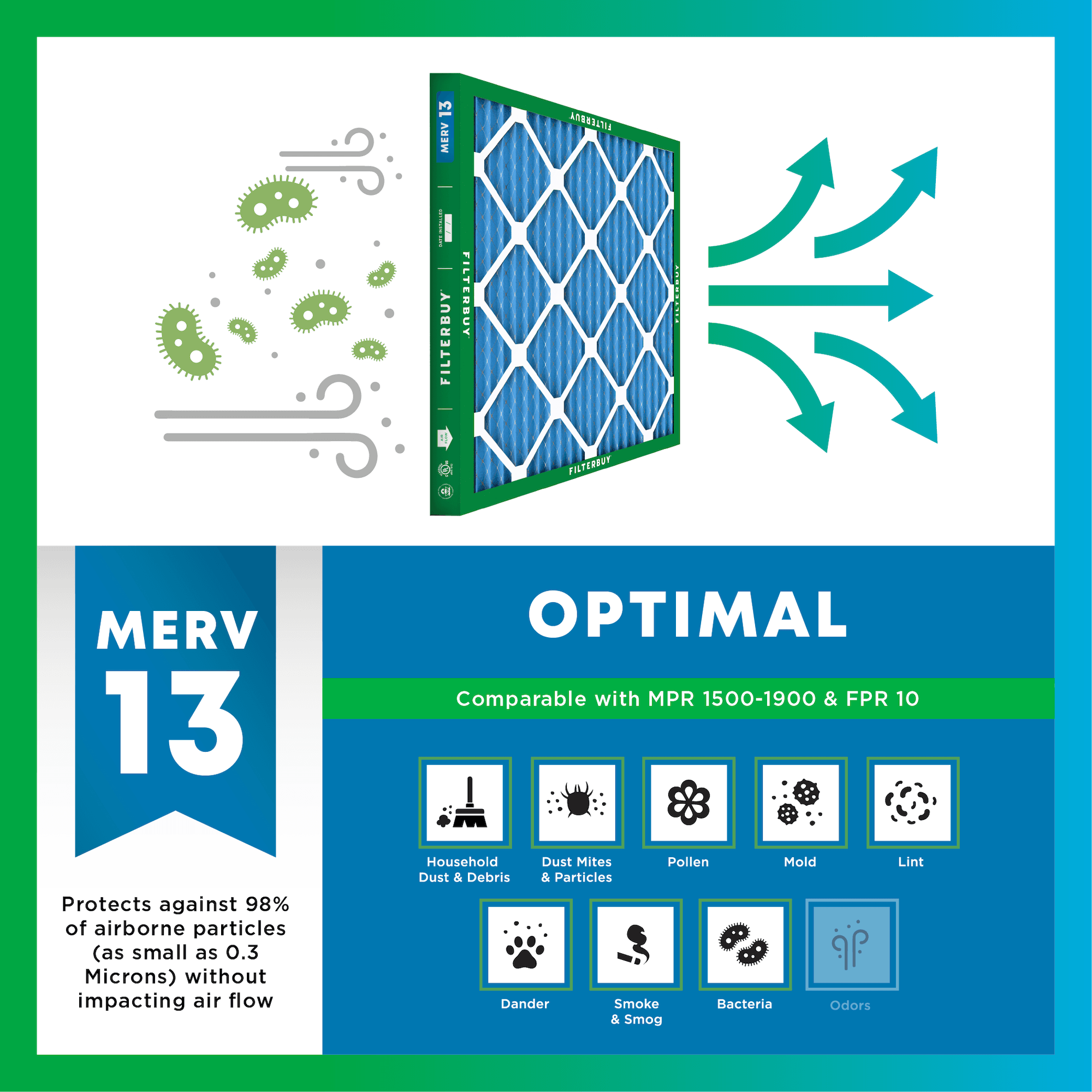
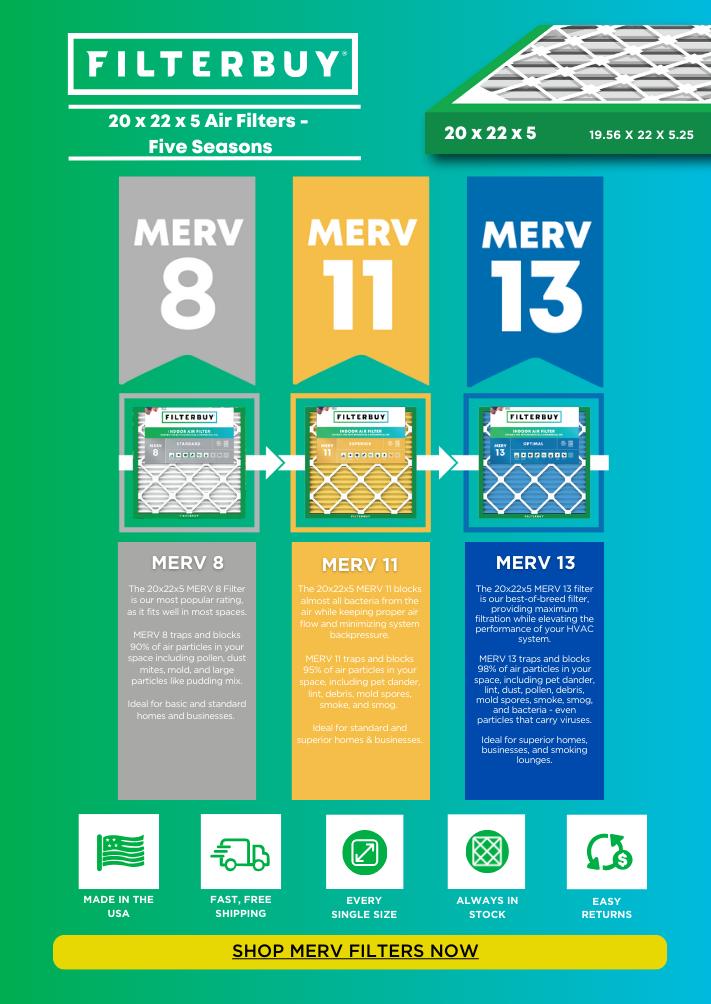
MERV stands for Minimum Efficiency Reporting Value—but don't let the technical name fool you. It's just a way to rate how well an air filter traps stuff like dust, pollen, pet dander, and smoke. The higher the MERV number, the more particles it catches—and the cleaner your air will be.

Comparable to:FPR: 4-7
MPR: 600-1000
 Dust & Debris
 Dust Mites & Particles
 Pollen
 Mold
Mold Lint
Lint Dander
Comparable to:FPR: 6-9
MPR: 1200-1550
Dust & DebrisDust Mites & ParticlesPollenMoldLintDander Smoke & Smog
Comparable to:FPR: 10
MPR: 1900-2800
Dust & DebrisDust Mites & ParticlesPollenMoldLintDanderSmoke & Smog Bacteria


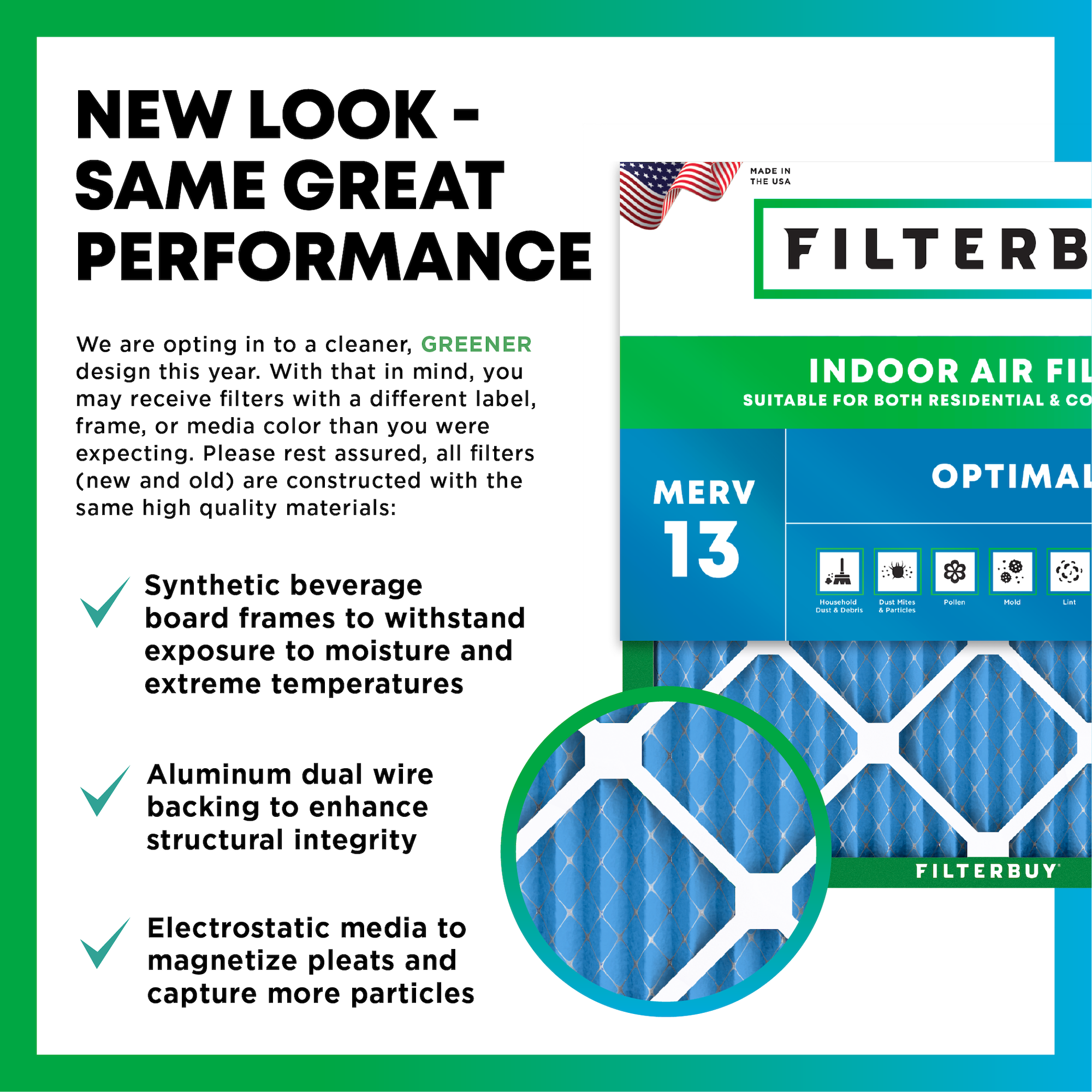
We build every Filterbuy filter to deliver reliable 90-day performance—thanks to smart design and premium materials that do the heavy lifting. Here's what makes the difference:
More pleats = more surface area to capture dust and debris, keeping your air cleaner longer.
Pleats are magnetized to attract and trap microscopic particles—like pet dander, pollen, and smoke.
Engineered to resist warping in extreme temperatures and high humidity.

A layer of metal reinforcement keeps pleats evenly spaced and structurally sound—no sagging, even at high airflow.
Assembled with care. Built to perform. Ships fast, free, and reliably from our U.S. facilities.

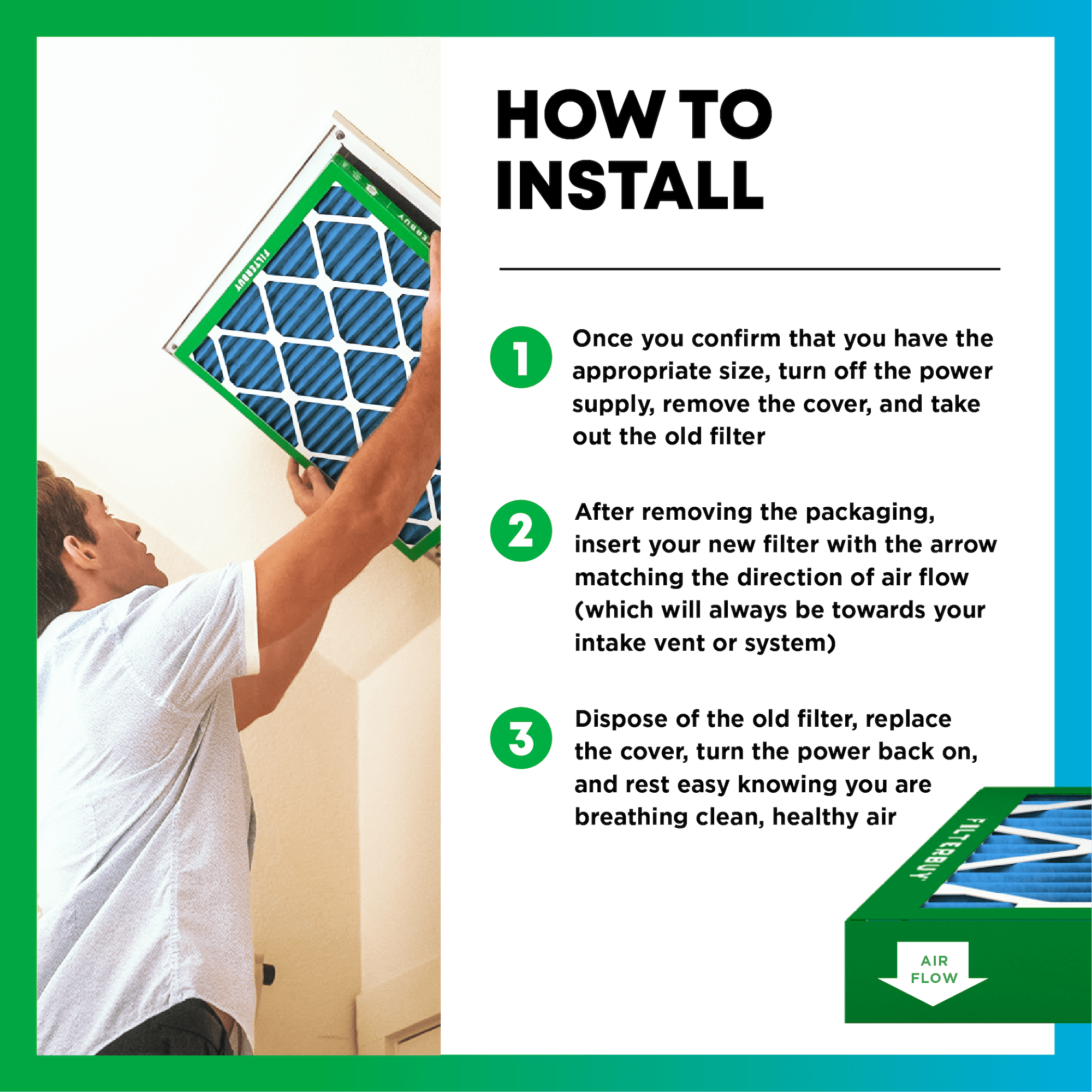
Turn Off Your HVAC SystemSafety first.

Remove The Old FilterLook for the airflow arrow and make note of the direction.

Slide In Your New FilterArrow should point toward the system (same direction as before).

Turn Your System Back OnAnd enjoy the fresh, clean air.

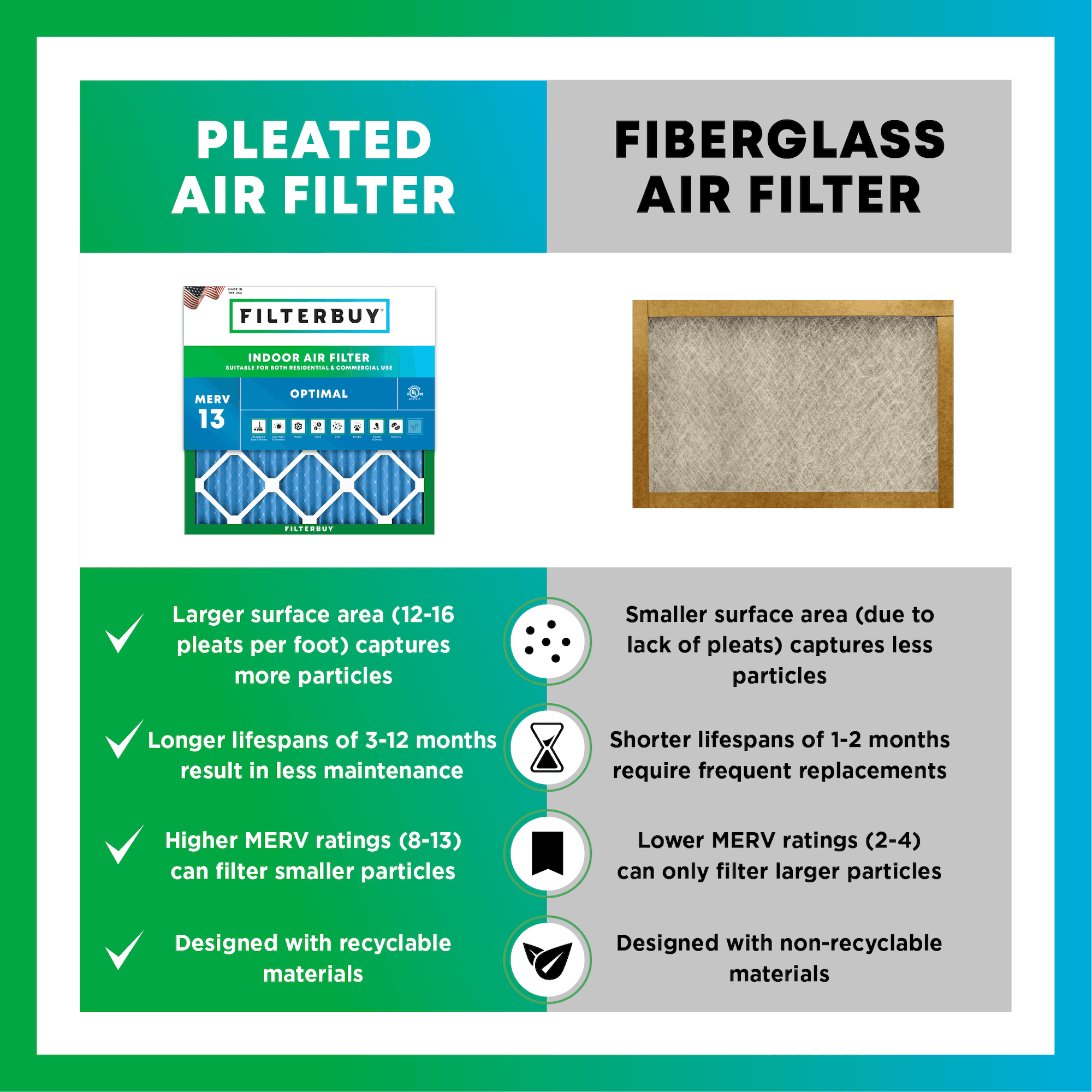
Not all air filters are created equal. Pleated filters don't just last longer—they actually clean your air better. Here's how they stack up:

Efficiency:
High (MERV 8–13) – Traps more particles
Lifespan:
90 days – Long-lasting performance
Air Quality:
Excellent – Cleaner, healthier air
Materials:
Recyclable and durable

Efficiency:
Low (MERV 4 or less) – Misses small stuff
Lifespan:
30 days or less – Replace often
Air Quality:
Minimal – Basic protection only
Materials:
Thin, flimsy, and not recyclable
Pleated filters are a no-brainer—more protection, less hassle, and better air for your home.
Changing your filter on time keeps your HVAC system running efficiently—and helps protect your lungs from dust, allergens, and airborne irritants. Here's how often to swap it out based on your needs:

For most homes without pets or special air quality concerns. Great for general upkeep and energy efficiency.

Shedding fur, dander, and allergy triggers can build up fast. Changing your filter every two months helps keep the air fresher and symptoms at bay.

For households affected by smoke, pollution, or respiratory conditions, monthly changes ensure maximum protection.

| Nominal Size | 20 x 22 x 5 inches |
| Actual Size | 19.56 x 22 x 5.25" inches |
| Filter Type | Pleated |
| Media | Electrostatically Charged |
| Frame | Beverage Board |
| MERV Ratings Available | 8, 11, 13 |
| Lifespan | Up to 12 Months |
| Origin | Made in USA |
Your HVAC system's biggest enemy isn't age — it's the wrong filter. After over a decade of manufacturing air filters and analyzing real-world performance data from millions of customers, we've found that upgrading to a MERV 13 20x22x5 filter compatible with Five Seasons systems is one of the most effective ways to extend equipment life. The reason is simple: a properly fitted MERV 13 filter captures fine particles like dust, pollen, and mold spores before they coat your blower motor, evaporator coil, and ductwork — the exact components where buildup quietly drives up repair costs and cuts system lifespan short.
On this page, we'll break down what our manufacturing and customer experience has taught us about how MERV 13 filtration protects your system from the inside out, why the 20x22x5 fit matters more than most homeowners realize, and what you can do today to get more years out of your HVAC investment.
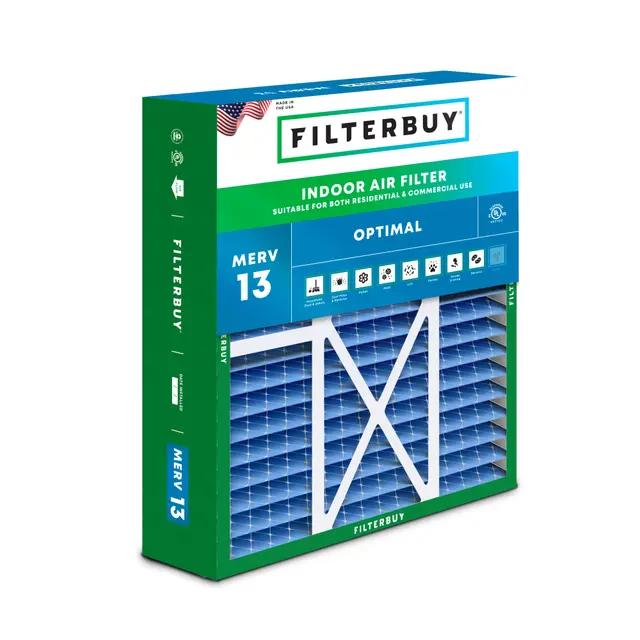
The MERV 13 20x22x5 air filter is a high-efficiency pleated replacement filter designed to fit Five Seasons, Amana, Goodman, and Nordyne HVAC systems. Its actual dimensions are approximately 19.56x22x5.25 inches.
What it captures: 98% of airborne particles including dust, pollen, mold spores, pet dander, bacteria, smoke, and fine dust down to 0.3 microns.
Why it matters for your HVAC system: After manufacturing this filter for over a decade, we've seen firsthand that MERV 13 is the threshold where filtration shifts from basic air cleaning to genuine system protection. It catches the fine particles that lower-rated filters miss — the ones that silently coat your evaporator coil, burden your blower motor, and shorten equipment life.
Key specs at a glance:
Nominal size: 20x22x5
Actual size: 19.56x22x5.25 inches
MERV rating: 13 (comparable to MPR 1500/1900 and FPR 10)
Compatible systems: Five Seasons, Amana, Goodman, Nordyne
Compatible part numbers: MFAH-M, 918737
Replacement interval: Check every 9 months. Replace no later than 12 months.
Made in the USA: Yes — manufactured across eight U.S. facilities
Bottom line: Both the EPA and ASHRAE recommend MERV 13 as the minimum residential filtration standard. Our manufacturing experience across millions of filters confirms why — it's the level that delivers the best balance of air quality protection, system efficiency, and long-term HVAC preservation.
A MERV 13 20x22x5 filter is one of the most effective ways to extend HVAC system life. It captures fine particles in the 0.3 to 1.0 micron range before they coat your evaporator coil, strain your blower motor, and line your ductwork.
Filter fit matters as much as filter rating. A properly sized 20x22x5 filter sits flush in the housing with no gaps. If air bypasses the media through poorly sealed edges, even a high MERV rating can't protect your system.
A clean filter can cut energy use by 5% to 15%. A clogged filter forces longer cycles and harder operation. A maintained MERV 13 filter keeps airflow steady and your system running efficiently.
The EPA and ASHRAE both recommend MERV 13 as the residential minimum. This is the standard set by the nation's leading air quality and building science authorities — and it matches what our manufacturing experience has confirmed across millions of filters produced.
Consistent replacement delivers long-term results. Check your 5-inch MERV 13 filter every 9 months. Replace no later than 12 months. Replace sooner if you have pets, allergies, or high dust and pollen exposure.
Every air filter carries a MERV (Minimum Efficiency Reporting Value) rating that tells you how effectively it captures airborne particles. A MERV 13 filter traps up to 98% of particles between 3.0 and 10.0 microns and around 90% of particles between 1.0 and 3.0 microns — including dust, pollen, mold spores, pet dander, and even some bacteria. What most homeowners don't realize is that those particles don't just affect your air quality. When they pass through a lower-rated filter, they settle on your blower motor, clog your evaporator coil, and line your ductwork. Over time, that buildup forces your system to work harder, run longer cycles, and consume more energy — all of which accelerate wear and shorten equipment life.
From our experience manufacturing MERV 13 filters and tracking customer feedback over the years, homeowners who upgrade from a basic fiberglass or MERV 8 filter consistently report fewer service calls, lower energy bills, and systems that maintain peak performance longer. A MERV 13 rating hits the sweet spot for most residential HVAC systems — high enough to capture the fine particles that cause real damage, without restricting airflow the way higher-rated filters can in systems not designed for them.
Filter size isn't just about fitting inside the cabinet — it's about ensuring full contact with the airstream passing through your system. A 20x22x5 filter compatible with Five Seasons systems is engineered to sit flush within the filter housing, leaving no gaps around the edges where unfiltered air can bypass the media. Even small gaps from an ill-fitting filter let particles slip through unchecked, defeating the purpose of a higher MERV rating and leaving your components exposed.
The 5-inch depth is equally important. Compared to standard 1-inch air filters, a 5-inch filter holds significantly more filtration media, which means it captures more contaminants while maintaining lower air resistance across its surface. This translates directly to less strain on your blower motor and more consistent airflow throughout your home. It also means longer intervals between replacements — typically 9 to 12 months instead of every 30 to 90 days — giving your system stable, uninterrupted protection rather than the performance swings that come with frequently clogged thin filters.
One of the most common mistakes we see is homeowners either running a filter that's too low-rated to protect their system or using one that doesn't fit their cabinet properly. Both scenarios create the same result: unfiltered particles reach your HVAC components and begin degrading performance. A coated evaporator coil reduces heat transfer efficiency. A dust-laden blower motor draws more electricity and runs hotter. Dirty ductwork recirculates the very contaminants you're trying to remove.
These aren't hypothetical problems. They're the root causes behind most premature HVAC failures and the costly repairs that come with them. The average HVAC replacement runs anywhere from $5,000 to $12,000 or more depending on the system. A properly fitted MERV 13 20x22x5 filter is one of the simplest and most cost-effective ways to defend against that kind of expense — protecting not just your air, but the mechanical health of the system itself.
Getting the right filter is step one. Keeping it on a consistent replacement schedule is what delivers long-term results. Even a high-quality MERV 13 filter loses effectiveness as it loads up with captured particles. For a 5-inch filter in a typical household, we recommend checking it every 9 months and replacing it no later than 12 months — sooner if you have pets, allergies, or live in an area with high dust or pollen levels.
Pro Tip: After manufacturing filters for millions of homes, one of the biggest patterns we've noticed is that homeowners who set a recurring replacement schedule see the best long-term HVAC performance. It's not just about buying the right filter once — it's about making consistent filter maintenance a habit. That one small routine protects your family's air quality, keeps energy costs in check, and gives your HVAC system the best possible chance at a long, efficient life.
"After manufacturing air filters for over a decade and helping millions of homeowners protect their HVAC systems, we've seen the proof over and over — the single most impactful thing you can do to extend your system's life isn't an expensive repair or a service contract, it's simply running the right filter in the right size on a consistent schedule."
We believe the best decisions start with the best information — and when it comes to protecting your HVAC system and your family's air quality, you deserve more than guesswork. After over a decade of manufacturing air filters and helping millions of homeowners find the right fit, we've pulled together the seven most valuable resources to help you feel confident about choosing a MERV 13 20x22x5 filter for your Five Seasons system. From our own product expertise to trusted government sources, here's everything you need in one place.
This is where it all starts. Our MERV 13 20x22x5 filter is engineered specifically for Five Seasons, Amana, Goodman, and Nordyne systems — with exact sizing specs, MERV rating options, bulk pricing, and subscription delivery so you never have to think about reordering. Every filter is manufactured right here in the USA and ships within 24 hours.
Source: Filterbuy — 20x22x5 Five Seasons MERV 13 Air Filter
URL: https://Filterbuy.com/brand/five-seasons-air-filters/five-seasons-20-x-22-air-filters/merv-13/
Not sure whether MERV 8, 11, or 13 is the right call for your household? We built this guide to take the confusion out of MERV ratings — breaking down every filtration level with specific recommendations based on your home, your family's health needs, and your HVAC system's capabilities. It's informed by real-world insights from over a decade of filter manufacturing and millions of customer conversations.
Source: Filterbuy — Which MERV Rating Should I Use?
URL: https://Filterbuy.com/resources/air-filter-basics/which-merv-rating-should-I-use/
Don't just take our word for it. The EPA explains exactly how the MERV rating system works and why they recommend at least a MERV 13 filter for homeowners who want to meaningfully improve their indoor air quality. This is the same standard we build our filters to meet — because protecting your family's air shouldn't be based on anything less than proven science.
Source: U.S. Environmental Protection Agency — What Is a MERV Rating?
URL: https://www.epa.gov/indoor-air-quality-iaq/what-merv-rating
Here's something most homeowners don't realize: your air filter is one critical piece of a bigger puzzle. The EPA's consumer guide explains how upgrading your HVAC filter works hand in hand with ventilation and source control to reduce the pollutants floating through your home — many of which you can't see but are absolutely breathing in every day.
Source: U.S. Environmental Protection Agency — Guide to Air Cleaners in the Home
URL: https://www.epa.gov/indoor-air-quality-iaq/guide-air-cleaners-home
This is one we wish every homeowner would read. The U.S. Department of Energy breaks down exactly what happens inside your HVAC system when a clogged filter restricts airflow — dirt bypasses the media, coats your evaporator coil, reduces heat absorption, and quietly pushes your system toward premature failure. It's the kind of invisible damage we see all the time, and it's entirely preventable with the right filter on a consistent schedule.
Source: U.S. Department of Energy — Air Conditioner Maintenance
URL: https://www.energy.gov/energysaver/air-conditioner-maintenance
Regular filter replacement is one of the most affordable and impactful things you can do to protect your HVAC investment — and ENERGY STAR agrees. Their maintenance guide and professional checklist walk you through everything from filter changes to electrical connections, helping you stay ahead of the kind of preventable breakdowns that lead to expensive emergency repairs.
Source: ENERGY STAR — Heating and Cooling Efficiency & Maintenance Checklist
URL: https://www.energystar.gov/saveathome/heating-cooling
If you want to go deeper, this is the technical foundation behind every MERV rating on the market. ASHRAE Standard 52.2 defines how air filters are tested across multiple particle size ranges — and it's the reason you can trust that a MERV 13 rating means consistent, verified filtration performance. We reference this standard because we believe you should know exactly what's backing the products that protect your home.
Source: ASHRAE — Standard 52.2: Method of Testing General Ventilation Air-Cleaning Devices
URL: https://www.ashrae.org/technical-resources/ashrae-standards-and-guidelines
We've spent over a decade manufacturing air filters and working with millions of homeowners. The federal data below confirms what our experience has shown us for years.
One of the biggest misconceptions we hear from customers is that outdoor air is dirtier than indoor air. The EPA says otherwise.
According to their data, Americans on average spend approximately 90 percent of their time indoors, where the concentrations of some pollutants are often 2 to 5 times higher than typical outdoor concentrations.
After working with homeowners across every climate and housing type, we can tell you this tracks with what we see daily. Common indoor pollutants cycling through your HVAC system include:
Pet dander and dust mite debris
Mold spores and pollen
Cooking particulates and household chemical off-gassing
A MERV 13 20x22x5 filter intercepts these fine contaminants before they coat your evaporator coil, clog your blower motor, and reduce system efficiency. The air inside your home is the air your family breathes most — and what your filter captures or misses shapes both your air quality and your HVAC system's lifespan.
Source: U.S. Environmental Protection Agency — Indoor Air Quality
URL: https://www.epa.gov/report-environment/indoor-air-quality
This U.S. Department of Energy statistic validates a pattern we've observed across millions of filter shipments: replacing a dirty, clogged filter with a clean one can lower your air conditioner's energy consumption by 5% to 15%.
Here's what happens inside your system when a filter clogs:
Airflow drops and the system runs longer cycles to reach thermostat settings.
The blower motor generates more heat and draws more electricity.
Compounding stress accelerates wear on your compressor and coils.
Customers who switch to a properly fitted MERV 13 20x22x5 filter and maintain a consistent replacement schedule consistently report:
Quieter system operation
Stabilized energy bills
Longer intervals between service calls
The DOE's 5% to 15% figure is the baseline. In homes where the previous filter was severely neglected or undersized, the real-world improvement can be even more noticeable.
Source: U.S. Department of Energy — Maintaining Your Air Conditioner
URL: https://www.energy.gov/energysaver/maintaining-your-air-conditioner
When the two most authoritative voices in air quality and building science agree on a standard, it's worth paying attention. The EPA and the American Society of Heating, Refrigerating, and Air-conditioning Engineers (ASHRAE) recommend a minimum filter rating of MERV 13 for managing COVID-19 and other virus concentrations in a home.
That recommendation gained attention during the pandemic, but the science applies every day your system runs. As manufacturers who have produced MERV 8, 11, and 13 filters for over a decade, here's what we've seen:
MERV 13 captures fine particles in the 0.3 to 1.0 micron range that lower-rated filters can't hold.
Those particles silently coat your evaporator coil, reduce heat transfer, and create slow-building inefficiency.
The long-term result is early system failure — the kind of damage that's entirely preventable with the right filter.
When the EPA and ASHRAE set the bar at MERV 13, they're recommending the same level of protection we've seen deliver the best results for real homeowners in real homes.
Source: U.S. Department of Energy, Building America Solution Center — High-MERV Filters
URL: https://basc.pnnl.gov/resource-guides/high-merv-filters
After manufacturing air filters for over a decade and working with millions of homeowners, we've arrived at a straightforward conclusion.
The single most cost-effective thing you can do to extend your HVAC system's life isn't an expensive repair, a premium service contract, or an early equipment upgrade. It's running the right filter in the right size on a consistent replacement schedule.
A MERV 13 20x22x5 filter compatible with Five Seasons systems addresses every major factor that contributes to premature HVAC failure:
Fine particle capture. It traps contaminants in the 0.3 to 1.0 micron range that lower-rated filters miss — the particles that coat your evaporator coil, strain your blower motor, and silently reduce efficiency.
Precision fit. It sits flush inside the filter housing with no gaps, ensuring every cubic foot of air passes through the media instead of bypassing it.
5-inch depth advantage. More filtration media means lower air resistance, steadier airflow, and longer intervals between replacements — typically 9 to 12 months instead of every 30 to 90 days.
We believe most premature HVAC failures are preventable.
Not with complex solutions or expensive technology. With basic filtration discipline that too many homeowners overlook because no one has explained it clearly enough. Here's how the damage typically builds:
Fine particles pass through an inadequate or ill-fitting filter.
Dust and debris accumulate on the evaporator coil and blower motor.
Airflow drops, forcing the system to run longer and harder to compensate.
Energy costs rise while components wear down under compounding stress.
By the time symptoms appear — high bills, uneven temperatures, unusual noise — months or years of hidden damage have already occurred.
That's why we don't just sell filters. We educate homeowners on why filtration matters and what the real cost of neglect looks like over time.
The EPA, the Department of Energy, and ASHRAE all point to the same truth:
Proper filtration at the MERV 13 level is one of the highest-impact, lowest-cost maintenance decisions a homeowner can make.
Regular filter replacement protects both air quality and mechanical system health.
MERV 13 is the recommended minimum standard from the nation's leading air quality and building science organizations.
Every homeowner with a Five Seasons, Amana, Goodman, or Nordyne system running a 20x22x5 filter cabinet should be using a MERV 13 filter. Not because it's our most popular product — but because the data, the science, and our own firsthand manufacturing experience all say it delivers the best balance of:
Air quality protection
System efficiency
Long-term equipment preservation
Your HVAC system can't tell you it's struggling. But the right filter makes sure it doesn't have to.
You have the knowledge. Here's how to put it into action in five steps.
Verify that your Five Seasons, Amana, Goodman, or Nordyne system uses a 20x22x5 filter. Check these three places:
Your current filter. Look for the dimensions printed on the frame. Nominal size reads 20x22x5. Actual size is approximately 19.56x22x5.25 inches.
Your HVAC unit. Find the label on or near the filter cabinet listing the compatible size.
Your owner's manual. Search the filter specifications section or look up your model number online.
If you're unsure, measure the filter slot with a tape measure and round each dimension up to the nearest whole number.
For most households, we recommend MERV 13. The EPA and ASHRAE agree. Here's a quick comparison:
MERV 8 — Captures dust, lint, and large particles. Best for homes with no pets or allergy concerns.
MERV 11 — Adds pet dander, mold spores, and finer dust capture. Good for pet owners and mild allergy sufferers.
MERV 13 — Our recommended level. Captures 98% of airborne particles including bacteria, smoke, and fine dust. Best for maximum air quality and HVAC component protection.
Not sure which rating your system can handle? Start with MERV 13. Our 20x22x5 filters are engineered for high-efficiency capture without restricting airflow in compatible systems.
Once you've confirmed your size and rating:
Visit our 20x22x5 MERV 13 Five Seasons air filter product page.
Select your quantity. Buy 4 or more and save up to 38% per filter.
Consider Auto Delivery. Save an additional 5% and never miss a replacement.
Every filter ships within 24 hours — manufactured in the USA with free delivery to your door.
Proper installation takes less than five minutes:
Turn off your HVAC system at the thermostat.
Remove the old filter. Note the airflow direction arrow on the frame.
Slide in the new filter with the arrow pointing toward the blower motor.
Confirm a snug fit with no visible gaps around the edges.
Close the cabinet and restart your system.
Pro Tip: Write the installation date on the filter frame with a marker. It gives you a quick visual reference for when it's time to replace.
The best filter can't protect your system if it's left in place too long. For a 5-inch MERV 13 filter in a typical household:
Check every 9 months.
Replace no later than 12 months.
Replace sooner if you have multiple pets, allergy or asthma sufferers in the home, or live in an area with high dust, pollen, or wildfire smoke.
Consistent replacement is the single most important habit for long-term HVAC health. It keeps airflow steady, energy costs predictable, and internal components protected.
A: The nominal size is 20x22x5. The actual dimensions are approximately 19.56x22x5.25 inches.
This is one of the most common points of confusion we explain to customers every day. Every air filter is manufactured slightly smaller than its nominal size so it slides into the cabinet without forcing. When ordering, always search by the nominal size: 20x22x5.
If your current filter is missing or damaged:
Measure the filter slot opening with a tape measure.
Round each dimension up to the nearest whole number.
Use that number as your nominal size to search for the correct replacement.
After manufacturing hundreds of filter sizes for over a decade, we can tell you that getting the size right is the most important first step. A filter that's too small leaves gaps where unfiltered air bypasses the media. One that's too large won't seat properly. Both leave your HVAC components exposed.
A: In the vast majority of cases, no — especially with a 5-inch depth filter.
Here's why. The 5-inch design holds significantly more filtration media than a standard 1-inch filter. More media means:
More surface area for air to pass through
Higher particle capture at lower overall resistance
Efficient filtration without sacrificing airflow
This is a principle we've engineered around since we started manufacturing. Higher efficiency doesn't have to mean restricted airflow when the filter depth supports it.
After producing MERV 13 filters for millions of homes, we've found that compatible Five Seasons, Amana, Goodman, and Nordyne systems handle this rating without issue when the filter is:
Properly sized for the cabinet
Replaced on a consistent schedule
Where we occasionally see problems is in much older systems or units originally designed for low-resistance fiberglass filters. If you have any doubt, check your manufacturer's specifications or consult a licensed HVAC technician before upgrading.
A: For a typical household, check every 9 months and replace no later than 12 months. Replace sooner if you have:
Multiple pets generating dander and hair
Household members with allergies, asthma, or respiratory sensitivities
High outdoor dust, pollen, or wildfire smoke exposure
Heavy system usage during extreme summer or winter months
Here's what our manufacturing experience has taught us that most filter guides won't tell you. The biggest risk isn't choosing the wrong interval. It has no schedule at all.
After working with millions of homeowners, the pattern we see most often with premature HVAC failures is a filter that was installed and forgotten. Here's what happens:
The filter loads with captured particles over time.
Airflow drops gradually.
Stress on the system builds quietly.
By the time symptoms appear, damage has been accumulating for months.
Pick a schedule. Set a reminder. Stick to it. That one habit does more for your system's longevity than almost anything else.
A: The MERV rating measures how effectively a filter captures particles at different sizes. Here's how the three most common residential ratings compare:
MERV 8 — Captures dust, lint, and pollen down to about 3.0 microns. Basic protection for homes with minimal concerns.
MERV 11 — Adds pet dander, mold spores, and finer dust down to about 1.0 micron. Strong middle ground for pet owners and mild allergy sufferers.
MERV 13 — Captures 98% of airborne particles including bacteria, smoke, and fine dust down to 0.3 microns. Highest residential level recommended by both the EPA and ASHRAE.
Here's what those numbers mean in practice — something we've observed firsthand as manufacturers.
The particles that MERV 8 and MERV 11 let pass are exactly the particles that cause the most long-term HVAC damage:
They form a thin layer on your evaporator coil that reduces heat transfer.
They settle into your blower motor assembly.
They gradually restrict the airflow your system depends on.
MERV 13 catches what the others miss. That's the functional difference — not just cleaner air, but cleaner internal components and a system that holds its efficiency over time.
A: Yes. Our MERV 13 20x22x5 filter is compatible with:
Five Seasons
Amana
Goodman
Nordyne
Compatible filter part numbers: MFAH-M, 918737. Compatible housing part numbers: AHMAC-M, MFAH-M, N-MFAH-B.
One thing we want homeowners to understand is that compatibility isn't just about brand name — it's about precise dimensional fit. We've seen what happens when filters don't fit properly:
Gaps allow bypass air around the filter edges.
Bypass air means unfiltered particles reaching your coils and motor.
Unprotected components degrade faster and drive up repair costs.
That's why every Filterbuy 20x22x5 filter is built with:
Electrostatically charged pleated media for maximum particle capture
Reinforced wire backing for structural integrity
Durable beverage board frame engineered to resist warping under extreme temperatures and humidity
If you're not sure whether your system uses a 20x22x5 filter, check the dimensions on your current filter's frame or measure the slot and round up. If the filter you order doesn't fit, we'll send you the right size.
Now that you know how a MERV 13 20x22x5 filter improves HVAC lifespan, take the next step and get the right filter in place today. Shop Filterbuy's MERV 13 20x22x5 Five Seasons air filter — manufactured in the USA, shipped within 24 hours, and delivered straight to your door with free shipping.

