
Tip: Ensure you buy the exact air filter size for your system. Certain brands have precise dimensions that only fit their specific models. See related filters
Actual Size: 15.88x19.75x4.38"
 Free Delivery
  Factory-Direct Low Prices, Made in the USA
 Hassle-Free Returns & Free Exchanges
RESIDENTIAL AND/OR COMMERCIAL USE
Change Every 3 Months
Tip: Ensure you buy the exact air filter size for your system. Certain brands have precise dimensions that only fit their specific models. See related filters
Actual Size: 15.88x19.75x4.38"
Free Delivery Factory-Direct Low Prices, Made in the USAHassle-Free Returns & Free ExchangesRESIDENTIAL AND/OR COMMERCIAL USE
Change Every 3 Months
Tip: Ensure you buy the exact air filter size for your system. Certain brands have precise dimensions that only fit their specific models. See related filters
Actual Size: 15.88x19.75x4.38"
Free Delivery Factory-Direct Low Prices, Made in the USAHassle-Free Returns & Free ExchangesRESIDENTIAL AND/OR COMMERCIAL USE
Change Every 3 Months
At Filterbuy, we don't cut corners—we craft high-quality air filters right here in the USA and ship them to your doorstep for free. No delays, no gimmicks—just clean air, made easy. With thousands of five-star reviews and filters built for real life & every HVAC system, it's no wonder why over 4 million families trust Filterbuy.

Proudly Made In The USA

Fast, Free Shipping on Every Order

Premium Materials That Go The Distance

85,000+ 5-Star Reviews From Happy Customers

Save Up to 70% Per Filter with Packs


Measure length × width × depth with a tape measure to find the actual size.

Round up each dimension to the nearest whole number to get the nominal size. Example: 15.88x19.75x4.38" in → 16x20x5 nominal.

Search by nominal size on our site for the best fit.


5″ filters give you maximum filtration with minimal maintenance — lasting up to 12 months while handling higher MERV ratings without restricting airflow.
Sizing note:

If the filter you buy doesn't fit, we'll send you a better size.
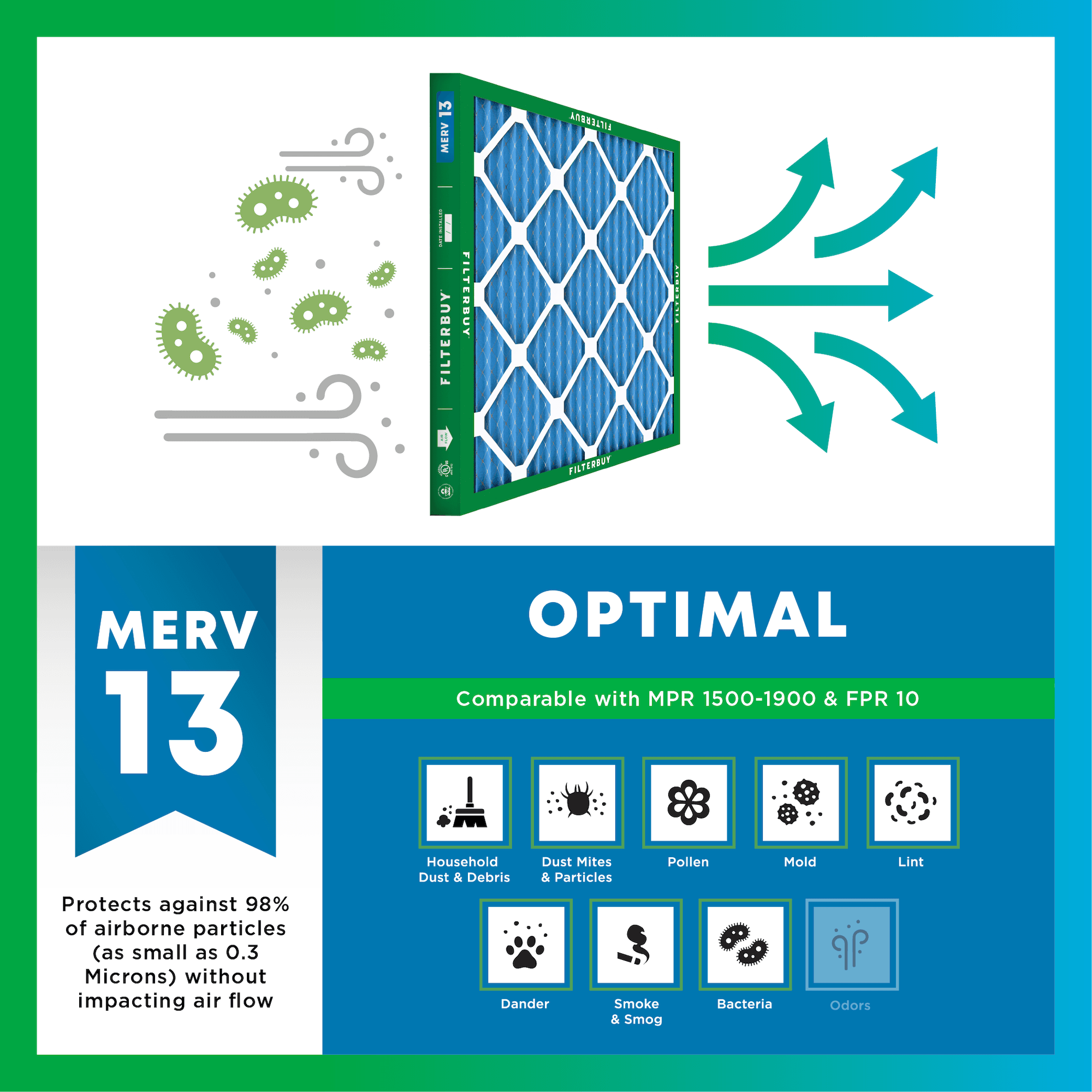
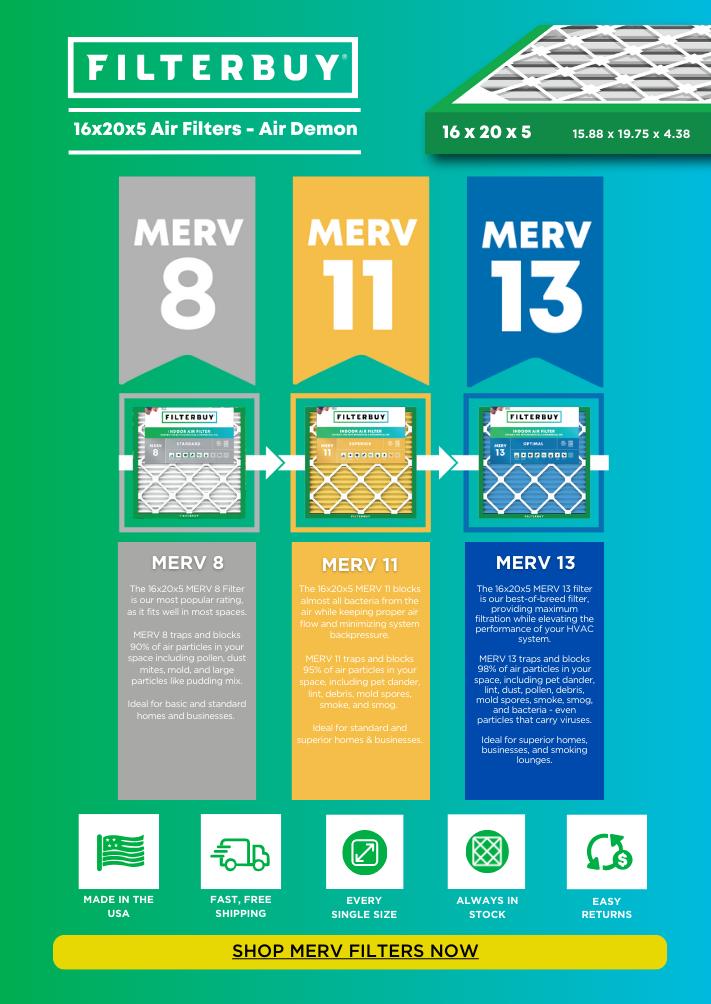
MERV stands for Minimum Efficiency Reporting Value—but don't let the technical name fool you. It's just a way to rate how well an air filter traps stuff like dust, pollen, pet dander, and smoke. The higher the MERV number, the more particles it catches—and the cleaner your air will be.

Comparable to:FPR: 4-7
MPR: 600-1000
 Dust & Debris
 Dust Mites & Particles
 Pollen
 Mold
Mold Lint
Lint Dander
Comparable to:FPR: 6-9
MPR: 1200-1550
Dust & DebrisDust Mites & ParticlesPollenMoldLintDander Smoke & Smog
Comparable to:FPR: 10
MPR: 1900-2800
Dust & DebrisDust Mites & ParticlesPollenMoldLintDanderSmoke & Smog Bacteria


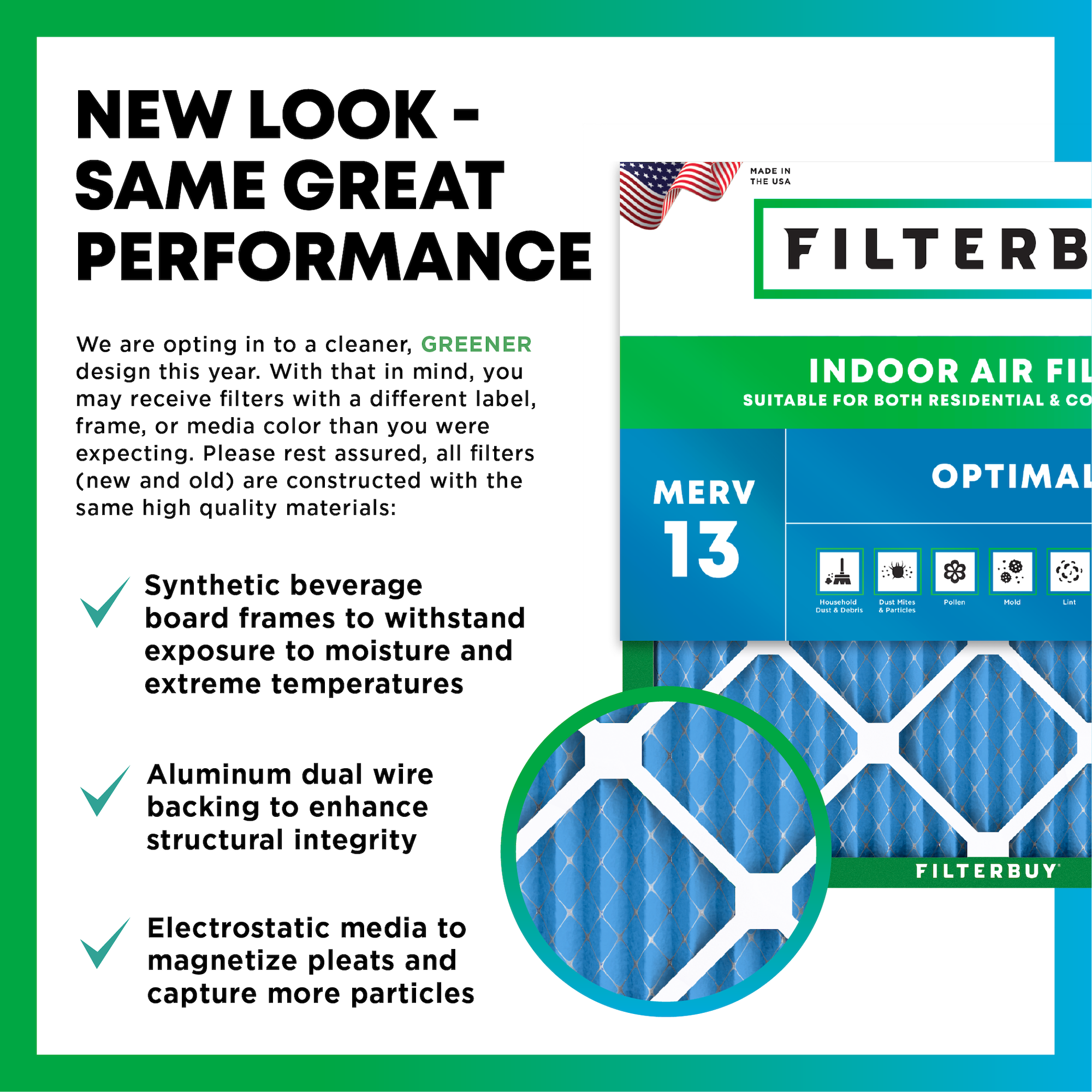
We build every Filterbuy filter to deliver reliable 90-day performance—thanks to smart design and premium materials that do the heavy lifting. Here's what makes the difference:
More pleats = more surface area to capture dust and debris, keeping your air cleaner longer.
Pleats are magnetized to attract and trap microscopic particles—like pet dander, pollen, and smoke.
Engineered to resist warping in extreme temperatures and high humidity.

A layer of metal reinforcement keeps pleats evenly spaced and structurally sound—no sagging, even at high airflow.
Assembled with care. Built to perform. Ships fast, free, and reliably from our U.S. facilities.

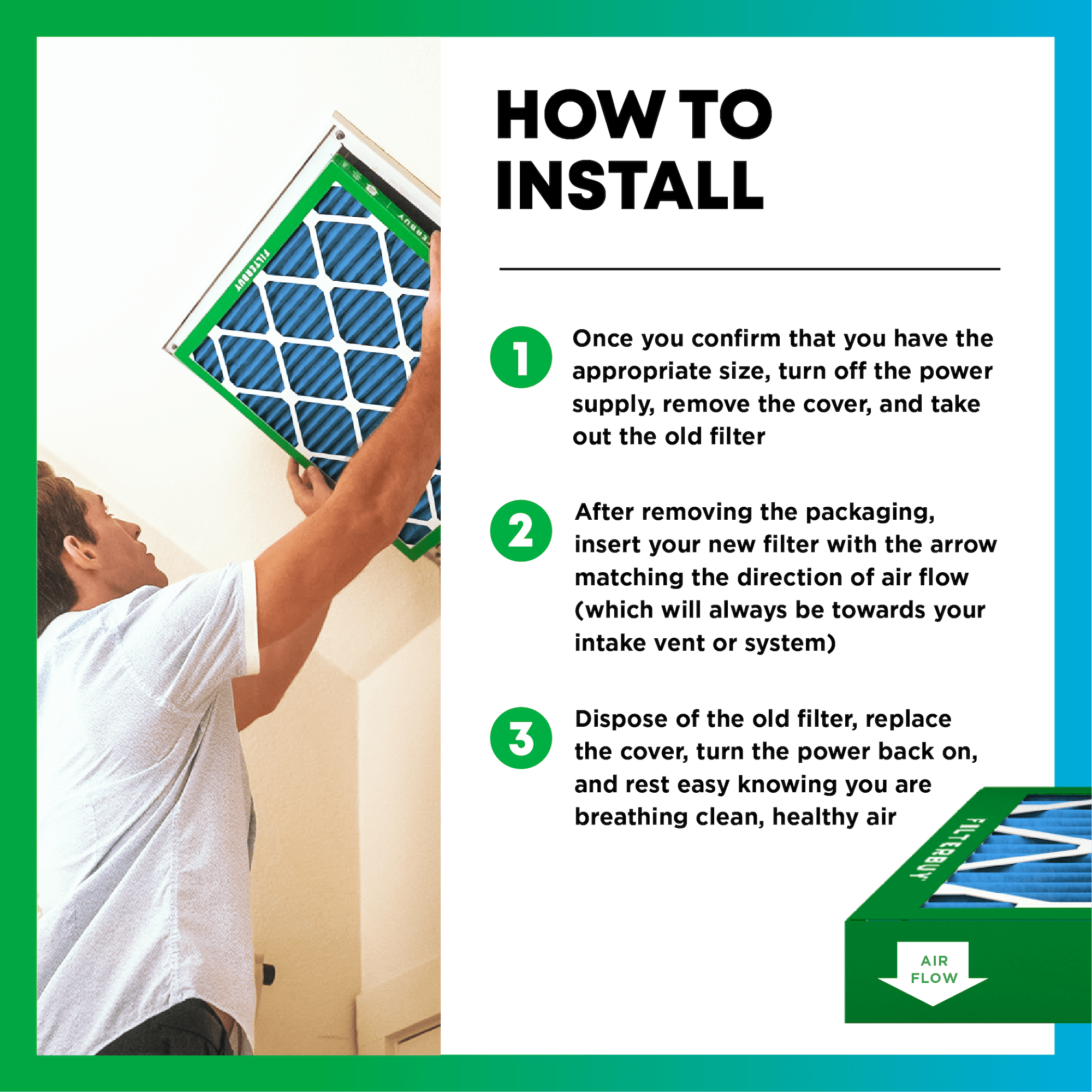
Turn Off Your HVAC SystemSafety first.

Remove The Old FilterLook for the airflow arrow and make note of the direction.

Slide In Your New FilterArrow should point toward the system (same direction as before).

Turn Your System Back OnAnd enjoy the fresh, clean air.

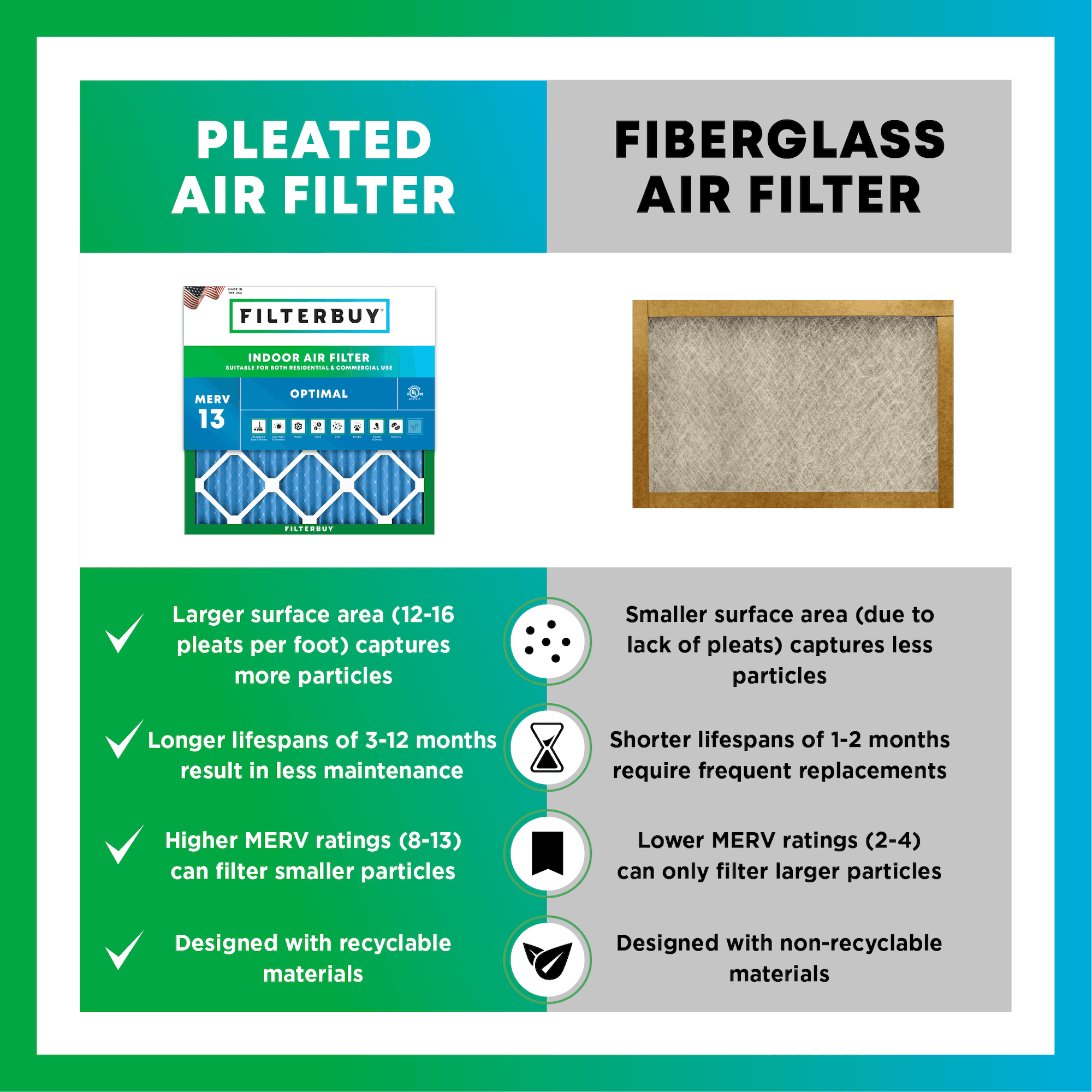
Not all air filters are created equal. Pleated filters don't just last longer—they actually clean your air better. Here's how they stack up:

Efficiency:
High (MERV 8–13) – Traps more particles
Lifespan:
90 days – Long-lasting performance
Air Quality:
Excellent – Cleaner, healthier air
Materials:
Recyclable and durable

Efficiency:
Low (MERV 4 or less) – Misses small stuff
Lifespan:
30 days or less – Replace often
Air Quality:
Minimal – Basic protection only
Materials:
Thin, flimsy, and not recyclable
Pleated filters are a no-brainer—more protection, less hassle, and better air for your home.
Changing your filter on time keeps your HVAC system running efficiently—and helps protect your lungs from dust, allergens, and airborne irritants. Here's how often to swap it out based on your needs:

For most homes without pets or special air quality concerns. Great for general upkeep and energy efficiency.

Shedding fur, dander, and allergy triggers can build up fast. Changing your filter every two months helps keep the air fresher and symptoms at bay.

For households affected by smoke, pollution, or respiratory conditions, monthly changes ensure maximum protection.

| Nominal Size | 16 x 20 x 5 inches |
| Actual Size | 15.88 x 19.75 x 4.38" inches |
| Filter Type | Pleated |
| Media | Electrostatically Charged |
| Frame | Beverage Board |
| MERV Ratings Available | 8, 11, 13 |
| Lifespan | Up to 12 Months |
| Origin | Made in USA |
If you’re questioning whether your MERV 13 16x20x5 Air Demon filter is still doing its job, here’s what we’ve learned after manufacturing and testing millions of filters at Filterbuy: clogging rarely shows up as obvious dirt first—it shows up as restricted airflow and system strain. In this guide, we break down the real-world signs we see most often when these filters are ready to be replaced, how those warning signals affect your HVAC system and air quality, and exactly when to swap your filter to keep clean air flowing without overworking your system.
A MERV 13 16x20x5 Air Demon filter is a high-efficiency, deep-pleated HVAC filter designed to capture fine airborne particles—like pollen, smoke, pet dander, and bacteria—while maintaining proper airflow when replaced on time. Based on real-world use and manufacturing experience, it performs best when changed every 6–9 months, with earlier replacement needed in homes with pets, allergies, or heavy HVAC use to prevent airflow restriction and system strain.
Airflow restriction appears before visible dirt.
Reduced airflow increases HVAC strain and energy use.
Most homes need replacement every 6–9 months.
MERV 13 performance depends on maintaining airflow.
Weak airflow and longer run times signal it’s time to replace.
The first sign most homeowners notice is weaker airflow from supply vents. A clogged 16x20x5 MERV 13 filter restricts the volume of air your blower can pull through the return, forcing it to work harder while delivering less conditioned air. Walk through your home and hold your hand near each vent — if output feels noticeably weaker than when the filter was fresh, the media is likely loaded beyond its effective capacity.
That restricted airflow creates a chain reaction. Rooms farther from the air handler feel stuffy or several degrees off from rooms closest to the unit, and your system runs longer cycles trying to reach the thermostat setpoint. If your monthly energy costs climb 15–20% or more without a change in usage habits or weather extremes, a loaded MERV 13 filter is one of the most common and easily corrected causes. In severe cases, the system may start short-cycling — rapidly turning on and off — as the high-limit switch or frozen evaporator coil forces protective shutdowns that accelerate compressor wear.
Remove the filter and inspect it under good lighting. A fresh MERV 13 16x20x5 filter is white or off-white with clean, defined pleats. A clogged filter shows heavy gray or brown discoloration across the entire upstream surface. Hold it up to a light source — if you can no longer see light passing through the media, the filter has reached or exceeded its useful life.
You may also notice increased dust accumulating on furniture and surfaces faster than usual, or household members experiencing more frequent allergy or asthma symptoms. When a MERV 13 filter is overloaded, microscopic particles begin bypassing the media or recirculating through gaps caused by filter deformation under excessive static pressure. These indoor air quality changes are a reliable secondary indicator that confirms what a visual inspection reveals.
Most 16x20x5 MERV 13 filters last between 6 and 12 months under average residential conditions. However, homes with multiple pets, active construction nearby, or high occupancy may need replacement every 3 to 4 months. Setting a calendar reminder and performing a monthly visual inspection is the most reliable way to stay ahead of a clogged filter before it impacts your system performance or indoor air quality.
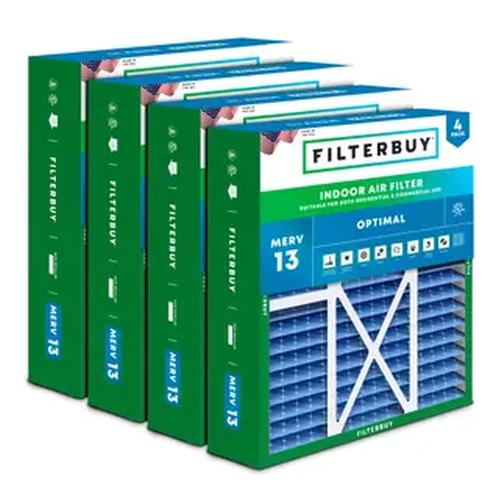
“After manufacturing and testing millions of high-efficiency filters, we’ve found that airflow restriction—not visible dirt—is the earliest and most reliable sign a MERV 13 filter is clogged. Replacing it at the right time protects both your air quality and the long-term health of your HVAC system.”
Choosing the right high-efficiency filter isn’t just about the rating—it’s about protecting your air, your HVAC system, and the people in your home. These expert-vetted resources help you make a confident, informed decision, guided by science, real-world HVAC experience, and Filterbuy’s air-obsessed expertise.
What Is a MERV Rating? (U.S. EPA)This government-backed guide explains what particles MERV 13 filters capture—including pollen, smoke, and fine airborne contaminants—and why it matters for indoor air quality.
URL: https://www.epa.gov/indoor-air-quality-iaq/what-merv-rating
Which HVAC Filter Is Right for My Home? (U.S. EPA)Learn how to balance cleaner air and proper airflow, so your HVAC system isn’t overworked while delivering better air for your family.
Debunking Myths About MERV & Air Filtration (ASHRAE)HVAC engineers explain why higher MERV doesn’t automatically mean restricted airflow—and how proper filter design makes the difference.
URL: https://www.ashrae.org/news/ashraejournal/debunking-myths-about-merv-air-filtration
Minimum Efficiency Reporting Value (MERV) ExplainedFor those who want deeper technical clarity, this overview explains how MERV ratings are tested and standardized across the industry.
URL: https://en.wikipedia.org/wiki/Minimum_efficiency_reporting_value
1. Most air exposure happens indoors.
Americans spend about 90% of their time indoors, making indoor air filtration one of the most important defenses for everyday air quality. This aligns with what we see in real homes—most airborne exposure happens inside, not outside.
Source: https://www.epa.gov/report-environment/indoor-air-quality
2. Indoor air can be more polluted than outdoor air.
The EPA reports that indoor pollutant levels are often 2–5 times higher than outdoor levels, especially when air isn’t filtered effectively or airflow becomes restricted. In practice, clogged filters accelerate this buildup.
Source: https://www.epa.gov/iaq-schools/why-indoor-air-quality-important-schools
3. MERV 13 filtration captures fine particles at a high rate.
ASHRAE confirms that MERV 13 filters capture at least 85% of particles in the 1–3 micron range, which includes many of the airborne pollutants homeowners are most concerned about. Maintaining airflow through timely replacement keeps that efficiency working as designed.
Source: https://www.ashrae.org/technical-resources/filtration-and-disinfection-faq
Clogging is often misunderstood. From our experience manufacturing and testing high-efficiency filters, MERV 13 filters rarely fail because they’re “too dirty.” They fail because airflow becomes restricted before visual dirt appears.
How your system performs matters more than how a filter looks. Subtle changes—like weaker airflow or longer run times—are often the earliest signs it’s time to replace your Air Demon filter.
Our experience-driven opinion:
The best filter protects your air and your HVAC system.
Timely replacement keeps airflow balanced and efficiency intact.
Treat your filter as an active system component, not a passive accessory.
Bottom line:
Replace your MERV 13 16x20x5 Air Demon filter based on performance signals—not just appearance—and your home’s air quality and HVAC system will both benefit.
Take these quick, practical steps to keep your MERV 13 16x20x5 Air Demon filter performing as designed:
Check airflow at your vents Weak airflow is often the earliest sign of a clogged filter.
Confirm your last replacement date Most homes need a new filter every 6–9 months—sooner with pets or allergies.
Inspect the pleats, not just the surface Clogging happens deep in the filter, not where dust is most visible.
Replace before performance drops Early replacement protects airflow and reduces HVAC strain.
Set a replacement reminder Staying on schedule keeps clean air moving consistently.
Bottom line:
If airflow is reduced or you’re near your replacement window, swapping your air filter now is a simple step with lasting benefits for your air and your HVAC system.
A:
Most homes: every 6–9 months
Homes with pets, allergies, or heavy use: closer to 6 months
Performance usually drops before the filter looks dirty.
A:
High-MERV filters trap particles deep in the pleats.
Airflow restriction shows up before visible dirt.
Watch for weak airflow or longer HVAC cycles.
A:
Not when properly sized and replaced on time.
Airflow issues are almost always caused by overused filters, not the MERV rating.
A:
Pollen
Mold spores
Pet dander
Smoke particles
Bacteria and fine airborne debris
A:
Yes, when clean airflow is a priority.
Best results come from timely replacement, not waiting for visible dirt.
If your MERV 13 16x20x5 Air Demon filter is showing any of the warning signs above, it's time for a fresh replacement before restricted airflow leads to costly repairs. Browse our full selection of 16x20x5 MERV 13 filters to find the exact fit for your system and get back to breathing cleaner, healthier air.

