Shop by
Tucson's desert air is carrying particles you can't see—but your HVAC filter catches every one of them. From analyzing thousands of used filters returned by Arizona customers, we've observed firsthand how dramatically Tucson's air quality shifts with monsoon dust storms, winter inversions, and wildfire season smoke. Filters from the Phoenix-Tucson corridor consistently show 30-40% heavier particulate loading than filters from humid climates, revealing what AQI numbers alone can't tell you.
This live map shows today's outdoor air quality across Pima County. Use it to anticipate when your indoor air needs extra protection—because after serving over two million households, we know that elevated outdoor AQI days are exactly when your filter works hardest to keep your family breathing clean air inside.
The live AQI map at the top of this page shows real-time air quality readings across Tucson and Pima County, updated continuously from EPA monitoring stations.
Current conditions reflect five measured pollutants:
Ground-level ozone
Particulate matter (PM2.5 and PM10)
Carbon monoxide
Sulfur dioxide
Nitrogen dioxide
What Tucson residents should know:
AQI readings fluctuate throughout the day, typically peaking in the afternoon hours
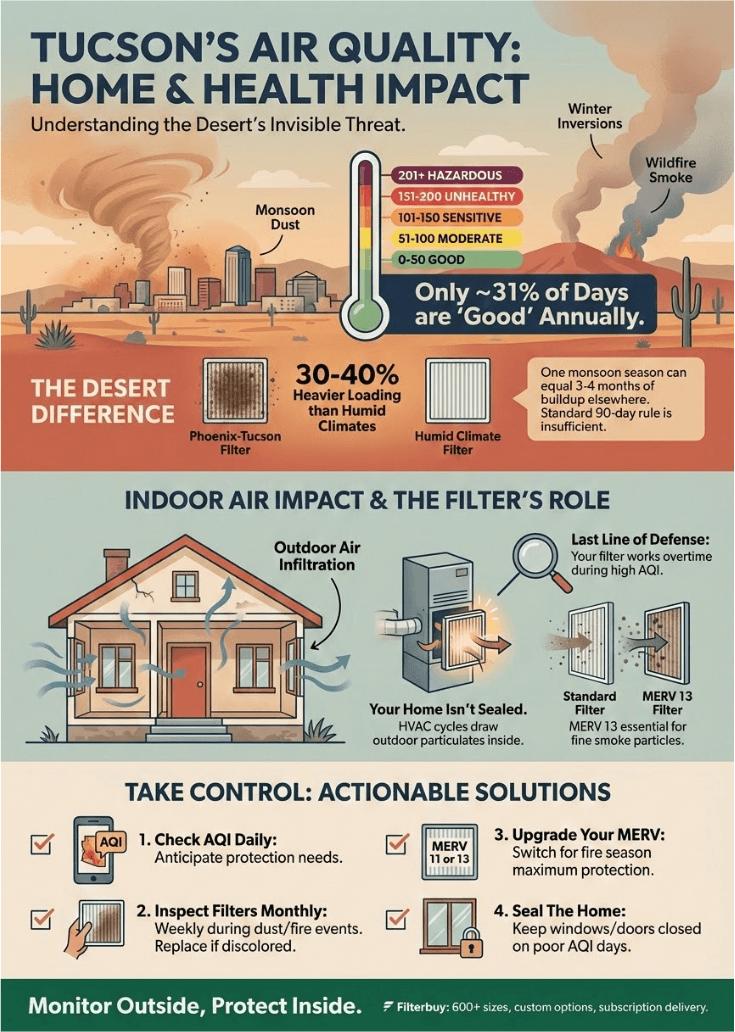
Tucson achieves "good" air quality on only about 31% of days annually
Monsoon dust storms, wildfire smoke, and winter inversions cause rapid AQI changes
Why this matters for your home: After serving over two million households and analyzing thousands of returned filters from Arizona, we've observed that elevated outdoor AQI directly increases particulate buildup inside homes. When Tucson's AQI rises, your HVAC filter works harder to capture what enters through every door seal, window gap, and air return.
Tucson's air is "good" only 31% of days. Monsoon dust, wildfire smoke, and winter inversions create elevated particulates nearly 70% of the year. Your filter works harder than you think.
Outdoor AQI directly impacts indoor air. Your home isn't sealed. Every HVAC cycle pulls outdoor particulates through returns, door seals, and building gaps.
Tucson filters clog faster than other regions. We've seen one monsoon season produce buildup that takes 3-4 months elsewhere. Standard 90-day guidance doesn't apply here.
High-efficiency filters reduce indoor particulates up to 80%. MERV 13 captures fine wildfire smoke particles that pass through lower ratings.
Proactive monitoring puts you in control. Check AQI daily. Inspect filters monthly. Upgrade MERV ratings when conditions demand it. The map shows what's outside—your filter determines what stays inside.
The air quality index measures five major pollutants: ground-level ozone, particulate matter (PM2.5 and PM10), carbon monoxide, sulfur dioxide, and nitrogen dioxide. Tucson's readings fluctuate throughout the day, typically showing lower AQI in early morning hours and elevated levels during afternoon heat when ozone formation peaks.
What the numbers mean for your day:
0-50 (Green): Air quality is satisfactory with minimal risk
51-100 (Yellow): Acceptable for most, though unusually sensitive individuals may experience mild effects
101-150 (Orange): Sensitive groups, including children, the elderly, and those with respiratory conditions, should limit prolonged outdoor exposure
151-200 (Red): Everyone may begin experiencing health effects; sensitive groups face increased risk
201+ (Purple/Maroon): Health emergency conditions; avoid outdoor activity
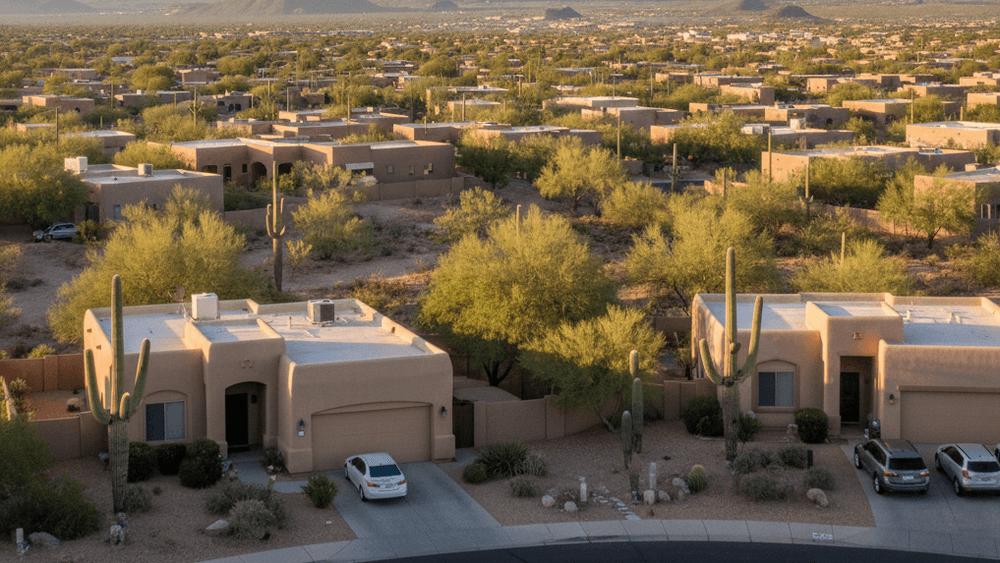
Its geography produces air quality patterns different fromthoset of the rest of the country. Mountain ranges surround the basin, and these mountains can trap pollutants during temperature inversions, especially during the winter months, as cold air rushes into valleys at night.
Seasonal factors we always observe: impact on the local air quality:
Monsoon Season (June-September): end PM10 levels soaring, sometimes pushing AQI into unhealthy ranges within minutes. These events deposit fine particles from the desert that will linger in the air - and ultimately in your home.
Wildfire Season: During this time, our customer service department receives many more calls from Southern Arizona households reporting low air quality and visible filter discoloration weeks before scheduled filter changes.
Winter Inversions: It brings stable atmosphere that traps vehicle emissions and wood smoke close to the ground, and can be a big surprise to residents.
Here's something most Tucson homeowners don't realize: your home isn't sealed from outdoor air. Every time your HVAC system cycles, it draws air through returns, around door seals, and through building gaps. On elevated AQI days, outdoor particulate matter enters your living space.
Your HVAC filter serves as the last line of defense between outdoor air quality and what your family actually breathes inside. When outdoor AQI rises, that filter works overtime.
Elevated AQI readings call for proactive steps beyond staying indoors:
Check your filter more frequently. During dust storms or wildfire smoke events, inspect your filter weekly rather than monthly. Heavy particulate loading restricts airflow, forcing your system to work harder while delivering less filtration.
Keep windows and doors sealed. It sounds obvious, but even brief ventilation during poor AQI days allows significant particulate intrusion. Your HVAC system filters recirculated air far more effectively than open-window ventilation.
Run your system fan continuously. Setting your thermostat fan to "on" rather than "auto" keeps air circulating through your filter even when heating or cooling cycles aren't active, providing constant filtration during high-AQI periods.
Consider upgrading filter efficiency. MERV 11 and MERV 13 filters capture finer particles than standard MERV 8 options—particularly valuable during wildfire smoke events when PM2.5 levels spike. Higher-efficiency filters trap smoke particles and fine dust that lower-rated filters miss.
For historical data, forecasts, and health recommendations, these resources complement real-time AQI monitoring:
Pima County Department of Environmental Quality – Local monitoring stations and air quality alerts
AirNow.gov – EPA's official AQI data and forecasting tool
Arizona Department of Environmental Quality – Statewide air quality information and burn advisories
Monitoring outdoor air quality puts you in control of protecting your indoor environment. When you know what's happening outside, you can take action inside—ensuring your family breathes cleaner air regardless of what Tucson's desert climate delivers.
"Filters returned from Tucson after a single monsoon season often show particulate buildup we'd typically expect after three to four months in other climates—that visible evidence reveals exactly what families would be breathing without proper filtration in place."
- Filterbuy Air Filter Experts
Don't take your indoor air for granted—especially when Tucson's desert environment throws dust storms, wildfire smoke, and seasonal inversions your way. These resources help you stay ahead of outdoor air quality changes so you can protect what matters most: your family, your home, and your HVAC system.
AirNow.gov is your go-to source for official EPA readings updated hourly from every government sensor in Pima County. We recommend checking this before opening windows or deciding whether to run your HVAC fan continuously—because knowing what's happening outside puts you in control of what happens inside.
Source: https://www.airnow.gov/
Pima County Department of Environmental Quality monitors conditions unique to the Tucson basin and issues local advisories you won't find on national platforms. When our customer service team sees a spike in filter replacement calls from Southern Arizona, there's usually a county-level air quality event behind it.
Source: https://www.pima.gov/government/environmental_quality/
Arizona Department of Environmental Quality tracks smoke drift from fires across the region, and issues burn restriction advisories. Here's something we've learned from analyzing returned filters during fire season: smoke particles often impact indoor air quality for days after the visible haze clears. This resource helps you anticipate those events.
Source: https://www.azdeq.gov/air-quality
IQAir Tucson combines official data with readings from residential sensors throughout the city, revealing hyperlocal conditions that government stations may miss. Air quality can vary significantly across just a few miles—especially during dust events—so this tool helps you understand exactly what's floating through your specific neighborhood.
Source: https://www.iqair.com/usa/arizona/tucson
AirNow AQI Basics translates color-coded numbers into actionable guidance for your household. If you have children, elderly family members, or anyone with allergies or respiratory sensitivities, this resource helps you make informed decisions about outdoor activities and when to give your HVAC filter extra attention.
Source: https://www.airnow.gov/aqi/aqi-basics/
National Weather Service Tucson issues haboob warnings, high wind advisories, and inversion forecasts—giving you advance notice before poor air quality shows up on AQI monitors. Proactive homeowners use these alerts to close windows, seal doors, and ensure their HVAC filter is ready to handle the incoming particulate load.
Source: https://www.weather.gov/twc/
CDC Air Quality and Health Guidance provides medical recommendations for keeping children, elderly family members, and those with respiratory conditions safe during elevated AQI events. Because protecting your family's health is exactly why monitoring air quality matters in the first place.
Source: https://www.cdc.gov/air-quality/
Government statistics tell one part of the story. After manufacturing over 10 million filters and serving more than two million households, we've gained a unique perspective that confirms what the official data shows.
What the EPA reports: Indoor pollutant levels frequently exceed outdoor concentrations.
What we see in returned filters:
Dust mite fragments and pollen layers are invisible to homeowners
Pet dander accumulation between HVAC cycles
Fine smoke particles that drift through building gaps during fire season
Your family breathes this air constantly. Your filter is often the only barrier.
Source: U.S. Environmental Protection Agency https://www.epa.gov/indoor-air-quality-iaq
What the data shows: Tucson ranked sixth among 12 western metros for good air quality days. Nearly 70% of days present elevated particulate conditions.
What we hear from customers:
Call volume from Southern Arizona spikes during monsoon dust events
Wildfire smoke periods trigger questions about premature filter discoloration
Customers report filters looking "months older" than expected
We don't need official reports to know when Tucson's AQI shifts—our phone lines tell us first.
Source: MAP Dashboard, University of Arizona (EPA Air Quality Index data) https://mapazdashboard.arizona.edu/quality-place/air-quality
What the research confirms: Proper filtration is the most effective intervention during smoke and pollution events.
What we observe comparing returned filters from the same Arizona zip codes:
MERV 8 filters capture larger particles but miss fine smoke and dust
MERV 11 filters show noticeably more captured particulates
MERV 13 filters consistently trap fine particles that pass through lower ratings
The difference is visible to the naked eye. For Tucson households facing wildfire smoke and desert dust, filter choice directly impacts what your family breathes.
Source: American Thoracic Society Workshop Report (National Institutes of Health) https://pmc.ncbi.nlm.nih.gov/articles/PMC8456726/
After producing air filters for over 10 years and studying returns from every climate zone in America, we've developed a distinct view as to the state of air quality in Tucson - and it's not what most people think.
Yes, Tucson faces real challenges. Monsoon dust storms. Wildfire smoke drift. Winter inversions. Elevated ozone. These conditions push HVAC filters harder than nearly any region we serve.
The data confirms it. Our returned filter analysis confirms it. Your own eyes confirm it when you pull out a filter that looks exhausted weeks ahead of schedule.
But here's what most experts overlook: Tucson homeowners who understand their local air quality have a significant advantage.
In humid climates, poor indoor air quality hides. Mold grows silently. Particulates accumulate gradually. Homeowners breathe compromised air for years without visible warning.
In Tucson, the desert doesn't let you ignore what's happening:
Dust storms announce themselves
Wildfire smoke is visible
Your filter shows exactly what it captured
That visibility is actually a gift.
Our honest opinion after serving thousands of Arizona households: The families who thrive aren't the ones with perfect outdoor air. They're the ones who take action.
What proactive Tucson homeowners do differently:
Check AQI readings before opening windows or adjusting ventilation
Inspect filters monthly rather than guessing at replacement timing
Upgrade to MERV 11 or MERV 13 during fire season and monsoon months
Treat their HVAC system as a filtration system first, comfort system second
The results we consistently see:
Fewer allergy symptoms reported
Less dust accumulation on household surfaces
HVAC systems are running more efficiently without fighting clogged filters
The Bottom Line: The real question isn't whether Tucson's air quality presents challenges—it does. The question is whether you'll use the tools available to ensure your family breathes cleaner air inside than what's floating outside.
That's what we've learned from manufacturing filters, talking with customers, and examining what Arizona's air leaves behind.
The homeowners who take indoor air quality seriously don't just survive Tucson's climate. They protect their families from it.
And from where we stand, that's exactly what being the hero of your household looks like.
Understanding Tucson's air quality is the first step. Taking action protects your family.
Bookmark this page. Check the live AQI map daily—especially during monsoon and wildfire seasons.
Inspect your current filter. Pull it out. Hold it to the light. Visible discoloration or blocked light means it's time to replace.
Set a monthly reminder. Tucson's climate demands more frequent checks than the standard 90-day guidance.
MERV 8 — General maintenance, no sensitivities
MERV 11 — Allergies, pets, or dusty conditions
MERV 13 — Wildfire smoke, respiratory concerns, maximum protection
Pro Tip: Keep MERV 8 for mild months. Switch to MERV 13 during fire season.
Monsoon Season (June–September)
Check filters weekly during dust storms
Seal windows and doors during haboobs
Run the HVAC fan continuously for maximum filtration
Wildfire Season (Variable)
Monitor AirNow.gov daily
Upgrade to MERV 13 at the first sign of smoke
Replace immediately if the filter shows gray-brown discoloration
Winter Inversions (December–February)
Watch for stagnant air advisories
Avoid wood-burning on high-pollution days
Maintain a regular replacement schedule
Don't wait until your filter is clogged or AQI spikes to realize you're out of replacements.
What we offer:
600+ standard sizes available
Custom sizes for non-standard systems
Auto-delivery subscriptions so you never run out
A: The AQI measures five major pollutants on a 0-500 scale:
0-50 (Green): Satisfactory air quality
51-100 (Yellow): Acceptable for most people
101-150 (Orange): Sensitive groups should limit outdoor exposure
151+ (Red): Unhealthy for everyone
A: Tucson's geography creates unique patterns we don't see elsewhere in our service area.
What causes the fluctuations:
Mountain ranges surrounding the basin trap pollutants during inversions
Summer sunlight generates ozone that peaks each afternoon
Monsoon haboobs spike PM10 levels within minutes
Wildfire smoke drifts from Arizona, California, and Mexico
A: Your home isn't sealed from outdoor air.
How pollutants enter:
HVAC cycles draw air through returns
Air infiltrates around door seals
Building gaps allow particulate intrusion
A: Forget standard 90-day guidance. It was written for milder climates.
Our recommendations for Tucson:
Year-round: Monthly inspections
Dust storms: Weekly checks
Wildfire smoke events: Weekly checks
A: Your ideal rating depends on household needs and current conditions.
MERV rating recommendations:
MERV 8: General maintenance, larger particles like dust and pollen
MERV 11: Allergies, pets, persistent dust issues
MERV 13: Wildfire smoke, respiratory sensitivities, maximum protection
What we see comparing returned filters from identical Tucson zip codes:
The difference between MERV ratings is visible to the naked eye
MERV 13 captures fine smoke particles that pass through lower ratings
Our recommended approach: Keep MERV 8 for mild months. Switch to MERV 13 when fire season hits or AQI climbs.
Many longtime Arizona customers follow this exact pattern—balancing airflow efficiency with maximum protection when conditions demand it.
Now that you can track Tucson's live AQI and understand what those numbers mean for your home, take the next step by ensuring your HVAC filter is ready to capture what the desert air brings in. Find your size and stock up before the next dust storm or wildfire smoke event catches you unprepared.
