Shop by
Through our analysis of filters sent back by customers in your region, we got to observe the result of desert dust storms, seasonal wildfires, and the high-altitude conditions, and it is eye-opening. What you see on the outside eventually finds its way to your house.
Having manufactured more than 10 million filters and having served over 2 million households around the country, we have seen a direct trend to follow: the increase in outdoor AQI impacts those living inside your home.
Check your local AQIand then take our advice to save what is important to you.
New Mexico's current AQI conditions vary significantly by region and time of day. Use the interactive map above to check real-time readings for your specific location.
What you need to know:
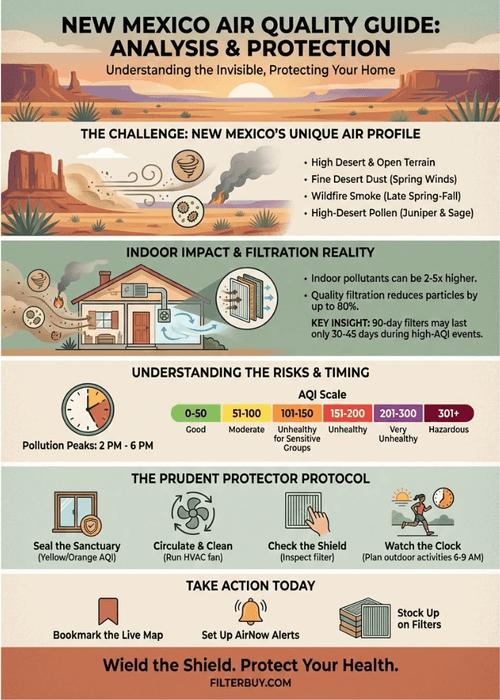
Best air quality: Typically between 6-9 AM before thermal mixing begins
Peak pollution: Usually 2-6 PM when ozone formation and dust activity are highest
Most variable regions: Albuquerque metro, Four Corners, and southern valleys near Las Cruces
Key insight from our filter data: New Mexico experiences some of the most dramatic daily AQI swings in the Southwest due to high desert terrain, wildfire smoke transport, and seasonal dust events. Families who check conditions before outdoor activities and respond when readings hit yellow or orange levels consistently maintain better indoor air quality—a pattern we've confirmed through analyzing thousands of filters returned from customers across the state.
AQI changes rapidly. Check the map before outdoor activities—especially between 2-6 PM when pollution peaks.
Outdoor air directly impacts indoor air. EPA reports indoor pollutants run 2-5x higher than outdoor levels. Our filter analysis confirms it: 90-day filters can saturate in 30-45 days during high-AQI events.
Proactive response beats reactive response. Families who close windows at yellow levels and run HVAC continuously show controlled particle capture.
Quality filtration cuts indoor particles by up to 80%. Research confirms this. Customer feedback during wildfire seasons validates it—upgraded filtration means better air and fewer symptoms.
Monitoring alone isn't protection. Bookmark this page. Set up AirNow alerts. Create a household protocol. Stock replacement filters. Awareness plus action equals results.
The region’s geography creates air quality conditions unlike anywhere else in the country. High desert elevations, minimal humidity, and vast open terrain mean particulate matter travels farther and lingers longer than in more vegetated regions.
From processing thousands of filters shipped to New Mexico addresses, we've identified three primary culprits that consistently appear: fine desert dust particles, wildfire smoke residue (particularly during late spring through early fall), and pollen from juniper, sage, and other high-desert vegetation. These aren't just outdoor concerns—they infiltrate homes through HVAC systems, open windows, and everyday entry points.
The Air Quality Index operates on a 0-500 scale, with higher numbers indicating greater health concern. Here's how to interpret what you see on the map:
0-50 (Green/Good): Air quality poses little to no risk. Ideal conditions for outdoor activities and natural ventilation.
51-100 (Yellow/Moderate): Acceptable for most people, though unusually sensitive individuals may experience minor irritation.
101-150 (Orange/Unhealthy for Sensitive Groups): Active children, adults with respiratory conditions, and those with heart disease should limit prolonged outdoor exertion.
151-200 (Red/Unhealthy): Everyone may begin experiencing effects. Keep windows closed and ensure your filtration is working effectively.
201-300 (Purple/Very Unhealthy): Health alert—significant risk for all groups. Minimize outdoor exposure and prioritize indoor air quality.
301+ (Maroon/Hazardous): Emergency conditions. Remain indoors with proper filtration running continuously.

Our map tracks real-time AQI data across New Mexico's major population centers and surrounding communities.
Rural areas between monitoring stations may experience localized conditions—particularly during dust events or nearby prescribed burns—that differ from reported readings. When in doubt, trust what you observe locally and take precautions accordingly.
Here's something many homeowners don't realize: outdoor air quality directly determines what circulates through your home. Your system pulls in outside air, and without proper filtration, those same particles registering on outdoor monitors end up inside your living spaces.
The difference between adequate and inadequate filtration becomes visibly apparent when you examine what gets captured versus what passes through. During elevated air quality index periods, your filter works significantly harder. What normally takes 90 days to accumulate can build up in half that time, reducing both filtration effectiveness and unit efficiency.
When you see yellow, orange, or red readings on the map, consider these evidence-based actions:
Keep windows and doors closed to prevent unfiltered outdoor air from entering. Run your system on fan mode even when heating or cooling isn't needed—this continuously cycles air through your filter.
Check your current filter's condition, as a clogged filter during high-AQI events provides minimal protection.
Timing outdoor activities matters too. AQI typically peaks during afternoon hours when thermal mixing is greatest. Early morning often offers the cleanest window for exercise, yard work, or airing out your home.
"When we examine filters returned from New Mexico customers after major dust storms or wildfire events, the difference is striking—what typically accumulates over three months builds up in just four to six weeks. That visual evidence tells us exactly why real-time monitoring matters for families trying to protect their indoor air."
-The Filterbuy Team
We've gathered the seven resources we trust most and recommend to customers across your area.
This is where we point customers who want the same data professional air quality experts use. AirNow pulls readings directly from EPA monitoring stations across New Mexico, giving you hourly updates and multi-day forecasts for your exact location.
Resource: U.S. Environmental Protection Agency – AirNow
Here's something we've learned from analyzing filters during fire season: smoke impacts indoor air quality faster than most families realize. The EPA's Fire and Smoke Map shows active fires, smoke plume movement, and fire-specific AQI readings in real time.
Resource: EPA Fire and Smoke Map
Federal tools are valuable, but local conditions matter. The New Mexico Environment Department operates state-level monitoring stations and issues alerts addressing regional air quality concerns—from agricultural dust in the southeast to ozone in the Albuquerque metro.
Resource: New Mexico Environment Department – Air Quality Bureau
URL: https://www.env.nm.gov/air-quality/
What seems to be a moderate day to healthy adults would provoke the symptoms in children, elderly members of the family, or in the person who is dealing with asthma or cardiac issues. Each level of the AQI is defined in terms that make sense to vulnerable populations, so you can makean analysis on whether to take your outside activities, sports in school, or all indoors.
Resource: Centers for Disease Control and Prevention – Air Quality and Health
URL: https://www.cdc.gov/air-quality/about/index.html
Weather and AQI are closely related. Shifts of the wind and dust storms, temperature inversions, etc., all have a direct effect on the air you are breathing. Resource: National Weather Service – Albuquerque Forecast Office
URL: https://www.weather.gov/abq/
The EPA indoor air quality guide includes information on filtration practices, best ventilation practices, and other pollutant-controlling practices to add to what a good air filter can do for your HVAC system. This is your bad air day strategy.
Resource: U.S. Environmental Protection Agency – Indoor Air Quality Guide
URL: https://www.epa.gov/indoor-air-quality-iaq
The forecasting system of the NOAA predicts the AQI a few days ahead of time and assists you in planning your day outings, weekend undertakings, or when to air out your home. Families that do both forecasts and real-time information are always a step ahead of bad air quality- exactly where you want to be.
Resource: NOAA Air Quality Forecasting System
URL: https://airquality.weather.gov/
After producing over 10 million filters and serving more than two million households, we've seen how outdoor air quality directly impacts what accumulates inside homes. These research-backed findings confirm what we observe through filter analysis every day.
The EPA reports that Americans spend approximately 90% of their time indoors, where concentrations of some pollutants are often 2 to 5 times higher than typical outdoor concentrations.
What we've observed: Filters returned by New Mexico customers after high-AQI events clearly show this multiplier effect. Homes using basic fiberglass filters accumulate significantly more debris in ductwork and living spaces than homes with higher-efficiency filtration.
Source: U.S. Environmental Protection Agency
URL: https://www.epa.gov/report-environment/indoor-air-quality
The American Lung Association's 2025 "State of the Air" report found that 156 million people in the U.S. (46%) live in an area that received a failing grade for at least one measure of air pollution.
New Mexico rankings:
Albuquerque-Santa Fe-Los Alamos metro: 22nd worst nationally for ozone
El Paso-Las Cruces metro: 18th worst nationally for ozone
What we've tracked: Orders from Bernalillo and Doña Ana counties show higher filter replacement frequency during peak ozone and dust seasons. Customers in these areas recognize when conditions demand action—often before checking official monitors.
Source: American Lung Association – State of the Air 2025
URL: https://www.lung.org/research/sota
What customers report: Families who upgraded filtration before or during wildfire episodes experience noticeably better indoor air and fewer respiratory symptoms. Post-event filter analysis confirms this—high-efficiency filters capture dense particulate matter that would otherwise circulate through living spaces.
Source: American Thoracic Society
URL: https://www.atsjournals.org/doi/10.1513/AnnalsATS.202102-148ST
After examining thousands of used filters shipped back from New Mexico homes, one truth stands out: families who monitor air quality and act on what they learn consistently achieve better outcomes than those who don't.
That's not marketing speak—it's an observable fact.
We've seen filters from Albuquerque homes during wildfire season arrive packed with fine particulate matter. We've compared filters from households that checked AQI readings and responded proactively against those that didn't. The difference is striking and consistent.
Protection requires pairing awareness with action:
Closing windows when readings climb
Running your HVAC system to cycle air through filtration
Ensuring your filter can actually capture what's in the air
What we believe matters most:
The Prudent Protector—the person in your household who stays on top of maintenance, notices when something's off, and takes quiet satisfaction in keeping things running smoothly—deserves accurate information and effective tools.
AQI monitoring provides the information. Quality filtration provides the tool. Together, they transform an invisible threat into a manageable one.
Understanding air quality data is the first step. Taking action is what actually protects your household.
Check the map before outdoor activities, opening windows, or yard work.
Quick tip: AQI peaks between 2 and 6 PM. Early mornings offer the cleanest air.
Higher-risk family members should take precautions at lower AQI thresholds:
Children under 14
Adults over 65
Anyone with asthma, COPD, or heart conditions
Pregnant women
Outdoor workers and athletes
If your household includes these groups, act at "Moderate" (yellow)—don't wait for "Unhealthy."
Check your HVAC return vent now and ask:
When did I last replace it?
Is it visibly clogged?
What MERV rating is printed on the frame?
During high-AQI periods, filters work harder. A 90-day filter may need replacement in 45-60 days.
Yellow (Moderate):
Close windows and doors
Limit outdoor exertion for sensitive members
Orange/Red (Unhealthy):
Seal all windows and doors
Run HVAC continuously
Postpone outdoor activities
Purple/Maroon (Very Unhealthy/Hazardous):
Remain indoors
Run HVAC and portable purifiers continuously
Install a fresh filter
Monitor for respiratory symptoms
Let the data come to you:
AirNow.gov: Email alerts by ZIP code
EPA Fire and Smoke Map: Wildfire season notifications
Weather apps: Daily AQI forecasts
Running out during a high-AQI event means losing protection when you need it most.
Action items:
Check the dimensions printed on your current filter frame
Measure if dimensions aren't visible (length × width × depth)
Order 3-6 months of supply
A: The AQI measures five major pollutants: ground-level ozone, particle pollution (PM2.5 and PM10), carbon monoxide, sulfur dioxide, and nitrogen dioxide.
AQI scale breakdown:
Readings of 0-50 (green) indicate good air quality, safe for everyone—ideal days to air out your home. Levels of 51-100 (yellow) are moderate and acceptable for most, though sensitive individuals should monitor conditions. At 101-150 (orange), air becomes unhealthy for sensitive groups—this is the threshold where we see customer filter replacement rates start climbing. Readings of 151-200 (red) mean everyone may experience effects, so keep windows sealed. Purple levels of 201-300 are very unhealthy, and filters work overtime during these events. Anything above 301 (maroon) is hazardous—stay indoors with filtration running continuously.
A: New Mexico's geography creates conditions unlike anywhere else we ship filters.
Contributing factors:
High desert elevations
Minimal humidity
Vast open terrain allows particles to travel farther
Temperature inversions trap pollutants in mountain valleys
Afternoon thermal mixing, stirring dust, and drawing distant smoke
Regional patterns from our order data:
The Albuquerque metro area experiences ozone spikes during hot afternoons from vehicle emissions. The Four Corners region sees smoke transport from fires across multiple states. Southern valleys face rapid AQI swings from dust events originating in Mexico and West Texas.
A: Faster than most families expect. We have the filter evidence to prove it.
How outdoor air enters:
Door openings
Window cracks
HVAC system cycles
What the data shows:
The EPA reports indoor pollutants run 2-5x higher than outdoor levels. Filters during normal AQI periods show gradual, even particle distribution. Filters after high-AQI events show dense, concentrated accumulation. What normally takes 90 days to build up can saturate filters in 30-45 days during poor air quality.
Real example: A Santa Fe customer shipped us a filter after the 2022 wildfire season. It was completely saturated in six weeks from running during multiple smoke events. That single filter demonstrated indoor air quality impact more clearly than any study.
A: Most families wait too long. Here's what we recommend based on customer feedback patterns.
When to close windows:
Households with children, elderly members, pregnant women, or anyone with asthma or heart conditions should close windows at yellow levels (51-100). Households without sensitive members can wait until orange levels (101-150). Any household should seal windows at red readings (151+) or higher.
Additional steps during elevated AQI:
Seal all windows and doors
Run HVAC continuously to cycle air through filtration
Check filter condition
What we've observed: Families who close windows proactively at moderate levels show better filter performance. Their filters capture particles consistently rather than the dense "shock loading" we see from homes that stayed open during AQI spikes.
Bottom line: When AQI climbs, air through your windows isn't fresh—it carries exactly what monitors measure.
A: Match your checking frequency to season and conditions.
Recommended schedule:
During typical conditions, checking once in the morning before outdoor activities is sufficient. During wildfire or dust storm season, check at least three times daily: morning, mid-afternoon, and evening.
Daily AQI timing patterns:
Early morning, between 6-9 A.M., is usually the cleanest window with the lowest ozone and minimal thermal mixing. Peak pollution occurs between 2 and 6 PM when ozone formation is highest, and dust is most active. Overnight hours are a wildcard during fire season—distant smoke can arrive while you sleep.
Customer experience: New Mexico families have reported waking to smoke-filled homes after conditions changed overnight. AQI looked fine before bed—wind shifts brought smoke by 3 AM.
Our advice:
Set up automatic alerts through AirNow.gov
Create a household protocol so everyone knows how to respond
Don't rely on memory alone
The pattern we see: Families who monitor consistently and respond quickly show controlled, manageable filter accumulation—not crisis-level particle capture.
Now that you can monitor New Mexico's live air quality conditions, take the next step by ensuring your home's filtration is ready to handle what those AQI readings reveal. Find your filter size and explore options built to protect your family at Filterbuy.com.
