Shop by
Use the live AQI map to check the outdoor air where you live or work in metro Detroit. It shows a number and color for your area so you can plan time outside and decide when to focus on cleaner air indoors.
The fastest way to check Detroit's live AQI right now is AirNow.gov — the EPA's official real-time source updated hourly for every monitor in metro Detroit.
Here's how to read what you see:
Green (0–50): Outdoor plans are fine for everyone.
Yellow (51–100): Most people are fine. Sensitive groups take it easier.
Orange (101–150): Children, older adults, pregnant people, and anyone with heart or lung conditions should limit harder outdoor activity.
Red (151–200): Move strenuous activity indoors. Most people should cut outdoor efforts.
Purple and above (201+): Stay inside. Seal up. Run filtration.
After manufacturing millions of air filters and shipping them to Detroit-area homes through multiple smoke seasons, our strongest advice is this: don't just check the number — act on it before it climbs. Bookmark the Fire and Smoke Map alongside AirNow so you can see what's heading your way, not just what's already arrived. And make sure the filter in your HVAC system is rated MERV 13 and ready to work — because the map tells you when the air is bad, but your filter is what keeps that bad air out of your home.
Detroit’s AQI can swing fast due to shifting smoke and local conditions. Check the live map before outdoor plans.
August–September 2025 brought statewide advisories and brief world-ranked poor air in Detroit, underscoring the need to monitor and adjust.
Keep one “clean room,” run HVAC on recirculate, and use the highest MERV your system safely supports.
Detroit has seen several poor-air episodes tied to long-range wildfire smoke. Last September 2025, IQAir listed Detroit among the world’s top 10 most polluted major cities that morning as Canadian smoke pushed AQI into unhealthy ranges. In cases like this, and as recommended by experts, it is best to upgrade to MERV 13 like that of Filterbuy.
Earlier in August 2025, state officials kept air quality advisories in place across Michigan as smoke lingered. Local coverage noted Detroit’s AQI among the worst globally during parts of that period.
Smoke from distant fires can reach Southeast Michigan, then shift with wind and frontal changes. Local traffic corridors, industry, and hot sunny afternoons that form ground-level ozone also add to higher readings on some days. These patterns make the AQI change hour by hour, so a quick map check before outdoor plans is useful.
Use the map’s number and color to judge outdoor plans. Start with the current reading, then check the forecast line for the rest of the day.
Green means outdoor plans are fine. Yellow means most people are fine, but sensitive groups may take it easier. Orange means children, older adults, and people with heart or lung conditions should limit harder outdoor activity. Red and above means move strenuous activity indoors and most people should cut outdoor effort. If the hourly outlook climbs during the day, shift workouts earlier, choose lighter activity, or head indoors.
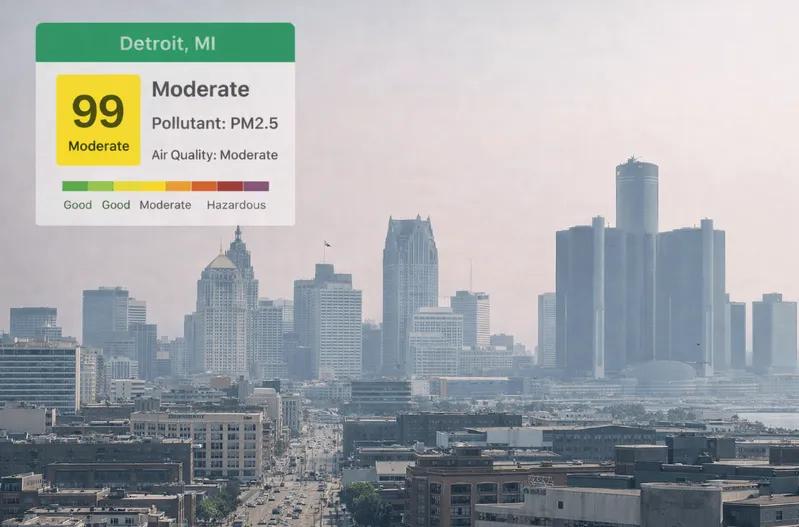
Check in the morning before yard work, commuting by bike, kids’ practices, or outdoor jobs. Recheck if the wind shifts or the forecast calls for smoke. If AQI spikes along your route, pick streets away from heavy traffic or wait until conditions improve.
Detroit sees frequent poor-air days, and the AQI is your quick guide from 0–500 for how safe it is to be outside. It rolls five key pollutants into one number, with ground-level ozone and fine particles doing most of the harm. Green (0–50) is generally safe; as the number and color rise, risk rises too, especially for children, older adults, people who are pregnant, outdoor workers, and anyone with heart or lung disease.
On higher-AQI days, experts advise shifting harder activity indoors or to cooler morning/evening hours, keeping windows closed, and avoiding extra indoor smoke sources like candles and wood fires. If symptoms like coughing, wheezing, or chest tightness appear, slow down, head inside, and check with a clinician or local clinics.
Keep hard exercise shorter and take more breaks.
Choose parks and paths farther from busy roads when possible.
If you notice coughing, chest tightness, or shortness of breath, move activity indoors and rest.
Close windows and exterior doors during the worst hours.
Set HVAC/central air to recirculate. Use the highest MERV your system supports (MERV 13 for wildfire smoke if compatible). Filterbuy offers custom sizes for a snug fit and ships free in the U.S.
Avoid added indoor smoke and strong fumes. No indoor smoking and go easy on aerosols and solvents.
Run a room air purifier in the bedroom or main living space to keep at least one “clean room.”
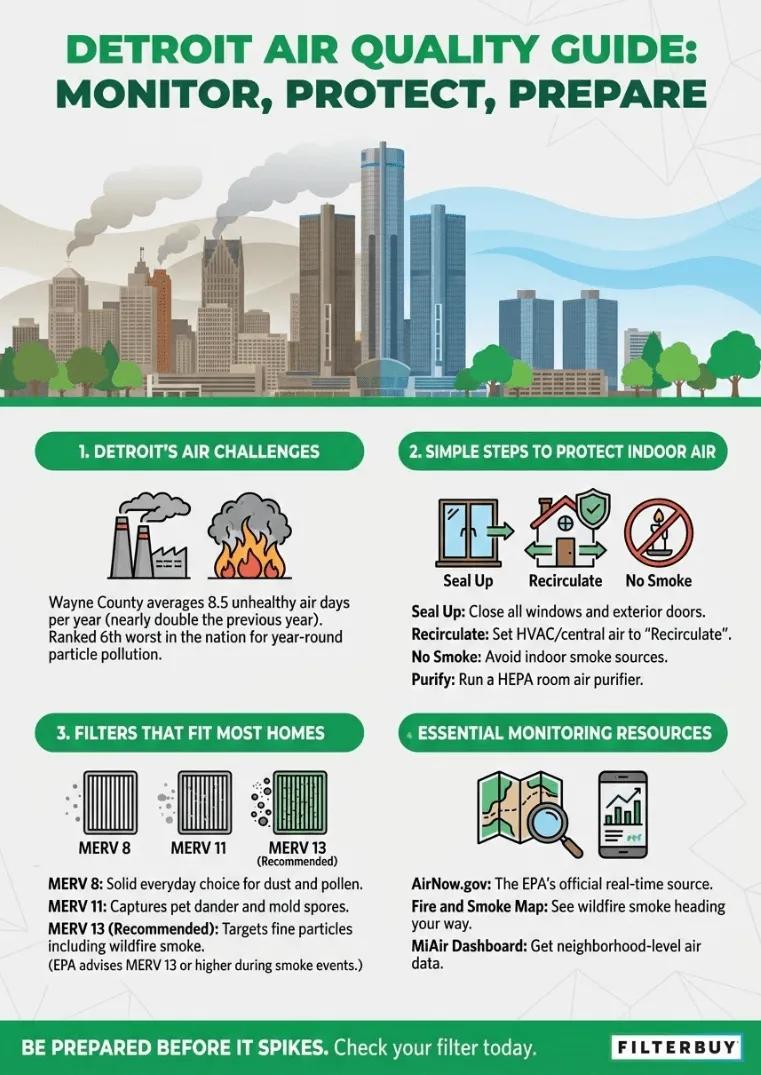
MERV 8 is a solid everyday choice for dust and larger pollen and helps keep the system cleaner.
MERV 11 captures more small particles such as pet dander and many mold spores, which suits homes with pets or mild allergies.
MERV 13 targets finer particles. The EPA advises using a filter that is MERV 13 or higher for wildfires and if your HVAC system can safely support it. If not, use the highest MERV your system allows and pair it with a HEPA room purifier.
All three options are available from Filterbuy.
It helps to have replacements on hand. Filterbuy offers top-quality filters that are made in the USA. Auto-delivery can keep changes on schedule during smoke season without last-minute store runs.
When outdoor air improves, wipe hard surfaces with a damp cloth or microfiber, vacuum rugs with a HEPA-type vacuum if available, and wash bedding and throws. Let the HVAC fan run with a clean filter for a few hours, then check the filter and replace if it looks loaded.
"During the September 2025 smoke event, we saw Detroit-area customers ordering MERV 13 filters at three times the normal rate overnight — that kind of surge tells you people aren't waiting for the next advisory to act, and neither should you."
Don't take your indoor air for granted — especially in metro Detroit, where Canadian wildfire smoke can push AQI readings from green to red in a matter of hours. After manufacturing millions of air filters and shipping them to homes across Michigan, we've seen firsthand how quickly demand spikes when smoke rolls in. The families who stay ahead of these events aren't guessing. They're checking the right sources, acting early, and making sure their filtration is already in place. These seven resources give you the real-time data, alert systems, and expert guidance to protect your household before the next bad-air day — not during it.
This is the EPA's official real-time AQI source and the tool we recommend to every customer who asks, "How bad is the air today?" It delivers hourly readings, color-coded maps, and forecast data for every Detroit-area monitor. We tell homeowners to treat this the same way you check the weather — make it a morning habit, because the AQI number tells you what your lungs can't see.
Source: AirNow.gov — Michigan
This joint EPA and U.S. Forest Service map layers active fire locations, smoke plume movement, and PM2.5 readings from both regulatory monitors and PurpleAir crowd-sourced sensors. Customers tell us the worst smoke events catch them off guard because the sky still looks clear. This map shows you what's coming before you can smell it — and that lead time is when smart families check their HVAC filter and close the windows.
Source: AirNow Fire and Smoke Map
Michigan EGLE's own air quality hub provides real-time and historical monitoring data with the kind of localized detail that national maps don't always capture. After years of shipping filters to every corner of metro Detroit, we know air quality varies block by block. Southwest Detroit reads differently from Grosse Pointe. This dashboard lets you check your specific neighborhood instead of relying on a city-wide average that may not reflect what you're actually breathing.
Source: MiAir — Michigan EGLE
The state's official wildfire smoke resource explains the difference between advisories and alerts, links to the free EnviroFlash text and email notification system, and connects you to the MDHHS environmental health hotline (800-648-6942) for direct health questions. We've watched Smoke Season grow more unpredictable year over year. Signing up for EnviroFlash takes two minutes and puts early warnings directly on your phone — giving you the time to seal up your home and switch HVAC to recirculate before conditions peak.
Source: Michigan EGLE — Wildfire Smoke Response
Detroit's municipal guidance breaks recommended actions down by AQI color tier and by population group, including children, pregnant people, older adults, and outdoor workers. It also lists local clean-air shelter locations and school outdoor-activity protocols. If you're a parent, an outdoor worker, or caring for aging family members in Detroit, this page gives you specific steps — not general advice — for the people you're responsible for protecting.
Source: City of Detroit — Air Quality Index Warnings
The EPA's comprehensive indoor protection guide covers setting HVAC to recirculate, upgrading to a MERV 13 filter, building a DIY box-fan air cleaner, and designating one "clean room" in your home. This is the resource we point to most often because it validates what we've been telling customers for years: your HVAC filter is your home's first line of defense during smoke events, and MERV 13 is the rating the EPA specifically recommends when wildfire particulates are in the air. A high-quality MERV 13 filter that fits properly can reduce indoor PM2.5 by up to 50 percent.
Source: EPA — Wildfires and Indoor Air Quality
EPA-tested designs show that a box fan paired with a MERV 13 filter panel can perform close to a commercial portable air cleaner at a fraction of the cost. During the September 2025 smoke event, we saw Detroit-area orders spike overnight — and we know not every family has a HEPA purifier ready to go. This page gives you step-by-step instructions and UL safety test results so you can build an effective backup with materials you may already have. Pair it with a properly fitted MERV 13 in your HVAC system, and you're giving your household two layers of protection instead of one.
Source: EPA — Research on DIY Air Cleaners to Reduce Wildfire Smoke Indoors
The American Lung Association's 2025 "State of the Air" report moved metro Detroit from 13th to 6th worst in the nation for year-round particle pollution. Wayne County now averages 8.5 unhealthy air days per year — nearly double the 4.8 days reported just one year earlier.
We started seeing the shift before the report dropped.
MERV 13 orders from Southeast Michigan climbed steadily through summer 2025.
By the August and September smoke events, customers weren't browsing — they were buying in bulk.
The families who fared best already had filters on the shelf.
The ones caught off guard paid for rushed shipping while breathing the worst of it.
That gap between prepared and reactive is exactly what we built our auto-delivery program to eliminate.
Source: American Lung Association — 2025 State of the Air, Detroit Metro Area
The EPA states that upgrading to a high-efficiency HVAC filter and running the system fan continuously may decrease indoor PM2.5 concentrations by approximately 50 percent during wildfire smoke events. Even a standard low-efficiency filter running nonstop can reduce particle levels by about 24%.
After manufacturing millions of filters across every MERV rating, we hear the same story from customers who finally make the switch. They describe waking up without the scratchy throat and dry cough they had been blaming on allergies for years.
The detail most homeowners miss — and the one we now print on our packaging inserts — is the thermostat setting.
"Auto" mode means the fan sits idle between heating and cooling cycles. During a smoke event, every idle minute lets particles accumulate.
"On" mode keeps air moving through the filter continuously. This turns your entire duct system into a whole-home air cleaner.
Your MERV 13 can only do its job if the fan actually runs.
Source: U.S. EPA — Preparing for Smoke and Heat
The EPA reports that during wildfire smoke events, indoor PM2.5 levels typically settle at 55 to 60 percent of outdoor concentrations — even with doors and windows sealed. In some homes, indoor air reaches 100 percent of outdoor levels without active filtration.
This is the misconception we spend the most time correcting with first-time buyers. They call, expecting a closed-up house means clean air. It doesn't. Smoke infiltrates through every crack, vent gap, and degraded weatherstrip seal.
Closing the house is step one — necessary, but nowhere near sufficient. The families who actually close the gap between outdoor hazards and indoor safety stack three layers of protection:
Seal up. Close all windows, exterior doors, and fireplace dampers.
Run HVAC on recirculate with a MERV 13 that fits snugly — no air bypass around the edges.
Place a HEPA room purifier in the bedroom where your family spends eight hours breathing.
One layer gets you to roughly a 50 percent reduction. Three layers working together is how you get your family close to clean.
Source: U.S. EPA — Strategies to Reduce Exposure Indoors
After manufacturing millions of air filters and shipping them to homes across every Michigan zip code, we've watched the same cycle repeat every smoke season.
The AQI map turns orange. Local news runs the advisory. Our phone lines light up with the same question: "What filter do I need and how fast can you get it here?"
By then, they're already behind.
The families who come through smoke events breathing the cleanest indoor air aren't the ones who react fastest. They're the ones who prepared weeks earlier.
They checked their MERV rating in May.
They set up auto-delivery so a fresh filter arrived before fire season.
They already knew where the thermostat fan switch was and why "On" beats "Auto" when the air turns bad.
The AQI map is a decision-making tool, not a panic button. Use it the way you use a weather forecast — to plan, not just to react.
Indoor air protection is not a single action. It's a system. Closing windows, running HVAC on recirculate with a properly fitted MERV 13, and adding a HEPA purifier in the bedroom — those three layers together separate a home that feels clean from one that actually is.
Detroit's air quality challenge is not going away. The American Lung Association didn't move this metro area to the 6th worst in the nation by accident. Canadian wildfire smoke, ground-level ozone, and local industrial emissions are converging in ways that make bad-air days more frequent and less predictable.
The cheapest time to prepare is right now. Every smoke event has taught us the same lesson — filters sell out, shipping slows down, and the families left scrambling assumed last year's air wouldn't get worse. It did. The data says next year likely will too.
We've seen both sides of preparation during every smoke event.
The prepared family swapped in a MERV 13 two weeks before the September 2025 smoke event. Their kids slept through the night for the first time that week.
The unprepared family called during the same event, coughing on the phone, asking us to overnight a filter because theirs hadn't been changed in seven months.
Both families had the same outdoor AQI that day. They didn't have the same indoor air.
That difference — between checking the map and actually being ready for what it shows you — is the entire reason we do what we do.
Check the AQI today. Then make sure your home is ready for tomorrow.
You've seen the data. You understand the risk. Here's exactly how to act on it.
Step 1: Bookmark Your Three Go-To AQI Sources
Check these the way you check the weather every morning.
AirNow.gov — Detroit's official real-time AQI reading.
AirNow Fire and Smoke Map — wildfire smoke plume tracking for Southeast Michigan.
MiAir Dashboard — neighborhood-level readings across metro Detroit.
Step 2: Sign Up for Free Air Quality Alerts
Don't rely on checking manually. Let the warnings come to you.
Register for EnviroFlash text or email alerts for your Detroit zip code.
Save the MDHHS health hotline: 800-648-6942.
Two minutes now gives you an early warning before conditions peak.
Step 3: Check Your Current HVAC Filter Right Now
Pull the filter out and look at it.
Dark gray or brown? Replace it immediately. A loaded filter restricts airflow and lets particles bypass.
MERV rating below 13? Plan your upgrade. The EPA recommends MERV 13 for wildfire smoke. Most newer systems handle it safely.
Not sure what your system supports? Check the owner's manual or ask an HVAC technician before the next event — not during it.
Step 4: Set Up Your Home's Three Layers of Protection
One layer helps. Three layers together are how you get close to clean.
Seal the envelope. Close all windows, exterior doors, and fireplace dampers during elevated AQI hours.
Optimize your HVAC. Set to recirculate. Switch the thermostat fan from "Auto" to "On." Install a MERV 13 that fits snugly with no air gaps.
Add a room purifier. Place a HEPA unit in the bedroom or main living space. Keep the door closed to maintain your clean room.
Step 5: Designate Your Clean Room Before You Need It
Pick one room — ideally a bedroom with an attached bathroom.
Close and seal the door.
Run the HEPA purifier on its highest setting.
Keep windows and vents shut.
Stock it with water, medications, phone chargers, and essentials.
Having this room ready before an event means you don't waste the first hour of bad air figuring out logistics.
Step 6: Stock Replacement Filters So You're Never Caught Without One
Heavy smoke can load a MERV 13 in as little as 30 days. During back-to-back events like August and September 2025, one filter may not last the season.
Keep at least one spare on hand at all times.
Set up Filterbuy auto-delivery, so replacements arrive on schedule — made in the USA, shipped free.
Check weekly during active smoke events. Dark media or reduced airflow means swap it now.
Step 7: Follow Your After-Smoke Cleanup Checklist
Once the AQI drops back to green, don't skip recovery.
Open windows briefly to flush stale air once outdoor conditions improve.
Wipe all hard surfaces with a damp cloth or microfiber.
Vacuum rugs and upholstery with a HEPA-type vacuum.
Wash bedding, throws, and exposed fabrics.
Run the HVAC fan with a clean filter for a few hours to cycle remaining particles out.
Inspect your filter. Replace if visibly loaded.
Preparation time is measured in weeks. Response time is measured in hours. Use the weeks wisely.
Check the AQI map today. Verify your filter is ready. Make sure every layer of protection is in place before Detroit's next bad-air day arrives — because the data tells us it's coming.
Most likely, a wind shift brought wildfire smoke aloft into Southeast Michigan, or afternoon sun boosted ground-level ozone. These drivers can raise AQI quickly — even when skies look hazy but not smoky.
Limit harder outdoor activity when AQI reaches orange or higher if you are:
A child or older adult
Pregnant
Living with asthma, COPD, or heart disease
Working outdoors or training as an endurance athlete
Pace effort and take frequent breaks regardless of fitness level.
Four actions in order of priority:
Close windows and exterior doors.
Set HVAC to recirculate mode.
Avoid indoor smoke sources — no candles, wood fires, or aerosol sprays.
Run a HEPA room purifier in the bedroom or main living space.
After conditions improve, wipe surfaces and swap in a fresh HVAC filter if it's visibly loaded.
No. Most home HVAC systems are not designed for true HEPA.
Use the highest MERV your system safely supports — often MERV 8 to 13.
Pair the HVAC filter with a separate HEPA room purifier if you need extra protection.
This two-layer approach gives you whole-home baseline filtration plus targeted clean air where you sleep.
That headline reflects real-time rankings during short smoke events. It does not mean Detroit's year-round average is always that poor. What it signals:
A temporary spike driven by wildfire smoke or atmospheric conditions.
People should adjust outdoor plans while the episode lasts.
Conditions typically improve once wind patterns shift.
Air quality can vary block by block due to:
Traffic corridor proximity
Active construction sites
Localized wind patterns
Check the map for your exact location and a few nearby spots before planning your day.
At minimum, check three times daily:
Morning — before outdoor plans or commuting.
Midday — when ozone tends to peak on hot days.
Evening — before any outdoor activity after work.
Recheck anytime the weather changes, the wind shifts, or you smell smoke.
Most healthy adults: Light activity like walking is usually fine.
Sensitive groups: Move harder workouts indoors or reschedule for a cleaner hour.
Everyone: Shorten sessions, take more breaks, and move inside immediately if you notice coughing, chest tightness, or shortness of breath.
N95 or KN95 (well-fitting): Yes. Significantly reduces fine particle inhalation outdoors.
Cloth or surgical masks: No. Not designed to filter fine smoke particles.
Fit matters as much as rating. A loose N95 performs like no mask at all.
Yes.
Set it to recirculate with windows closed.
Avoid idling in heavy traffic when possible.
Choose routes away from congested corridors if AQI is elevated.
MERV 11 — a common step up for homes with pets or mild allergies. Captures pet dander and most mold spores.
MERV 13 — captures smaller particles often found in smoke. Best choice if your system supports it and you deal with seasonal allergies or live near high-traffic corridors.
Check your owner's manual or ask an HVAC technician to confirm the highest MERV your system can safely handle.
During elevated AQI: Run on a higher setting continuously.
After conditions improve, switch to auto or a lower setting to maintain air quality.
Key rule: Keep doors and windows closed in that room for the best results. An open door undermines everything the purifier is doing.
No, not in any meaningful way during active smoke.
Houseplants are fine to have, but they do not replace filtration. For real reduction during a smoke event, you need:
A properly rated HVAC filter (MERV 13 if your system supports it).
A HEPA room purifier in your primary living or sleeping space.
Fine particles can be present in dangerous concentrations even when the sky looks normal. PM2.5 is invisible to the naked eye.
Trust the AQI reading and the hourly forecast.
Do not rely on what you see or smell.
Haze-free skies during a smoke event often mean the particles are smaller — and smaller particles penetrate deeper into the lungs.
Follow this cleanup sequence once outdoor AQI returns to green:
Open windows briefly to flush stale indoor air.
Wipe hard surfaces with a damp cloth or microfiber.
Vacuum rugs and upholstery with a HEPA-type vacuum.
Wash bedding, throws, and any exposed fabrics.
Run the HVAC fan with a clean filter for a few hours.
Inspect your filter — replace immediately if visibly loaded.
Check your HVAC filter today and upgrade to a MERV 13 before the next bad-air day hits metro Detroit. Filterbuy makes it easy with American-made filters in every size, free shipping, and auto-delivery so you're never caught off guard when the map turns orange.
