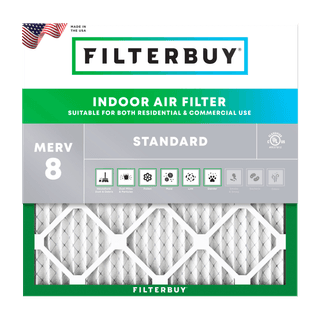
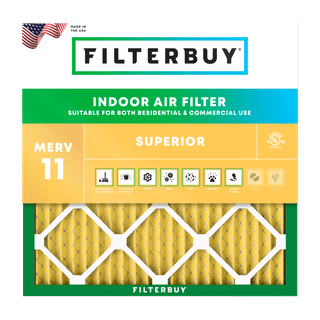
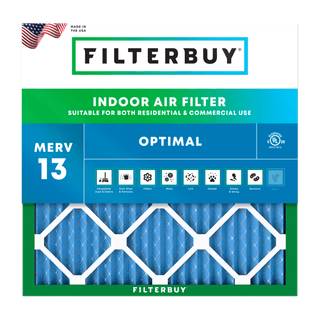
When air quality in your area reaches unhealthy levels, we'll send you a quick alert, along with expert tips on how to reduce your exposure.
The Air Quality Index (AQI) measures how polluted the air is and how it may affect your health.
0–50 (Good): Air quality is satisfactory.
51–100 (Moderate): Acceptable, but some pollutants may pose minor concerns.
101–150 (Unhealthy for Sensitive Groups)
151–200 (Unhealthy)
201–300 (Very Unhealthy)
301+ (Hazardous)
Still okay for most, but if you have asthma or allergies, take it easy and avoid long outdoor workouts.
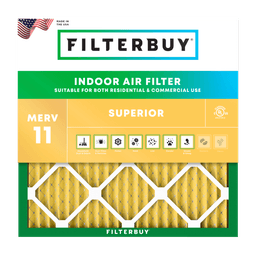
Shop MERV 11 filters→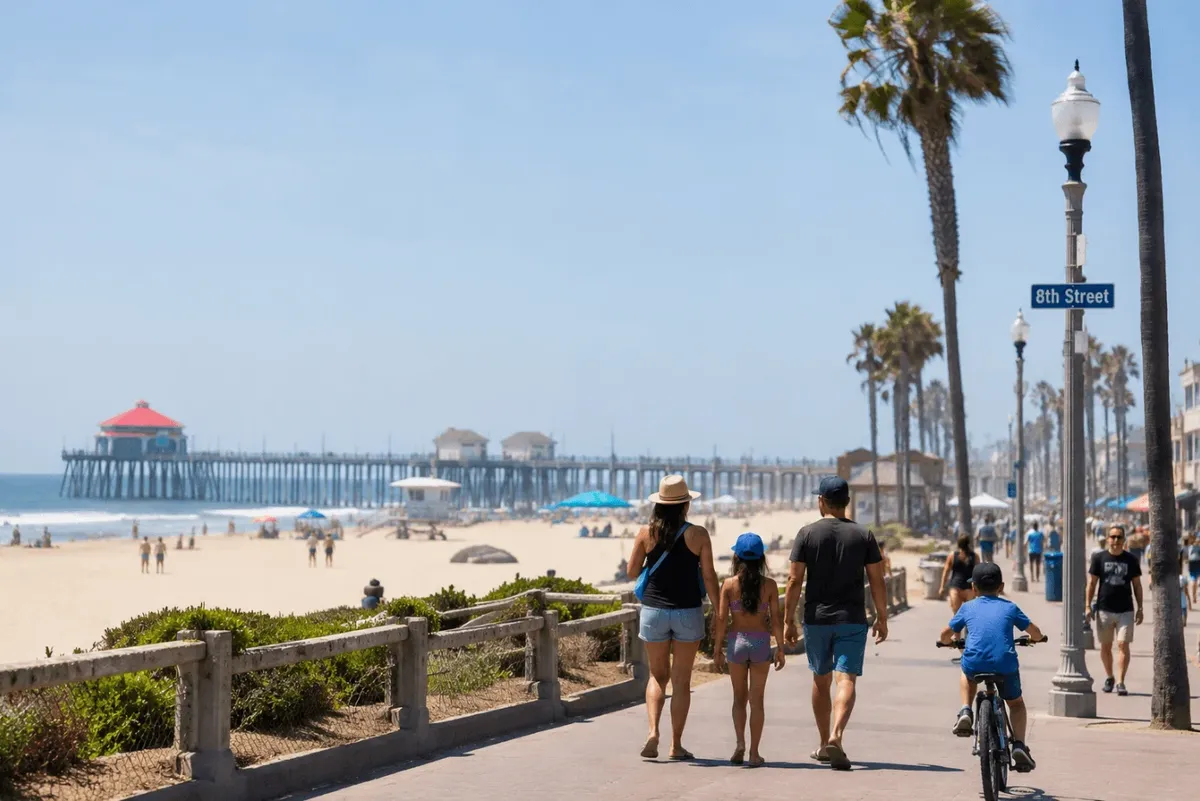
By Michelle Wan · Reviewed by David Clark, Licensed HVAC Technician · Published July 21, 2026 · Updated July 21, 2026
Huntington Beach's live air quality index (AQI) is {{current_aqi}} ({{aqi_category}}) right now, based on EPA AirNow and South Coast AQMD monitors. Coastal Orange County usually enjoys clean ocean air, but summer ozone and wildfire-season PM2.5 can push the number higher. Check the live map above, then use the AQI-to-filter table below to protect the air inside your home.
Huntington Beach's current AQI is {{current_aqi}}, updated in real time from EPA AirNow and South Coast AQMD data.
An AQI of 0–50 (green) is good, 51–100 (yellow) is moderate, and anything 101 or higher is unhealthy for sensitive groups or worse.
Ground-level ozone is Huntington Beach's biggest warm-season pollutant; wildfire smoke is the main source of PM2.5 spikes.
The EPA reports indoor air can be 2–5 times more polluted than outdoor air, so a rising outdoor AQI usually means acting indoors too.
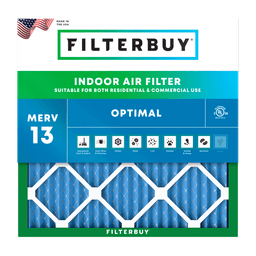
A MERV 13 HVAC filter captures fine PM2.5 and wildfire-smoke particles; a MERV 11 handles everyday pollen and dust.
Huntington Beach's current air quality index is shown live on the map above, updated hour by hour from EPA AirNow and South Coast Air Quality Management District (South Coast AQMD) monitors. The AQI is a 0–500 scale: the lower the number and the greener the color, the cleaner the air. Tap your neighborhood on the map to see the reading closest to you.
The map reflects outdoor conditions across the 92646, 92647, 92648, and 92649 ZIP codes. Because Huntington Beach sits on the Orange County coast, an onshore ocean breeze often keeps its air cleaner than inland cities like Anaheim, but conditions can change within hours when ozone builds or wildfire smoke drifts in.
The AQI uses six color-coded categories set by the U.S. Environmental Protection Agency (EPA). Each band tells you how clean the air is and who should take precautions. Match today's live color on the map above to the row below.
Source: U.S. EPA AirNow, AQI Basics.
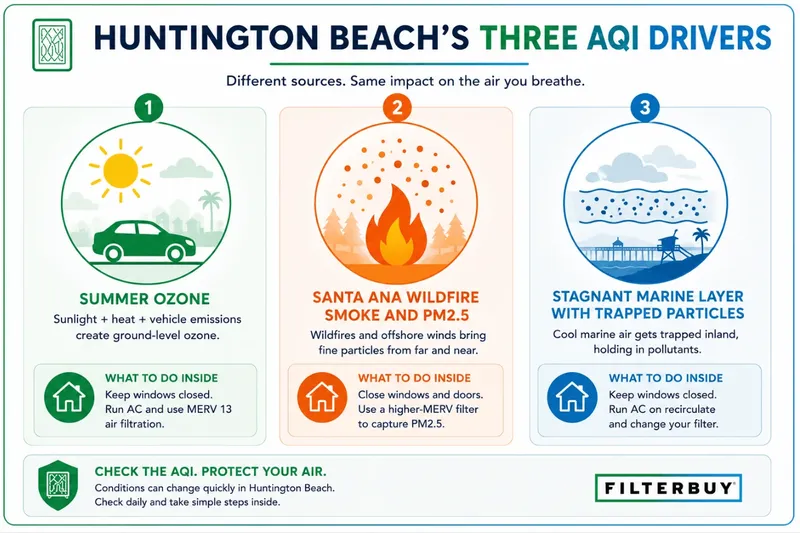
Living near the ocean gives Huntington Beach a real edge: the onshore breeze pushes most pollution inland, which is why the city usually reads cleaner than Anaheim or the Inland Empire. Coastal air is not always clean air, though. After years of fielding the calls Huntington Beach homeowners make to Filterbuy about their indoor air, we see the same three patterns push the local AQI up, and each one calls for a different move inside.
Sunlight cooks vehicle and industrial emissions into ground-level ozone, worst on hot, windless afternoons from late spring through early fall. You may notice a hazy sky and a smoggy feeling as the AQI climbs into yellow or orange. Kids, older adults, and anyone with asthma or a heart condition feel it first, so close the windows in the afternoon, run the HVAC fan, and move workouts to the cooler morning.
When hot, dry Santa Ana winds blow during fire season, they can carry smoke from fires miles away toward the coast, sometimes overnight. Expect a campfire smell, orange-tinted light, and an AQI spiking into red or worse. Seal up, switch the system to recirculate, skip anything that adds indoor smoke, and run a MERV 13 filter continuously. This is the one pattern where the filter you install before fire season matters most.
On calm mornings, the marine layer and a temperature inversion can act like a lid, holding traffic particles and coarse PM10 dust near the ground until the sea breeze picks up. The air looks gray and heavy early, then usually clears by midday with a small AQI bump. Keep windows closed until it lifts and run the fan; it eases once the onshore breeze returns.
The pattern worth remembering: Huntington Beach's outdoor air is good most of the time, so the risk is event-driven, not constant. The city sits in the South Coast Air Basin, one of the most closely monitored air regions in the country, regulated by South Coast AQMD. California also sets stricter ozone and nitrogen-dioxide limits than the federal government, so knowing which of these three patterns is happening tells you exactly what to do inside.
A rising outdoor AQI rarely stays outside. The EPA reports that indoor air can be two to five times more polluted than outdoor air, because outdoor particles infiltrate through windows, doors, and your HVAC system, then mix with indoor sources like cooking and dust. When Huntington Beach's map turns orange or red, your indoor air usually needs attention too.
Your home's first line of defense is the HVAC filter. Running your system's fan pulls household air through that filter again and again, capturing particles before they reach your lungs. The higher the filter's MERV rating, within what your system is built to handle, the more fine particles it removes.
Most air quality pages hand you a number and stop. Filterbuy cannot, because building the thing that cleans your air is what we actually do. For more than a decade we have manufactured HVAC filters in our own U.S. facilities and shipped millions of them to families' doors. That vantage point changes how we read an AQI map: we do not just see today's reading, we see what it is about to do to the air inside your home, and which filter is built to stop it. Every outdoor number on this page connects to an indoor action, because the AQI you cannot control outside is only as dangerous as the filter you can control inside.
People check the outdoor AQI, then walk inside and forget the air followed them in. A live map is only useful if it changes what you do at home, which is why every reading on this page points you to a filter, not just a color.
Michelle Wan, Brand Manager, Filterbuy
Use this table to turn today's live number into a specific indoor action. It pairs each AQI category with what to do inside and the filter that matches the threat: Filterbuy's practical guidance for local homeowners, reviewed by a licensed HVAC technician.
Filterbuy guidance for Huntington Beach homeowners, reviewed by a licensed HVAC technician.
Check today's reading on the map, then find your exact filter size. Filterbuy makes 600+ sizes in the USA, shipped factory-direct, with optional auto-delivery so you never miss a change.
Summer and fire season are the two windows to watch. Ozone peaks on hot afternoons from June through September, and PM2.5 spikes whenever wildfire smoke rides a Santa Ana wind, most often in fall. Winter and spring are usually the cleanest. Check the live map above before outdoor plans on hot summer afternoons and smoky fall days.
The advice on this page is not guesswork. Here is what the EPA and the American Lung Association actually found.
1. You breathe more indoor air than outdoor air, and it is often dirtier.
Americans spend about 90% of their time indoors.
Indoors, some pollutants run 2 to 5 times higher than outside.
Takeaway: today's outdoor AQI is only half your story. Your filter handles the other half.
2. The most dangerous particles are small enough to reach your bloodstream.
PM2.5 is about 30 times smaller than a human hair.
It slips deep into the lungs, and some particles reach the bloodstream.
The EPA flags PM2.5 as the pollutant posing the greatest risk to health.
Takeaway: that is why we recommend a MERV 13 filter, built to catch particles this small.
3. Our region knows ozone better than almost anywhere.
Los Angeles-Long Beach, which includes Orange County and Huntington Beach, has ranked the nation's most ozone-polluted area in 26 of 27 years tracked.
Nationwide, 44% of Americans (152.3 million people) live where the air earns a failing grade.
Takeaway: ozone really is Huntington Beach's warm-season concern, and the data proves it.
Check the live map at the top of this page for the current reading. Green or yellow (AQI 0–100) means good-to-moderate air. Orange or higher (101+) means sensitive groups should limit outdoor time and run a MERV 13 filter indoors.
The current AQI is {{current_aqi}}, shown live on the map above and refreshed hourly from EPA AirNow and South Coast AQMD monitors.
Today's live PM2.5 reading appears on the interactive map above. Tap your neighborhood for the closest monitor. PM2.5 is Huntington Beach's most common fine-particle pollutant and the one a MERV 13 filter targets.
Its coastal location brings a near-constant ocean breeze that disperses pollutants, so it often reads cleaner than inland Orange County and the Inland Empire. Compare it with nearby Anaheim or the rest of California, though summer ozone and wildfire smoke can still push numbers up.
Yes. A properly rated HVAC filter captures outdoor particles that infiltrate your home. A MERV 13 filter removes fine PM2.5 and wildfire-smoke particles; run your system's fan to keep filtering during high-AQI days. Not sure which rating fits your system? See which MERV rating you need.
Checking today's AQI is a great start, but it is only half the picture. These are the seven resources we would point our own neighbors to.
AirNow.gov is where the EPA posts live readings, multi-day forecasts, and fire-and-smoke maps for all of Orange County. It is a smart first stop before a morning run or a beach day.
Big national maps show a dot or two for a whole county. South Coast AQMD pulls from more than 1,200 monitors and sensors, so you get a reading for your actual neighborhood.
IQAir pairs live AQI and PM2.5 with historical trends and a 3-to-7-day forecast for Huntington Beach, so you can tell when today is running higher than usual.
The EPA's AQI Basics guide runs from green (Good, 0–50) to maroon (Hazardous, 301+), and each color is a plain-English cue for who should take it easy outdoors.
CARB sets California's air rules, tougher than the federal ones for ozone and nitrogen dioxide, and tracks smoke across the state. It is the why behind the numbers.
The American Lung Association grades Orange County every year on ozone and particle pollution and points out who is most at risk, an honest big-picture look beyond any single day.
Most tools skip what today's number means indoors. Filterbuy's live AQI map connects the outdoor reading to the right MERV-rated filter for the moment, something we have gotten good at after building filters in the USA for over a decade.
Author: Michelle Wan is Filterbuy's Brand Manager and Air Quality Writer. She translates indoor air quality (MERV ratings, filtration, HVAC efficiency) into plain-English advice for homeowners, working directly with Filterbuy's U.S. manufacturing team across its Alabama, Florida, Pennsylvania, and Utah factories.
Reviewer: David Clark is a Licensed HVAC Technician with Filterbuy HVAC Solutions who reviewed this page for technical accuracy on HVAC systems, MERV ratings, airflow, and filter compatibility.
Sources: U.S. EPA AirNow: AQI Basics (AQI scale and health categories); South Coast AQMD (local monitoring for the South Coast Air Basin); U.S. EPA: Indoor Air Quality (indoor vs. outdoor pollutant levels); U.S. EPA: What is a MERV rating? (filter efficiency, per ANSI/ASHRAE Standard 52.2).
About Filterbuy: Filterbuy is a family-owned American manufacturer that has made air filters in the USA since 2013, with factories in Alabama, Florida, Pennsylvania, and Utah, offering 600+ standard sizes plus custom filters shipped factory-direct. Last updated July 19, 2026.
Air Quality Index (AQI): A 0–500 scale from the U.S. EPA that reports how clean or polluted outdoor air is, and the associated health risk. See AirNow's AQI Basics.
PM2.5: Fine particulate matter 2.5 microns or smaller, about 30× thinner than a human hair, small enough to reach deep into the lungs.
PM10: Coarse particulate matter up to 10 microns, including road dust, construction debris, and coastal salt spray.
Ozone (O₃): A reactive gas formed when sunlight reacts with vehicle and industrial emissions; Huntington Beach's main warm-season pollutant.
MERV rating: Minimum Efficiency Reporting Value (1–16) measuring how effectively an air filter captures particles; higher numbers trap smaller particles. See the EPA's MERV guidance or Filterbuy's MERV rating chart.
AirNow: AirNow is the U.S. EPA's official real-time air quality reporting service.
South Coast AQMD: The South Coast Air Quality Management District, the agency that monitors and regulates air quality across the South Coast Air Basin, including Huntington Beach.
Sensitive groups: Children, older adults, and people with asthma, heart, or lung conditions, who feel air-pollution effects sooner.