Shop by

Actual Size: 13.50x17.50x0.75"
 Free Delivery
  Factory-Direct Low Prices, Made in the USA
 Hassle-Free Returns & Free Exchanges
RESIDENTIAL AND/OR COMMERCIAL USE
Change Every 3 Months
Actual Size: 13.50x17.50x0.75"
Free Delivery Factory-Direct Low Prices, Made in the USAHassle-Free Returns & Free ExchangesRESIDENTIAL AND/OR COMMERCIAL USE
Change Every 3 Months
Actual Size: 13.50x17.50x0.75"
Free Delivery Factory-Direct Low Prices, Made in the USAHassle-Free Returns & Free ExchangesRESIDENTIAL AND/OR COMMERCIAL USE
Change Every 3 Months
At Filterbuy, we don't cut corners—we craft high-quality air filters right here in the USA and ship them to your doorstep for free. No delays, no gimmicks—just clean air, made easy. With thousands of five-star reviews and filters built for real life & every HVAC system, it's no wonder why over 4 million families trust Filterbuy.

Proudly Made In The USA

Fast, Free Shipping on Every Order

Premium Materials That Go The Distance

85,000+ 5-Star Reviews From Happy Customers

Save Up to 70% Per Filter with Packs


Measure length × width × depth with a tape measure to find the actual size.

Round up each dimension to the nearest whole number to get the nominal size. Example: 13.50x17.50x0.75" in → 14x18x1 nominal.

Search by nominal size on our site for the best fit.


If the filter you buy doesn't fit, we'll send you a better size.
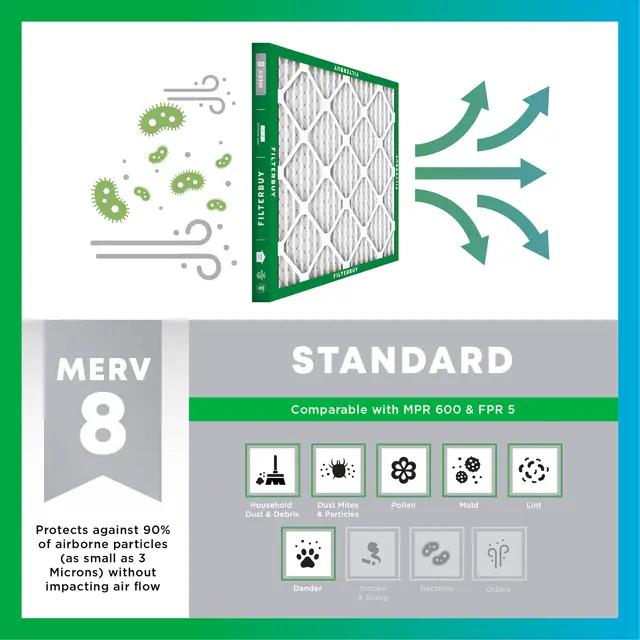
MERV stands for Minimum Efficiency Reporting Value—but don't let the technical name fool you. It's just a way to rate how well an air filter traps stuff like dust, pollen, pet dander, and smoke. The higher the MERV number, the more particles it catches—and the cleaner your air will be.

Comparable to:FPR: 4-7
MPR: 600-1000
 Dust & Debris
 Dust Mites & Particles
 Pollen
 Mold
Mold Lint
Lint Dander
Comparable to:FPR: 6-9
MPR: 1200-1550
Dust & DebrisDust Mites & ParticlesPollenMoldLintDander Smoke & Smog
Comparable to:FPR: 10
MPR: 1900-2800
Dust & DebrisDust Mites & ParticlesPollenMoldLintDanderSmoke & Smog Bacteria
Comparable to:FPR: 10
MPR: 1900-2800
Dust & DebrisDust Mites & ParticlesPollenMoldLintDanderSmoke & Smog Odors
Odors


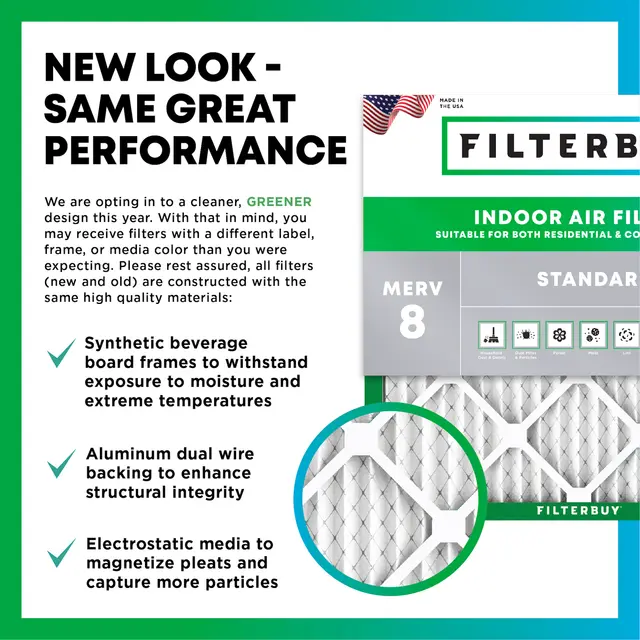
We build every Filterbuy filter to deliver reliable 90-day performance—thanks to smart design and premium materials that do the heavy lifting. Here's what makes the difference:
More pleats = more surface area to capture dust and debris, keeping your air cleaner longer.
Pleats are magnetized to attract and trap microscopic particles—like pet dander, pollen, and smoke.
Engineered to resist warping in extreme temperatures and high humidity.

A layer of metal reinforcement keeps pleats evenly spaced and structurally sound—no sagging, even at high airflow.
Assembled with care. Built to perform. Ships fast, free, and reliably from our U.S. facilities.

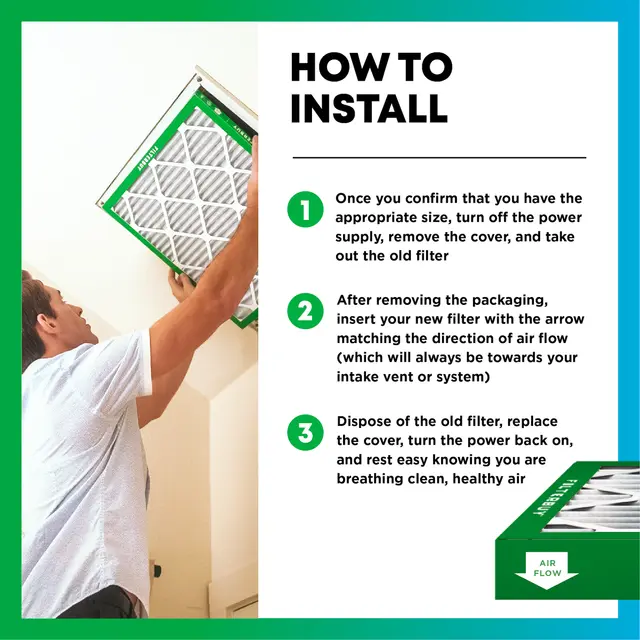
Turn Off Your HVAC SystemSafety first.

Remove The Old FilterLook for the airflow arrow and make note of the direction.

Slide In Your New FilterArrow should point toward the system (same direction as before).

Turn Your System Back OnAnd enjoy the fresh, clean air.

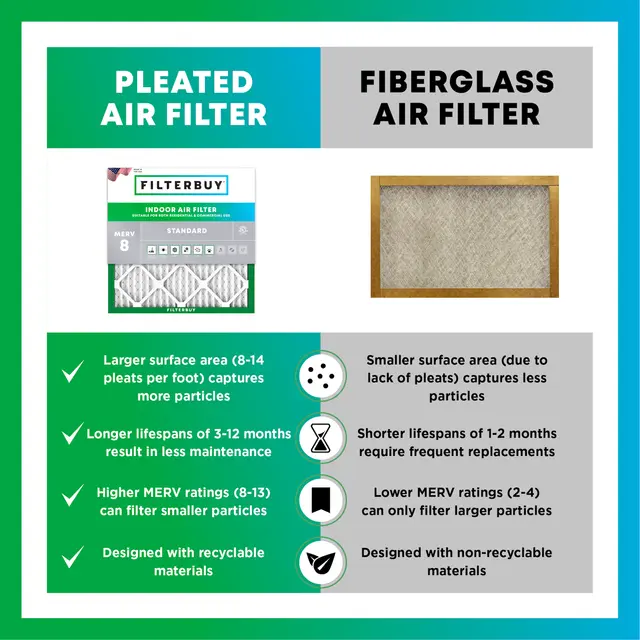
Not all air filters are created equal. Pleated filters don't just last longer—they actually clean your air better. Here's how they stack up:

Efficiency:
High (MERV 8–13) – Traps more particles
Lifespan:
90 days – Long-lasting performance
Air Quality:
Excellent – Cleaner, healthier air
Materials:
Recyclable and durable

Efficiency:
Low (MERV 4 or less) – Misses small stuff
Lifespan:
30 days or less – Replace often
Air Quality:
Minimal – Basic protection only
Materials:
Thin, flimsy, and not recyclable
Pleated filters are a no-brainer—more protection, less hassle, and better air for your home.
Changing your filter on time keeps your HVAC system running efficiently—and helps protect your lungs from dust, allergens, and airborne irritants. Here's how often to swap it out based on your needs:

For most homes without pets or special air quality concerns. Great for general upkeep and energy efficiency.

Shedding fur, dander, and allergy triggers can build up fast. Changing your filter every two months helps keep the air fresher and symptoms at bay.

For households affected by smoke, pollution, or respiratory conditions, monthly changes ensure maximum protection.

| Nominal Size | 14 x 18 x 1 inches |
| Actual Size | 13.50 x 17.50 x 0.75" inches |
| Filter Type | Pleated |
| Media | Electrostatically Charged |
| Frame | Beverage Board |
| MERV Ratings Available | 8, 11, 13, Carbon |
| Lifespan | Up to 90 Days |
| Origin | Made in USA |
Clean air isn’t one-size-fits-all—especially when it comes to your HVAC system. That’s why our 14x18x1 MERV 8 filters are engineered in the U.S. with the same care we’ve put into millions of filters shipped directly to families nationwide. After more than a decade of manufacturing, we’ve seen how the right filter size and quality can make the difference between an efficient system and one that struggles with dust, allergens, and high energy bills. With factory-direct pricing, custom sizing, and free fast shipping, Filterbuy gives you more than just a filter—we give you peace of mind that your home’s air is truly protected.
MERV 8 = Best Balance – Traps dust, pollen, mold, and dander while keeping airflow strong.
14×18×1 Size – Standard fit, easy install, no air leaks.
Replace on Time – Every 90 days (30–60 with pets/allergies).
Avoid Overkill – High-MERV can strain systems; MERV 8 protects without drawbacks.
Hassle-Free with Filterbuy – U.S.–made, factory-direct, fast, free shipping.
Most people living in houses, around eight out of ten, have no clue about MERV 8 air filters in their HVAC systems. Are MERV ratings confusing to you? To put it simply, we are here to help.
MERV is short for Minimum Efficiency Reporting Value, a rating system that shows how efficient an air filter is in capturing particles of various sizes. Ratings go from 1 to 20, where 20 means that the filter is most efficient. The higher the MERV rating, the better the filter will be in removing smaller particles, hence cleaner air in the house.
If you still wonder why we should talk about MERV 8 filters, the answer would be that these filters are good at catching particles whose size is 3 microns or less. They can capture dust, pollen, mold, and at least some bacteria types. Don't you agree that it's great?
There are filters with higher MERV ratings, but MERV 8 is a good compromise. This filter dramatically reduces the presence of the most common pollutants in the air, thus maintaining good indoor air quality, and at the same time, without putting too much pressure on your HVAC system. So, next time you are shopping for a new filter, make sure that it is MERV 8.
Opting for 14x18x1 dimensions in an HVAC filter brings notable benefits for your home environment.
Most standard HVAC systems accommodate these dimensions effortlessly, reducing the likelihood of air bypassing the filter along with any contaminants. Cleaner air results, sparing your system from unnecessary strain.
Trapping significant amounts of dust, pollen, and other pollutants is another advantage of these filters. Despite their substantial size, they maintain optimal airflow, ensuring smooth system operation.
A final benefit of the 14x18x1 size is its manageability. Installation and replacement prove straightforward. As this size is common, sourcing replacements poses no difficulty.
Filterbuy.com emerges as your go-to option for HVAC and furnace filters amid a multitude of choices. They stock a variety of filter types, catering to your unique requirements. Be it enhanced air quality or extended HVAC system lifespan, Filterbuy.com provides the answer.
Dedicated to offering superior filters, Filterbuy.com helps upgrade your home's air quality. Their stock features a range of MERV ratings, each capable of trapping different particles. Filters that can capture dust mites, mold spores, pollen, and pet dander are available, reinforcing their commitment to your health and comfort.
Shopping at Filterbuy.com is simple. They have streamlined the process, making it easy for you to find the ideal filter. Excellent customer service stands by to guide you through your purchase, ensuring you make a smart choice.
Installing a new HVAC or furnace filter from Filterbuy.com? Let this guide assist you in the process, ensuring you circumvent common installation blunders.
Start by verifying the size of your filter. Should the filter be undersized, it won't secure sufficiently; oversized, it won't fit. For safety, switch off your HVAC system next, a step that helps prevent dust or debris from entering the system during setup.
Proceed to extract the pre-existing filter, usually found in an indoor unit slot. Handle gently to avoid inflicting damage on adjacent areas. Pay attention to the airflow arrow on the removed filter; your new filter ought to align similarly.
Insert the fresh filter, checking its snug fit and correct airflow arrow direction. With this done, reactivate your HVAC system.
With your filter installed securely, focus shifts to maintaining its prime performance. Preserving an air filter's operational efficiency not only guarantees cleaner air but also extends the device's lifespan.
Regular inspections of your filter are imperative. Should you find it clogged or unclean, immediate replacement is necessary. Avoid procrastination, as this can put undue pressure on your HVAC system. Typically, filters need replacement every three months. However, in homes with pets or allergy sufferers, monthly change-outs might be more suitable.
Bear in mind, filters differ in their capabilities. A filter with a high MERV rating can trap smaller, numerous particles. This is beneficial for air quality but might necessitate more frequent replacements. Select a filter and establish a replacement schedule considering your home's unique requirements.
Ensuring a spare filter is always available is a good practice. Unexpected situations might necessitate an immediate filter change. Being prepared for such instances is always beneficial.
“After more than a decade of working with homeowners and HVAC systems, I’ve found that the smartest choice isn’t always the highest MERV rating or the most expensive filter. For most homes, a well-made MERV 8–11 filter provides the right balance—strong enough to trap everyday dust, pollen, and dander, but gentle enough to keep airflow efficient and energy bills low. We’ve seen firsthand how sticking to the right filter and a consistent replacement schedule saves money, extends equipment life, and makes the air in your home noticeably cleaner.”
— Filterbuy Air Quality Team
Clean air and HVAC efficiency aren’t guesses—we’ve seen the proof in millions of filters shipped, and the research confirms it.
EPA: “Many home HVAC systems will have a MERV-8 filter installed as the default.”
Why it matters: Our 14×18×1 MERV 8 filters hit the sweet spot—trusted nationwide and effective for dust, pollen, and dander.
Our take: After a decade of manufacturing, we’ve found MERV 8 is the right balance for most homes. (EPA)
ENERGY STAR: Nearly 50% of home energy use goes to heating and cooling.
Replacing filters on time = lower bills and fewer repairs.
What we see: Customers report noticeable savings after staying on a filter change schedule. (ENERGY STAR)
DOE study: High-MERV filters (MERV 16) can raise energy use by 5%+ in residential systems.
Problem: Over-filtration strains systems.
Our insight: MERV 8 captures the most common pollutants while maintaining airflow. (Lawrence Berkeley National Lab)
MERV 8 = trusted by experts and proven by our customers.
Regular replacements = healthier air and lower bills.
Smart balance = protection without HVAC strain.
With Filterbuy, you’re not just buying a filter—you’re choosing a solution backed by research and real-world results.
Choosing the right filter isn’t about guessing—it’s about balance. Research and our own manufacturing experience agree: MERV 8 is the sweet spot for most homes.
Backed by EPA and ENERGY STAR research.
Captures dust, pollen, mold, and dander.
Keeps HVAC systems running efficiently.
Prevents wasted energy and costly repairs.
Delayed filter changes = higher bills and early breakdowns.
Over-filtration (very high MERV) = restricted airflow and wasted energy.
Consistent replacements with MERV 8 = healthier air and longer system life.
Clean air doesn’t need to be complicated.
The best choice isn’t the highest number—it’s the right balance.
For most households, that’s a Filterbuy 14×18×1 MERV 8 filter: reliable, affordable, and built in the U.S. to last.
Confirm Your Size
Look for “14×18×1” on your current filter.
Or measure length × width × depth.
Select Your MERV Rating
MERV 8 = best balance for most homes.
Pets/allergies? Consider a higher MERV.
Set a Replacement Schedule
Every 90 days for most homes.
Every 30–60 days with pets or allergies.
Use auto-delivery so you never forget.
Order from Filterbuy
Made in the USA.
Fast, free shipping.
Filters built to protect your home and HVAC system.
Most HVAC techs recommend MERV 8–11 for typical homes. It balances filtration and airflow without straining systems.
Trusted brands include Filterbuy, Honeywell, 3M Filtrete, and Lennox. Technicians often prefer U.S.–made filters with consistent sizing and build quality.
For most homes, MERV 8 is sufficient. MERV 14 captures finer particles but can restrict airflow in residential systems not designed for high resistance.
Yes. MERV 8 filters trap dust, pollen, mold spores, and pet dander effectively, which covers most household needs.
Carrier generally recommends MERV 8–13, depending on system type. Many standard Carrier systems ship with MERV 8 filters.
MERV 11 offers stronger filtration (better for allergies/pets). MERV 8 is easier on airflow and efficient for general use.
Not always. HVAC pros warn that overly expensive/high-MERV filters can reduce efficiency and shorten equipment life if not sized properly.
MERV 8 is the most common residential filter rating.
Pleated filters last longer than fiberglass. With proper use, MERV 8 pleated filters typically last 90 days. High-capacity media filters can last 6–12 months.
Every 90 days in average homes, every 30–60 days if you have pets, allergies, or high dust levels.
FPR (Filter Performance Rating) is a Home Depot rating system (1–10 scale). It’s similar to MERV but proprietary.
MERV 13 captures finer particles (like smoke, bacteria, and some viruses). But it may restrict airflow in standard residential systems. MERV 8 is safer for most homes unless your system is designed for a higher MERV.

