
Heat Pump Benefits for Homes Go Deeper Than Price — Find Out
April 7, 2026

Heat Pump Benefits for Homes Go Beyond Comfort: Here's What the Prices Actually Include and Why Cleaner Air Is Part of the Deal
Homeowners who love their heat pump rarely say the price is what sold them. They talk about the utility bill that dropped in January, the one system doing two jobs, and the allergies that finally eased up. The price just paid for all of that.
So before you close the browser on that quote, here's what's worth understanding: what a heat pump actually costs over time, and what it costs you to keep doing what you're doing.
TL;DR Quick Answers
What Are the Main Heat Pump Benefits for Homes?
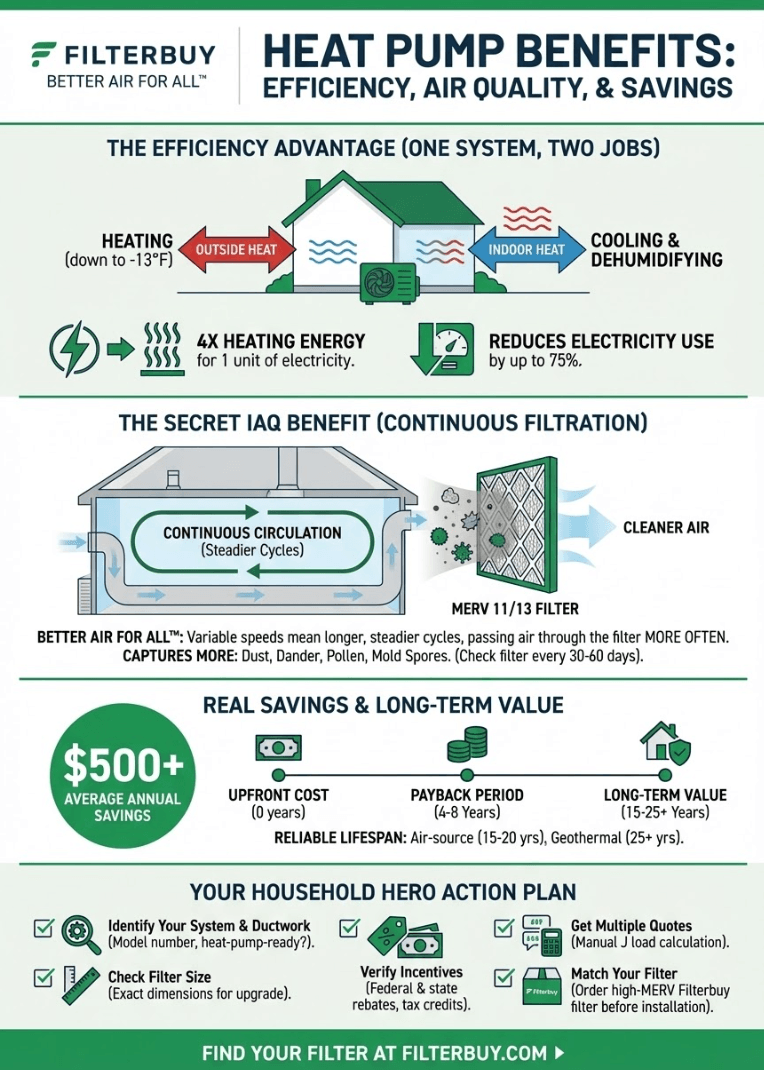
Heat pumps deliver year-round heating and cooling from a single system, using up to 2–4× less energy than electric resistance heating (U.S. Department of Energy). Key benefits:
● One system replaces two. A heat pump handles both heating and cooling, eliminating a separate furnace and A/C.
● Lower energy bills. Homeowners save an average of $500+ per year, with those switching from electric resistance, oil, or propane saving the most.
● Better humidity control. Variable-speed operation dehumidifies more effectively than standard central A/C.
● Cleaner indoor air. Heat pumps run more continuously, circulating air through your filter more often, capturing more dust, dander, pollen, and fine particulates on every cycle.
● Longer lifespan. Air-source heat pumps last 15–20 years. Geothermal systems last 25+ years, with ground loops rated for 50 years or more.
● Federal incentives available. The Section 25D credit for geothermal remains active through 2032.
Top Takeaways
● Heat pumps deliver up to 2–4× more heat energy per unit of electricity than electric resistance heating (U.S. Dept. of Energy).
● One system replaces both your furnace and A/C, cutting equipment costs, maintenance, and complexity.
● The IRA Section 25C tax credit (30%, up to $2,000/yr) for air-source heat pumps expired December 31, 2025 .
● Most homeowners recoup the cost difference within 4–8 years, then enjoy lower utility costs for the life of the system.
● Geothermal systems reach COP 3.0–5.0, with ground loops lasting 50+ years and a DOE-cited payback of 5–10 years.
● Continuous heat pump operation means more air passes through your filter, making MERV rating selection critical to realizing the full air quality benefit.
What Is a Heat Pump and Why Are So Many Homeowners Making the Switch?
A heat pump is a single HVAC system that handles both heating and cooling. It doesn't burn fuel the way a furnace does. It moves heat instead pulling it out of your home in summer and drawing it from outdoor air in winter.
Cold-climate models work efficiently down to –13°F. One system replaces two. And because moving heat requires far less energy than generating it, the bill difference adds up across every month you own it.
In practical terms, that efficiency means:
● Lower monthly energy bills, especially compared to gas or electric resistance heating
● One system to maintain instead of two
● Quieter, more consistent operation with no hard on/off cycling
● Better humidity control year-round
● Continuous air circulation your filter works harder and catches more
● A smaller carbon footprint, particularly when paired with renewable electricity
Heat Pump vs. Air Conditioner: What's Actually Different?
A central A/C only cools. A heat pump handles both jobs using the same refrigerant cycle, running in reverse from summer to winter. If you're running a central A/C and a separate furnace right now, you own two systems with two maintenance schedules and two cost clocks ticking. A heat pump replaces both.
Unlike a central A/C, a heat pump handles both heating and cooling powered entirely by electricity, no gas or oil required.
What that means for your home:
● Dual capability. One system replaces your furnace and A/C. A central A/C only cools.
● Efficiency is rated differently. Heat pumps are measured by COP (2–4×) and HSPF2, not just a SEER2 cooling rating.
● Cold-climate ready. Modern models perform efficiently down to –13°F.
● Installed cost in context. Air-source heat pumps run $4,000–$8,000+. A central A/C runs $3,500–$7,500 — but that doesn't include your separate heating system, which a heat pump eliminates.
● Longer lifespan. 15–20 years for a heat pump vs. 12–15 years for a central A/C, with your furnace aging on its own separate clock.
● Better indoor air quality. Heat pumps run at variable speeds and cycle more continuously so your air passes through the filter more often. A seasonal A/C can't replicate that.
The indoor air advantage matters most if your household has pets, allergies, or anyone with respiratory sensitivities, and it's the one column most comparison guides leave out entirely.
Heat Pumps for Homes Prices: What the Numbers Actually Include
A standard air-source heat pump for a typical 2,000 sq. ft. home runs $4,000 to $8,000 installed. That comparison to a new A/C only falls apart once you add the cost of separate heating across years of ownership.
Air-Source Heat Pump
● Installed cost: $4,000–$8,000
● Est. annual savings: $300–$1,500/yr
● Lifespan: 15–20 years
Geothermal Heat Pump
● Installed cost: $10,000–$30,000+
● Tax credit: Section 25D — 30% through 2032
● Est. annual savings: $600–$2,000/yr
● Lifespan: 25+ years
Central A/C + Furnace
● Installed cost: $7,000–$15,000 combined
● Tax credit: Limited
● Est. annual savings: Baseline
● Lifespan: 12–15 years per system, each aging on its own clock
What the numbers don't show at a glance:
● DOE data shows homeowners switching from electric resistance, fuel oil, or propane typically save $300–$1,500/yr with savings averaging $500+ per year across all system types.
● Most homeowners recoup the cost difference within 4–8 years, then spend less on utilities for the life of the system.
● One system instead of two means one service schedule a maintenance cost and complexity advantage that compounds every year.
Geothermal Heat Pumps for Homes: The Premium Option, Explained Plainly
Geothermal systems tap into the ground, where temperatures hold steady at 50–60°F year-round. Geothermal heat pumps reach a COP of 3.0 to 5.0, meaning 3 to 5 units of heating or cooling for every unit of electricity consumed (confirmed by U.S. DOE and ENERGY STAR). Nothing else in residential HVAC gets close.
Geothermal heat pumps make the most sense when:
● You own enough land for a horizontal ground loop, or have access for vertical drilling
● You're building new construction and can design the system from the start
● You're in a climate where air-source efficiency drops hard in deep winter
● You want the lowest long-term operating costs and have the upfront budget
The U.S. Department of Energy cites a payback period of 5 to 10 years for geothermal systems with ground loops lasting 50+ years and indoor components up to 24 years. Installations run $10,000–$30,000+. The Section 25D credit (30%) remains active through 2032.
The Benefit Nobody Talks About: Heat Pumps and Indoor Air Quality
Traditional systems cycle hard, then stop. Your filter gets working time and then nothing, over and over. Heat pumps run at variable speeds with longer, steadier cycles your home's air passes through the filter more often, and more of what's floating in that air actually gets caught.
After manufacturing filters for over a decade and shipping to millions of households, we've watched what happens when someone upgrades to a heat pump but keeps a MERV 4 or MERV 6 filter in the system. They gain efficiency but keep breathing the same under-filtered air. The heat pump upgrade only does half the job.
The Filterbuy Recommendation
A heat pump paired with a MERV 11 or MERV 13 filter is a genuinely different experience. Dust, pet dander, pollen, mold spores, and fine particulates. The constant recirculation means your filter is catching more on every pass.
● Higher MERV ratings capture smaller particles but create more airflow resistance. Most modern systems handle MERV 11–13 fine. Anything higher, check with your HVAC tech first.
● Change your filter on schedule. A heat pump running continuously will load a filter faster. Check it every 30–60 days until you know your home's pattern.
● The right filter turns your heat pump into a whole-home air quality system, not just a comfort upgrade.
“After manufacturing filters for over a decade and shipping to more than two million households, we’ve identified a pattern that most HVAC guides completely miss: homeowners who upgrade to a heat pump but keep a low-MERV filter in the system gain efficiency on their utility bill and lose it right back in the air they breathe. The heat pump creates the conditions for cleaner air, but only the right filter actually delivers it.”
— Filterbuy Air Quality Team | filterbuy.com
Essential Resources
U.S. Department of Energy — Air-Source Heat Pumps
Efficiency data (2–4× energy delivery), installation guidance, and cold-climate performance specs. Primary source for the efficiency claims in this article.
https://www.energy.gov/energysaver/air-source-heat-pumps
U.S. Department of Energy — Geothermal Heat Pumps
Loop types, system lifespan (50+ year ground loop), and DOE-cited payback period of 5–10 years for ground-source systems.
https://www.energy.gov/energysaver/geothermal-heat-pumps
U.S. Department of Energy — Heat Pump Systems (Overview)
All heat pump types, including dual-fuel hybrids, dehumidification benefits, and the foundational mechanics of heat transfer vs. heat generation.
https://www.energy.gov/energysaver/heat-pump-systems
IRS — Energy Efficient Home Improvement Credit (Section 25C)
Official guidance on 25C eligibility, credit limits, and Form 5695. Note: The 25C credit expired December 31, 2025.
https://www.irs.gov/credits-deductions/energy-efficient-home-improvement-credit
ENERGY STAR — Air Source Heat Pumps Tax Credit
Consumer guide to tax credit eligibility requirements, certified product listings, and CEE efficiency tier thresholds for qualification.
https://www.energystar.gov/about/federal-tax-credits/air-source-heat-pumps
ENERGY STAR — Geothermal Heat Pumps Key Product Criteria
COP and EER minimum standards for ENERGY STAR-certified geothermal systems, including open- and closed-loop qualification thresholds.
https://www.energystar.gov/products/geothermal_heat_pumps/key_product_criteria
U.S. Department of Energy — FEMP Purchasing Guide for Geothermal Heat Pumps
Regional efficiency benchmarks, lifecycle cost analysis, and guidance on evaluating geothermal performance across Southeast, Southwest, and Northern climate zones.
https://www.energy.gov/femp/purchasing-energy-efficient-geothermal-heat-pumps
Supporting Statistics
A properly installed air-source heat pump can deliver up to two to four times more heat energy to a home than the electrical energy it consumes and can reduce electricity use for heating by up to 75% compared to electric resistance heating such as furnaces and baseboard heaters.
— U.S. Department of Energy — Air-Source Heat Pumps
https://www.energy.gov/energysaver/air-source-heat-pumps
Heat pump savings can average over $500 per year, with homes using electricity, fuel oil, or propane for heat seeing median savings of $300–$650 annually — and potentially more with insulation upgrades.
— U.S. Department of Energy / National Renewable Energy Laboratory (NREL)
https://www.energy.gov/articles/pump-your-savings-heat-pumps
The U.S. Department of Energy estimates that additional installation costs for a geothermal system may be returned in energy savings in 5 to 10 years, with ground loop systems lasting 50+ years and indoor components up to 24 years.
— U.S. Department of Energy — Geothermal Heat Pumps
https://www.energy.gov/energysaver/geothermal-heat-pumps
Final Thoughts and Opinion
Heat pump benefits for homes aren't just a checklist of features you'll forget by next Tuesday. We're talking about lower bills every winter and summer, one system instead of two, and air that your family actually wants to breathe.
Most HVAC conversations stop at the equipment. We think that's the wrong place to stop. The system earns the efficiency rating on paper, but your filter earns the air quality in practice. A heat pump running MERV 4 filtration is a significant investment, delivering a partial result.
Whether you're comparing a heat pump vs. an air conditioner, working through the price math, or wondering if geothermal makes sense for your property start with the filter. It's the piece most people add last. It shouldn't be.
Here’s Your Next Steps
You've done the research. Here's how to turn it into action in the right order.
Step 1: Know your current system.
● Pull the model number off your existing furnace, air handler, or A/C unit before you buy anything or call anyone.
● That number tells a tech everything needed to size a replacement correctly.
● It also reveals whether your ductwork and electrical panel are already heat-pump-ready two factors that directly affect your installation quote.
Step 2: Check your filter size.
● Find the dimensions printed on the side of your current filter.
● If the size isn't listed, measure the filter slot: length, width, and depth.
● This is the number you'll need when you upgrade filtration to match a heat pump's continuous-run cycle.
After manufacturing filters for over a decade and serving more than two million households, this is the step we see homeowners skip most and the one that determines whether your new system actually delivers cleaner air.
Step 3: Verify current federal and state incentives.
The IRA Section 25C tax credit for air-source heat pumps expired December 31, 2025. Don't rely on older articles or quotes that still reference it. Check your current eligibility at:
● irs.gov — Energy Efficient Home Improvement Credit — for current federal incentive status
● dsireusa.org — to search active state and utility rebates
● Geothermal installations may still qualify under Section 25D through 2032
Step 4: Get at least two installation quotes.
Ask each contractor to quote the same system type and SEER2/HSPF2 rating so you're comparing apples to apples.
● Request a Manual J load calculation — the industry-standard sizing method.
● Any contractor who skips this step is guessing at the right system size.
● An oversized or undersized heat pump will underperform regardless of its efficiency rating.
Step 5: Match your filter before the first run.
Check your heat pump's manufacturer documentation for the maximum supported MERV rating. For most modern systems, that's MERV 11 to MERV 13. Order before installation day not after.
● A heat pump running its first cycle through a MERV 4 filter is already working against itself.
● Find the Filterbuy filter sized for your system →
Step 6: Set a 30-day filter check reminder.
Heat pumps running continuous variable-speed cycles load a filter faster than traditional systems.
● 30 days out: check the filter it may need replacing sooner than you expect.
● 60–90 days out: you'll know your home's actual load cycle.
● Adjust your change schedule from there and stick to it.
Frequently Asked Questions on Heat Pumps Benefits
What are the main benefits of a heat pump over a traditional furnace and A/C?
The biggest advantages are efficiency and simplicity. The U.S. Department of Energy confirms air-source heat pumps can deliver up to 2–4× more heat energy than the electrical energy they consume, and reduce electricity use by up to 75% compared to electric resistance heating. They also replace two separate systems with one and because they run more consistently, they improve humidity control and give your air filter more working time.
How much do heat pumps for homes actually cost?
Air-source heat pumps run $4,000–$8,000 installed for a typical home. Geothermal systems cost $10,000–$30,000+, with higher efficiency and longer lifespans. The IRA 25C tax credit for air-source systems expired December 31, 2025. The 25D credit for geothermal remains active through 2032.
Is a heat pump better than an air conditioner for indoor air quality?
Generally yes. Heat pumps run more continuously than traditional A/C systems, so air moves through the filter more often. The actual improvement depends on which filter you're using. A MERV 11 or MERV 13 filter in a heat pump system can cut allergens, dust, pet dander, and fine particulates on every cycle. The heat pump creates the conditions. The filter does the work.
Do heat pumps work in cold climates?
Modern cold-climate heat pumps are rated to work efficiently down to –13°F (–25°C). Brands like Mitsubishi, Bosch, and Carrier make variable-speed cold-climate models built specifically for northern U.S. winters. Geothermal heat pumps don't depend on outdoor conditions at all; ground temperatures stay stable year-round.
Are geothermal heat pumps worth it for a home?
For homeowners with the right property, budget, and timeline, yes. Geothermal systems have the highest efficiency ratings in residential HVAC, COP 3.0–5.0, with ground loops lasting 50+ years. The U.S. Department of Energy cites a payback period of 5 to 10 years.
Your Home Deserves the Full Benefit of a Heat Pump, Starting With the Right Filter
After manufacturing filters for over a decade and serving more than two million households, we know the upgrade most homeowners make last is the one that matters most. Find the Filterbuy filter sized for your heat pump system and make every cycle count.