
Heat Pump Maintenance Made Simple: Expert Checklist, DIY Tips, Professional Service and Cost Guide
April 7, 2026
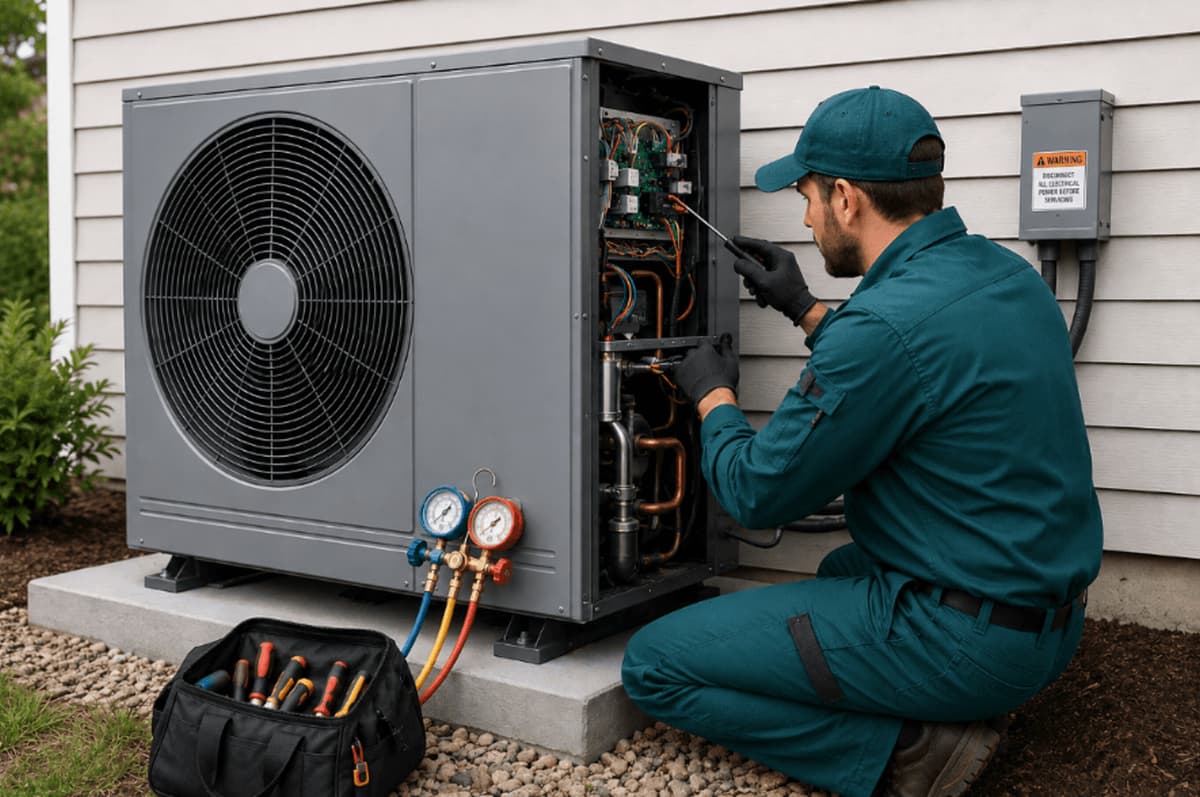
We've seen the same repair story often enough to recognize the pattern: a homeowner receives a $900 compressor bill, we ask when they last replaced their filter, and there's a long pause. It's rarely a mystery. The heat pump didn't fail without warning; it sent signals for months while maintenance was repeatedly pushed to next weekend, then next month, then next season.
Most residential heat pump maintenance is simpler than people expect. A lot of it takes under 30 minutes and requires nothing beyond a new filter. What's harder to find is a single, straight resource that tells you what actually needs doing, when, and how much to budget for the jobs that require a licensed technician. That's what this page covers.
At Filterbuy, we manufacture air filters in the U.S. and have shipped millions to homeowners who care about protecting their HVAC systems. The filter is where maintenance begins for most people and where it most often breaks down. We'll cover that, and everything else, below.
What you'll find in this guide:
1. A heat pump maintenance checklist broken down by DIY and professional tasks
2. A seasonal maintenance schedule so you always know what to do and when
3. Honest heat pump maintenance costs range so you can plan your budget
4. How to find a qualified heat pump maintenance service provider near you
5. Whether a heat pump maintenance plan is worth the investment
6. Answers to the most common questions homeowners ask about heat pump upkeep
Why This Matters to Your Home and Your Air
A poorly maintained heat pump doesn't just break down. It degrades your indoor air quality for months before the mechanical failure shows up, dirty coils and clogged filters pushing more dust, dander, and particulates through your home every day the system runs. At Filterbuy, we treat air quality as a whole-system problem. The filter is step one. The heat pump is the reason step one matters.
TL;DR: Quick Answers
What is heat pump maintenance?
Heat pump maintenance is the routine upkeep that keeps your system running efficiently year-round, covering both what you do yourself and what a licensed technician handles once a year.
DIY tasks include replacing the air filter every 1–3 months, clearing debris from the outdoor unit, and checking for unusual sounds or frost buildup.
Professional tasks include refrigerant level checks, coil cleaning, electrical inspections, and thermostat calibration, typically scheduled annually, ideally each spring.
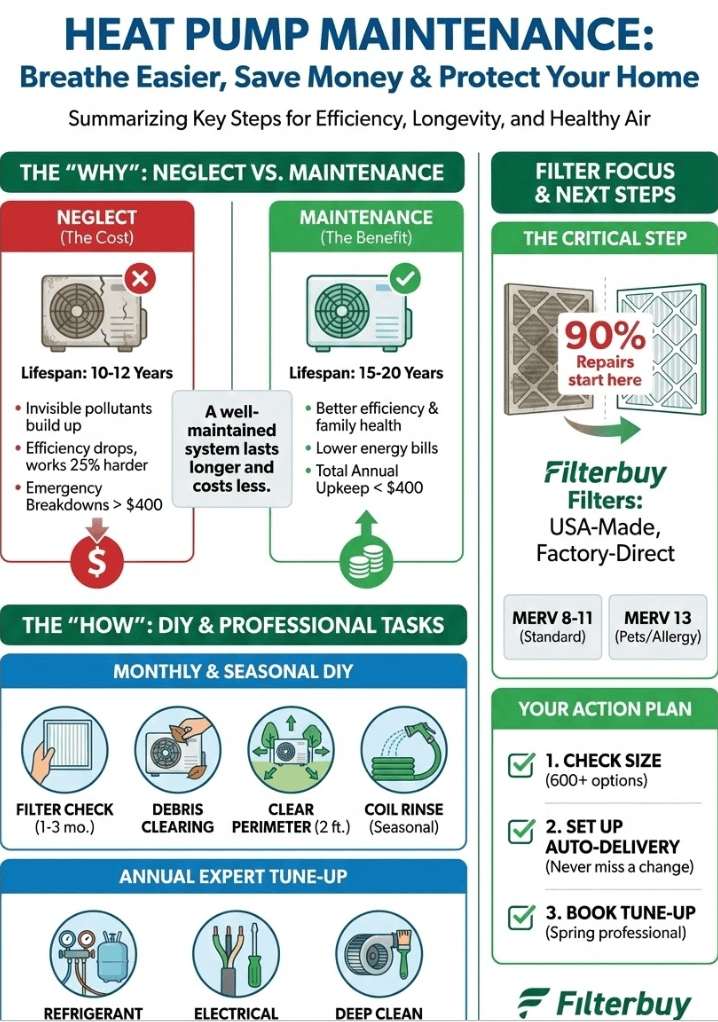
A well-maintained heat pump lasts 15–20 years. Without regular service, most systems need replacement after 10–12. The filter is where most homeowners start and where most problems begin when it gets skipped.
Top Takeaways
1. Replace your air filter every 1–3 months, it's the single most impactful DIY task you can do.
2. Schedule a professional tune-up once a year, ideally in spring before peak cooling season.
3. Air source heat pumps run year-round and accumulate wear faster than seasonal system, maintain accordingly.
4. A well-maintained heat pump lasts 15–20 years. A neglected one typically needs replacement after 10–12.
5. Dirty filters waste up to 25% of your heat pump's energy output, you're paying for comfort you're not getting.
6. Annual professional maintenance costs $75–$200. Emergency repairs run $300–$1,500+.
7. When hiring locally, look for NATE-certified technicians with documented heat pump experience.
What Is Heat Pump Maintenance and Why Does It Matter More Than You Think?
A heat pump moves heat rather than generating it, pulling warmth from outdoor air in winter and pushing it back out in summer. Wikipedia's overview of heat pump technology clearly covers the mechanics, if you want a deeper look at the refrigeration cycle. For maintenance, the key point is that the system runs in both directions year-round, so wear accumulates on both the heating and cooling components simultaneously.
For a comparison of how a heat pump stacks up against a traditional furnace or central air conditioner covering efficiency ratings and long-term cost differences Filterbuy's heat pump vs. HVAC comparison guide walks through both clearly. The short version: heat pumps are more efficient, but that efficiency holds only as long as maintenance stays on schedule.
Skip maintenance long enough, and the damage follows a predictable sequence:
● Efficiency drops: A clogged filter alone can force your heat pump to work 15-20% harder, driving up energy costs without delivering more comfort.
● Parts wear faster: The blower motor, compressor, and fan compensate for restricted airflow and dirty coils. That compensation adds hours to their effective wear.
● Air quality suffers: Dirty coils and filters push dust, allergens, and particulates through every room in your home.
● Lifespan shrinks: A well-serviced heat pump can run reliably for 15-20 years. Neglected systems routinely need replacement after just 10-12.
Your Complete Heat Pump Maintenance Checklist
Use this checklist as your master reference for what needs attention and how often. DIY tasks are things most homeowners can handle confidently. Professional tasks require a licensed HVAC technician.
Monthly DIY Tasks
● Check and replace your air filter (every 1-3 months — pets, dust levels, and occupancy all affect the timeline)
● Inspect the outdoor unit for leaves, grass clippings, or debris blocking the fins
● Verify the thermostat is reading and responding accurately
● Listen for any new sounds: rattling, grinding, or clicking that wasn't there last month
Seasonal DIY Tasks (Spring & Fall)
● Clear a 2-foot perimeter around the outdoor unit — shrubs and mulch restrict airflow
● Rinse condenser coil fins gently with a garden hose (low pressure, top-down)
● Check refrigerant lines for ice buildup or frost. Either signals a problem worth investigating.
● Test emergency heat mode before temperatures drop
● Clean indoor vents and registers. Check that none are blocked by furniture.
Annual Professional Inspection Tasks
● Refrigerant level check and leak test
● Electrical connections inspection — tighten, clean, and test all contacts
● Professional coil cleaning with approved chemical treatment
● Blower motor lubrication and belt/bearing inspection
● Thermostat calibration and full system controls test
Your heat pump maintenance schedule by frequency: what to do monthly, seasonally, and annually
A heat pump running year-round needs attention on multiple timelines. Most problems don't start as emergencies — they start as a skipped filter change or a coil that hasn't been cleaned in two seasons. When a system begins cycling on and off more frequently than normal, that's usually the first sign something's been missed.
Air source heat pump maintenance — a few things that don't apply to other system types
Air source heat pumps pull heat from outdoor air even on cold days. They're the most common residential type, and that outdoor exposure creates a few maintenance considerations that geothermal or dual-fuel systems don't share. For a full look at the problems air source systems run into, that resource is worth bookmarking.
● Defrost cycles are normal: You'll see the outdoor unit steam or run briefly in reverse on cold days. That's the system clearing ice from its coils, not a malfunction.
● Elevation matters in snow climates: The outdoor unit should sit at least 4-8 inches off the ground to prevent snow from blocking the base. Check the mounting after heavy storms.
● Airflow on both sides: Unlike a traditional AC condenser, your heat pump needs clear space on both the intake and exhaust sides of the outdoor unit.
● Wrong MERV rating hurts more than it helps: A MERV 16 filter designed for hospital environments in a standard heat pump air handler restricts airflow severely. MERV 8-13 is where most residential systems perform best.
Heat pump maintenance cost: what to budget before replacement becomes the conversation
Being upfront about cost is how we do things here. These are real-world ranges, not best-case estimates:
● DIY air filter replacement — $10–$30 per filter, every 1–3 months
● Annual professional tune-up — $75–$200, once per year
● Professional coil cleaning — $100–$400, annually or as needed
● Refrigerant recharge — $150–$400+, every 3–5 years if needed
● Maintenance plan / contract — $150–$500 per year, covers multiple visits plus priority scheduling
● Emergency repair (no upkeep) — $300–$1,500+, and in most cases, entirely preventable
Look at that bottom row. Emergency repair without regular upkeep runs $300-$1,500+ — the most expensive line in the table and the most preventable one. The entire annual maintenance picture, including a professional tune-up, filter replacements, and a basic service contract, typically stays well under $400. That math isn't hard.
How to find a reliable heat pump maintenance service when you search for heat pump maintenance near me
Search your area, and you'll find dozens of options. Most are fine. Some are not. Here's how to tell the difference:
● Look for NATE certification: The North American Technician Excellence credential is the gold standard for HVAC professionals. It means the technician has passed rigorous testing on heat pump systems specifically.
● Ask directly about heat pump experience: Not all HVAC technicians are equally comfortable with heat pump systems. Ask how many they service regularly.
● Look beyond the tune-up: A solid HVAC provider handles air duct repair and system-level work, not just filter swaps and visual inspections.
● Request an itemized quote: A reputable technician tells you exactly what the tune-up includes before starting. A vague quote is a reason to keep looking.
● Watch for upsells on refrigerant: Refrigerant doesn't run out like gas in a tank. If a technician recommends recharging it without proving a leak, ask for documentation.
Is a heat pump maintenance plan worth the investment?
A maintenance plan — sometimes called a service agreement or HVAC contract typically covers one or two annual tune-ups, priority scheduling, and discounts on parts. For most homeowners with newer systems, yes. They're worth it.
● Plans typically cost $150-$500 per year depending on your region and provider
● Two annual visits (spring and fall) are better than one, especially for year-round heat pump systems
● Priority service access is genuinely valuable when your heat pump fails on a 95-degree July afternoon
● Many plans include parts discounts that offset the contract cost if you need a minor repair
● Read the fine print carefully. Make sure the plan covers your specific heat pump type (air-source, mini-split, dual-fuel), includes both heating and cooling inspections, and clearly states what's excluded.
The filter: the maintenance step most homeowners overlook most
We'd be letting you down if we didn't spend a moment here. The air filter in your heat pump's air handler is the single most impactful DIY maintenance task you have and the one most commonly skipped.
● How often to change it: Every 1-3 months. Common sizes like 12x12x4 air filters are available in multiple MERV ratings to fit different heat pump air handlers.
● What MERV rating to use: MERV 8-11 is the sweet spot for most residential heat pump air handlers. MERV 13 is suitable for households with allergy sufferers or pets, but confirm it doesn't restrict your system's airflow. Check your equipment manual.
● What happens when you skip it: Restricted airflow forces the blower motor to work harder, causes coils to run hotter, and drives energy consumption up sometimes dramatically.
At Filterbuy, we manufacture all of our filters right here in the U.S., with no middlemen and no markups, in sizes that actually fit. Set up auto-delivery and your filter shows up when it's time. No store run, no reminder needed.
"In our experience shipping filters to millions of homeowners, the ones who never face a surprise repair bill aren't doing anything complicated — they're just changing their filter on schedule and getting one professional visit a year. That's genuinely most of it."
— Filterbuy HVAC Content Team
7 Essential Resources for Heat Pump Maintenance
These are the most authoritative, genuinely useful references we recommend for heat pump owners. Each one earns its place.
1. U.S. Department of Energy, Heat Pump Systems Guide
The DOE's full guide to heat pump operation, efficiency ratings, proper sizing, and maintenance best practices. A government source, updated regularly, and free. If you read one official resource on heat pumps, this is the one.
energy.gov/energysaver/heat-pump-systems
2. ENERGY STAR — Heat Pump Product Finder and Efficiency Guide
Use this to verify your current system's efficiency rating, understand HSPF and SEER2 scores, and find ENERGY STAR certified replacement units when the time comes. Also includes maintenance impact data on rated efficiency.
energystar.gov/products/heat_pumps
3. Wikipedia — Heat Pump (Technology Overview)
A thorough, citation-backed overview of how heat pumps transfer energy, the refrigeration cycle, and how air source systems differ from geothermal. Good foundation if you want to understand the mechanics behind what you're maintaining.
en.wikipedia.org/wiki/Heat_pump
4. NATE — Find a Certified Heat Pump Technician Near You
The gold standard for HVAC technician certification. Use the NATE locator to find certified professionals in your area who have passed rigorous testing on heat pump systems specifically. This is how you find someone who actually knows what they're doing.
natex.org/consumers/find-a-nate-certified-technician
5. EPA — Indoor Air Quality and HVAC Systems
The EPA's guidance on how HVAC maintenance including filter selection and coil cleaning directly impacts indoor air quality. Useful for homeowners who care about what's actually circulating through their home's air, not just whether the system is running.
epa.gov/indoor-air-quality-iaq/hvac-systems-and-indoor-air-quality
6. Filterbuy — Heat Pump vs. HVAC: Differences, Efficiency & Cost Comparison Guide
Our own in-depth guide comparing heat pumps to traditional furnaces and central air conditioners — covering efficiency ratings, operating costs, climate suitability, and which system makes sense for different homeowners. Read this before your next system replacement conversation.
filterbuy.com — Heat Pump vs. HVAC Comparison Guide
7. ASHRAE — Residential HVAC Systems and Standards
The American Society of Heating, Refrigerating and Air-Conditioning Engineers publishes the standards that licensed HVAC technicians follow. If you want to know what a professional tune-up is actually supposed to include from a technical standards perspective, ASHRAE is the source.
ashrae.org — Heat Pump Consumer Resources
3 Statistics That Show Why Maintenance Is Non-Negotiable
These three figures come from verified government and certification sources — the DOE and ENERGY STAR. Each one changes the math on what regular maintenance is actually worth.
● Up to 50% reduction in electricity use vs. electric resistance heating with a properly maintained heat pump — U.S. Department of Energy
● 25% of a heat pump's energy can be wasted when air filters are neglected and airflow is restricted — U.S. DOE Energy Savers Guide
● 15–20 years expected lifespan of a well-maintained heat pump vs. 10–12 years without regular service — ENERGY STAR / DOE Guidance
Read those three figures together and the calculation gets simple. A heat pump running on a neglected filter wastes up to a quarter of its energy — energy you're paying for and not getting back in comfort. Multiply that across a full heating and cooling season, and you're looking at a real addition to your utility bill every year. Then factor in the lifespan difference: five to eight extra years of reliable performance versus early replacement. At $3,000-$8,000+ for a new installation, the math on annual maintenance is decisively in your favor.
Final Thoughts and Our Honest Opinion
Heat pump maintenance isn't complicated, and it isn't expensive. The version that costs real money is the one where nothing happened for two years, and the compressor finally said so.
The homeowners who end up on the wrong end of a $1,200 heat pump repair almost always fall into one of two categories: they skipped the annual professional tune-up for a few years running, or they let the air filter go gray and didn't think much of it. Both are completely avoidable. And both tend to compound the dirty filter accelerates coil buildup, the coil buildup stresses the compressor, and before long, you're having a conversation with a technician about parts costs instead of a routine checkup.
Our honest take on the annual professional service debate: yes, it's worth it. The $75-$200 for a qualified technician's annual inspection is the single best-value service call in residential HVAC. For most homeowners, we'd actually recommend pairing it with a maintenance contract if you can find a reputable provider in your area. The priority service access alone is worth the premium when summer heat or a January cold snap makes emergency repair scheduling a nightmare.
On the DIY side: the filter is your most powerful tool. Change it on schedule every one to three months and you've addressed the most common root cause of heat pump inefficiency before it ever develops. Set up auto-delivery so it's one less thing to think about. That's exactly how we designed our program at Filterbuy: your filter shows up, you swap it in, your system breathes easy. That's the whole idea.
A Note on Air Source Heat Pumps Specifically
Air source systems are increasingly common as homeowners upgrade from older gas furnaces and window AC units, particularly in mild-to-moderate climates. They're efficient, effective, and increasingly capable in cold climates thanks to advances in variable-speed compressor technology. But they run constantly in a way that traditional split systems do not. That means the maintenance timeline is compressed: a filter that might last two months in a traditional AC-only system will often need replacement in 6-8 weeks on a year-round heat pump. Build that into your maintenance calendar.
Frequently Asked Questions About Heat Pump Maintenance
How often should a heat pump be serviced?
Heat pumps should receive a professional tune-up at least once per year ideally in spring before cooling season begins. Because heat pumps operate in both heating and cooling modes year-round, many HVAC professionals recommend two light seasonal check-ins (spring and fall) in addition to one full annual inspection. On top of professional service, homeowners should replace air filters every 1-3 months and check the outdoor unit monthly for debris.
What does heat pump maintenance include?
A complete professional heat pump maintenance service includes: refrigerant level check and leak test, electrical connection inspection and tightening, coil inspection and chemical cleaning, blower motor lubrication and bearing check, thermostat calibration, and a full system controls test in both heating and cooling modes. DIY maintenance primarily means consistent air filter changes and keeping the outdoor unit clear of debris, leaves, and overgrowth.
How much does heat pump maintenance cost?
A professional annual tune-up for a residential heat pump typically runs $75-$200. Add a maintenance plan or service contract and expect $150-$500 per year depending on your region and provider. DIY air filter replacement costs $10-$30 per filter. Compare that to an emergency repair on a heat pump compressor or refrigerant system, which typically runs $300-$1,500 or more, and the case for regular upkeep makes itself.
Can I perform heat pump maintenance myself?
Yes — several meaningful maintenance tasks are fully DIY-friendly: replacing air filters, clearing debris from around the outdoor unit, rinsing condenser coil fins with low-pressure water, checking for unusual sounds or frost buildup, and verifying thermostat accuracy. Refrigerant handling, electrical component testing, compressor diagnostics, and coil chemical cleaning all require a license and proper equipment. Leave those to a certified technician.
What happens if you don't maintain a heat pump?
Unmaintained heat pumps lose efficiency gradually often without obvious warning signs until the damage is significant. Clogged filters force the blower motor to work harder. Dirty coils reduce heat transfer efficiency. Low refrigerant stresses the compressor. Over time, these conditions compound: energy bills climb, comfort decreases, and components wear faster than designed. Homeowners who skip regular maintenance routinely face emergency repair bills of $500-$1,500 and often need full system replacement 5-8 years earlier than they would with proper upkeep.
What MERV rating filter should I use with a heat pump?
For most residential heat pump air handlers, a MERV 8-11 filter provides the right balance between effective filtration and healthy airflow. MERV 13 works for households with allergy sufferers or pets, but confirm compatibility with your system's airflow specifications first. High-efficiency filters can restrict airflow in systems not built for them, which causes exactly the strain you're trying to avoid. When in doubt, check your system's manual or ask your HVAC technician.
How long does a heat pump last with proper maintenance?
A well-maintained heat pump can reliably run for 15-20 years. Systems that receive irregular or no professional service typically need replacement after 10-12 years, often with costly component failures in the final stretch before full replacement. The difference in total cost of ownership between a maintained and unmaintained system, factoring in early replacement and repair costs, can easily exceed $5,000-$10,000 over the equipment's life.
Protect Your Heat Pump - Start With the Filter
The checklist, the schedule, and the cost breakdown are all in this guide. The one action that matters most right now takes two minutes: check your heat pump's air filter.
If it's been more than three months, it's time to swap it out. A clean filter is the foundation of everything else on this page — better efficiency, cleaner air, longer equipment life, lower bills.
At Filterbuy, we manufacture American-made air filters in over 600 sizes — including the sizes that fit heat pump air handlers that big-box stores routinely don't stock. Every order ships fast and free, factory-direct, with no middlemen and no markups. Set up auto-delivery and we'll make sure you never have to remember when it's time to change it again.
Better air starts with the right filter. Shop Filterbuy now.