
Heat Pump Heating Cost Guide: Installation, Operation, and Comparison with Traditional Heating Systems
March 3, 2026
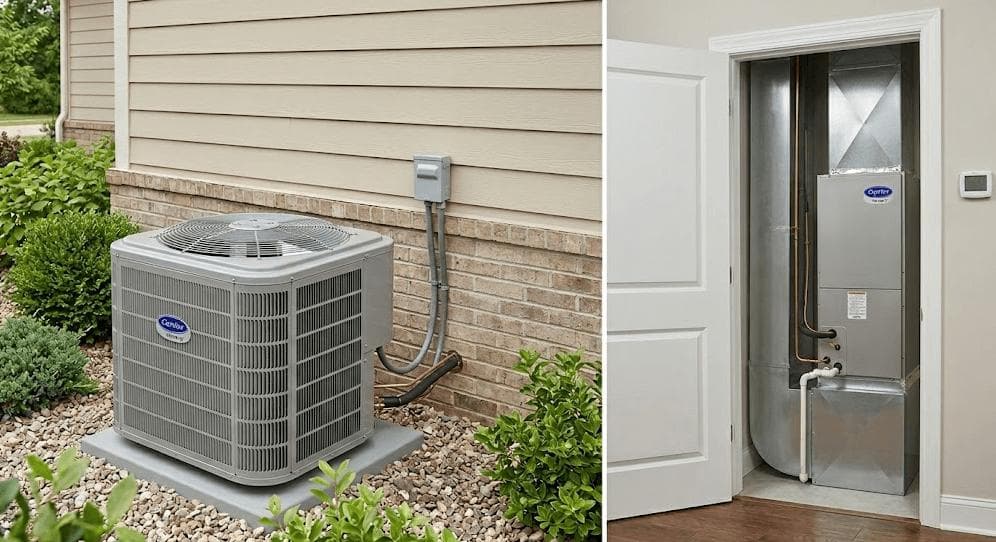
A heat pump can slash your heating costs by up to half, but from our experience installing and servicing HVAC systems in homes across the country, we've seen too many homeowners overpay for the wrong setup because they didn't have the full cost picture before signing a contract.
At Filterbuy HVAC Solutions, we work inside these systems every day. We've seen firsthand how the right heat pump paired with proper sizing and quality filtration delivers real savings, and how the wrong match leads to inflated energy bills and premature wear. That hands-on knowledge is exactly what we've put into this guide: actual installation price ranges by system type, operating cost breakdowns based on climate and home size, what efficiency ratings like HSPF and SEER mean for your monthly bill, and an honest side-by-side comparison with gas furnaces, oil boilers, and electric resistance heat. No filler, just the practical numbers and insights we wish every homeowner had before making this decision.
TL;DR: Quick Answers
How Much Does Heat Pump Heating Cost?
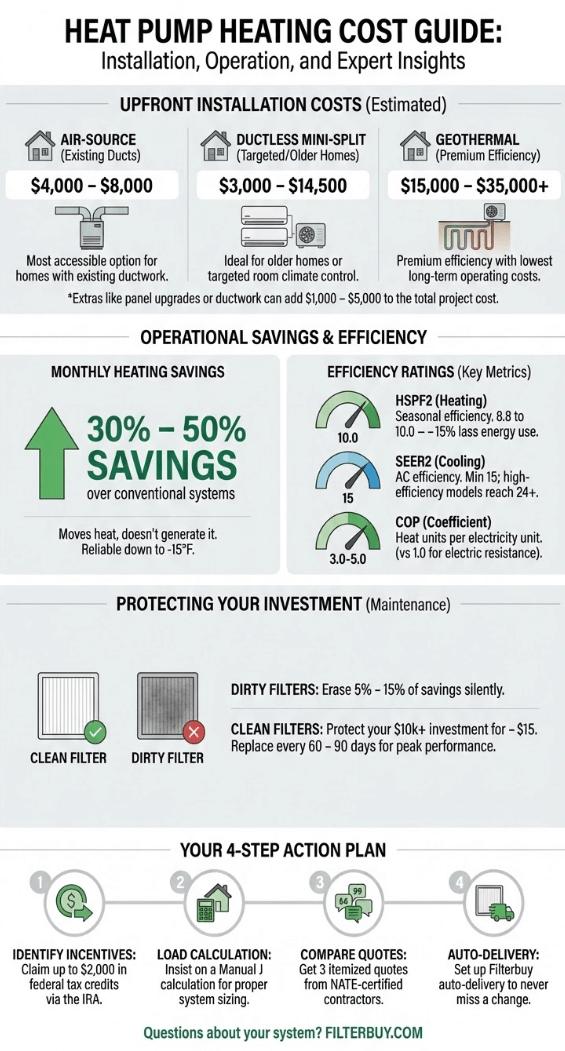
Upfront: Most homeowners pay $4,000–$8,000 for a standard air-source heat pump installed. Ductless mini-splits run $3,000–$14,500. Geothermal systems start around $15,000.
Monthly: Expect $50–$150/month during winter, roughly 30%–50% less than gas furnaces or oil boilers in comparable homes.
What we've learned from thousands of installations: The purchase price gets all the attention, but it's your operating cost over 15–20 years that actually determines whether a heat pump was a good investment. Two things control that number more than anything else: proper system sizing at installation and consistent air filter replacement afterward. Get both right, and the savings the DOE projects (up to 50% reduction in heating energy use) show up reliably on your bill, month after month. Skip either one and you'll spend years wondering why your numbers don't match the brochure.
Bottom line: For the majority of U.S. homes, a heat pump is the lowest-cost way to heat, if it's sized correctly, maintained consistently, and paired with clean filtration. At Filterbuy, that last part is what we do best.
Top Takeaways
What It Costs
Air-source: $4,000–$8,000 | Mini-splits: $3,000–$14,500 | Geothermal: $15,000–$35,000+
Hidden extras (panel upgrades, ductwork, permits) can add $1,000–$5,000
Federal, state, and utility incentives can offset thousands — always check before you buy
What You'll Pay Monthly
Heat pump: $50–$150/month in winter for most homes
Gas furnace or oil boiler: $150–$300+/month for comparable homes
A dirty filter can erase 5%–15% of those savings silently
Efficiency Ratings Worth Knowing
HSPF2 (heating): minimum 8.8, high-efficiency 10–13+
SEER2 (cooling): minimum 15, high-efficiency 20–24+
Best value for most homes: 10 HSPF2 / 17–20 SEER2
The One Thing Most Guides Skip
Your heat pump is only as efficient as the air flowing through it. Replace your filter every 60–90 days, choose the right MERV rating for your household, and set up Filterbuy auto-delivery so it never slips through the cracks.
What Does a Heat Pump Cost to Install?
The biggest question homeowners ask us is simple: how much am I going to spend upfront? The answer depends on the type of heat pump, your home's existing infrastructure, and the complexity of the installation, but here are the real-world ranges we see consistently.
A standard air-source heat pump typically runs between $4,000 and $8,000 installed, making it the most accessible option for most homes. If your property already has ductwork in good condition, you're looking at the lower end of that range. Ductless mini-split systems, which are ideal for older homes without existing ducts or for targeted room-by-room climate control, generally fall between $3,000 and $14,500, depending on how many indoor units (zones) you need. Geothermal (ground-source) heat pumps are the premium option. Installation typically ranges from $15,000 to $35,000 or more because of the underground loop system required, though the long-term energy savings and equipment lifespan often justify the investment.
From our experience, the costs that catch homeowners off guard aren't the equipment itself; they're the extras. Electrical panel upgrades, ductwork modifications, permits, and removal of old equipment can add $1,000 to $5,000 to any project. We always recommend getting at least three detailed quotes that break out labor, equipment, and materials separately so you can compare apples to apples.
One more thing worth knowing: federal tax credits and local utility rebates can significantly offset your upfront costs. The Inflation Reduction Act currently offers tax credits up to $2,000 for qualifying heat pump installations, and many state programs stack additional incentives on top of that.
Monthly Operating Costs, What You'll Actually Pay to Run a Heat Pump
Installation is a one-time expense. Your monthly operating cost is what you'll live with for the next 15 to 20 years, and this is where heat pumps genuinely shine.
Because heat pumps move heat rather than generate it by burning fuel, they use significantly less energy than conventional systems. In moderate climates, most homeowners we work with report monthly heating costs between $50 and $150 during winter months with an air-source heat pump, compared to $150 to $300 or more with a gas furnace or oil boiler serving a similar-sized home. Geothermal systems push those savings even further, often reducing heating bills by 30% to 60% compared to traditional systems because the underground temperature stays remarkably consistent year-round.
Climate plays a major role here, and we want to be upfront about that. In mild to moderate regions (think the Southeast, Mid-Atlantic, or Pacific Northwest), heat pumps operate at peak efficiency, and your savings will be most dramatic. In colder northern climates where temperatures regularly drop below freezing, modern cold-climate heat pumps have come a long way; many now perform efficiently down to -15,°F but operating costs will be higher than in milder zones, and some homes may still benefit from a dual-fuel backup for the coldest stretches.
The other factor that directly impacts your operating costs and one most guides overlook is your air filtration. A clogged or low-quality filter forces your heat pump to work harder, increasing energy consumption and driving up your monthly bill. We've seen systems lose 5% to 15% of their efficiency simply from neglected filters. Keeping a clean, properly rated filter in place is one of the easiest and cheapest ways to protect your operating budget.
Heat Pump Efficiency Ratings Explained — HSPF, SEER, and COP
Efficiency ratings tell you how much heating or cooling you get for every dollar of energy you spend. Understanding these numbers is the fastest way to compare systems and predict your long-term costs.
HSPF2 (Heating Seasonal Performance Factor) measures heating efficiency over an entire season. The current federal minimum is 8.8 HSPF2 for new heat pumps. Higher-efficiency models range from 10 to 13+ HSPF2. In practical terms, moving from an 8.8 to a 10 HSPF2 unit can reduce your heating energy use by roughly 12% to 15%, real dollars back in your pocket every winter.
SEER2 (Seasonal Energy Efficiency Ratio) measures cooling efficiency, which matters because your heat pump handles both heating and cooling. The federal minimum is 15 SEER2, with high-efficiency models reaching 20 to 24+ SEER2. If you live in a climate where you run air conditioning four or more months per year, investing in a higher SEER2 rating pays for itself faster.
COP (Coefficient of Performance) is the simplest efficiency measure; it tells you how many units of heat you get per unit of electricity consumed. A heat pump with a COP of 3.0 delivers three units of heat for every one unit of electricity, making it roughly three times more efficient than electric resistance heating (which has a COP of 1.0). Geothermal systems often achieve COPs of 4.0 to 5.0, which is why their operating costs are so low.
Our recommendation: don't chase the highest efficiency number at any price. The sweet spot for most homeowners is a mid-to-high efficiency unit (around 10 HSPF2 and 17–20 SEER2) that balances upfront cost with long-term savings. The ultra-premium models make the most financial sense in extreme climates or for homes with very high energy usage.
Heat Pumps vs. Traditional Heating Systems — An Honest Comparison
Every heating system has trade-offs, and the right choice depends on your climate, your home, and your priorities. Here's how heat pumps stack up against the most common alternatives based on what we see in the field.
Heat Pump vs. Gas Furnace: A high-efficiency gas furnace (95%+ AFUE) heats quickly and performs reliably even in extreme cold. However, it only heats; it can't cool your home. A heat pump handles both, which means you're replacing two systems (furnace and AC) with one. In areas where electricity rates are reasonable relative to natural gas, a heat pump often wins on total annual cost. Where natural gas is very cheap, and winters are severe, a gas furnace or dual-fuel setup may still make more sense.
Heat Pump vs. Oil Boiler: Oil heating is among the most expensive options per BTU, and oil prices fluctuate significantly. In almost every scenario we've evaluated, homeowners switching from oil to an air-source heat pump see meaningful savings, often 30% to 50% on annual heating costs. The upfront investment typically pays for itself within four to seven years.
Heat Pump vs. Electric Resistance Heating: This is the most clear-cut comparison. Electric baseboard heaters and electric furnaces convert electricity to heat at a 1:1 ratio. Heat pumps deliver two to four times more heat per unit of electricity consumed. If you're currently heating with electric resistance, a heat pump is almost always the single best upgrade you can make for both comfort and cost.
Heat Pump vs. Geothermal Heat Pump: Geothermal systems are technically heat pumps, too; they just source their heat from underground rather than outdoor air. They're more efficient and more consistent across all climates, but the installation cost is substantially higher. For homeowners who plan to stay in their home long-term (10+ years), geothermal can deliver the best lifetime return. For shorter time horizons, a quality air-source heat pump gives you the best value.
Protecting Your Heat Pump Investment with Proper Filtration
Here's something we tell every homeowner we work with: your heat pump is only as efficient as the air flowing through it. A dirty, restrictive, or poorly fitting filter doesn't just hurt your indoor air quality; it strains your compressor, increases energy consumption, shortens equipment life, and can void manufacturer warranties.
At Filterbuy, this is where our expertise runs deepest. We manufacture HVAC air filters right here in the U.S. in over 600 standard sizes, plus custom sizes for non-standard systems, because we know that a filter that fits right performs right. For heat pump systems specifically, we typically recommend a MERV 8 to MERV 13 filter, depending on your household's air quality needs. MERV 8 provides solid protection against dust and common allergens while maintaining excellent airflow. MERV 11 and MERV 13 step up capture efficiency for pet dander, finer pollen, mold spores, and smoke particles, ideal for families with allergies, pets, or respiratory concerns.
The key is replacing your filter on schedule. During the heating season, when your system runs frequently, we recommend checking your filter monthly and replacing it every 60 to 90 days at a minimum. Setting up auto-delivery takes the guesswork out entirely. Your filters show up at your door right when you need them, shipped fast and free from our factory direct to your home.
A small investment in consistent, quality filtration protects the much larger investment you've made in your heat pump system. It's one of those simple steps that pays for itself many times over in lower energy bills, fewer repair calls, and a longer equipment lifespan.
"After servicing thousands of heat pump systems across every climate zone, the one thing we can say with certainty is that the homeowners who get the best return on their investment aren't the ones who bought the most expensive unit; they're the ones who sized the system correctly and stayed on top of their filter changes. A $15 filter replaced on schedule will protect a $10,000 heat pump better than any extended warranty."
— Filterbuy HVAC Solutions Team
7 Heat Pump Cost Resources We Actually Use — And Think You Should Too
Look, we get it. You're staring down a big HVAC decision, a million websites are saying a million different things, and you just want to know what you're really going to pay. We've been in the heating and cooling business long enough to know which sources give you the real numbers, and which ones are just noise. These are the seven resources our own HVAC team keeps bookmarked. We're sharing them because we believe an informed homeowner makes a better decision every time, and that's good for everyone.
1. Start Here — Learn How Heat Pumps Actually Work (Without the Textbook)
Source: U.S. Department of Energy — Heat Pump Systems Overview
Before you look at a single price tag, it helps to understand what you're buying and why it saves money. The DOE breaks it all down in plain English, air-source, geothermal, ductless, the works. They point out that today's heat pumps can cut your electricity use for heating by up to 75% compared to electric resistance systems like furnaces and baseboard heaters. That's a big deal, and it's why we recommend heat pumps to so many of the homeowners we work with.
Visit: https://www.energy.gov/energysaver/heat-pump-systems
2. Shop Smarter — Compare Certified Models Side by Side
Source: ENERGY STAR — Air-Source Heat Pumps Product Finder
Not all heat pumps are created equal, and the efficiency gap between a budget unit and a top-tier model can mean hundreds of dollars a year on your energy bills. ENERGY STAR's product finder lets you filter by efficiency, type, and cold-climate rating so you're not guessing. Their data shows that certified air-source heat pumps can deliver up to three times more heat energy than the electrical energy they consume, which is exactly why efficiency ratings matter when you're trying to keep operating costs low.
Visit: https://www.energystar.gov/products/air_source_heat_pumps
3. Don't Leave Money on the Table — Know Your Federal Tax Credit
Source: IRS — Energy Efficient Home Improvement Credit (Section 25C)
We talk to homeowners all the time who didn't realize they qualified for a significant tax credit until after they'd already installed their system. Don't be that person. The IRS spells out that the credit covers 30% of qualified expenses, up to $2,000 per year, specifically for heat pumps and heat pump water heaters. One important heads-up: the federal tax credit for air-source heat pumps expires after December 31, 2025, so if you completed your install before that deadline, make sure you claim it on your 2026 return. Geothermal credits are still going strong through 2032.
Visit: https://www.irs.gov/credits-deductions/energy-efficient-home-improvement-credit
4. Find Local Rebates You Probably Don't Know About Yet
Source: DSIRE — Database of State Incentives for Renewables & Efficiency
Here's something we've learned from working with homeowners across the country: almost everyone knows about the federal tax credit, but most people miss the state and utility rebates that can save them just as much, sometimes more. DSIRE is the most comprehensive source of information on incentives and policies supporting renewables and energy efficiency in the United States, and it's run by N.C. State University, so it's not trying to sell you anything. Just plug in your zip code and see what's available. We've watched homeowners uncover $500 to $10,000 in savings they had no idea were out there.
Visit: https://www.dsireusa.org/
5. See What You'll Actually Pay After All Incentives Are Applied
Source: Rewiring America — Electrification Savings Calculator
This is the tool we wish every homeowner used before getting quotes. It takes your income, location, and current heating setup and shows you a personalized breakdown of every incentive you're eligible for, including the HEEHRA program that most people haven't heard of. Rewiring America explains that HEEHRA can provide qualifying households with up to $8,000 in point-of-sale rebates for heat pump installations. Five minutes with this calculator can completely change your out-of-pocket math.
Visit: https://homes.rewiringamerica.org/
6. Get Real Prices from Real Projects — Not Guesswork
Source: EnergySage — Heat Pump Costs and Benefits Marketplace
Generic price ranges are fine for ballpark planning, but when you're ready to get serious, you want numbers from actual installations. That's what EnergySage delivers. Their marketplace data, based on verified homeowner projects, shows ducted systems averaging around $15,326 and ductless mini-splits averaging about $19,556 after state and local incentives. You can also request and compare quotes from vetted contractors in your area, which saves you the hassle of calling around and wondering if you're getting a fair price.
Visit: https://www.energysage.com/heat-pumps/costs-and-benefits-air-source-heat-pumps/
7. Understand the New Efficiency Standards (and Why They Affect Your Bottom Line)
Source: U.S. Energy Information Administration — Residential Efficiency Standards
If you've run into terms like SEER2 and HSPF2 and thought, "Wait, didn't these used to be called something else?" you're not alone. The efficiency testing standards changed in 2023, and those changes directly impact what you'll pay for equipment and how much you'll save over time. The EIA lays it all out. They report that the DOE projected these updated standards will save homeowners using central air conditioners or heat pumps somewhere between $2.5 billion and $12.2 billion collectively over the next 30 years. Knowing what these numbers mean helps you decide if stepping up to a higher-rated unit is actually worth it for your home or if a mid-range model gets the job done.
Visit: https://www.eia.gov/todayinenergy/detail.php?id=40232
The Numbers Behind the Savings — What We See in the Field (and What Federal Research Confirms)
When homeowners ask us whether a heat pump is really worth it, we don't hand them a brochure. We share the same federal data our HVAC technicians reference daily, because the numbers line up almost exactly with what we've experienced across thousands of installations and service calls.
Here are three statistics that keep coming up in those conversations, and what they actually mean for your home.
1. Over 90% of U.S. Households Would Save Money with the Right Heat Pump
Peer-reviewed research from two national laboratories, published by the U.S. Department of Energy, found that for over 90% of American households assessed, replacing worn-out heating equipment with the right heat pump will save on energy bills.
That tracks with what we see firsthand, but the keyword is "right." The homeowners who didn't save almost always ended up with a system that was improperly sized or mismatched to their climate.
Who saves the most, based on DOE findings and our field experience:
Oil and propane homes — these homeowners typically notice the biggest drop on their very first utility bill after switching
Older electric resistance systems — baseboard heaters and electric furnaces are the least efficient option out there, so the improvement is dramatic.
Natural gas homes — the DOE found that 13 million gas-heated homes would also save by making the switch, particularly in regions where electricity rates are competitive.
Our takeaway: Proper load calculations and honest conversations about what your home actually needs matter more than any brand name on the box.
Source: U.S. Department of Energy, Office of Policy — "For Most Americans, A Heat Pump Can Lower Bills Right Now" (February 2024)
Link: https://www.energy.gov/policy/articles/most-americans-heat-pump-can-lower-bills-right-now
2. 42% of U.S. Households Now Heat Primarily with Electricity
The U.S. Energy Information Administration reports that 42% of U.S. households identified electricity as their main space heating fuel in 2024, according to annual estimates from the U.S. Census Bureau's American Community Survey.
We're seeing this shift in real time. Five years ago, most of our service calls involved gas furnaces and oil boilers. Today, heat pump work makes up a rapidly growing share of our workload.
What's driving the switch, according to the EIA and our own experience:
Technology improvements in electric air-source heat pumps have expanded the share of homes heating with electricity, especially in colder climates
Cold-climate models we install today perform reliably in conditions that would have been a dealbreaker for older units
Northern homeowners who were skeptical five years ago are now some of our most enthusiastic repeat customers, especially after seeing their first winter bill compared to their old system.
Our takeaway: This isn't early-adopter territory anymore. The technology has matured, costs have come down, and millions of families are already seeing the results.
Source: U.S. Energy Information Administration — "Electricity use is becoming more common for residential heating" (2025)
Link: https://www.eia.gov/todayinenergy/detail.php?id=66324
3. New Efficiency Standards Are Projected to Save Homeowners Billions
The EIA reports that the DOE projected households using central air conditioners or heat pumps will collectively save between $2.5 billion and $12.2 billion on energy bills during the 30 years following implementation of updated efficiency standards.
We noticed the impact almost immediately in the equipment we installed. The new baseline units simply perform better, and homeowners feel it in their monthly bills.
What this means in practical terms, from our perspective:
Even a "standard" heat pump purchased today runs more efficiently than a top-of-the-line model from 2015
SEER2 and HSPF2 testing standards are stricter than the old metrics, so the numbers on the box reflect real-world performance more accurately than ever
The floor has been raised, you're getting solid efficiency, no matter where you enter the market.
The biggest payoff we see is when homeowners pair efficient equipment with clean, properly sized air filters and consistent maintenance. That's where savings really compound.
Our takeaway: Good equipment plus good filtration is the combination that delivers the best long-term return. One without the other leaves money on the table.
Source: U.S. Energy Information Administration — "Efficiency requirements for residential central AC and heat pumps to rise in 202.3"
Link: https://www.eia.gov/todayinenergy/detail.php?id=40232
Our Honest Take — What We'd Tell a Friend About Heat Pump Heating Costs
We've installed, serviced, and maintained heat pumps in homes of every size, age, and climate zone. We've seen systems pay for themselves in under five years, and we've seen homeowners overspend on equipment that was wrong for their situation.
Here's what we'd tell you if you were sitting across the kitchen table from us.
The short answer: yes, for most homes, a heat pump is the smartest heating investment you can make right now.
The federal data backs it up:
Over 90% of households would save by switching
The technology now performs reliably even in the coldest climates
Today's entry-level units outperform premium models from just a decade ago
The Part Most Guides Won't Tell You
The system is only half the equation. What happens after installation is what separates the homeowners who save big from the ones wondering why their bills didn't drop as expected.
We see it constantly. A family invests $8,000 to $15,000 in a quality heat pump, gets it professionally sized and installed, then neglects the one thing that keeps it running efficiently: the air filter.
What a clogged or low-quality filter actually does to your heat pump:
Forces the compressor to work harder on every cycle
Drives up electricity consumption month after month
Accelerates wear on expensive components
Quietly erodes the savings you invested in
We've measured efficiency losses of 5% to 15% from filtration neglect alone. Over a 15-year equipment lifespan, that's thousands of dollars in avoidable cost.
Why Our Perspective Is Different
As both an HVAC service provider and the country's leading direct-to-homeowner air filter manufacturer, we have a view most heating guides simply don't offer. We're not just reading equipment spec sheets — we're inside these systems regularly, and we see what keeps them performing and what breaks them down.
The pattern is unmistakable: homeowners who get the best return on their heat pump investment treat filtration as part of the system, not an afterthought.
That doesn't mean spending a fortune. It means three things:
Using a filter that fits your system correctly
Choosing the right MERV rating for your household's air quality needs
Replacing it every 60 to 90 days during heating season, without exception
Small habit. Big protection for a big investment.
Our 5-Step Recommendation, All in One Place
Do your homework before you buy. Use the DOE guides, ENERGY STAR product finder, DSIRE incentive database, and Rewiring America calculator. Know your costs, incentives, and options before you talk to a single contractor.
Get the sizing right. An oversized heat pump short-cycles and wastes energy. An undersized one runs constantly and can't keep up. Insist on a Manual J load calculation, not a rough guess based on square footage.
Don't ignore the incentive stack. Federal credits, state rebates, and utility programs can combine to take thousands off your upfront cost. The homeowners who do this legwork save significantly more than those who don't.
Protect your investment with proper filtration from day one. A clean, correctly rated filter is the cheapest and most effective way to keep your heat pump running at peak efficiency for its entire lifespan. At Filterbuy, we make this easy, with over 600 sizes, custom options for non-standard systems, and auto-delivery so you never have to think about it.
Think in total cost of ownership, not sticker price. The real cost of heating your home isn't what you pay upfront, it's what you pay every month for the next 15 to 20 years. A heat pump with the right filtration and maintenance will cost you less over that window than almost any other option available.
The Bottom Line
We built this guide because homeowners deserve the full picture, not a watered-down overview that skips the details that actually affect your bottom line. At Filterbuy, we've always believed better information leads to better air, and better air starts with the decisions you make about the systems that move it through your home.
Ready to take the next step? We're here, whether that's finding the right filter for your new heat pump or answering questions about how filtration and HVAC efficiency work together. That's what we do, and we're not going anywhere.
Ready to Move Forward? Here's Exactly What to Do Next
You've got the research, the data, and the real-world perspective. Now it's time to act. These steps are in the order that saves homeowners the most time, money, and headaches, based on what we've seen work best.
Step 1 — Find Out What Incentives You Qualify For
Do this before anything else. Most homeowners are surprised by what's available.
Run the Rewiring America calculator at homes.rewiringamerica.org, enter your income, location, and current system for a personalized incentive breakdown.
Search your zip code on DSIRE at dsireusa.org, uncover every state rebate, utility program, and financing option near you.
Check geothermal credit eligibility if considering a ground-source system; the 30% federal credit under Section 25D remains active through 2032
Why this comes first: Your incentive picture determines which system makes the most financial sense. Know your real out-of-pocket number before you shop.
Step 2 — Get a Professional Home Energy Assessment
This step alone can save you thousands.
Ask your utility company — many offer free or subsidized audits
Request a Manual J load calculation — the industry standard for sizing HVAC equipment to your specific home
Prioritize insulation and air sealing — DOE research shows envelope upgrades can reduce heat pump purchase and installation costs by up to $3,700
Why it matters: We've seen homeowners install a 4-ton system when a 2.5-ton was perfect, because nobody did the math. Oversized equipment short-cycles, wastes energy, and wears out faster.
Step 3 — Compare Quotes from Qualified Contractors
Not all installers are equal. Installation quality affects efficiency for the life of the system.
Get at least three itemized quotes — equipment, labor, materials, permits, and ductwork modifications should each be broken out separately.
Verify credentials — look for DOE Energy Skilled Heat Pump Program or NATE certification.
Confirm efficiency standards — use the ENERGY STAR product finder to verify any quoted unit qualifies for the current incentives.
Ask about cold-climate ratings — northern homeowners should confirm the unit carries an ENERGY STAR Cold Climate label.
Pro tip: The lowest quote isn't always the best value. Ask each contractor to explain the SEER2 and HSPF2 trade-offs. If they can't, they may not be the right fit.
Step 4 — Choose the Right System for Your Home
Use your incentive data, energy audit results, and contractor recommendations together.
Our advice: Don't chase the highest efficiency number at any price. For most homeowners, a mid-to-high efficiency unit (around 10 HSPF2, 17–20 SEER2) hits the sweet spot.
Step 5 — Set Up Filtration Before the Install Is Complete
This is the step most homeowners skip, and the one that makes the biggest long-term difference.
Three things to do right now:
Know your filter size. Check your current filter slot or ask your installer to confirm the exact dimensions.
Choose your MERV rating:
MERV 8 — everyday protection against dust, pollen, and lint; excellent airflow
MERV 11 — captures pet dander, mold spores, and finer particles; ideal for homes with pets or mild allergies
MERV 13 — highest residential recommendation; traps smoke, bacteria, and fine allergens for families with respiratory concerns
Set up auto-delivery with Filterbuy. Pick your size, choose your MERV rating, select your schedule, and filters arrive at your door when you need them. No store runs. No forgotten replacements. Shipped fast, free, and factory-direct.
Why this is non-negotiable: We've measured 5% to 15% efficiency losses from filtration neglect alone. A $15 to $25 filter every 60 to 90 days is the highest-return maintenance investment you can make on a system you just spent thousands to install.
Step 6 — Mark Your Calendar for Seasonal Maintenance
A heat pump runs year-round. It needs year-round attention.
Every 60–90 days: Replace your air filter (monthly during heavy-use seasons)
Every spring: Professional tune-up before cooling season, check refrigerant, clean coils, inspect electrical connections
Every fall: Second tune-up before heating season, confirm defrost cycle, test backup heat, and clear outdoor unit debris.
Ongoing: Keep two feet of clearance around the outdoor unit at all times
Our experience: Homeowners who follow this schedule see fewer repairs, lower bills, and equipment that hits or exceeds its 15- to 20-year lifespan. Those who don't are the ones calling us for compressor replacements years early.
FAQ on "Heat Pump Heating Cost"
Q: How much does it cost to heat a house with a heat pump compared to a gas furnace?
A: Based on what we see across our customer base, most homeowners spend $50–$150/month in winter with a properly sized heat pump, roughly 30%–50% less than a gas furnace in a comparable home.
Who saves the most, from our experience:
Oil and propane homes — the biggest drop, often noticeable on the very first bill
Electric resistance homes — dramatic improvement due to the massive efficiency gap
Natural gas homes — real savings in moderate climates, though the gap is narrower
One pattern our technicians flag constantly: Homeowners celebrate great savings in year one, then watch bills creep up in year two because they stopped replacing their filter. We've measured 5%–15% efficiency loss from a dirty filter alone, real dollars, every month, traced back to a $15 fix most people forget.
Q. What Is the Average Cost to Install a Heat Pump in 2025?
Short answer: The average air-source heat pump costs $4,000–$8,000 installed. The total depends on system type, home setup, and your region.
By system type:
Air-source (ducted): $4,000–$8,000 — most common, most affordable for homes with existing ductwork
Ductless mini-split: $3,000–$14,500 — cost scales with the number of zones
Geothermal: $15,000–$35,000+ — highest upfront cost, lowest long-term operating expense
Q: Are heat pumps worth the cost in cold climates?
A: Absolutely — and this is the misconception our team corrects more than any other.
What we're seeing firsthand:
Cold-climate heat pumps we install today perform efficiently down to -15°F or lower
That's not a manufacturer promise we're repeating, it's what we observe on actual service calls in real winter conditions.
Northern homeowners who told us they'd "never go electric" are now among our most loyal repeat customers.
The EIA confirms this trend, pointing to air-source heat pump improvements as a key reason more cold-climate households are switching to electric heating.
Our honest recommendation for extreme cold zones: If your area sees extended stretches well below zero, not just a few cold snaps, but weeks of extreme temperatures, consider a dual-fuel hybrid setup. This pairs your heat pump with a gas furnace backup:
Heat pump efficiency for ~90% of the winter
Furnace reliability for the coldest days
Not a failure of the technology — just smart system design
Every homeowner we've recommended this approach to has told us it was the right call.
Q: How long does it take for a heat pump to pay for itself?
A: In our experience, most homeowners hit full payback in 5–12 years. Where you land depends on what you're replacing, your incentives, and how well you maintain the system.
What we've observed across different scenarios:
Replacing oil or propane: 4–5 year payback in high-fuel-cost areas, savings are almost immediate
Replacing a gas furnace: 8–12 years, tighter in regions with competitive electricity rates
Replacing electric resistance heat: 3–5 years, the efficiency gap makes this among the fastest paybacks we see
Two factors that quietly stretch the payback timeline (and that most guides don't mention):
Poor sizing — we've walked into homes where an oversized unit has been short-cycling and wasting energy since day one
Neglected filtration — homeowners who go a full year without a filter change run up electricity costs they never connect back to maintenance.
Getting both right from the start is the fastest path to recouping your investment. Getting either wrong shows up silently in every monthly bill.
Q: What can I do to keep my heat pump heating costs as low as possible?
A: After years of installing and servicing these systems, we've identified five things that make the biggest measurable difference. This isn't textbook advice; it's what separates the homeowners with great bills from the ones wondering where their savings went.
Get proper sizing from the start. Insist on a Manual J load calculation, not an eyeball estimate. We've seen oversized units short-cycle every few minutes, wasting energy and wearing out components years early. This is the foundation everything else builds on.
Replace your filter every 60–90 days — no exceptions. We've measured 5%–15% efficiency losses from neglected filters in home after home. Your compressor doesn't know the filter is dirty; it just works harder, uses more electricity, and wears down faster. Filterbuy auto-delivery solves this: pick your size, choose your MERV rating, set your schedule, done.
Set your thermostat and leave it alone. Heat pumps work most efficiently at a consistent temperature. Big swings force the system into less efficient recovery modes and can trigger expensive auxiliary heat strips. Find your comfort zone and hold it steady.
Schedule professional maintenance twice a year. One tune-up before the heating season, one before the cooling season. Check refrigerant, clean coils, and inspect electrical connections. We've caught countless small issues during routine visits that would have become costly repairs one season later.
Invest in insulation and air sealing. Your heat pump can only be as efficient as the envelope it's heating. DOE research and our field experience agree: the best-performing heat pump homes we service are almost always the ones where insulation was addressed before or alongside installation.
Protect Your Heat Pump Investment, Starting with the Right Filter
Now that you know what heat pump heating really costs to install, operate, and maintain, take the one step that keeps those savings on track for the life of your system. Visit Filterbuy.com to find your exact filter size, choose the MERV rating that fits your home, and set up free auto-delivery, so your heat pump runs at peak efficiency without you ever having to think about it.